–––––––––––––––––––––––––––––––––––––––––––––––––––––––––––––––––––––––––––––––––––––––––––– Chapter 6 – Expenditure Accounts
CHAPTER 6 – Expenditure Accounts
Table of Contents
Page
INTRODUCTION ... 1
PROGRAM/REVENUE DESCRIPTIONS ... 2
GENERAL FUND EXPENDITURES ... 7
Program Codes ... 7
00 Regular Instruction ... 7
20 Special Education Instruction ... 7
30 Vocational Education Instruction ... 7
40 Skill Center Instruction ... 7
50/60 Compensatory Education Instruction ... 7
70 Other Instructional Programs ... 8
80 Community Services ... 8
90 Support Services ... 8
PROGRAM EXPENDITURE CODES ... 8
00 Regular Instruction ... 8
01 Basic Education ... 8
02 Basic Education—Alternative Learning Experience ... 8
03 Basic Education—Dropout Reengagement ... 9
20 Special Education Instruction ... 9
21 Special Education—Supplemental—State ...10
22 Special Education—Infants and Toddlers—State ...10
24 Special Education—Supplemental—Federal ...10
25 Special Education—Infants and Toddlers—Federal ...10
26 Special Education—Institutions—State ...10
29 Special Education—Other—Federal ...10
30 Vocational Education Instruction ...11
31 Vocational—Basic—State ...11
34 Middle School Career and Technical Education—State...11
38 Vocational—Federal ...11
39 Vocational—Other Categorical ...11
40 Skill Center Instruction ...11
45 Skill Center—Basic—State ...11
46 Skill Center—Federal ...12
50/60 Compensatory Education Instruction ...12
51 ESEA Disadvantaged—Federal ...12
52 Other Title Grants Under ESEA—Federal ...12
53 ESEA Migrant—Federal ...13
54 Reading First—Federal ...13
55 Learning Assistance Program—State ...13
56 State Institutions, Centers, and Homes—Delinquent ...13
57 State Institutions—Neglected and Delinquent—Federal ...14
58 Special and Pilot Programs—State...14
59 Institutions—Juveniles in Adult Jails ...14
–––––––––––––––––––––––––––––––––––––––––––––––––––––––––––––––––––––––––––––––––––––––––––– Chapter 6 – Expenditure Accounts
62 Math and Science—Professional Development—Federal ...14
64 Limited English Proficiency—Federal ...14
65 Transitional Bilingual—State ...15
67 Indian Education—Federal—JOM ...15
68 Indian Education—Federal—ED ...15
69 Compensatory—Other ...15
70 Other Instructional Programs ...15
71 Traffic Safety ...15
73 Summer School ...15
74 Highly Capable ...16
75 Professional Development—State ...16
76 Targeted Assistance—Federal ...16
78 Youth Training Programs—Federal ...16
79 Instructional Programs—Other ...16
80 Community Services ...17
81 Public Radio/Television ...17
86 Community Schools ...17
88 Child Care ...17
89 Other Community Services ...17
90 Support Services ...17
97 Districtwide Support ...17
98 School Food Services ...18
99 Pupil Transportation ...18
ACTIVITY EXPENDITURE CODES ... 19
Activity Codes ...19
10 Administration ...19
20 Instruction...19
30 Instructional Support ...19
40 School Food Services ...19
50 Pupil Transportation ...19
60 Maintenance and Operation ...19
70 Other Services ...20 80 Debt Service ...20 90 Public Activities ...20 10 Administration ...20 11 Board of Directors ...20 12 Superintendent’s Office ...20 13 Business Office ...21 14 Human Resources ...21 15 Public Relations ...21 20 Instruction ...21 21 Supervision ...21 22 Learning Resources ...21 23 Principal’s Office...22
24 Guidance and Counseling ...22
25 Pupil Management and Safety ...22
26 Health/Related Services ...23
–––––––––––––––––––––––––––––––––––––––––––––––––––––––––––––––––––––––––––––––––––––––––––– Chapter 6 – Expenditure Accounts
28 Extracurricular ...24
29 Payments to School Districts ...24
30 Instructional Support ...24
31 Instructional Professional Development ...24
32 Instructional Technology ...24
33 Curriculum ...25
40 School Food Services ...26
41 Supervision ...26 42 Food ...26 44 Operations...26 49 Transfers ...26 50 Pupil Transportation ...27 51 Supervision ...27 52 Operations...27 53 Maintenance ...27 56 Insurance ...27 59 Transfers ...28
60 Maintenance and Operation ...28
61 Supervision ...28
62 Grounds Maintenance ...28
63 Operation of Buildings ...28
64 Maintenance ...29
65 Utilities ...29
67 Building and Property Security ...29
68 Insurance ...30
70 Other Services ...30
72 Information Systems ...30
73 Printing ...30
74 Warehousing and Distribution...31
75 Motor Pool ...31 80 Debt Service ...31 83 Interest ...31 84 Principal ...31 85 Debt-Related Expenditures ...31 90 Public Activities ...32 91 Public Activities ...32
OBJECT EXPENDITURE CODES ... 32
Object of Expenditure Code Description ...32
Object 0 Debit Transfer ...32
Object 1 Credit Transfer ...32
Object 2 Salaries—Certificated Employees ...33
Object 3 Salaries—Classified Employees ...33
Object 4 Employee Benefits and Payroll Taxes ...34
Object 5 Supplies, Instructional Resources, and Non-capitalized Items...34
Criteria for Distinguishing Non-capitalized Items from Capital Outlay ...35
Object 6 (Not Used)...35
Object 7 Purchased Services ...35
–––––––––––––––––––––––––––––––––––––––––––––––––––––––––––––––––––––––––––––––––––––––––––– Chapter 6 – Expenditure Accounts
Object 9 Capital Outlay ...37
Transfer Objects of Expenditure ...38
School Food Services Series—41 through 44 ...38
Pupil Transportation Series—51 through 56 ...39
Activity 64 Maintenance ...39
Activity 72 Information Systems...39
Activity 73 Printing ...39
Activity 74 Warehousing and Distribution ...39
Activity 75 Motor Pool ...40
Program Expenditure Matrices ... 45
ASSOCIATED STUDENT BODY FUND EXPENDITURES ... 61
Activity Classification Categories Defined ...61
100(0) Series—General Student Body ...61
200(0) Series—Athletics ...61
300(0) Series—Classes ...61
400(0) Series—Clubs ...61
600(0) Series—Private Moneys ...61
DEBT SERVICE FUND EXPENDITURES ... 62
CAPITAL PROJECTS FUND EXPENDITURES ... 62
Expenditure Type Codes ...62
10 Sites ...63
20 Buildings ...63
30 Equipment ...63
40 Energy ...63
50 Sale and Lease Expenditures ...63
60 Bond/Levy Issuance ...63
90 Debt ...63
Descriptions of Type Codes ...63
11 Purchases ...63 12 Improvements ...63 21 New ...64 22 Remodeling ...64 31 Initial ...64 32 Additional ...64 35 Instructional Technology ...64 41 Audits ...65 42 Capital Improvements ...65
51 Sale of Real Estate ...65
52 Lease and Rental of Surplus Real Property ...65
61 Bond/Levy Issuance and/or Election ...65
91 Principal ...66
92 Interest ...66
93 Arbitrage Rebate ...66
Object Expenditure Codes—Optional ...66
Capital Projects Fund Expenditure—Source/Use Codes ...66
–––––––––––––––––––––––––––––––––––––––––––––––––––––––––––––––––––––––––––––––––––––––––––– Chapter 6 – Expenditure Accounts
Expenditure Type Codes ...67
30 Equipment ...67
60 Bond/Levy Issuance ...67
90 Debt ...67
Descriptions of Type Codes ...67
33 Transportation Equipment Purchase ...67
34 Transportation Equipment Major Repair ...68
61 Bond/Levy Issuance and/or Election ...68
91 Principal ...68
92 Interest ...68
93 Arbitrage Rebate ...68
–––––––––––––––––––––––––––––––––––––––––––––––––––––––––––––––––––––––––––––––––––––––––––– Chapter 6 – Expenditure Accounts
–––––––––––––––––––––––––––––––––––––––––––––––––––––––––––––––––––––––––––––––––––––––––––– Chapter 6 – Expenditure Accounts
INTRODUCTION
This chapter illustrates the subsidiary expenditure account structure and contains listings of the expenditure accounts for the various school district funds. Because expenditure account structure and account numbers are not uniform for all funds, this chapter is organized into sections and each section relates to an appropriate fund. The user can find the specific information needed by referring to the appropriate section. Information about the ASB Fund begins on page 6-61; the Debt Service Fund begins on page 6-62 the Capital Projects Fund begins on page 6-62; and the Transportation Vehicle Fund begins on page 6-67.
In each fund, subsidiary expenditure accounts are summarized in General Ledger Account 530 Expenditures and controlled by establishing estimates in Account 900 Appropriations for Expenditures. The various account structures are summarized below. Immediately following this summary are the account listings and definitions of subsidiary accounts for the general, capital projects, and transportation vehicle funds. For the remaining funds, see the chapters indicated for additional information on the applicable expenditure accounts. Detailed
expenditure account listings for these funds are not included in this chapter because of the limited number of expenditure accounts.
Each district shall maintain general ledger accounts that show the amount appropriated and the amount expended. The purpose of this requirement is to guard against the creation of liabilities in excess of the appropriations approved by the board of directors. General ledger accounts are also provided for the purpose of creating a formal accounting record of
encumbrances. At the end of the year, outstanding encumbrances are closed to Account 820 Committed to Encumbrances. At the start of the next fiscal year, encumbrances should be reestablished, if still valid (GASB Cod. Sec. 1700.128).
See Chapter 7 General Journal Entries for recording examples and Appendix B for the note disclosures required.
FUND SUBSIDIARY ACCOUNT FORMAT
Information on the following funds are presented in this chapter:
General Program-Activity-Object
Capital Projects Type-Object-Source/Use Code Transportation Vehicle Type-Object
Information on the following funds can be found in Chapter 9—Information Unique to Each Fund and Account Group:
Debt Service ASB
Private-Purpose Trust
The program codes are the last two digits of the revenue codes. The first two digits reflect the source of the funds. The following chart shows the revenue codes for each program.
––––––––––––––––––––––––––––––––––––––––––––––––––––––––––––––––––––––––––––––––––––––––––––
PROGRAM/REVENUE DESCRIPTIONS
Program Description Revenues Description
Regular Instruction
01 Basic Education 7301 Nonhigh Participation 02 Basic Education—Alternative
Learning Experience 03 Basic Education—Dropout
Reengagement
Special Education Instruction
21 Special Education—Supplemental— State
3121 Basic Education Redirection 4121 Special Education 4321 7121 6121 6221 6321 8521
22 Special Education—Infants and Toddlers—State
2122
Special Education—Infants and Toddlers 4122 4322 6122 6222 6322 7122 8522 24 Special Education—Supplemental— Federal 6124 Special Education—Supplemental 6224 6324
25 Special Education—Infants and Toddlers—Federal
6125 Special Education—Infants and Toddlers—Federal
6225 6325 26 Special Education—Institutions—
State
4126 State Institutions—Special Education 4326
29 Special Education—Other—Federal 5329 Impact Aid—Special Education Funding
Vocational Education Instruction
31 Vocational—Basic—State
2131 Secondary Vocational Education— Tuition and Fees
2231
Secondary Vocational Education— Sales of Goods, Supplies, and Services
7131 Vocational Education 34 Middle School Career and Technical Education—State
38 Vocational—Federal
6138
Secondary Vocational Education 6238
6338 39 Vocational—Other Categorical
––––––––––––––––––––––––––––––––––––––––––––––––––––––––––––––––––––––––––––––––––––––––––––
Skill Center Instruction
45 Skill Center—Basic—State
2145 Skill Center—Tuition and Fees 2245 Skill Center—Sales of Goods,
Supplies, and Services 7145 Skill Center 46 Skill Center—Federal 6146 Skill Center 6246 6346
Compensatory Education Instruction
51 ESEA Disadvantaged—Federal
6151
Disadvantaged 6251
6351
52 Other Title Grants Under ESEA— Federal 6152 School Improvement 6252 6352 53 ESEA Migrant—Federal 6153 Migrant 6253 6353 54 Reading First—Federal 6154 Reading First 6254 6354
55 Learning Assistance Program—State 4155 Learning Assistance 56 State Institutions, Centers, and Homes—Delinquent
4156 State Institutions, Centers, and Homes—Delinquent 4356 State Institutions—Centers and
Homes
57 State Institutions—Neglected and Delinquent—Federal
6157 Institutions—Neglected and Delinquent
6257 6357
58 Special and Pilot Programs—State 4158 Special and Pilot Programs 4358
59 Institutions—Juveniles in Adult Jails 4159 Institutions—Juveniles in Adult Jails 61 Head Start—Federal
6161
Head Start 6261
6361
62 Math and Science—Professional Development—Federal
6162 Math and Science—Professional Development
6262 6362
64 Limited English Proficiency—Federal
6164
Limited English Proficiency 6264
6364
65 Transitional Bilingual—State 4165 Transitional Bilingual 4365 67 Indian Education—Federal—JOM 6167 Indian Education—JOM 6267 6367 68 Indian Education—Federal—ED 6168 Indian Education—ED 6268 6368 69 Compensatory—Other
––––––––––––––––––––––––––––––––––––––––––––––––––––––––––––––––––––––––––––––––––––––––––––
Other Instructional Programs
71 Traffic Safety
2171 Traffic Safety—Education Fees 4171 Traffic Safety Education—Inactive
Account
73 Summer School 2173 Summer School—Tuition and Fees 74 Highly Capable 4174 Highly Capable
75 Professional Development—State 76 Targeted Assistance—Federal 6176 Targeted Assistance 6276 6376
78 Youth Training Programs—Federal
6178
Youth Training Programs 6278
6378 79 Instructional Programs—Other
Community Services
81 Public Radio/Television
86 Community Schools 2186 Community School—Tuition and Fees
88 Child Care
2188 Child Care—Tuition and Fees 4188 Child Care 4388 6188 6288 6388 8188
89 Other Community Services
2289
Other Community Services 6189 6289 6389 7189 8189 Support Services
97 Districtwide Support 7197 Support Services
98 School Food Services
2298
School Food Services 4198 4398 6198 6298 6398 6998 7198 8198 99 Pupil Transportation 4199 Transportation—Operations 4499 Transportation—Depreciation 4399 Transportation 6199 6299 6399 7199 8199
––––––––––––––––––––––––––––––––––––––––––––––––––––––––––––––––––––––––––––––––––––––––––––
Other Revenue Accounts
No specific Programs assigned to these revenue codes.
1100 Local Property Tax 1300 Sale of Tax Title Property 1400 Local In Lieu of Taxes 1500 Timber Excise Tax
1600 County-Administered Forests 1900 Other Local Taxes
2000 Local Support Non-tax
2100 Tuition and Fees—Unassigned 2200 Sales of Goods, Supplies, and Services—Unassigned 2300 Investment Earnings
2400 Interfund Loan Interest Earnings 2500 Gifts, Grants, and Donations 2600 Fines and Damages
2700 Rentals and Leases 2800 Insurance Recoveries
2900 Local Support Non-Tax—Unassigned 2910 E-Rate
3000 State Revenue—General Purpose 3100 Apportionment
3300 Local Effort Assistance 3600 State Forests
3900 Other State General Purpose— Unassigned
4000 State Revenue—Special Purpose 4100 Special Purpose—Unassigned 4130 State Matching—Paid Direct to
District (CPF)
4230 State Matching—Paid Direct to Contractor (CPF)
4300 Other State Agencies—Unassigned 5000 Federal Revenue—General Purpose 5200 General Purpose Direct Federal Grants—Unassigned 5300 Impact Aid—Maintenance and
Operations
5400 Federal in Lieu of Taxes 5500 Federal Forests
5600 Qualified Bond Interest Credit— Federal
6100 Special Purpose—OSPI Unassigned 6200 Direct Special Purpose Grants 6300 Federal Grants Through Other Entities—Unassigned 6310 Medicaid Administrative Match 7000 Revenues From Other School
Districts
7100 Program Participation—Unassigned 8000 Other Entities
––––––––––––––––––––––––––––––––––––––––––––––––––––––––––––––––––––––––––––––––––––––––––––
Other Revenue Accounts
No specific Programs assigned to these revenue codes.
8200 Private Foundations
8500 Educational Service Districts 9000 Other Financing Sources 9100 Sale of Bonds
9200 Sale of Real Property 9300 Sale of Equipment
9400 Compensated Loss of Capital Assets 9500 Long-Term Financing
9600 Sale of Refunding Bonds 9900 Transfers
––––––––––––––––––––––––––––––––––––––––––––––––––––––––––––––––––––––––––––––––––––––––––––
GENERAL FUND EXPENDITURES
Program Codes
00 Regular Instruction
01 Basic Education
02 Basic Education—Alternative Learning Experience 03 Basic Education—Dropout Reengagement
20 Special Education Instruction
21 Special Education—Supplemental—State 22 Special Education—Infants and Toddlers—State 24 Special Education—Supplemental—Federal 25 Special Education—Infants and Toddlers—Federal 26 Special Education—Institutions—State
29 Special Education—Other—Federal
30 Vocational Education Instruction
31 Vocational—Basic—State
34 Middle School Career and Technical Education—State 38 Vocational—Federal
39 Vocational—Other Categorical
40 Skill Center Instruction
45 Skill Center—Basic—State 46 Skill Center—Federal
50/60 Compensatory Education Instruction
51 ESEA Disadvantaged—Federal
52 Other Title Grants Under ESEA—Federal 53 ESEA Migrant—Federal
54 Reading First—Federal
55 Learning Assistance Program—State
56 State Institutions, Centers, and Homes—Delinquent 57 State Institutions—Neglected and Delinquent—Federal 58 Special and Pilot Programs—State
59 Institutions—Juveniles in Adult Jails 61 Head Start—Federal
62 Math and Science—Professional Development—Federal 64 Limited English Proficiency—Federal
65 Transitional Bilingual—State 67 Indian Education—Federal—JOM 68 Indian Education—Federal—ED 69 Compensatory—Other
––––––––––––––––––––––––––––––––––––––––––––––––––––––––––––––––––––––––––––––––––––––––––––
70 Other Instructional Programs
71 Traffic Safety 73 Summer School 74 Highly Capable
75 Professional Development—State 76 Targeted Assistance—Federal 78 Youth Training Programs—Federal 79 Instructional Programs—Other
80 Community Services
81 Public Radio/Television 86 Community Schools 88 Child Care
89 Other Community Services
90 Support Services
97 Districtwide Support 98 School Food Services 99 Pupil Transportation
PROGRAM EXPENDITURE CODES
Educational programs consist of activities of a school district which are directly involved in the instruction and education of students.
00 Regular Instruction
01 Basic Education
Record expenditures to provide free appropriate kindergarten through twelfth grade public education to pupils, which shall include instruction in reading, language arts, mathematics, social studies, science, music, art, health, physical education, industrial arts, and other subjects and activities, deemed appropriate by the school district.
(Reference: RCW 28A.150.210 and 28A.150.220.)
02 Basic Education—Alternative Learning Experience
Record expenditures providing basic education to students claimed for state
apportionment under the provision of WAC 392-121-182 Alternative Learning Experience. This would include expenditures for providing basic education to those students that are enrolled in an on-line program as defined in WAC 392-502-010.
Expenditures are allowed in Activity 32 Instructional Technology within this program only to the extent that they are directly related to the ALE program. Examples of allowable expenditures for this program are computers and related hardware necessary to run the
–––––––––––––––––––––––––––––––––––––––––––––––––––––––––––––––––––––––––––––––––––––––––––– program, software and software licenses, and other charges that are directly attributable to the program.
(Reference: RCW 28A.150.262, WAC 392-121-182, WAC 392-502-010, Chapter 37, Laws of 2010 1st Special Session, ¶501(1)(p).)
03 Basic Education—Dropout Reengagement
Record expenditures providing basic education to students, claimed for state apportionment under the provision of ESSHB 1418, for a statewide dropout
reengagement system to provide appropriate educational opportunities and access to services for students age sixteen to twenty-one who have dropped out of high school or are not accumulating sufficient credits to reasonably complete a high school diploma in a public school before the age of twenty-one.
(Reference: RCW 28A.175.100, 28A.175.105 through 28A.175.115.)
20 Special Education Instruction
Program expenditure type 20 includes the series of programs for the education of eligible special education students.
Record in these programs the excess cost expenditures for providing special education and related services to special education-eligible students.
“Excess costs” are those expenditures for special education and related services for special education students that exceed the amount needed to provide a basic education to those students. Basic education costs are to be recorded in Program 01 Basic Education. An “eligible special education student” means a student receiving specially designed
instruction in accordance with a properly formulated individualized education program (IEP). Special education students are individuals classified as developmentally delayed, mentally retarded, multi-disabled, deaf-blind, hearing impaired, deaf, communication disordered, visually disabled, emotionally/behaviorally disabled, orthopedically impaired, health impaired, specific learning disabled, autistic, or traumatic brain injured who, by reason thereof, require special education and related services.
Note: Beginning with the 2007–08 school year, districts are subject to the Washington State
Excess Cost Method (WSECM).
The new WSECM continues to rely on each school district’s December federal child count Report 1077–Implementation of Least Restrictive Environment to determine the amount of service provided to special education students outside the regular classroom.
The WSECM assumes that:
Special education students receive their appropriate share of basic education support from basic education staff when served in the regular classroom.
When special education students are served outside the regular classroom, basic education dollars follow them to partially support the special education services.
––––––––––––––––––––––––––––––––––––––––––––––––––––––––––––––––––––––––––––––––––––––––––––
21 Special Education—Supplemental—State
Record special education expenditures funded by state and other sources. Include preschool special education expenditures. Also include expenses for providing home hospital services pursuant to WAC 392-172A-02100 and Medicaid Special Education pursuant to RCW 74.09.5255.
22 Special Education—Infants and Toddlers—State
Record expenditures for providing early intervention services to all children with disabilities from birth through age two. Once a child reaches age three, record relevant expenditures in Program 21 Special Education—Supplemental—State.
(Reference: RCW 28A.155.065)
24 Special Education—Supplemental—Federal
Record special education excess cost expenditures for federal grants under the
Individuals with Disabilities Education Act (IDEA). Safety net awards (revenue code 6124) should be reflected in program 24 expenditures.
For this federal program, “excess cost” means those expenditures exceeding the minimum average amount that must be spent for the education of children with
disabilities. This minimum amount is calculated using a formula in federal regulation. This formula is based on the requirement that an LEA must be able to demonstrate it
expended the same amount, or more, of state and/or local resources on the basic
education and supplementary services to eligible special education students, exclusive of certain special education expenditures, as they expended for the basic education services to regular students. IDEA resources are intended to supplement and, to the extent
practicable, increase the level of state and local moneys expended for the education of special education students and in no case to supplant such state and local funds.
25 Special Education—Infants and Toddlers—Federal
Record expenditures for providing early intervention services to all children with disabilities from birth through age two, under Part C of the Individuals with Disabilities Education Act. Once a child reaches age three, record relevant expenditures in Program 24 Special Education—Supplemental—Federal.
26 Special Education—Institutions—State
Record special education expenditures for conducting approved education programs for students in state residential institutions for the disabled or emotionally disturbed.
29 Special Education—Other—Federal
Record special education federal excess cost expenditures (see definition under Program 24 above) for non-designated federal special education sources. An example of this is the 8003(d) portion of impact aid.
––––––––––––––––––––––––––––––––––––––––––––––––––––––––––––––––––––––––––––––––––––––––––––
30 Vocational Education Instruction
Record the direct expenditures incurred for operating vocational education secondary programs approved by OSPI.
31 Vocational—Basic—State
Record expenditures for work skills programs that have been approved for funding by OSPI, including state/local match requirements for federal vocational grants. Vocational work skills include, but are not limited to, family and consumer sciences education, business education, marketing education, agriculture education, health occupations education, trade and industrial education, technology education, and career education. (Reference: RCW 28A.150.220.)
34 Middle School Career and Technical Education—State
Record expenditures for OSPI approved Career and Technical Education programs provided to middle school (Grades 7 & 8) students.
(Reference: 2007–09 State Biennial Operating Budget, Section 513(10).)
38 Vocational—Federal
Record expenditures from federal grants to assist school districts in providing improved educational programs that lead to academic and occupational skills to work in a
technologically advanced society.
(Reference: Carl D. Perkins Career and Technical Education Improvement Act of 2006.)
39 Vocational—Other Categorical
Record expenditures for vocational education programs for secondary students funded by categorical sources that are not identified with a specific program number in the 30 series.
40 Skill Center Instruction
Record direct expenditures incurred for operating a skill center program approved by OSPI. The skill center is encouraged to direct charge expenditures such as insurance and items related to grounds and maintenance.
45 Skill Center—Basic—State
Record expenditures for secondary vocational skill center programs that have been approved for funding by OSPI, including state/local match requirements for federal vocational grants.
Teacher salaries and other curricular expenditures should be charged to this program. The skill center program director should be charged to Activity 23 Principal’s Office.
––––––––––––––––––––––––––––––––––––––––––––––––––––––––––––––––––––––––––––––––––––––––––––
46 Skill Center—Federal
Record expenditures from federal grants to assist school districts in providing improved educational programs that lead to academic and occupational skills to work in a
technologically advanced society through the use of a skill center. (Reference: 20 USC 2301–2465 and 34 CFR 401.)
50/60 Compensatory Education Instruction
Programs designed to assist student participation in the regular instruction programs.
51 ESEA Disadvantaged—Federal
Record expenditures for federal grant programs approved by OSPI to assist districts in providing services to educationally deprived children living in low-income areas. Also record expenditures from federal entitlement grants under ESEA Title I, Part D, subpart 2, local institutions to assist school districts providing services to children under 18 years of age who have been placed in local detention centers and group homes. Schools identified for supplemental services under school improvement should report expenditures for services to students from low socio-economic families.
Specific programs include, but are not limited to, the following:
Title I, Part A—Basic (includes Title I, Part A set aside for neglected and delinquent in Part D, subpart 2)
Title I, Part B, 3—Even Start
Title I, Part G—Advanced Placement
Title X, Part C—McKinney-Vento Homeless Assistance Act, Subtitle B
(Reference:20 USC 6301–6323, No Child Left Behind Act of 2001, Title I, Parts A, B, F, and G; Title X; 34 CFR 200; RCW 28A.300.070; and chapter 392-163 WAC.)
NOTE: ESEA Title I, Part D, subpart 1 expenditures are recorded under program 57.
52 Other Title Grants Under ESEA—Federal
Record expenditures from federal grants designed to assist school districts in improving the quality of education. Specific programs include, but are not limited to, the following:
Title II, Part A—State Grants for Improving Teacher Quality Title II, Part D (1), (2), and (3)—Educational Technology Title IV, Part A—Safe and Drug-Free Schools
Title IV, Part A—Community Service for Expelled Students Title IV, Part B—21st Century Learning Centers
Title V, Part A—Innovative Programs
Title V, Part D—Funding for the Improvement of Education (Carol M. White Physical Education Program)
Title VI, Part B (1) and (2)—Rural and Low Income Schools (Reference: No Child Left Behind Act of 2001.)
––––––––––––––––––––––––––––––––––––––––––––––––––––––––––––––––––––––––––––––––––––––––––––
53 ESEA Migrant—Federal
Record expenditures for federal grant programs to assist districts in providing services to migratory children age 3 through 21, or until graduation, of migratory agricultural workers or of migratory fishers who have moved from one school district to another during the past 36 months to obtain temporary or seasonal employment in agriculture, fishing, or related food-processing activities.
(Reference: No Child Left Behind Act of 2001, Title I, Part C; 34 CFR 206, RCW 28A.300.070, chapter 392-164 WAC.)
54 Reading First—Federal
Record expenditures from federal grants to assist school districts in establishing K–3 reading programs that are based on scientifically based reading research, to provide professional development to teachers in using scientifically based reading research, programs, and assessments, to strengthen coordination among schools, early literacy, and family literacy programs.
(Reference: No Child Left Behind, Title I, Part B[1].)
55 Learning Assistance Program—State
Record expenditures for state-funded assistance to students who are deficient in basic skills achievement in reading, mathematics, and language arts.
(Reference: RCW 28A.165.010 through 28A.165.090; chapter 392-162 WAC.)
56 State Institutions, Centers, and Homes—Delinquent
Record expenditures for the following:
State group homes for delinquent youth—Educational programs provided by local school districts in facilities financed by the Division of Juvenile Rehabilitation of DSHS to house adjudicated youth 24 hours a day.
Juvenile parole learning centers—Education provided under the guidance of local school districts in facilities for adjudicated youth funded by the Division of Juvenile Rehabilitation of DSHS.
County detention centers—Education in facilities maintained for treatment and education of juveniles who have been placed under protective custody or have committed a criminal offense.
State institutions for delinquent youth—Education in facilities established by DSHS for the diagnosis, confinement, and rehabilitation of juveniles committed by the courts. Adult correctional facilities operated by the Department of Corrections.
––––––––––––––––––––––––––––––––––––––––––––––––––––––––––––––––––––––––––––––––––––––––––––
57 State Institutions—Neglected and Delinquent—Federal
Record expenditures from federal grants (No Child Left Behind Act of 2001, Title I, Part D, subpart 1) to assist school districts in providing services to children under 21 years of age who have been placed in a state institution for neglected or delinquent children, in an adult correctional institution, or a community day program operated by a state agency.
(Reference: No Child Left Behind Act of 2001, ESEA Title I, Part D, subpart 1.)
NOTE: ESEA Title I, Part D, subpart 2 expenditures are recorded under program 51.
58 Special and Pilot Programs—State
Record expenditures for state-funded special and pilot programs as defined by the state Legislature.
59 Institutions—Juveniles in Adult Jails
Record expenditures for providing a program of basic education to youth under the age of 18 who are incarcerated in adult correctional facilities.
(Reference: RCW 28A.194.005 through 28A.195.900, WAC 392-122-205 and 392-122-228.)
61 Head Start—Federal
Record expenditures from federal grants to assist school districts in providing
comprehensive health, educational, nutritional, social, and other services primarily to economically disadvantaged children from age 3 to school age and to involve parents in activities with their children so that the children will attain overall social competence. (Reference: 45 CFR 1300.)
62 Math and Science—Professional Development—Federal
Record expenditures from federal grants to assist school districts to participate in professional development activities that increase the subject matter knowledge and instructional skills of science, mathematics, and technical education with respect to achievement in science, mathematics, reading to learn, and technical writing.
(Reference: No Child Left Behind Act of 2001, Title II, Part B, Mathematics and Science Partnerships.)
64 Limited English Proficiency—Federal
Record expenditures from federal grants to assist school districts in developing and providing services to children with limited proficiency in understanding, speaking, reading, and/or writing English.
(Reference: No Child Left Behind Act of 2001, Title III; 20 USC 3281–3283; 20 USC 3291–3292; 34 CFR.)
––––––––––––––––––––––––––––––––––––––––––––––––––––––––––––––––––––––––––––––––––––––––––––
65 Transitional Bilingual—State
Record expenditures for supplemental services for the benefit of students in the bilingual education program in the district. Under this program, an eligible student is one whose primary language is not English and whose English language skills are significantly deficient or absent.
(Reference: RCW 28A.180.010 through 28A.180.080.)
67 Indian Education—Federal—JOM
Record expenditures from federal grants to assist school districts in providing
supplemental education programs for children who are (1) enrolled members (or at least quarter-blood members) of federally recognized tribes eligible for service by the Bureau of Indian Education and (2) are between age 3 through Grade 12 with priority given to those residing on or near Indian reservations. (Education contracts under Johnson O’Malley Act [P.L. 93-638].)
(Reference: Johnson O’Malley Act (JOM) and 25 CFR.)
68 Indian Education—Federal—ED
Record expenditures for supplemental federal assistance to develop and carry out
programs designed to meet the unique educational and culturally related academic needs of Indian pupils in public schools, with priority given to urban and other non-reservation-based Indian students.
(Reference: P.L. 103-82, 20 USC 7801.)
69 Compensatory—Other
Record expenditures for other compensatory programs. This could include programs funded in total or in part by counties, cities, foundations, or other private agencies not identified with specific expenditure program numbers previously listed in the 50 and 60 series; for example, Learn and Serve grants.
70 Other Instructional Programs
71 Traffic Safety
Record the expenditures for accredited courses in traffic safety instruction. Traffic safety education develops student skills to safely operate motor vehicles, the knowledge of motor vehicle laws, and an understanding of causes and consequences of traffic accidents.
(Reference: chapter 28A.220 RCW and chapter 392-153 WAC.)
73 Summer School
Record expenditures for summer school programs. (Reference: RCW 28A.320.500 and 28A.320.510.)
––––––––––––––––––––––––––––––––––––––––––––––––––––––––––––––––––––––––––––––––––––––––––––
74 Highly Capable
Record expenditures for supplemental services for the benefit of highly capable pupils. (Reference: RCW 28A.185.010 through 28A.185.030.)
75 Professional Development—State
Record expenditures for math and science professional development related to the funding provided under Revenue 4175.
(Reference: 2007–09 State Biennial Operating Budget, Section 513.)
76 Targeted Assistance—Federal
Record expenditures for promising educational programs for:
At-risk students and those students who require higher than average expenditures to serve.
Support for supplementary resources and instructional computer hardware. Schoolwide improvements.
Professional development.
Enhancement of student academic achievements. Other innovative projects.
(Reference: Improving America’s Schools Act of 1994, Title I, Part A; 34 CFR 200; and chapter 392-165 WAC.)
78 Youth Training Programs—Federal
Record expenditures for federally funded programs to provide disadvantaged youth with job training. Examples include Job Training Partnership Act (JTPA) and Youth Work Experience programs.
(Reference: 29 USC 801 et. seq. and 20 CFR 680.)
79 Instructional Programs—Other
Record expenditures not directly identifiable with specific other instructional programs in the 70 series. Examples include, but are not limited to, the following:
AIDS Education Character Education
Drug and Alcohol Substance Abuse (DASA) Prevention and Intervention Refugee School Impact
Linking Education REAP
Teen Aware GEAR UP
Local funded full-day Kindergarten program (This should include costs for the tuition based or levy supported full-day kindergarten portion and not identified with any other specific expenditure program.)
––––––––––––––––––––––––––––––––––––––––––––––––––––––––––––––––––––––––––––––––––––––––––––
80 Community Services
Record in the 80 series expenditures for operating programs primarily for the benefit of the whole community or some segment of the community. Exclude regular instructional programs operated by the school district. This series includes direct expenditures for custodial and detention care of children and recreation such as ski school, swimming, and civic activities. Expenditures for feeding the elderly should be charged here by transfer from Program 98 School Food Services.
81 Public Radio/Television
Record expenditures for the operation of radio/television stations broadcasting on the public airwaves and accessible to the general public. Grants from the Corporation for Public Broadcasting or public donations in support of public broadcasting are expended in this program.
86 Community Schools
Record expenditures for community education programs and/or service programs on a noncredit and nontuition basis.
(Reference: chapter 28A.620 RCW.)
88 Child Care
Record expenditures for child care programs operated by the school district. Expenditures for the Child Care Food Programs are transferred to this program using the debit/credit transfer procedure from Program 98 School Food Services.
(Reference: chapter 28A.215 RCW.)
89 Other Community Services
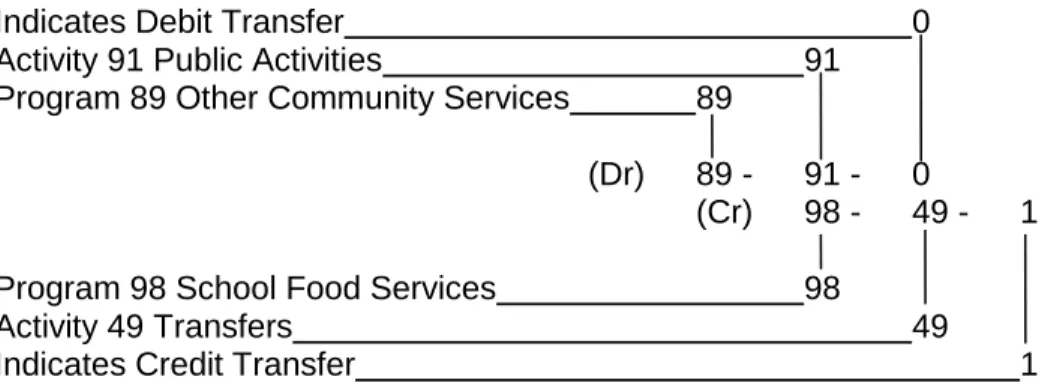
Record expenditures for community service programs for which a specific program has not been assigned in the 80 series. Expenditures for the Summer Food Service Program are transferred to this program using the debit/credit transfer procedure from Program 98 School Food Services. Districts that are a part of a vehicle maintenance cooperative with other school districts should transfer costs for vehicles other than the district’s school buses from Program 99 into this program using the debit/credit transfer procedure.
90 Support Services
Support service programs consist of activities to accomplish objectives that support the educational programs of the district.
97 Districtwide Support
Record expenditures for districtwide support assigned to Activities 11 through 14, 25, 61 through 68, 72 through 75, and 83 through 85 that are not directly identifiable with any
–––––––––––––––––––––––––––––––––––––––––––––––––––––––––––––––––––––––––––––––––––––––––––– one program. These are shared expenditures related to operations of the school district as a whole rather than any particular program.
98 School Food Services
Record the direct expenditures for preparing and serving meals and a la carte items to pupils under the National School Lunch Program, School Breakfast Program, Special Milk Program, Seamless Summer Feeding Waiver, and the Fresh Fruit and Vegetable
Program. Also, record the direct expenditures for serving meals and a la carte items to adults.
Direct expenditures for the Child and Adult Care Food Program and the Summer Food Services Program charged to Program 98 must be transferred using debit/credit transfers. The direct expenditures for the Child and Adult Care Food Program are transferred to Program 88 Child Care. The direct expenditures for the Summer Food Service Program are transferred to Program 89 Other Community Services. All other food service direct expenditures not incurred for the National School Lunch Program, School Breakfast Program, or Special Milk Program are charged to Program 98 and later transferred to the program that sponsored the direct expenditure.
Credit transfers (Activity 49) to transfer expenditures for meal service to other programs and debit other program/activities as appropriate.
(Reference: 42 USC 1751–1760, 1779; P.L. 79-396, 89-642, 91-248, 95-166, 95-627, 96-499, 97-35; and 7 CFR 210 through 247.)
99 Pupil Transportation
Record expenditures for transporting pupils to and from school, including between locations in the district, during the school year. Other transporting of students and nonstudents may be initially charged to this program when the expenditures cannot be easily and conveniently separated from the regular transportation expenditures (to and from school, including interdistrict) and then transferred to other programs as appropriate. Adult school crossing guards should be charged to Program 99. Adult supervision for programs such as Walking School Bus and other walk to school programs should also be charged to Program 99.
Appendix E contains more guidance on to/from transportation, including guidance on separating and removing costs that are non to/from transportation expenditures out of Program 99.
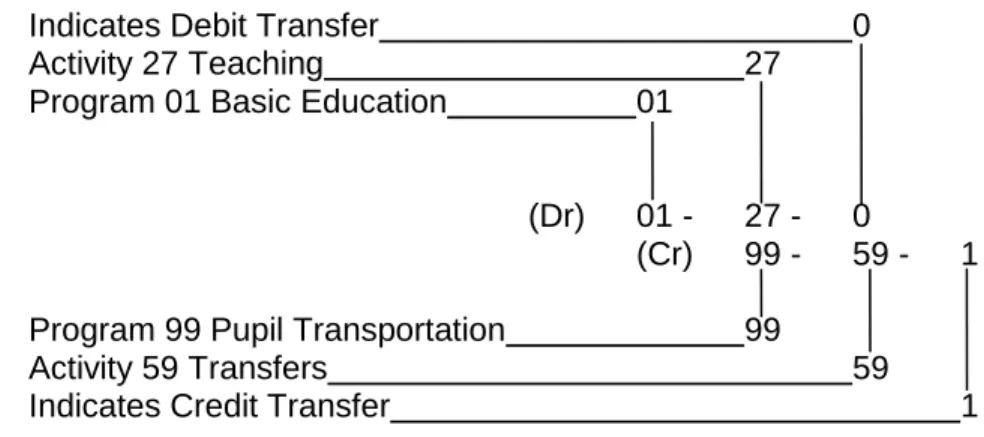
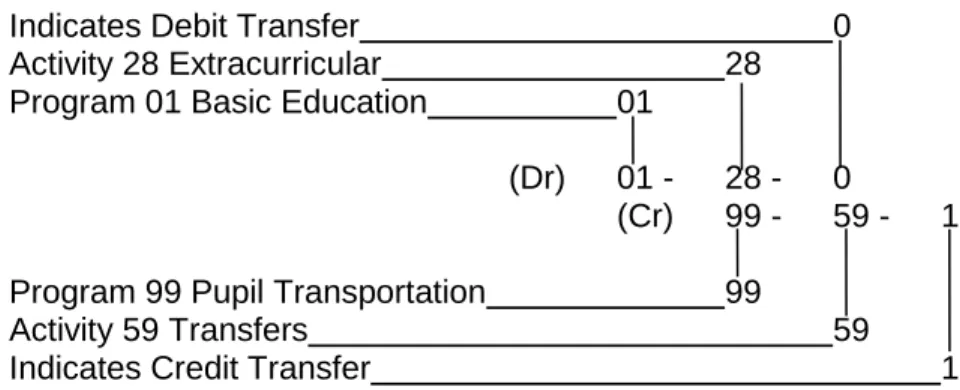
Credit transfers (Activity 59) to transfer expenditures for transportation to other programs and debit other program/activities as appropriate.
––––––––––––––––––––––––––––––––––––––––––––––––––––––––––––––––––––––––––––––––––––––––––––
ACTIVITY EXPENDITURE CODES
Activity Codes
10 Administration 11 Board of Directors 12 Superintendent’s Office 13 Business Office 14 Human Resources 15 Public Relations 20 Instruction 21 Supervision 22 Learning Resources 23 Principal’s Office24 Guidance and Counseling 25 Pupil Management and Safety 26 Health/Related Services 27 Teaching
28 Extracurricular
29 Payments to School Districts
30 Instructional Support
31 Instructional Professional Development 32 Instructional Technology
33 Curriculum
40 School Food Services
41 Supervision 42 Food 44 Operations 49 Transfers 50 Pupil Transportation 51 Supervision 52 Operations 53 Maintenance 56 Insurance 59 Transfers
60 Maintenance and Operation
61 Supervision
62 Grounds Maintenance 63 Operation of Buildings
–––––––––––––––––––––––––––––––––––––––––––––––––––––––––––––––––––––––––––––––––––––––––––– 64 Maintenance
65 Utilities
67 Building and Property Security 68 Insurance
70 Other Services
72 Information Systems 73 Printing
74 Warehousing and Distribution 75 Motor Pool 80 Debt Service 83 Interest 84 Principal 85 Debt-Related Expenditures 90 Public Activities 91 Public Activities
10 Administration
This series consists of those activities related to the general direction, regulation, and control of the affairs of the school district that are organization-wide. These expenditures are to be charged to Program 97, Districtwide Support.
11 Board of Directors
Include those responsibilities that are not delegated but are retained and carried out by the school district’s governing board. Delegated responsibilities will be charged to the activity in which the responsible person is charged.
Include such items as expenditures for board memberships, audits, elections, legal services, judgments not covered by insurance, census, and, as provided by RCW 36.70.015 for regional planning.
Election costs for successful bonds and levies for capital projects may be paid from the Capital Projects Fund. The Capital Projects Fund may reimburse election costs for
unsuccessful levies paid from the General Fund if the levy is passed within the same fiscal year. The Capital Projects Fund may also reimburse election costs for prior unsuccessful bond elections paid from the General Fund to the extent such reimbursement complies with the federal tax code.
12 Superintendent’s Office
This activity relates to districtwide administrative responsibility. It consists of general administration and superintendent’s office.
––––––––––––––––––––––––––––––––––––––––––––––––––––––––––––––––––––––––––––––––––––––––––––
13 Business Office
This activity consists of the financial and accounting operations of a district. Include districtwide research and planning for budgeting, accounting, bookkeeping and statistical services, business administration, fiscal control, purchasing, and payroll.
14 Human Resources
This activity consists of the personnel recruitment and placement activities of the district. This would include expenditures such as employee assistance programs, employment services, classification and compensation, human resources information systems, labor relations, recruitment and development, employee association representatives, etc.
15 Public Relations
This activity consists of writing, editing, and other preparation necessary to disseminate educational and administrative information to parents, students, staff, and the general public through direct mailing, the various news media, email, internet websites, and personal contact.
20 Instruction
This series consists of activities dealing directly with or aiding in the teaching of students or improving the quality of teaching, such as professional development. These are the activities of teachers, principals, consultants, supervisors of instruction, attendance services, guidance and counseling, psychological and speech services, health services, and social services. Direct charging to specific instructional programs is done if the expenditures can be identified as applying to the specific program(s).
Do not charge supportive services expenditures to Programs 97, 98, or 99 except for Activity 25 Pupil Management and Safety and Activity 29 Payments to School Districts.
21 Supervision
This activity is used to record expenditures for overall leadership for the instructional programs.
Include the expenditures for staff members providing supervision, coordination, evaluation, and development in instruction, instructional materials, and pupil services programs. Also include secretarial and clerical assistants along with nonemployee-related costs for these functions. Include expenditures for training supervisors for their
supervisory activities.
22 Learning Resources
Include the part of the instructional program that provides services and materials
specifically designed to improve learning through use of instructional/educational aids. It provides for organizing learning resources in a systematic manner at locations where they are available for use by pupils and staff members in educational programs of the school.
–––––––––––––––––––––––––––––––––––––––––––––––––––––––––––––––––––––––––––––––––––––––––––– Learning resource materials include books, film, video, pictures, charts, models, and other materials for aiding instruction.
Operations performed under this activity include, but are not limited to, film inspection; audio-visual equipment operation; storing and dispensing of audio-visual materials and equipment; development of films, charts, models, and other materials for aiding
instruction; and other activities which have as their purpose the improvement of learning through the use of pictures, films, tapes, or other media. Include such services as those of the audio-visual consultant, film inspector, film librarian, projectionist, programmer,
graphic artist, librarians, and catalogers, and their secretarial, clerical, and other assistants. Include services, equipment, and materials designed to provide learning through the use of television or radio. Include such services as script writing, planning, and recording broadcast programs. In terms of personnel it includes the director,
projectionist, scriptwriter, camera operator, and secretarial, clerical, and other assistants. The operation of computers previously recorded in this activity should now be recorded in Activity 32 Instructional Technology.
23 Principal’s Office
This activity covers management and coordination of a school unit. Specifically, it includes the implementation of administrative policies, assignment of duties to staff members, administration of the instructional program, evaluation of the efficiency of staff members, supervision of the maintenance and operation workers as their work may affect the school unit’s program, management of records, coordination of the school unit’s program of instruction with the districtwide program, and such other management and coordination of programs as required for the operation of an elementary or secondary school or school of adult education.
Include the duties of the principal, assistant principal, vice principal, and skill center director, and their secretarial and clerical assistants assigned to coordinate and manage the operation of a school unit, including attendance secretaries.
24 Guidance and Counseling
Include expenditures involved in aiding pupils to assess and understand their abilities, aptitudes, interests, environmental factors, and educational needs through activities such as student assessment testing.
Include that part of the pupil services program concerned with assisting pupils in
increasing their understanding and use of educational and career opportunities. Include activities of the counselor, social worker, guidance director, secretaries, registrars, clerks, and other assistants, and outreach for deprived students and/or homeless liaison work.
25 Pupil Management and Safety
Include expenditures for hall guards, crossing guards, bus aides, playground aides, and pupil security personnel. Also include expenditures for lunchroom aides when their duties involve control and assistance of students. Lunchroom aides who assist in preparation or distribution of food are charged to Activity 44 Operations.
–––––––––––––––––––––––––––––––––––––––––––––––––––––––––––––––––––––––––––––––––––––––––––– In addition, include personnel who are involved with early identification of patterns of nonattendance, analysis of causes of nonattendance, early professional action on
problems of nonattendance, and enforcement of compulsory attendance laws. Attendance secretaries whose position does not involve resolving the nonattendance issues listed above should be coded to Activity 23.
Do not include expenditures for building security that must be charged to Activity 67 Building and Property Security.
Also include administrative expenses such as cell phones that are utilized by personnel responsible for pupil management and safety. The cost of adult crossing guards and/or adult supervisors for programs such as Walking School Bus should be charged to this activity within Program 99.
26 Health/Related Services
Include services in the field of physical and mental health consisting of medical, dental, optometry, psychiatric, doctor, nurse, orientation-mobility specialists, occupational
therapists, and physical therapists. Also include duties of the psychologist, psychometrist, language pathologists, and audiometrists, and their secretarial, clerical, and other
assistants.
27 Teaching
Include expenditures of instructing pupils in a teacher-pupil learning situation where the teacher is regularly in the presence of the pupils or in regular communication with pupils (such as with distance learning and running start) in a systematic program designed to assist pupils in acquiring new or improved knowledge, skills, and understandings. Include the direct expenditures for classroom teachers, teachers’ aides, teachers of homebound, teachers of institutionalized, correspondence teachers, and others assigned to instruct pupils regularly in a teacher-pupil learning situation, and their secretaries, clerks, and other assistants.
Do not include the costs of textbooks, electronic textbooks, instructional software, science equipment, workbooks, and similar items. These costs should be charged to Activity 33 Curriculum.
The following costs are examples of materials and supplies that should be charged to this activity:
Instructional materials Student supplies Student planners Classroom materials
Reference materials used in the classroom Basic instructional supplies
Basic instructional supplemental materials Test prep workbooks
––––––––––––––––––––––––––––––––––––––––––––––––––––––––––––––––––––––––––––––––––––––––––––
28 Extracurricular
This activity is used to record expenditures directly related to student services such as coaching, class or student activity advising, supervising student body fund accounting, and related duties. (Legal reference: AGO 1973, No. 11—Student Fees; AGO 1973, No.
22—Uniforms; see also AGO 1974, No. 21—Funding of Interscholastic Athletic Activities;
RCW 28A.325.010 through 28A.325.030; chapter 392-138 WAC.) Also include
transportation expenditures (chartered or provided in-district) for extracurricular activities that are not recorded in the ASB Fund. District-operated transportation expenditures should be charged to this activity using debit and credit transfer objects of expenditure. Also chargeable to this account are expenditures directly related to skill center project (job) accounts, including bookstores and child care services. Child care services are charged to Activity 91 Public Activities in Program 88 Child Care.
29 Payments to School Districts
This activity is used to record payments to other school districts including, but not limited to, nonhigh, special education, and skill center payments by participating school districts.
30 Instructional Support
The activities in this series are used to record expenditures that are incurred in support of the district’s educational programs.
31 Instructional Professional Development
This activity is used to record expenditures for the instructional professional development of school district personnel. These include such activities as in-service training,
workshops, conferences, demonstrations, and other activities related to the ongoing growth and development of personnel.
This activity may include course registration fees, tuition reimbursement, charges from external vendors to conduct training courses (at either school facilities or offsite), related travel and other expenditures associated with training and professional development. Base salaries for attendees should not be coded to this activity. Assigned professional development staff will have their regular salaries charged to this activity. Additional contract days that are provided for the express purpose of professional development should be recorded in this category.
32 Instructional Technology
This activity is used to record expenditures relating to costs of computers and related equipment that is based in the school. Expenditures to be recorded in this activity are computers and other classroom technology such as printers, projectors, document cameras, smart boards and other peripheral equipment. Software costs of operating school-based computers and other standard software installed on all school-based computers may be charged here. Expenditures for computer-based curriculum, such as digital textbooks or educational software, should be coded consistent with other
–––––––––––––––––––––––––––––––––––––––––––––––––––––––––––––––––––––––––––––––––––––––––––– The salary and benefit costs for those staff members that support instructional technology may be charged to this activity. Expenditures for districtwide technology, or central
services such as a help desk or IT department should not be coded here, but should be coded to Program 97 Activity 72.
33 Curriculum
This activity is used to record costs relating to the development and implementation of curriculum for the school district. The term “curriculum” has two meanings. The first meaning of “curriculum” is all of the subjects and course offerings within a district, as well as policy and procedure changes that constitute a course of study. The second meaning of
“curriculum” is all of the textbooks, electronic resources, and other instructional materials that are associated with a particular course offering.
The costs for salaries and benefits for this activity are limited to those staff members that support curriculum. This includes tasks such as proposing, researching, evaluating,
recommending, planning, developing and/or implementing changes to the overall curriculum of the district or to individual course offerings. It also includes reviewing and recommending changes to relevant school board policies and related administrative expenditures.
The cost of new and/or replacement textbooks and other materials that relate to curriculum implementation are recorded here. These are items that will be utilized in a classroom setting to provide instruction to students. These costs include, but are not limited to:
Textbooks
Electronic textbooks (including annual licensing or subscription fees) Instructional software (including annual licensing or subscription fees) Durable equipment related to specific curriculum delivery.
Hands-on science kits Mathematic manipulatives Sheet music
Workbooks and/or kits used in lieu of workbooks
The purchase of electronic equipment that will be used to deliver curriculum such as tablets, computers, or e-readers should not be charged to this activity. The cost of electronic
equipment that is to be used in the classroom should be coded to Activity 32 Instructional Technology.
The cost for teacher training in the implementation of new curriculum, whether in the form of new courses of study or new textbooks for existing courses of study, should not be charged to this activity. The cost of training should be charged to Activity 31 Instructional
Professional Development.
Consumable supplies, with the exception of workbooks, are not considered curriculum, and should be charged to Activity 27 Teaching.
––––––––––––––––––––––––––––––––––––––––––––––––––––––––––––––––––––––––––––––––––––––––––––
40 School Food Services
The activities in this series are used to record operating expenditures for nutrition services (the preparation and serving of regular and incidental meals for pupils and teachers as provided by RCW 28A.235.120) provided in connection with regular school activities. Expenditures identified with this series must be charged to Program 98 School Food Services, except:
Expenditures chargeable to other programs for which program approval has been obtained through the use of debit and credit transfer objects.
Expenditures chargeable to Program 73 Summer School and Program 89 Other Community Services through the use of debit and credit transfer objects.
41 Supervision
This activity is used to record the expenditures for managing, directing, and supervising the food service program.
Services include those of supervisory, secretarial, and other assistants involved in the administration of the food service program. Examples include: directors, director’s support staff, and dieticians.
42 Food
Include the expenditures for all food (purchased and commodities) used in connection with the regular food services program including expenditures for processing, freight, delivery, and storage.
44 Operations
Include the direct expenditures for preparing and serving breakfasts and lunches in connection with school activities and the delivering of prepared meals to schools. Include services of cooks, cashiers, and kitchen help expenditures, contractual services, supplies and materials (other than food), travel, and capital outlay. Include lunchroom aides who assist in food preparation or distribution.
49 Transfers
This activity, under Program 98 School Food Services, is used exclusively for transferring expenditures for banquets, feeding of the elderly, feeding approved child care children, and other feeding operations not chargeable to Program 98. Expenditures to be
transferred out are accumulated in Activities 41 through 44 along with other school food services expenditures.