Open Access
Research
The effect of titanium dioxide nanoparticles on pulmonary
surfactant function and ultrastructure
Carsten Schleh
1,2, Christian Mühlfeld
3, Karin Pulskamp
4, Andreas Schmiedl
5,
Matthias Nassimi
1,6, Hans D Lauenstein
1,2, Armin Braun
1, Norbert Krug
1,
Veit J Erpenbeck
1,2and Jens M Hohlfeld*
1,2Address: 1Fraunhofer Institute of Toxicology and Experimental Medicine, Division of Immunology, Allergology and Airway Research,
Nikolai-Fuchs-Str. 1, 30625 Hannover, Germany, 2Department of Respiratory Medicine, Hannover Medical School, Germany, 3Institute of Anatomy,
Division of Histology, University of Bern, Switzerland, 4Forschungszentrum Karlsruhe, Institute of Toxicology and Genetics, Department of
Molecular and Environmental Toxicology, Germany, 5Institute of Functional and Applied Anatomy, Hannover Medical School, Germany and 6Department of Pharmaceutics, Technical University Carolo-Wilhelmina at Braunschweig, Germany
Email: Carsten Schleh - [email protected]; Christian Mühlfeld - [email protected]; Karin Pulskamp - [email protected]; Andreas Schmiedl - [email protected];
Matthias Nassimi - [email protected]; Hans D Lauenstein - [email protected];
Armin Braun - [email protected]; Norbert Krug - [email protected]; Veit J Erpenbeck - [email protected]; Jens M Hohlfeld* - [email protected]
* Corresponding author
Abstract
Background: Pulmonary surfactant reduces surface tension and is present at the air-liquid interface in the alveoli where inhaled nanoparticles preferentially deposit. We investigated the effect of titanium dioxide (TiO2) nanosized particles (NSP) and microsized particles (MSP) on biophysical surfactant function after direct particle contact and after surface area cycling in vitro. In addition, TiO2 effects on surfactant ultrastructure were visualized.
Methods: A natural porcine surfactant preparation was incubated with increasing concentrations (50-500 μg/ml) of TiO2 NSP or MSP, respectively. Biophysical surfactant function was measured in a pulsating bubble surfactometer before and after surface area cycling. Furthermore, surfactant ultrastructure was evaluated with a transmission electron microscope.
Results: TiO2 NSP, but not MSP, induced a surfactant dysfunction. For TiO2 NSP, adsorption
surface tension (γads) increased in a dose-dependent manner from 28.2 ± 2.3 mN/m to 33.2 ± 2.3 mN/m (p < 0.01), and surface tension at minimum bubble size (γmin) slightly increased from 4.8 ± 0.5 mN/m up to 8.4 ± 1.3 mN/m (p < 0.01) at high TiO2 NSP concentrations. Presence of NSP
during surface area cycling caused large and significant increases in both γads (63.6 ± 0.4 mN/m) and
γmin (21.1 ± 0.4 mN/m). Interestingly, TiO2 NSP induced aberrations in the surfactant ultrastructure.
Lamellar body like structures were deformed and decreased in size. In addition, unilamellar vesicles were formed. Particle aggregates were found between single lamellae.
Conclusion: TiO2 nanosized particles can alter the structure and function of pulmonary surfactant. Particle size and surface area respectively play a critical role for the biophysical surfactant response in the lung.
Published: 30 September 2009
Respiratory Research 2009, 10:90 doi:10.1186/1465-9921-10-90
Received: 17 April 2009 Accepted: 30 September 2009
This article is available from: http://respiratory-research.com/content/10/1/90
© 2009 Schleh et al; licensee BioMed Central Ltd.
Background
High amounts of ambient particulate matter (PM) exist in our atmosphere, and it is known that a high proportion of these particles are nanosized particles (NSP) with a diam-eter of ≤ 100 nm. NSP can be found in the air as a result of combustion processes such as automobile engines and fires. In addition, the rapidly developing field of nanote-chnology is becoming a potential source for human expo-sure to NSP. Titanium dioxide (TiO2) NSP e.g. are widely produced for industrial processes since several years [1].
Importantly, PM exposure is linked with the occurrence of cardio-respiratory disease as well as mortality [2,3]. Epide-miological and experimental data suggest a relationship between PM and e.g. asthma [4], chronic obstructive pul-monary disease [5], and cystic fibrosis [6,7]. Unfortu-nately, the exact mechanism by which PM induces or aggravates airway disease is still unknown.
Dependent on their size, particles preferentially deposit in different compartments of the lung. Importantly, most of the nanosized particles have a high alveolar deposition rate [8]. In the alveoli, these particles come into contact with the pulmonary surfactant layer that covers the entire alveolar region. Surfactant decreases the surface tension at the air-liquid interface and thereby prevents alveolar col-lapse. Surface activity is mainly accomplished by sur-factant phospholipids and the specific sursur-factant proteins (SP)-B, and -C. Morphologically, surfactant exists in dif-ferent subfractions. The surface active fraction consists of lamellar bodies and tubular myelin whereas the less sur-face active fraction is comprised of unilamellar vesicles. By ultracentrifugation, lamellar bodies and tubular myelin can be pelleted and are thereby called large aggregates (LA). In contrast, unilamellar vesicles remain in the super-natant and are defined as small aggregates (SA). Conver-sion of LA into SA occurs during respiration [9].
It has been demonstrated that particles of anthropogenic origin are able to directly interact with pulmonary sur-factant components [10-13]. Further, it has been shown that nanosized particles can disturb surfactant function [14,15]. However, a systematic comparison of nanosized and microsized particles (MSP) of different composition has not been made. Moreover, it is unclear whether parti-cle-surfactant interactions during dynamic conditions of surface area cycling aggravate the biophysical surfactant dysfunction. Therefore, we investigated the effect of increasing concentrations of TiO2 NSP and TiO2 MSP, as model particles, on pulmonary surfactant function by means of a pulsating bubble surfactometer both under native conditions and following surface area cycling. For comparison reasons, the effect on surfactant function was investigated for nanosized and microsized polystyrene particles as well as for quartz particles. Furthermore, we
studied the effect of nanosized TiO2particles on surfactant ultrastructure by transmission electron microscope (TEM). In order to elaborate on the in-vivo relevance, rats were exposed to TiO2 NSP versus TiO2 MSP, lungs were fixed and lung tissue blocks were prepared for electron microscopy. The ultrastructure and distribution of the dif-ferent subtypes of intra-alveolar surfactant was observed.
Methods
Particles
Nanosized and microsized titanium dioxide particles (Alfa Aesar, Karlsruhe, Germany; product numbers: 44689 & 42681) were used in this study. For comparison, polystyrene particles (Micromod, Rostock-Warnemuende, Germany), Sikron SF 800 quartz particles (Quarzwerke, Frechen, Germany) as well as citrate coated nanosized gold particles (Plano, Wetzlar Germany: product number: EM.GC5) were studied [for details see additional file 1]. Particle stock solutions were prepared in sterilized bidis-tilled water at a concentration of 25 mg/ml or 50 mg/ml. Particles were sonicated prior to each experiment.
Acute Effects on Biophysical Surfactant Function
A natural porcine surfactant preparation (Curosurf®,
Asche Chiesi, Hamburg, Germany) was used as a standard and was adjusted to 1.5 mg/ml phospholipids in Ringer's solution. Particles at increasing concentrations were added (50 μg/ml - 500 μg/ml) and biophysical surfactant function was assessed with a pulsating bubble surfactom-eter (PBS) (Electronetics, Buffalo, NY, USA) as described below.
Surface Area Cycling
Surface area cycling is a standardized method to simulate the in vivo conversion of surface active surfactant subtypes (lamellar bodies, tubular myelin) to inferior surfactant subtypes (unilamellar vesicles) in vitro [16-20]. We meas-ured the biophysical surfactant function following surface area cycling in the presence or absence of particles in order to assess the effect of particles during the conversion proc-ess. Curosurf® was adjusted to 1.5 mg/ml phospholipids
in ringer solution with or without particles in increasing concentrations (50 μg/ml - 500 μg/ml). Aliquots were placed in 12 × 75 mm capped plastic tubes (Falcon 2058) and rotated end over end for 8 hours at 0.43 Hz and 37°C in the dark. Thereby, surface area changed from 1.1 cm2 to
9 cm2 twice per cycle. After surface area cycling
biophysi-cal surfactant function was measured in a pulsating bub-ble surfactometer as described below.
Surface Activity Evaluated with the Pulsating Bubble Surfactometer
sta-tistical analysis of this study was the value at minimum bubble size (γmin) registered after 330 seconds of pulsa-tion at a rate of 20 cycles/min and a temperature of 37°C. In addition, adsorption surface tension (γads) was evalu-ated by determining surface tension 10 s after formation of a bubble under static bubble conditions. All data were digitalized and recorded by computer. All assays were per-formed in duplicate and the mean value was reported. The PBS was calibrated and checked with reference substances for proper operation before starting the measurements on each day.
Transmission Electron Microscope
Surfactant was fixed in Eppendorf tubes with 1.5% glutar-aldehyde and 1.5% paraformglutar-aldehyde in 0.15 M Hepes buffer. The samples were stored in the fixative for 1 hour at room temperature and at least 24 hours at 4°C. After-wards, samples were centrifuged at 10,000 g to obtain a surfactant pellet. After several washings in buffer, the sam-ples were subsequently postfixed in osmium tetroxide and half-saturated aqueous uranyl acetate, dehydrated in an ascending acetone series and embedded in Epon at 60°C. The Eppendorf cups were removed and ultrathin 50 nm sections were cut using an ultramicrotome. The sections were analyzed with a Philips CM12 transmission electron microscope (FEI Co. Philips Electron Optics, Zürich, Swit-zerland).
Exposure of rats to particles and assessment of surfactant ultrastructure
Female Wistar rats (162 - 200 g) were randomly exposed once for 6 hours to either TiO2 NSP (P25; Evonik Degussa,
Essen, Germany), TiO2 MSP (Bayertitan T, Bayer,
Leverkusen, Germany), or clean air, respectively (n = 5 per group). The exposure atmosphere was adjusted to either
10 mg TiO2 MSP/m3 or 25 mg TiO
2 NSP/Na2HPO4/m3
(60% Na2HPO4; 40% TiO2 NSP). Since the TiO2 MSP and TiO2 NSP/Na2HPO4 droplets in the atmosphere were approximately of the same size, a similar alveolar deposi-tion rate of 60 μg TiO2 particles per animal was accom-plished [21]. Rats were sacrificed by pentobarbital overdose at the end of the exposure and the lungs were perfusion-fixated as described before [22]. Surfactant ultrastructure was assessed on ultrathin sections by elec-tron microscopy and surfactant subtype conversion was studied semiquantitatively.
Statistical Analysis
Values are given as means ± SEM. Statistical analysis was performed using GraphPad Prism®, Version 4.03. The
one-way ANOVA was used for statistical analysis of the data. A Bonferroni correction was used throughout. P values < 0.05 were considered to be significant.
Results
Direct Effect of Particles on Pulmonary Surfactant Function
To assess the direct effect of particles on surfactant func-tion, surface tension was measured after addition of parti-cles. Pure surfactant showed an adsorption surface tension of ~28 mN/m and addition of TiO2 NSP in concentrations
up to 200 μg/ml did not affect this active surface tension (Figure 1A). However, further increase of the particle dose up to 500 μg/ml led to a significant increase in adsorption surface tension to 33.2 ± 2.3 mN/m. In contrast, surface tension was unaffected by treatment with the same mass concentrations of TiO2 MSP (Figure 1B). TiO2 NSP slightly increased γmin from ≤ 5 mN/m, which denotes active sur-factant, up to 8.4 ± 1.3 mN/m at 500 μg/ml (Figure 1C). Again, TiO2 MSP showed no effect on surface tension in this concentration range (Figure 1D). However, at very high particle concentrations of TiO2 MSP (~10 mg/ml) that deliver a similar surface area compared to TiO2 NSP
γmin increased to 15.9 ± 1.3 mN/m (n = 6, p < 0.01).
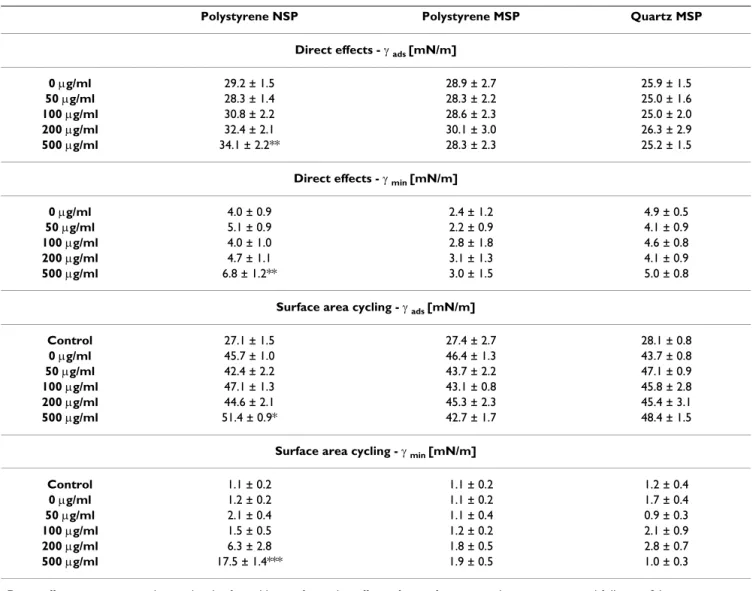
As for the TiO2 particles similar results were observed for the other particles. Whereas polystyrene NSP significantly increased adsorption surface tension for 500 μg/ml, poly-styrene and quartz MSP did not influence the surface ten-sion up to a concentration of 500 μg/ml (Table 1). In addition, nanosized polystyrene particles increased sur-face tension at minimum bubble size significantly at 500
μg/ml up to 6.8 ± 1.2 mN/m, whereas microsized particles did not influence surfactant function in this concentration range (Table 1). Again, MSP (Quartz) at a very high con-centration (~10 mg/ml) that deliver a similar surface area compared to TiO2 NSP increased γmin to 15.5 ± 1.8 mN/m (n = 5, p < 0.05).
Furthermore, we tested commercially available gold NSP with citrate coating (5 nm) in single experiments. At 200
μg/ml and 500 μg/ml, gold NSP increased γmin to 7.7 ± 2.8 and 13.2 ± 5.3, respectively (n = 4).
Effects of Particles Following Surface Area Cycling
200 μg/ml and 500 μg/ml TiO2 NSP, respectively. TiO2 MSP led to a slight but non-significant increase in γmin (Figure 2D).
Polystyrene NSP led to a slight increase in adsorption sur-face tension from 45.7 ± 1.0 mN/ml up to 51.4 ± 0.9 mN/ ml which was only significant at a concentration of 500
μg/ml polystyrene NSP (Table 1). All other MSP did not influence adsorption surface tension (Table 1). Surface tension at minimum bubble size was also unaffected by polystyrene MSP and quartz MSP (Table 1), while polysty-rene NSP induced a strong surfactant dysfunction at
min-imum bubble size. Incubation with 500 μg/ml
polystyrene NSP during the cycling process led to a surface tension of 17.5 ± 1.4 mN/m (Table 1).
Influence of Nanosized TiO2 Particles on Surfactant Ultrastructure
Natural porcine surfactant used in this study consisted mostly of lamellar body-like forms. Unilamellar vesicles were hardly present (Figure 3A and 3B). After addition of
100 μg/ml TiO2 NSP, lamellar body-like forms were
decreased in size and deformed (Figure 3C). In addition, an increase in the amount of unilamellar vesicles appeared (Figure 3C). Interestingly, small TiO2 NSP aggre-gates accumulated between lamellae of the lamellar body-like forms (Figure 3D). Rotation of the pure surfactant in the absence of particles readily led to a conversion of lamellar body-like forms to unilamellar vesicles (Figure 3E). Rotation in the presence of TiO2 NSP did not further change subtype conversion (Figure 3F). However, large Surface activity evaluated with the pulsating bubble surfactometer
Figure 1
Surface activity evaluated with the pulsating bubble surfactometer. A) Adsorption surface tension (γads) after incuba-tion with TiO2 nanosized particles (NSP) at a static bubble condition. B) Influence of TiO2 microsized particles (MSP) on γads C) Influence of TiO2 NSP on surface tension at minimal bubble size (γmin) during pulsation D) γmin after incubation with TiO2 MSP. Values are given as means of at least 4 experiments ± SEM. ** indicates p values < 0.01 compared with the control at 0 μg/ml particle concentration.
0 50 100 200 500
20 25 30
35 **
TiO2 NSP [μg/ml]
ad
s
[
m
N
/m
]
0 50 100 200 500
20 25 30 35
TiO2 MSP [μg/ml]
ad
s
[
m
N
/m
]
0 50 100 200 500
0.0 2.5 5.0 7.5
10.0 **
TiO2 NSP [μg/ml]
mi
n
[
mN
/m]
0 50 100 200 500
0.0 2.5 5.0 7.5 10.0
TiO2 MSP [μg/ml]
mi
n
[
m
N
/m]
A
B
TiO2 aggregates were found after rotation (Figure 3F). These aggregates were larger in size than the TiO2 aggre-gates in the non-rotated sample (Figure 3D).
Effect of inhaled particles on surfactant ultrastructure in rats
Semiquantitative analysis of intra-alveolar active (tubular myelin and lamellar bodies) and inactive surfactant sub-types (unilamellar vesicles) did not differ between both groups. There were no signs of alveolar oedema or inflam-mation.
Discussion
The present data show that nanosized particles, but not microsized particles, induce a dysfunction of pulmonary surfactant. Nanosized titanium dioxide as well as
nano-sized polystyrene particles at high concentrations can induce a slight pulmonary surfactant dysfunction in vitro. Interestingly, surface area cycling in vitro aggravated the surfactant dysfunction induced by nanoparticles, both by TiO2 NSP and by polystyrene NSP. In addition,
biophysi-cal alterations of pulmonary surfactant by TiO2 NSP were accompanied by changes of the surfactant ultrastructure indicating increased surfactant subtype conversion.
A direct interaction between particles and the surfactant constituents is the most likely explanation for the observed surfactant dysfunction. It is well known that phospholipids bind to particles [10,14,23] and to TiO2 structures [24,25]. In this respect, surface area seems to be the major determinant of the observed biophysical and ultrastructural changes. Accordingly, particles with the Table 1: Surface activity evaluated with the pulsating bubble surfactometer.
Polystyrene NSP Polystyrene MSP Quartz MSP
Direct effects - γads [mN/m]
0 μg/ml 29.2 ± 1.5 28.9 ± 2.7 25.9 ± 1.5
50 μg/ml 28.3 ± 1.4 28.3 ± 2.2 25.0 ± 1.6
100 μg/ml 30.8 ± 2.2 28.6 ± 2.3 25.0 ± 2.0
200 μg/ml 32.4 ± 2.1 30.1 ± 3.0 26.3 ± 2.9
500 μg/ml 34.1 ± 2.2** 28.3 ± 2.3 25.2 ± 1.5
Direct effects - γmin [mN/m]
0 μg/ml 4.0 ± 0.9 2.4 ± 1.2 4.9 ± 0.5
50 μg/ml 5.1 ± 0.9 2.2 ± 0.9 4.1 ± 0.9
100 μg/ml 4.0 ± 1.0 2.8 ± 1.8 4.6 ± 0.8
200 μg/ml 4.7 ± 1.1 3.1 ± 1.3 4.1 ± 0.9
500 μg/ml 6.8 ± 1.2** 3.0 ± 1.5 5.0 ± 0.8
Surface area cycling - γads [mN/m]
Control 27.1 ± 1.5 27.4 ± 2.7 28.1 ± 0.8
0 μg/ml 45.7 ± 1.0 46.4 ± 1.3 43.7 ± 0.8
50 μg/ml 42.4 ± 2.2 43.7 ± 2.2 47.1 ± 0.9
100 μg/ml 47.1 ± 1.3 43.1 ± 0.8 45.8 ± 2.8
200 μg/ml 44.6 ± 2.1 45.3 ± 2.3 45.4 ± 3.1
500 μg/ml 51.4 ± 0.9* 42.7 ± 1.7 48.4 ± 1.5
Surface area cycling - γmin [mN/m]
Control 1.1 ± 0.2 1.1 ± 0.2 1.2 ± 0.4
0 μg/ml 1.2 ± 0.2 1.1 ± 0.2 1.7 ± 0.4
50 μg/ml 2.1 ± 0.4 1.1 ± 0.4 0.9 ± 0.3
100 μg/ml 1.5 ± 0.5 1.2 ± 0.2 2.1 ± 0.9
200 μg/ml 6.3 ± 2.8 1.8 ± 0.5 2.8 ± 0.7
500 μg/ml 17.5 ± 1.4*** 1.9 ± 0.5 1.0 ± 0.3
highest surface area - TiO2 NSP and also reference polysty-rene NSP - induced the most prominent alterations. Microsized particles with a relatively low surface area did not induce a surfactant dysfunction in our study.
In separate experiments, we compared equal surface areas by testing very high microparticle mass concentrations. With concentrations of ~10 mg/ml TiO2 MSP and quartz MSP, we observed a strong surfactant dysfunction. How-ever, the experimental conditions were limited because microsized particles at this very high concentration aggre-gated and rapidly sedimented to the bottom of the test capillary. By this segregation, the phospholipid
concentra-tion was not stable which limits the comparison of NSP and MSP at similar surface areas.
Bakshi and coworkers demonstrated a potent pulmonary surfactant dysfunction at low concentrations of ~2 μg/ml gold nanoparticles [14]. In contrast, much higher concen-trations of TiO2 NSP were required to induce an increase of surface tension in our experiments. In addition, the degree of surfactant dysfunction was less with TiO2 NSP in our study compared to the gold nanoparticles used by Bakshi et al. Differences in 1) the measuring system, 2) the surfactant preparation and concentration, or 3) the nano-particles themselves might account for the discrepancy. Surface activity evaluated with the pulsating bubble surfactometer following 8 hour rotation at 0.43 Hz
Figure 2
Surface activity evaluated with the pulsating bubble surfactometer following 8 hour rotation at 0.43 Hz. A) Influence of TiO2 NSP on adsorption surface tension (γads) at a static bubble condition. B) Influence of TiO2 MSP on γads C) Influence of TiO2 NSP on surface tension at minimal bubble size (γmin) during pulsation D) TiO2 MSP effect on γmin. Values are given as means ± SEM of at least 4 experiments. ** indicates p values < 0.01; *** indicates p values < 0.001; both compared with the rotated 0 μg/ml particle concentration (grey columns). CO/white columns - control surfactant which was placed for 8 hours in an incubator without rotation.
CO 0 50 100 200 500
20 30 40 50 60
*** ***
TiO2 NSP [μg/ml]
ad
s
[
m
N
/m
]
CO 0 50 100 200 500
0 5 10 15 20 25
*** ***
**
TiO2 NSP [μg/ml]
mi
n
[
mN
/m]
CO 0 50 100 200 500
20 30 40 50 60
TiO2 MSP [ μg/ml]
ad
s
[
m
N
/m
]
CO 0 50 100 200 500
0 5 10 15 20 25
TiO2 MSP [ μg/ml]
mi
n
[
m
N
/m]
A
B
Representative transmission electron microscope pictures of the surfactant ultrastructure Figure 3
Representative transmission electron microscope pictures of the surfactant ultrastructure. A) and B) untreated control surfactant. C) and D) porcine surfactant after addition of 100 μg/ml TiO2 nanosized particles. Red circles show small particle aggregates. E) Control surfactant after 8 hours rotation at 0.43 Hz and 37°C. F) Surfactant after 8 hours rotation at 0.43 Hz and 37°C in the presence of 100 μg/ml TiO2 nanosized particles. Black arrows show large particle aggregates; lbl -
Both, the pulsating bubble surfactometer (PBS) and the captive bubble surfactometer (CPS) are able to evaluate low surface tensions [26] while the CPS is regarded to yield even lower surface tensions [27] which makes differ-ences in the device an unlikely explanation. Regarding surfactant preparation and concentration, we used Curo-surf®, a natural surfactant derived from minced porcine
lungs [28] while a semisynthetic surfactant composed of two phospholipids plus SP-B was used by Bakshi. It is unlikely that differences in the surfactants are solely responsible for the different effects seen with gold nano-particles and TiO2 NSP. Both surfactants have been
dem-onstrated to have excellent surface activity and to achieve very low surface tensions under compression at the con-centrations used. The most likely explanation for the potent dysfunction in the study by Bakshi seems related to the material properties (size/surface) of the gold nanopar-ticles. Since the gold NSP had citrate groups on their sur-face, aggregation is mostly avoided [29]. In contrast, pure TiO2 nanoparticles highly aggregate. Although the surface
area is not known for the gold NSP from Bakshis study, it is likely that the surface area per mass unit is higher for the citrate coated gold NSP than for the TiO2 NSP. This could
explain the more potent induction of surfactant
dysfunc-tion by gold NSP compared to TiO2 NSP because
sur-factant components could be bound to the large gold nanoparticle surface area making them unavailable for lowering surface tension at the air-liquid interface.
In an attempt of direct comparison between TiO2 NSP and the gold nanoparticles by Bakshi (~15 nm), we tested commercially available gold NSP with citrate coating (5 nm) in single experiments. Interestingly, at equal mass the surfactant dysfunction by gold NSP was stronger com-pared with TiO2 NSP. However, the dysfunction was less compared with data from Bakshi et al., but this discrep-ancy can be accounted to differences in surface area of the gold NSP or the surfactant preparations used in both stud-ies.
The in vivo conversion of surface active LA to inferior SA can be simulated in vitro by surface area cycling [16]. By this technique, the impact of meconium, serum proteins, or surfactant proteins during the surfactant conversion process have been studied [19,30-32]. We assessed the effect of TiO2 NSP on the conversion process. Importantly, a dose-dependent increase in surface tension was obtained. Remarkably, this effect was much stronger than the direct biophysical effect of TiO2 NSP without cycling. TEM pictures demonstrated that the occurrence of unila-mellar vesicles was independent from NSP presence. Pos-sibly, binding of NSP to SP-B and subsequent loss of SP-B from the air-liquid-interface could explain the loss of sur-face activity following sursur-face area cycling in the presence of NSP. In vivo, SP-B becomes cleaved by a serine active
carboxylesterase called convertase [33-35]. However, Curosurf® is prepared by chlorofom extraction and hence
does not contain convertase [20]. Therefore, intact SP-B should be present in Curosurf® following surface area
cycling. We speculate that free SP-B could interact with TiO2 NSP which in turn becomes depleted leading to dis-turbed surfactant function. High ability of SP-B to bind to surfaces during surface area cycling was shown before when binding of SP-B to tube walls was investigated dur-ing surface area cycldur-ing [18]. Unfortunately, we were not able to provide direct evidence of binding of SP-B to TiO2 NSP by TEM due to methodological limitations.
Admittedly, inhaled particles act directly on the surfactant layer at the air-liquid interface and not primarily through the subphase as in our in vitro experiments. However, after deposition at the air-liquid interface the particles subse-quently become dissolved in the epithelial lining layer and interfere with the dynamic process of phospholipid arrangement at the interface. Therefore, the assay system with the pulsating bubble surfactometer is at least capable to demonstrate differential effects of nanoparticles versus microparticles in phospholipid suspensions when parti-cles interfere with the formation of the surfactant layer from the hypophase. It is very well conceivable that the initial effect of particles might even be greater when they are reaching the interface directly.
Although we have demonstrated that TiO2 NSP elicited biophysical and structural changes of surfactant in vitro, the in vivo relevance has to be scrutinized because the par-ticle concentrations that we found effective in vitro can hardly occur in vivo. With the human alveolar surface area of ~100 m2 and assuming an average thickness of the
alve-olar lining fluid of approximately 200 nm [36], the amount of alveolar lining fluid can be assessed as ~20 ml. In accordance, the epithelial lining fluid has been sug-gested to be 6 ml/L total lung capacity, resulting in 40 ml in man [37]. With the assumption of a particle concentra-tion of 100 μg/m3, which can occur in polluted inner
cit-ies, and an alveolar deposition rate as high as 50%, the amount of particles deposited per day would be ~360 μg. At steady state, this would result in a concentration of ~10
vivo. Assuming an alveolar lining fluid in rats of approxi-mately 70 μL [36], the in vivo particle concentration in the epithelial lining fluid would have been approximately 53.5 μg/mL (normalized to 1.5 mg/ml phospholipids and assuming static conditions). Noteworthy, the local con-centration at the air-liquid interface was probably much higher suggesting that no changes of surfactant ultrastruc-ture occur in vivo under acute maximal TiO2 particle expo-sure.
Although these considerations suggest that the impact of TiO2 NSP on surfactant function in the human lung is
highly unlikely to cause adverse effects in healthy individ-uals, in diseased subjects, however, additive effects of NSP on pulmonary surfactant function and ultrastructure have to be taken into account. For example, it has been demon-strated that a pulmonary surfactant dysfunction can be found in various airway diseases like asthma [38], cystic fibrosis [39], or after lung transplantation [40]. In partic-ular, leakage of plasma proteins into the airway lumen is known to induce a surfactant dysfunction [41,42]. Impor-tantly, NSP can induce [43-45] or enhance [46,47] pul-monary inflammation which is accompanied by protein leakage. This in turn could lead to a surfactant dysfunction in vivo. Moreover, NSP are able to induce oxidative stress and lipid peroxidation [48-50]. Oxidative stress with lipid peroxidation can induce an increase in surface tension [51,52]. In addition, NSPs emitted by engines are contam-inated with alkanes and sulfates [53] and it is known, that eicosane, a specific n-alkane constituent of diesel exhaust NSPs, can affect the biophysical surfactant function [54]. Therefore, nanoparticles might amplify alterations of the pulmonary surfactant system, particularly under predis-posed conditions of airway inflammation.
Conclusion
Taken together, TiO2 NSP induce biophysical and struc-tural alterations of pulmonary surfactant in vitro. Under dynamic conditions of surface area cycling, this interfer-ing impact is aggravated. Although our data do not sug-gest that inhalation of nanoparticles cause a significant disturbance of the pulmonary surfactant system in vivo, nanoparticles might be detrimental in patients with preex-isting airway disease.
Abbreviations
CPS: Captive bubble surfactometer; CO: Control; DPPC: Dipalmitoylphosphatidylcholine; LA: Large aggregates; lbl: Lamellar body-like forms; MSP: Microsized particles; NSP: Nanosized particles; PBS: Pulsating bubble surfac-tometer; PM: Particulate matter; SA: Small aggregates; SEM: Standard error of the mean; SP: Surfactant protein; TEM: Transmission electron microscope; TiO2 : Titanium dioxide; ulv: Unilamellar vesicles; γmin: surface tension at minimum bubble size; γads: adsorption surface tension
Competing interests
The authors declare that they have no competing interests.
Authors' contributions
CS planned the concept and study design, performed the surface area cycling as well as pulsating bubble surfactom-eter experiments, interpreted the results and wrote major parts of the manuscript. CM performed the electron microscopic analyses of the surfactant ultrastructure and interpreted the results. KP performed the electron micro-scopic analyses of the particles and interpreted the results. AS performed the electron microscopic analyses of the surfactant ultrastructure and interpreted the results. MN participated in characterization of the particles and inter-preted the results. HDL made substantial contributions to the analysis and interpretation of the data. AB made sub-stantial contributions to the analysis and interpretation of the data. NK made substantial contributions to the analy-sis and interpretation of the data. VJE participated in plan-ning the study design and made substantial contributions to the analysis and interpretation of the data. JMH planned the concept and study design, made substantial contributions to the analysis and interpretation of the data and wrote major parts of the manuscript. All of the authors have critically read the manuscript and approved its submission.
Additional material
Acknowledgements
The authors thank Dr. Wolfgang G. Kreyling and Dr. Ruud Veldhuizen for helpful discussion and Prof. Dr. Hartmut Hecker for statistical advice.
References
1. Ellsworth DK, Verhulst D, Spitler TM, Sabacky BJ: Titanium nano-particles move to the marketplace. Chemical Innovation 2000,
30:30-35.
2. Dockery DW, Pope CA III, Xu X, Spengler JD, Ware JH, Fay ME, et al.: An association between air pollution and mortality in six U.S. cities. N Engl J Med 1993, 329:1753-1759.
3. Wichmann HE, Spix C, Tuch T, Wolke G, Peters A, Heinrich J, et al.:
Daily mortality and fine and ultrafine particles in Erfurt, Ger-many part I: role of particle number and particle mass. Res Rep Health Eff Inst 2000:5-86.
4. Li N, Hao M, Phalen RF, Hinds WC, Nel AE: Particulate air pollut-ants and asthma. A paradigm for the role of oxidative stress in PM-induced adverse health effects. Clin Immunol 2003,
109:250-265.
Additional file 1
Characterization of the particles. Representative transmission electron microscopic pictures of the particles [see figure S1 in additional file 1] as well as a table with the characteristics of the particles [see table S1 in additional file 1] are shown.
Click here for file
5. Kirkham P, Rahman I: Oxidative stress in asthma and COPD: antioxidants as a therapeutic strategy. Pharmacol Ther 2006,
111:476-494.
6. Collaco JM, Vanscoy L, Bremer L, McDougal K, Blackman SM, Bowers A, et al.: Interactions between secondhand smoke and genes that affect cystic fibrosis lung disease. JAMA 2008, 299:417-424. 7. Goss CH, Newsom SA, Schildcrout JS, Sheppard L, Kaufman JD:
Effect of ambient air pollution on pulmonary exacerbations and lung function in cystic fibrosis. Am J Respir Crit Care Med
2004, 169:816-821.
8. Oberdorster G, Oberdorster E, Oberdorster J: Nanotoxicology: an emerging discipline evolving from studies of ultrafine par-ticles. Environ Health Perspect 2005, 113:823-839.
9. Ikegami M: Surfactant catabolism. Respirology 2006,
11(Suppl):S24-S27.
10. Mornet S, Lambert O, Duguet E, Brisson A: The formation of sup-ported lipid bilayers on silica nanoparticles revealed by cryo-electron microscopy. Nano Lett 2005, 5:281-285.
11. Kendall M: Fine airborne urban particles (PM2.5) sequester lung surfactant and amino acids from human lung lavage. Am J Physiol Lung Cell Mol Physiol 2007, 293:L1053-L1058.
12. Hill CA, Wallace WE, Keane MJ, Mike PS: The enzymatic removal of a surfactant coating from quartz and kaolin by P388D1 cells. Cell Biol Toxicol 1995, 11:119-128.
13. Schleh C, Hohlfeld JM: Interaction of nanoparticles with the pul-monary surfactant system. Inhal Toxicol 2009, 21:97-103. 14. Bakshi MS, Zhao L, Smith R, Possmayer F, Petersen NO: Metal
nan-oparticle pollutants interfere with pulmonary surfactant function in vitro. Biophys J 2008, 94:855-868.
15. Ku T, Gill S, Lobenberg R, Azarmi S, Roa W, Prenner EJ: Size dependent interactions of nanoparticles with lung surfactant model systems and the significant impact on surface poten-tial. J Nanosci Nanotechnol 2008, 8:2971-2978.
16. Gross NJ, Narine KR: Surfactant subtypes of mice: metabolic relationships and conversion in vitro. J Appl Physiol 1989,
67:414-421.
17. Beatty AL, Malloy JL, Wright JR: Pseudomonas aeruginosa degrades pulmonary surfactant and increases conversion in vitro. Am J Respir Cell Mol Biol 2005, 32:128-134.
18. Inchley K, Cockshutt A, Veldhuizen R, Possmayer F: Dissociation of surfactant protein B from canine surfactant large aggregates during formation of small surfactant aggregates by in vitro surface area cycling. Biochim Biophys Acta 1999, 1440:49-58. 19. Kakinuma R, Shimizu H, Ogawa Y: Effect of meconium on the
rate of in vitro subtype conversion of swine pulmonary sur-factant. Eur J Pediatr 2002, 161:31-36.
20. Veldhuizen RA, Yao LJ, Lewis JF: An examination of the different variables affecting surfactant aggregate conversion in vitro. Exp Lung Res 1999, 25:127-141.
21. Price OT, Asgharian B, Miller FJ, Cassee FR, de Winter-Sorkina R:
Multiple Path Particle Dosimetry model (MPPD v1.0): A model for human and rat airway particle dosimetry. RIVM rapport 650010030 CD-rom publication 2002.
22. Schmiedl A, Hoymann HG, Ochs M, Menke A, Fehrenbach A, Krug N,
et al.: Increase of inactive intra-alveolar surfactant subtypes in lungs of asthmatic Brown Norway rats. Virchows Arch 2003,
442:56-65.
23. Blank F, Rothen-Rutishauser BM, Schurch S, Gehr P: An optimized in vitro model of the respiratory tract wall to study particle cell interactions. J Aerosol Med 2006, 19:392-405.
24. Fortunelli A, Monti S: Simulations of lipid adsorption on TiO2 surfaces in solution. Langmuir 2008, 24:10145-10154.
25. Jiang C, Gamarnik A, Tripp CP: Identification of lipid aggregate structures on TiO2 surface using headgroup IR bands. J Phys Chem B 2005, 109:4539-4544.
26. Putz G, Goerke J, Taeusch HW, Clements JA: Comparison of cap-tive and pulsating bubble surfactometers with use of lung surfactants. J Appl Physiol 1994, 76:1425-1431.
27. Rudiger M, Kolleck I, Putz G, Wauer RR, Stevens P, Rustow B: Plas-malogens effectively reduce the surface tension of sur-factant-like phospholipid mixtures. Am J Physiol 1998,
274:L143-L148.
28. Bernhard W, Mottaghian J, Gebert A, Rau GA, Hardt von der, Poets CF: Commercial versus native surfactants. Surface activity, molecular components, and the effect of calcium. Am J Respir Crit Care Med 2000, 162:1524-1533.
29. Kim T, Lee CH, Joo SW, Lee K: Kinetics of gold nanoparticle aggregation: experiments and modeling. J Colloid Interface Sci
2008, 318:238-243.
30. Veldhuizen RA, Inchley K, Hearn SA, Lewis JF, Possmayer F: Degra-dation of surfactant-associated protein B (SP-B) during in vitro conversion of large to small surfactant aggregates. Bio-chem J 1993, 295(Pt 1):141-147.
31. Ueda T, Ikegami M, Jobe A: Surfactant subtypes. In vitro conver-sion, in vivo function, and effects of serum proteins. Am J Respir Crit Care Med 1994, 149:1254-1259.
32. Veldhuizen RA, Yao LJ, Hearn SA, Possmayer F, Lewis JF: Sur-factant-associated protein A is important for maintaining surfactant large-aggregate forms during surface-area cycling. Biochem J 1996, 313(Pt 3):835-840.
33. Gross NJ, Schultz RM: Requirements for extracellular metabo-lism of pulmonary surfactant: tentative identification of ser-ine protease. Am J Physiol 1992, 262:L446-L453.
34. Gross NJ, Bublys V, D'Anza J, Brown CL: The role of alpha 1-anti-trypsin in the control of extracellular surfactant metabolism. Am J Physiol 1995, 268:L438-L445.
35. Ruppert C, Pucker C, Markart P, Schmidt R, Grimminger F, Seeger W,
et al.: Selective inhibition of large-to-small surfactant aggre-gate conversion by serine protease inhibitors of the bis-ben-zamidine type. Am J Respir Cell Mol Biol 2003, 28:95-102. 36. Bastacky J, Lee CY, Goerke J, Koushafar H, Yager D, Kenaga L, et al.:
Alveolar lining layer is thin and continuous: low-temperature scanning electron microscopy of rat lung. J Appl Physiol 1995,
79:1615-1628.
37. Effros RM, Feng NH, Mason G, Sietsema K, Silverman P, Hukkanen J:
Solute concentrations of the pulmonary epithelial lining fluid of anesthetized rats. J Appl Physiol 1990, 68:275-281.
38. Hohlfeld JM, Ahlf K, Enhorning G, Balke K, Erpenbeck VJ, Petschallies J, et al.: Dysfunction of pulmonary surfactant in asthmatics after segmental allergen challenge. Am J Respir Crit Care Med
1999, 159:1803-1809.
39. Griese M, Birrer P, Demirsoy A: Pulmonary surfactant in cystic fibrosis. Eur Respir J 1997, 10:1983-1988.
40. Hohlfeld JM, Tiryaki E, Hamm H, Hoymann HG, Krug N, Haverich A,
et al.: Pulmonary surfactant activity is impaired in lung trans-plant recipients. Am J Respir Crit Care Med 1998, 158:706-712. 41. Ikegami M, Jobe A, Jacobs H, Lam R: A protein from airways of
premature lambs that inhibits surfactant function. J Appl Phys-iol 1984, 57:1134-1142.
42. Holm BA, Notter RH, Finkelstein JN: Surface property changes from interactions of albumin with natural lung surfactant and extracted lung lipids. Chem Phys Lipids 1985, 38:287-298. 43. Sung JH, Ji JH, Yoon JU, Kim DS, Song MY, Jeong J, et al.: Lung
func-tion changes in Sprague-Dawley rats after prolonged inhala-tion exposure to silver nanoparticles. Inhal Toxicol 2008,
20:567-574.
44. Niwa Y, Hiura Y, Sawamura H, Iwai N: Inhalation exposure to car-bon black induces inflammatory response in rats. Circ J 2008,
72:144-149.
45. Ferin J, Oberdorster G, Penney DP: Pulmonary retention of ultrafine and fine particles in rats. Am J Respir Cell Mol Biol 1992,
6:535-542.
46. Inoue K, Takano H, Yanagisawa R, Hirano S, Sakurai M, Shimada A, et al.: Effects of airway exposure to nanoparticles on lung inflammation induced by bacterial endotoxin in mice. Environ Health Perspect 2006, 114:1325-1330.
47. Inoue K, Takano H, Yanagisawa R, Ichinose T, Sakurai M, Yoshikawa T: Effects of nano particles on cytokine expression in murine lung in the absence or presence of allergen. Arch Toxicol 2006,
80:614-619.
48. Worle-Knirsch JM, Kern K, Schleh C, Adelhelm C, Feldmann C, Krug HF: Nanoparticulate vanadium oxide potentiated vanadium toxicity in human lung cells. Environ Sci Technol 2007, 41:331-336. 49. Arora S, Jain J, Rajwade JM, Paknikar KM: Cellular responses induced by silver nanoparticles: In vitro studies. Toxicol Lett
2008, 179:93-100.
50. Sayes CM, Marchione AA, Reed KL, Warheit DB: Comparative pulmonary toxicity assessments of C60 water suspensions in rats: few differences in fullerene toxicity in vivo in contrast to in vitro profiles. Nano Lett 2007, 7:2399-2406.
Publish with BioMed Central and every scientist can read your work free of charge "BioMed Central will be the most significant development for disseminating the results of biomedical researc h in our lifetime."
Sir Paul Nurse, Cancer Research UK
Your research papers will be:
available free of charge to the entire biomedical community
peer reviewed and published immediately upon acceptance
cited in PubMed and archived on PubMed Central
yours — you keep the copyright
Submit your manuscript here:
http://www.biomedcentral.com/info/publishing_adv.asp
BioMedcentral oxygenated and native arachidonic acid in vitro. Biochim
Bio-phys Acta 1985, 835:58-67.
52. Shelley SA: Oxidant-induced alterations of lung surfactant sys-tem. J Fla Med Assoc 1994, 81:49-51.
53. Kittelson DB: Engines and nanoparticles: A review. Journal of Aerosol Science 1998, 29:575-588.
54. Kanno S, Furuyama A, Hirano S: Effects of eicosane, a compo-nent of nanoparticles in diesel exhaust, on surface activity of pulmonary surfactant monolayers. Arch Toxicol 2008,