THE PRESENCE OF THE
ROSA CANINA
IN DIFFERENT PLANT
COMMUNITIES IN ROMANIA
MARIANA NICULESCU1, RODICA SOARE2, MARIN SOARE3, DORINA BONEA4*
1Department of Botany. University of Craiova. 2Department of Vegetable. University of Craiova. 3,4Department Genetics and Plant Breeding *Corresponding author, e-mail:[email protected]
Key words: corology, ecology, plant communities, Rosa canina, inter-taxa, Natura 2000, habitats
ABSTRACT
A principal objective of this study was to summarise the presence and distribution of the Rosa canina in the different plant communities in Romania. The Rosa canina species and its inter-taxa were identified in the 60 plant communities. The Rosa canina species and inter-taxa are included in various types of NATURA 2000 Habitats.
Rosa caninaare characteristic for the alliances BerberidionBr.-Bl. 1950 (Prunion spinosae Soó (1930) n.n 1940). In this paper also are referenced of the corology, ecology, phytocoenologie of plant communities with Rosa canina, as well as their conservation status.
INTRODUCTION
Rosa canina L. (common name Wild rose, Thorn) is a shrub in the spontaneous flora of Romania. Taxonomic position: Rosaceae, Rosoideae,RosaL. subgenusEurosaFocke,sectionCinnamomeae(DC.) Rehder. Section Caninaeis very important in the subgenusEurosa, which contains all but four of the approximately 150 Rosaspecies in the world (Tutin, T.G., (eds.), 1964–1980 & 1993). Rosa canina L. is a shrub with a height that varies between 2-3 m, rarely higher or lower (Ciocârlan, 2009). The Rosa canina species and its inter-taxa are found in deciduous forests, rare hardwood, edges and thinning of forests, clearings, on ribs, in addition to fences and roads, in pastures and hay fields. The Rosa canina species presents 55 inter-taxa: 8 varieties and 43 forms (Flora of Romania, vol. IV).
MATERIALS AND METHODS
The field research on the field was carried out between 1997-2014, during all seasons and having clearly defined itineraries. The research underpinned solid bibliographical documentation with respect to the physical and geographical environment: the relief, geology-lithology, types of rocks, hydrographic net, soils and the general and local climate. In order to identify the species and the inter-taxa, we looked into: Romanian Flora, vol. I-XII (1952-1976); Flora Europaea, vol. I-V (Tutin, T. G. et al., 1964-1980). For the study of the plant communities, we have used methods of phyto-sociologic research characteristic to the Central European phyto-sociologic School. The plant communities were identified and distinguished according to the characteristic, edifying, dominant and differential species. For the classification of the plant associations, we have used the synthesis papers on the Romanian or European vegetation, elaborated by G. Coldea (1986, 1991), D. Ivan – coordinator (1992), L. Mucina, G. Grabher & T. Ellmauer (1993), J.S. Rodwell, J.H.J. Schaminée, L. Mucina, S. Pignatti, J. Dring, D. Moss (2002) and in accordance weith the International Code of Phytosociological Nomenclature. 3rd edition (Weber et al., 2000).
RESULTSAND DISCUSSION
During our study, we identified 60 plant communities who in their floristic composition the Rosa canina species or inter-taxa of this species (Tab. 1, 2). The plant communities examined with Rosa canina are divided into the following groups: forestry, shrublands, grasslands and ruderal. In the Romania,Rosa canina is found in natural communities (Rodwell, et al., 2000): in the pure beech forests -Symphyto cordati-Fagetum Vida (1959) 1963); in the mixed forests of beech and fir tree -Pulmonario rubrae-Fagetum (Soó 1964) Täuber 1987; in the alder tree groves - Stellario nemori-Alnetum glutinosae (Kärstner 1938) Lohm. 1957 and Telekio speciosae-Alnetum incanaeColdea (1986) 1990; in the underwoods edified by Prunus spinosa and Crataegus monogyna, in the Coryletum avellanae Soó 1927, Pruno spinosae-Ligustretum vulgarae Tx. 1952, Salicetum albae Issler 1924 (Sanda et al, 1997) (Fig. 1) ; in the meadows of Festuca pratensis, F. valesiaca, F. rubra, Poa pratensis, Anthoxanum odoratum; in the ruderal vegetation of Agropyron repens,Cicuta virosa, Sambucus ebulus(Fig. 2).
Rosa canina species and inter-taxa have been identified in different habitat types, in which they contribute to the ecological and coenotic integrity of plant assemblages. Out of 59 plant communities, the majority are included in various NATURA 2000 habitats types (Gafta, D. et al., 2008). The review of phytosociological data reveals the presence of the Rosa canina and its inter-taxa in 22 habitat types with scientific significance (Tab. 1, 2). Also Rosa canina characterize alliances Berberidion Br.-Bl. 1950 (Prunion spinosae
Soó (1930) n.n 1940).
Fig. 1.Rosa caninain theSalicetum albaeIssler 1924 plant community (foto M. Niculescu, Cîrcea, 2014)
Table 1
The presence and distribution of theRosa caninaand its inter-taxa in the grasslands, shrublands and ruderal plant communities and Natura 2000 Habitats
Plant communities Types Natura 2000 Habitat Types
1. Medicaginiminimae-Festucetum valesiacaeWagner 1941;
2. Botriochloëtum ischaemi(Krist. 1937) pop 1977;
3. Thymio pannonici-Chrysopogonetum grylliDonita et al. 1992;
4. Danthonio-Chrysopogonetum grylli
Boscaiu (1970) 1972;
5. Poëtum pratensisRavarut et al. 1956 6. Festucetum pratensisSoó (1938)
1955, 1969
7. Cirsio cani-Festucetum pratensis
Majovsky ex Ruzickova 1975 8. Agrostio-Festucetum pratensisSoo
1949;
9. Agrostietum stoloniferae(Ujvarosi 1941) Burduja et al. 1956;
10. Arrhenatheretum elatiorisBr.-Bl. ex Scherrer 1925
11. Agropyro repentis-Convolvuletum arvensisFelföldy (1942) 1943 (Syn.
Agropyretum repentisFelföldy 1942) 12. Sambucetum ebuli(Kaiser 1926)
Felföldy 1942
13. Prunetum tenellaeSoo 1947 typicum (Syn.:Prunetum nanaeBorza 1931,
Amygdaletum nanaeSoo (1927) 1959)
1. 6240*- Sub-pannonic steppic grasslands]; CLAS. PAL.: 34.31;
2. 6440 - Alluvial meadows of river valleys of theCnidion dubii; CLAS. PAL.: 37.23; 3. 6510 - Lowland hay meadows (Alopecurus pratensis, Sanguisorba officinalis); CLAS. PAL.: 38.2;
4. 40A0* -Subcontinental peri-Pannonic scrub] CLAS. PAL.: 31.8B12p, 31.8B13, 31.8B14, 31.8B3p
Table 2
The presence and distribution of theRosa caninaand its inter-taxa in the forestry plant communities and Natura 2000 Habitats
Plant communities Types Natura 2000 Habitat Types
1. Festuco drymeiae-Fagetum
Morariu et al. 1968; Hieracio rotundati-Fagetum (Vida 1963) Tauber 1987 (Syn.: Deschampsio flexuosae-FagetumSoo 1962);
2. Carpino-Fagetum Pauca 1941;
Galio schultesii-Fagetum(Burduja et al. 1973) Chifu et Stefan 1994;
3. Carici brizoidi-Quercetum roboris
Rațiu et al. 1977;
4. Carici pilosae-Carpinetum
Neuhausl et Neuhauslova-Novotna 1964 (Syn. Carici pilosae-Carpinetum Chifu 1995;
Carici pilosae-Quercetum
petraeae typicum Sanda et
Popescu 1999,Querco
petraeae-Carpinetum sensu auct.,
Euonymo europeae-Carpinetum
Chifu (1995) 1997);
5. Convallario-Quercetum roboris
Soo (1939) 1957;
6. Bromo sterilis-Robinietum (Pócs 1954) Soó 1964;
1. 9110 -Luzulo-Fagetumbeech forests; CLAS. PAL.: 41.11 ;
2. 9130 - Asperulo-Fagetum beech
forests; CLAS. PAL.: 41.13;
3. 9160 - Sub-Atlantic & medio-European oak or oak-hornbeam forests of
Carpinion betulii; CLAS. PAL.: 41.24 ;
4. 9170 - Galio-Carpinetum
oakhornbeam forests; CLAS. PAL.: 41.261, 41.262;
5. 9190 - Old acidophilous oak forests with Quercus robur on sandy plains; CLAS. PAL.: 41.51 şi 41.54;
6. 91E0* - Alluvial forests with Alnus glutinosa and Fraxinus excelsior
(Alno-Padion, Alnion incanae, Salicion albae); CLAS. PAL.: 44.3, 44.2 şi 44.13;
7. 91F0* - Riparian mixed forests of
Quercus robur, Ulmus laevis and
Ulmus minor, Fraxinus excelsior or
7. Pruno spinosae-Crategetum (Soó 1927) Hueck 1931;
8. Pruno spinosae-Ligustretum
vulgare Tx. 1952 ( Euonymo-Prunetum-spinosae(Hueck 1931) Tx. 1952 em. Pass. et Hofm.); 9. Rubo plicatae-Prunetum spinosae
Web. 1974 em. Oberd.1992 (Rubo-CoryletumOberd. 1957);
10. Coryletum avellanaeSoó 1927;
11. Telekio speciosae-Alnetum incanae Coldea(1986) 1991; 12. Stellario nemori-Alnetum
glutinosae(Kastner 1938) Lohmeyer 1957;
13. Carici brizoides-Alnetum
glutinosae Horvat 1938 em. Oberd. 1953;
14. Carici remotae-Fraxinetum Koch ex Faber 1936;
15. Pruno padi-Fraxinetum
Oberdorfer 1953;
16. Salicetum fragilisPassarge 1957; 17. Salicetum albaeIssler 1924;
18. Quercetum
roboris-pedunculifloraeSimon 1960;
19. Fraxino pallisae-Quercetum
pedunculiflorae (Popescu et al. 1979) Oprea 1997;
20. Corno-Quercetum pubescentis
Jakucs et Zolyomi ex Mathe et Kovacs 1962;
21. Aceritatarico-Quercetum
pubescenti-roborisZolyomi 1957; 22. Quercetum pedunculiflorae-cerris
Morariu 1944;
23. Quercetum pedunculifloraeBorza 1937;
24. Quercetum frainetto-cerris
(Georgescu 1945) Rudski 1949;
25. Aremonio agrimonioidi-Fagetum
Boscaiu 1971;
26. Quercetum petraeae-cerris Sóo (1957) 1969 (including the subass. tilietosum tomentosae
Pop et Cristea 2000);
27. Cytiso-Quercetum cerrisBoșcaiu et al 1941;
28. Aremonio-Quercetum petraeae
Hoborka 1980;
29. Tilio argenteae-Quercetum
petraeae-cerris Soo 1957;
30. Quercetum cerris Georgescu
1941;
31. Quercetum frainetto-cerris
(Georgescu 1945) Rudski 1949; 32. Carpino-Quercetum cerris Klika
1938 (Boscaiu et al. 1969); 33. Quercetum frainettoPaun 1964; 34. Pulmonario rubrae-Fagetum(Sóo
1964) Tauber 1987 (inclusiv subas. taxetosum baccatae
rivers (Ulmenion minoris); CLAS. PAL.: 44.4;
8. 91H0* - Pannonian woods with
Quercus pubescens; CLAS. PAL.: 41.7373, 41.7374;
9. 91I0* - Euro-Siberian steppic woods with Quercus spp.; CLAS. PAL.: 41.7A;
10. 91K0 - Illyrian Fagus sylvatica
forests(Aremonio-Fagion); CLAS. PAL.: 41.1C;
11. 91L0 - Illyrian oakhornbeam forests (Erythronio-Carpinion);CLAS. PAL.: 41.2A;
12. 91M0 - Pannonian-Balkanic turkey oak -sessile oak forests; CLAS. PAL.: 41.76;
13. 91V0 - Dacian Beech forests (Symphyto- Fagion);CLAS. PAL.: 41.1D2;
14. 91Y0 - Dacian oak-hornbeam forests; CLAS. PAL.: 41.2C ;
15. 91AA* - Eastern white oak woods; CLAS. PAL.: 41.7371, 41.7372; 16. 9260 -Castanea sativawoods; CLAS.
PAL.: 41.9;
17. 92A0 - Salix alba and Populus alba
galleries; CLAS. PAL.: 44.141, 44.162 şi 44;
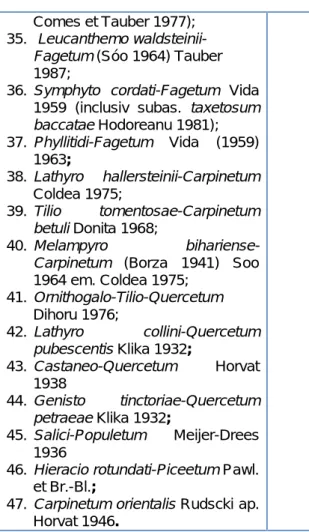
Comes et Tauber 1977); 35. Leucanthemo
waldsteinii-Fagetum(Sóo 1964) Tauber 1987;
36. Symphyto cordati-Fagetum Vida 1959 (inclusiv subas. taxetosum baccataeHodoreanu 1981); 37. Phyllitidi-Fagetum Vida (1959)
1963;
38. Lathyro hallersteinii-Carpinetum
Coldea 1975;
39. Tilio tomentosae-Carpinetum betuliDonita 1968;
40. Melampyro
bihariense-Carpinetum (Borza 1941) Soo 1964 em. Coldea 1975;
41. Ornithogalo-Tilio-Quercetum
Dihoru 1976;
42. Lathyro collini-Quercetum
pubescentisKlika 1932;
43. Castaneo-Quercetum Horvat
1938
44. Genisto tinctoriae-Quercetum petraeaeKlika 1932;
45. Salici-Populetum Meijer-Drees 1936
46. Hieracio rotundati-PiceetumPawl. et Br.-Bl.;
47. Carpinetum orientalisRudscki ap. Horvat 1946.
According to the geobotanical research in the upper basin of the Luncavăţ river, it has been noted that in the Pruno spinosae-Crataegetum monogynae (Soó 1927) Hueck 1931 plant communityRosa canina it is characterized by a big abundance-dominance and high constancy (Tab. 3). The underwoods edified by Prunus spinosa and Crataegus monogyna are frequently met in the hilly floor and with a less frequency in the lower mountain sub-floor (Niculescu, 2006).
The phytocoenoses of this plant community in meet at the edge of forests, on the slopes with varying exposure (Singuru Hill), but at the edge of rangelands (Horezu), at altitudes ranging between 480 m and 650 m (Niculescu, 2009).
Table 3
Ass.Pruno spinosae-Crataegetum monogynae(Soó 1927) Hueck 1931
No. of relevée 1 2 3 4 5 6 7 K Altitude m.o.s. (x 10 m) 55 48 48 48 48 65 65 Exposure - S S V V E E Inclination (in grades) - 5 5 15 10 15 10 Canopy 100 90 90 100 100 100 95 Sampling surface (m2) 50 100 50 100 100 200 200
Char. ass.
Crataegus monogyna 4 4
3-4
4 4 4 5 V
Prunis spinosa 2 1 2 2 2 1 + V
Prunetalia et Prunion spinosae
Rosa canina 1 1
1-2
1 2 2 1 V
Geum urbanum + + + - + + + IV
Fagetalia
Fagus sylvatica (reg.) - + - + - - + III
Euphorbia amygdaloides - - + + + - - III
Viola reinchenbachiana + + - + + + + V
Rubus hirtus - - - - + + + III
Luzula luzuloides - + 1 + + 1 1 V
Querco – Fagetea
Campanula rapunculoides
- - + - + + - III
Fragaria vesca 1 + + + + - + IV
Prunela vulgaris + + - + - - - III
Poa nemoralis - + + - - + + III
Moehringia trinervia 1 - + - - + + III
Variae Syntaxa
Galium aparine + - - + + + - III
Urtica dioica + - - - +-1 +-1 + III
Geranium robertianum - + + - - + + III
Thynus pulegioides - + + + + + + V
Veronica chamaedrys + + + + + - - IV
Potentilla chyrsanta - - - + - + - II
Hypericum perforatum + - - + - + - III
Glechoma hederacea + + 1 +-1 +-1 + + V
Cruciata laevipes - + + + + - + IV
Viola tricolor + + + - + + + V
Stellaria media + + + + - - + IV
Ranunculus repens + + + + + + + V
Place and data of the relevés::1, 2 – Vaideeni, 7.VI.2014; 2, 3, 4, 5 - Horezu, 21.VI.2009, 6, 7 - Singuru Hill, 5.VI.2002
(M.Niculescu)
CONCLUSION
In the present research work, is presented a study on the presence ofRosa canina in different plant communities in Romania. This plant communities is divided into the following groups: forestry, shrublands, grasslands and ruderal. The Rosa canina species and its inter-taxa were identified in the 59 plant communities. The Rosa canina species and inter-taxa are included in various types of NATURA 2000 Habitats. The review of phytosociological data reveals the presence of the Rosa canina and its inter-taxa in 22 habitat types with scientific significance. Rosa canina are characteristic for the alliances
BerberidionBr.-Bl. 1950 (Prunion spinosae Soó (1930) n.n 1940).
ACKNOWLEDGMENT. This work was partially supported by the grant number 13C/27.01.2014/2014, awarded in the internal grant competition of the University of Craiova.
REFERENCES
1.Ciocârlan, V., (2009). Flora ilustrată a României, Pteridophyta et Cormophyta, Ed.Ceres, Bucureşti
2.Coldea, Gh. (1997). Les associations vegetales de Roumanie, Ed. Presses Universitaires de Cluj, Cluj- Napoca
3.Gafta, D., Mountford, O., (coord.). (2008). Manual de interpretare a habitatelor Natura 2000 din România, Ed. Risoprint, Cluj-Napoca
4.Géhu, J.-M., Rivas-Martinez, S. (1981). Notions fondamentales de Phytosociologie, Ber. Intern.Symposion Syntaxonomie in Rinteln: 1-33.
6.Niculescu, M.(2006). Flora and vegetation in the upper basin of the Luncavat River, Ph.D. thesis, "Babes-Bolyai" University of Cluj-Napoca,.347 pp.
7.Niculescu, M. et al.(2009). Researches aboutQuercus cerrisforests situated in the North-East of Dolj County, Analele Universitatii din Craiova, Agricultura, Montanologie/ Annals of the University of Craiova, Agriculture, Montanology, Cadastre series,
http://agronomie.administrativ.ucv.ro/aamc/index.php/aamc, vol. XXXIX/B 2009
8.Sanda, V., Popescu, A., Barabaş, N. (1997). Cenotaxonomia şi caracterizarea grupărilor vegetale din România, St. Com., Muz. Şt. Nat. Bacău, 14: 5-366.
9.Rodwell J.S. et al. (2002).The Diversity of European Vegetation, Raport EC-LNV nr. 2002/054, Wangeningen
10.Tutin, T.G., (eds.) (1964–1980 & 1993). Flora Europaea. Vols 1–5 & Vol. 1 (2nd edition). Cambridge: Cambridge University Press.
11.Weber, H.E., Moravec, J., Theurillat, P. (2000). International Code of Phytosociological Nomenclature. 3rd edition, Journal of Vegetation Science, 11 (5): 739– 768.