856 | P a g e
Comparative Study of Existing Library
System and RFID based library
management system
Sucheta Rani
ABSTRACT
Radio Frequency Identification (RFID) is another age of Auto Identification and Data gathering innovation which computerizes business forms and permits distinguishing proof of expansive number of labeled articles like books, utilizing radio waves. RFID based Library Management System (LMS) would permit quick exchange stream for the library and will demonstrate prompt and long haul advantages to library in traceability and security. The paper covers the segments and specialized highlights of a cutting edge RFID library framework, its points of interest and issues identified with utilization of RFID in libraries. It additionally talks about the relative investigation of existing library framework and RFID based library administration framework and gives a few proposals for executing RFID in libraries.
Keyword: RFID, Radio Frequency Identification, use of RFID in libraries.
INTRODUCTION
RFID was invented in 1969 and is now being used in numerous applications. At the point when utilized as a part of ventures or retail shops they for the most part hold the cost of the great. Additionally in a basic supply shop the products once left have minimum odds of returning once more. This isn't the situation when utilized as a part of a library, as the books are issued and given a particular timeframe inside which the book should be returned. A similar book might be taken over and over relying upon the necessity of the clients. Additionally the clients are likewise furnished with exceptional ID codes. The clients may utilize the library more than once. So the peruser should read a similar label more than once. RFID is a programmed recognizable proof procedure utilized for the quick exchange of books, diaries or DVDs utilizing RFID labels and perusers. The RFID innovation helps in quick issuing, returning, and reissuing of books. The innovation helps in coordinate exchange of data from the labels to the PC of the administrator and in programmed updation of exchanges in the clients account.
857 | P a g e
Librarians' Glossary and Reference Book, "Radio Frequency Identification, an alternative to the Bar Code that usages little microchips in marks to hold and transmit point by point data about the thing named. RFID has central focuses over institutionalized distinguishing pieces of proof, for instance, the ability to hold more data, the ability to change the set away data as taking care of happens, it doesn't require detectable pathway to trade data and is uncommonly effective in unforgiving circumstances where scanner label names may not work". RFID, thusly is a dull term for technologys that use radio waves to therefore perceive people or articles.
EXISTING SYSTEM AND BACKGROUND
There is a blast in the business to utilize RFID innovation in the current years. Innovative work in this field has made this innovation to be utilized as a part of inventory network administration, participation administration, library administration, robotized toll accumulation and so forth. A simple method to follow the gathering paper organizing prerequisites is to utilize this report as a format and just compose your content into it. The present library frameworks are utilized with standardized tag innovation. Each book in the library is furnished with a standardized identification. The uniqueness of the standardized identification fluctuates with the thickness of the lines. This sort of library administration requires manual control. All the significant elements of the library, for example, issuing, reissuing and returning of books are should be checked and controlled physically. The standardized tag perusers have the capacity to peruse just a single code at any given moment and consequently at most events it prompts a long line at the issue and return counters. The scanner tags should be customized at the season of fabricate and these codes can be modified just once. Once characterized the properties of the codes can't be modified. The codes are imprinted on a bit of paper and glued on the books.
858 | P a g e
Amid both issue and return of the books the standardized identification peruser ought to have coordinate line of contact with the scanner tag. For making this conceivable it is necessary to make the activity manual. Indeed, even under manual activity it is exceptionally repetitive and tedious process since each time the peruser should be put extremely close to the scanner tag for the book to be perused legitimately. The scanner tag perusers have a little perused scope of about not very many centimeters to make the activity tedious.
Drawbacks of Barcode Technology
Barcode readers require a direct line of sight, using laser technology
Scan and read one tag at a time and also time consuming
Human intervention is required to scan a barcode
It should be visible on the product for scanning
Does not have read/write memory
COMPONENTS OF RFID SYSTEM
RFID Tag
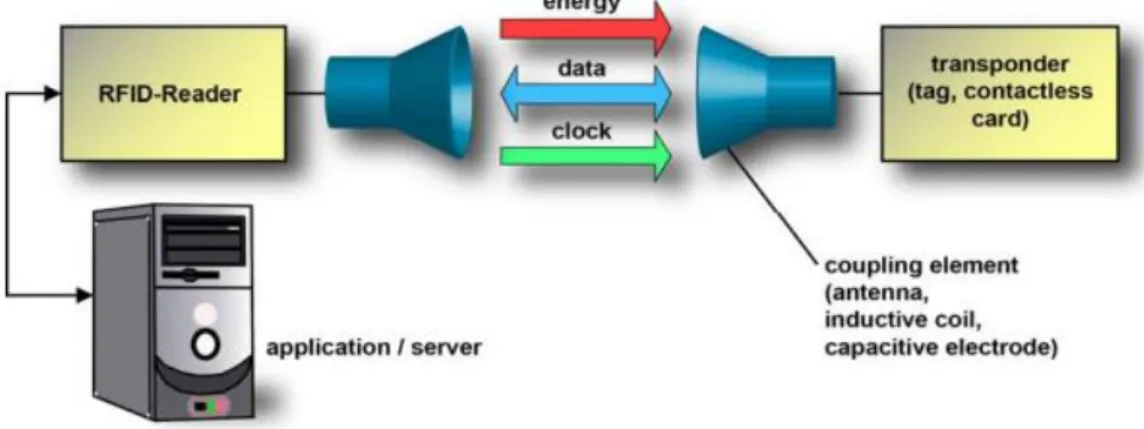
A RFID tag is a modest radio gadget that is additionally alluded to as transponder, brilliant tag, savvy name, or radio standardized identification. There are two standard parts show in the RFID tag. Immediately, a little silicon chip or facilitated circuit which contains an uncommon conspicuous verification number (ID). Likewise, a gathering device that sends and gets radio waves. The gathering mechanical assembly involves a level, metallic conductive circle and the chip which isn't as much as a substantial bit of a millimeter.
Perusers and Antenna
The second portion in a fundamental RFID structure is the cross inspector or peruser. Truth be told, peruser units are handsets (i.e., a blend of transmitter and beneficiary) and their standard part is to scrutinize a tag and get data from it. RFID peruser changes over radio waves from RFID marks into a shape that can be passed to middleware programming. A RFID mark peruser use gathering mechanical assemblies to talk with the RFID chip. It can read information set away in the RFID tag and moreover invigorate RFID tag with the new information. Hereafter, RFID peruser accomplishes two errands: it gets charges from the application programming and talks with marks.
Middleware
859 | P a g e
Despite isolating data from the RFID marks and regulating data stream to the backend, middleware perform limits, for instance, key filtering and peruser fuse and control. RFID middleware help with recouping data from perusers, filtering data supports to application programming, delivering stock improvement sees, checking tag and peruser mastermind execution, discovering history and analyzing tag-read events for application tuning and progression.
Server
A server may be outlined with a RFID system. It is a correspondence entry among the diverse portions. It gets the information from no less than one perusers and checks the information against its own specific database or exchanges information with the course database of the library composed organization system. The server regularly consolidates a trade database with the objective that the reports can be conveyed.
Fig. 1: Main components of every RFID system
RFID BASED LIBRARY MANAGEMENT SYSTEM
860 | P a g e
Furthermore, the perception bit in the book's tag is deactivated by the system. Exactly when a book is reestablished, the enrollment/out structure activates the perception bit.
Book Drops: The Book Drops can be discovered wherever, inside or outside the library. Possible remote territories outside the library consolidate MRT/get ready stations, strip shopping centers, schools, et cetera. This offers unprecedented versatility and convenience of returning library things at whatever point of the day, despite when the library is closed.
RFID Transponder or Tagging: It is the most basic association in any RFID structure. It can store information relating to the specific thing to which they are annexed, adjust again with no essential for contact or discernible pathway. Data inside a tag may offer ID to a thing, affirmation of ownership, special accumulating territory, credit status and history. RFID marks have been especially proposed to be joined into library media, including books, CDs, DVDs and tapes.
Counter Station is a staff helped station on organizations, for instance, propel, return, naming, orchestrating et cetera. It is stacked with outfitting/crippling module, naming module and masterminding module. Equipping/Disarming module licenses EAS (Electronic Article Surveillance) bit inside the tag of the library material to be set/reset keeping in mind the end goal to trigger/not trigger the alert of the EAS entryway.
The Patron self enlistment station: It is basically a PC with a touch screen and a certain RFID peruser, notwithstanding unprecedented programming for individual unmistakable evidence, book and other media dealing with and course. Consequent to perceiving the supporter with a library ID card, an institutionalized label card, or his own ID number (PIN), the sponsor is asked for to pick the accompanying action (enrollment of one or a couple of books). Consequent to picking enrollment, the promoter puts the book(s) before the screen on the RFID peruser and the show will exhibit the book title and its ID number (other optional information can be showed up if needed) which have been taken a gander at.
861 | P a g e
Advantages of RFID Technology
• Patrons will invest less energy enduring within proper limits lines by
utilizing Self Check in - Check out frameworks.
• Patrons find what they are searching for rapidly and effortlessly.
• Reminders for due dates enables supporters to submit acquired materials in
time.
• Use of book drops and returns chutes for returning library material takes
into consideration adaptable timings.
• RFID empowered supporter cards considers simple benefactor ID.
• Self charging releasing
• Reliability
• Streamlined Inventory Management
• Longitivity of Tag life
• Faster Circulation
• Reduction in working environment wounds
• Automated materials taking care of
• Easy stock confirmation
• Theft diminishment
• High level of security
• Mis-hold simple distinguishing proof
• External Book Return
• Improved following of high esteem things
• Reduce Shrinkage blunders
• Technology benchmarks to drive down cost
• Reduce materials cost and taking care of
• Automated issue/return
• Automated arranging of books on return
• Inventory perceivability precision and productivity
• Improved Production arranging
• Ability to deal with the costs over various years.
CONCLUSION
862 | P a g e
RFID Systems are being used for self checkout, for anti-theft control, for inventory control, and for the sorting and conveying of library books. These applications can lead to significant savings in labor costs, enhance customer service, lower book theft and provide a constant record update of new collections of books.
REFERENCES
[1]. Thornton, Frank (2006). RFID security. Rockland, MA, Syngress. Retrieved
from http://www.doko.vn/tai-lieu/rfid-security-1746299.
[2]. Boss, R.W. (2011). RFID technology for libraries. Retrieved from
http://www.ala.org/pla/tools/technotes/rfidtechnology
[3]. Finkenzeller, K. (2012). Introduction to RFID. Retrieved from
http://rfidhandbook.de/about-rfid.html
[4]. Singh, J., Brar, N., & Fong, C. (2006). The State of RFID Applications in
Libraries. Information Technology and Libraries, 25(1), 24-32. doi: 10.6017/ital.v25i1.3326.
[5]. Syed, S., 2005 Use of RFID Technology in libraries : a new approach to
circulation, tracking, inventorying and security of library materials. Library Philosophy and Practice. 8(1), 15-21.
[6]. LibBest: Library Management System: http://www.rfid.library.com
[7]. Karen Coyle, “Management of RFID in Libraries”, Preprint version of article
published in the Journal of Academic Librarianship, v. 31, n. 5, pp. 486-489
[8]. Smart, Laura "Making Sense of RFID," Netconnect (Fall, 2004): 4-14.
[9]. RFID Based Library Management System, Dhanalakshmi M, Uppala
Mamatha.
[10]. RFID and Organizational Transformation in the National Library Board of
Singapore Paul Raj DEVADOSS
[11]. RFID Technology: A Revolution in Library Management, By Dr. Indira
Koneru.
[12]. Roadmap for RFID Implementation in Central Library,PEC University of
Technology, By Seema Vasishta.
[13]. Development of RFID Based Library Management System Using MATLAB C.
Srujana, B. Rama Murthy, K. TanveerAlam, U. Sunitha, Mahammad D.V, P. Thimmaiah
[14]. Implementing RFID in Library: Methodologies, Advantages and Disadvantages
Narayanan A., Sanjay Singh and Somasekharan M.
[15]. Karen Coyle, “Management of RFID in Libraries” , Preprint version of article
published in the Journal of Academic Librarianship, v. 31, n. 5, pp. 486-489
863 | P a g e [17]. Psion Teklogix handheld reader manual – www.psionteklogix.com [last
accessed on 20/2/2009]
[18]. Mercury 4 RFID reader manual – www.thingmagic.com [last accessed on
20/2/2009]
[19]. UHF RFID – Libraries taking the next step into the future –
www.Adilam.com.au [last accessed on 20/2/2009]
[20]. Bansode, S.Y. & Desale, S.K. (2009).Implementation of RFID technology in
University of Pune Library. Program: electronic library and information systems, 43(2), 202-214.
[21]. Radio Frequency Identification (RFID) Vs Barcodes, ElectroCom (Australia)
Pty Ltd.
[22]. Finkenzeller, RFID Handbook: Fundamentals and Applications, 2nd ed., Wiley