STEREOSELECTIVE FUNCTIONALIZATION OF MELDRUM’S ACIDS AND THE EFFORTS TOWARD
TOTAL SYNTHESIS OF ECHINOSPORIN
Dung Tien Do
A dissertation submitted to the faculty of the University of North Carolina at Chapel Hill in partial fulfillment of the requirements for the degree of Doctor of Philosophy in the Department
of Chemistry.
Chapel Hill 2014
Approved by:
Jeffrey S. Johnson
David A. Nicewicz
Maurice S. Brookhart
Erik J. Alexanian
iii
ABSTRACT
Dung Tien Do: Stereoselective Functionalization of Meldrum’s Acids and the Efforts toward Total Synthesis of Echinosporin
(Under the direction of Jeffrey S. Johnson)
I. Cu(II)-Catalyzed Aerobic Hydroperoxidation of Meldrum’s Acid Derivatives and Application in Intramolecular Functionalization to Access Complex Building Blocks
Aerobic hydroperoxidation of Meldrum’s acid derivatives via a Cu(II)-catalyzed process
is presented. The mild reaction conditions are tolerant to variety of vulnerable functional groups.
iv
Cleavage of the OO bond provides 1,n-diols with differentiation of the hydroxy groups. A novel
research plan centered on the hydroperoxidation of designed Meldrum’s acids to generally access
fully substituted hemiketal-viable substrates for preparation of complex building blocks is also
discussed.
II. Conceptual Blueprint for a Stereoselective Heterofunctionalization of Carbonyl Compounds
The glamour of a general stereoselective heterofunctionalization of carbonyl compounds
encourage us to develop a novel -heterofunctionalization of lactone. The strategy based on a
highly diastereoselective Michael addition of variety of nucleophiles to readily accessible chiral
alkylidene Meldrum’s acid and a feasible heterofunctionalization of Meldrum’s acids to access
difunctionalization adducts. Those compounds have been carried on a symmetry-breaking
intramolecular lactonization to reveal a new stereocenter with excellent chirality induction at
carbon bearing heterofunctional group. Limited efforts provided a proof of concept for a
v
III. Efforts Toward The Total Synthesis of Echinosoirin
Two approaches for the construction of the echinosporin core are presented. A key strategy
includes the rapid formation of the fully substituted-dihydropyran substructure via intermolecular
inverse electron demand hetero Diels-Alder reaction of a chiral heterodiene. Highly
diastereoselective cyclizations realized by the use of copper(II) triflate and tBu-box ligand,
provided access to the dihydropyran core. The stereochemical features of this cycloaddition were
previously well established and produced the dihydropyran with high diastereocontrol. An
vi
To my family and
in honor of my parents, Dong Do and Toan Nguyen
vii
ACKNOWLEDGEMENTS
First and foremost, I would like to express my deepest gratitude to my advisor Jeffrey
Johnson. It has been a great privilege to work under Jeff’s guidance the past five years. Jeff’s
creative approach to chemistry is very inspiring and it is something that I strive to mimic, although
this may not always be evident. I am indebted to Jeff for his incredible level of patience to develop
me. Jeff is always willing to listen to any thoughts, concern and most of the time,
counterproductive ideas from a student who barely speaks a proper English. I am thankful that Jeff
always found the way to make those conversations productively work out and patiently guided me
into a right direction of doing research. Additionally, Jeff’s support and willingness to let us
explore our own idea and plan our own experiments is refreshing and has greatly contributed to
my development. The matureness I have developed into during my time in Johnson lab is largely
a result of Jeff’s constant intellectual and moral support, for which I am truly grateful. To all of
the things I have had in UNC, I feel I cannot express enough my sincere gratitude to Jeff.
I would like to thank Professors Maurice Brookhart, Joseph Templeton, Erik J. Alexanian and
Prof. David Nicewicz (chair) for serving on my final defense committee and prelim orals. I am
especially thankful to Prof. Maurice Brookhart and David Nicewicz for the references and
recommendation letters to help me secure my postdoc position.
I feel I am fortunate to be working in Johnson group and have had the privilege to work
viii
Andrew Parsons, Chris Tarr, Greg Boyce, Dan Schmitt, Mike Slade, Austin Smith, Kim Steward,
Justin Malinowski, my fellow year Michael Corbett, Rani Ulrich, Ryan Carris, Ericka Malow,
Steve Wales and Jamie Rogers. Chris Tarr was the mentor who taught me many fundamental stuff
starting from how set up reactions. Mike Slade, Austin Smith, Kim Steward all had a major role
in my early development. My fellow year “old” Corbett was always there sharing his passion about
chemistry mixing with F1 and MotoGP action. His work ethic is also inspiring. I also want to thank
all of the contemporary Johnson Group members: Scott Krabbe, Guy Goodman, Robert Sharpe,
Sam Bartlett, Will Mackay, John Farrokh, Matt Horwitz, Kendrick Smith, James Giarrusso and
Qihai Xu. Scott Krabbe for sharing the Meldrum acid project, Guy Goodman for sharing the DKR
chemistry and together with Corbett, giving me “sketchy guy” banter. Scott Krabbe, Guy
Goodman, Robert Sharpe, Will Mackay for their help on proofreading my thesis. You guys are all
great labmates to me.
Next I would like to thank my friends and people home. I owe a debt of gratitude to my
undergraduate advisor Thao Minh Nguyen, who provided me the foundation to continue studying
organic chemistry. I also thank Dr. Phong Pham for his academic and spiritual guidance. He always
encouraged me to try and come to US for my PhD. My close friends Mon Doan and Son Nguyen
for always supporting and encouraging me to pursue my career. My “framily” members: Luong
Nguyen, Bong Nguyen, Little Trang Nguyen, Duc Tran and Linh Nguyen for the great time we
shared over the years at NC. I will miss those weekend-hangouts and the jokes we shared together.
My Vietnamese friends that I have met during the years in NC. You guys gave me a family in NC.
Finally, I would like to express my special thankful to my family. I wouldn’t be the person
I am today if it wasn’t for my parents’ unconditional love and unwavering support. My parent
ix
never questioned my decision even though, sometimes they might want me to do other things. For
so, I think I can never express enough my gratitude to them. I also want to thank my sister Dung
Thuy Do for the great time we grew up together, though in fact, most of the time, we were likely
to set up some “little fights”. I want to extend my gratitude to all members in my big family back
x
TABLE OF CONTENTS
LIST OF TABLES...xiii
LIST OF FIGURES AND SCHEMES………..xiv
LIST OF ABBREVIATIONS AND SYMBOLS………..xvii
CHAPTER ONE: CU(II)-CATALYZED AEROBIC HYDROPEROXIDATION OF MELDRUM’S ACID DERIVATIVES AND APPLICATION IN INTRAMOLECULAR FUNCTIONALIZATION TO ACCESS COMPLEX BUILDING BLOCKS………..1
1.1 Introduction ...1
1.2 Background ...3
1.2.1 Extant Methods for Enolate Peroxidation ...3
1.2.2 Diverse Endoperoxides as Candidates for Antimalarial and Anticancer Agents ...5
1.2.3 Copper-Catalyzed Enolate Oxidation ...6
1.3 Results and Discussion ...8
1.3.1 Preliminary Results and Experimental Plan ...8
1.3.2 Synthesis of Substituted Meldrum’s Acids and Barbituric Acids ...10
1.3.3 Hydroperoxidation of Meldrum’s Acid Derivatives ...10
1.3.4 Au(I)-Catalyzed Endoperoxidations of Hydroperoxyalkynes ...13
1.3.5 The Remote Oxidation of Alkenyl Hydroperoxy Meldrum’s Acid Derivatives ...18
1.3.6 Secondary Transformation of Endoperoxides ...19
1.3.7 Application in Stereoselective Access Fully Substituted Building Blocks ...22
1.4 Conclusion ...30
xi
1.6 References ...60
CHAPTER TWO: CONCEPTUAL BLUEPRINT FOR THE STEREOSELECTIVE HETEROFUNCTIONALIZATION OF CARBONYL COMPOUNDS………...63
2.1 Introduction ...63
2.2 Background ...64
2.2.1 The Difunctionalization of α,β-Unsaturated Carbonyl Compounds ...64
2.2.2 The Alkylidene Meldrum’s Acids ...70
2.2.3 Intramolecular Asymmetric Desymmetrization ...72
2.2.4 Research Proposal ...74
2.3 Results and Discussion ...75
2.3.1 Identification of Chiral Alkylidene Meldrum’s Acids ...75
2.3.2 Michael Reaction of The Chiral Alkylidene Meldrum’s Acid ...76
2.3.3 Functionalization of Chiral Meldrum’s Acid ...78
2.3.4 Model One-Pot Procedure for Michael Addition/Fluorination of Alkylidene Meldrum’s Acid ...80
2.3.5 Model Intramolecular Desymmetrization ...82
2.4 Conclusion ...84
2.5 Experimental Details ...85
2.6 References ...95
CHAPTER THREE: EFFORTS TOWARD THE SYNTHESIS OF ECHINOSPORIN………...98
3.1 Introduction ...98
3.2.1 Biological Activity and Biosynthetic Proposal of Echinosporin ...99
3.2 Prior Synthesis of Echinosporin...101
3.2.1 Overview of A. B. Smith Total Synthesis of Echinosporin ...101
3.2.2 Overview of Weinreb’s Approach to The Synthesis of Echinosporin ...104
3.2.3 Overview of K. J. Hale Formal Total Synthesis of Echinosporin ...105
3.3 Results and Discussion ...108
xii
3.3.2 Synthesis of Pyruvate Alkylidene Dimer ...110
3.3.3 Reactivity Profile of Pyruvate Alkylidene Dimer ...116
3.3.4 Revised Retrosynthetic Analysis ...119
3.3.5 Synthesis of Chiral Building Block-The β,γ-Unsaturated-α-Ketoester ...120
3.3.6 Inverse Electron Demand Hetero Diels-Alder Reaction-Construction of Dihydropyran Ring ...121
3.3.7 Synthesis of α-Diazo Ketone Intermediate ...124
3.4 Conclusions and Future Direction ...126
3.5 Experimental Details ...128
xiii
LIST OF TABLES
Table 1-1 Cu(II)-Catalyzed Aerobic Oxidation of a Substituted Meldrum’s Acid ...9
Table 1-2 Hydroperoxidation of Meldrum’s Acid Derivatives………....11
Table 1-3 Screen for Acid-Catalyzed Endoperoxidation of Alkynyl Hydroperoxides...14
Table 1-4 Illustrative Examples for The Gold(I)-Catalyzed Cyclization ...…..16
Table 1-5 Synthesis of Endoperoxide Hemiketals ...27
Table 2-1 Nucleophilic Additions to Chiral Alkylidene Meldrum’s Acid ...77
Table 2-2 Electrophilic Functionalization of Chiral Meldrum’s Acid ...79
Table 2-3 Representative Substrates forOne-Pot Michael Addition/Fluorination ...82
Table 3-1 1,2-Addition Profile of Pyruvate Alkylidene Dimer ...117
Table 3-2 Attempts to Selectively Protect Pyruvate Alkylidene Dimer ...118
Table 3-3 Optimization for The Inverse Electron Demand Hetero Diels-Alder Reaction… ...122
xiv
LIST OF FIGURES AND SCHEMES
Scheme 1-1 Methods of Enolate Oxidation ...2
Scheme 1-2 Photosensitized Hydroperoxidation ...3
Scheme 1-3 Metal Catalyzed Hydroperoxidation ...4
Scheme 1-4 Aerobic Hydroperoxidation of Dimedone Derivatives………..4
Scheme 1-5 Mn(III) Catalyzed Hydroperoxidation of Barbituric Acids ...5
Figure 1-1 Natural products possessing cyclic peroxides...6
Scheme 1-6 Steward Cu(II)-Catalyzed Oxidative Deacylation ...7
Figure 1-2 Oxidative Deacylation Reaction Proposed Mechanism ...7
Figure 1-3 Desired Mechanistic Pathway for Meldrum’s Acids ...8
Scheme 1-7 Synthesis of Unsaturated Substituted Meldrum’s Acids and Barbituric Acid..10
Figure 1-4 Limitation of Alkene Substrates. ...12
Scheme 1-8 Possible Solution of Internal Alkene Substrate………13
Scheme 1-9 Control Experiments ...16
Scheme 1-10 Proposed Mechanism for The Gold(I)-Catalyzed Cyclization……….17
Scheme 1-11 Iodoendoperoxidation of Homoallylhydroperoxy-Meldrum’s Acid and Barbituric Acid Derivatives ...18
Scheme 1-12 Endoperoxide Cleavage in 1,2-Dioxolane System ...19
Scheme 1-13 Synthesis of Tetrahydrofuran Derivatives ...20
Scheme 1-14 Mixed Ketal Endoperoxide Functionalization ...21
Figure 1-5 Areas of Improvement ...22
Figure 1-6 Proposed Condition to Access Fully Substituted Endoperoxides ...23
Figure 1-7 Proposed Approach to Access Fully Substituted Building Blocks ...25
Scheme 1-15 Preparation of Keto-Meldrum’s Acids via Michael Reaction ...26
xv
Scheme 1.17 Attempts to The Synthesis of Fully-Substituted Endoperoxide ...29
Figure 2-1 The Vicinal Difunctionalization of α,β-unsaturated Carbonyl Compounds….…...65
Scheme 2-1 Difunctionalization of Enones using Organocopper Reagents ...67
Scheme 2-2 Stereochemical Issues in Tandem Difunctionalizations ...68
Figure 2-2 Organo-Cascade Catalysis ...69
Figure 2-3 MacMillan’sSynthesis of Aromadendranediol via Organo-Cascade Catalysis...……70
Figure 2-4 Electrophilicity Parameter of Alkylidenes………...71
Scheme 2-3 Intramolecular Desymmetrization ...72
Scheme 2-4 Chiral Template for The Intramolecular Desymmetrization ...73
Scheme 2-5 Intramolecular Desymmetrization of Difunctionalized Alkylidene Meldrum’s cid………..75
Scheme 2-6 Synthesis of Chiral Alkylidene Meldrum’s Acid...76
Scheme 2-7 One-Pot Michael Addition/Fluorination ...81
Scheme 2-8 Model Intramolecular Desymmetrization ...83
Scheme 3-1 Silyl Glyoxylate Umpolung Reactivity ...99
Scheme 2-7 Reagents Evolution ...99
Figure 3-1 Natural Product Echinosporin ...100
Scheme 3-3 The Shikimate Biosynthetic Pathway of Echinosporin ...101
Scheme 3-4 A.B Smith’s Echinosporin Retrosynthesis ...102
Scheme 3-5 Summary of A.B.Smith Total Syntheis of Echinosporin………...103
Scheme 3-6 Weinreb’s Approach to The Synthesis of Echinosporin ...105
Scheme 3-7 K.J Hale’s Echinosporin Retrosynthesis ...106
Scheme 3-8 Summary of K.J. Hale Formal Total Syntheis of Echinosporin ...107
Scheme 3-9 First Generation Retrosynthetic Analysis ...109
Scheme 3-10 The Extant Synthesis of Ethyl Pyruvate Alkylidene Dimer ...110
xvi
Scheme 3-12 Approach to theSynthesis of Ethyl Pyruvate Dimer via Homo-Metatheis ...112
Scheme 3-13 Ramberg-BacklundApproach for Synthesis of Ethyl Pyruvate Alkylidene Dimer………..112
Scheme 3-14 Attempts to Synthesize Alkyl Pyruvate Dimer ...114
Scheme 3-15 Second Generation Retrosynthetic Analysis ...120
Scheme 3-16 Synthesis of Chiral β,γ-Unsaturated-α-Ketoester ...121
Scheme 3-17 Synthesis of Precursors of α-Diazo Ketone Intermediate ...125
Scheme 3-18 Synthesis of α-Diazo Ketone Intermediate ...125
xvii
LIST OF ABBREVIATIONS AND SYMBOLS
2D-NMR two-dimensional nuclear magnetic resonance
Ac acetate
Ar aryl
aq aqueous
Au gold
atm atmospheres
Bn benzyl
br broad
bs broad singlet
nBu normal-butyl
tBu tert-butyl
Bz benzoyl
PTSA para-toluene sulfonic acid
13C NMR carbon nuclear magnetic resonance spectroscopy
C–C carbon-carbon single bond
C=C carbon-carbon double bond
C≡C carbon-carbon triple bond
cat catalytic amount or catalyst
Ce(III) Cesium (III) ion
C-H carbon-hydrogen bond
xviii
COSY correlated spectroscopy
m-CPBA meta-chloroperoxybenzoic acid
Cu(NO3)2•3H2O copper(II) nitrate trihydrate
CuCN copper(I) cyanide
d doublet or days
DBU 1,8-diazabicyclo[5.4.0]undec-7-ene
DCC N,Nʹ-dicyclohexylcarbodiimide
DCM dichloromethane
dd doublet of doublet
ddt doublet of doublet of triplets
DEAD Diethyl azodicarboxylate
DMP Dess–Martin periodinane
DIBAL-H diisobutylaluminum hydride
DIPEA ethyldiisopropylamine
DTR dynamic thermodynamic resolution
DKR-ATH dynamic kinetic resolution asymmetric transfer hydrogenation
dq doublet of quartet
DMAP 4-N,N-dimethylaminopyridine
DMF N,N-dimethylformamide
DMSO dimethyl sulfoxide
d.r. diastereomeric ratio
dt doublet of triplet
xix
e- electron
En enamine catalysis
eq equation
equiv equivalents
e.r. enantiomeric ratio
ESI electrospray ionization
Et ethyl
Et3N triethyl amine
Et2O diethyl ether
EtOAc ethyl acetate
EtOH ethanol
EtONa sodium ethoxide
Et3SiH triethylsilane
EWG electron withdrawing group
FID flame ionization detector
G2 Grubbs’ second generation catalyst
h hour
H2 hydrogen
HCl hydrochloric acid
cHex
2NH dicyclohexanyl amine
1H NMR proton nuclear magnetic resonance spectroscopy
HOAc acetic acid
xx
HMPA Hexamethylphosphoramide
HPLC high performance liquid chromatography
HRMS high resolution mass spectroscopy
Hz hertz
IR infrared spectroscopy
IEDH Inverse Electron Demand Hetero
Im iminium catalysis
J coupling constant
kcal kilocalorie
K2CO3 potassium carbonate
L liter or ligand
LA Lewis acid
LAH lithium aluminum hydride
LDA lithium diisopropylamide
LiTMP Lithium tetramethylpiperidide
LiTFA lithium trifluoroacetate
LRMS low resolution mass spectroscopy
LUMO lowest unoccupied molecular orbital
M metal or molarity
m multiplet
MeI methyl iodide
MnIII Manganese(III) ion
xxi
MeCN acetonitrile
MeMgBr Methylmagnesium bromide
MeOH methanol
MeONa sodium methoxide
p-MeOPh para methoxyphenyl
mg milligram
MgSO4 Magnesium sulfate
MHz megahertz
min minutes
mL milliliter
mmol millimole
mp melting point
n number of atoms or counterions
N2 nitrogen
NaH sodium hydride
NaIO4 sodium periodate
NaN3 sodium azide
NBS N-bromosuccinimide
NCS N-chlorosuccinimide
NaBH4 Sodium borohydride
nd not determined
NFSI N-fluorobenzenesulfonimide
xxii
NOESY nuclear Overhauser enhancement spectroscopy
NR no reaction
Nu nucleophile
O2 oxygen
O–O oxygen-oxygen bond
[O] oxidation
PCC pyridinium chlorochromate
Pd/C Palladium on carbon
PG protecting group
Ph phenyl
ppm parts per million
iPr iso-propyl
psig pound-force per square inch
Pt/C platinum on carbon
q quartet
R substituent
Rf retention factor
rt room temperature
s singlet
T temperature
t triplet
tr retention time
xxiii
TBS tert-butyldimethylsilyl
TEA triethylamine
TMS trimethylsilyl
TMSCl trimethylsilyl chloride
TfOH trifluoromethanesulfonic acid
THF tetrahydrofuran
TLC thin-layer chromatography
TMS trimethylsilyl
triflate trifluoromethanesulfonate
triflic trifluoromethanesulfonic
triflimide trifluoromethanesulfonimide
UV ultraviolet
X halide, substituent, or number
δ chemical shift or partial charge
π pi bond
1
CHAPTER ONE: CU(II)-CATALYZED AEROBIC HYDROPEROXIDATION OF MELDRUM’S ACID DERIVATIVES AND APPLICATION IN INTRAMOLECULAR FUNCTIONALIZATION TO ACCESS
COMPLEX BUILDING BLOCKS*
1.1 Introduction
Enolate oxidation is an important tool in organic synthesis for the preparation of various
-functionalized carbonyl compounds.1 This reaction is often achieved through the application
of nonideal reagents such as complex oxygen-based electrophiles--oxaziridines, dioxiranes,
and diacyl peroxides (Scheme 1-1, equation 1); these reagents are useful for the installation of a hydroxyl group or hydroxyl surrogate but are relatively poor in term of atom economy.2
When hydroperoxides are generated during the course of enolate functionalization (often as
mixtures with the corresponding alcohols), it is common practice to reduce the mixture to the
alcohol upon workup (Scheme 1-1, equations 2, 4). This reductive workup in essence wastes one oxidation level conferred by the oxidant. In contrast, an enolate oxidation that preserves
the elevated product oxidation state could in principle be used to functionalize remote sites
(Scheme 1-1, equations 3, 5), provided the distal functionality was compatible with the oxidation conditions.
Ideally to achieve such a transformation, oxidation of enolate 1.1 with molecular oxygen would initially provide a hydroperoxide 1.3 which would undergo an intramolecular
*Reproduced in part by permission from Krabbe, S. W.; Do, D.; Johnson, J. S. Org. Lett.
2
remote oxidation to provide endoperoxide 1.4. Hydrogenolysis of the OO bond, would
furnish formal dihydroxylation products 1.5 in a redox-economical manner.3 Moreover, a catalytic enolate oxidation reaction that used O2 would carry the inherent advantages of
complete atom economy through the use of a green oxidant.
Scheme 1.1 Methods of Enolate Oxidation
There are two key tasks to be addressed for translating this construct to practice. First,
the development of a mild, functional group-tolerant enolate oxidation using O2, and second,
the development of tools for remote functionalization using the hydroperoxide products. The
goal of this study is to develop an efficient, operationally simple method for the catalytic
aerobic hydroperoxidation of Meldrum’s acid derivatives4 and the application of these products
in intramolecular alkene/alkyne remote oxidation to access structurally unique endoperoxides.
Further manipulation of these endoperoxides would provide a variety of synthetically
3
1.2 Background
1.2.1 Extant Methods for Enolate Peroxidation
While research associated with enolates is widely present in the literature, extant
methods for hydroperoxidation of -dicarbonyls are hardly adequate. These methods often
require harsh conditions and/or providing mixtures of hydroperoxides and alcohols. As early
as 1933, Hasegawa reported the use of photosensitized 1O2 in the hydroperoxidation of
β-dicarbonyls. The conditions allow the formal addition of O2 into the active methine in 1.6 with
retention of the OO bond.5
Scheme 1-2. Photosensitized Hydroperoxidation
However, the reaction was moderately selective for the formation of the hydroperoxide 1.7, which was always isolated with a significant amount of the naphtol 1.8 (Scheme 1-2).
4
Scheme 1-3. Metal Catalyzed Hydroperoxidation
β-Dicarbonyl compounds 1.9 can be oxidized to their α-radicals with Ce(III) or Mn(III).
Subsequent trapping of the radical with alkenes and molecular oxygen generated the hemiketal
endoperoxides 1.10 in moderate yield (Scheme 1-3).
Serendipitously, Xia and coworkers reported a hydroperoxidation under aerobic
oxidation of dimedone derivatives7 (Scheme 1-4). Exposing solution of chalcone 1.11 in DCE to air for the indicated time, they isolated the hydroperoxide 1.12 with excellent yield (9 examples with >95% yield). While the aerobic oxidation conditions are quite tempting,
this reaction was specific only to dimedone derivatives.
Scheme 1-4. Aerobic Hydroperoxidation of Dimedone Derivatives
5
Nishino demonstrated an efficient autoxidation of heterocyclic 1,3-dicarbonyl
compounds employing Mn(III)/O2 to peroxidize 1,2-diphenylpyrazolidine-3,5-diones and
barbituric acid derivatives 1.13 (Scheme 1-5).8 In all cases, the hydroperoxides 1.14 were isolated with excellent yields (8 examples, >95% yields). However, Mn(III) is well-known to
give electrophilic radical intermediates with -dicarbonyls presumably, rendering this method
incompatible with pendant unsaturation due to competitive cyclization.9 It is not surprising that
there are no reported examples of hydroperoxidation of β-dicarbonyls containing alkene or
alkyne functionality that would be required for useful subsequent transformations.
Scheme 1-5. Mn(III) Catalyzed Hydroperoxidation of Barbituric Acids
1.2.2 Diverse Endoperoxides as Candidates for Antimalarial and Anticancer Agents
Cyclic peroxides exhibit many useful biological activities which provide the potential
for application in small molecule therapeutics.10 The natural product artemisinin and its
derivatives are broadly used in antimalarial treatment and cyclic peroxides figure prominently
in synthetic artemisinin mimics, as it is believed that the mechanism of action is linked to the
peroxide bridge.11,12 1,2-Dioxanes and 1,2-dioxolanes are distinguishing features of natural
products exhibiting anticancer activity (e.g. plakinic acids),13,14 but synthetically produced
1,2-dioxolane rings have not been broadly evaluated for antimalarial15 or anticancer activities.
With this knowledge and the findings that many structurally simpler cyclic peroxides can still
6
become a topic of increased effort.16 Thus, the value of endoperoxides 1.4 is twofold as they are both biologically relevant and potential precursors to ubiquitous 1,n-diols 1.5. This chapter will highlight our work to prepare new unnatural cyclic peroxides and their use in accessing
complex building blocks stereoselectively.
Figure 1-1 Natural products possessing cyclic peroxides
1.2.3 Copper-Catalyzed Enolate Oxidation
Developed from some early studies,17,18 Steward reported a simple protocol for the
preparation of β-stereogenic α-keto esters through the aerobic deacylation of substituted
acetoacetate derivatives (Scheme 1-6).19 The acetoacetate derivative 1.15 exposed to Cu(II)/air (55 psig; standard Fisher-Porter bottle) in acetonitrile at ambient temperature provided the
β-stereogenic α-keto esters 1.16. It is noteworthy that this mild reaction proceeded with good
7
Scheme 1-6. Steward Cu(II)-Catalyzed Oxidative Deacylation
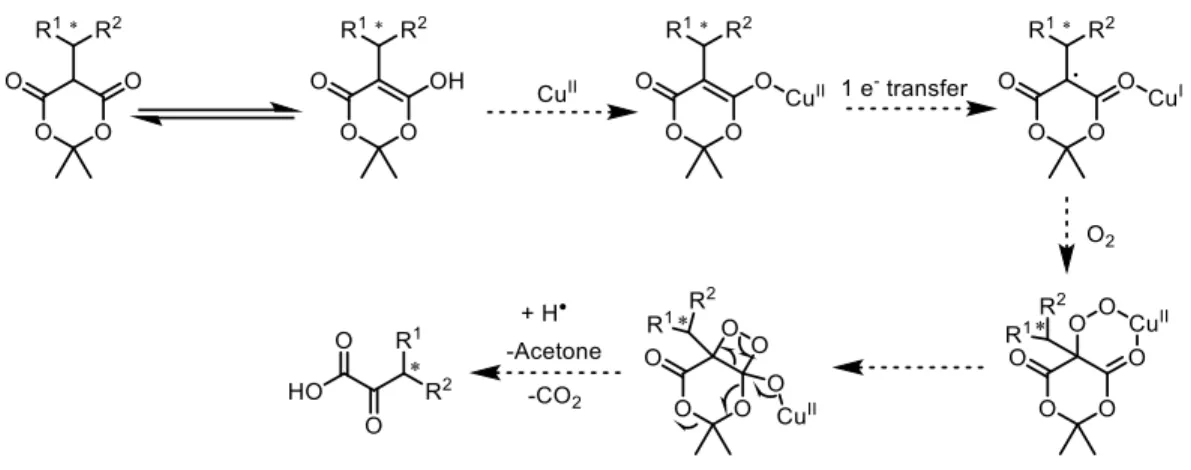
The generation of the reactive enol 1.19 under these mild reaction conditions, by virtue of the low pKa of acetoacetates 1.18, initiates the series of steps in a proposed mechanism
shown in Figure 1-2.
Figure 1-2. Oxidative Deacylation Reaction Proposed Mechanism
8
1.3 Results and Discussion
1.3.1 Preliminary Results and Experimental Plan
In the course of attempting to extend Steward’s recently reported aerobic deacylation
of acetoacetates to other dicarbonyls,20 we proposed a pathway to access α-keto acids. (Figure
1-3). Our point of departure for this study was to examine oxygenation of β-dicarbonyls with
the expectation that the unusually high CH acidity of Meldrum’s acids could translate to
relatively mild activation conditions.
Figure 1-3. Desired Mechanistic Pathway for Meldrum’s Acids
In addition, the use of substituted Meldrum’s acids as flexible starting materials for
CH oxidation was attractive, since asymmetric syntheses of these compounds have been
developed to a high level of sophistication, simplicity, and scalability.21,22
We began by exposing isopropyl Meldrum’s acid 1.25 to Cu(II)/air, expecting the
formation of the oxidative cleavage product keto acids 1.26. However, the reduced electrophilicity of the ester carbonyl prevented the formation of α-keto acid 1.26 and led
9
hydroperoxide 1.27 and alcohol 1.28 was obtained when reaction was prolonged to 17 h at room temperature (entry 1). The ratio of hydroperoxide to alcohol increased when the reaction
was quenched earlier (entries 2-4). Reducing the temperature to 0 C minimized or eliminated
reduction to alcohol 1.28 while still providing good conversion to the hydroperoxide 1.27
(entry 5). Operational simplicity was further enhanced without detriment to yield by using a
balloon of O2, eliminating the need for a pressure vessel.22 With the optimized conditions in
hand, we aimed to extend this simple, mild and efficient reaction to the hydroperoxidation of
a variety of Meldrum’s acid derivatives, including those with unsaturation. Possessing a similar
property as Meldrum’s acids, barbituric acid derivatives will also be investigated for this
reaction.
10
1.3.2 Synthesis of Substituted Meldrum’s Acids and Barbituric Acids
The conjugate addition of Grignard reagents to alkylidene Meldrum’s acids 1.29a-i or barbituric acid 1.30-j proved most effective for the rapid generation of substituted Meldrum’s acids and barbituric acid library 1.31-j (Scheme 1-7). In general, the reaction proceeded with complete conversion and both alkylidene Meldrum’s acids and barbituric acid provided the
desired products with high isolated yields. Both saturated and unsaturated substituted
Meldrum’s acids were conveniently synthesized via this method.
Scheme 1-7. Synthesis of Unsaturated Substituted Meldrum’s Acids and Barbituric Acid
1.3.3 Hydroperoxidation of Meldrum’s Acid Derivatives
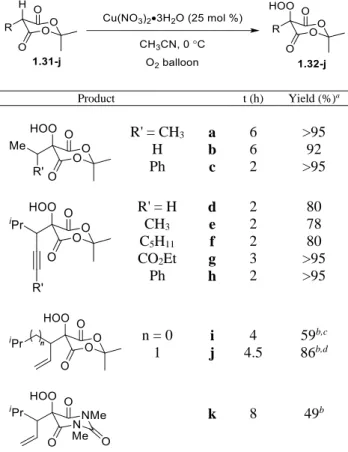
With optimized conditions for the hydroperoxidation in hand,23 various Meldrum’s
acids 1.31a-j were subjected to the hydroperoxidation conditions (Table 1-2).
The mild reaction conditions proved tolerant of a variety of potentially vulnerable
functional groups including alkenes, terminal and internal alkynes, arenes, tertiary benzylic C–
H bonds, and esters. In most cases, the hydroperoxide products 1.32a-h were obtained in analytically pure form following a simple aqueous work-up. Alkene substrates only provided
modest to good yields of the desired hydroperoxides 1.32i-j following purification.24 In
11
also provided the barbituric acid derivative 1.32k with pendant unsaturation in modest yield, a product that would presumably be unattainable using the Mn(III)-catalyzed conditions.
Table 1-2. Hydroperoxidation of Meldrum’s Acid Derivatives
Product t (h) Yield (%)a
R' = CH3
H Ph a b c 6 6 2 >95 92 >95
R' = H CH3
C5H11
CO2Et
Ph d e f g h 2 2 2 3 2 80 78 80 >95 >95
n = 0 1 i j 4 4.5 59b,c 86b,d
k 8 49b
a Isolated yield without need for purification (except 1.32i, 1.32j, 1.32k). b Yield following purification on SiO
2. c 10:1 with alcohol. d 17:1 with alcohol.
It is noteworthy that the internal alkene substrates are not tolerated with the reaction
condition. The reaction of those substrates generally resulted in a messy mixture where the
hydroperoxide was not present in the crude mixture. We reasoned that when the
12
Figure 1-4. Limitation of Alkene Substrates
If the proposed scenario in Figure 1-4 were the only complication, we felt that we could
potentially control each step of the process. To probe this, we considered pre-forming the
epoxide 1.34 and subjecting it to the hydroperoxidation condition. This approach could provide us the endoperoxide 1.37 via an intramolecular epoxide ring-opening reaction of intermediate
1.36. Since the epoxidation is a stereospecific process and we can expect a regioselective epoxide-ring opening, it seemed reasonable that we could achieve a diastereoselctive formation
for the endoperoxide 1.37.
Unfortunately, while we were able to generate the epoxide 1.36 from alkenyl Meldrum’s acid 1.35 in situ, it readily underwent an intramolecular epoxide ring-opening with
the enol 1.38 to form compound 1.39, relinquishing the opportunity for the hydroperoxidation.
Although we were not successful with the internal alkene substrates, those substrates
with the pendant πC≡C (1.32d-h) and terminal πC=C (1.32i-k) functionality would provide us the
opportunity to assay the utility of unsaturated hydroperoxide products in intramolecular
13
Scheme 1-8. Possible Solution of Internal Alkene Substrates
1.3.4 Au(I)-Catalyzed Endoperoxidations of Hydroperoxyalkynes
Although metal-catalyzed cycloetherifications have been reported with a variety of
catalysts,25 to the best of our knowledge, the corresponding endoperoxidation was unknown at
the time. The primary goal of this endoperoxidation was to find conditions that could tolerate
the susceptibility of the OO bond to metal-mediated cleavage of the hydroperoxide. Drawing
an analogy to the alcohol/alkyne etherifications enabled by electrophilic activation, we
14
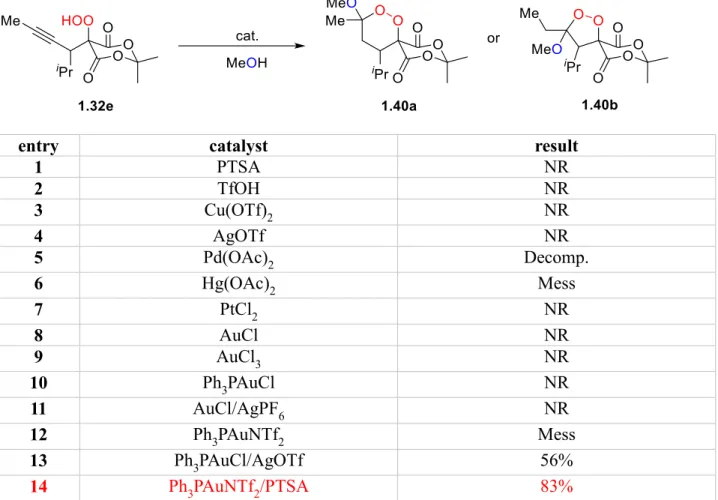
Table 1-3. Screen for Acid-Catalyzed Endoperoxidation of Alkynyl Hydroperoxides
entry catalyst result
1 PTSA NR
2 TfOH NR
3 Cu(OTf)2 NR
4 AgOTf NR
5 Pd(OAc)2 Decomp.
6 Hg(OAc)2 Mess
7 PtCl2 NR
8 AuCl NR
9 AuCl3 NR
10 Ph3PAuCl NR
11 AuCl/AgPF6 NR
12 Ph3PAuNTf2 Mess
13 Ph3PAuCl/AgOTf 56%
14 Ph3PAuNTf2/PTSA 83%
The five-(1.40b) or six-membered ring mixed ketal endoperoxides (1.40a) could both be envisioned as potential products (Table 1-3). Initial attempts included a screen of Brønsted
acids catalysts. Unfortunately, both strong acids such as PTSA and triflic acid did not promote
any reaction (entries 1,2). We next probed the effect of Lewis acids on the transformation.
Copper(II) and silver triflate showed no effect (entries 3,4), while mercury(II) acetate gave a
mess with low conversion (entry 6). Palladium(II) acetate displayed an unusual effect by
destroying the Meldrum’s acid under the reaction condition (entry 5). Even catalysts that are
15
were unreactive in our case. The use of triphenylphosphine gold triflate and a 1:1 mixture of
combination of gold(I) chloride and silver hexafluorophosphate were also ineffective at
promoting the desired transformation (entries 7-11). The use of triphenylphosphine gold(I)
triflimide surprisingly gave a messy reaction, given the mild reactivity of the catalyst (entry
12).26 Gratifyingly, a 1:1 mixture of triphenylphosphine gold(I) chloride and silver triflate
provided the mixed ketal endoperoxide 1.40a with 56% yield (entry 13). It should be noted that no five-membered ring mixed ketal endoperoxide 1.40b formed in this reaction indicating that a complete regioselective six-endo cyclization occurred under this reaction condition. We
were delighted to achieve an increased yield of 83% when a combination of 2 mol % of
triphenylphosphine gold(I) triflimide and 10 mol % of PTSA was used (entry 14).27 The
diastereoselectivity for the cyclization was moderate; Nonetheless, the epimerization at the
ketal carbon is irrelevant, since the stereochemistry at this position will be erased in the
following reduction step, so this highest yielding reaction condition was chosen as the optimal
condition.
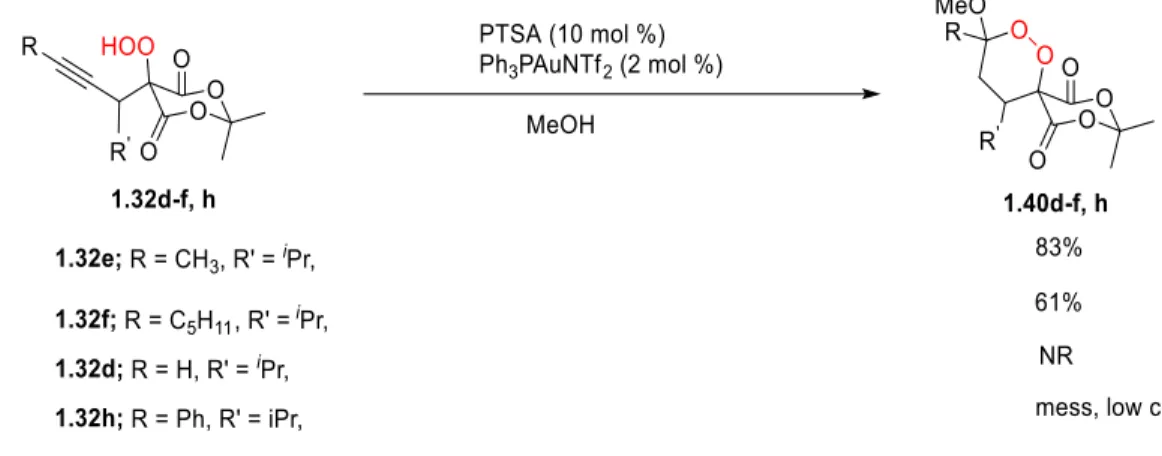
With the optimized conditions in hand, we began to extend this reaction to the alkynyl
hydroperoxides (Table 1-4). While the reaction worked moderately well with alkyl alkynyl
16
Table 1-4. Illustrative Examples for The Gold(I)-Catalyzed Cyclization
Regarding the mechanism of this novel reaction, control experiments were run to
provide insight into the role of methanol in this reaction (Scheme 1-9). We replaced
methanol from the reaction with a non-nucleophilic alcohol such as trifluoroethanol. If the
role of methanol in the reaction was not necessary as a nucleophile, we would expect the
formation of ene-peroxide 1.41e. However, no reaction was observed when 1.32e was treated with the combination of 2 mol % of triphenylphosphine gold(I) triflimide and 10 mol % of
PTSA in trifluoroethanol. Similarly, replacing methanol by a less nucleophilic solvent such
as water, the expected hemiketal 1.42e was not formed under the reaction condition, and the hydroperoxide 1.32e was completely recovered.
17
These two experimental results suggest that a strongly nucleophilic solvent such as
methanol is necessary for the reaction to proceed and that it participates in the reaction before
the intramolecular action of the hydroperoxide. Given the highly nucleophilic profile of
hydroperoxide, it is assumed that two electron withdrawing carboxyl groups in Meldrum’s
acid reduce the nucleophilicity of the hydroperoxide in this case. The proposed mechanism
for this reaction is shown below (Scheme 1-10).
Scheme 1-10. Proposed Mechanism for The Gold(I)-Catalyzed Cyclization
Following the coordination and activation of gold(I) to the alkyne 1.32-j, methanol attacks the less hindered side of the alkyne complex to form the intermediate 1.43. A proton transfer from the oxygen to the carbon attached to gold generates the oxocarbenium 1.44, which is susceptible to the attack of the hydroperoxide, forming the protonated mixed ketal
18
1.3.5 The Remote Oxidation of Alkenyl Hydroperoxy Meldrum’s Acid Derivatives
While the gold(I)-catalyzed 6-endo cyclization reaction has demonstrated a formal
remote intramolecular oxidation for the alkynes, we sought the complementary cyclization
mode through the remote oxidation of alkenyl hydroperoxy Meldrum’s acid derivatives.
Homoallyl-hydroperoxy 1.32i cyclized via electrophilic activation of the alkene with 1,3-diiodo-5,5-dimethyl hydantoin (DIH).28 This process was highly regio- and stereoselective
providing the 1,2-dioxolane 1.46i with pendant iodide in modest yield. The N,N -dimethylbarbituric acid derivative 1.32k reacted analogously giving the endoperoxide 1.47k
in 49% yield.
Scheme 1-11. Iodoendoperoxidation of Homoallylhydroperoxy-Meldrum’s Acid and
19
A noteworthy feature of this reaction is that a 5-exo cyclization mode is dominant in
this case. We reasoned that the 6-endo cyclization in the gold(I)-catalyzed cyclization was
dictated by the attack of methanol to the less hindered side of the alkyne and regioselectivity
of the cyclization of alkenes was controlled by the preference of 5-exo over 6-endo iodonium
ring-opening reaction.
1.3.6 Secondary Transformation of Endoperoxides
To highlight the synthetic application of the endoperoxides by accessing 1,n-diols via
formal dihydroxylation with O2 as the oxidant and H2 as the reductant, illustrative secondary
transformation were pursued. The endoperoxide 1.46i was the first candidate to test this green chemistry principle. Exposure of 1.46i to a standard hydrogenolysis condition of hydrogen balloon in the presence of Pt/C in ethanol provided smooth O–O bond cleavage. Concomitant
cyclization/ring opening occurred on the Meldrum’s acid with complete diastereotopic group
discrimination to provide the differentiated 1,3-diol functionality in the form of lactone 1.48i, which was conveniently isolated in analytically pure form as the dicyclohexylamine salt in
good yield as a single diastereomer (Scheme 1-12).
20
The relative configuration of 1.48i was determined by single crystal x-ray diffraction.
A similar result was achieved when thiourea/MeOH was used as the reductant for the OO
bond cleavage.29
Encouraged by the diastereoselective ring opening of the Meldrum’s acid, we
investigated the feasibility of performing a similar practice for the mixed ketal endoperoxides
and demonstrate an opportunity to access complex building blocks. The mixed ketal
endoperoxide 1.40e was then exposed to the hydrogenolysis condition with a hydrogen balloon and Pd/C in DCM at room temperature for 30 minutes. Subsequent reductive cleavage of the
OO bond of 1.40e followed by hemiketal formation with the transient ketone provides
hemiketal 1.49e in excellent yield with 3:1 dr (Scheme 1-13).
Scheme 1-13. Synthesis of Tetrahydrofuran Derivatives
Subjecting the hemiketal 1.49e to the established ionic hydrogenation with triflic acid and Et3SiH afforded tetrahydrofuran 1.50e in a highly diastereoconvergent process.30 The
21
delivery anti to the isopropyl group gave the illustrated diastereomer of 1.50e providing a unique diastereoselective access to highly-substituted tetrahydrofurans (Scheme 1-13).
Interestingly, by reversing the order of operations, entirely different products can be
accessed from the same mixed ketal endoperoxide. Under ionic hydrogenation condition with
triflic acid and triethylsilane, 1.40e provides endoperoxide 1.51e in modest yield with good diastereoselectivity (Scheme 1-14a). A similar oxocarbenium ion intermediate with delivery
of the hydride source anti to the isopropyl group could be used to explain the highly
diastereoconvergent process. Reductive cleavage of the OO bond of 1.51e with concomitant Meldrum’s acid opening and decarboxylation gives the desired 1,4-diol functionality as lactone
1.52e in good yield as a single diastereomer, implying that the decarboxylation/protonation is completely stereoselective (Scheme 1-14b).
22
1.3.7 Application in Stereoselective Access Fully Substituted Building Blocks
From our demonstration of quick access to mixed ketal endoperoxides, endoperoxides,
and substituted tetrahydrofurans and the development of atom-efficient O2/H2
dihydroxylations, we feel that there are still some areas of improvement for this promising
chemistry (Figure 1-5). While the gold(I)-catalyzed cyclization provides unique access to the
mixed ketal endoperoxides, the scope for the reaction was very limited. Only substrates with
the alkyl substitution on the internal alkyne were the competent partners in the cyclization.
And although the reaction proceeds well with a catalyst loading of 2 mol % of the
triphenylphosphine gold(I) triflimide, the catalyst itself is not an economic option. It is
therefore desirable to seek a more general and economical method to access the endoperoxides.
Figure 1-5. Areas of Improvement
As shown in Figure 1-5, the gold(I)-catalyzed cyclization only furnished a mixed ketal
endoperoxide with no substitution at the carbons denoted by red dots, thus neglecting an
23
There are two obvious questions to ask at this point: can we access a more general scope for
the synthesis of endoperoxide hemiketal? And can we stereoselectively access fully substituted
building blocks?
Figure 1-6. Proposed Condition to Access Fully Substituted Endoperoxides
Regarding the first question, we proposed that while the cyclization of the alkynyl
hydroperoxides 1.40-j could not provide the fully-substituted hemiketal endoperoxides 1.53-j, these compounds could be prepared by intramolecular trapping of the transient hydroperoxide
24
transient hydroperoxide itself could be readily access via the standard hydroperoxidation
process of the corresponding Meldrum’s acid 1.55-j which presumably accessible via a
Michael reaction of the alkylidene or arylidene with the designated ketones (Figure 1-6a).
The second question concerning the stereoselectivity appears more challenging. When
two preexisting stereocenters are present in molecule, it is expected that the two diastereomeric
hydroperoxides 1.54-ja and 1.54-jb will undergo a non-diastereoselective cyclization to furnish two sets of diastereomers 1.53-ja and 1.53-jb (Figure 1-6b), thereby preventing us from accessing the fully substituted endoperoxide stereoselectively.
To overcome this challenging issue associated with the fully substituted substrates, we
hypothesized that if X were an electron withdrawing group, the methine α-proton of the ketone
1.54-j would be acidic enough to undergo rapid epimerization under acidic conditions. Standard dynamic thermodynamic resolution (DTR) conditions, with rapid epimerization at
the methine stereocenter, where one epimer cyclizes faster relative to the other, should allow
us to set the relative stereochemistry at the two tertiary centers (Figure 1-6c).
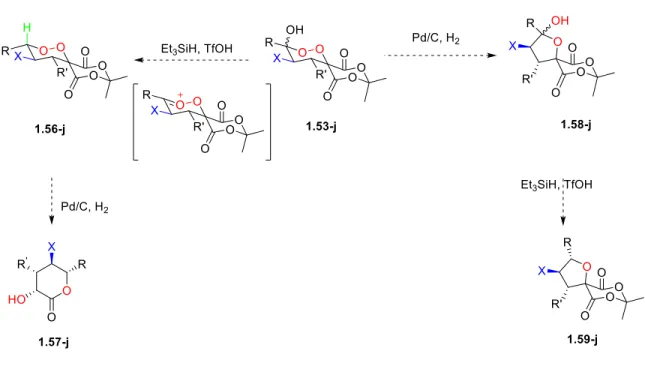
The newly-established chemistry for the diastereoselective ionic hydrogenation would
be an ideal tool to “fix” the stereochemistry at the quaternary hemiketal (Figure 1-7). Exposing
the hemiketal endoperoxide 1.53-j to an ionic hydrogenation with triethylsilane and triflic acid would diastereoselectively provide the endoperoxide 1.56-j. Upon treatment of 1.56-j with an
established hydrogenation method to undergo a tandem OO bond cleavage, ring-opening of
Meldrum acid following of decarboxylation, would diastereoselectively furnish the
fully-substituted α-hydroxy lactone 1.57-j. Reversing the order of reactions, the hemiketal
25
hemiketal tetrahydrofuran derivative 1.58-j, which would be subjected to the ionic hydrogenation condition with triethylsilane and triflic acid to diastereoselectively access
fully-substituted tetrahydrofuran 1.59-j (Figure 1-7).
Figure 1-7. Proposed Approach to Access Fully Substituted Building Blocks
To realize the hypothesis, we started to synthesize the keto-Meldrum’s acids,
designated substrates for the hydroperoxidation. Michael reaction of the alkylidene or
arylidene Meldrum’s acids 1.30-j and the ketones 1.60-j were elected methods for its simplicity
and efficiency. As depicted in Scheme 1-15, representative keto-Meldrum’s acids were
synthesized via this reaction by treating the 1:1 mixture of ketones and alkylidene or arylidene
Meldrum’s acids with stoichiometric amount of base (NaH, K2CO3 or MeONa). Expectedly,
the reaction provided these keto-Meldrum’s acids with good to excellent yield (75-90%) and
poor diastereoselectivity (1:1-3:1 dr). Fortunately, in most case the reaction was clean enough
26
messier mixture due to a retro-Michael reaction of the product over silica gel. Due to these
complications during isolation, we decided to use the mixture of two diastereomers for the next
oxidation step without further purification.
Scheme 1-15. Preparation of Keto-Meldrum’s Acids via Michael Reaction
With the keto-Meldrum’s acids in hand, we subjected those compounds to the standard
hydroperoxidation conditions of 25 mol % of Cu(NO3)2•3H2O in acetonitrile under an oxygen
balloon atmosphere. It is necessary that the reaction be set at 0 °C for 3-5 hours before slowly
warming to room temperature, since retro-Michael and retro-Knovenagel condensation were
27
Table 1-5. Synthesis of Endoperoxide Hemiketals
Entry R1 R2 X Results
1 p-MeOPh- Me CH3CO- 65%, 3:1 dr
2 p-MeOPh- Me -COOEt 85%, 5:1 dr
3 Ph- Me -COOEt 65%, 5:1 dr
4 iPr- Me -COOEt 75% 3:1 dr
To our delight, under our hydroperoxidation conditions, hemiketal Meldrum’s acids
were formed with high efficacy (Table 1-5). Gratifyingly, when X= CH3CO or CO2Et, the
hydroperoxidation reaction provided good to excellent yields of a mixture of only two
diastereomers of hemiketal endoperoxides (entries 1-4, Table 1-5).
The formation of only two diastereomers in these reactions provided evidence for the
existence of DTR conditions, whereas a mixture of four diastereomers would be expected
otherwise. The R1 group did not have strong influence to the outcome of these reactions. Both
aryl (Table 1-5, entries 1-3) and isopropyl (Table 1-5, entries 2-6) groups provided a mixture
of two diastereomers, with the anticipated moderate diastereoselectivity due to a
28
These promising results have prompted us to explore further functionalization of the
hemiketal Meldrum’s acids based on our previous established chemistry (Scheme 1-16).
Illustrative secondary transformation were then pursued. Exposure of hemiketal
Meldrum’s acids 1.53b,d with R = p-methoxyphenyl and isopropyl, to a hydrogenolysis
condition with Pd/C under a hydrogen balloon in ethanol provided the corresponding hemiketal
tetrahydrofuran derivatives 1.58b,d in good yields (70-75% yield) and moderate dr (Scheme 1-16a). The hemiketal 1.58b and 1.58d were then subjected to the established ionic hydrogenation with triflic acid and triethylsilane in acetonitrile at -78 °C for 45 min. To our
delight, the fully substituted tetrahydrofuran 1.59b and 1.59d were isolated as a single diastereomer with a promising 55% and 65% corresponding yield. This preliminary result
provides an experimental proof for our DTR hypothesis and will open opportunities to extend
this promising chemistry.
29
With the hypothesis experimentally confirmed, we shifted our focus to developing
suitable conditions for the diastereoselective ionic hydrogenation for the hemiketal Meldrum’s
acids 1.53-j which could pave the way to access fully-substituted endoperoxides 1.56-j and lactones 1.57-j (Scheme 1-17).
Scheme 1-17. Attempts to The Synthesis of Fully-Substituted Endoperoxide
However, several attempts to reduce the hemiketal endoperoxides 1.53-j to endoperoxides 1.56-j were unsuccessful (Scheme 1-17). In this case, the established ionic hydrogenation condition failed to provide the desired endoperoxide. No reaction was observed
when the reaction was cooled down to -78 °C, and reaction was messy when slowly warmed
up to -20 ºC. Having an additional electron withdrawing group in the position of CO2Et seems
to reduce the reactivity of the ketal to the ionic reduction. We tried to incorporate an oxalate
ester in a hope to provide a better leaving group than the hydroxide due to a
double-coordination activation with a Lewis acid catalyst. However, a messy reaction with low
30
Current efforts in our group will continue to develop suitable conditions for the
reduction of these hemiketal endoperoxides and try to develop a broader scope of the
hydroperoxidation-cyclization cascade.
1.4 Conclusion
We have developed a simple, mild and efficient catalytic method for the
hydroperoxidation of Meldrum’s acid derivatives including those with unsaturation. The
hydroperoxide products can be used for intramolecular oxidation via electrophilic activation
of the pendant alkyne and alkene functionality. Au(I)-catalyzed endoperoxidations of
hydroperoxyalkynes have been reported for the first time. Reductive cleavage of the O–O bond
yields 1,n-diol functionality with convenient differentiation of the alcohols via lactonization,
thereby providing the conceptual blueprint for the development of atom-efficient O2/H2
dihydroxylations. Current efforts in our laboratory are focused on expanding this methodology
to a new approaches with select Meldrum’s acid derivatives to provide a stereoselective
approach to fully-substituted endoperoxides and 1,n-diols. This chemistry also provides a
31
1.5 Experimental Details
Methods: General. Methods. Infrared (IR) spectra were obtained using a Jasco 260 Plus Fourier transform infrared spectrometer. Proton and carbon nuclear magnetic resonance
spectra (1H NMR and 13C NMR) were recorded on a Bruker DRX 400 or 600 (1H NMR at 400
MHz or 600 MHz and 13C NMR at 100 or 150 MHz) spectrometer with solvent resonance as
the internal standard (1H NMR: CDCl3 at 7.26 ppm. 13C NMR: CDCl3 at 77.0 ppm). 1H NMR
data are reported as follows: chemical shift, multiplicity (s = singlet, bs = broad singlet, d =
doublet, dd = doublet of doublet, ddd = doublet of doublet of doublets, t = triplet, q = quartet,
m = multiplet), coupling constants (Hz), and integration. Melting point data was collected on
a Thomas Hoover Capillary Melting Point Apparatus and are uncorrected. Thermogravimetric
data was collected on a PerkinElmer Pyris 1 Thermogravimetric Analyzer (25 C initial
temperature, 20 C/min ramp rate, Purge gas: N2 at 20 mL/min). Analytical thin layer
chromatography (TLC) was performed on Sorbent Technologies Silica G 0.20 mm silica gel
plates. Visualization was accomplished with UV light, aqueous basic potassium permanganate
solution, or aqueous ceric ammonium molybdate solution followed by heating. Flash
chromatography was performed using Silia-P flash silica gel (40-63 μm) purchased from
Silicycle. Yield refers to isolated yield of analytically pure material unless otherwise noted.
Yields and diastereomeric ratios (dr) are reported for a specific experiment and as a result may
differ slightly from those found in the tables, which are averages of at least two experiments.
Materials. Copper(II) nitrate trihydrate, acetonitrile, and thiourea were purchased from Fisher and used as received. Methylmagnesium bromide, vinylmagnesium bromide, ethylmagesium
32
received. Dichloromethane, diethyl ether and tetrahydrofuran were passed through a column
of neutral alumina under nitrogen prior to use. The following reagents were prepared by
literature procedures: 1,3-diiodo-5,5-dimethylhydantoin,31a Meldrum’s acid31b, isopropylidene
Meldrum’s acid 1.29d,32 3-methylbutylidine Meldrum’s acid 1.29j,33N,Nꞌ-dimethylbarbituric
acid S,34 isopropyl Meldrum’s acid 1.25,35 ethyl Meldrum’s acid 1.32b,36a 1-phenethyl Meldrum’s acid 1.31c,20c 2,2-dimethyl-5-(2-methylhex-4-yn-3-yl)-1,3-dioxane-4,6-dione
1.31e,20d Ethyl 4-(2,2-dimethyl-4,6-dioxo-1,3-dioxan-5-yl)-5-methylhex-2-ynoate 1.31g.20g
arylidene Meldrum’s acid 1.30a,c 36b
Preparation of 2,2-dimethyl-5-(4-methylpent-1-yn-3-yl)-1,3-dioxane-4,6-dione (1.31d)
To a flame-dried 150-mL round bottomed flask was added a 0.6 M solution of
ethynylmagnesium chloride in THF/toluene (6.0 mmol, 2.0 equiv) under N2. A solution of
alkylidene Meldrum’s acid 1.29d (594 mg, 3.0 mmol) in dry THF (12 mL) was added over 10 min. The reaction was stirred at rt overnight then was quenched with 1 M citric acid (20 mL)
and extracted with Et2O (2 x 50 mL). The combined organic extracts were washed with brine
(15 mL), dried (MgSO4) and concentrated. Flash chromatography with gradient elution
(20-30% EtOAc/hexanes) afforded 1.31d (403 mg, 1.8 mmol, 60% yield) as a white solid.
Analytical data for 5d: mp 92-93 C; IR (thin film, cm-1) 3276, 2970, 2369, 1744, 1473, 1387,
1336, 1307, 1209, 1079, 996; 1H NMR (400 MHz, CDCl
3) 3.67 (d, J = 2.6 Hz, 1H),
3.09-3.06 (ddd, J = 2.4, 2.6, 10.5 Hz, 1H), 2.48-2.41 (doublet of septets, J = 6.6, 10.5 Hz, 1H), 2.18
33 3H); 13C NMR (100 MHz, CDCl
3) 165.1, 163.5, 105.3, 82.4, 72.1, 47.5, 39.4, 29.9, 28.5,
27.8, 21.8, 20.2; TLC (30% EtOAc/hexanes) Rf = 0.35. HRMS (ESI) Calcd. for C12H17O4:
225.1127, Found: 225.1121.
Preparation of 2,2-dimethyl-5-(2-methyldec-4-yn-3-yl)-1,3-dioxane-4,6-dione (1.31f)
To a flame-dried 150-mL round bottomed flask containing 1-heptyne (6.0 mmol, 3.0 equiv) in
THF (12 mL) was added a 3.0 M solution of methylmagnesium bromide in THF (4.4 mmol,
2.2 equiv) under N2. The reaction was then stirred at rt for 2 h. A solution of alkylidene
Meldrum’s acid 1.29f (396 mg, 2.0 mmol) in dry THF (20 mL) was then added over 10 min
and the reaction was stirred at rt overnight. The reaction was quenched with 1 M citric acid (20
mL) and extracted with Et2O (2 x 50 mL). The combined organic extracts were washed with
brine (15 mL), dried (MgSO4) and concentrated. Flash chromatography with gradient elution
(20-30% EtOAc/hexanes) afforded 1.31f (529 mg, 1.8 mmol, 90% yield) as a white solid.
Analytical data for 1.31f: mp 52-53 C; IR (thin film, cm-1) 2961, 2871, 2235, 1785, 1750,
1394, 1335, 1294, 1207, 1075; 1H NMR (400 MHz, CDCl
3) 3.61 (d, J = 2.9 Hz, 1H),
3.02-2.98 (ddd, J = 2.3, 2.9, 10.6 Hz, 1H), 2.41-2.37 (doublet of septets, J = 6.7, 10.6 Hz, 1H),
2.14-2.09 (ddd, J = 2.3, 6.7, 6.7 Hz, 2H), 1.79 (s, 3H), 1.75 (s, 3H), 1.47-1.41 (m, 2 H), 1.34-1.26
(m, 4H), 1.13 (d, J = 6.7 Hz, 3H), 0.99 (d, J = 6.7 Hz, 3H), 0.88 (t, J = 7.0 Hz, 3H); 13C NMR
(150 MHz, CDCl3) 166.1, 164.0, 105.1, 84.6, 78.1, 47.7, 40.6, 30.9, 30.4, 28.5, 28.4, 28.1,
22.1, 21.8, 20.3, 18.6, 14.0; TLC (20% EtOAc/hexanes) Rf = 0.30. HRMS (ESI) Calcd. for
34
Preparation of 2,2-dimethyl-5-(4-methyl-1-phenylpent-1-yn-3-yl)-1,3-dioxane-4,6-dione (1.31h)
To a flame-dried 250-mL round bottomed flask containing phenylacetylene (2.37 g, 23.2
mmol, 2.00 equiv) and dry THF (25 mL) under N2 was added a 1.0 M solution of
ethylmagnesium bromide in THF (23.2 mL, 23.2 mmol, 2.0 equiv) over 5 min. A solution of
alkylidene Meldrum’s acid 1.29h (2.30 g, 11.6 mmol) in dry THF (20 mL) was added via
syringe pump over 3 h. After the addition was completed, the reaction was allowed to warm to
RT and was stirred for 3 h. The reaction was quenched with 1 M HCl (10 mL) and the resulting
mixture was extracted with Et2O (2 x 50 mL). The combined organic extracts were washed
with brine (15 mL), dried (MgSO4) and concentrated. Flash chromatography (10%
EtOAc/hexanes) afforded 1.31h (3.02 g, 10.1 mmol, 87 % yield) as an off-white solid. Analytical data matched that previously reported.36
Preparation of 2,2-dimethyl-5-(4-methylpent-1-en-3-yl)-1,3-dioxane-4,6-dione (1.31i)37
To a flame-dried 250-mL round bottomed flask was added dry THF (50 mL) and 0.7 M
vinylmagnesium bromide in THF (33.7 mmol, 1.5 equiv) under N2. The resulting solution was
cooled to 0 C and a solution of alkylidene Meldrum’s acid 1.29i (4.45 g, 22.5 mmol) in dry
35
reaction was allowed to warm to rt and was stirred for 1.5 h. The reaction was quenched with
1 M HCl (100 mL) and the resulting mixture was extracted with Et2O (3 x 150 mL). The
combined organic extracts were washed with brine (50 mL), dried (MgSO4), and concentrated.
Flash chromatography (15% EtOAc/hexanes) afforded 5i (4.59 g, 20.3 mmol, 90 % yield) as
an off-white solid. Analytical data for 1.31i: mp 55-57 C; IR (thin film, cm-1) 3081, 2963,
2873, 1782, 1748, 1385, 1292, 1207, 1006, 840; 1H NMR (400 MHz, CDCl
3)5.80-5.70 (m,
1H), 5.18-5.11 (m, 2H), 3.64 (d, J = 2.5 Hz, 1H), 2.74 (ddd, J = 2.5, 10.0, 10.0 Hz, 1H),
2.27-2.17 (doublet of septets, J = 6.7, 10.0 Hz, 1H), 1.72 (s, 3 H), 1.71 (s, 3 H), 0.97 (d, J = 6.7 Hz,
3H) 0.91 (d, J = 6.7 Hz, 3H); 13C NMR (100 MHz, CDCl
3) 165.8, 164.6, 136.9, 119.4, 104.9,
51.7, 48.1, 28.5, 28.3, 27.8, 21.4, 20.6; TLC (25% EtOAc/hexanes) Rf = 0.58. HRMS (ESI)
Calcd. for C12H18O4Na: 249.1103, Found: 249.1098.
Preparation of 2,2-dimethyl-5-(5-methylhex-1-en-3-yl)-1,3-dioxane-4,6-dione (1.31j)
To a flame-dried 100-mL round bottomed flask was added a 1.0 M solution of vinylmagnesium
bromide in THF (9.43 mmol, 2.0 equiv) under N2. The flask was cooled to 0 C and a solution
of alkylidene Meldrum’s acid 1.29j (1.00 g, 4.71 mmol) in dry THF (8 mL) was added over 5
min. After the addition was completed, the reaction was allowed to warm to rt and was stirred
for 40 min. The reaction was quenched with 1M HCl (20 mL) and extracted with Et2O (2 x 50
mL). The combined organic extracts were washed with brine (15 mL), dried (MgSO4) and
concentrated. Flash chromatography (5% EtOAc/hexanes) afforded 1.31j (0.840 g, 3.50 mmol,
36
2871, 1783, 1748, 1385, 1295, 1205, 1007, 884; 1H NMR (400 MHz, CDCl
3) 5.95-5.86
(ddd, J = 10.2, 10.2, 16.5 Hz, 1H), 5.21-5.16 (ddd, J = 0.7, 1.6, 16.5 Hz, 1H), 5.13-5.10 (dd, J
= 1.6, 10.2 Hz, 1H), 3.49 (d J = 2.7 Hz, 1H), 3.26-3.19 (m, 1H), 1.83-1.77 (ddd, J = 4.8, 10.5,
13.4 Hz, 1H), 1.73 (s, 3H), 1.72 (s, 3H), 1.62-1.53 (s, 3H), 1.26-1.19 (ddd, J = 4.4, 9.1, 13.4
Hz, 1H), 0.90 (d, J = 6.5 Hz, 3H), 0.88 (d, J = 6.3 Hz, 3H); 13C NMR (100 MHz, CDCl 3)
164.9, 164.5, 137.8, 118.3, 104.8, 51.1, 41.5, 40.5, 28.3, 27.4, 25.6, 23.4, 21.2; TLC (25% EtOAc/hexanes) Rf = 0.39. HRMS (ESI) Calcd. for C13H20O4Na: 263.1260, Found: 263.1254. Preparation of 1,3-dimethyl-5-(2-methylpropylidene)pyrimidine-2,4,6(1H,3H,5H)-trione (1.30)
To a stirred mixture of N,N'-dimethylbarbituric acid S (0.50 g, 3.2 mmol) and H2O (30 mL)
was added isobutyraldehyde (0.44 mL, 4.8 mmol, 1.5 equiv) at rt in a 100-mL round bottomed
flask. After stirring for 18 h, the reaction was extracted with EtOAc (2 x 30 mL). The combined
organic extracts were dried (MgSO4) and concentrated. Flash chromatography (5%
EtOAc/hexanes) afforded 1.30 (393 mg, 1.87 mmol, 58%) as a white solid. Analytical data for
1.30: mp 50-52 C; IR (thin film, cm-1) 2965, 2871, 1737, 1672, 1620, 1378, 1094, 795; 1H
NMR (400 MHz, CDCl3) 7.71 (d, J = 10.3 Hz, 1H), 3.98-3.89 (doublet of septets, J = 6.6,
10.3 Hz, 1H), 3.31 (s, 3H), 3.30 (s, 3H), 1.11 (d, J = 6.6 Hz, 6H); 13C NMR (100 MHz, CDCl 3)
173.8, 161.7, 160.8, 151.3, 118.3, 29.1, 28.7, 28.0, 21.3; TLC (25% EtOAc/hexanes) Rf =
37
Preparation of 1,3-dimethyl-5-(4-methylpent-1-en-3-yl)pyrimidine-2,4,6(1H,3H,5H)-trione (1.31k)
To a flame-dried 50-mL round bottomed flask was added a 1.0 M solution of vinylmagnesium
bromide in THF (3.26 mmol, 2.0 equiv) under N2. The flask was cooled to 0 C and a solution
of alkylidene barbituric acid 1.30 (343 mg, 1.63 mmol) in dry THF (7 mL) was added over 5 min. After the addition was completed, the reaction was stirred for 30 min. The reaction was
allowed to warm rt and was stirred for an additional 2 h. The reaction was quenched with 1M
HCl (10 mL) and extracted with Et2O (2 x 30 mL). The combined organic extracts were washed
with brine (15 mL), dried (MgSO4) and concentrated. Flash chromatography with gradient
elution (5-10% EtOAc/hexanes) afforded 1.31k (303 mg, 1.09 mmol, 67% yield) as a white
solid. Analytical data for 1.31k: mp 44-46 C; IR (thin film, cm-1) 2963, 2360, 1681, 1455,
1377, 1288, 1000, 929; 1H NMR (400 MHz, CDCl
3) 5.43-5.34 (m, 1H), 5.05-4.96 (m, 2H),
3.67 (d, J = 3.4 Hz, 1H), 3.22 (s, 3H), 3.20 (s, 3H), 2.44 (ddd, J = 3.4, 10.1, 10.1 Hz),
2.00-1.87 (doublet of septets, J = 6.6, 10.1 Hz, 1H), 1.08 (d, J = 6.6 Hz, 3 H), 0.83 (d, J = 6.6 Hz,
3H); 13C NMR (100 MHz, CDCl
3) 169.2, 167.2, 151.7, 135.5, 119.2, 56.8, 51.2, 28.6, 28.2,
28.0, 20.9, 20.7; TLC (25% EtOAc/hexanes) Rf = 0.42. HRMS (ESI) Calcd. for C12H19N2O3:
239.1395, Found: 239.1393.
38
General Procedure A for hydroperoxidation of Meldrum’s acid derivatives
To a solid mixture of Meldrum’s acid derivative 1.31a-j and Cu(NO3)23H2O at 0 C in a
round bottomed flask was added cold CH3CN (0 C). The flask was capped with a Teflon
septum and charged with O2 in one of two ways. For small volume reactions (<0.5 mL) the
headspace was purged with O2 (balloon) for 3-5 min. For larger volume reactions, O2 (balloon)
was bubbled through the solvent for 5 min. When the starting material was consumed (TLC
analysis) the reaction was partitioned between H2O and EtOAc. The aqueous layer was
separated and extracted a second time with EtOAc. The combined organic extracts were dried
(MgSO4) and concentrated to afford hydroperoxy Meldrum’s acid derivatives 1.32a-j as white
solids unless otherwise noted. [Note: The hydroperoxide products failed to provide the
molecular ion during analysis by mass spectrometry. In addition to several derivatizations that