Isolation in
Drosophila
David A. Turissini,
1Joseph A. McGirr,
1Sonali S. Patel,
1Jean R. David,
2,3and Daniel R. Matute*
,1 1Department of Biology, University of North Carolina, Chapel Hill, NC 2
Laboratoire Evolution, Ge´nomes, Comportement, Ecologie (EGCE) CNRS, IRD, Univ. Paris-sud, Universite´ Paris-Saclay, 91198 Gif sur Yvette, France
3Institut de Syste´matique, Evolution, Biodiversite´, UMR 7205, CNRS, MNHN, UPMC, EPHE, Muse´um National d’Histoire Naturelle, Sorbonne Universite´s, rue Buffon, 75005, Paris, France
*Corresponding author:E-mail: [email protected].
Associate editor:Stuart Newfeld
Abstract
Reproductive isolation is an intrinsic aspect of species formation. For that reason, the identification of the precise isolating traits, and the rates at which they evolve, is crucial to understanding how species originate and persist. Previous work has measured the rates of evolution of prezygotic and postzygotic barriers to gene flow, yet no systematic analysis has studied the rates of evolution of postmating-prezygotic (PMPZ) barriers. We measured the magnitude of two barriers to gene flow that act after mating occurs but before fertilization. We also measured the magnitude of a premating barrier (female mating rate in nonchoice experiments) and two postzygotic barriers (hybrid inviability and hybrid sterility) for all pairwise crosses of all nine known extant species within the mela-nogastersubgroup. Our results indicate that PMPZ isolation evolves faster than hybrid inviability but slower than premating isolation. Next, we partition postzygotic isolation into different components and find that, as expected, hybrid sterility evolves faster than hybrid inviability. These results lend support for the hypothesis that, inDrosophila, reproductive isolation mechanisms (RIMs) that act early in reproduction (or in development) tend to evolve faster than those that act later in the reproductive cycle. Finally, we tested whether there was evidence for reinforcing selection at any RIM. We found no evidence for generalized evolution of reproductive isolation via reinforcement which indicates that there is no pervasive evidence of this evolutionary process. Our results indicate that PMPZ RIMs might have important evolutionary consequences in initiating speciation and in the persistence of new species.
Key words:premating isolation, postmating-prezygotic isolation, conspecific sperm precedence, postzygotic isolation, hybrids, Drosophila, genomic alignment.
Introduction
Barriers to gene flow, or reproductive isolating mechanisms (RIMs), evolve as a byproduct of divergence between popu-lations that accrue genetic differences over time (Coyne and Orr 1989,1997). The process of speciation is thus the accu-mulation of RIMs. The strength of reproductive isolation (RI) dictates whether nascent species persist or whether they merge into a single lineage once they come into contact with each other. In cases where RI is absolute and no inter-mixing through hybridization is possible, speciation is com-plete. In other cases, RIMs are weak and can be overcome by gene flow, thus merging nascent species into a single lineage (Comeault et al. 2015;Cenzer 2016). There is an intermediate scenario, which is likely to be common, in which hybridization—and admixture—occurs but species persist (Rosenblum et al. 2012). Therefore, the nature and magnitude of RIMs that evolve between groups and the rate at which they evolve are key factors influencing the origin of new spe-cies. The systematic identification of these barriers in a
phylogenetic context (to infer their rates of evolution) is a prerequisite for understanding which barriers are important drivers of speciation and which result from postspeciation divergence (Coyne and Orr 2004).
Depending on when they occur in the reproductive cycle, RIMs may be classified as premating, postmating-prezygotic, or postzygotic (Dobzhansky 1937; Coyne and Orr 2004). Premating RIMs encompass all the biological traits that pre-clude populations from encountering or mating with each other. Niche specificity, habitat preferences, reproductive tim-ing, and mate choice are all examples of premating barriers. A second type of barrier that acts after mating but before a zygote is formed (i.e., postmating-prezygotic [PMPZ] barriers) involves discordant interactions between gametes or be-tween the female reproductive tract and components of the male seminal fluid. Gametic interactions include the phys-ical and chemphys-ical cues that allow for mutual gametic recog-nition and eventual formation of a zygote. Gametic incompatibilities may arise if these cues are incompatible between gametes from different species, thereby restricting
Article
ßThe Author 2017. Published by Oxford University Press on behalf of the Society for Molecular Biology and Evolution. This is an Open Access article distributed under the terms of the Creative Commons Attribution Non-Commercial License (http://creativecommons.org/licenses/by-nc/4.0/), which permits non-commercial re-use, distribution, and reproduction in any
medium, provided the original work is properly cited. For commercial re-use, please contact [email protected]
Open Access
gene flow. Finally, postzygotic isolation includes all defects that lead to fitness reductions in interspecific hybrid individ-uals and not in the pure species and includes developmental (Orr and Presgraves 2000; Presgraves 2010) and behavioral defects (e.g.,McBride and Singer 2010;Turissini et al. 2017) in hybrids.
Several meta-analyses have inferred the rate at which RIMs evolve over time and most have found a positive relationship between their strength and genetic distance (reviewed in
Edmands 2002). Hybrid sterility and hybrid inviability both scale with genetic distance, with the former seemingly evolv-ing before the latter (Wu 1992;Coyne and Orr 1997;Sasa et al. 1998;Presgraves 2002;Price and Bouvier 2002;Scopece et al. 2008; De Vienne et al. 2009; Tubaro and Lijtmaer 2002). Premating isolation usually evolves before postzygotic isola-tion inDrosophila, amphibians, and certain groups of plants and fish (e.g.,Bolnick and Near 2005reviewed inCoyne and Orr 2004). This body of work has led to the widespread no-tion that prezygotic isolano-tion is necessary to initiate speciano-tion (e.g.,Abbott et al. 2013,Seehausen et al. 2014among many others). However, premating, and postzygotic isolation have similar rates of evolution in some plant genera (e.g.,Bolnick and Near 2005reviewed inWidmer et al. 2009), and in cope-pods, postzygotic isolation evolves before prezygotic isolation (Ganz and Burton 1995;Palmer and Edmands 2000;Edmands et al. 2009). Clearly, more comparative work, in terms of traits and taxa, is needed before a conclusion on what RIMs are responsible for setting the process of speciation in motion.
In contrast to studies measuring the magnitude of premat-ing, and postzygotic isolation relative to genetic distance, the rates at which PMPZ isolation is achieved have rarely been investigated, with the notable exception of plant taxa. In orchids and Fragaria, there is no apparent correlation be-tween the magnitude of prezygotic isolation (either premat-ing isolation or postpollination prezygotic, the equivalent of PMPZ) and genetic distance (Scopece et al. 2007, 2008;
Nosrati et al. 2011). In Glycine (Fabaceae) and Silene (Caryophyllaceae), postpollination prezygotic and postzygotic isolation both increase monotonically with divergence time and at similar rates (Moyle et al. 2004). In Chilean Bellflowers (Nolana, Solanaceae), postzygotic isolation evolves faster than postpollination prezygotic isolation (Jewell et al. 2012). The results from these five taxa suggest that postpollination pre-zygotic isolation is important but the extent of importance is heterogeneous across groups.
In animals, less is known about the evolution and prevalence of PMPZ RIMs compared with premating or postzygotic mech-anisms (Servedio 2004;Pitnick et al. 2009but seeMarkow 1997;
Civetta and Clark 2000;Birkhead and Pizzari 2002;Civetta et al. 2008;Sweigart 2010;Jennings et al. 2011;Ahmed-Braimah and McAllister 2012;Larson et al. 2012;Ahmed-Braimah 2016; Ala-Honkola et al. 2016;Miller and Pitnick 2002,Pitnick et al. 2001,
Sagga and Civetta 2011). This is surprising because this type of barrier seems to be common (e.g.,Fricke and Arnqvist 2004;
Mendelson et al. 2007;Dopman et al. 2010). Few studies have explored the effect of genetic distance on the magnitude of PMPZ isolation. Gametic incompatibilities are crucial in main-taining species boundaries in sea urchins of the genus
Echinometra. Qualitative measurements revealed no apparent increase in the magnitude of gametic isolation in two species pairs (Lessios and Cunningham 1990). A second study mea-sured the magnitude of conspecific sperm precedence in two pairs of species ofDrosophilaand suggested that this type of gametic barrier does scale with genetic distance and evolves after premating isolation (Dixon et al. 2003). Finally, a compar-ative analysis of in vitrofertilization rates (i.e., percentage of fertilized eggs) in toads revealed that genetic distance between the parental species had no effect on the magnitude of gametic interactions (Malone and Fontenot 2008). These three studies highlight there is no current consensus on whether PMPZ iso-lation increases with divergence. These disparate conclusions indicate that a more systematic approach is needed to under-stand the rate of evolution of these traits. More generally, this lack of precise estimates is surprising given that PMPZ isolation has been implicated in the origin of new species (Palumbi 1994;
Palumbi 2009;Manier et al. 2013;Jennings et al. 2014) and with the persistence of species in nature in the face of gene flow (Howard et al. 1998; Howard 1999; Wolstenholme 2004;
Matute and Coyne 2010; Hart et al. 2014). These types of RIMs have also been shown to be the object of reinforcing selection, the evolutionary process that increments the magni-tude of prezygotic isolation (in this case PMPZ) as an indirect response to avoid maladaptive hybridization (Matute 2010a;
Davis et al. 2017;Castillo and Moyle 2016).
We measured the rate of evolution of RI in a common environment for all pairwise crosses of all nine known extant species within the Drosophila melanogaster species sub-group (supplementary fig. S1, Supplementary Material on-line). We provide fine scale measurements of two PMPZ RIMs: noncompetitive gametic isolation (i.e., the number of eggs a female lays after a mating with males from a heterospecific species; NCGI) and conspecific sperm prece-dence (i.e., the number of individuals a conspecific male sires after mating with a female that also mated with a hetero-specific male; CSP). We also improve upon previous sum-maries of premating, and postzygotic isolation in the melanogaster subgroup by attempting all possible hybrid-izations in the group, measuring the magnitude of these barriers in a controlled laboratory environment, and incor-porating genome-wide information to quantify genetic dis-tance between species. Our results show that PMPZ barriers evolve faster than hybrid inviability but slightly slower than premating RIMs. Using this data set, we also quantify the rate of evolution of different mechanisms of postzygotic isolation and find that hybrid sterility evolves faster than hybrid inviability. Of the different types of hybrid inviability, we find that RI acting early in development evolves faster than RI acting later in the life cycle. In general, our results provide support for the idea that reproductive isolating barriers that act earlier evolve more rapidly.
Results
between species of theDrosophila melanogasterspecies sub-group (supplementary fig. S1, Supplementary Material on-line). The indexes we used to measure the magnitude of each RIM are shown intable 1. Indexes equal to 1 indicate complete isolation. We report our results for each barrier in the Supplementary Material (supplementary text, figs. S2–S5, and tables S1–S6, Supplementary Material online). Next, we compared the rates of evolution of these four RIMs using the melanogastersubgroup data set and then did similar compar-isons performing phylogenetic corrections. Even though our main goal was to assess the rate of evolution of PMPZ RIMs, our data set also allowed us to quantify the rate of evolution of different types of postzygotic isolation. Finally, we also assessed whether PMPZ RIMs were stronger in sympatric populations than in allopatric populations, a test of the in-fluence of reinforcement.
Rate of Evolution of Reproductive Isolating
Mechanisms: no Phylogenetic Corrections
We evaluated the rate at which PMPZ isolation (which has rarely been measured in animals) evolves compared with premating, and postzygotic isolation. To do this, we tested whether the genetic distance between the parental species influenced the magnitude of RI between them.Ks, the
num-ber of per site synonymous substitutions between a pair of species was used as a proxy for genetic distance (and there-fore divergence time; supplementary table S7, Supplementary Material online), andps, the per synonymous site nucleotide
diversity was used as the average genetic distance between individuals of the same species (table 2). It is worth noting
that genetic divergence can be underestimated byKsbetween
divergent species because of mutational saturation at synon-ymous sites (Gojobori 1983;Smith and Smith 1996) and ref-erence genome bias (i.e., reduced ability to map reads from a divergent species).
As expected, the magnitude of all types of RI scales posi-tively with divergence time. A logistic regression for each of the RIMs showed a strong positive relationship between the magnitude of RI and the genetic distance between the paren-tals (fig. 1). Linear regressions show the same pattern but we restrict our analyses to the logistic regressions because of the bounded nature of the traits (i.e., RI cannot be higher than 1). These regressions are approximations and are likely to not encompass the whole level of variability in the traits (see points around the regressions in fig. 1). The fit of each of these regressions is shown in supplementary table S8, Supplementary Material online. The increase in premating isolation (fig. 1, red lines) is rapid and almost complete at Ks10% between the hybridizing species. The two
mecha-nisms of PMPZ also follow a similar pattern. The magnitude of both NCGI and CSP is almost complete between species withKs12%. This is in contrast to hybrid inviability, which
also scales positively with divergence but evolves more slowly; hybrid inviability is complete in only one of the possible crosses in themelanogasterspecies subgroup ($D. santomea
#D. sechellia;fig. 1, blue lines). Analyses with phylogenet-ically independent pairs yielded similar results (see below).
We tested whether any of the four RIMs evolved more quickly than others. Due to the perfect separation of values alongKsin hybrid sterility, we analyzed this trait separately
(see below). The rate at which the magnitude of RI incre-ments (shown infig. 1) is different among RIMs (logistic re-gression, test of rate of increment with a common intercept: F4,1115¼325.02,P<110
15
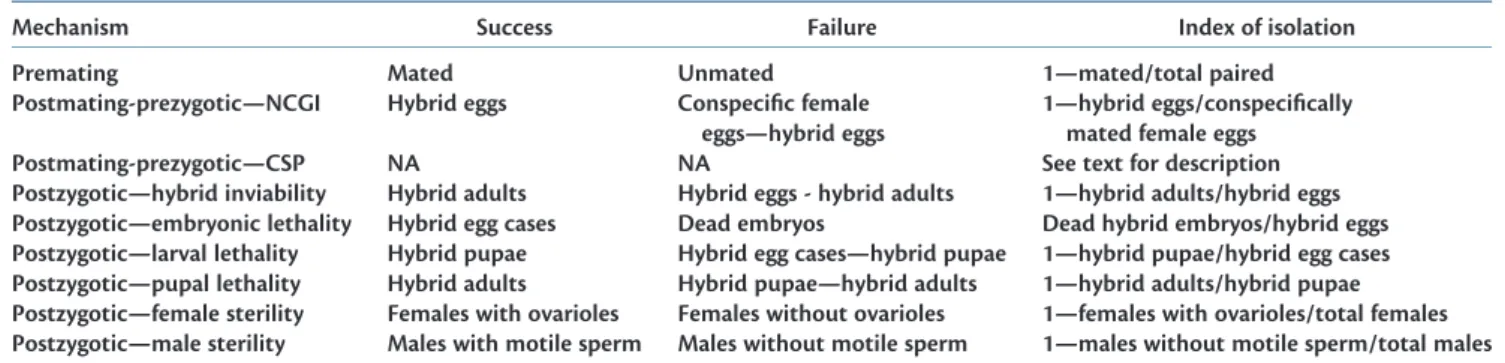
; results with other regressions are shown in supplementary tables S9 and S10, Supplementary Material online). Pairwise comparisons of the rate of increment indicate that of all four types of RI, premating isolation seems to evolve quickest followed by the two types of premating-postzygotic isolation (supple-mentary table S10, Supple(supple-mentary Material online). We found that of the two PMPZ barriers, CSP evolves faster than noncompetitive gametic isolation (supplementary table S10, Supplementary Material online). All prezygotic barriers evolve quicker than postzygotic isolation (supplementary Table 1.Reproductive Isolation Barriers Studied in This Report.
Mechanism Success Failure Index of isolation
Premating Mated Unmated 1—mated/total paired
Postmating-prezygotic—NCGI Hybrid eggs Conspecific female
eggs—hybrid eggs
1—hybrid eggs/conspecifically mated female eggs
Postmating-prezygotic—CSP NA NA See text for description
Postzygotic—hybrid inviability Hybrid adults Hybrid eggs - hybrid adults 1—hybrid adults/hybrid eggs
Postzygotic—embryonic lethality Hybrid egg cases Dead embryos Dead hybrid embryos/hybrid eggs
Postzygotic—larval lethality Hybrid pupae Hybrid egg cases—hybrid pupae 1—hybrid pupae/hybrid egg cases
Postzygotic—pupal lethality Hybrid adults Hybrid pupae—hybrid adults 1—hybrid adults/hybrid pupae
Postzygotic—female sterility Females with ovarioles Females without ovarioles 1—females with ovarioles/total females
Postzygotic—male sterility Males with motile sperm Males without motile sperm 1—males without motile sperm/total males
NCGI: noncompetitive gametic isolation; CSP: conspecific sperm precedence.
Table 2.Within Species Nucleotide Diversity.
Species N ps Genes
D. melanogaster 599 0.013 10,499
D. simulans 29 0.0329 8,975
D. sechellia 41 0.0018 9,157
D. mauritiana 13 0.0201 9,097
D. yakuba 56 0.0243 8,598
D. santomea 11 0.0172 8,952
D. teissieri 13 0.0367 8,951
NOTE.—Average heterozygosity values across the whole genome based on synon-ymous sites (ps) values.Nrepresents the number of sequenced lines per species.Ks,
table S10, Supplementary Material online). Note that in one analysis—linear regression with a common intercept—both types of premating-postzygotic isolation show similar rates of increase to premating isolation (supplementary table S10, Supplementary Material online).
To illustrate how fast each RIM achieves completion, we calculated Threshold_Ks, the genetic distance at which 95% of RI is achieved (i.e., any of the four indexes of RI equals 0.95;
fig. 2). This quantity shows how quickly the logistic regression approaches 1, and constitutes a proxy of how fast a RIM evolves. These distributions show the same results from the regression coefficients. Collectively, the results from the linear models and the bootstrapped distributions indicate that ear-lier acting RIMs evolve faster than those that evolve later in the reproductive cycle.
Rate of Evolution of Reproductive Isolating
Mechanisms: Phylogenetic Corrections
We collected additional data for four more species pairs from otherDrosophilasubgroups different frommelanogasterto address two potential issues. First, we needed to assess whether our measurements of the rate of evolution of
different RIMs were robust to phylogenetic nonindependence (i.e., multiple overlapping branches when only studying the melanogaster species subgroup). Second, when premating isolation is complete, the number of measurements of esti-mates of any type of postmating isolation (either PMPZ or postzygotic) is reduced. This will inflate the estimates of the rate of evolution of premating isolation (Wu 1992). To ad-dress these two potential issues, we identified species for which we could measure the magnitude of all the four types of RI. We added these four species pairs to the data from our original study for threemelanogasterspecies pairs that are phylogenetically independent (the most possible hybridiza-tions without overlapping branches; supplementary fig. S1, Supplementary Material online). In total, this gave us seven independent species pairs to compare. Results did not change when measuring isolation between any random two over-lapping branches in the melanogaster subgroup— accounting for the D. simulans, D. sechellia, D. mauritiana polytomy—for a total of seven species pairs, or when exclud-ing these species in this polytomy altogether—for a total of six species pairs. As observed before, the rate of evolution of these traits differs (logistic regression, test of rate of increment
0.00 0.05 0.10 0.15 0.20 0.25 0.30
0.0 0.2 0.4 0.6 0.8 1.0
Ks / ππs
Isolation ● ● ● ● ● ●● ● ● ● ● ● ● ● ● ● ● ● ● ● ● ● ● ● ● ● ● ● ● ● ● ● ● ● ● ● ● ● ● ● ● ● ● ● ● ● ● ● ● ● ● ● ● ● ● ● ● ● ● ● ● ● ● ● ● ● ● ● ● ● ● ● ● ● ● ● ● ● ● ● ● ● ● ● ● ● ● ● ● ● ● ● ● ● ● ● ● ● ● ● ● ● ● ● ● ● ● ● ● ● ● ● ● ● ● ● ● ● ● ● ● ● ● ● ● ● ● ● ● ● ● ● ● ● ● ● ● ● ● ● ● ● ● ● ● ● ● ● ● ● ● ● ● ● ● Premating CSP NCGI Postzygotic
FIG. 1.Premating, conspecific sperm precedence, noncompetitive gametic isolation, and postzygotic isolation increase with pairwise genetic distance between species. Proxies of premating isolation (red), conspecific sperm precedence (CSP, yellow), noncompetitive gametic isolation (NCGI, green), and postzygotic isolation (blue) were regressed against phylogenetic distance (Ksbetween species andpswithin species). The four
with a common intercept:F4,433¼115.77,P< 1 1015;
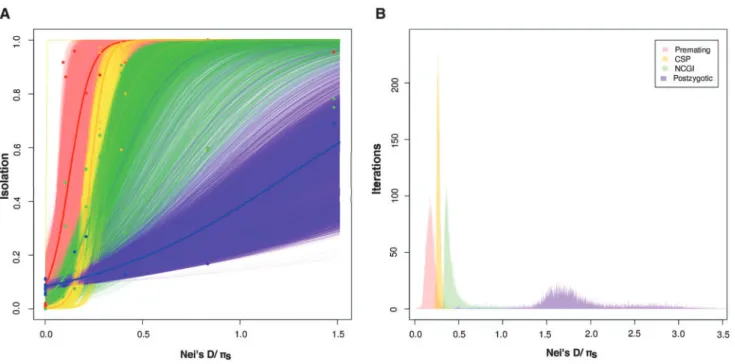
results with other regressions are shown in supplementary tables S11 and S12, Supplementary Material online). Similar to what we observed in themelanogastersubgroup-only analy-sis, premating isolation is the fastest RIM to evolve, followed by conspecific sperm precedence, noncompetitive gametic isolation, and finally postzygotic isolation (fig. 3A;pairwise comparisons in supplementary table S12, Supplementary Material online). Bootstrap Threshold_Ks values illustrate this difference (fig. 3B). These results indicate that the ranking of the rates of evolution of the four RIMs is not exclusive to themelanogasterspecies subgroup ofDrosophila, and instead is a more general pattern that might pertain to the whole Sophophoragenus. The extent which this generalization can be made for the wholeDrosophilagenus and other clades will require additional data.
Rate of Evolution of Different Types of Postzygotic
Isolation
Postzygotic isolation includes all developmental defects that might reduce the fitness of interspecific hybrids. By perform-ing all the possible pairwise crosses among species of the melanogaster subgroup, we could measure the rate of
evolution of hybrid sterility and of hybrid inviability in the melanogasterspecies subgroup. The results from this section are threefold. First we report all the possible hybridizations in the species group. Second, we compare the rate of evolution of hybrid inviability with that of hybrid sterility. Finally, we compare the rate of evolution of hybrid inviability at three developmental stages.
Pairwise Hybridizations in themelanogasterSpecies Group
We set up interspecific crosses that lasted for over 4 weeks. Thirty-three crosses produce progeny (table 3). Of these, 32 produce viable adult hybrids of at least one sex. Among these 33 crosses, we find seven previously undescribed hybridiza-tions, mostly between highly divergent species of theyakuba species complex and themelanogaster/simulansclade. The list of hybridizations that produced progeny is shown intable 3. We found that hybrid inviability is rare in theD. melanogaster subgroup, even after 15 million years of divergence. Of all crosses, only$D. santomea#D. sechelliashowed complete hybrid inviability (table 3). In this cross, half of the progeny died as embryos, and the other half died as pupae. Dissection of these pupae revealed that all individuals had testes (N¼34)
0.00 0.05 0.10 0.15 0.20 0.25 0.30
0
100
200
400
500
600
700
Ks / πs
Iterations
Premating CSP NCGI Postzygotic
3
00
FIG. 2.Premating, NCGI, CSP, and postzygotic isolation evolve at different rates in themelanogasterspecies subgroup. Threshold_Ks illustrates the Ksvalue for which a given RI barrier achieves a value of 0.95. Premating isolation values are red, conspecific sperm precedence (CSP) are yellow,
FIG. 3.Premating, CSP, NCGI, and postzygotic isolation increase with pairwise genetic distance between species across theSophophorasubgenus. To account for the possibility of phylogenetic nonindependence in themelanogasterspecies subgroup, we subsampled phylogenetically inde-pendent crosses and added a pair of species from other fourDrosophilaclades (all within theSophophoragenus). Proxies of RI are similar to the ones shown infigure 1. Premating isolation (red), conspecific sperm precedence (CSP, yellow), noncompetitive gametic isolation (NCGI, green), and postzygotic isolation (blue) were regressed against phylogenetic distance (Nei’s distance between species andpswithin species). (A) As
observed in themelanogasterspecies subgroup, the four types of isolation increase with genetic distance, and premating isolation evolves faster than hybrid inviability. The thick red, yellow, green, and blue lines represent fitted logistic regressions for the premating and postzygotic data, respectively. The thinner lines of each of the four colors are the regressions for each of 10,000 bootstrap resamplings of the data. (B) Premating, NCGI, CSP, and postzygotic isolation (hybrid inviability) evolve at different rates in theDrosophilagenus in a set of phylogenetically independent species pairs (supplementary table S10, Supplementary Material online). Bootstrapped distributions of Threshold_Ks show theKsvalue for which a
given RI barrier achieves a value of 0.95 and illustrate that all RIMs evolve at a different rate.
Table 3.Postzygotic Isolation in themelanogasterSpecies Group.
Male
Female melanogaster simulans sechellia mauritiana orena erecta yakuba santomea teissieri
melanogaster Sterile$,
dead#
Sterile$,
dead#
Sterile$,
dead#
NA NA NA Sterile$,
dead#
Sterile$,
dead#
simulans Dead$,
Sterile#
Fertile$,
sterile#
Fertile$,
sterile#
NA NA NA Sterile$,
dead#
Sterile$,
dead#
sechellia Dead$,
Sterile#
Fertile$,
sterile#
Fertile$,
sterile#
NA NA NA Sterile$,
dead#
Sterile$,
dead#
mauritiana Dead$,
Sterile#
Fertile$,
sterile#
Fertile$,
sterile#
NA NA Sterile$,
dead#
Sterile$,
dead#
Sterile$,
dead#
orena NA NA NA Sterile$,
dead#
NA NA NA NA
erecta NA NA NA Sterile$,
dead#
NA NA NA NA
yakuba NA NA NA Sterile$,
sterile#
NA NA Fertile$,
sterile#
Fertile$,
sterile#
santomea NA NA dead$,
dead#
Sterile$,
sterile#
NA NA Fertile$,
sterile#
Fertile$,
sterile#
teissieri NA NA NA Sterile$,
sterile#
NA NA Fertile$,
sterile#
Fertile$,
sterile#
NOTE.—In the majority of crosses for which we observed interspecific matings (i.e., inseminated females), we obtained viable interspecific hybrids. Black cells mark conspecific
suggesting (but not confirming) that females died at an earlier developmental stage, possibly as embryos.
Hybrid Sterility versus Hybrid Inviability
We compared the rates of evolution of hybrid sterility (fig. 4A
andB) and of hybrid inviability (fig. 4CandD). We analyzed the two sexes separately. First, we compared the rate of evolution of male inviability with that of female inviability. Clearly, hybrid male inviability evolves faster than hybrid female inviability (lo-gistic regression, test of rate of increment with a common
intercept:F2,191¼94.013,P<110
15
; results are identical with other regressions which are shown in supplementary tables S13 and S14, Supplementary Material online). This is not surprising since hybrid female inviability is not present in most crosses (at least whenKs0.25; (fig. 4C). On the other
hand, hybrid male inviability (95% complete) occurs at Ks
0.15.
We observed a similar pattern in the evolution of hybrid sterility. Hybrid male sterility evolves faster than hybrid female sterility (logistic regression, test of rate of increment with a common intercept:F2,211¼47.67,P<110
15
; results with
0.00 0.05 0.10 0.15 0.20 0.25 0.30
0.0 0.2 0.4 0.6 0.8 1.0
Hybridsterility − female
Ks / πs
Isolation ● ● ● ● ●●●●●●● ●●●●●● ●●● ●●●●●●●●● ● ● ● ● ● ● ● ● ● ● ● ● ● ● ● ● ● ● ● ● ● ● ● ● ● ● ● ● ● ● ● ● ● ● ● ● ● ● ● ● ● ● ● ● ● ● ● ● ● ● ● ● ● ● ● ● ● ● ● ● ● ● ● ● ● ● ● ● ● ● ● ● ●●●● ● ● ● ● ● ● ● ● ● ● ● ● ● ● ● ● ● ● ● ● ● ● ● ● ● ● ● ● ● ● ● ● ● ●●●●●●●●● ●●●●●●●●●●●●●●●●●●●●●●●●●●●●●●● ●●●●●●●●●●●●●●●●●●●●●●●●● ● ● ● ● ● ● ● ● ● ● ●
0.00 0.05 0.10 0.15 0.20 0.25 0.30
0.0 0.2 0.4 0.6 0.8 1.0
Hybridsterlity − male
Ks / πs
Isolation ● ● ● ● ● ● ●●●●● ●●●●●● ● ● ● ● ● ● ● ● ● ● ●●●●● ●●●●●●●●● ●●●● ●●●●● ● ● ● ● ● ●●●● ● ●●●●●●●●●● ●●●●● ●●●● ● ● ● ● ● ● ● ● ● ●●●●●●●●● ●●●●●●●●●●●●●●●●●●●●●●●●●●●●●●●●●●●●●●●●●●●●●●●●●●●●●●●● ● ● ● ● ● ● ● ● ● ● ●
0.00 0.05 0.10 0.15 0.20 0.25 0.30
0.0 0.2 0.4 0.6 0.8 1.0
Hybridinviability − female
Ks / πs
Isolation ● ● ● ● ● ● ● ● ● ● ● ● ● ● ● ● ● ● ● ● ● ● ● ● ● ● ● ● ● ● ● ● ● ● ● ● ● ● ● ● ● ● ● ● ● ● ● ● ● ● ● ● ● ● ● ● ● ● ● ● ● ● ● ● ● ● ● ● ● ● ● ● ● ● ● ● ● ● ● ● ● ● ● ● ● ● ● ● ● ● ● ● ● ● ● ● ●
0.00 0.05 0.10 0.15 0.20 0.25 0.30
0.0 0.2 0.4 0.6 0.8 1.0
Hybridinviability − male
Ks / πs
Isolation ● ● ● ● ●●●●●● ●●●●● ●●●●● ●●●●● ● ● ● ● ● ● ● ● ● ● ● ● ● ● ● ● ● ● ● ● ●●●●● ● ● ● ● ● ● ● ● ● ● ● ● ● ● ● ● ● ● ● ● ●●●●●●●●●●●● ● ● ● ● ● ● ● ● ● ● ● ● ● ● ● A B C D
FIG. 4.Hybrid sterility evolves faster than hybrid inviability. Values of female and male inviability and female and male sterility were regressed against phylogenetic distance (Ksbetween species andpswithin species). The four types of isolation increase with genetic distance. In both sexes,
fertility evolves faster than hybrid inviability. Given the perfect separation of values along thex-axis (Ks/ps), hybrid sterility was not directly
other regressions are shown in supplementary tables S15 and S16, Supplementary Material online). All interspecific male hybrids were sterile while only hybrid females from parents with aKs0.10 were sterile. This pattern holds regardless of
how hybrid sterility is measured.
Third, we compared the rates of evolution of hybrid ste-rility and of hybrid inviability for each sex. The rate at which these two RIMs increment is different for both, males (logistic regression, test of rate of increment with a common inter-cept:F2,179¼21.643,P¼3.82109; supplementary tables
S17 and S18, Supplementary Material online) and females (logistic regression, test of rate of increment with a common intercept:F2,223¼179.5,P<110
15
; supplementary tables S19 and S20, Supplementary Material online). Not surpris-ingly, we found that hybrid male sterility is achieved much earlier than hybrid male inviability (pairwise comparisons in supplementary table S18, Supplementary Material online). Hybrid male sterility (95% complete) evolves atKs 0.05.
An equivalent strength of hybrid male inviability takes more divergence to occur (Ks 0.15). A similar comparison in
females revealed that hybrid female sterility evolves faster than female inviability (pairwise comparisons in supple-mentary table S20, Supplesupple-mentary Material online).
Hybrid female sterility (95% complete) evolves at Ks
0.10. An equivalent strength of hybrid female inviability must necessarily take a Ks value higher than 0.25 (the
maximum level of pairwise genetic divergence in this study). Bootstrap distributions of Threshold_Ks illustrate the difference between hybrid sterility and hybrid invia-bility (fig. 5). These results confirm the largely accepted, but untested, hypothesis that hybrid sterility evolves faster than hybrid inviability in both sexes.
Hybrid Inviability by Developmental Stage
Hybrid inviability can manifest within three discrete develop-mental stages in holometabolan insects: the larvae, the pupae, or the adults. We assessed if hybrid inviability evolved faster at any of these three developmental stages. We quantified de-velopmental stage specific rates of inviability by scoring the number of individuals that die at each of three crucial devel-opmental transitions: embryo-to-L1 larva (embryonic lethality), L1 larvae-to-pupa (larval lethality), and pupa-to-adult (pupal lethality). As expected, the strength of all three types of postzygotic isolation increased with diver-gence time (fig. 6A–C), and in general, the lowest viabilities
0.00 0.05 0.10 0.15 0.20
0
500
1000
1500
2000
2500
Ks / ππs
Iterations
Femalesterility
Malesterility
Maleinviability
FIG. 5.Female sterility, male sterility, and female sterility evolve at different rates in themelanogasterspecies subgroup. Threshold_Ks indicates the Ksvalue for which a given RI barrier achieves a value of 0.95 (similar to the distributions shown infig. 2). Even though these distributions of
were observed for the crosses between the most distantly related species (supplementary table S5, Supplementary Material online). We next compared the rate at which hybrid inviability increased with genetic distance.We find signifi-cant differences in the rate of increase of each type of hybrid inviability (logistic regression, test of rate of increment with a common intercept:F3,491¼14.621,P¼3.904109;
sup-plementary tables S21 and S22, Supsup-plementary Material on-line). Pairwise comparisons (supplementary table S22,
Supplementary Material online) and Threshold_Ks (fig. 6D) illustrate that complete embryonic lethality is reached before larval lethality, but complete larval lethality and pupal lethal-ity are reached at similar rates.
Detection of Reinforcement Using Comparative
Analyses
We evaluated the possibility of different mechanisms of RI evolving through reinforcing selection. Linear models revealed FIG. 6.Rates at which inviability increases with genetic distance for three developmental stages. Measures of inviability at each developmental stage were regressed against phylogenetic distance (Ksbetween species andpswithin species). The three types of postzygotic isolation (i.e., death at a
that the geographic origin effect, whether a line was sympatric or not, did not significantly predict the strength of any RIM (table 4). Threshold_Ks also suggests that there is no differ-ence between the rates at which allopatric and sympatric lines in the magnitude of premating, NCGI, CSP, or postzy-gotic isolation approach completion (supplementary fig. S6, Supplementary Material online). We thus find no support for the hypothesis that reinforcing selection consistently acts on any one of the RIMs. This does not mean that reinforcement has not played a role in the evolution of RI in some of these pairs (e.g.,Matute 2010a); rather, the influence of reinforcing selection is likely to be idiosyncratic and does not always influence the same RIM.
Finally, we compared the magnitude of RI in two species triads characterized by an allopatric pair and a sympatric pair. The comparisons for each RIM for each triad are shown in supplementary table S23, Supplementary Material online. The majority of RIMs show no difference in magnitude between allopatric and sympatric pairs in any of the two triads. There are two notable exceptions. Behavioral isolation is stronger betweenD. yakuba and D. teissieri(a sympatric pair) than betweenD. santomeaandD. teissieri(an allopatric pair). This observation has been reported before and is consistent with the action of reinforcement (Turissini et al. 2015). Second, and contrary to the expectations of reinforcing selection,D. sechel-liaandD. melanogaster(a mostly allopatric pair) show stron-ger hybrid inviability thanD. simulansandD. melanogaster(a mostly sympatric pair). In particular, hybrid inviability is stron-ger in crosses whereD. melanogasteris the female (D. mela-nogasterD. simulans—mean¼0.593—vs.D. melanogaster
D. sechellia—mean¼ 0.833—Welch’s two samplet-test: t7.8¼6.5561,P¼1.98410
4
). These results are opposite to the expectations if hybrid inviability evolved through rein-forcement in this species pair. Regardless of how it was mea-sured, our analyses indicate that reinforcement has indeed occurred in themelanogasterspecies subgroup but does not leave a consistent signature on any one RIM.
Discussion
Little is known about the rate of evolution of postmating-prezygotic (PMPZ) isolation in animals. Studies on plants have found that PMPZ and postzygotic isolation evolve at a similar rate in at least three plant genera. Unlike plant studies,
most studies evaluating the rate of accumulation of repro-ductive isolation in animals have a common limitation: they have not looked at the rate of evolution of PMPZ barriers. We thus measured the rate of evolution of such barriers in Drosophila species pairs while assessing the magnitude of premating, and postzygotic isolation in the same crosses. This makes our study the first to measure the magnitude of PMPZ isolation, compare it with other RIMs, and explicitly test its rates of evolution in animals. Our results have impli-cations for our understanding of three large topics in speci-ation: 1) the evolution of PMPZ barriers, 2) the evolution of postzygotic isolation, and 3) the role of PMPZ isolation and other RIMs on speciation via reinforcement. We discuss each of these topics as follows. We also present a series of caveats and general conclusions of our analyses.
The Evolution of PMPZ Barriers
PMPZ RIMs, both noncompetitive and CSP have been hy-pothesized to evolve through the influence of postcopulatory sexual selection (Birkhead and Pizzari 2002) and natural se-lection (Knowles et al. 2004). The femalemale interactions that underlie NCGI can be interpreted as discrimination against heterospecific sperm by an inseminated female and are thus sexually selected (Price et al. 2001; Birkhead and Pizzari 2002;Fricke and Arnqvist 2004). Sperm morphology and traits associated with fertilization success show fast rates of change across species (Pitnick et al. 1999;Presgraves et al. 1999;Byrne et al. 2003;Manier et al. 2013). These phenotypes also evolve rapidly within and between species due to the constant influence of antagonistic sexual conflict (e.g.,
Knowles and Markow 2001;Comeault et al. 2016; reviewed inPizzari and Snook 2003). Proteins involved in fertilization, gametic fusion, and stimulation of oviposition show tures of positive selection across all taxa for which this signa-ture has been systematically sought (e.g., Lee et al. 1995;
Swanson et al. 2001; Galindo et al. 2003; Marshall et al. 2011;Harrison et al. 2015). This accelerated evolution at the phenotypic and molecular level is consistent with evolution of these interactions via either sexual or natural selection.
The second type of PMPZ barrier we examined, CSP, is also affected by sexual selection. CSP and its plant equivalent, conspecific pollen precedence, is ubiquitous and has been uncovered in a variety of organisms (references in Table 4.Linear Regression of PMPZ RIMs in Sympatric and Allopatric Lines.
Sympatric Lines Allopatric Lines Origin Effect
Mean SD Mean SD Degrees of Freedom
(numerator, denominator)
FValue PValue
Premating isolation 0.702 0.580 0.703 0.584 17,306 1.1462 0.3089
NCGI 0.8938 0.0751 0.8644 0.0966 11,141 6.9568 2.561109
CSP 0.1488 1.5807 0.1434 1.7568 18,88 0.4602 0.9679
Postzygotic isolation 0.5036 0.2687 0.5142 0.2824 12,203 2.2074 0.01262
Postzygotic isolation—embryonic lethality 0.0905 0.1909 0.0905 0.1900 12,203 1.6188 0.08846
Postzygotic isolation—larval lethality 0.2280 0.2231 0.2224 0.2388 12,203 1.3817 0.1767
Postzygotic isolation—pupal lethality 0.2048 0.1923 0.2282 0.2058 12,203 0.6689 0.7801
Yeates et al. 2013). CSP is the aggregate of the three possible interactions between the female reproductive tract, conspe-cific sperm, and heterospeconspe-cific sperm. These interactions cre-ate the grounds for reproductive incompatibilities due to sexual antagonism between sexes of different species, sexual antagonism between sexes of the same species, and sexual competition between sperm of different species (Howard 1999;Simmons 2005). Our results indicate that at least one of these interactions scales up with genetic divergence which leads to stronger CSP in divergent species.
Since premating and PMPZ traits usually cooccur in organ-isms with internal fertilization (such asDrosophila), the rapid evolution of PMPZ traits poses a conundrum: how can sexual selection or reinforcing selection influence the evolution of PMPZ barriers in the presence of premating isolation? First, premating isolation is often not complete, giving natural and sexual selection the opportunity to drive the evolution of PMPZ traits. Second, in organisms with internal fertilization, the evolution of PMPZ traits might be accelerated in instan-ces where “the wallflower effect” applies (Kokko and Mappes 2005); females might adaptively lower their sexual preferences for males of high condition (conspecifics) if they are only exposed to males of low condition (heterospecifics). Similar models (Wilson and Hedrick 1982) and experimental meas-urements (Matute 2014) have shown that females might mate with heterospecifics if mates are rare. These instances where premating isolation is not an effective RIM might favor the accelerated evolution of PMPZ. The formal test of this hypothesis will require measuring PMPZ isolation in sister populations (or species) that differ in their strength of pre-mating isolation.
The Evolution of Postzygotic Isolation
Our measurements also allowed us to discern which devel-opmental stage was most affected by hybrid defects. Of the three possible transitions (embryo to larva, larva to pupa, and pupa to adult), we found that embryonic lethality arises first and evolves faster than larval or pupal lethality. A possible explanation for this result is that more genes are involved in embryogenesis than in other developmental stages, which seems to be the case from multispecies analyses of gene ex-pression (Graveley et al. 2011). Hybrid incompatibilities would, therefore, have more potential targets at the embry-onic stage. The GO category “embryo development” indeed contains more genes (740) than “larvae and prepupal devel-opment” (177), which in turn contains more genes than “pupal development” (17; supplementary table S24, Supplementary Material online). The identification of alleles involved in hybrid inviability has yielded mixed support for this hypothesis. Mapping of X-linked dominant factors in threeDrosophilainterspecific hybrids revealed that the ma-jority ofX-linked alleles inmel/sanhybrids cause embryonic inviability. In the other two hybrids (mel/simandmel/mau), however, no embryonic lethality alleles were found (Matute and Gavin-Smyth 2014). Similarly, in mel/simhybrid males the vast majority of alleles involved in hybrid inviability cause postembryonic and not embryonic lethality (Presgraves 2003). We found that genes associated to all RIMs (clustered
by GO terms and including different developmental transi-tions) show average rates of molecular evolution (as deter-mined by their ratio of nonsynonymous to synonymous substitutions;KA/KS) comparable with the rest of the genome
(supplementary text and in tables S24 and S25, Supplementary Material online). This is important because a nontrivial fraction of genes found to cause hybrid inviability and hybrid sterility have signatures of positive selection (e.g.,
Presgraves et al. 2003;Tang and Presgraves 2009reviewed in
Coyne and Orr 2004and Nosil and Schluter 2011). Yet, we find no evidence for a consistent signature of positive selec-tion at a particular RIM. Even thoughKA/KSand GO analyses
have important caveats (reviewed in Rhee et al. 2008 and
Venkat et al. 2017), and we cannot rule out that strong se-lection has occurred atcis-regulatory elements, our results generally refute the idea that genes involved in RIMs that act early in reproduction evolve faster than genes involved in RIMs that act later on.
Finally, we also saw complete hybrid male sterility for all interspecific crosses where males were viable (Kshigher than
0.05), and hybrid females were consistently sterile whenKs
exceeded0.10. It is worth noting how dramatically full hy-brid sterility can arise when compared with the other forms of isolation we investigated. Since hybrid inviability is the slowest barrier to evolve, our results are consistent with the idea that hybrid sterility evolves faster than hybrid inviability in both sexes (Wu 1992), an idea that had remained formally untested because indexes of postzygotic isolation usually conflate ste-rility and inviability.
The Role of PMPZ Isolation on Speciation via
Reinforcement
Our results are also important in the context of reinforce-ment. Two different approaches have been historically used to detect reinforcement: detecting reproductive character displacement in areas of secondary contact, and detecting the phylogenetic signal in sympatric species pairs. We used a modified version of the former approach. Comparing allo-patric and symallo-patric lines from the same species can reveal reinforcement at recent scales (after secondary contact). On the other hand, phylogenetic comparison of the magnitude of RIMs detects reinforcement at deeper scales of divergence (Hopkins 2013,Hudson and Price 2014). We found no new evidence for cases of reinforcement besides the already reported influence of reinforcing selection in NCGI in theD. yakuba/D. santomeahybrid zone (Matute 2010a), and the phylogenetic signature of reinforcement at behavioral isola-tion in theD. teissieri/D. yakubaspecies pair (Turissini et al. 2015). It is possible that our experiment has little power to detect differences because all RIMs are already strong and the influence of sympatry is minimal compared with the amount of divergence that has already occurred between species.
pattern goes against the expectation of evolution of RI by reinforcing selection. The reasons behind such stark difference in the magnitude of RI remain unknown but we can formu-late two possibilities. First,D. sechelliamay have accumulated more hybrid incompatibilities due to extreme bottlenecks during its evolutionary history. Second,D. melanogasterand D. simulansmay have had more opportunities to interbreed in the distant past, thus purging hybrid incompatibilities that still separateD. sechelliaandD. melanogaster. More research on the demographic history of these species, as well as the effect of different demographic events on the accumulation of incompatibilities is needed before addressing the reasons for this difference.
The influence of PMPZ isolation on speciation by rein-forcement remains largely unstudied. Reinrein-forcement is tradi-tionally viewed as the process of strengthening premating isolation driven by selection against unfit hybrids. However, PMPZ acts earlier in the reproductive cycle and has a faster rate of evolution compared with hybrid inviability and hybrid female sterility (shown here). Therefore, deleterious and costly PMPZ incompatibilities, such as reduced female fertility after interspecific crosses, might lead to the evolution of behavioral barriers in the same manner that postzygotic costs lead to premating isolation during conventional reinforcement (Harrison 1993;Servedio 2001). Even though we did not per-form a per-formal comparison between the rates of evolution of PMPZ barriers and hybrid male sterility, the two types of RIMs seem to evolve at roughly the same rate. Thus, both PMPZ and hybrid male sterility might be equally important in in-ducing the evolution of premating isolation via reinforce-ment. Currently, the evidence that reproductive interference (excluding the production of unfit hybrids) might be costly is scattered and has been circumscribed to premating interactions (e.g., reproductive character displace-ment caused by noisy neighbors,Mullen and Andre´s 2007but seeMatute 2015).
Theoretical arguments have also suggested that CSP can hamper the evolution of premating isolation by reinforce-ment because if CSP is complete, and a female has the chance to mate with multiple males, then no hybrids are likely to be produced if one of those males is a conspecific (Lorch and Servedio 2007). A similar argument can also be made about noncompetitive gametic isolation. If NCGI is strong, then no hybrids will be produced after interspecific crosses and if a female remates with a conspecific, then most of her progeny will be pure species and fit. In both of these cases, there will be no cost to hybridization and no incentive to strengthen pre-mating isolation. This hypothesis yields a clear prediction: reinforcement of premating isolation should be rarer in clades where PMPZ isolation is strong. In spite of its straightforward-ness, it might be premature to test this hypothesis because bona fide cases of reinforcement and of gametic isolation are still rare.
Conversely, postzygotic isolation might also lead to the evolution of PMPZ traits in the same manner that it leads to the evolution of premating isolation. This is obvious in aquatic organisms that spawn in open waters but it has been more controversial in animals with internal fertilization.
Overall, reinforcement should affect the evolution of any trait that minimizes parental investment on an unfit hybrid (Coyne 1974; Servedio and Noor 2003). Two examples show that reinforcement can indeed lead to the evolution of PMPZ traits. In the case ofDrosophila yakuba, females from the hybrid zone withD. santomeashow stronger noncompe-titive gametic isolation than females from areas where D. yakuba is not present (Matute 2010b; Comeault et al. 2016). Similarly, CSP inD. pseudoobscurais stronger in areas of sympatry withD. persimilis(Castillo and Moyle 2016). Both patterns of reproductive character displacement are highly suggestive of reinforcement and indicate that reinforcement of PMPZ barriers might not be a rare instance even in animals with internal fertilization.
Caveats
Our study is not devoid of caveats. The first one pertains to how much reinforcement can affect different types of repro-ductive barriers. Since reinforcement is thought to affect pre-zygotic isolation more commonly than other RIMs (Servedio and Noor 2003; but seeCoyne 1974), then it is possible that reinforcing selection has led to an increase in the rate of evolution in premating isolation, NCGI, an CSP. This in turn would lead to an inflation of our estimated rate of evolution of these three RI barriers. Even though we compared allopat-ric and sympatallopat-ric populations from eight species pairs, rein-forcement might act at deeper levels of divergence that do not involve contemporary coexistence. An obvious research avenue is to test whether sympatric species evolve PMPZ mechanisms faster than allopatric pairs. This approach is not trivial as the range of species contracts and expands along their history making the distinction between allopatric and sympatric a gray area. Our data set does not allow us to split between currently allopatric and currently sympatric pairs because species from themelanogastersubgroup are largely sympatric (Lachaise et al. 1988) and an expanded data set will be necessary to address the importance of reinforcement.
A second bias is that when an early acting barrier is com-plete, we cannot measure the magnitude of later acting bar-riers. This introduces a bias that might inflate the rates of evolution of premating isolation because there will be more measurements of strong premating isolation than of post-mating isolation. However, we attempted to minimize this bias by trying all possible crosses and, for one analysis, only including species for which we had measured the magnitude of the four types of RI barriers.
Conclusions
pollen reaches the stigma. More research in different plant and animal taxa is needed to establish whether this difference is real or whether it is the byproduct of sparse taxonomic sampling. Similarly, and even though there is evidence for the existence of PMPZ in fungi (Turner et al. 2010,2011) the rate of evolution of premating, and postmating isolation in this group and other eukaryotes remains largely unexplored (but seeGourbie`re and Mallet 2010;Giraud and Gourbiere 2012). These estimates across currently understudied taxa are sorely needed to understand what biological features drive the or-igin of new species.
Across metazoans,Drosophilahas been one of the premier model systems for studying the evolution of reproductive isolation which in turn has provided support for several hy-potheses such as the existence of reinforcement (Coyne and Orr 1989;Coyne and Orr 1997;Nosil 2013), the relative rate of evolution ofRI (Yukilevich 2012;Rabosky and Matute 2013), and the role of ecology in speciation (Funk et al. 2006;Turelli et al. 2014). Overall, the fast accumulation of PMPZ isolation indicates that these RIMs are likely to be driven by selection, either sexual or natural. The integration of our results show that the earlier a barrier acted during the reproductive/devel-opmental process, the faster its rate of accumulation over time. PMPZ isolation accumulates quickly in Drosophila thus indicating that this type or RI might be an important source of isolation in promoting the evolution of new species and maintaining species barriers.
Materials and Methods
Drosophila melanogaster
Subgroup: Species and
Stocks
All wild-type stocks are described in supplementary table S26, Supplementary Material online. Briefly, for all genetic crosses we used synthetic stocks (i.e., outbred stocks derived from a combination of isofemale lines) with the exception of Drosophila erecta. Stocks from D. santomea,D. yakuba,D. teisseiri,D. orena,D. sechellia, D. simulans, andD. melanogaster were collected by D.R. Matute (supplementary table S26, Supplementary Material online Matute and Harris 2013). Stocks from these species were kept in large numbers (>200 flies) since their creation.Drosophila erectawas pur-chased at the San Diego Stock Center (Stock number: 14021-0224.00). All lines were reared on standard cornmeal/Karo/ agar medium at 24C under a 12 h light/dark cycle in 100 ml bottles. Adults were allowed to oviposit for 1 week and after that time they were cleared from the bottles. We added 1 ml of propionic acid (0.5% V/V solution to the vials and provided a pupation substrate to the vial (Kimberly Clark, Kimwipes Delicate Task; Irving, TX). At least ten bottles of each species were kept in parallel to guarantee the collection of large numbers of virgins.
To measure conspecific sperm precedence, we also used mutants from each of eight of the species (with the exception ofD. orena, see below). All mutants were raised in identical conditions to the wild-type stocks.
Virgin Collection
Pure species males and females of each species were collected as virgins within 8 h of eclosion under CO2anesthesia and
kept for 3 days in single-sex groups of 20 flies in 30 ml, corn meal food-containing vials. Flies were kept at 24C under a 12 h light/dark cycle. On day four, we assessed whether there were larvae in the media. If the inspection revealed any prog-eny, the vial was discarded.
Premating Isolation: Insemination Rates
We measured premating isolation as the number of females that did not accept heterospecific males when housed to-gether in no-choice experiments for 24 h. Two hundred females (i.e., individuals pooled from ten virgin vials) were housed with 200 males either from the same species or from a different species. Females and males were housed to-gether for 24 h. After that time, females were anesthetized with CO2 and males were discarded. We dissected all the
females and extracted their reproductive tract (spermathe-cae, seminal receptacles, and uterus) and placed it in chilled (4C) Ringer’s solution. We assessed whether the female car-ried any sperm, either dead or alive anywhere in their repro-ductive tract. The vials where the crosses occurred were kept to study the magnitude of hybrid inviability (see below “Postzygotic isolation: Hybrid inviability”). We used the pro-portion of females inseminated in theen massematings in each bottle (see “Insemination rates”) and calculated a proxy of the strength of premating isolation:
IsolationPremating¼1
Inseminated females Total females
Five batches (bottles) per cross (each with 100 females) were counted.
We assessed whether there was heterogeneity in insemi-nation rates among conspecific matings. We counted how many females were inseminated in five replicates. To detect heterogeneity, we fit a linear model in which the proportion of inseminated females in these conspecific crosses was the response and the cross (i.e., species) was the only factor.
Next, we studied whether there was heterogeneity in pre-mating isolation among interspecific crosses. We fit two linear regressions to analyze the data. First, to assess if any particular combination of species was more prone to mating than others, we fit a linear regression in which IsolationPremating in
each bottle was the response, and the identity of the cross was the only fixed effect. There were five replicates per species for a total of 360 bottles. Second, we analyzed whether any type of female (and male) were more prone to hybridize with other species. To do so, we used the same data set but fit a factorial model in whichIsolationPremating in each bottle was
PMPZ Isolation: noncompetitive Gametic
Isolation (NCGI)
We next measured gametic incompatibilities between females and males from different species in single matings, namely, the inability of a male to induce a female to lay eggs (Price et al. 2001;Matute 2010b;Marshall and DiRienzo 2012). We watched single heterospecific and conspecific pairs for 8 h and kept the females that mated successfully for each of the 81 possible hybrid crosses (72 heterospecificþ9 conspecific). We repeated this approach until we collected at least five females from each of the interspecific and conspecific crosses. We kept all females who mated (either to con- or hetero-specific males) to measure gametic isolation. To prevent females from remating, males were removed from the vial by aspiration after mating. Each mated female was allowed to oviposit for 24 h in a vial. The female was then transferred to a fresh vial, and the total number of eggs were subsequently counted daily for 10 days. At least five females were scored for each cross.
Ig, an index of PMPZ isolation which was calculated as:
Ig¼1
Number of viable eggs produced in interspecific matings
Number of viable eggs in conspecific femaleð Þmatings
ðChang 2004Þ
Ig values were compared across crosses using a linear model in which cross was the only fixed factor. This index is not devoid of caveats. We list two of them. First, some species may differ in the number of eggs a sexually mature virgin female will lay. This will lower the confidence level for the estimate of NCGI because some of the laid eggs will be noninseminated. Second, it is also possible that laid eggs are dying before embryogenesis begins and thus conflates early embryonic lethality with NCGI. This latter concern is further addressed below (section “Postzygotic isolation: Hybrid inviability”).
PMPZ Isolation: Competitive Gametic Isolation
CSP Indexes
We also scored how much hybrid progeny a female produces after mating with two males: a heterospecific, and a conspe-cific male. To do so, we used a combination of mutants to differentiate between hybrid and pure species progeny in crosses that involved more than one male. Traditionally, CSP is measured as P2, the proportion of progeny sired by the second male in double matings (Boorman and Parker 1976;Chang 2004). Nonetheless, this measurement conflates two important biological aspects. First, second males have an advantage over first males (regardless of their genotype) and in conspecific crosses, they invariably sire more progeny than first males. Second, conspecific sperm might indeed have an advantage over heterospecific sperm (true conspecific sperm precedence). We propose to quantify CSP as the proportion of progeny sired by a heterospecific male by a doubly mated female respective to a conspecific mating that mated to two conspecific males. To account by the fact that the second
male usually has an advantage over the first male, we propose to do normalizations taking into account the order of mating. Matings with two males can occur in two different orders. In an interspecific/conspecific mating, we counted the number of hybrid progeny (HCH) and the number of conspecific
prog-eny (HCc). In crosses where the heterospecific male was mated first followed by a conspecific male, the indexes took the form HCH1and HCC2. In crosses where the conspecific
male was first and was followed by a heterospecific male, the indexes took the form HCC1(i.e., the progeny sired by the
heterospecific male in females mated to a heterospecific male and then to a conspecific male) and HCH2(i.e., the progeny
sired by the heterospecific male in females mated to a con-specific male and then to a heterocon-specific male).In
conspe-cific/conspecific matings, we counted the progeny sired by a wildtype and a mutant stock of the same species. This yielded two quantities: the progeny sired by the first male, CCC1(i.e.,
the progeny sired by the first male in females mated to two conspecific males) and the progeny sired by the second male, CCC2(i.e., the progeny sired by the second male in females
mated to two conspecific males).
These quantities were then incorporated into two indexes of conspecific sperm precedence, one for crosses when het-erospecific males were the first to mate, and one for crosses where conspecific males were first. The two indexes followed the form:
ICSP1¼1
HCC1
CCC1
and
ICSP2¼1
HCC2
CCC2
There was only true CSP if bothICSP1andICSP2indexes were
low.
Mutant Stocks
In order to quantify CCC1and CCC2 we needed to obtain
females that mated to conspecific males twice and be able to distinguish between the progeny sired by each father. To do so, we needed mutant stocks that could be visually rec-ognized from the wild type. We described the mutants for eight species in the melanogaster species subgroup (no mutants were available forD. orena).
i. Drosophila melanogaster:D. melanogaster yellowwhite
(mely1 w1) males and females were derived from a stock
purchased at the Bloomington Stock Center (Stock number: 1,495).
ii. Drosophila mauritiana:D. mauritiana yellow(mauy1 w1 f1) males and females were derived from a stock pur-chased at the San Diego Stock Center (Stock num-ber: 14021-0241.55).
iv. Drosophila teissieri: D. teissieri yellow(teiy)was isolated from a line collected in Bioko (2009). Both,yakyand teiy, are a fully recessive body color mutation identical to that on theD. melanogaster Xchromosome (Llopart et al. 2002).
v. Drosophila erecta:D. erecta yellow(erey) also has a body color mutation. Whether this yellow mutation comple-mentsmelyremains unknown.
vi. Drosophila santomea:D. santomea white(sanw) males and females were derived from the STO.4 isofemale line, originally collected on S~ao Tome´ in 1998. All the white-eyed mutations described in this contribution are fully recessive eye color mutations orthologous (i.e., fail to complement) to white eyed mutations on theD. yakubaand/orD. melanogaster Xchromosomes. vii. Drosophila sechellia: D. sechellia white(sechw) was
iso-lated from a recently collected line in Denis island. viii. Drosophila simulans:D. simulans white(simw) was
do-nated by D.C. Presgraves.
Measuring CSP
First matings were watched as described above (Section “Premating isolation: Insemination rates”). Mated females were then separated from the males and housed in groups of 1–5 females. On the morning of day 4, females were indi-vidually transferred to a new vial with cornmeal food. The male to be mated was also transferred to the vial by aspira-tion. We observed up to 300 individual matings at the same time. Second matings were allowed to proceed for 16 h. To identify true CSP, we attempted to measure the magnitude of sperm precedence in two orders of the cross. Crosses that involved a conspecific male first and an interspecific male second are challenging and in some cases estimates involved only a few measurements. The sample sizes of each mating are shown in supplementary table S3, Supplementary Material online. Once doubly mated females were obtained, we removed the male from the vial, kept the females and tended their progeny. Females were transferred to a new vial every 7 days until they died. Vial tending and fly husbandry were done as described immediately below. ICSPwere
com-pared using a linear model with the identity of the cross and the order (i.e., what male was mated first) as the two fixed factors.
Postzygotic Isolation: Hybrid Inviability
Finally, we measured viability in F1 hybrids. For each interspe-cific and conspeinterspe-cific species pair, we calculated overall F1 inviability and three components of inviability: embryonic lethality (death during the embryo-to-L1 transition), larval lethality (death during the L1 larvae-to-pupa transition), and pupal lethality (death during the pupa-to-adult transi-tion). We collected virgin males and females as described above (See “Virgin collection”). We studied hybrid inviability following two approaches: by letting crosses occur over a period longer than 4 weeks, and by following the development of the embryos deposited by females over a period of 24 h (obtaining roughly staged hybrid individuals).
The procedure for the former approach is described some-where else (Turissini et al. 2015). Briefly, on the morning of day four after collection, we placed 40 males and 20 females together at room temperature (21–23C) to mateen masse on corn meal media. We set up 50 crosses per species pair for a total of 4,050 crosses (81 crosses50 replicates). Vials were inspected every 5 days to assess the presence of larvae and/or dead embryos. We transferred all the pure species adults to a new vial (without anesthesia) every ten days. This procedure was repeated until the cross stopped producing progeny (all females died, over 5 weeks). L1larvae were allowed to feed on
an apple-agar plate and were tended daily. Once L2 larvae
were observed, we added a solution of 0.05% propionic acid and a KimWipe (Kimberly Clark, Kimwipes Delicate Task, Roswell, GA) to the vial. Adult hybrids were collected and counted using CO2anesthesia. In order to maximize the
life-span of the parents, we kept all the vials lying on their sides. We repeated this procedure until we obtained five cages that produced hybrid progeny for the crosses for which we could obtain inseminated females.
To follow the development of hybrid embryos, we col-lected mated females as described above (See “Premating isolation: Insemination rates” and “PMPZ isolation: noncom-petitive gametic isolation (NCGI)”). The development of the eggs laid by these females and the rates of transition to the next developmental stage (egg to larvae, larvae to pupae, pupae to adult) were recorded daily. We partitioned overall inviability into three components by comparing the number of individuals that entered a developmental stage (Total) to the number that survived it (Successes) using the equations shown intable 1. The proportions were then transformed to a logistic index following the form:
IsolationPostzygotic ¼1
Successes Total
Overall inviability was based on the number of individuals that died during development (from embryo to adulthood). For a global estimate of inviability, we counted the total number of viable eggs and the number of those that devel-oped into adults. To quantify embryonic inviability, we counted the total number of embryos defined as the total number of egg cases (successes) plus the number of dead embryos (brown eggs). This procedure was applied to 69 interspecific crosses (the exception being crosses between females from thesimulanscladeand D. melanogastermales; See below). To quantify larval lethality, we counted the num-ber of egg cases (Total) and pupae (Successes) in each vial. If larvae pupated on the food media, the vial was discarded. Finally, to quantify pupal viability we counted the number of pupae (Total) and adults (Successes). We quantified lethality for at least five replicates per cross and summed the results. The number of replicates per cross is listed in supplementary table S27, Supplementary Material online.