The Journal of Infectious Diseases
The Journal of Infectious Diseases® 2017;215:984–91
Impact of Pre-exposure History and Host Genetics on
Antibody Avidity Following Norovirus Vaccination
Lisa C. Lindesmith,1 Michael L. Mallory,1 Taylor A. Jones,2 Charles Richardson,3 Robert R. Goodwin,3 Frank Baehner,4 Paul M. Mendelman,3Robert F. Bargatze,3 and Ralph S. Baric1
1Department of Epidemiology, University of North Carolina, Chapel Hill; 2Department of Integrated Genomics, Oregon Health & Science University, Beaverton; 3Takeda Vaccines, Deerfield, Illinois; 4Takeda Pharmaceutical International AG, Vaccine Business Unit, Zurich, Switzerland
Background. Development of high avidity, broadly neutralizing antibodies (Abs) is a priority after vaccination against rapidly evolving, widely disseminated viruses like human norovirus. After vaccination with a multivalent GI.1 and GII.4c norovirus virus-like particle (VLP) vaccine candidate adjuvanted with alum and monophosphoryl lipid A (MPL), blockade Ab titers peaked early, with no increase in titer following a second vaccine dose.
Methods. Blockade Ab relative avidity was evaluated by measuring the slope of blockade Ab neutralization curves.
Results. Blockade Ab avidity to the GI.1 vaccine component peaked at day 35 (7 days after dose 2). Avidities to heterotypic genogroup I VLPs were not sustained at day 35 after vaccination or GI.1 infection, as measured from archived sera. Only secre-tor-positive participants maintained high avidity blockade Ab to GI.1 at day 180. Avidity to the GII.4c vaccine component peaked at day 7, remained elevated through day 180, and was not secretor dependent. Avidity to an immunologically novel GII.4 strain VLP correlated with preexisting Ab titer to an ancestral strain Epitope A.
Conclusions. Host genetics and pre-exposure history shape norovirus vaccine Ab responses, including blockade Ab avidity. Avidity of potentially neutralizing Ab may be an important metric for evaluating vaccine responses to highly penetrant viruses with cross-reactive serotypes.
Keywords: norovirus; avidity; antibody; viral evolution; enteric vaccine.
Human noroviruses (NoVs) are the leading cause of acute viral gastroenteritis, resulting in substantial morbidity and financial burdens [1–4]. Development of an effective vaccine would partic-ularly benefit vulnerable populations, including young children, immunocompromised persons, and older adults, who are most likely to suffer severe NoV illness and the consequences thereof. There are several obstacles to the development of a successful NoV vaccine—extensive genetic diversity; lack of a readily repro-ducible cell culture system (although progress is being made [5, 6]) or small animal model [7]; antigenic drift, particularly within the predominant genotype (GII.4) [8, 9]; and the unknown effect of pre-exposure history [10]. In addition, methods to assess vac-cine-induced immune responses to capture potentially important correlates of protection remain to be established.
Exposure to multiple NoV genotypes results in cross-react-ing antibody (Ab), makcross-react-ing preexistcross-react-ing enzyme immunoassay
(EIA)–reactive Ab an imprecise predictor of protection from infection [10, 11] because preexisting serum Ab levels in pre-viously exposed individuals could limit the magnitude of the fold rise in titer [12, 13]. The blockade assay, a surrogate neu-tralization assay that measures the ability of Abs to block bind-ing of NoV virus-like particles (VLPs) to carbohydrate ligands [14–16], is more sensitive to epitope variation and is a proposed correlate of immune protection [17–19]. In the context of vac-cination, blockade Ab titers reach a plateau [20, 21]. This ceil-ing effect may contribute to the reported lack of titer increase in previously exposed individuals after a second dose of NoV vaccine 28 days after the first vaccine dose, as has also been described for some subjects with preexisting influenza hemag-glutination inhibition assay (HAI) titer [12, 22].
Neutralization depends on Ab affinity (strength of the Ab– antigen molecular interaction at a concentration) and accessibil-ity of epitopes [23]. In polyclonal sera, the strength of all antigen interactions is called avidity. Avidity may provide an informa-tive metric for evaluating vaccine responses to antigens with high population exposure where the polyclonal serum response includes specific and cross-reactive non-neutralizing Abs [12, 22]. Previous studies using classical avidity assays that rely on chaotropic reagents to disrupt antigen–Ab interactions found increases in immunoglobulin G and immunoglobulin A avidity by 2 weeks after NoV infection [24, 25]. Neutralizing Abs com-prise only a fraction of the total reactive serum Ab repertoire and
M A J O R A R T I C L E
© The Author 2017. Published by Oxford University Press for the Infectious Diseases Society of America. All rights reserved. For permissions, e-mail: [email protected]. DOI: 10.1093/infdis/jix045
Received 25 November 2016; editorial decision 13 January 2017; accepted 17 January 2017; published online February 01, 2017.
Presented in part: Annual Meeting of the American Society for Virology, Blacksburg, Virginia, 18–22 June 2016. Workshop 33-3; 6th International Calicivirus Meeting, Savannah, Georgia, 9–13 October 2016.
are characterized for potency by sigmoidal dose–response curves that define neutralization as a function of Ab concentration. Neutralizing Abs typically have extensive somatic hypermutation of complementarity-determining regions and increased affinity for the antigen. Both Ab affinity (avidity for polyclonal sera) and access to neutralizing epitopes on the antigen are reflected in the slope at the half maximal effective concentration EC50 titer (Hill slope) of the dose–response curve. Higher value (steeper) slope indicates higher avidity from either higher affinity Ab (somatic hypermutation of the binding sites) [26] or better epitope access [27] and, subsequently, increased likelihood of attaining neutral-ization. In the studies included here, the amount of antigen (epi-topes) and Ab is held constant between VLPs, allowing changes in slope to indicate changes in relative avidity. Slope analysis may be preferable to urea treatment for measurement of avidity of neutralizing Abs because urea preferentially disassociates Ab bound to discontinuous epitopes [28]. Recent studies of human immunodeficiency virus broadly neutralizing Abs and retroviral drugs have found the neutralization curve slope to be more pre-dictive of clinical outcome than EC50 titer alone [29, 30].
Several NoV vaccine candidates are in development [4]. The most advanced, a multivalent VLP candidate vaccine, is currently in phase IIb clinical trials [20, 31, 32]. The vaccine includes a genogroup I prototype VLP (GI.1) and a genogroup II GII.4 consensus VLP (GII.4c). In initial studies, 4 dosages (5/5, 15/15, 50/50, and 150/150 µg GI.1/GII.4c VLP) of the mul-tivalent vaccine elicited similar reactogenicity and EIA-reactive serum Ab responses in adults [31]. Peak reactive IgG was detected at day 7, indicating that the Ab responses are second-ary responses resulting from past NoV exposures. In this study, we evaluated relative avidity of blockade Ab using the slope of the blockade curve as a potential metric for vaccine Ab response after NoV vaccination.
MATERIALS AND METHODS
Ethics Statement
This study used coded human samples under University of North Carolina Institutional Review Board exemption approval number 14–2129. Original samples were collected by Takeda Vaccines Inc under approval by institutional review boards at Saint Louis University School of Medicine, Saint Louis, Missouri; University of Rochester School of Medicine and Dentistry, Rochester, New York; and the Navy Medical Research Center, Silver Springs, Maryland (registered on Clinical Trials.gov, NCT 01168401). All participants provided written informed consent.
Serum Samples
Serum was collected from 29 participants in a NoV vaccine dose–response study (cohorts A2–A4 [31]) conducted by Takeda Vaccines Inc, Deerfield, Illinois. Participants were vac-cinated in January 2011 with an intramuscular injection of GI.1 and GII.4c VLPs adjuvanted with 3-O-deacyl monophosphoryl
lipid A (MPL, GlaxoSmithKline) and aluminum hydroxide (Brenntag Biosector, Denmark) on day 0 (dose 1) and again on day 28 (dose 2). Ten subjects each received 15 µg of VLP (subgroup A2) and 50 µg of VLP (subgroup A3), and 9 subjects received a dose of 150 µg VLP (subgroup A4). Demographics of the complete study population and subgroups A2–A4 are avail-able [21, 31]. Two participants, 1 each in the 15-µg and 150-µg dose groups, did not provide sera past day 21 and were excluded from this study. One participant in the 50-µg VLP group did not provide day 180 serum. All other serum samples collected were included in the analyses unless the sample volume was depleted (50 µg/VLP dose sera for GII.4.2012 avidity measurements on days 7 [n = 7] and 180 [n = 8]). The secretor status of sample donors was determined previously [31]. Additionally, archived sera from 10 secretor-positive subjects experimentally infected with GI.1 in a separate study [24, 33] were evaluated. One day 35 sample was not available for analysis.
Blockade Antibody Titer and Relative Avidity
Blockade Ab data were fit using sigmoidal dose–response anal-ysis of nonlinear data in GraphPad Prism 6.02, and the mean EC50 and slope of the curve with 95% confidence intervals (95% CIs) were determined [21]. Sera that did not block 50% of bind-ing at the highest concentration tested were assigned an EC50 of 20. By definition, these samples would not have any Hill slope (no EC50) and were assigned a slope (relative avidity) of 0.1 for statistical comparison.
Statistical Analysis
Statistical analyses were done using GraphPad Prism 6.02. Geometric mean titer (GMT), and geometric mean fold rise (GMFR), slope (avidity), EC50 titers, and 95% confidence inter-vals were determined from dose–response sigmoidal curve fits. Endpoints were compared within group but between days or doses by Wilcoxon signed rank test (Wilcoxon) for repeated measurements without normal distribution [34]. Association between secretor-status and responses was evaluated with Fisher’s exact test. Correlations between day 0 serum titer to GII.4.1997 Epitope A and day 180 avidity to GII.4.2012 and between blockade Ab slope and IgG/IgA urea-determined avid-ity were assessed with the Spearman rank correlation. P < .05 was considered significant.
RESULTS
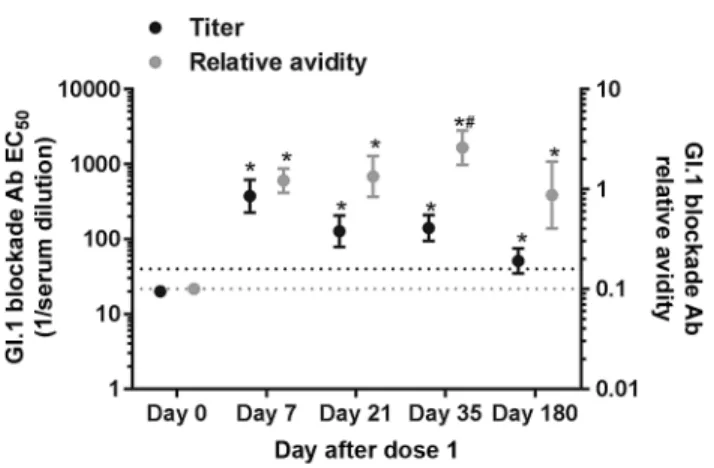
the EC50 and slope of the blockade curve of time-ordered serum samples collected from NoV vaccinated participants dosed with 150, 50, or 15 µg of GI.1 and GII.4c VLP adju-vanted with alum and MPL [31]. Blockade Ab avidity was not dose dependent at any day for GI.1 (Wilcoxon). For all doses combined, GI.1 blockade Ab avidity increased at day 7 (GMFR = 12.2; 95% CI = 9.2–16.1), remained consistent at day 21, and then at day 35 (7 days after dose 2) rose (GMFR of 2.1, 95% CI = 1.3–3.4 compared with day 7; GMFR = 26.0, 95% CI = 17.5–38.6 compared with day 0) (Wilcoxon) (Figure 1). At day 180, avidity declined below day 7 levels but remained elevated above day 0 levels. Comparing the individual dose groups, titers peaked at day 7 and gradually declined through day 180 (Supplementary Figure 1A–C), whereas avidity improved at day 35 compared with day 7 for the 150– and 50–µg/VLP doses (Wilcoxon) (Supplementary Figure 1D–F). Elevated avidity was maintained at day 180 in the 150-µg group but in only select participants in the 15- and 50-µg dose groups (Wilcoxon). Although short-term Ab response to the VLP vaccine was not dependent on secre-tor phenotype, secresecre-tor-positive participants (closed circles, Supplementary Figure 1, [21]) of any blood type were more likely to maintain GI.1 high avidity Ab at day 180, compared with secretor-negative participants (P = .02, Fisher’s). None of the 4 secretor-negative subjects had blockade Ab titer to GI.1 at day 180, regardless of vaccine dose.
Antigenic cartography analyses of blockade Ab cross-reactiv-ity patterns to other GI NoV VLPs not included in the vaccine among the 50-µg VLP dose group suggested that the blockade Ab response to the GI.1 vaccine component was predominately strain specific [21]. In agreement, avidity to GI.1, GI.3, and GI.4
was similar at day 0 and rose above baseline for GI.1 (GMFR 15.5; 95% CI = 10.4–23.0) and GI.3 (GMFR = 5.6; 95% CI = 2.3– 13.5) at day 7 (Figure 2). Avidity to only GI.1 increased at day 35 (GMFR = 37.3; 95% CI = 30.3–45.9; Wilcoxon), whereas avidity to GI.3 and GI.4 retuned to baseline levels. Avidities were simi-lar between all GI VLPs at day 180.
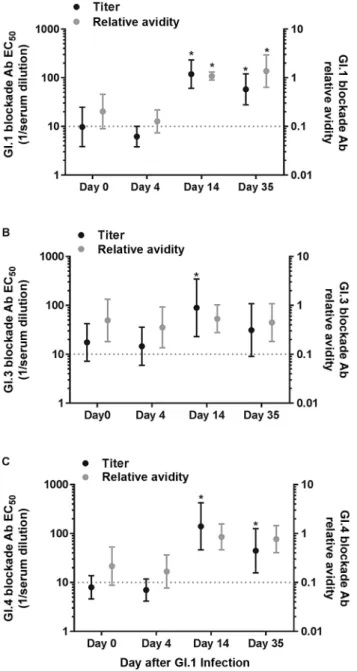
To determine whether the patterns of strain-specific GI blockade Ab titer and avidity responses to vaccination mimic the patterns after GI.1 natural infection, we retested archived serum samples collected from secretor-positive sub-jects experimentally infected with GI.1 (Figure 3) [24, 33]. When tested under similar assay conditions, subjects infected with GI.1 developed increased homotypic blockade Ab titer at day 14 (GMFR = 12.2; 95% CI = 4.6–32.0). Elevated titer was maintained at day 35 (GMFR = 5.5; 95% CI = 2.3–13.0; Wilcoxon) after challenge. Similarly, GI.1 blockade Ab avidity was elevated at day 14 (GMFR = 5.4; 95% CI = 2.2–13.0) and sustained at least through day 35 (GMFR = 6.3; 95% CI = 2.2– 17.8; Wilcoxon) (Figure 3A). Previously-determined total GI.1 Ab avidity determined by urea EIA [24] correlated with blockade Ab slope for IgA (Spearman r = 0.54; P = .0006) and IgG (Spearman r = 0.58; P = .0002). At day 14 heterotypic blockade Ab titers to GI.3 (GMFR = 5.1; 95% CI = 1.6–16.0) (Figure 3B) and GI.4 (GMFR = 17.6; 95% CI = 5.5–56.2) increased. Titer to GI.4 remained elevated at day 35 (GMFR = 5.3; 95% CI = 1.8–15.7; Wilcoxon) (Figure 3C). Blockade Ab avidity did not change from baseline levels for either GI.3 or GI.4 at any time point. These data indicate that cross-GI blockade Ab titer and avidity response patterns to vaccination with GI.1 VLP are similar to the response pat-terns to GI.1 strain infection.
Comparing the individual dosage groups, blockade Ab titers to GII.4c peaked at day 7 and gradually declined through day 180 (Supplementary Figure 2A–C). However, avidity improved only on days 7, 21, and 35 for the 15– and 50–µg/VLP dose group (Wilcoxon) and was unchanged over time in the 150–µg/ VLP dose group (Supplementary Figure 2D–F). For all doses combined, GII.4c blockade Ab titers peaked at day 7 after dose 1 (GMFR = 16.4; 95% CI = 7.5–35.6; Wilcoxon) and generally remained consistent through day 35 before declining at day 180 (Figure 4). Responses were generally similar between dose groups (Wilcoxon). After vaccination, GII.4c blockade Ab avid-ity rose at day 7 (GMFR = 4.9; 95% CI = 2.7–8.8; Wilcoxon), reaching a plateau through day 180. At day 0, blockade Ab avidity to GII.4c was already measureable, possibly limiting the effect of vaccination when measured by a change compared with day 0. Consistent with infection and in vitro binding data [35–37], GII.4c Ab avidity at day 180 was not associated with secretor phenotype (Supplementary Figure 2D–F), although the number of secretor-negative participants is low (n = 4). There was also no association between participant blood type and Ab avidity at day 180.
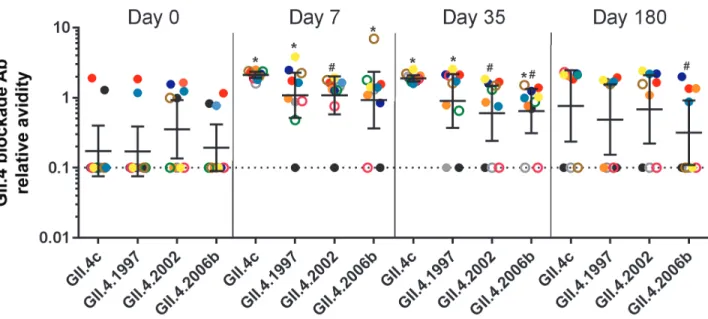
Among the 50-μg dosage group, on days 0 and 7 blockade Ab avidities were similar between GII.4c, and previous pan-demic strain VLPs GII.4.1997, 2002, and 2006b (Figure 5). At day 35, blockade Ab avidity between GII.4c and GII.4.1997 remained similar to each other and greater than the avid-ity for 2002 and 2006b (Wilcoxon), establishing avidavid-ity as an additional metric identifying the association between GII.4c and GII.4.1997 Ab response after vaccination. At day 180, GII.4.2006b blockade Ab avidity was lower compared with the other GII.4 VLPs, which were similar to each other (Figure 5). Thus, blockade Ab relative avidity measurements indicate vaccination primarily elicits a memory blockade Ab response to cross-reactive GII.4 epitopes. For GII.4.2012, a strain that emerged about 1 year after study sample collection was com-pleted, Ab avidity was higher on day 7 and 21 compared with day 0 (Wilcoxon) (Figure 6). Increased blockade Ab avidity was not sustained long-term. However, 3 of 8 participants maintained high avidity blockade Ab responses to the novel GII.4 VLP at day 180. These 3 participants were secretor pos-itive and had preexisting blockade-of-binding (BOB) titer to Epitope A of GII.4.1997. Preexisting BOB titer to Epitope A of GII.4.1997, but not to Epitope A of GII.4.2006b or Epitope F of either strain, correlated with avidity to GII.4.2012 at day 180 (Spearman r = 0.84; P = .02), further implicating host genetics and subsequent strain exposure history as key determinants of vaccine response.
DISCUSSION
In this article, we focused on relative avidity of the blockade Ab response across NoV strain, vaccine dose, and host secretor status. Using the slope of the Ab blockade curve, as opposed
to urea treatment of total serum, allows specific assessment of the avidity of the fraction of total serum immunoglobulin that potentially blocks the virus binding to its cellular receptor. This approach eliminates the effect of cross-reactive serum Ab as well as the inherent skewing of urea-based EIA methodologies toward Abs to linear epitopes, which confound classical avidity measurements of serum [28].
Our analyses revealed key differences in avidity responses between the vaccine components. Importantly, blockade Ab avidity to GI.1 increased over time, largely in a strain-spe-cific pattern. This suggests that memory B cells likely under-went further somatic hypermutation and refinement for the GI.1 immunogen, either as a result of time or the second vaccine dose. This would explain the increased avidity to GI.1 and the reported decrease in blockade Ab titer to GI.3 and GI.4 because these responses likely can be attributed to cross-GI Ab epitopes that were selected against during fur-ther GI.1 affinity maturation. The lack of change in avidity to GI.3 or GI.4 after the second dose of vaccine or after natural infection supports this hypothesis. If this is indeed the case, then vaccination with a different GI genotype VLP at the sec-ond dose may have different effects, preferentially selecting for expansion of Ab to conserved GI epitopes, improving the avidity to multiple GI strains instead of driving a largely GI.1-specific blockade Ab response. Further research is nec-essary to determine whether this pattern of Ab expansion exists and what the implication may be for infection and vaccination.
gene and as a result have low levels of HBGAs expression (non-secretors) are genetically resistant to GI.1 infection/illness [10]. Secretor-negative status does not protect against infection with all strains or even with some other GI strains [38] and, subse-quently, secretor-negative individuals may have serum Ab that cross-reacts with GI.1 by EIA [10]. Blockade Ab titer in response to vaccination was independent of secretor status in the 50–µg/
VLP dose group [21], however, none of the secretor-negative participants maintained high-avidity GI.1 blockade Ab at day 180. These data support the hypothesis that, mechanistically, vaccination of previously exposed individuals activates preexist-ing memory B cells that are the result of previous exposure and illustrate how the dosing regimen and host genetics will impact vaccine outcomes.
In comparison with the genetic restriction of GI.1 infection, GII.4 strains bind to a diverse set of HBGAs and infect both secretor-positive and, to a lesser degree, secretor-negative indi-viduals [35–37, 39]. Further, successive GII.4 strains circulate globally, causing both endemic and pandemic levels of disease [39, 40]. These factors keep population exposure to GII.4 strains high and maintain herd immunity to ancestral strains. This repeat exposure of similar antigen is reflected in the focusing GII.4 avidity measurements [41]. If a serum sample had a block-ade Ab titer above the limit of detection, the avidity remained relatively consistent across time and GII.4 VLP. These data suggest that the first dose of multivalent vaccine in previously exposed individuals activates preexisting memory B cells to epitopes conserved across multiple GII.4 strains and accounts for the broad GII blockade Ab response reported and mecha-nistically mirrors the GI VLP response at early time points. In contrast with the GI.1 response, the GII.4 avidity response was not specific for GII.4c. At day 35, GII.4c avidities were similar to GII.4.1997 and greater than GII.4.2002 and 2006b, supporting antigenic cartography and epitope-specific BOB assays indicat-ing that early GII.4 strain exposure may shape subsequent GII.4 blockade Ab responses [21].
Figure 3. GI.1 infection induces broad GI blockade antibody (Ab) titer response but only GI.1-specific increases in blockade Ab relative avidity. Geometric mean blockade Ab titer EC50 (black) and avidity (gray) were determined from GI.1 (A), GI.3 (B), and GI.4 (C) blockade Ab dose–response curves on day 0, 4, 14, and 35 after GI.1 infection. Bars represent the geometric mean titer (GMT), and whiskers repre-sent the 95% confidence interval. Dotted line equals the limit of detection for both assays. Abbreviation: *, Significant increase from day 0.
Elucidating epitopes targeted by neutralizing Abs provides a framework for vaccine design and a metric for evaluating pro-tective immune responses with fewer clinical trials. Of particular interest are epitopes for broadly neutralizing Abs that provide protection from infection across strains [29, 42, 43]. Our studies with NoV-vaccinated individuals did not include virus challenge after immunization; therefore protection cannot be assessed, but multivalent vaccination did induce broad blockade Ab responses, a proposed correlate of protection from infection,
that cross-reacted with novel GII.4 VLPs representing emergent variants for which the population was immunologically naive [21]. These data suggest that the vaccine may provide cross-pro-tection to emergent GII.4 strains. In support, avidity to the novel GII.4.2012 VLP followed the same pattern as the avidity to the other GII.4 VLPs that had widely circulated in the general pop-ulation of the United States. However, as described for the GI.1 response, only a subset of individuals sustained high avidity Ab to day 180. The participants that did sustain long-term responses were all secretor-positive and had detectable high-avidity block-ade Ab to the immunodominant Epitope A of GII.4.1997, the first recognized pandemic NoV strain, further indicating that vaccination is driving a cross-reactive memory Ab response to the GII.4c vaccine component and identifying Epitope A as a possible primary driver of the vaccine response.
The chief limitation of this study is the lack of testing of the association of increased Ab avidity and protection from NoV infection/illness in a biological model. Use of a biochemical assay to measure potential neutralizing Ab titers and avidities incurs confounding variables. Incubation at room tempera-ture, as reported here, favors binding of Abs to surface-exposed residues with strong blocking potential and steep blockade curve slopes. In comparison, incubation at 37°C likely favors binding of Ab to surface-exposed epitopes, occluded epitopes, and cross-reactive-lower avidity Abs [27, 44, 45]. Subsequent additional Ab binding increases the blockade Ab titer (EC50) but decreases the slope of the curve because less potent Abs contribute to the blockade activity. Extended incubation times may partially compensate for the effects of decreased incuba-tion temperatures [46]. The effects of incubation temperatures Figure 6. Select secretor-positive participants maintain blockade antibody (Ab)
relative avidity to novel antigen GII.4.2012 virus-like particles (VLPs) in the 50–µg/ VLP dose group. Mean slope was determined from GII.4.2012 blockade antibody dose–response curves for each secretor-positive (closed circles) and secretor-nega-tive (open circles) participant in the 50–µg/VLP dose group before vaccination (day 0), 7 days after first dose (day 7), 21 days after first dose (day 21), 7 days after second vaccine dose (day 35), and 180 days after first dose (day 180). Bars represent the geometric mean titer (GMT), and whiskers represent the 95% confidence inter-vals. Dotted line equals the assay limit of detection. Abbreviation: *, Significant increase from day 0.
and times on Ab reactivity and avidity measurements apply to both the human test antiserum and the rabbit antiserum used to detect the VLP bound to the carbohydrate ligand, although this concern is mitigated in part by the use of lim-iting amounts of VLP and rabbit antiserum in these assays. Further, between-VLP dynamics regulating epitope access were assumed to be negligible, and this may not be the case, especially for the GII.4c VLP, the only VLP in the study not made in a mammalian expression system [27]. Despite these challenges, we were able to identify novel outcomes of NoV vaccination associating a genetic phenotype with the likeli-hood of maintaining long-term (180 days), high-quality Ab responses.
Additional studies including virus challenges with and with-out prior vaccination are needed to further our understanding of the mechanistic correlates to protection from NoV infection/ illness as well as the long-term effects of dosing regimens and adjuvant usage. Inclusion of blockade Ab avidity as a study end-point may clarify the impact of host genetics and preexisting immunity for not only NoV but also other highly penetrant, antigenically diverse viruses, including human immunodefi-ciency virus, influenza, and dengue.
Supplementary Data
Supplementary materials are available at The Journal of Infectious Diseases
online. Consisting of data provided by the authors to benefit the reader, the posted materials are not copyedited and are the sole responsibility of the authors, so questions or comments should be addressed to the correspond-ing author.
Notes
Acknowledgments. The authors are grateful to each of the principal
investigators at the clinical sites for recruiting and providing care for the study participants, specifically Dr Sharon Frey and staff at Saint Louis University Center for Vaccine Development, Dr John Treanor and staff of the University of Rochester Medical Center, and Dr Robert Gormley and staff at the Naval Medical Research Center and the Walter Reed Army Medical Center. The authors would like to thank Dr Robert L. Atmar of the Baylor College of Medicine for the determination of secretor status and Victoria Madden and C. Robert Bagnell Jr of Microscopy Services Laboratory, Department of Pathology and Laboratory Medicine, University of North Carolina–Chapel Hill for expert technical support.
Financial support. This work was supported by grants from the
National Institutes of Health, Allergy and Infectious Diseases (R01 AI056351, R56 AI106006, and U19 AI109761 CETR).
Potential conflicts of interest. L. C. L. and R. S. B. have served as
consultants to Takeda Vaccines. R. S. B. has received contract grants and patent royalties for unrelated work from Takeda Vaccines. R. R. G., P. M. M., and R. F. B. are employees of Takeda Vaccines, and F. B. is an employee of Takeda Pharmaceuticals, the manufacturer of the noro-virus vaccine used in this study. Takeda employees may receive salary, bonus, and stock as compensation. C. R. was an employee of Takeda Vaccines until August of 2015. He remains a consultant to Takeda Vaccines through Pharmoros Consulting LLC and may receive fees for specific tasks. All other authors report no potential conflicts. All authors have submitted the ICMJE Form for Disclosure of Potential Conflicts of Interest. Conflicts that the editors consider relevant to the content of the manuscript have been disclosed.
References
1. Bartsch SM, Lopman BA, Ozawa S, Hall AJ, Lee BY. Global economic burden of norovirus gastroenteritis. PLoS One 2016; 11:e0151219.
2. Riddle MS, Walker RI. Status of vaccine research and development for norovirus. Vaccine 2016; 34:2895–9.
3. Pringle K, Lopman B, Vega E, Vinje J, Parashar UD, Hall AJ. Noroviruses: epidemi-ology, immunity and prospects for prevention. Future Microbiol 2015; 10:53–67. 4. Kocher J, Yuan L. Norovirus vaccines and potential antinorovirus drugs: recent
advances and future perspectives. Future Virol 2015; 10:899–913.
5. Ettayebi K, Crawford SE, Murakami K, et al. Replication of human noroviruses in stem cell-derived human enteroids. Science 2016; 353:1387–93.
6. Jones MK, Watanabe M, Zhu S, et al. Enteric bacteria promote human and mouse norovirus infection of B cells. Science 2014; 346:755–9.
7. Taube S, Kolawole AO, Hohne M, et al. A mouse model for human norovirus. mBio 2013; 4:e00450–13.
8. Lindesmith LC, Beltramello M, Donaldson EF, et al. Immunogenetic mechanisms driving norovirus GII.4 antigenic variation. PLoS Pathog 2012; 8:e1002705. 9. Debbink K, Lindesmith LC, Donaldson EF, et al. Emergence of new pandemic
GII.4 Sydney norovirus strain correlates with escape from herd immunity. J Infect Dis 2013; 208:1877–87.
10. Lindesmith L, Moe C, Marionneau S, et al. Human susceptibility and resistance to Norwalk virus infection. Nat Med 2003; 9:548–53.
11. Malm M, Uusi-Kerttula H, Vesikari T, Blazevic V. High serum levels of norovirus genotype-specific blocking antibodies correlate with protection from infection in children. J Infect Dis 2014; 210:1755–62.
12. Feng J, Gulati U, Zhang X, et al. Antibody quantity versus quality after influenza vaccination. Vaccine 2009; 27:6358–62.
13. Brokstad KA, Cox RJ, Major D, Wood JM, Haaheim LR. Cross-reaction but no avidity change of the serum antibody response after influenza vaccination. Vaccine 1995; 13:1522–8.
14. Harrington PR, Lindesmith L, Yount B, Moe CL, Baric RS. Binding of Norwalk virus-like particles to ABH histo-blood group antigens is blocked by antisera from infected human volunteers or experimentally vaccinated mice. J Virol 2002; 76:12335–43.
15. Lindesmith LC, Costantini V, Swanstrom J, et al. Emergence of a norovirus GII.4 strain correlates with changes in evolving blockade epitopes. J Virol 2013; 87:2803–13.
16. Lindesmith LC, Donaldson EF, Baric RS. Norovirus GII.4 strain antigenic varia-tion. J Virol 2011; 85:231–42.
17. Reeck A, Kavanagh O, Estes MK, et al. Serological correlate of protection against norovirus-induced gastroenteritis. J Infect Dis 2010; 202:1212–8.
18. Bok K, Parra GI, Mitra T, et al. Chimpanzees as an animal model for human norovirus infection and vaccine development. Proc Natl Acad Sci U S A 2011; 108:325–30.
19. Atmar RL, Bernstein DI, Lyon GM, et al. Serological correlates of protection against a GII.4 norovirus. Clin Vaccine Immunol 2015; 22:923–9.
20. Bernstein DI, Atmar RL, Lyon GM, et al. Norovirus vaccine against experimental human GII.4 virus illness: a challenge study in healthy adults. J Infect Dis 2015; 211:870–8.
21. Lindesmith LC, Ferris MT, Mullan CW, et al. Broad blockade antibody responses in human volunteers after immunization with a multivalent norovirus VLP candi-date vaccine: immunological analyses from a phase I clinical trial. PLoS Med 2015; 12:e1001807.
22. Gulati U, Kumari K, Wu W, Keitel WA, Air GM. Amount and avidity of serum antibodies against native glycoproteins and denatured virus after repeated influ-enza whole-virus vaccination. Vaccine 2005; 23:1414–25.
23. Pierson TC, Diamond MS. A game of numbers: the stoichiometry of anti-body-mediated neutralization of flavivirus infection. Prog Mol Biol Transl Sci 2015; 129:141–66.
24. Lindesmith LC, Beltramello M, Swanstrom J, et al. Serum immunoglobulin A cross-strain blockade of human noroviruses. Open Forum Infect Dis 2015; 2:ofv084. 25. Rockx B, Baric RS, de Grijs I, Duizer E, Koopmans MP. Characterization of the
homo- and heterotypic immune responses after natural norovirus infection. J Med Virol 2005; 77:439–46.
26. Bonsignori M, Zhou T, Sheng Z, et al. Maturation pathway from germline to broad HIV-1 neutralizer of a CD4-mimic antibody. Cell 2016; 165:449–63.
27. Lindesmith LC, Donaldson EF, Beltramello M, et al. Particle conformation reg-ulates antibody access to a conserved GII.4 norovirus blockade epitope. J Virol 2014; 88:8826–42.
29. Webb NE, Montefiori DC, Lee B. Dose-response curve slope helps predict thera-peutic potency and breadth of HIV broadly neutralizing antibodies. Nat Commun 2015; 6:8443.
30. Shen L, Peterson S, Sedaghat AR, et al. Dose-response curve slope sets class-spe-cific limits on inhibitory potential of anti-HIV drugs. Nat Med 2008; 14:762–6. 31. Treanor JJ, Atmar RL, Frey SE, et al. A novel intramuscular bivalent norovirus
virus-like particle vaccine candidate–reactogenicity, safety, and immunogenicity in a phase 1 trial in healthy adults. J Infect Dis 2014; 210:1763–71.
32. Baehner F, Bogaerts H, Goodwin R. Vaccines against norovirus: state of the art trials in children and adults. Clin Microbiol Infect 2016; 22:136–9.
33. Lindesmith LC, Donaldson E, Leon J, et al. Heterotypic humoral and cellular immune responses following Norwalk virus infection. J Virol 2010; 84:1800–15. 34. Puschnik A, Lau L, Cromwell EA, Balmaseda A, Zompi S, Harris E. Correlation between
dengue-specific neutralizing antibodies and serum avidity in primary and secondary dengue virus 3 natural infections in humans. PLoS Negl Trop Dis 2013; 7:e2274. 35. Carlsson B, Kindberg E, Buesa J, et al. The G428A nonsense mutation in FUT2
provides strong but not absolute protection against symptomatic GII.4 norovirus infection. PLoS One 2009; 4:e5593.
36. Nordgren J, Nitiema LW, Ouermi D, Simpore J, Svensson L. Host genetic factors affect susceptibility to norovirus infections in Burkina Faso. PLoS One 2013; 8:e69557. 37. Carmona-Vicente N, Fernández-Jiménez M, Vila-Vicent S, Rodríguez-Díaz J,
Buesa J. Characterisation of a household norovirus outbreak occurred in Valencia (Spain). BMC Infect Dis 2016; 16:124.
38. Nordgren J, Kindberg E, Lindgren PE, Matussek A, Svensson L. Norovirus gas-troenteritis outbreak with a secretor-independent susceptibility pattern, Sweden. Emerg Infect Dis 2010; 16:81–7.
39. Lindesmith LC, Donaldson EF, Lobue AD, et al. Mechanisms of GII.4 norovirus persistence in human populations. PLoS Med 2008; 5:e0050031.
40. Debbink K, Lindesmith LC, Donaldson EF, Baric RS. Norovirus immunity and the great escape. PLoS Pathog 2012; 8:e1002921.
41. Kang M, Eisen TJ, Eisen EA, Chakraborty AK, Eisen HN. Affinity inequality among serum antibodies that originate in lymphoid germinal centers. PLoS One 2015; 10:e0139222.
42. McCoy LE, Falkowska E, Doores KJ, et al. Incomplete neutralization and deviation from sigmoidal neutralization curves for HIV broadly neutralizing monoclonal antibodies. PLoS Pathog 2015; 11:e1005110.
43. Corti D, Lanzavecchia A. Broadly neutralizing antiviral antibodies. Annu Rev Immunol 2013; 31:705–42.
44. Diamond MS, Pierson TC, Fremont DH. The structural immunology of antibody protection against West Nile virus. Immunol Rev 2008; 225:212–25.
45. Pierson TC, Fremont DH, Kuhn RJ, Diamond MS. Structural insights into the mechanisms of antibody-mediated neutralization of flavivirus infection: implica-tions for vaccine development. Cell Host Microbe 2008; 4:229–38.