P
ARADISER
EGAINED: N
AIVES
EMANTICS ANDR
EGULATIVEM
ETAPHYSICSRobert Smithson
A dissertation submitted to the faculty of the University of North Carolina at Chapel Hill in partial fulfillment of the requirements for the degree of Doctor of Philosophy in the
Department of Philosophy in the College of Arts and Sciences.
Chapel Hill 2016
Approved by:
Thomas Hofweber
Marc Lange
Ram Neta
Laurie Paul
ABSTRACT
ROBERT SMITHSON: Paradise Regained: Naive Semantics and Regulative Metaphysics. (Under the direction of Thomas Hofweber)
In this dissertation, I identify areas of language that are not threatened by empirical
evidence or theoretical argument in ways that we typically expect when doing
philoso-phy. Examples I consider include assertions aboutordinary objects,laws of nature,
depen-dence, causation, and existence. In each case, I argue that our mistaken epistemological
assumptions are the result of mistaken semantic assumptions about our ordinary
linguis-tic expressions. I appeal to these semanlinguis-tic conclusions to clarify and regulate a variety
of metaphysical debates, such as the dispute between Humeans and non-Humeans about
natural laws and the dispute between ontologists and deflationists over the substantivity of
This dissertation is dedicated to my spouse, Caroline. Thank you for your love and
ACKNOWLEDGMENTS
I thank Thomas Hofweber, Matt Kotzen, Marc Lange, Bill Lycan, Alan Nelson, Ram
Neta, Laurie Paul, John Roberts for helpful comments on this dissertation. I thank Krasi
Filcheva, Chris Dorst, Sam Reis-Dennis, Mike Bertrand, and Vida Yao for inspiring
TABLE OF CONTENTS
1 INTRODUCTION. . . 1
1.1 Introduction . . . 1
1.2 Regulative metaphysics . . . 2
1.2.1 Historical examples . . . 3
1.2.2 Motivations. . . 4
1.2.3 Project . . . 6
1.3 A contemporary defense . . . 7
1.3.1 Objection 1: worries about common sense . . . 7
1.3.2 Objection 2: weaker standards of justification . . . 11
1.3.3 Objection 3: the unavailability of analysis . . . 14
1.3.4 Summary . . . 17
1.4 Contemporary applications . . . 18
1.4.1 Causation (ch. 2) . . . 18
1.4.2 Existence (ch. 3) . . . 20
1.4.3 Laws of nature (ch. 4) . . . 21
1.4.4 Dependence (ch. 5) . . . 22
1.4.5 Edenic Idealism (chs. 6-11) . . . 24
1.5 Future prospects for regulative metaphysics . . . 26
2 WATER, GAMES, AND CAUSES: A DECISION PROCEDURE FOR ESSENCE HUNTERS. . . 27
2.2 The project of analysis . . . 28
2.2.1 Conceptual analysis. . . 28
2.2.2 Metaphysical analysis . . . 29
2.2.3 The path ahead . . . 30
2.3 ‘water’ vs. ‘game’ . . . 31
2.3.1 Epistemic security . . . 31
2.3.2 Epistemic rigidity . . . 33
2.3.3 A test . . . 34
2.4 ‘cause’ vs. ‘water’ . . . 34
2.4.1 Epistemic security . . . 35
2.4.2 Epistemic rigidity . . . 38
2.4.3 Summary . . . 40
2.5 A deflationary alternative . . . 40
2.5.1 The corresponding metaphysical picture . . . 43
2.6 Conclusion . . . 44
3 THE CONTEXT PRINCIPLE AND ONTOLOGESE GAMBITS . . . 45
3.1 Introduction . . . 45
3.2 Background. . . 46
3.3 Two pictures of language, two pictures of the world . . . 48
3.3.1 Priority and metaontology . . . 51
3.3.2 The Hirsch-Sider dispute . . . 52
3.4 A new objection . . . 53
3.4.1 The tifleron example . . . 55
3.4.2 A few clarifications . . . 57
3.4.3 The original examples . . . 58
3.5 Denying the antecedent . . . 61
3.5.1 Paraphrase . . . 61
3.5.2 Composition as identity . . . 62
3.5.3 Fictionalism . . . 63
3.6 Conclusion . . . 64
4 A NEW EPISTEMIC ARGUMENT FOR HUMEAN LAWS . . . 65
4.1 Introduction . . . 65
4.2 Background. . . 65
4.2.1 The traditional epistemic argument . . . 66
4.2.2 Shortcomings of the traditional argument . . . 67
4.2.3 A new epistemic argument . . . 68
4.3 Defending premise 1 . . . 69
4.3.1 Laws in scientific practice . . . 69
4.3.2 Preliminaries . . . 71
4.3.3 Case 1: the Humean world . . . 73
4.3.4 Case 2: the fragile world . . . 75
4.3.5 Summary . . . 76
4.4 Defending premise 2 . . . 77
4.4.1 Fictionalism . . . 77
4.4.2 Conceptual change . . . 78
4.4.3 A different semantic role . . . 79
4.4.4 Summary . . . 80
4.4.5 An objection: illegitimate focus on the term ‘law’ . . . 81
4.4.6 The path ahead . . . 82
4.5 The explanatory work argument . . . 82
4.7 The argument from the failures of analysis . . . 86
4.7.1 A deflationary analysis . . . 87
4.7.2 Clarifications . . . 89
4.7.3 Objections . . . 91
4.8 Conclusion . . . 93
5 METAPHYSICAL AND CONCEPTUAL GROUNDING . . . 94
5.1 Introduction . . . 94
5.2 Distinct types of grounding . . . 95
5.2.1 Metaphysical grounding . . . 95
5.2.2 Conceptual grounding . . . 96
5.2.3 Two distinct types of grounding. . . 99
5.3 The relation between metaphysical and conceptual grounding . . . 102
5.3.1 The Conceptual/Metaphysical Thesis . . . 102
5.3.2 The Grounding Exclusion Thesis . . . 103
5.3.3 Preliminary notes . . . 103
5.4 Arguments for Grounding Exclusion . . . 106
5.4.1 The triviality argument . . . 107
5.4.2 The explanatory work argument . . . 109
5.4.3 Summary . . . 112
5.4.4 Objections . . . 113
5.5 Heuristics . . . 114
5.5.1 The Scrutability Heuristic . . . 114
5.5.2 The Vagueness Heuristic . . . 115
5.5.3 A test case . . . 117
5.5.4 How widespread is conceptual grounding? . . . 120
6 EDENIC IDEALISM . . . 122
6.1 Introduction . . . 122
6.2 Threats to the manifest image . . . 123
6.2.1 Color properties . . . 123
6.2.2 Spatial properties . . . 124
6.2.3 Functional identification . . . 126
6.3 The puzzles . . . 126
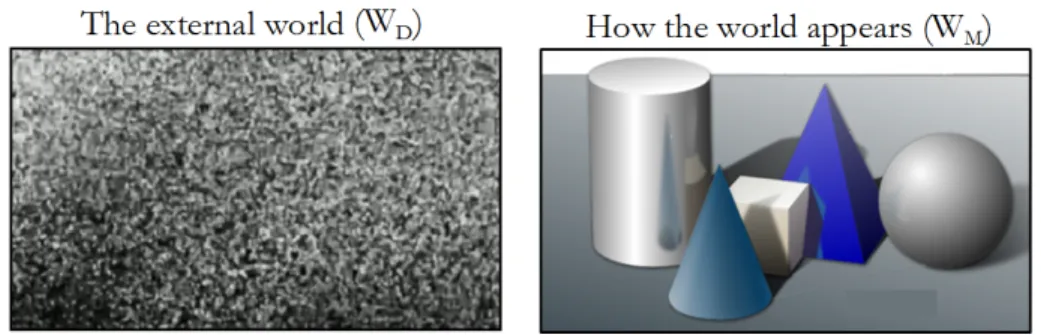
6.3.1 Puzzle 1: the dust worldWD. . . 128
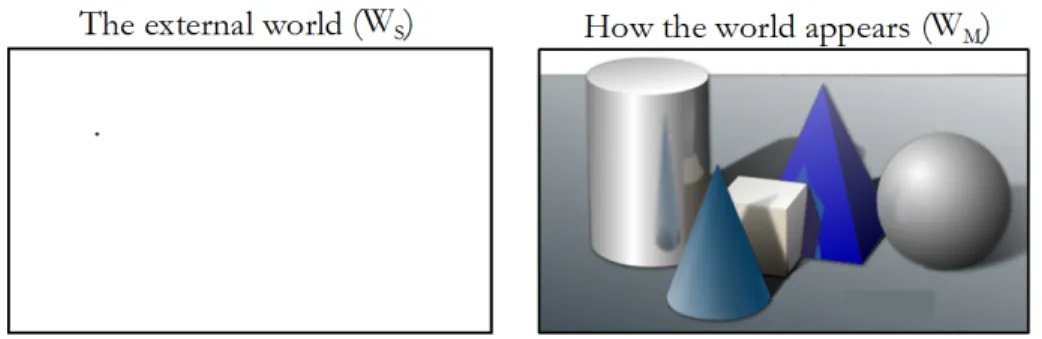
6.3.2 Puzzle 2: the single particle worldWS . . . 130
6.3.3 Puzzle 3: the frozen worldWF. . . 131
6.4 Possible responses . . . 133
6.4.1 Simple error theory . . . 133
6.4.2 Paraphrases . . . 134
6.4.3 Fictionalism . . . 136
6.4.4 Deflationism . . . 137
6.4.5 Non-standard functional identification. . . 138
6.5 Edenic idealism . . . 140
6.5.1 Two worlds . . . 143
6.5.2 Which world is actual? . . . 144
6.5.3 Unique features of edenic idealism . . . 145
6.5.4 Why accept edenic idealism? . . . 147
6.5.5 Summary . . . 150
6.6 Conclusion . . . 150
7 THE DEFERENCE PRINCIPLE. . . 151
7.1 Introduction . . . 151
7.2 The Deference Principle . . . 151
7.4 Clarificatory notes. . . 156
7.5 Correspondence between truth and judgment . . . 159
7.6 Objections . . . 160
7.6.1 Is the deference principle dispensable? . . . 162
7.7 A taxonomy of objections . . . 164
8 THE DISCREPANCY OBJECTION. . . 167
8.1 Introduction . . . 167
8.2 Cases of illusion . . . 167
8.2.1 Illusions and the deference principle. . . 168
8.2.2 The ordinary epistemology of veridicality judgments . . . 170
8.2.3 Indetectable illusions? . . . 171
8.3 Cases of incompatible experiences . . . 173
8.3.1 Splitting the world . . . 173
8.4 Scientific cases . . . 175
8.4.1 Special and general relativity . . . 176
8.4.2 Quantum mechanics . . . 177
8.4.3 More semantic support for EI (and a critique of scientism) . . . 180
8.4.4 Microphysical ontology . . . 183
8.4.5 Other scientific ontology . . . 185
8.4.6 Scientific macro-ontology . . . 186
8.4.7 What world does fundamental physics describe? . . . 188
8.4.8 Relations between worlds . . . 189
8.4.9 Summary . . . 190
8.5 Conclusion . . . 191
9 THE INCOMPLETENESS OBJECTION . . . 192
9.2 Difficult cases . . . 193
9.2.1 Inaccessibility cases . . . 193
9.2.2 A worry. . . 196
9.2.3 Interference cases . . . 196
9.3 The Sellarsian objection . . . 198
9.3.1 The basic response . . . 199
9.3.2 World selection as an ordered process . . . 200
9.3.3 Merely possible objects. . . 202
9.3.4 Merely apparent objects . . . 203
9.3.5 World exploration and world selection . . . 204
9.3.6 Summary . . . 206
9.4 The determinacy objection . . . 207
9.4.1 A general response. . . 208
9.4.2 Difficult cases . . . 209
9.4.3 Summary . . . 210
9.4.4 The direct strategy as backup . . . 211
9.5 The insufficiency objection . . . 212
9.5.1 Judgment defeasibility . . . 212
9.5.2 Other types of truths . . . 213
9.6 Summary . . . 216
10 FURTHER OBJECTIONS. . . 217
10.1 Introduction . . . 217
10.2 The mind-dependence objection . . . 217
10.3 The intersubjectivity objection . . . 219
10.4 The ordinary language objection . . . 221
10.4.1 Berkeley on common sense . . . 221
10.4.3 Specific types of ordinary judgments . . . 225
10.5 The battle cry objection . . . 226
10.6 Conclusion . . . 228
11 APPLICATIONS OF EDENIC IDEALISM . . . 229
11.1 Introduction . . . 229
11.2 The debate on composition . . . 229
11.3 Deflationism and ontological pluralism . . . 231
11.4 External world skepticism . . . 234
11.5 Perception . . . 235
11.6 Summary . . . 238
A OTHER ARGUMENTS RELEVANT TO CAUSAL DEFLATIONISM. . . 239
1 INTRODUCTION
1.1 Introduction
Suppose we travel to the all-knowing Oracle to settle once and for all whether there
is an external world of material objects. There, we receive a disheartening report: our
experiences are caused not by material objects, but rather by a malicious demon intent on
deceiving us. This testimony would surprise and dismay us. We might say things like
‘Tables and chairs don’t really exist!’ and ‘We don’t have bodies after all!’
But this initial shock would pass. And after several minutes, we would go back to
saying things like ‘There is an apple in the kitchen’ or ‘The bus arrives soon’ just as we
always had. This is because we would have to return to the ordinary concerns of human
life: buying groceries, getting to the bus stop on time, and so on.
This raises a puzzle. Ordinarily, when we receive evidence that we think contravenes
our judgment that P, we abandon our judgment thatP. But in the above thought
experi-ment, after temporarily abandoning our judgments about material objects, we would soon
return to making such judgments.
Why? Is it because we are irrationally ignoring the evidence? Is it because we’ve
changed the meanings of our object terms? Is it because we engage in pretense when we
talk about objects? In this dissertation, I argue that none of these proposals are correct.
What our return to ordinary speech really shows, I argue, is that we — or those of us
who regard the demon scenario as a skeptical challenge to our judgments about objects
— have false beliefs about what our ordinary object terms refer to. We initially retract our
object judgments because we assume these judgments purport to describe some fully
is mistaken. What we refer to with ordinary object terms depends on how we use these
terms, and how we use these terms depends on our interests and concerns. When making
judgments about objects in ordinary life, we do not care about what the mind-independent
external world is like “in itself”; we care about the world as it appears to us. So I defend
a semantic version of idealism — edenic idealism — on which our object terms refer to
items in the world presented to us in experience.
Similar remarks apply to other areas of our discourse. When doing philosophy, we
often treat our ordinary judgments as if they are theoretical hypotheses: hypotheses that
aim at a certain objectivity, or unity, or explanatory power. So when evidence suggests that
our discourse fails to meet these standards, we are tempted to conclude that our ordinary
judgments are defective. But when the concerns of ordinary life impinge upon us, we return
to speaking as we always have. This is because the use of our language is driven by our
interests and concerns, and what matters to us in ordinary life is very different from what
matters to us when giving philosophical theories.
In this dissertation, I identify areas of language that are not threatened by empirical
evidence or theoretical argument in ways that we typically expect when doing
philoso-phy. Examples I consider include assertions aboutordinary objects,laws of nature,
depen-dence, causation, and existence. In each case, I argue that our mistaken epistemological
assumptions are the result of mistaken semantic assumptions about our ordinary
linguis-tic expressions. I appeal to these semanlinguis-tic conclusions to clarify and “regulate” a variety
of metaphysical debates, such as the dispute between Humeans and non-Humeans about
natural laws and the dispute between ontologists and deflationists over the substantivity of
ontological debates.
1.2 Regulative metaphysics
In the argument sketched in the introduction, I leveraged facts about the epistemology
of argument owes its greatest debt to Berkeley and Hume, each of whom thought that we
could use epistemic results to diagnose mistaken semantic presuppositions in our
theoriz-ing. I will refer to arguments of this form as “regulative arguments” since results from
ordinary epistemology are used toregulateadmissible philosophical theories.
In my dissertation, I offer updated versions of the arguments from Berkeley and Hume.
So it will be helpful to briefly review the importance of regulative arguments for these
historical philosophers.1
1.2.1 Historical examples
Consider Hume’s arguments against necessary connections. Hume (1999, 7.2) claims
that, even if necessary connections wereintelligible, the fact remains that necessary
con-nections aren’t what we are actually talking about when we use the ordinary term ‘cause’.
According to Hume, we are able to infer (in ordinary contexts) thatCcausesEwhen we
ob-serve certain types of regularities. But, says Hume, if our ordinary term ‘cause’ expressed
necessary connections, we would be unjustified in making this inference. So theories where
causation involves necessary connections are incompatible with the ordinary epistemology
of our causal judgments.
Berkeley (1948a, 171-207) offers a similar argument against mind-independent
mate-rial objects. Berkeley claims that we are able to know, on the basis of our sensations, that
ordinary objects like tables and chairs exist. But if our ordinary object terms referred to
items in some mind-independent external world, this inference would be unjustified. So
Berkeley concludes that theories where ordinary objects are mind-independent do not use
ordinary object terms with their normal meanings.
1For ease of presentation, I will present Berkeley’s and Hume’s regulative arguments within the
These “regulative” arguments share three basic features. First: each argument
iden-tifies a tension between a philosophical theory T and certain judgments we make during
everyday life. Second, it is claimed thatT is defective, not our ordinary judgments. Third,
the arguments identifyT’s defect as a mistaken presupposition about the semantic role of
our ordinary linguistic expressions. We can precisify this form of argument as follows2:
Traditional regulative argument
1. On theT-theorist’s conception ofX, judgments about X are not
epistemi-cally justified on the basis of ordinary evidenceE.
2. Judgments aboutX areepistemically justified on the basis of ordinary evi-denceE.
3. The semantic role of the expression ‘X’ is different from the one
presup-posed byT.
Here,Xmight stand for causation, ordinary objects, colors, free will, etc.
1.2.2 Motivations
In a regulative argument, there is a tension between our ordinary judgments and a
philosophical theoryT. Given the tension, why locate the problem withT instead of
locat-ing the problem with ordinary judgments?
One might defend ordinary discourse by appealing to common sense. For example,
one might think that the claims of common sense deserve more confidence than we could
ever have in a philosophical theory challenging them.3 Berkeley, in particular, often
ap-pealed to common sense in order to defend the correctness of our ordinary judgments.4
But at present, I want to focus on a second possible defense, one that figures
promi-nently in the arguments of this dissertation. Berkeley and Hume were much impressed by
a phenomenon we might call the “powerlessness of theorizing”: no matter how convincing
2See Garrett (1997, chs. 1-2) for further discussion of this style of argument.
3Cf. Moore (1925).
philosophical challenges to our ordinary beliefs might seem at the time, such theorizing has
little hold on us when we return to the business of everyday life. Says Hume (1999, 120):
“Nor need we fear, that this philosophy, while it endeavors to limit our
en-quiries to common life, should ever undermine the reasonings of common life,
and carry its doubts so far as to destroy all action, as well as speculation.
Na-ture will always maintain her rights, and prevail in the end over any abstract
reasoning whatsoever. ... If the mind be not engaged by argument to make
[in-ferences from experience], it must be induced by some other principle of equal weight and authority; and that principle will preserve its influence as long as
human nature remains the same.”
Similarly, Berkeley (1948b, 25) observes:
“...the illiterate majority of people, who walk the high road of plain common
sense and are governed by the dictates of nature, are mostly comfortable and
undisturbed. To them nothing that is familiar appears hard to explain or to
understand. They don’t complain of any lack of certainty in their senses, and
are in no danger of becoming sceptics.”
Why is it that, so often, arguments that seem convincing when doing philosophy fail to
move us in everyday life? Berkeley and Hume offer a very simple explanation: our interests
and concerns when doing philosophy are very different from our interests and concerns in
everyday life. Says Hume (2000, 1.7):
“I dine, I play a game of backgammon, I converse, and am merry with my
friends. And when, after three or four hours’ amusement, I would return to
these speculations, they appear so cold, and strained, and ridiculous, that I
cannot find in my heart to enter into them any farther.”
Similarly, Berkeley (1948a, 182) claims that our language is “framed by the Vulgar,
merely for conveniency and dispatch in the common actions of life, without any regard to
speculation.”5 This is why we see Philonous try to draw Hylas away from skepticism by
appealing to ordinary human concerns:
5For an excellent exposition of Berkeley’s view of ordinary subjects’ resistence to philosophical
“But are you all this while in earnest, Hylas; and are you seriously persuaded
that you know nothing real in the world? Suppose you are going to write,
would you not call for pen, ink, and paper, like another man; and do you not know what it is you call for? ... I am of a vulgar cast, simple enough to believe
my senses, and leave things as I find them. To be plain, it is my opinion that
the real things are those very things I see, and feel, and perceive by my senses.
These I know; and, finding they answer all the necessities and purposes of life,
have no reason to be solicitous about any other unknown beings.” (Berkeley
(1948a, 228-229))
We might characterize Berkeley’s and Hume’s insight as follows. There are certain
desiderata for our judgments when doing philosophy; perhaps we aim for judgments with a
certain objectivity, or a certain unity, or a certain explanatory depth. But these desiderata do
not matter to us in ordinary contexts. Because of this difference in the norms that matter to
us, it is no surprise that discourse that seems satisfactory in ordinary contexts often seems
defective when doing philosophy. But by the same token, it is no surprise that philosophical
theorizing can sometimes fail to move us when we return to ordinary life.
This difference in norms explains why Berkeley and Hume locate the problem with
theorizing rather than ordinary language. A philosophical theory could have authority over
our ordinary discourse only if only if we were inclined to defer to that theory in everyday
contexts. But, at least according to Berkeley and Hume, we do not actually care about
theoretical norms in ordinary contexts.6
1.2.3 Project
Despite their historical importance, regulative arguments are no longer so prominent
in contemporary philosophy. This is because regulative arguments have traditionally been
associated with views in epistemology and the philosophy of language that no longer enjoy
support.
As I mentioned earlier, my dissertation updates regulative arguments for a
contempo-rary setting. This project involves two tasks. First, I defendregulative arguments against
contemporary objections, showing that they can be formulated without problematic
episte-mological and semantic assumptions. Second, I identify contemporarytargetsof regulative
arguments. I will discuss these tasks in the next two sections, respectively.
1.3 A contemporary defense
In this section, I’ll discuss three challenges to regulative arguments from
contempo-rary philosophy. Each of these objections challenges an epistemic or semantic assumption
traditionally associated with regulative arguments. To respond to these objections, I show
that these assumptions are unnecessary.
N.b.: There is not one specific context in my dissertation where I discuss these
objec-tions. They are objections that periodically arise throughout the chapters ahead.
1.3.1 Objection 1: worries about common sense
Regulative arguments identify a tension between our ordinary judgments and a
philo-sophical theoryT. And as discussed in 1.2.2, these arguments locate the problem withT
rather than with our ordinary judgments.
In 1.2.2, I mentioned two ways one might justify this choice. One option is to simply
appeal to common sense; another option is appeal to the phenomenon I called “the
power-lessness of theorizing”. As it happens, the former option receives the most attention in the
contemporary literature.7 So we might say that, at least within contemporary philosophy,
regulative arguments are associated with the following assumption:
Assumption 1 (A1): Our ordinary judgments are epistemically justified be-cause they are common sense.
Because of this association, one way a contemporary philosopher might resist a regulative
argument is by denying A1. For example, some philosophers think that common sense
should have no role to play in philosophical theory choice. Says Sider (2013, 10):
“there is no independent reason to think that common sense is reliable about whether there exist tables and chairs as opposed to there merely existing
suit-ably arranged particles. Our forbears presumsuit-ably did not even consider the
latter possibility. The Mooreanism I oppose says that we should trust common
sense even in the absence of independent reason to think that it is reliable. And
that seems no better than the absurd: “believe the masses...”
Other philosophers are inclined to afford common sense at least some measure of respect.
For example, many philosophers regard the fact that a theoryT violates common sense to
be a cost ofT.8 But even among this group, it is often thought that common sense can be
abandoned if the theoretical utility is great enough. In other words, respecting common
sense is not considered a constraint of adequacy forT; it is just one virtue among many.9
On either of the above views, common sense judgments are defeasible. One reason
this view may seem compelling is that, in many cases, common senseismistaken. For
ex-ample, common sense says that the world is flat, that simultaneity is observer-independent,
etc. These examples show us that common sense is fallible. So, it might be argued, we
should not automatically rule a theory T simply because it conflicts with common sense
(as regulative arguments seem to suppose).
Response: the powerlessness of theorizing
In my dissertation, I show that regulative arguments do not actually require A1. As
discussed in 1.2.2, Berkeley and Hume did not rest their critiques of philosophical theories
solely on common sense. They were also motivated by facts about the kinds of evidence
that subjects are responsive to in ordinary contexts.
8See, e.g., Lewis (1973b) and Lycan (2001, 41).
9For explicit endorsement of this stance, see Merricks (2001, 24), Paul & Hall (2013, 40-41), and Rinard
Suppose, for example, that a subject S asserts ‘That table is brown’ on the basis of
her sensory experience. There are various types of evidence that would causeS to revise
this judgment. For example, she might realize that the table only looked brown because of
a trick of the light. Or she might remember that she took hallucinogenic drugs that affect
her color vision. But there are other kinds of evidence that wouldnotcauseSto revise her
judgment. For example, the Oracle thought experiment in the introduction to this chapter
suggests thatSwouldnot(permanently) revise her judgment in response to evidence about
evil demon scenarios.
In my dissertation, I argue that the best explanation of this behavior is the one given
by Berkeley and Hume: our interests and concerns in ordinary life are different from our
interests and concerns when doing philosophy. Since our ordinary judgments are governed
by different norms, these judgments cannot be threatened by philosophical arguments in
ways that are typically supposed.
The proponent of regulative arguments need not and should not endorse any claim
to the effect that our ordinary judgments are infallible; these judgments are threatened by
ordinaryevidence all the time. But these beliefs are not threatened by distinctly
philosoph-ical evidence or argumentation. This is because philosophical discourse is governed by
different norms than ordinary discourse.
Two types of evidence
Speaking more carefully: we should not assume that ordinary judgments are never
threatened by philosophical theorizing. Instead, it is best to consider particular areas of our
discourse one by one, examining the evidence in each case. There are two main types of
evidence that I consider in my dissertation: scrutability resultsandOracle arguments.
Scrutability results: Let C0 be the conjunction of a set of sentences C. We can say
prioritruth in ordinary language.10 One way to show that an ordinary judgmentO is not
threatened by philosophical theorizing is to show thatO is scrutable from the evidenceE
subjects ordinarily consider relevant to assessingO’s truth. For example, considerEi ≡‘x
has a mass of 2.5 kilograms’. Any competent subject givenEi could trivially inferOi ≡
‘xhas a mass’. SinceOi has the status of aa prioritruth (conditional on the truth ofEi),
it is not the kind of sentence that could be threatened by philosophical argument (while
supposing that Ei is true). While this example is very simple, I discuss more interesting
cases of scrutability in 1.3.3.
We can leverage results about scrutability into a strengthened form of regulative
argu-ment:
Updated Regulative Argument, Scrutability Version
1. On theT-theorist’s conception of X, sentences about X are not inferablea priorifrom ordinary evidenceE.
2. Sentences about Xareinferablea priorifrom ordinary evidenceE.
3. The expression ‘X’ does not refer to an item meeting theT-theorist’s
con-ception.11
This argument is not threatened by concerns about common sense because it shows
that X-judgments are not merely judgments that “seem obvious” to ordinary subjects.
Be-cause these sentences area prioriconditional onE, it is better to think of them as having
the same status as conceptual truths in these contexts.
Oracle arguments: Let ET be evidence that, acccording to philosophical theory T,
contravenes ordinary judgmentO. If ordinary subjects would not abandon their judgment
O even after receiving and accepting ET, this is strong evidence that ET is not actually
evidentially relevant to O (and that T relies on mistaken semantic presuppositions). To
10Here, and throughout the rest of this chapter, I am putting aside any Quine-inspired qualms with
aprior-ity.
11I offer arguments of the above form to show that: (i) Quinean ontologists are mistaken in their
obtain this kind of evidence, I sometimes appeal to Oracle thought experiments like the
one from section 1.1. In such cases, an all-knowing and completely trustworthy Oracle
gives ordinary subjects the evidenceET. We can put Oracle arguments into the following
step-by-step form:
Updated Regulative Argument, Oracle Version
1. Even if ordinary subjects were to accept (allegedly) contravening evidence ET, they would continue to make judgments about X on the basis of ordinary
evidenceEO.
2. If ordinary subjects would continue to make judgments about X on the basis
of ordinary evidenceEO, the term ‘X’ does not refer to an item meeting the
T-theorist’s conception.
3. The expression ‘X’ does not refer to an item meeting theT-theorist’s
con-ception.12
Throughout my dissertation, I consider various objections to premise 2. This premise
as-sumes that the best explanation of the behavior in the Oracle thought experiment is that
subjects are not referring to an item meeting the T-theorist’s conception. But there are
other possible explanations. For example, one might diagnose the behavior as a case of
conceptual change. Or one might say that ordinary subjects are merelypretendingto talk
about X after the Oracle’s testimony. I argue that, at least in the cases considered in this
dissertation, these alternative explanations are not plausible.
1.3.2 Objection 2: weaker standards of justification
Premise 1 of the traditional regulative argument asserts that, on the semantic
presup-positions of theoryT, our judgments about X are unjustified. Whether this premise is true
will depend on our standards for epistemic justification. Traditionally, many proponents of
regulative arguments have endorsed strong assumptions about these standards, such as:
12I offer arguments of this form to show that: (i) the term ‘cause’ does not express a relation with a unified
Assumption 2 (A2): A beliefO is justified iff one has evidence that favorsO
over every alternative hypothesis.
But many philosophers would worry that A2 sets the standard for justification too high. So
if premise 1 relies on A2, traditional regulative arguments will be unconvincing.
For example, most theorists today believe that, pace Berkeley, wecan have justified
beliefs about mind-independent material objects. For example, many philosophers (such as
Vogel (1990)) claim that we can support the existence of material objects using inference
to the best explanation (IBE). Other philosophers have given a contextualist defense of
our knowledge of material objects, claiming that skeptical hypotheses only threaten our
knowledge in philosophical contexts.13 Other philosophers endorse dogmatism, claiming
that our beliefs in material objects enjoy a default justification that is not threatened by
skeptical hypotheses.14
Response: the powerlessness of theorizing
In the chapters ahead, I argue that regulative arguments do not require A2 or any other
substantive assumptions about epistemic justification. To illustrate this defense, I will again
consider ordinary object discourse.
On each of the above views (IBE, contextualism, and dogmatism), the objector
as-sumes that our judgments about objects are “hostage to fortune” in the following sense: it
is coherent to suppose that all actual and counterfactual experiences are just as they are,
but due to facts about some external reality independent of the human mind, truths about
objects are different. One such example might be a scenario where an evil demon causes
our experiences.
But there is a problem: the Oracle thought experiment (see section 1.1) suggests that
our object judgments are not actually hostage to fortune in the way that these responses
13See, e.g., Neta (2003).
suppose. It suggests that our object judgments would be trueeven if an evil demon were
the cause of our experiences. So the explanationist, contextualist, and dogmatist are tilting
at windmills: they are defending our object judgments from possibilities that were never a
threat to begin with.15
At least in the ordinary object case, objection 2 represents a second way of failing
to appreciate “the powerlessness of theorizing”. For the same reasons that philosophical
arguments cannot threaten our ordinary judgments, so too they cannotvindicateorjustify
them. Philosophical arguments could only vindicate our object judgments if these
judg-ments were threatened by the skeptical possibilities that interest philosophers (e.g., evil
demon scenarios). But there is no such threat to begin with. Says Berkeley (1948a, 231):
“What a jest is it for a philosopher to question the existence of sensible things, till he hath
it proved to him from the veracity of God; or to pretend our knowledge in this point falls
short of intuition or demonstration!”
For example, I mentioned above that Vogel uses inference to the best explanation to
defend the existence of ordinary objects. But ordinary subjects would continue talking
about tables and chairs whether his argument was successful or not. So any alleged
justifi-cation such an argument would provide is idle and a mirage; given their ordinary evidence,
subjects already possess all the justification ever wanted or needed.
We can show that a theoryT cannot vindicate an ordinary claimO in the same ways
that we show that T cannot threaten O (see 1.3.2). One strategy is to show that O is
scrutable from our ordinary evidenceE. IfOis inferablea prioriin this way, then it isn’t
hostage to fortune in the way that the proponent ofT assumes. A second strategy is to use
an Oracle argument to show thatO is not actually threatened by the possibilities that — by
T’s lights — falsifyO.
15Here is an alternative way to make the point. The Oracle thought experiment suggests that our object
judgments are “conditonallya priori”: so long as all possible ordinary evidence supports them, they cannot be threatened by hypotheses about what the external world is like “in itself”. Even if the contextualist,et al
1.3.3 Objection 3: the unavailability of analysis
Traditional regulative arguments do not explicitly offer any positive account of how
sentences about X are epistemically justified by ordinary evidence E. But historically,
proponents of regulative arguments have tried to account for ordinary epistemology by
providingconceptual analyses of X-sentences in more basic terms (i.e., terms involved in
sentences that are less epistemologically problematic):16
Assumption 3 (A3): Sentences about X can be given concise conceptuual
anal-yses.
The project of conceptual analysis still has its contemporary adherents. But for several
reasons, most theorists today no longer think this project carries much chance of success.17
One major challenge was Wittgenstein’s (1968) suggestion that we apply terms based on
family resemblances; this suggestion was the guiding idea behind “prototype” theories of
concepts (see Rosch (1978)). A second challenge was the recognition of a posteriori
ne-cessities by theorists like Putnam (1975), who argued that names and natural kind terms are
nota prioriequivalent to descriptions. But perhaps the most important challenge has been
the poor track record of attempts at conceptual analysis. For example, given the dozens of
failed attempts to provide a suitable conceptual analysis of terms like ‘knowledge’, many
theorists have concluded that the term ‘knowledge’ has no definition.18
As I mentioned above, regulative arguments do not explicitly appeal to A3. But the
fact that the positive epistemological account traditionally associated with regulative
argu-ments has proved problematic can be seen as constituting an indirect objection to this style
16See, e.g., Russell (1985, 160-161). I note that Hume (1999) himself is often interpreted as a proponent
of conceptual analysis. But Garrett (1997) persuasively argues that this is a mistaken interpretation; Hume never thought we needed to be able to give a precise definition of terms like ‘cause’, ‘free’, etc. As shall be seen in 1.3.3, I think Hume was exactly right on this point.
17For discussion, see Chalmers (2012, 10-12), Margolis & Laurence (1999, 2.2), and Prinz (2002, chs.
2-3).
of argument. If the proponent of regulative arguments cannot provide a better account, we
might conclude that the epistemology of X-judgments is just a problem for everyone.
Response: scrutability without definitions
In this dissertation, I argue that regulative arguments do not require A3. As I described
in 1.3.1, updated regulative arguments merely require that X-sentences are scrutable from
(i.e.,a prioriinferable from) ordinary evidenceE. And the very counterexamples that tell
against the definibility of X-sentences actually support the claim that they are scrutable in
this sense.
To sketch the basic idea, I’ll consider the term ‘knows’.19 Because of the Gettier
literature, the term ‘knows’ is the most famous example of the failure of the project of
conceptual analysis. Still, we can make the following observation. Across a wide variety of
ordinary cases, when a situation is described without using the term ‘knows’ or its cognates,
we are able to judge a priori whether or not the situation is a case of knowledge. For
example, let¬Sbe the sentence ‘John does not know that: either Jones owns a Ford or else
Brown is in Barcelona’. LetDbe the conjunction of the sentences in the following Gettier
case:
Smith believes with justification that Jones owns a Ford. Smith initially has
no beliefs about Brown’s whereabouts. Smith forms a belief that Jones owns
a Ford or Brown is in Barcelona, based solely on a valid inference from his
belief that Jones owns a Ford. Jones does not own a Ford, but as it happens, Brown is in Barcelona.
Competent subjects can judgea priori that¬S is true when presented with D. The same
goes for all other cases in the Gettier literature: the entire progress of this literature
de-pended on our ability to make thesea priorijudgments when presented with descriptions
of cases. Taken together, these cases suggest the following: when we are told sufficient
information about truth, evidence, and causes of a subject’s beliefs, we can often judgea
prioriwhether or not that subject has knowledge. It is striking dialectical situation: while
Gettier cases threaten the the definability of the term ’knows’, they seem to support the
more fundamental idea that sentences involving the term ‘knows’ stand ina priori
inferen-tial relations to sentences describing a subject’s belief state.20
What can explain our ability to make these a priori judgments? Here’s one very
plausible explanation: it is partially constitutive of the meaning of the term ‘knows’ that
one is disposed to judge that ¬S when presented withD (and similarly for other cases).
This suggests that, even if the term ‘knowledge’ cannot be given an explicit definition, there
is still a weaker type of conceptual link between ‘knowledge’-sentences and more primitive
sentences describing subjects’ belief states.
This is not an isolated case. Philosophers have tried to give analyses of dozens of
philosophically-interesting concepts (‘cause’, ‘good’, ‘compose’, ‘law’, ‘freedom’,
‘possi-ble’, ‘person’, ‘chance’, ‘fragile’, ). But in each case, the counterexamples that rule against
the proposed analyses actuallysupportthe more basic claim that there area priori
inferen-tial relations between sentences about X and the ordinary evidence for such sentences.
Deference Principles
It was a mistake to think there was ever a need to provide conceptual analyses of
sen-tences about X. Instead of offering an analysis that purports toexplainthe ordinary
episte-mology of our judgments about X, the regulative theorist should simply defer to ordinary
epistemology itself to determine when sentences about X are true. So in my dissertation,
I endorse “deference principles” of the following schematic form (here, O is an ordinary
judgment):
Schematic Deference Principle: O is true in a possible case C iff (actual)
20Importantly, I am not claiming that our judgments of the form ‘X knows that P’ are never subject to
revision; we revise these judgments all the time. For example, if we were to learn that Jones actuallydoes
subjects would (ideally) judge thatO when fully-informed of all evidence
or-dinarily considered relevant to assessing the truth ofOatC.
For instance, here are two specific deference principles I defend in my dissertation (in chs.
7 and 8, respectively):
Deference Principle for Laws: P is a law of nature in a possible world W
iff (actual) scientists would (ideally) judge thatP falls under the predicate ‘is
a law of nature’ when given an appropriate description of the Humean base at
W.
Deference Principle for Causation:xcausesyin a possible caseCiff (actual)
subjects would (ideally) judge that x and y fall under the predicate ‘causes’
when given an appropriate description ofC.
In the chapters ahead, I will clarify how exactly these principles should be understood.
1.3.4 Summary
In each of 1.3.1-1.3.3, I have identified a problematic epistemic or semantic
assump-tion tradiassump-tionally associated with regulative arguments. In each case, I have argued that the
assumption is inessential. We can summarize the above discussion with the following key
points:
1. Our interests and concerns in ordinary life are different from our interests
and concerns when doing philosophy (see 1.2.2).
2. Because of (1), the ordinary epistemology of our judgments can neither be
threatened nor vindicated by philosophical argument (see 1.3.1 and 1.3.2).
3. Because of (1), there is no need for a philosophical theory explaining the
ordinary epistemology of our judgments (see 1.3.3).
Stripped of their problematic assumptions, I think that regulative arguments should have an
1.4 Contemporary applications
In this section, I’ll briefly describe some of the targets of the regulative arguments
developed in my dissertation. This section will summarize and draw from the main results
of the chapters ahead.
1.4.1 Causation (ch. 2)
We think that some things have a unified nature for us to discover.21 For example, we
think science has revealed the nature of water to be H2O. We think that other things do not
have a unified nature for us to discover. For example, we do not think that there is anything
to discover about what it is to be a game.
What about the causal relation, or dispositions, or free will? For any
philosophically-interesting itemX, one can find a host of competing theories regarding the nature ofX. In
offering such analyses, philosophers assume thatXis relevantly similar to water, not
game-hood. My project in chapter 2 is to show how, in a given particular case, this assumption
might be challenged.
I begin by identifying a semantic difference between terms like ‘water’ and terms like
‘game’ that explains why an informative analysis is possible for the former but not the
latter.22 This difference can be seen by comparing two thought experiments.
Suppose that all of our ordinary evidence suggests that a certain sampleX is water: it
has the right appearance, taste, boiling point, etc. On the basis of this evidence, we would
justifiably endorse the sentenceP ≡‘Xis a sample of water’. But notice thatP is hostage
to empirical fortune: if we were to find out thatX has a different chemical structure from
the one shared by all the other water-like liquids in our environment, we would revise our
judgment and conclude thatP is false. This shows thatP’s truth presupposes thatXshares
21I precisify what I mean by a “discoverable, unified nature” in chapter 2.
22I actually identify two semantic differences, but for ease of presentation, I will describe only one of
some unified nature with other water-like substances in our environment.
But the following thought experiment shows that game judgments are different.23
Sup-pose we become convinced that a certain theoryAis the best possible analysis of gamehood
(on whatever desiderata for theory choice one prefers24). But suppose (plausibly enough)
that there are stillsome cases whereAconflicts with our intuitions; for example, perhaps
A classifies multiplication tables as games. Now consider: how would our belief that A
is the best possible analysis of gamehood affect the game-judgments we are disposed to
make inordinary contexts? For example, how would it affect our disposition to assertQ≡
‘Multiplication tables are not games’ in ordinary contexts? I submit that, even if we were
convinced that Awas the best possible analysis of gamehood, we would feel no pressure
at all to revise our judgment thatQ(in any ordinary context). We would continue to assert
Qjust as we always had. This is because, when judging whetherY is a game in ordinary
contexts, we do notcarewhether it shares some unifying feature with other cases of games.
This thought experiment reveals an important difference between ‘water’ and ‘game’.
The fact that we revise our water-judgments when we learn that X does not share some
unifying feature with other water-like samples suggests that ‘water’ expresses a property
with a unified nature. But the fact that we feel no similar pressure to revise our
game-judgments suggests that ‘game’ does not express a property with a unified nature. To
capture this difference, I will say that game judgments are epistemically secure in a way
that water judgments are not: our judgment that X is a game is not threatened by the
possibility thatXfails to share some unifying feature with other games.
The above discussion provides a method for determining whether a
philosophically-interesting item X can be given an informative analysis: we test whether X-judgments
are epistemically secure in the way described above. To illustrate this method, I consider
23While this thought experiment does not directly appeal to an Oracle (see 1.3.1), it has a very similar
structure and purpose.
24For example, perhaps we become convinced thatAupholds more of our our intuitive judgments than
causal judgments, ultimately defending the following thesis:
Thesis: The term ‘cause’ does not have the semantic role of expressing a
rela-tion with a discoverable, unified nature
1.4.2 Existence (ch. 3)
There is a vigorous debate over the existence of material objects like tables and trees.
But deflationary theorists like Thomasson (2007) and Hirsch (2011) have argued that there
is something misguided about this debate. It seems that, in ordinary language, the
sen-tence ‘The table exists’ has the status of a trivial truth (on the assumption that there are
particles arranged table-wise). So deflationists claim that the composition debate can be
trivially resolved in favor of realism simply by reflecting on how we use ordinary English.
Deflationists have made similar claims about other areas of ontology as well.25
Recently, some ontologists have claimed that there can still be substantive debates
in ontology even if deflationists are correct about ordinary language.26 The claim is that,
even if it is trivially true in ordinary English that tables exist, there is still a substantive
debate over whether tablesexist*, where the existence* quantifier is a quantifier stipulated
to correspond to the world’s most natural carving. Following Sider (2014), we can call the
proposed shift in quantifiers theOntologese gambit.
Some deflationists have worried that the notion of an existence* quantifier is
unintel-ligible.27 But in this chapter, I will raise an independent objection. I will argue that, even if
we grant thatsomeexistence* questions are substantive, there are no substantive questions
to ask about the existence* of things like ordinary objects, numbers, and properties – things
whose ordinaryexistence is given a deflationary treatment. More precisely, I defend the
following thesis:
25For example, Schiffer (2003, 2.3) argues that we can trivially establish the existence of properties by
looking to the ordinary use of property terms.
26See, e.g., Cameron (2010).
Thesis: If the deflationist offers the correct explanation of the triviality of a
certainordinary existence statement, then there is no substantive question to ask about the truth of the corresponding existence statement
To defend this conclusion, I appeal to scrutability results (see 1.3.1) involving our ordinary
object discourse.
1.4.3 Laws of nature (ch. 4)
Many philosophers have worried about the epistemology of non-Humean laws.28 It is
clear how we learn about the Humean base; at least in many cases, we directly observe and
measure it. But if the laws are something over and above the Humean base, it is not clear
how we could ever be epistemically justified in our beliefs about the laws.
The above argument has the form of a traditional regulative argument (see 1.2.1). But
it is inconclusive as it stands. Along the lines of 1.3.2, non-Humeans have claimed that
justified belief in the laws is possible even on the non-Humean view. For example, some
non-Humeans have claimed that we are justified in positing non-Humean laws because they
are needed to explain the striking empirical regularities science has discovered.29
In chapter 4, I give an updated regulative argument for Humean laws which evades
this non-Humean response:
Updated Regulative Argument for Humeanism
Premise 1: Even if scientists were to receive evidence E that — by the
non-Humean’s lights — falsifies their law judgments, they would not alter their law
discourse.
Premise 2: If scientists would not alter their law discourse upon learningE, scientists are not referring to non-Humean laws when they use the term ‘law’
in ordinary scientific contexts.
3: Scientists are not referring to non-Humean laws when they use the term
28See, e.g., Earman & Roberts (2005).
‘law’ in ordinary scientific contexts. (from 1,2)
Corollary: two possible worlds cannot differ on what is a law of nature unless
they also differ in their Humean base.
To establish premise 1, I consider Oracle thought experiments (see 3.1.2) where the
Oracle tells us that the non-Humean laws are different than what ordinary scientific
evi-dence leads us to believe. I argue that scientists would not change their law discourse in
response to this testimony because of the central role that the law/non-law distinction has
within ordinary scientific practice.
1.4.4 Dependence (ch. 5)
Some theorists (e.g., Schaffer (2009)) have recently claimed that the world has an
or-dered, hierarchical structure. Entities at lower ontological levels are said tometaphysically
groundentities at higher ontological levels. In general, theorists claim that we need
meta-physical grounding in order to accommodate cases of non-causal explanation:30
1. xis roughly spherical in virtue of its having determinate shapeR.
2. xis fragile in virtue of its molecular arrangement and the physical laws.
3. x’s action is wrong in virtue of its being done with the sole motive to cause harm.
It is said, for example, that the fact x’s being roughly spherical is metaphysically
grounded by the factx’s having a determinate shape R. But in chapter 5, I argue that there
is another way to understand cases of non-causal explanation. Consider the following
ex-amples:
10. xis a vixen in virtue of the fact thatxis a female fox.
20. xis a piece of furniture in virtue of fact thatxis a chair.
30. xis bald in virtue of the fact thatxhas 20 hairs.
In cases [10]-[30], the relevant explanation seems to be conceptual rather than
meta-physical. We can say that these cases involve conceptual grounding, where conceptual
grounding is a semantic relation between our sentences rather than a metaphysical
connec-tion between things out in the world. Intuitively,Sconceptually groundsT if the sentence
‘IfS, thenT’ is true because of the constitutive inferential roles of the expressions inSand
T (see 1.3.3).
My project in chapter 5 is to clarify the relation between these two types of grounding.
I argue that conceptual and metaphysical grounding are exclusive: if a given in-virtue-of
claim involves conceptual grounding, then it does not involve metaphysical grounding.
Here is one such argument for grounding exclusion. Suppose we consider a case like
[1], which features the property being roughly spherical. There are various views one
might take of this property. One option is to say thatbeing roughly sphericaldoesn’t exist
(eliminativism). Another option is to identify it with a set or a predicate (nominalism).
Another option is to view it as a deflationary entity: a mere “shadow of a predicate”.31 Or
one can adopt a “heavyweight” view of this property, which I use as a catch-all term for
any view not canvased above.
In chapter 5, I first argue that anyone who views [1] as a case of metaphysical
ground-ing is implicitly committed to viewground-ing the property being roughly spherical as
heavy-weight. Next, I argue that we cannot trivially infer that any given heavyweight property
is instantiated. But now suppose that [1] involves conceptual grounding. Then the
infer-ence between the sentinfer-ences ‘xhas determinate shapeR’ and ‘xis roughly spherical’will
be trivial for ordinary subjects. So I use this scrutability result in a regulative argument to
establish that the propertybeing roughly sphericalis not heavyweight.32 This entails that
31See Schiffer (2003).
[1] does not involve metaphysical grounding.
I argue that the same considerations apply to many other proposed cases of
meta-physical grounding. Once we recognize that these cases involve semantic connections, we
cannot view the relevant objects and properties in the heavyweight way that is needed to
view the case as involving metaphysical grounding.
1.4.5 Edenic Idealism (chs. 6-11)
Science suggests that the “external world” is very different from the world presented
to us in experience. For example, most theorists today reject the claim that external objects
have the vivid, sensuous color properties that they seem to have in experience. For a second
example: results from special and general relativity suggest that external space is very
different from the space presented to us in experience.
Despite these results, most philosophers think that we can uphold the truth of our
everyday judgments about ordinary objects through a strategy calledfunctional
identifica-tion. The basic idea is: even if the world does not contain vivid, sensuous redness, the world
does contain properties (such as surface reflectance properties and dispositional properties)
whose role is similar enough to preserve our ordinary usage. By saying that ‘redness’ refers
to one of those properties, we can preserve the truth of our ordinary color judgments.33
But in chapter 6, I present a series of puzzles for this standard strategy. The puzzles
are cases where it is very difficult to match up the objects and properties presented in
experience with corresponding items in the external world.
On first pass, we might be tempted to say that the puzzles are cases where ordinary
objects don’t exist. But I use an Oracle argument like the one given in the introduction to
show that this conclusion is mistaken. On the basis of this Oracle argument, I offer the
following regulative argument (see 1.3.1) against realism about ordinary objects:
33Tye (2000) and McLaughlin (2003) adopt this strategy for colors, while Thompson (2010) and Chalmers
Updated regulative argument against realism
Premise 1: Even if ordinary subjects were to learn that the external world WE does not contain suitable denotations for their ordinary object terms,
they would not alter their discourse about objects.
Premise 2: If ordinary subjects would not alter their object discourse upon
learning thatWE has no suitable denotations for their object terms, terms
like ‘table’ and ‘chair’ do not have the semantic role of referring to items
fromWE.
3. Terms like ‘table’ and ‘chair’ do not have the semantic role of referring to
items fromWE.34.
Supposing this argument is successful, what doour ordinary object terms refer to? I
argue that the best way to explain the our response to the Oracle’s testimony is to adopt the
following semantic form of idealism:
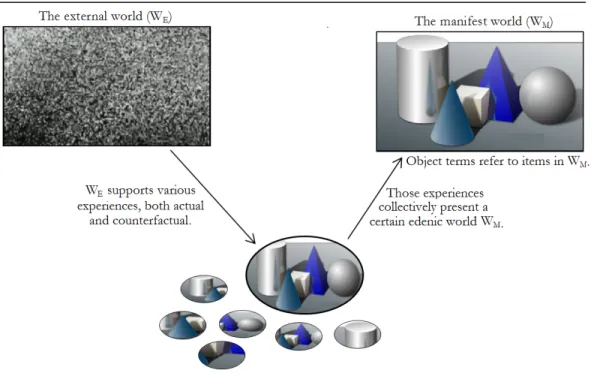
Edenic Idealism (EI): Ordinary object terms refer to items in the manifest world: the world WM of primitive objects and properties presented by our
experiences.
For example, suppose you have a phenomenal experience of an apple. The realist
wants to identify this apple with some item in the external world. But according to edenic
idealism, the apple is a denizen of the possible world WM presented by your experience.
Far from being some outlandish metaphysical theory, I argue that, in fact, EI is the position
of common sense. It is the most intuitively plausible view about what we are actually
talking about when we use terms for ordinary objects.
In chapter 7, I develop the edenic idealist’s positive metaphysical account in more
detail. In chapters 8-10, I defend edenic idealism from various traditional objections to
idealism. I conclude by discussing some applications of edenic idealism in chapter 11.
1.5 Future prospects for regulative metaphysics
In this chapter, I have sought to show that regulative arguments still have an important
role in contemporary philosophy. To this end, I have explained why these arguments do
not require certain problematic epistemic and semantic assumptions traditionally
associ-ated with them (section 1.3). I have also identified a variety of contemporary targets for
regulative arguments (section 1.4).
In future research, I hope to apply the regulative approach to metaphysics to further
areas of discourse. To conclude this chapter, I will mention a few further areas of discourse
where regulative arguments may be relevant:
-Scientific ontology. In chapter 8, I discuss what view the edenic idealist should take
towards scientific ontology. There, I observe that the same thought experiments used to
challenge a realist view of ordinary objects may also challenge a realist view of items
from scientific ontology (e.g., electrons, fields, quarks, etc.). This suggests the intriguing
possibility of motivating a semantic form of idealism for scientific ontology as well. I am
interested in defending this view, which I callmicrophysical idealism, in future work.
-Time: With edenic idealism (see 1.4.5), I argue that the semantics of our ordinary
object judgments are closely tied to our experience of objects. I suspect that there is also
a close link between the semantics of our temporal discourse and our experience of time.
For example, I think Oracle thought experiments may help clarifiy certain debates in the
philosophy of time (e.g., A-theory vs. B-theory).
-Chance: In future work, I am also interested in extending my argument for Humean
2 WATER, GAMES, AND CAUSES: A DECISION PROCEDURE FOR ESSENCE HUNTERS
2.1 Introduction
We think that some things have a unified nature for us to discover.1 For example, we
think science has revealed the nature of water to be H2O. We think that other things do not
have a unified nature for us to discover. For example, we do not think that there is anything
to discover about what it is to be a game.
What about the causal relation, or dispositions, or free will? For any
philosophically-interesting item X, one can find a host of competing theories regarding the nature of X.
In offering such analyses, philosophers assume that X is relevantly similar to water, not
gamehood. My project in this chapter is to show how, in a given particular case, this
assumption might be challenged.
I will identify two semantic features of the term ‘water’ that distinguish it from the
term ‘game’. These features explain why an informative analysis is available for water but
not gamehood. They also provide a method for determining whether a
philosophically-interesting itemXcan be given an informative analysis. As an application, I will consider
the term ‘cause’, defending the following thesis:
Thesis: The term ‘cause’ does not have the semantic role of expressing a
rela-tion with a discoverable, unified nature.
2.2 The project of analysis
Before beginning, it will be useful to distinguish two main ways in which philosophers
have thought about the project of philosophical analysis.
2.2.1 Conceptual analysis
On the traditional view, the project of analysis is an investigation of our concepts. For
example, (1) would be interpreted as a definition of the term ‘cause’:
(1) EventCcauses distinct eventE iff there is a (possibly empty) set of events
D1, D2, ... , Dn such that D1 counterfactually depends on C, D2
counter-factually depends onD1, ..., and E counterfactually depends on Dn. (Lewis
(1973a))
The standard strategy for evaluating traditional conceptual analyses is the method by
coun-terexample.”2 On this method, we test a proposed analysis of a term ‘X’ by checking
whether it agrees with our intuitive judgments aboutXacross various possible cases. Since
these intuitive judgments plausibly involve the exercise of our conceptual capacities, any
proposal that conflicts with these judgments fails as an analysis of the term. For example,
consider the following case:
“Billy and Suzy throw rocks at a bottle. Suzy throws first, or maybe she throws
harder. Her rock arrives first. The bottle shatters. When Billy’s rock gets to
where the bottle used to be, there is nothing there but flying shards of glass.
Without Suzy’s throw, the impact of Billy’s rock on in the intact bottle would
have [shattered the bottle]. But, thanks to Suzy’s preempting throw, that impact
never happens.” (Lewis (2000, 184))
Since (1) fails to uphold our intuition that Suzy’s throw causes the shattering of the bottle,
this case is a counterexample to (1).3 So the task for the theorist analyzing the term ‘cause’
2For discussion, see Williamson (2007, ch. 6) and Paul & Hall (2013, chs. 2 and 6).
3In this case, the set of events connecting Suzie’s throw to the shattering would be: the flight of Suzie’s
would now be to provide an amended analysis that avoids this counterexample.
2.2.2 Metaphysical analysis
While conceptual analysis still has its contemporary adherents, this project no longer
enjoys its traditional prominence.4 While there are several reasons for this decline, perhaps
the most important reason is that successful definitions have been very difficult to come by.
For example: after many iterations of the method by counterexample, some philosophers
have concluded that the term ‘cause’ simply does not have a definition.5
In response to these failures, some theorists have suggested that we reorient our
ap-proach to theorizing about causation, dispositions, knowledge, etc. Instead of interpreting
biconditionals like (1) as an analysis of the term ‘cause’, we should instead view them as
“metaphysical analyses” of the causal relation itself.6 Here is a representative quotation
from the causation literature:
“Conceptual analysis ... is an explication of everyday concepts. ... On the other
hand, [metaphysical] analysis seeks to establish what causation in factisin the actual world. [Metaphysical analysis] aims to map the objective world, not our
concepts” (Dowe (2000, 3))
This proposed shift from conceptual to metaphysical analysis is found in many other areas
of the literature as well.7
4For discussion, see Chalmers (2012, 10-12).
5See Schaffer (2007, 872). Another famous example is the Gettier literature: after dozens of failed
attempts to define the term ‘knows’, some philosophers have concluded that this term cannot be defined. See Shope (1983) for an overview.
6See, e.g., Sosa (2015, ch. 1). This project has various other names in the literature, including “factual
analysis” (Mackie (1985, 178)), “empirical analysis” (Dowe (2000, ch. 1)), and “ontological reduction” (Paul & Hall (2013, 29)).
7For example, Milikan (1984, 73) claims that she is not analyzing theconceptof meaning, but is instead
One can motivate the project of metaphysical analysis with examples ofa posteriori
necessities. The identification of water with H2O was not the result of traditional conceptual
analysis; instead, it was a substantive discovery about the metaphysical nature of water.
Similarly, the alleged identification of pain states with neural states is typically viewed as
a substantive discovery about the nature of consciousness.
Metaphysical analyses have different criteria of adequacy than traditional conceptual
analyses. They do not need to be analytic or a priori.8 They may not even have to be
metaphysically necessary.9 But perhaps the most important difference is that metaphysical
analyses are not required to align with our linguistic intuitions across all possible cases.
For the purposes of this chapter, I will consider this a sufficient condition for a theory to
count as an attempt at metaphysical analysis.10
2.2.3 The path ahead
To clarify the target of this chapter’s arguments, this section has provided background
on the various ways in which theorists have understood the project of analysis. Given the
decline of the traditional project of conceptual analysis, the arguments ahead are primarily
directed towards proponents ofmetaphysicalanalysis.
Let’s say that X has a unified nature iff there is some single, natural feature that is
necessary and sufficient for being an instance of X. Let’s say that X has a discoverable
nature iff learning X’s nature involves genuine discovery (i.e., extends beyond mere
re-flection on our concepts). Then, differences notwithstanding, proponents of metaphysical
8See Fair (1979, 231), Bigelow & Pargetter (1990), and Dowe (2000, 3).
9While some theorists (e.g., Earman (1976, 24), Tooley (1987, ch. 7)) require metaphysical analyses to
be necessary, other theorists (e.g., Aronson (1982, 302), Salmon (1984, 239-242), and Dowe (2000, 3)) only require truth in the actual world. Paul & Hall (2013, 40-41) take a middle position, claiming that metaphysical analyses should not rely on facts “too specific to one’s own world.”
10Given this sufficient condition, here are some examples of metaphysical analyses in the literature.