pages. Advisor: Phillip M. Edwards
This master’s paper describes an exploratory study of Association of Research Libraries member institution websites intended to detect references to Patron Initiated Collection Development (PICD) programs. This study was conducted in order to measure the prevalence of such references, to determine the types of documentation in which they occurred, and to determine the extent to which these references represent an attempt to represent PICD programs to the user.
References to PICD programs were discovered on 46 of the 124 ARL institution websites surveyed. These references varied greatly in content and specificity. Less than half of these were determined to be directed at an audience of users; an even smaller proportion of these references were intended to facilitate the submission of PICD requests. This data suggests that ARL institutions rarely cultivate user awareness of PICD programs via their websites.
Headings:
Research Libraries -- Collection Development Web sites -- Evaluation
James Steiner
A Master’s paper submitted to the faculty of the School of Information and Library Science of the University of North Carolina at Chapel Hill
in partial fulfillment of the requirements for the degree of Master of Science in
Library Science.
Chapel Hill, North Carolina April, 2011
Approved by
Table of Contents
1. Introduction...2
1.1 Area of Research ...2
1.2 Research Problem:...4
1.3 Research Objectives and Research Question: ...5
2. Literature Review ...7
2.1 Introduction ...7
2.2 Sources and Analysis ...10
2.3 Conclusion...17
3. Methodology ...19
3.1 Introduction ...19
3.2 Selecting a Sample Group...19
3.4 Classifying Documentation by Location...21
3.5 Classifying Documentation by Type: ...27
4. Presentation of Findings ...32
4.1 Overview of Results...32
4.2 Grouping Results by Type of PICD Reference...35
a. Coding Ambiguous References ...36
b. Coding Definite References ...38
4.4 Refining the Elsewhere Category:...41
5. Data Analysis ...43
5.1 Overview of Data Categorizations...43
5.2 Defining Analytical Categories ...44
5.3 Facilitating the Request Process...46
5.4 Explaining Policies and Practices...49
5.5 Professional Documentation ...52
6. Conclusion: ...56
1.
Introduction
1.1 Area of Research
This research project addresses the topic of patron-initiated collection development (PICD) programs and the manner in which they are represented on the websites of Association of Research Libraries member institutions. Over the past decade collection development departments at major academic libraries have increasingly employed PICD programs as a means of supplementing staff directed purchases (Nixon, Freeman & Ward 2010). PICD programs provide institutions with a means for rapidly fulfilling user requests for titles that are unavailable from a library’s general collection. Unlike inter-library loan (ILL) programs, which provide similarly rapid request
who then assess the requested title as to its suitability for potential purchase (Perdue & Van Fleet, 1999). The criteria by which these assessments are made vary from program to program, but commonly include measures such as price, ease of acquisition, subject heading, date of publication, and appropriateness to general collection development goals (Hodges, Preston & Hamilton 2010; Gee & Shirkey, 2010).
PICD began to be implemented by college and university libraries in the early 2000s (Nixon, Freeman & Ward 2010) but have their origins in earlier observations made by researchers concerning the low frequency with which patrons made use of librarian selected materials (Kent, 1979), the high cost of inter-library loan (ILL) transactions (Jackson, 1998) and the potential efficacy of using ILL requests as a basis for forming collection development policies in academic libraries (Byrd, Thomas, & Hughes,
This study will deal with one aspect of PICD programs: the manner in which the institutions that implement them represent them to end-users. This topic is of importance to collection development professionals interested in measuring user awareness of library programs; it will also provide a measure of the extent to which institutions are using the internet as a vehicle to educate patrons about the existence of PICD programs. These programs have been in effect at a significant number of academic libraries for the better part of a decade and are beginning to attract a wealth of evaluative scholarly literature. It is hoped a study that approaches these programs from the perspective of user education and user services will constitute an original contribution to this body of scholarship.
1.2 Research Problem:
The majority of research on PICD programs has examined their cost effectiveness (Allen et al., 2003; Foss, 2007; Anderson et al, 2003), and the long-term effect of their implementation of the makeup of core-collections (Tyler et al., 2010; Nixon & Saunders, 2010). Studies have also been performed that analyze what user groups most frequently utilize PICD services, whether these user groups request titles appropriate to their particular academic discipline, and whether or not books acquired through PICD programs have proven appropriate for university library collections (Anderson et al., 2010). The issues covered by these studies engage the concerns of the collection development professionals that implement PICD programs but do not successfully describe the experiences of the patrons that utilize them, nor do they measure the extent to which information about these programs is communicated to the user.
first-step in assessing users’ experiences of such programs. To date, treatment of this issue has been restricted to the occasional references to limitations that institutions impose on user access to information about the PICD process. A number of studies of PICD programs refer to the fact that PICD purchases generally take place “behind the scenes” (Hodges, Preston & Hamilton, 2010), in reference to the fact that ILL interfaces are often altered minimally, if at all, when PICD programs are implemented (Nixon, Freeman & Ward, 2010). This practice raises the question of whether institutions that have implemented PICD programs provide meaningful documentation of them to their users and to the public at large. The lack of research on this question within LIS studies represents a gap in the literature, and an opportunity to initiate analysis of PICD programs from a user services perspective.
1.3 Research Objectives and Research Question:
The objective of this research will be to document the manner in which libraries represent PICD programs to their users. The study will seek documentation of this
will further be limited by restricting the sample group to Association of Research Libraries (ARL) member institutions. This sample group has been chosen because its membership consists of a large number of often-interlinked institutions with diverse user groups and because a number of ARL Libraries have frequently documented their
implementation of PICD programs (Anderson et al., 2003; Way, 2009; Tyler et al., 2010). With these limitations in mind we can frame the research questions driving this study as follows: How prevalent are statements relating to PICDs on ARL member library websites? What kind of documentation contains these statements? Can they be found in ILL related documents, Collection Development related documents, or elsewhere on ARL member sites? Thirdly how are the parameters of PICD programs described to their users and to what extent do statements referring to them constitute an intentional effort on the part of ARL institutions to educate their users as to the nature and existence of PICD programs? Finally, to what extent do the presence of statements about PICD programs on ARL member websites correspond to institutional
2.
Literature Review
2.1 Introduction
Until very recently the collection development procedures at university libraries operated entirely on the basis of “just-in-case” resource selection models. Collection development librarians and subject specialists selected and ordered titles on the basis of anticipated user needs. In the past decade the rise of automated ILL request services and online book vendors has made more response based, “just-in-time”, collection
development programs possible and financially feasible. These programs, referred to variously as “books on demand” (Anderson, Freeman, Herubel, Mykytiuk, Nixon & Ward, 2010), “patron-initiated collection development” or simply “PICD” (Way, 2009), and “patron-driven acquisitions” (Nixon, Freeman & Ward, 2010), began to be
implemented by college and university libraries is the early ‘00s (Nixon et. el., 2010) but have long been proposed as a means to redress shortcomings of “just-in-case” models of collection development.
As such programs have become more popular numerous studies have been conducted to gauge their effectiveness in relation to older “just-in-case” models of collection development (Way, 2010; Perdue & Van Fleet, 1999; Hodges, Preston & Hamilton, 2010; Nixon & Saunders, 2010; Tyler, Xu, Melvin, Ep & Kreps, 2010). Yet despite the breadth of these evaluative analyses little work has been done that
Additionally, in none of these evaluative studies was an attempt made to describe the way in which the institutions that have implemented these programs represent them to their patrons.
In the absence of deliberate attempts to cultivate user awareness of PICD programs, there is often little to alert patrons to the fact that a PICD program is in operation. The majority of the evaluative studies treated by this literature review deal with programs in which PICD has been implemented to operate alongside more traditional ILL programs. In these programs requests resulting in the purchase of titles through PICD programs begin as normal ILL requests. Thus there is little detectable difference between PICD programs and ILL programs to the patron who receives a PICD acquired title shortly after submitting a request. Patron awareness of these programs is largely the result of deliberate institutional documentation. The forms that this
documentation takes and the frequency with which it occurs, particularly in the context of institutions’ websites are the subjects of this study. The scope of this study was limited to websites as they serve as the venue through which most ILL and PICD requests are processed.
The issue of librarian mediation of PICD requests has importance to this study insofar as librarian mediation represents a professional assessment of user needs in the context of larger institutional goals. This task of request assessment could arguably be aided or expedited by increasing user awareness of PICD programs and the criteria by which PICD requests are assessed. By reviewing studies of PICD programs that include librarian mediation of requests we can confirm the importance of the subject of
institutional representation of PICD programs. Most of the studies treated in this review (Hodges et. al., 2010; Perdue & Van Fleet, 1999; Tyler et. al., 2010; Anderson et. al. 2010; Nixon & Saunders, 2010; Adler, 2007), evaluated programs where PICD requests were subject to some form of mediation. A small number of studies (Levine-Clark, 2010; Way, 2009) dealt with programs that were not subject to librarian mediation.
All of these studies were searched for references to the need to cultivate, or to discourage, user awareness of PICD programs either through documentation of PICD programs on institutions’ websites, or through any other channels. Little substantive documentation of this issue was found. Studies that do make references to user awareness of PICD programs often do so in contradictory fashions. Some studies (Hodges et. al., 2010; Perdue & Van Fleet, 1999; Levine-Clark, 2010; Adler, 2007) state that users need not be made aware of the existence of PICD programs, while others (Anderson et al., 2010) portray user education as a means to increase the effectiveness of PICD programs. None of the evaluative studies that made reference to the issue of user awareness of PICD programs made any attempt to describe the way in which these programs were
2.2 Sources and Analysis
“Patron-Initiated Collection Development: Progress of a Paradigm Shift” (Hodges et. al., 2010) assesses the effectiveness of two programs implemented by Ohio State University Libraries (OSUL), an interlibrary loan PICD program and a patron-driven e-books acquisition program. References to user awareness of the programs are minimal in this study. In two instances the Ohio State’s PICD programs are described as being hidden from users. Purchases of patron requested materials are referred to as taking place “behind the scenes”, and the e-book PICD interface is described as offering “no
indication… (that a user request) would trigger a purchase.” No rationale is provided for the deliberate opacity of these programs.
Both the implementation and the assessment of OSUL’s PICD programs involve librarian mediation. In these studies this mediation often takes forms derived from more traditional collection development processes. These forms include, librarian oversight of selected titles to ensure financial feasibility and academic appropriateness,
interdepartmental communication to ensure the timely ordering, cataloging and distribution of selected titles, and librarian led analyses of request and circulation
statistics. All titles requested through OSUL’s PICD program were subject to significant librarian oversight. Librarians established criteria for patron-initiated requests that included limitations on price, publication type, subject matter and media type. This oversight policy is framed as a dynamic process that admits exceptions. In certain
instances nominally prohibited materials – fiction, computer manuals and other classes of title - could be purchased provided they met librarians’ standards for research use.
base and of the program’s budgetary requirements as compared with previously used “just-in-case” collection development programs. Hodges’ description of these processes of mediation portrays librarians’ efforts to balance user needs against collection
development policy, a process that might be facilitated by raising user awareness of PICD programs.
“Borrow or Buy? Cost-Effective Delivery of Monographs” (Perdue & Van Fleet, 1999), a study of a PICD program implemented at Bucknell University’s Bertrand Library in 1990, found that patron-initiated collection development programs could provide libraries with collection relevant, frequently circulated materials in a cost effective manner at a time when few libraries as implemented such programs. The study is frequently cited as having inspired many academic libraries to adopt similar programs (Way, 2009; Anderson et. al., 2010; Tyler et. al., 2010). The study does not contain any evidence that Bertrand Library’s acquisition department prioritized the cultivation of user awareness of their PICD program. Perdue & Van Fleet quote Bertrand Library’s
acquisitions staff on this issue: “Our reasoning was that library patrons didn’t really care how we acquired needed materials. The patron’s initial concern was speed of delivery” (1999).
indicated that selective employment of such measures could enable it to function more smoothly.
“Just How Right Are The Customers? An Analysis of the Relative Performance of Patron-initiated Interlibrary Loan Monograph Purchases” (Tyler et. al., 2010) contains research conducted on the University of Nebraska Lincoln Libraries’ PICD program that addresses librarians’ concerns that the implementation of such programs will supplant traditional collection development policies and will result in unregulated, indiscriminate acquisition policies. Concerned librarians predicted that the long-term implementation of such policies would result in the creation of collections with “poor usage and poor use value” (Tyler et. al., 2010). The study compares circulation rates of patron and librarian acquired items and finds that the former generally have higher effective use rates,
meaning these items generally possess higher use to cost ratios. The study also addressed the issue of topical idiosyncrasy, or the potential for patron-acquired books to fall outside of what librarians and faculty regarded as relevant fields of academic study. The study contained no mention of efforts made by UNL librarians to either cultivate or curtail user awareness of the library’s PICD program. The study found that librarian mediation of patron-initiated acquisitions, including the implementation of accession guidelines that, in many cases, resemble traditional collection development policies, resulted in the acquisition of frequently used, topically relevant materials, a conclusion echoed by a number of other studies (Anderson, et. al., 2002; Ward et. al., 2003; Way, 2009)
“Liberal Arts Books on Demand: A Decade of Patron Driven Collection
University in 2000. Through the statistical analysis of ten years of Books on Demand records the authors measure the size and makeup of the Purdue Books on Demand system’s user base, the frequency with which Books on Demand users request scholarly as opposed to general interest titles, and the frequency with which requested titles re-circulate (Anderson et al., 2010). The study takes as its main point of inquiry the extent to which patrons who utilized the Books on Demand system requested titles from outside of their area of academic specialization. It found that such requests were surprisingly
common and that patrons most often requested titles from fields separate from, but related to, their chief areas of research – a literature student requesting a title on film theory, or a philosophy student requesting a women’s studies text. Based on these findings they concluded that cross disciplinary patron-initiated requests could not be explained by recreational reading, but rather that they indicated that the implementation of the Books on Demand program had created an upswing in cross-disciplinary research (Anderson, et al., 2010). This information helped to refine librarians’ understanding of user research habits and improved librarian oversight of the Books on Demand program, particularly in the field of title assessment. Anderson et al. make no direct mention of institutional efforts to educate users about the implementation of Purdue’s PICD
“Developing a Multiformat Demand Driven Acquisitions Model” (Levine-Clark, 2010) discusses the prospect of implementing a PICD program at the University of Denver. The study proposes a system that involves minimal librarian mediation. It posits the incorporation of an electronic database of all scholarly titles offered by Blackwell Book Services into the main catalog of the University of Denver’s Penrose Library. This proposed database would be browsable by students, with each record containing a link allowing the student to request purchase of the title. Librarian mediation would amount to ensuring that the request was not redundant, and that the material was not already in the Penrose Library’s collection. Interestingly, this proposal advances claims of increased circulation for patron-initiated requests that are significantly greater than those advanced in other studies (Nixon & Saunders, 2010; Hodges et. al., 2010; Tyler et. al., 2010), but draws these figures from an interview (Lugg et. al., 2010) rather than from an empirical study. This study makes only one reference to user awareness of Penrose Library’s PICD program. Levine-Clark notes that the interface supporting Penrose Library’s PICD
Program is designed in such a way as to be invisible to the patron using it and that a patron who makes a request that results in a PICD purchase “will not be aware that their use has sparked a purchase” (Levine-Clark, 2010).
“Direct Purchase as a Function of Interlibrary Loan” (Adler, 2007) presents a study of the patron-initiated collection development program at Brigham Young
lasting relevance to the collection, an attribute judged by both the Acquisitions Manager and subject specialist librarians. Adler’s study makes no direct reference to user
awareness of Harold B. Lee Library’s PICD program but does state that “the patron cares little about how books are acquired” (Adler, 2007). This statement, which implies that patrons do not need to be aware of the existence of PICD programs, echoes the claim found in Perdue & Van Fleet that states “library patrons didn’t really care how we acquired needed materials” (1999).
“The Assessment of Patron-Initiated Collection Development via Interlibrary Loan at a Comprehensive University” (Way, 2009) analyzes the implementation of a PICD program at Grand Valley State University, a comprehensive university in which a preponderance of undergraduate students are enrolled and which does not offer degrees above the Masters level. This is of particular significance, as numerous studies have noted that graduate students and faculty submit the majority of PICD requests (Anderson et. al., 2003; Hodges et. al., 2010). This study made no direct mention of institutional efforts to educate users about the implementation of Purdue’s PICD program.
over depth of coverage” (Way, 2009), and consequently decided to dispense with the assessment of patron-requested items by bibliographers and subject specialist librarians – the method of assessment favored by several other institutions (Anderson et. al., 2003; Hodges et. al., 2010; Perdue, et. al. 1999). Instead, Grand Valley State used the holdings of peer-institutions as a benchmark for predicting which patron-requested titles would prove relevant. Researchers found that patron-requested titles that were also held by peer institutions circulated more frequently than those that were not. This instance of using peer comparison rather than staff review as a criterion for item selection appears to be unique in the literature addressing patron-initiated collection development programs in that it forgoes subjective librarian mediation and oversight in the process of research selection.
2.3 Conclusion
The existing literature on PICD programs consists almost entirely of evaluative studies. These studies have measured the effectiveness of patron-initiated collection development models in terms of their expeditiousness, the breadth of the patron groups that utilize them, the extent to which materials acquired meet librarians’ standards of authoritativeness and subject appropriateness, and PICD programs’ general cost effectiveness when judged in comparison with more traditional ILL programs. Yet
3.
Methodology
3.1 Introduction
This study performed a qualitative analysis of references to PICD programs gathered from ARL member websites. The following methodology will provide a justification for the selection of the ARL as a sample group, a narrative of the data
gathering process and a description of and rationale for the process of classifying the data gathered by location – where on the website data was gathered from, and specificity of reference – whether the reference made to PICD could be considered definite or
ambiguous. These basic classifications provided the basis for a more detailed data coding process that will accompany the presentation of the data. This inductive coding process classified references to PICD programs according to the characteristics of the institution from which they were gathered and according to their textual content. Exemplary references were then selected from each of these groupings for more detailed content analysis.
3.2 Selecting a Sample Group
including the Library of Congress, Harvard University Library and the New York Public Library. More importantly for the purposes of this study, ARL member libraries boast large and innovative collection development departments. ARL member institutions’ user bases include huge numbers of university faculty, graduate students and government researchers all of whom have extensive and diverse research needs. The ARL Statistics 2008-2009 recorded ARL member libraries total annual acquisitions as exceeding 6 million monographs, with a mean of 53,292 monograph purchases per institution (Association of Research Libraries, Kyrillidou & Bland, 2010). The collection
development departments of these institutions are continually looking for more efficient ways to measure and fulfill user needs and, as a consequence, have often been early adopters of PICD programs.
Many of the most significant and influential evaluative studies to appear on the effectiveness of PICD programs in the last ten years have been performed on programs instituted by ARL members. Subjects of such studies include PICD programs
are ARL institutions providing any documentation of PICD programs to the user groups that they are designed to serve?
3.3 Scope and Classification Schemes
This study sought to gather data on the manner in which ARL institutions represent PICD programs to their patrons. PICD purchases largely originate as ILL requests which ILL and collection development staff judge to be desirable, appropriate additions to their institution’s general collection. As online forms have replaced paper slips as the vehicle for ILL requests ILL request interfaces have largely migrated from analogue to electronic environments. Consequently this study looked to ARL websites as the source of institutional documentation of PICD programs. This study intended to determine the extent to which ARL institution websites were educating their users about the existence of PICD programs. In order to do this it was necessary to classify the types of documentation that we encountered. Documentation types were categorized according to their intended audience and their potential efficacy as tools for user education. We did this by classifying documentation of PICD programs found on ARL sites according to the location in which they were discovered and the type of reference that they contained.
3.4 Classifying Documentation by Location
This study sought references to PICD programs on ARL institutions’ websites in three general types of documentation: ILL documentation, collection development
step towards the more detailed coding and eventual analysis of references to PICD programs discovered on ARL institutions’ websites.
This study classified ILL related documentation as any portions of an ARL institution’s website that a user might resort to in order to complete an ILL request. This included the ILL interface itself, as well as any pages relating to the ILL interface that could be classified as instructional in nature, including “About” and “FAQ” pages. ILL related pages were located by browsing the menus and site maps of ARL institution sites and by performing Google “site:” searches for the terms “ILL”, “Interlibrary” and Inter-library”. ILL related documentation was discovered on all 126 ARL Institution sites.
Once ILL related documentation was discovered it was searched for references to PICD programs using the following pre-determined set of keywords:
Patron Directed User Directed Purchase on Demand
Patron Initiated User Initiated Purchase at Request
Patron Driven User Driven Books on Demand
Books at Request These keywords all appear as means of characterizing PICD programs in scholarly literature related to the topic.
scanning process also sought documentation that might lead a user to believe that his request would be dealt with by collection development staff rather than by ILL staff. This search of ILL documentation also recorded references to “recommend a purchase” or “suggest a purchase” programs. These programs can be distinguished from PICD programs in that they provide a means for patrons to suggest purchases to the Collection Development department to be considered over the long term. Unlike these programs, PICD programs are characterized by the rapid fulfillment of user requests with title purchased for addition to the general collection. ILL documentation was scanned for references to “request a purchase” or “suggest a purchase” programs because they are often characterized using language similar to that used to describe PICD programs. Figure 1 features a screen cap of the University of Oklahoma Libraries’ “Library
Figure 1: A Representative Recommend/Suggest a Purchase Form
This study also sought references to PICD programs in formal collection development policies posted on ARL institutions’ websites. Written collection
these policies online, a practice which has made them instantaneously accessible to library patrons. Of the 126 ARL institutions only 15 were found not to have posted collection development policies or other collection development related statements.
These policies were located by manual scanning of institutions’ websites. In many cases unclear or complicated website designs made these policies difficult to locate, in which case they were located through Google “site:” searches that used the following keywords:
Collection Development Collection Management Acquisitions
Once the policies were located they were read manually and searches were conducted using the same set of keywords employed to search ILL documentation for PICD references. These keywords all appear as means of characterizing PICD programs in scholarly literature related to the topic.
In many instances an institution will have posted multiple collection development policies; one for each subject specialist working in collection management, or one for each distinct library or collection located within an institution, Health Sciences Libraries and special collections departments for instance. In cases where institutions had multiple collection development policies or in which a collection development policy was
presented, with variations, in multiple locations all of these policies and/or locations were searched in the manner described above.
on collection development related services, policies and practices rather than
encountering them by chance in the course of utilizing library resources. Nonetheless publicly posted collection development policies constitute a formal attempt at user education. References to PICD programs contained in collection development policies can thus be seen as deliberate representations of these programs to an institution’s user base. The same cannot necessarily be said of references garnered from elsewhere on ARL institutions’ websites. The varied contexts in which these references occur can only sometimes be seen as instances of an institution’s deliberate representation of PICD programs to its users.
After searching the ILL related documentation and posted collection development policies of ARL institution websites for references to PICD programs the remainder of ARL institution websites were search for references to PICD programs. Searches were conducted using the same set of keywords employed to search ILL documentation for PICD references. These keywords all appear as means of characterizing PICD programs in scholarly literature related to the topic.
programs appearing in non-ILL and Collection development related contexts occurred in posted records of staff meetings or in semi-annual departmental reports. Despite having been publicly posted these references were seen as intended for groups of librarian peers rather than for users. In characterizing references to PICD programs that appear in non-ILL and collection development contexts it is important to distinguish between
documentation intended for an audience of users and documentation intended to be viewed by an audience of professional peers. All references, regardless of their origin were subject to an additional set of classifications by type.
3.5 Classifying Documentation by Type:
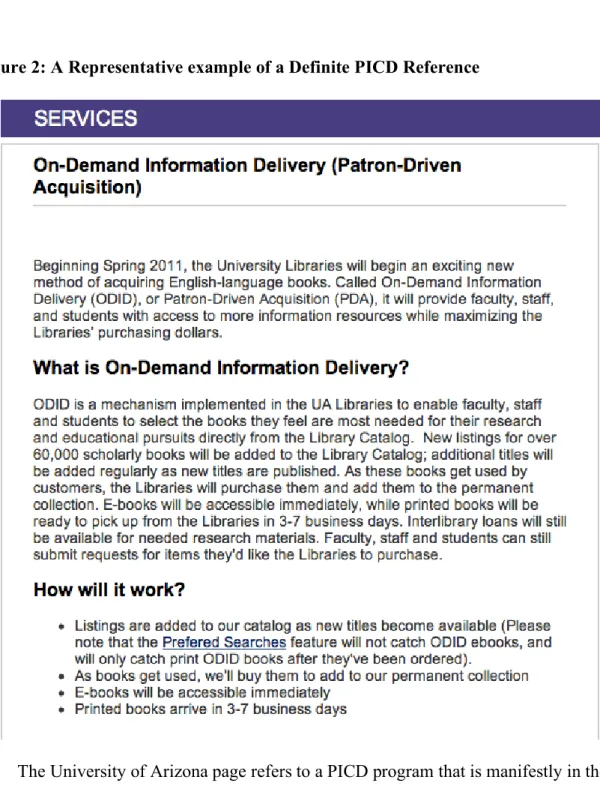
Figure 2: A Representative example of a Definite PICD Reference
The University of Arizona page refers to a PICD program that is manifestly in the process of being implemented. It explicitly uses language associated with PICD
Ambiguous References are classified as references that did not indicate the definite presence of a PICD program at a given institution. Ambiguous references fell into two general categories; explicit mentions of PICD programs that left it unclear as to whether or not an institution had adopted such a program, and references to programs for the acquisition of user requested material that were not described in enough detail in order to determine whether the program was in fact a PICD. In many cases these references were not specific enough to determine whether or not the referred to PICD programs or the more common suggest/recommend a purchase programs. Language used to describe request a purchase programs is often similar to that used to describe PICD programs, but in the case of the former patrons recommend a title to the collection development
department to be taken under considerations for purchase.
Figure 3: Representative Ambiguous Reference: Implementation Uncertain
Figure 3 describes plans for gradually adapting existing “suggest a purchase” and ILL request screening programs into a more complete PICD style program for the acquisition of patron requests. However, because Figure 3 provides neither a timetable for the implementation of this program, nor evidence that this program will shortly be implemented, it was classified as an ambiguous reference.
Figure 4 provides an example of a PICD reference that was classified as ambiguous because it could not be distinguished from more traditional recommend/suggest a
Figure 4: Representative Ambiguous Reference: Suggest a Purchase
Figure four is an excerpt from the University of Michigan’s Collections Overview that refers to an indefinite process for acquiring user requests. This reference was classified as ambiguous because it was not descriptive enough to determine whether it referred to a recommend/suggest a purchase program or to a PICD program.
4.
Presentation of Findings
4.1 Overview of Results
After conducting the search processes outlined in the preceding section data was tabulated and coded. Websites from 124 English-language institutions among the 126 ARL institution libraries were searched for references to PICD programs. Two institutions, the Bibliotheque de l'Universite' Montreal and the Bibliotheque de
l'Universite' Laval were deliberately excluded from this sample group as their websites were presented entirely in French. In order to properly search these sites for references to PICD programs it would be necessary to consult French language Information and
Library Science literature to determine the proper professional vocabulary used to refer to PICD programs, and to construct a list of appropriate search terms on the basis of this list. It was decided that this was beyond the scope of this research.
Table 1: Data Summary: PICD References on ARL Institution Websites
Reference Type Institutions # of Institutions % of Institutions # of Institutions % of
All
Institutions 126 100.0%
No Reference
to PICD 80 63.5%
In ILL
Docs 1 0.8%
In CD
Docs 4 3.2%
Ambiguous Reference to
PICD 26 20.6%
Elsewhere 21 16.7%
In ILL
Docs 1 0.8%
In CD
Docs 5 4.0%
Definite Reference to
PICD 20 15.9%
Elsewhere 14 11.1%
Total PICD
References 46 36.5%
References to Request a Purchase Programs
117 92.9%
No References to Request a Purchase Program
7 5.6%
Unable to Gather Data
on Any Point 2 1.6%
A total of forty-six references to PICD programs were found on ARL institution websites. Twenty-six of these references were classified as ambiguous, twenty as definite. No references to PICD programs were found on eighty-one, or 64.0%, of the websites of the 126 ARL institution libraries.
policy statements. References drawn from third location type – referred to in this study as ‘elsewhere on ARL institution site’ – were drawn from any area of ARL institution website other than ILL related documentation or collection development policy pages. This third category is defined in a more detailed fashion in Table 5, where references to PICD programs gathered from elsewhere on ARL institution sites are classified according to the location in which they were discovered. The more precise coding of this location type was deferred in order to simplify the initial presentation of the data.
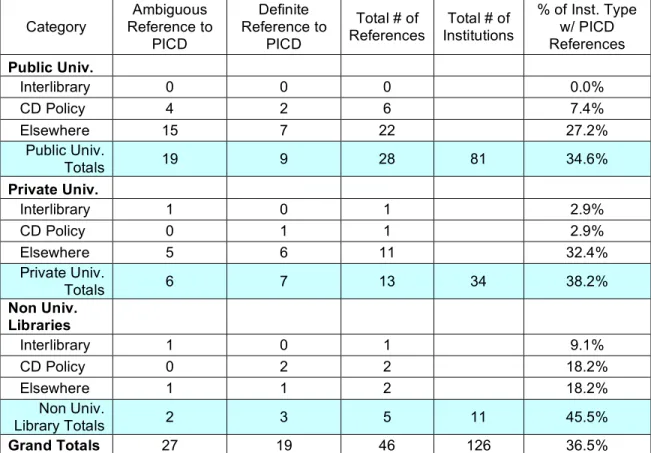
Definite and ambiguous references were distributed across these location types in consistent patterns. A preponderance of both definite and ambiguous references were discovered “elsewhere” on ARL institution websites regardless of institution type. An appreciable number of references – four ambiguous and five definite – were found in posted collection development policies. Only two references to PICD programs – one ambiguous and one definite – were discovered in ILL related documentation.
Table 2: Data Summary; PICD References on ARL Institution Websiteswith Breakdown by Institution Type
Category Ambiguous Reference to PICD Definite Reference to PICD
Total # of References
Total # of Institutions
% of Inst. Type w/ PICD References
Public Univ.
Interlibrary 0 0 0 0.0%
CD Policy 4 2 6 7.4%
Elsewhere 15 7 22 27.2%
Public Univ.
Totals 19 9 28 81 34.6%
Private Univ.
Interlibrary 1 0 1 2.9%
CD Policy 0 1 1 2.9%
Elsewhere 5 6 11 32.4%
Private Univ.
Totals 6 7 13 34 38.2%
Non Univ.
Libraries
Interlibrary 1 0 1 9.1%
CD Policy 0 2 2 18.2%
Elsewhere 1 1 2 18.2%
Non Univ.
Library Totals 2 3 5 11 45.5%
Grand Totals 27 19 46 126 36.5%
Types of references to PICD programs found within each of these institution types will be described in more detail by further coding.
4.2 Grouping Results by Type of PICD Reference
a. Coding Ambiguous References
Ambiguous references were coded according to the nature of their ambiguity. Analyses of the data resulted in the creation of three classes of ambiguity, cases in which the nature of the program referred to by the reference was indefinite, cases in which the nature of the program referred to was limited, and cases in which it could not be
determined whether the program referred to was yet in the process of being implemented. The data is presented below in table 3:
Table 3: Coding Ambiguous PICD References by Type
Reference Location
Nature of Program Indefinite
Nature of Program
Limited
Implementation
Uncertain Total
ILL
Documentation 1 1 0 2
CD Policies 2 2 0 4
Elsewhere 6 2 12 20
Total 9 5 12 26
Twelve ambiguous references were found that explicitly referred to PICD programs but left it uncertain as to whether or not these programs were in the process of implementation. These references often appeared in particular types of documentation, most notably in reports drawn up by collection development committees to outline their plans and projections for the upcoming year, or in posted meeting minutes of collection development departments. Typical of such references is the Collections Budget Reduction Plan for 2010-2011 posted by Rice University’s Fondren Library, which simply states, “we will be exploring purchase-on-demand” (Keck, 2010). This statement contains no details such as funds allotted, criterion for item purchases, or timetables for pilot
Fondren Library. All “Implementation Uncertain” ambiguous references to PICD programs occurred ‘Elsewhere’ on ARL institution sites, none occurred in ILL or collection development related documentation. The location in which these references were found is more thoroughly described in Table 5, which codes all references found “Elsewhere” by specific location.
The two other categories of ambiguity contained clear references to implemented programs for the purchase of user requests. However, these references were not specific enough to determine if the programs they described met the criteria of rapid and
permanent request fulfillment inherent to PICD programs. The category of “Nature of Program Indefinite” was used to describe ambiguous references that might be construed as referring either to PICD or more traditional recommend/suggest a purchase programs. For example the Graduate Library Collections Overview posted by the University of Michigan’s Hatcher Graduate Library, describes a program whereby patron requests are “treated on a priority basis, and patrons will be notified of the action taken by the
Graduate Library” (Desai, 2010). This reference is vague about the timeframe for request fulfillment and could be describing a policy that processes user requests rapidly, or one that subjects user requests to a more protracted review process. This reference does not definitively refer to a PICD program, but does refer to an imprecisely defined program for purchasing user requests.
programs for the acquisition of e-books upon request, or PICD programs available only to graduate students or faculty - were considered to be definite references to PICD
programs. References to programs subject to two or more such limitations were
considered to be ambiguous because of the limited nature of the program described. The
Procedures for Ordering New Library Materials posted on the Queens Library website provide an example of this. This document describes a program for the rapid acquisition of course reserve titles requested by faculty members (Phillips, 2009). This reference was classified as “ambiguous-nature of program limited” because it was limited both by patron group served and resource type acquired.
b. Coding Definite References
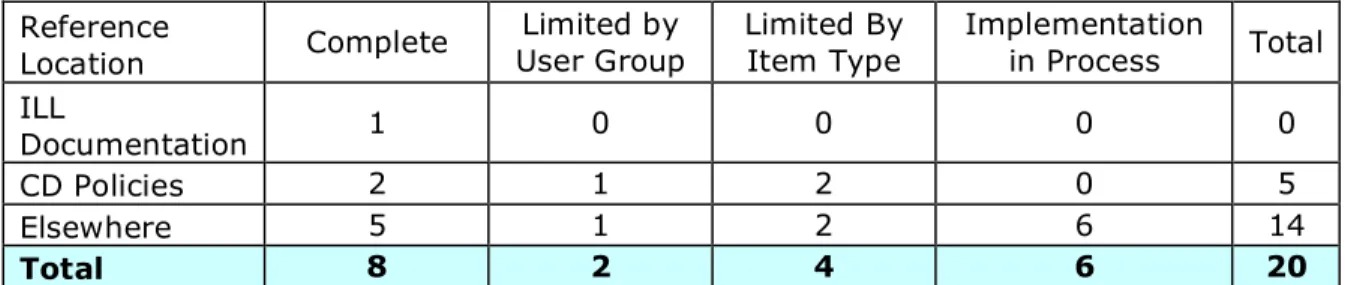
Table 4: Coding Definite References by Type
Reference
Location Complete
Limited by
User Group Limited By Item Type Implementation in Process Total ILL
Documentation 1 0 0 0 0
CD Policies 2 1 2 0 5
Elsewhere 5 1 2 6 14
Total 8 2 4 6 20
Two of the eight definite references to PICD Programs classified as “Complete” appeared within institutions’ posted collection development policies. The Washington State University Library Collection Development Policy devotes a paragraph to a
description of its PICD Program while the Center for Research Libraries’ Policy devotes an entire page to their Demand Purchase Program. The remaining five definite references to PICD Programs classified as “Complete” were found elsewhere on ARL institution sites. The location in which these five references were found is more thoroughly
described by Table 5, which codes all references found “Elsewhere” by specific location. Two definite references to PICD Programs discovered on ARL Institution
Four definite references to PICD Programs discovered on ARL Institution websites were classified as being limited by item type. Both such references found “Elsewhere” on ARL Institution websites indicated the presence of PICD Programs that served both students and faculty, but these programs were limited by item-type acquired to E-books only. An abstract of a conference presentation, “Let the Patron Drive:
Purchase on Demand of E-Books” posted on University of Southern Illinois’ website (Imre & Nabe 2010) describes that institution’s e-book limited PICD Program. Two references to similar e-book only programs were discovered in the collection
development policies posted on websites of the libraries of the University of Southern California and the University of Utah.
Six definite references to PICD Programs, all discovered “Elsewhere” on ARL Institution websites described programs that were in the process of being implemented. Four of these references were discovered on portions of ARL websites devoted to
professional communications. Professional communications can be defined as documents such as task force reports and transcripts of departmental meetings that are intended for an audience of professional peers rather than an audience of users. A Task Force Report posted on the Cornell University site described the steps taken by the library in
website, which features a page announcing a the progress of pilot PICD Program that they have implemented.
4.4 Refining the Elsewhere Category:
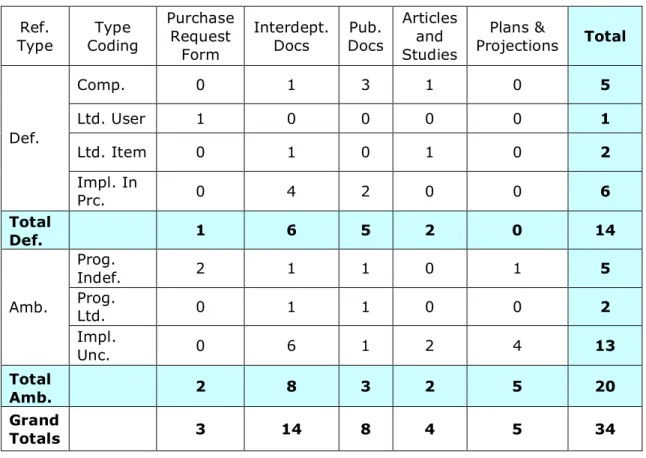
It is acknowledged that the location category “Elsewhere” used to describe the location in which a significant number of references were discovered on ARL institution websites is insufficiently refined for the purposes of this study. It was adopted for the purposes of simplifying preliminary data coding. Table 5 presents a more detailed, location specific coding of all references to PICD programs discovered on ARL institution websites:
Table 5: Coding “Elsewhere” by Location
Ref.
Type Coding Type
Purchase Request
Form
Interdept.
Docs Docs Pub.
Articles and Studies
Plans &
Projections Total
Comp. 0 1 3 1 0 5
Ltd. User 1 0 0 0 0 1
Ltd. Item 0 1 0 1 0 2
Def.
Impl. In
Prc. 0 4 2 0 0 6
Total
Def. 1 6 5 2 0 14
Prog.
Indef. 2 1 1 0 1 5
Prog.
Ltd. 0 1 1 0 0 2
Amb.
Impl.
Unc. 0 6 1 2 4 13
Total
Amb. 2 8 3 2 5 20
Grand
Totals 3 14 8 4 5 34
5.
Data Analysis
5.1 Overview of Data Categorizations
In the previous section, references to PICD programs discovered on ARL institution websites were categorized according to reference specificity and location. Definite PICD references that indicated the presence or manifest implementation of a program for the rapid and permanent fulfillment of user requests were distinguished ambiguous references whose nature was unclear or whose implementation was uncertain. References were further categorized by the location in which they were found. All of these references were subject to further coding.
Definite references were categorized by the relative completeness of the programs they described. Programs that were limited by user group and item type were
5.2 Defining Analytical Categories
In order to fully address the questions posed by this study these schema of categorization must be elaborated upon. The categorization of data summarized above gives us a notion of the prevalence of statements concerning PICD programs on ARL institution websites, the locations in which they can be found and the their prevalence on the websites of both public and private academic institutions as well as nonacademic institutions. However, they do not address the issue of how these references to PICD programs found on ARL institution websites represent them to users. Are these
references, be they ambiguous or definite, deliberate attempts on the part of institutions to educate their users about PICD programs? Are these references meant to ease the user’s engagement with the request process, or, rather than being directed at users, are they merely byproducts of institutional processes of self-documentation?
Content analysis of references to PICD programs discovered on ARL institutions’ websites found that they could be grouped into three categories according to the manner in which they represented these programs and the audiences for which these
representations were intended. These categories are as follows: references aimed at users in the process of submitting a request, references that occur in documentation that
explains policies and practices to curious users and references not deliberately aimed at any user group. Data gathered on reference location and type aided in the definition of these categories.
in the process of requesting a book not held in a library’s general collections. The second category can be further described as explicatory references. These references are directed at patrons, but are not intended to aid in the immediate facilitation of a request. These references, which were generally found in collection development related documentation, were deliberate statements to the public about library policy and practices. The third category can be further described as references that occur in the context of professional communications. Rather than representing institutional efforts to educate users about the existence of PICD they are instead byproducts of institutional processes of self
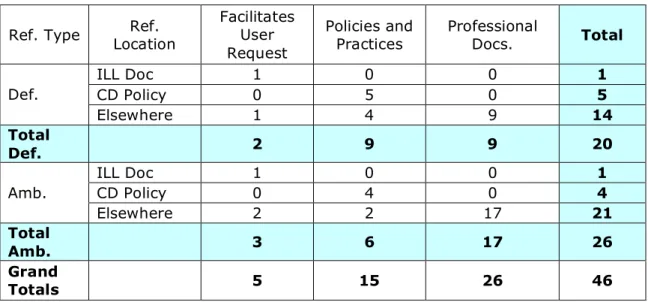
documentation, such as those references to PICD programs that were discovered in transcripts of departmental meetings or quarterly reports. Representative references, both definite and ambiguous, from each of these three categories are the subject of more detailed content analysis on the following sections. See Table 6 for the distribution of PICD references into categories based upon the manner of their representation of PICD programs to the user.
Table 6: PICD References by Representation Type
Ref. Type Location Ref.
Facilitates User Request
Policies and
Practices Professional Docs. Total
ILL Doc 1 0 0 1
CD Policy 0 5 0 5
Def.
Elsewhere 1 4 9 14
Total
Def. 2 9 9 20
ILL Doc 1 0 0 1
CD Policy 0 4 0 4
Amb.
Elsewhere 2 2 17 21
Total
Amb. 3 6 17 26
Grand
5.3 Facilitating the Request Process
References to PICD programs designed to facilitate the request process were undoubtedly the rarest type encountered on ARL institution sites in the course of this study. These references were identified by criterion of location and content. References had to be located in areas of an institution’s website that a user might encounter in the process of submitting a request. These locations might be classified as ILL related
documentation – which was granted a distinct category in the data gathering process - and ‘submit a purchase request’ pages. References located on submit a purchase request’ pages were included in the “elsewhere’ location category during the data gathering process (see table 5).
Auburn University Libraries has a set of Interlibrary Loan Services pages that includes a page dedicated to indexing and explaining the various document delivery services including standard ILL services as well as on campus delivery and serial and e-book printing services. Amongst these services is a service referred to as “Purchase Request” that meets this study’s criterion for PICD programs and allows students, faculty and staff to “Order books not currently owned by the AU libraries and be notified by email of their delivery.” (Auburn University Acquisitions, 2011). This reference not only contains details about the nature of the service, the user group served and the expected request-fulfillment time, it also provides a link to a Purchase Request page that allows users to submit their request.
The only other definite PICD reference discovered on an ARL institution website that seemed intended to facilitate the request process was found on the website of
Only four of the ambiguous references to PICD programs discovered on ARL institution websites seemed designed to facilitate the request process. Three of these appeared on purchase request forms. These references left it uncertain as to whether the program being described was a PICD program or a more traditional “suggest a purchase” program. As an example, The Harvard College Library website included a “Collections Purchase Request” page that describes a program that may or may not be a PICD program. Most of the language on the site – requests are referred to repeatedly as “recommendations” – indicates that a “suggest a purchase” program is being described though there is an option for “rush requests” (Harvard College Library, 2009) that may qualify as a PICD option.
The remaining reference designed to facilitate the request process was found on in the National Agricultural Library’s website. While it was discovered on pages related to the library’s ILL program, these pages were remote from the website’s main ILL
interface. A user would be unlikely to encounter this reference in the process of submitting a request. Thus, while it qualifies as a reference designed to facilitate the request process on the basis of content, its relatively inaccessible location qualifies this classification somewhat. This differentiates it from the references found on the Auburn University and Brigham Young University sites.
concerning the patron group served, the criterion for materials acceptable to request and the procedure and time periods for request processing. None of the PICD programs at other ARL institutions were supported by such transparent, detailed and accessible documentation. This documentation not only alerts patrons of the existence of a PICD program but, because of its content and the locations in which it appears, does so as the user is submitting a request.
5.4 Explaining Policies and Practices
References to PICD policies that facilitated the request process were relatively uncommon. More common were references that occurred in the context of documentation that stated Library Policy and Practices. The category of references intended to explain policy and practice can be defined by attributes of reference location, intended audience and reference content. References explaining policies and practices references were found in documents that were directed at an audience made up of patrons and the general public but were not directed at patrons who were actually in the process of submitting a request. This sort of documentation constitutes a deliberate effort to inform patrons about the existence of a PICD program but leaves the request interface itself opaque. At
institutions where this sort of documentation is found users can submit ILL requests without being made aware that their requests might be fulfilled by the rapid purchase of a title. Institutions that provide documentation of PICD programs in the context of
statements concerning policies and practices effectively ensure that purchases themselves generally take place “behind the scenes” (Hodges, Preston & Hamilton, 2010).
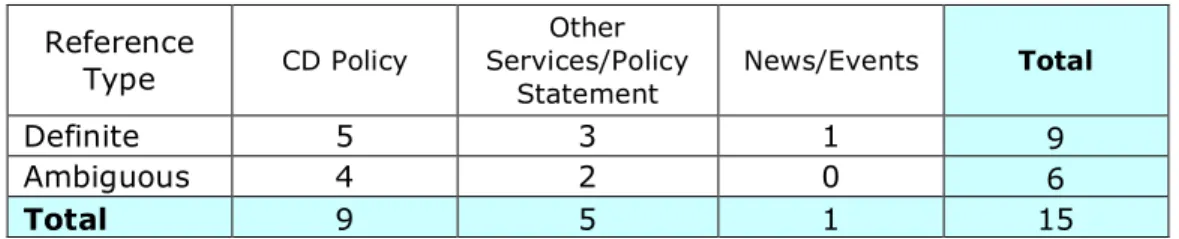
development related documentation were classified as “explaining policies and practices”, as were a number of those categorized as being found “elsewhere”. Documentation found “elsewhere” took a number of forms including policy related statements like collection overview statements (Desai, 2010), library services pages (University of Arizona Libraries, 2010), and news or events postings on an institutional main page (University of Nebraska Libraries, 2010). See table seven for the distribution of PICD references explaining policies and practices.
Table 7: PICD References Explaining Policies and Practices
Reference
Type CD Policy
Other Services/Policy
Statement
News/Events Total
Definite 5 3 1 9
Ambiguous 4 2 0 6
Total 9 5 1 15
Fifteen references to PICD programs were found in documentation describing Libraries’ policies and practices on ARL institution websites. Nine of these references were judged to be definite; six were judged to be ambiguous.
Of the nine definite references to PICD programs discovered on ARL Institution websites the University of Arizona Libraries’ page conveyed the greatest amount of information to the user. The University of Arizona Libraries’ PICD Program, entitled Online Information Delivery (ODID) was described as follows on a library services page separate from collection development related documentation:
printed books will be ready to pick up from the Libraries in 3-7 business days.
Interlibrary loans will still be available for needed research materials. Faculty, staff and students can still submit requests for items they’d like the Libraries to purchase.” (University of Arizona Libraries)
This description includes aspects familiar from documentation intended to facilitate the request process such as request processing time and intended user group but also a host of other information. This documentation not only describes the request and delivery
process but also describes ODID’s relationship to existing ILL programs. The level of detail put forward in the University of Arizona’s documentation exceeds that found in the other definite references to PICD programs that occur in the context of explaining
policies and practices. However the University of Arizona example is illustrative insofar as all of the details included in it – request process, purchasing process patron types served and request fulfillment time - appear in other PICD references that occur in the context of documentation of policies and practices.
Ambiguous references to PICD programs occurring in the context of
documentation of policies and practices are predictably less descriptive. These references did not contain enough detail to determine whether the programs they described were in fact implemented PICD programs. This Queens University Library reference to a program for acquiring reserve items for faculty is characteristic:
“Where books have to be ordered, they will ensure rush requests are sent to Acquisitions. They will also check to see whether copies are available at the Campus Bookstore to speed up the ordering process.” (Phillips, 2009)
ambiguous PICD references that appear in the context of documentation that explains policies and practices.
One third of the total number of PICD references discovered on ARL institution websites appeared in the context of statements intended to explain policies and
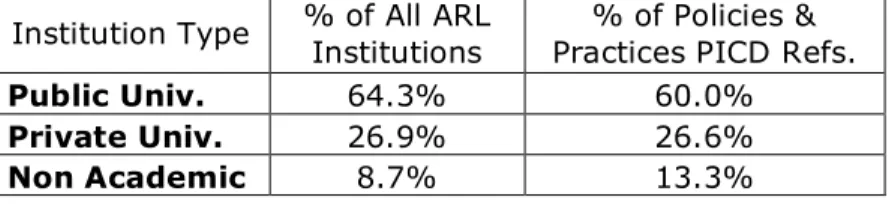
procedures to potential users. Nine of the fifteen references of this type were found on websites belonging to public academic institutions; four were found on the websites of private academic institutions and two were found on the websites of non academic institutions. As table eight shows this distribution is roughly proportional to the distribution of institution types in the ARL as a whole:
Table 8: Percent of Policies and Practices References and Total ARL Membership by Institution Type
Institution Type % of All ARL Institutions Practices PICD Refs. % of Policies &
Public Univ. 64.3% 60.0%
Private Univ. 26.9% 26.6%
Non Academic 8.7% 13.3%
5.5 Professional Documentation
Table 9: PICD References appearing within Professional Communications
Reference Type
Interdept. Communications
Articles and Studies
Plans &
Projections Total
Definite 7 2 0 9
Ambiguous 10 2 5 17
Total 17 4 5 26
References that facilitated the request process and those that appeared in the context of statements about policies and practices were aimed at an audience of users and patrons and, as such, contained information regarding criteria for acceptable requests, request fulfillment time and information about the request submission and purchase processes themselves. With the exception of references that appeared within articles and studies, all references to PICD programs appearing within professional documentation were much less detailed. Departmental reports often report no more than the intent to begin investigating the feasibility of PICD programs. The University of Michigan’s
Vision Task Force Report is representative. The report announces that the library will make it a priority to strengthen “social networks with faculty & students to better connect all to purchase process for collections" (Gong, et al. 2009). This could include the
eventual implementation of a PICD program, but this references lack of detail caused it to be coded as an ambiguous reference. This lack of detail remains characteristic even in cases where more explicit references are made to PICD Programs, such as in Notre Dame’s Hesburgh Library’s University Committee on Libraries Meeting Minutes: January 27, 2011. The Meeting Minutes reports that “the library has also set aside funds “to initiate a patron-driven acquisitions program for digital books.” (Thomas, 2011). The document contains no details concerning the shape that this program might take.
scholarly journals on the subject of Patron Initiated Collection Development. The Ohio State University Libraries’ website provided a characteristic example. It provided a citation for and link to Dracine Hodges’ study of the OSU program entitled “Resolving the challenge of e-books”. Though this study itself is full of detailed information about OSU’s e-book PICD Program, the reference that appears on the OSU library page appears in the context of a news item announcing the publication of the article in the journal Collection Management. In all cases in which references to articles and studies referring to PICD programs appear on ARL institution sites these articles seem to have been purchased in the context of showcasing the professional accomplishments of library staff rather that user education.
None of the 26 references to PICD programs that appear in the context of
professional documents go into depth concerning the details of the programs themselves. Rather, they serve various professional functions. Many of the plans and projections serve as markers on the pathway towards the eventual implementation of PICD programs, while interdepartmental communications often do little more than announce the
implementation of a PICD program. These references make up 56% of all PICD
references discovered on ARL institution pages. The prevalence of this type of reference indicates that the majority of PICD references on ARL institution sites do little to
private academic institutions than on that of any other institution type (see table 10).
Table 10: % of References Ocurring in Professional Documentation by Institution Type Compared to References of All Types
Institution Type
% of All ARL Institutions
% of Professional Documentation
Refs.
Public
Univ. 64.3% 65.4%
Private
Univ. 26.9% 45.0%
Non
6.
Conclusion:
This survey of 124 of 126 ARL Institution websites found references to PICD programs on to be extremely common, if not prevalent. Forty-six of the 124 sites
surveyed – or 39.1%, were found to contain such references. These references were found to vary greatly according to the content that they contained and the audience for which they were intended. None of this variation appeared to correspond to public, private or non-academic status. Twenty-five of the forty-six references discovered were judged to be ambiguous – meaning that they either referred to programs that could demonstrably meet the criteria to be considered PICD programs, or that the referred to programs that had not manifestly begun to be implemented. The remaining twenty references were determined to constitute definite references to PICD programs.
the forty-six references to PICD programs discovered on ARL institution sites appeared to serve the purpose of facilitating the user request process. Of these only one, that provided by the University of Auburn, provided documentation of the workings of its PICD program, to the extent that this institution could be said to be making an extensive effort at user education and outreach.
Bibliography:
Alder, N. L. (2008). Direct purchase as a function of interlibrary loan. Journal of Interlibrary Loan, Document Delivery and Electronic Reserve, 18(1), 9-15. Anderson, K. J., Freeman, R. S., Hérubel, J. V. M., Mykytiuk, L. J., Nixon, J. M. &
Ward, S. M. (2010). Liberal arts books on demand: A decade of patron-driven collection development, part 1. Collection Management, 35(3), 125-141. Anderson, K.J. , Freeman, R.S. , Hérubel, J.V. M. , Mykytiuk, L. J. , Nixon, J. M. &
Ward, S.M.(2003) Buy, don't borrow, Collection Management, 27(3), 1-11. Association of Research Libraries, Kyrillidou, M. C., & Bland, L. C. (2010). ARL
Statistics 2008-2009. Retrieved from:
http://www.arl.org/stats/annualsurveys/arlstats/arlstats09.shtml.
Auburn University Acquisition Dept. (2011). Auburn University Libraries: Document Delivery Service. Retrieved from: http://www.lib.auburn.edu/ill/.
Collection Development Dept. Harold B. Lee Library. (2011) Faculty Expedited Book Orders. Retrieved from: http://lib.byu.edu/expedite.php.
Entlich, Richard. (2010). Report of the Collection Development Executive Committee Task Force on Print Collection Usage Cornell University Library. Retrieved From: http://staffweb.library.cornell.edu/system/files/CollectionUsageTF_ReportFinal11-22-10.pdf.
CSU Libraries: Collection Development Dept. (2010). Library IT Task Force Final Report. Retrieved from:
http://lib.colostate.edu/images/about/goals/it/LibraryTFreport-CSUL_Response-FINAL-redactedfinal.pdf.
Desai, Shevon. (2010). Graduate Library Collections Overview. Retrieved from: http://www.lib.umich.edu/hatcher-graduate-library/graduate-library-collections-overview.
Foss, M. (2007). Books on demand pilot program: an innovative “patron-centric” approach to enhance the library collection. Journal of Access Services, 5(3), 305-315.
Gong, Rong Dao, Et al. (2008). Vision Task Force Report:MSU Libraries. Retrieved from: img.lib.msu.edu/about/VisionTaskForceReport.pdf.
Harvard College Library. (2009). Collections Purchase Request. Retrieved from: https://hcl.harvard.edu:8001/forms/requests/purchase.cfm.
Hodges, D, Preston, C. & Hamilton, M.J., (2010) Patron-initiated collection
development: progress of a paradigm shift, Collection Management, 35(3), 208-221.
Hodges, D., Preston, C., & Hamilton, M. J. (2010). Resolving the challenge of e-books. Collection Management, 35(3) 196-200.
Imre, A., Nabe, J. (2010). Let the Patron Drive: Purchase on Demand of E-Books:2010 NASIG Annual Conference, June 4, 2010. Retrieved from:
http://opensiuc.lib.siu.edu/morris_confs/12/.
Jackson, M E. (1998). Measuring the performance of interlibrary loan operations in
North American research and college libraries. Washington, DC: Association of
Research Libraries.
Johnson, Peggy. (2009). Fundamentals of Collection Development and Management Second Edition. Adolescence San Diego-, 44(173) 247.
Keck, K. A. (2010). Fondren Library: 2010-11 Collections Budget Reduction Plan. Retrieved from: http://library.rice.edu/collections/FY2011.
Kent, A. (1979). Use of library materials: The University of Pittsburgh study. New York: M. Dekker.
Levine-clark, M., (2010) Developing a multiformat demand-driven acquisition model,
Collection Management, 35(3), 201-207.
Lugg, R., Tucker, C. & Sugnet, C. (2010) Library collaboration and the changing environment: an interview with Rick Lugg, Collaborative Librarianship 2:1, 19-21