F
UZZY
L
OGIC
B
ASED
-S
KYHOOK
S
CHEME
W
ITH
F
IREFLY
A
LGORITHM FOR
S
EMI
-A
CTIVE
R
IDE
C
OMFORT
Mat Hussin Ab Talib*, Muhammad Khairul Ikhwan Khalid, Wan Abdul Malik Wan Rahim, Intan Zaurah Mat Darus, Pakharuddin Mohd Samin
School of Mechanical Engineering, Faculty of Enginering, Universiti Teknologi Malaysia, 81310 UTM Johor Bahru, Johor, Malaysia.
Article history Received
1 June 2018
Received in revised form
11 June 2018
Accepted
19 November 2018
Published
28 November 2018
*Corresponding author [email protected]
G
RAPHICALA
BSTRACTK
EYWORDSFirefly algorithm; fuzzy logic; ride comfort; semi-active suspension; skyhook
I
NTRODUCTIONMost modern car today relies on a number of electronic control systems. There are many type of controller that able to have an intelligent behaviour to make it a better system of the suspensions. These controllers are already can be found on breaking control, suspension control etc. The purpose of the sys-tem is to enhance the driving experience involving handling, safety and driving comfort. In most basic form, suspension consist of a couple components which are springs and shock absorbers. Under normal condition, the springs support the body of the car evenly by compressing and expending with every up-and-down movement after hit the bump. However, the movement gives unpleasant experience to the passenger and the effect is reduced by the shock absorber [1].
Latest trend of research on suspension system mainly focuses on the controller strategies as well optimization process. Previous controller done by research such as skyhook control [2], fuzzy logic control [3], neural network control [4] and optimal control [5] have been successfully published. The conventional skyhook as introduced by Karnop is one of the effective easy to be used.
A
BSTRACTHowever, the skyhook is mainly utilized to suppress body movement. Thus, the combination of other controllers with the skyhook control is one of the solutions that could be addressed in order to improve the controller performance. Previously, Ubaidillah and his team [6] presented the combination of the fuzzy logic based on skyhook controller and its performance has proven better than the conventional skyhook. However, in their research, no fuzzy gain scaling is considered since it is one of the important parts need to be considered due to be as a sort of context information [7]. Thus, in order to optimize the gain parameters, an intelligent optimization techniques based on evolutionary algorithm is used since it is very powerful and able to compute the controller with high performance level.
The intent of this research is to investigate the effect of the fuzzy logic based skyhook scheme (FLSS) controller tuned using the evolutionary algorithm based of the firefly algorithm (FA) technique to optimize the parameters of the said controlleras well as able to have a good ride comfort.The semi-active controller, namely skyhook, FLSS and FLSS-FA controllers are investigated in this study.
The paper begins with the Section 1 which is covers on introduction of the semi-active suspension system with MR damper and review on the previous works done by other researchers. Section 2 explains the modelling of the system, the Section 3 describes the controller approach used in this study including the explanation and strategy of the optimization technique. Analysis and discussion is presented under Section 4 and the Section 5, conclusion is presented.
S
EMI-A
CTIVE ANDMR
D
AMPERS
YSTEMThe view structure of the whole model for semi active system can be represented by using the following equation:
𝑚𝑠𝑥 𝑠+ 𝐹𝑑− 𝑘𝑠 𝑥𝑢− 𝑥𝑠 = 0(1) 𝑚𝑢𝑥 𝑢+ 𝐹𝑑− 𝑘𝑠 𝑥𝑢 − 𝑥𝑠 − 𝑘𝑡 𝑥𝑟− 𝑥𝑢 = 0 (2)
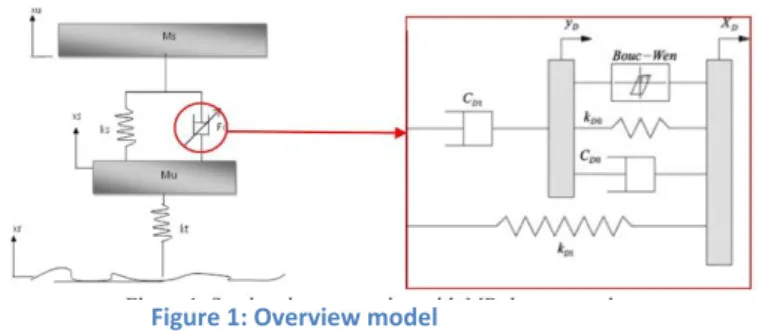
where the mass of the body and the tire of the body are represented by msand mu, respectively.
Road profile can be defined asxr, displacement of the body is known as, xs while the spring and tire stiffness are known as ks and kt, respectively. At last, Fd is known as output force. All parameters used in this study are taken from previous work as shown in Table 1.
Table 1: Full scale parameter [8]
Parameter Value
Sprung mass, ms 338.5 kg
Unsprung mass, mt 59 kg
Spring stiffness, ks 15000 N/m
Tire stiffness, kt 190000 N/m
An overview structure model for semi active including the use of Spencer model is also depicted as in Figure 1.
Figure 1: Overview model
The MR damper modelling is done by using a Spencer model approach that has been validated by previous work [9]
C
ONTROLD
ESIGN ANDO
PTIMIZATIONFuzzy Logic based Skyhook Scheme (FLSS)
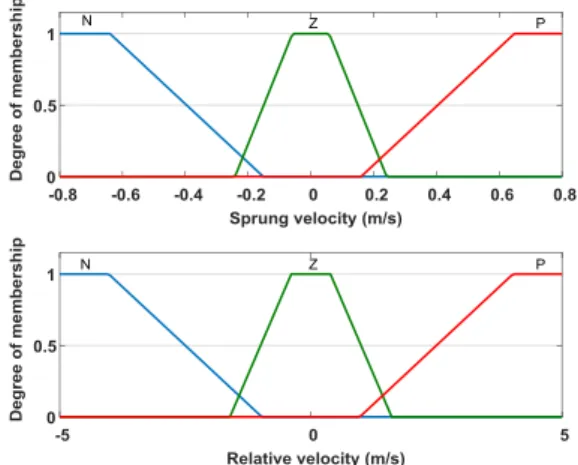
system have been widely used in any applications such Gaussian shape, Bell shape, Triangular shape and etc. Thus, in this study, the Trapezoidal membership function is randomly selected and used due to the most familiar shape that has been used in any applications previously. The fuzzy input for membership function is set to be as Negative (N), Zero (Z) and Positive (P). The shape of the membership function is shown in Figure 2.
Figure 2: The trapezoidal shape
By using IF-THEN rule, the relationship among of the variable is defined by the following fuzzy rule:
If 𝑧 𝑠 is (A) and 𝑧 𝑟𝑒𝑙 is (B) then 𝐶𝑑 is (C)
where the constant values of A, B and C are known as the body velocity, the relative velocity and the damper coefficient, respectively. The output of FL based on the damping coefficient is shown in Table 2.
Table 2: Fuzzy coefficient
Cmin Cd1 Cd2 Cd3 Cd4 Cmax
700 3000 6000 9000 12000 15000
Since, the use of FL controller is based on the Sugeno Fuzzy type, the output damping coefficient can be related by the following linguistic variables:
𝑉 = 𝐶𝑚𝑖𝑛, 𝐶𝑑1, 𝐶𝑑2, 𝐶𝑑3, 𝐶𝑑4, 𝐶𝑚𝑎𝑥 (3)
where all the coefficients are defined as the range of below and upper damping state. The
rules of the system are also being developedand it is shown in Table 3.
Table 3: Fuzzy rule
Relative Velocity (RV)
N Z P
N Cmax Cd3 Cmin
Z Cd4 Cd2 Cd1
P Cmin Cd2 Cmax
Since, the output of the outer loop controller should be damping force, the relationship equation based on the skyhook scheme is describes as follows:
𝐹𝑑 = 𝐶𝑑𝑧 𝑟𝑒𝑙 (4)
It is also important to study the integration of the gain scaling for each input and output of the said controllers. Thus, in this study, all the said gains are intercorporate with the fuzzy logic as a sort of context information as well as to improve the accuracy of the control system. The said gains are defined as the gain of the body velocity (GSV), the relative velocity gain (GRV) and the coefficient of gain controller (GC). To compute the optimum values of all gains, an intelligent optimization approach based on the FA strategy is used in this study.
Firefly Algorithm (FA)
In a practical problem, metaheuristic algorithm becomes an interesting strategy that could be used in order to optimize the parameters. The FA is one of the metaheuristic algorithm that has been previously discussed and used to compute any parameters in different applications. It is very efficient and able to solve with up to dynamical and global optimization problem[11].The FA begins with an introduction of the particles (firefly) which is based on the population and its concept is need to fine their best mate according to the light intensity. The process of the finding the mates is must follow the rules, which are the partners are unisex, the firefly finds the mate
Spr
u
n
gVe
lo
city (
which brighter than itself. If no one brighter, the firefly is move randomly. The process of finding mates is based on the fitness function (light intensity). Its behaviour obeys the rules follows:
𝐼𝛼𝑟12 (5)
The attractiveness 𝛽 of the firefly is proportional to the attractiveness and it can be represented in terms of equations as:
𝛽 𝑟 = 𝛽0𝑒−𝛾𝑟𝑚
, 𝑚 ≥ 1 (6)
where distance between the particles is known as r, 𝛽0 is attractiveness with zero distance𝛾 is the fixed light absorption coefficient. The distance between a couples of fireflies 𝑖 and 𝑗 at 𝑥𝑖 and 𝑥𝑗, respectively, is the Cartesian distance is expressed as
𝑟𝑖𝑗 = 𝑥𝑖− 𝑥𝑗 = 𝑑 𝑥𝑖,𝑘− 𝑥𝑗 ,𝑘 2
𝑘=1 (7)
where 𝑥𝑖,𝑘is the 𝑘𝑡ℎ component of the spatial coordinate 𝑥𝑖 of 𝑖𝑡ℎ firefly and d is the number of dimension. The movement of a firefly 𝑖 when attracted to another more attractive (brighter) firefly j can be defined as:
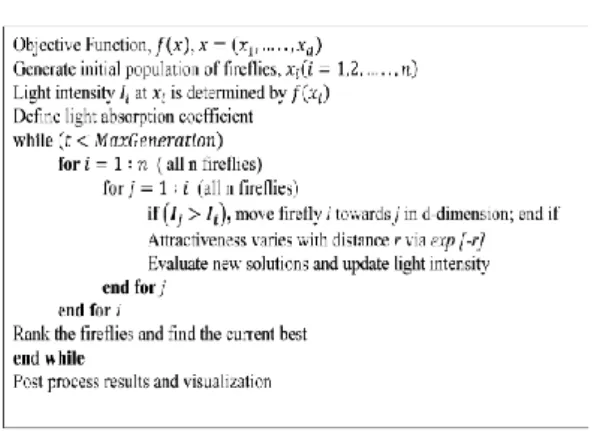
where 𝛼 is the random parameter, 𝜀𝑖 is a vector of random numbers drawn from a Gaussian distribution of uniform distribution. As a normal parameters, 𝛽 can be used as 1 and 𝛼 ∈ 0, 1 . The step of the firefly algorithm can be represented based on the pseudo code as shown as in Figure 3.
Figure 3: The pseudo code of FA
In this study, the firefly generation is set to be 200, the firefly size is 10, alpha, 𝛼 is 0.25, beta, 𝛽 is 0.8 and gamma, 𝛾 is 1. The optimization process of the FLSS gain scaling is computed based on the lowest MSE value. The integration of the FA and FLSS control system is shown in Figure 4.
𝑥𝑖 = 𝑥𝑖+ 𝛽0𝑒−𝛾𝑟𝑖𝑗2 𝑥
𝑗 − 𝑥𝑖 + 𝛼𝜀𝑖 (8)
The FA optimization results in computing the parameters is also shown in Figure 5.
Figure 5: The optimization performance of the gains
A
NALYSIS ANDD
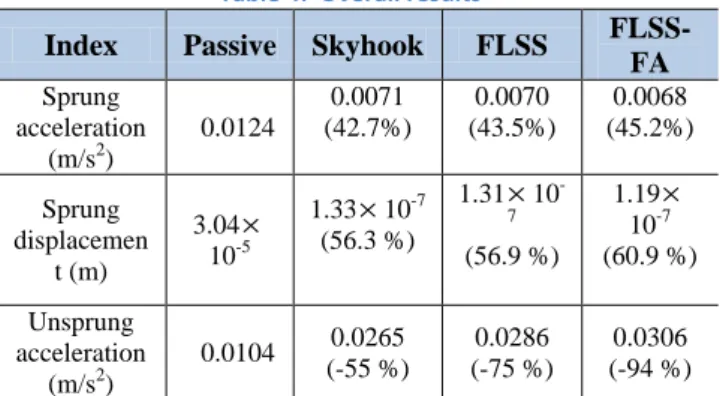
ISCUSSIONTaking the 0.7 Hz frequency (0.005 m amplitude) of sinusoidal as an input, the error and the improvement for all controllerare tabulated in Table 4.
Table 4: Overall results
Index Passive Skyhook FLSS FLSS-FA Sprung
acceleration (m/s2)
0.0124
0.0071 (42.7%)
0.0070 (43.5%)
0.0068 (45.2%)
Sprung displacemen
t (m)
3.04 10-5
1.3310-7 (56.3 %)
1.3110 -7 (56.9 %)
1.19 10-7 (60.9 %)
Unsprung acceleration
(m/s2)
0.0104 0.0265 (-55 %)
0.0286 (-75 %)
0.0306 (-94 %)
Referring to the table, the semi-active with the proposed controllers have shown a good respond. It is proven that, the proposed FLSS-FA controller shows a good response and manage to improve the ride comfort of the vehicle (sprung acceleration analysis) with up to 45.2 % reduction. For analysis of body displacement response, it can also be mentioned that the proposed FLSS-FA has significantly improve the body amplitude with up to 60.9 % over the passive system. For unsprung acceleration analysis, there are no improvement can be made for all semi active control systems. Hence, the controller design has a right track since all the forces has been
transferred to the sprung position in order to maintain the body amplitude. For controller’s comparison, the FLSS-FA has slightly improved the vehicle performance for both sprung acceleration and sprung displacement analyses as compared to the FLSS and skyhook controllers. All results can be obtained in time domain as shown in Figure 6.
Figure 6: Time domain responses
C
ONCLUSIONThis presents the investigation of the FLSS controller with FA strategy in order to improve the vehicle ride comfort. The semi-active based on the quarter vehicle model has been developed and fitted with the MR damper system. Taking the body acceleration, body displacement and tire acceleration as the parameters of interest, results indicates that, the proposed controller managed to improve the vehicle ride comfort with up to 45.2 % when the input of the system is set a 0.7 Hz sinusoidal disturbance. The integration of the FA strategy to the FLSS controller also manage to have a slightly improvement when it is compared to the FLSS itself as well as the skyhook controllers.
A
CKNOWLEDGEMENTSR
EFERENCES[1] Guglielmino, E., Sireteanu, T., Stammers, C., Ghita, G. and Giuclea, M. 2008. Semi-active Suspension Control. Verlag, London.
[2] Sammier, D., Sename, O. and Dugard, L. 2010.
Skyhook and H8 Control of Semi-active
Suspensions : Some Practical Aspects, International Journal of Vehicle Mechanics and Mobility, 39(4):279–308.
[3] Dong, X. and Yu, M. 2013. Genetic Algorithm Based Fuzzy Logic Control for a Magneto-rheological Suspension, Journal of Vibration and Contro., 20(9):1343–1355.
[4] Qin, Y., Langari, R., Wang, Z., Xiang, C. and Dong, M. 2017. Road excitation classification for semi-active suspension system with deep neural networks, Journal of Intelligent and Fuzzy Ssytem. 33(3):1907–1918.
[5] Khiavi, A. M., Mirzaei, M. and Hajimohammadi, S. 2013. A New Optimal Control Law For The Semi-Active Suspension System Considering the Nonlinear Magneto-rheological Damper Model, Journal of Vibration and Control. 20(14):2221– 2233.
[6] Ubaidillah, Hudha, K. and Jamaluddin, H. 2011. Simulation and experimental evaluation on a skyhook policy-based fuzzy logic control for semi-active suspension system, Int. J. Structural Engineering. 2(3):243–272.
[7] Magdanela, L. 1997. Adapting the gain of an FLC with genetic algorithms, International Journal of Approximate Reasoning. 17(97):327–349.
[8] Mahala, M. K., Gadkari, P. and Deb, A. 2009. Mathematical models for designing vehicles for ride comfort, Proceeding of the 2nd International Conference on Research into Design, India. 168– 175.
[9] Talib, M. A. H., Darus, I. Z. M. and Samin, P. 2018. Fuzzy logic with a novel advanced firefly algorithm and sensitivity analysis for semi-active using magneto-rheolgical damper, Journal of Ambient Intelligence and Humanized Computing. 1-6. https://doi.org/10.1007/s12652-018-1044-4 [10] Craft, M. J., Buckner, G. D. and Anderson, R. D.
2003. Semi-active vehicle shock absorbers: design and experimental evaluations, Proceedings of SPIE – The International Society for Optical Engineering, San Diego. 577–588.
[11] Al-Wagih, K. 2015. Improved Firefly Algorithm for
Unconstrained Optimization Problems,