*Correspondence to Author:
Guozhou Chen
College of Hydraulic & Environmen- tal Engineering, China Three Gorg-es University, Yichang, 443002, C-hina.
How to cite this article:
Xiaoxi Men, Guozhu Chen, Ziqi Liu, Xu Zhou, Jiaxin Liu. Interactive Multi-energy Complementary Island Microgrid Ecosystem. American Journal of Engineering Research and Reviews, 2019, 2:1
eSciPub LLC, Houston, TX USA. Website: http://escipub.com/
Xiaoxi Men. et al,. AJOERR, 2019, 2:1
American Journal of Engineering Research and Reviews
(ISSN:2637-3785)
Research Article AJOERR (2019) 2:1
Interactive Multi-energy Complementary Island Microgrid
Ecosystem
Reliable and stable island power supply system is an important guarantee for the development of the island. Based on the island connected to the main network by cable, this paper proposes an interactive multi-energy complementary microgrid consisting of new energy generation, electric energy interaction, electric vehicle charging and discharging, home photovoltaic system, power distribution and emergency rescue. The electricity generated by the residents themselves can be used by themselves, and the excess can be sold back to the main network. This system makes full use of the characteristics of electric vehicles energy storage and mobility and participate in grid dispatching, which can improve the popularity of new energy power generation, balance the peaks and valleys of island electricity consumption and reduce the cost of electricity for residents.
Keywords: Interactive grid; New energy generation; Electricity cost; Hydropower.
Xiaoxi Men1, Guozhu Chen2*, Ziqi Liu1, Xu Zhou1, Jiaxin Liu1
1.College of Electric & New Energy, China Three Gorges University, Yichang, 443002, China.
2.College of Hydraulic & Environmental Engineering, China Three Gorges University, Yichang, 443002, China.
1. Introduction
China is a big maritime country with a large number of islands and a wide distribution. With the development of islands, reliable and stable power grid is the basis of the island's new en-ergy system. At present, one of the major meth-ods of island power supply is connecting the submarine cable to the mainland, which costs high construction but is easily damaged and dif-ficult to repair. Otherwise, diesel power genera-tion can be another method for islands to get its power supply. However, this method has high power generation cost and serious pollution, which is not conducive to the island to maintain a good environment1. Nowadays, the increas-ingly popular and mature new energy power generation technology has undoubtedly pro-vided a new direction for island power supply. At present, China's island power supply mainly depends on land. Due to the closed operation and low reliability of the operation of the island power grid, once the power supply fails, a large-scale power outage will occur, affecting the nor-mal life of the residents. Therefore, it is urgent to construct a new type of power grid structure. On the one hand, it can achieve stable and reli-able power supply. On the other hand, it can re-duce investment as much as possible, adapting to the power supply of various islands.
The interactive multi-energy complementary is-land microgrid ecosystem is based on the tradi-tional microgrid, which consists of home photo-voltaic system, electric energy interaction sys-tem and island intelligent microgrid. The con-struction of an interactive multi-energy comple-mentary island microgrid ecosystem can im-prove the utilization and popularity of renewable energy in island power grids5. At the same time, it will add electric vehicles, energy storage equipment and other units to reduce the power supply pressure during the peak period of the power grid and also to reduce the energy loss on the transmission line, which can not only can reduce the operating cost of the power system, but also the cost of electricity for users. In the meanwhile, it brings significant benefits in im-proving the quality of power supply during peak hours, reducing the cost of power grid construc-tion, solving power supply difficulties in islands, and protecting the ecological environment.
2. System Composition
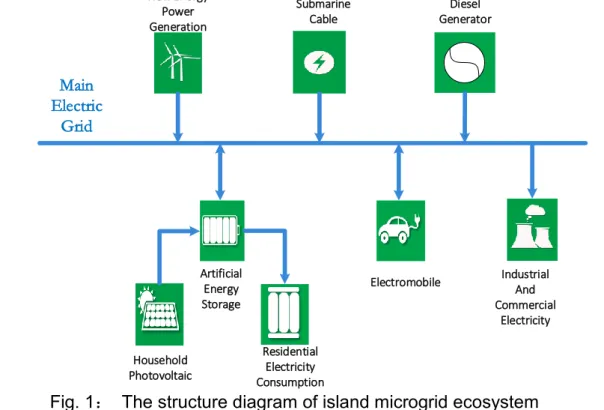
The system is mainly divided into six modules, including new energy generation, electric en-ergy interaction, electric vehicle charging and discharging, home photovoltaic system, power distribution and emergency rescue (Fig. 1). The emergency rescue is mainly provided by the main network power supply and diesel genera-tor.
Electromobile Artificial
Energy Storage
Residential Electricity Consumption Household
Photovoltaic
Industrial And Commercial
Electricity New Energy
Power Generation
Submarine Cable
Diesel Generator
Main Electric
Grid
Fig. 1: The structure diagram of island microgrid ecosystem
on the island electricity consumption graph and combines the time-of-use electricity price to pro-vide the best solar battery and electric vehicle charging and discharging time scheme. The user can set the charging and discharging time of the energy storage unit accordingly. Under the premise of ensuring the demand for electric-ity, discharge when the electricity price is high, and charge when the electricity price is low, thereby reducing the electricity cost and maxim-izing the profit. The system also provides users with a large charge and discharge mode, and users can flexibly switch the system's charge and discharge status according to their own needs.
According to the daily electricity consumption map of the island (Fig. 2), we divide the daily time into several time periods: the peak period is 9:00-12:00, 17:00-22:00, and the flat time is 8:00-9:00. 12:00-17:00, 22:00-23:00, and trough period is from 23:00 to 8:00 the next day. During the low electricity period, the system
load is low, and residents can selectively charge the household energy storage box. And during the flat period, if the illumination is sufficient, the photovoltaic power generation can store energy to the energy storage box or deliver it to the main network under the premise of satisfying the user's own use requirements. The energy storage box is used preferentially during the peak period of electricity consumption. If there is excess, it can be sold to the main network. For electric vehicles, according to statistics, most electric vehicles are idle for more than 95% of the time, and this part of the power is wasted undoubtedly. So, we add the electric vehicle charging and discharging scheduling module to the system, with which the users can return power to the main network during the peak pe-riod of power consumption and then recharge when the electricity price is low to obtain the profit combining the electric vehicle battery con-dition and the use demand.
平时段 高峰期 平时段 高峰期 平时段
23:00—8:00 8:00—
9:00 9:00—12:00 12:00—17:00 17:00—22:00 22:00—23:00
Electricity Consumption
Figure 2: The island total electricity consumption at different times.
2.2 Home Photovoltaic System
The household photovoltaic energy storage system mainly includes solar photovoltaic pan-els, grid-connected inverters, household energy storage batteries (capacity 16kwh), and two-way energy meters.
The primary goal of home solar power genera-tion is self-sufficiency, selling excess power un-der the condition of ensuring its own electricity demand. In order to maximize the benefits, the energy storage system is charged at the bottom of the valley, and the photovoltaic panels are used to generate electricity when the light is suf-ficient. In the case of normal power consump-tion, the main network power can no longer be
used. Conversely, we can sell electricity to it. This not only reduces the cost of electricity, but also alleviates the power shortage during the peak period of island electricity consumption.
2.3 Electric Vehicle Charging and Discharg-ing System
2.3.1 Electric Vehicle Scheduling Strategy
and during the peak period, the battery surplus is delivered back to the main network while en-suring that it is greater than SOC minimum value.
SOC State Analysis: The electricity cost of an electric vehicle includes the charging cost of the electric vehicle battery and the consumption
cost of it, which are both related to the state of the electric vehicle battery at the next moment after charging and discharging. The state of charge in the state of charge and discharge of the electric vehicle is recorded by the battery performance evaluation device on the electric vehicle, and the state is defined as the following:
( ) ( 1) 100
( ) ( ) 100
c d a b a d f b t R
SOC j SOC j
Q
d
SOC j SOC j
E Q = − + = −
d is the moment when the electric car leaves
the charging pile. a is the moment when the electric car returns.
t
c is the battery charging time.SOC j
d( )
is the charge state of the battery for the jth hour after the electric car leaves thecharging pile.
SOC j
a( )
is the state of charge of the battery when the electric car returned.(
1)
a
SOC j
−
is the state of charge of the battery in the (j-1) hour after the electric vehicle returns to the charging pile.E
fis the charging efficiencyof the battery.
Q
b is the charging capacity of electric vehicle battery.2.3.2 Analysis of Charge and Discharge Cost Based on Energy Storage Characteristics
(0.9 )
d c b m
chg
E
a t Q SOC
C
−
=
In the above formula,
t
cis the storage period of the electric vehicle battery, and
Eis the charg-ing efficiency of electric vehicles.Q
b is the charging capacity of electric vehicle battery andb
P
is the charging efficiency of electric vehicles.OC
V
is the open circuit voltage.SOC
m is the charge state corresponding to the open circuit voltage of each stage when charging the elec-tric vehicle battery and its solution is as follows.2 4
2
OC oc b b
m
b b
V V P R
SOC
Q R
− −
=
2.3.3 Analysis of Discharge Revenue of Bat-tery
Assuming that the electric vehicle battery has sufficient power and long life. When the SOC
state is greater than the SOC minimum value, the user can choose to supply the remaining battery power to the main network to obtain rev-enue. The revenue calculation formula is as fol-lows.
30 (
( ) 0.2)
(max)
ev a b d
g
=
I SOC j
−
Q a
In the above formula, Iis the battery charging current and
a
d(max)
is the peak hour price.3. Conclusion and Outlook
This paper proposed an interactive multi-energy complementary island microgrid ecosystem, which can make full use of the island's abundant natural resources. While increasing the popular-ity of new energy power generation, it will re-duce the user's electricity bills and the power supply voltage of the island's main network, cut-ting the peaks and filling the valleys. This method increases the utilization rate of the elec-tric vehicle battery, thus challenges the perfor-mance of the electric vehicle battery. In the fu-ture, we can not only use this method for islands, but also spread to the mainland, forming micro-networks according to regional divisions, which will bring convenience to residents' electricity use and main network operation.
References
1. Yuna Zhang, Chaofeng Gao, Wenming Wang, Wenjiang Zhu, Ming Hu.Effect of Load Rate on Transient Stability of Isolated Island Mi-crogrid[J]. Distributed Energy, 2018, 3(04): 32-40.
2. Jinyong Lei, Hao Bai, Xiyuan Ma, Lei Yu, Xiaobin Guo, Yingjun Liu, Mukai Hao, Guang-kai Li. Overview and Prospect of Multi-energy Complementary Island Microgrid in China Southern Power Grid[J].Southern Power Sys-tem Technology,2018,12(03) :27-34+73. 3. Yang Yu, Yifang Yang. Construction of
4. Qing Zhang. Research on distributed power planning and optimization scheduling of is-land microgrid [D]. Harbin Engineering Uni-versity, 2018.
5. Pengcheng Yang, Jian Cheng. Research on Optimal Configuration of Island Mi-crogrid[J].Science and Technology, 2017(17):177-178.
6. Huiping Deng, Bing Jiang, Changchun Cai. Research on Multi-source Coordinated Opti-mization Operation of Island Intelligent
Mi-crogrid[J].Information
Technol-ogy,2017(04):104-109
7. Yongguo Li. Design and implementation of an Island Intelligent Microgrid System [D]. Shan-dong Jianzhu University, 2017.
8. Jing Xiong. Optimization Design and Control Technology of Multi-energy Complementary Microgrid System [D]. North China Electric Power University (Beijing), 2016.