The Lean Bookstore
Josh Hirahara and Scott Santore
Industrial Technology
Orfalea College of Business
ABSTRACT
The bookstore industry has been changing in recent years with the growing popularity of e-books
and self-publishing. The publishing houses are losing their grip on the industry because a greater
portion of books are being sold by companies who don’t need to sell books to stay afloat, and
overproduction is rampant, with 40% of all printed books being pulped. Bookstores have been
suffering because of the high costs associated with the current value stream. E-books aimed to
reduce these costs but have been cannibalizing their print counterpart and do not generate enough
revenue to offset the loss of print sales. That being said, demand for books has not decreased in
recent years and physical books purchased in bookstores are still the most common form of
purchased literature. For the sake of consumers and the industry as a whole, there is a clear need
for change.
“The Lean Bookstore” seeks to change the way books are sold by creating a new kind of
bookstore that leverages point-of-sale printing and a simpler value stream to bring customers the
best combination of price, selection, and customer service on any book, at any time. Currently,
online is cheaper but you must wait; in store you can browse but you’ll pay more; online has
better selection but is difficult to browse; independents might have better service but less
selection. Customers won’t have to compromise anymore as all of these strengths are brought
under one roof.
Through developing and analyzing four different bookstore models, the airport bookstore
has the greatest potential because it reaches the largest market and has the most compelling value
propositions. Our business is different from current airport bookstores because we have
increased our selection of books by storing all of them digitally, reduced transportation and
ACKNOWLEDGEMENTS
We would like to thank: Professor Valdez for being our technical advisor and overseeing
our progress throughout the project; Jim Dunning for advising us in regards to pursuing
intellectual property; Bronwen Blaney of OnDemand Books for answering our questions and
providing us with valuable, insightful information about the business and industry; floor
managers at Barnes and Noble for insight into pain points of a bookstore; Zack Smith for help
with statistical analysis; Dave Cox for directional advice; Dr. Ken Macro for advice on printing
technology and GRC facility tour; Jake Disraeli and Tod Nelson for mentorship in the Hatchery;
Lou Tornatzky for early directional advice; Mark Bieraugel for directing our research efforts;
TABLE OF CONTENTS
Abstract ... ii
Acknowledgements ... iii
List of Figures ... vi
List of Tables ... vii
SECTION I. Introduction ...1
II. Literature Review ...7
Industry Overview ... 7
History of the Competitive Landscape ... 10
Industry Trends ... 11
Amazon ... 14
Barnes and Noble ... 15
Independent Bookstores ... 17
The Espresso Book Machine ... 18
Cost Breakdown of a Book... 19
Conclusion ... 21
III. Alternatives/Solutions ...23
Airport Store ... 22
Modernist Store ... 24
Hybrid Store ... 25
Minimalist Store ... 27
Statistical Testing/Performance Verification... 28
Tools Used ... 30
IV. Results ...32
Airport Store ... 32
Modernist Store ... 33
Hybrid Store ... 33
Minimalist Store ... 34
Launching the Airport Model ... 35
V. Conclusion...38
Summary of Work ... 38
Observations ... 38
Learning Outcomes ... 39
Existing Problems ... 40
VI. References ...42
VII. Appendix ...44
Figure I. Gantt Chart ... 44
Figure II. E-book and Paperback Consumption ... 45
Table I. Overview of Book Purchasing Population by Format ... 45
Table II Overview of Book Purchasing Population by Amount Purchased ... 46
Table III. Fiction Books Price Overview ... 47
Table IV. Nonfiction Books Price Overview ... 48
Bookstore Layout Sketches ... 49
Start-Up Cost Tables ... 53
Operating Cost Tables ... 56
Revenue Forecasts ... 58
Monte Carlo Simulations ... 61
Figure XXXIV. Projected Operating Profit after Statistical Analysis ... 83
LIST OF FIGURES
FIGURE
I. Projected Industry Growth Rate ...11
II. Espresso Book Machine...19
III. Cost Breakdown of a Book ...20
IV. Monte Carlo Simulation...30
LIST OF TABLES
TABLE
I. Sales Channel Trends ... 2
II. Customer and Business Requirements... 3
III. Consumers’ Book Purchasing Trends... 8
IV. Overview of Book Purchasing Population ... 9
V. Barnes and Noble Stores ... 16
VI. Cost Breakdown of Book Formats ... 20
VII. Business Comparison ... 21
VIII. Proposed Business Models Comparison ... 35
IX. Airport Model Start-up Cost ... 36
X. Airport Model Operating Cost ... 37
SECTION I INTRODUCTION
As the bookstore industry shifts its focus towards e-readers to keep up with the digital revolution, the inefficient model of the shopping mall-sized bookstore will soon become a thing of the past. Physical book sales are in a state of stagnancy and the bookstores are suffering, creating an opportunity for a lean bookstore model to take their place. This project seeks to analyze the most effective business models, and then use the findings from this project to supplement as a basic blueprint for an on-demand printing business. The significance of this work lies in the possibility of a new era of bookstores, where overhead is dramatically reduced and books can be printed in minutes at greater convenience to the customer. Who uses this product, business model, or machine depends on which route is pursued based on the results of this research: engineering a book printing machine and licensing it to struggling bookstores, opening retail stores utilizing an engineered machine, or opening retail stores utilizing a machine sourced from another company. Depending on the route chosen, the target market may vary. If it is decided to license the
machine to bookstores, then the target market will be bookstores, both chain and prominent independents. If starting a retail chain is pursued, then the target market will be Millennials and other early adopters, but will shift to the entire book buying market as this type of bookstore gains market acceptance.
Owning a brick and mortar bookstore is a tough business. Overhead costs are extremely high because bookstores require a huge retail space, which means higher rent, utility,
mediums, such as online, on an e
browse-and-buy experience that was once the only way to find a book, and, as a result, the average consumer is not exposed to a variety of literature and the number of books bought as gifts has dropped dramatically. Bookstores are forced to charge high
overhead costs, leaving the price
and wait for it to be shipped to them. Due to the rise of e
and mortar business model is outdated
This does not mean that there is not a place in the market for physical bookstores
anymore. In fact, market research shows that bookstores are still the most common avenue for a consumer to buy a book, although the figure has been droppi
declines, as seen in table I. It’s clear that having a physical storefront is valuable to consumers because, based on a survey administered by Simba Information, over 40% of book buyers say that they enter bookstores to brows
2012a). The reasons that bookstores are losing business vary depending on the consumer, but can summed up by several basic customer requirements that are not being met.
Table I. Sales Channel T
mediums, such as online, on an e-reader, or in a department store. Consumers are losing buy experience that was once the only way to find a book, and, as a result, the average consumer is not exposed to a variety of literature and the number of books bought as gifts has dropped dramatically. Bookstores are forced to charge higher prices to cover their overhead costs, leaving the price-conscious consumer no choice but to buy a used book online and wait for it to be shipped to them. Due to the rise of e-books and online book selling, the brick
and mortar business model is outdated and inefficient.
This does not mean that there is not a place in the market for physical bookstores
anymore. In fact, market research shows that bookstores are still the most common avenue for a consumer to buy a book, although the figure has been dropping as the number of bookstores
. It’s clear that having a physical storefront is valuable to consumers because, based on a survey administered by Simba Information, over 40% of book buyers say that they enter bookstores to browse and then buy from a competitor often or very often
. The reasons that bookstores are losing business vary depending on the consumer, but can summed up by several basic customer requirements that are not being met.
Table I. Sales Channel Trends
reader, or in a department store. Consumers are losing the buy experience that was once the only way to find a book, and, as a result, the average consumer is not exposed to a variety of literature and the number of books bought as
er prices to cover their conscious consumer no choice but to buy a used book online
books and online book selling, the brick
This does not mean that there is not a place in the market for physical bookstores
anymore. In fact, market research shows that bookstores are still the most common avenue for a number of bookstores . It’s clear that having a physical storefront is valuable to consumers because, based on a survey administered by Simba Information, over 40% of book buyers say
Bookstore customers tend to be relatively price
price, then they will purchase the book at the lower price. This is why there has been such a rise in the number of used books being purchased, and a contributing factor in the rise of e
Convenience is also an important factor for most book buyers, which,
an e-reader has a clear advantage. However, for the majority of the market, a local bookstore holds the advantage because a consumer can get the book that they are looking for immedi
For nearly all book buyers, selection is a key requirement, which is why bookstores need to hold such a large inventory - if the book the consumer is looking for is not in stock, they will buy it somewhere else. Service is another requirement that b
into bookstores. Having a knowledgeable staff to help consumers find what they are looking for and give recommendations is a huge value to consumers, and is worth the trip to the bookstore for many, even when they plan on purchasing the book elsewhere. A
of each customer and business requirement is listed in tab being the most important and one
Table II. Customer and Business Requirements
There are several market research companies that closely follow the book retailing industry and produce several extensive marketing reports per year that focus on various aspects of the industry, such as “Trends in Trade Book Retailing”, “Business of Consu
Publishing”, and “The US Market for Religious Publishing and Produc
that exist are Simba Information and Packaged Facts. Simba
the publishing industry, and has been reporting on the industry for over 40 years. They produce ers tend to be relatively price-sensitive, so if they can find a better price, then they will purchase the book at the lower price. This is why there has been such a rise in the number of used books being purchased, and a contributing factor in the rise of e
important factor for most book buyers, which, for a frequent book buyer, reader has a clear advantage. However, for the majority of the market, a local bookstore holds the advantage because a consumer can get the book that they are looking for immedi
For nearly all book buyers, selection is a key requirement, which is why bookstores need to hold if the book the consumer is looking for is not in stock, they will buy it somewhere else. Service is another requirement that brings book buyers and non
into bookstores. Having a knowledgeable staff to help consumers find what they are looking for and give recommendations is a huge value to consumers, and is worth the trip to the bookstore
on purchasing the book elsewhere. A summary of the importance each customer and business requirement is listed in table II below, with a ranking of four being the most important and one being the least.
Table II. Customer and Business Requirements
There are several market research companies that closely follow the book retailing industry and produce several extensive marketing reports per year that focus on various aspects of the industry, such as “Trends in Trade Book Retailing”, “Business of Consumer Book
Publishing”, and “The US Market for Religious Publishing and Products.” The major companies
are Simba Information and Packaged Facts. Simba Information focuses exclusively on the publishing industry, and has been reporting on the industry for over 40 years. They produce
sensitive, so if they can find a better price, then they will purchase the book at the lower price. This is why there has been such a rise in the number of used books being purchased, and a contributing factor in the rise of e-books.
for a frequent book buyer, reader has a clear advantage. However, for the majority of the market, a local bookstore holds the advantage because a consumer can get the book that they are looking for immediately.
For nearly all book buyers, selection is a key requirement, which is why bookstores need to hold if the book the consumer is looking for is not in stock, they will buy it
rings book buyers and non-book buyers into bookstores. Having a knowledgeable staff to help consumers find what they are looking for and give recommendations is a huge value to consumers, and is worth the trip to the bookstore
summary of the importance le II below, with a ranking of four
There are several market research companies that closely follow the book retailing industry and produce several extensive marketing reports per year that focus on various aspects
mer Book
ts.” The major companies
independent reports that focus on nearly every aspect of the industry, from children’s books to bestseller trends. Using primary and secondary research, they capture trends and important industry data with reliable statistics that will be extremely useful as market size and consumer behavior is translated into financial projections for the business models. Packaged Facts produces reports on a variety of topics, but does have several reports that apply to this project, mostly in the form of target market analysis. They use primary and secondary research as well,
and offer insight on the trends that they see occurring in the industry.
The product that currently exists for on demand printing is called the Espresso Book
Machine (EBM) and is a product of OnDemand Books. The machine is 64” x 35” x 81” and can print a perfect bound paperback book at roughly 100 pages per minute. The books can range in size from 4.5” x 5.0” to 8.25” x 10.75” and can range in page count from 40 to 830. The digital catalogue of books is called EspressNet and holds over seven million titles, including books from GoogleBooks, various major publishers, and self-published authors (Espresso Book Machine: A
Zerox Solution, 2013). EspressNet also manages the purchase of books on any EBM, including
royalty payments to the content owner. The EBM has the basic technology and capabilities of a machine that would be required to put into a retail store that focuses primarily on on-demand-printing because it can print quality bound books quickly at relatively low cost and has a digital server where all of the titles can be stored and purchased. However, the major problem with the EBM right now is that the machine needs the rights to more titles. The majority of the titles on EspressNet right now are free books, so more deals must be made with publishers for
mainstream titles. Also, from speaking with an operator of the EBM, it has been learned that the machine and software still has some bugs to be worked out before it becomes a reliable printing machine. A more consumer-friendly user interface that makes books easier to find and facilitates browsing would be needed as well. As the technology continues to be improved, it would be expected that books continue to be printed faster and color printing to be available on the interior pages as well.
chosen from the business models that have developed and analyzed in this project. The areas of the business models that will be analyzed and projected are: target markets, store layout, branding, technology integration, and key financial metrics. Barriers to entry and potential challenges with market acceptance and technology for each model will attempt to be predicted as well. To do this, two of the tools that will be used are primary research, in the form of surveys, and statistical analysis on the collected data.
Objectives:
a) Develop several bookstore models that leverage market trends and improved cost
structures.
b) Use primary research to predict performance. c) Analyze the collected data using statistical analysis. d) Recommend the most feasible business model.
This project is potentially valuable to publishers, existing bookstores, entrepreneurs looking to start a bookstore, and book buying consumers. Publishers can benefit from this research and analysis by understanding the implications of current industry trends and how to add a new sales channel that will potentially give them more power over their content. Existing bookstores can use the analysis presented to understand potential ways to adapt to consumer and industry trends, and how to utilize new technologies in their current businesses. An entrepreneur can use this report as an initial roadmap as they seek to validate the business model in the
marketplace. Consumers will benefit from this project because, regardless of whether it is used in a new or existing business, this research is aimed at utilizing new technology in a stagnant
industry to deliver a more cost effective way of putting books in the hands of consumers.
SECTION II LITERATURE REVIEW
The purpose of the project is to explore the feasibility and potential of several bookstore business models that utilize on-demand printing as the primary method to produce books. The main areas that will be addressed are barriers to entry, overhead costs, and product costs, as well as potential markets and revenues. In order to be able to generate and understand these numbers, it is
important to understand the industry, trends, and competition that the proposed business will be entering. Benchmarking the proposed business models against current industry leaders will give a reference point that will allow the potential success of the business to be gauged. That being said, the literature review is targeted at understanding the current financial health of the industry, consumer habits, as well as the cost structures of the main competition and their target markets. Current trends in book buying will be examined to understand the future of the industry and where areas for growth exist. In addition, the capabilities of current on demand printing technologies will be examined and how they could be used or adapted to fit a print on demand business model.
Industry Overview
The bookstore industry has annual revenue of $60 billion worldwide and $11 billion in the US, according to MarketLine, and a revenue of $14 billion according to Simba’s estimates (Hoover’s,
2013). There are approximately 9,500 physical bookstores in the US, with the main booksellers consisting of chain “superstores,” independent bookstores, department stores, and online
Average inventory accounts for 50% of the bookstores’ assets because bookstores are forced to hold high inventories to ensure that they have the products that consumers are looking for, exactly when they are looking for them (Hoover’s
that unsold books are usually able to be returned to the publishers for a full refund, which means that publishers are the ones who are absorbing this cost. However, there are still costs associated with purchasing these books, handling them, hold
back, which an on demand printing bookstore model would eliminate.
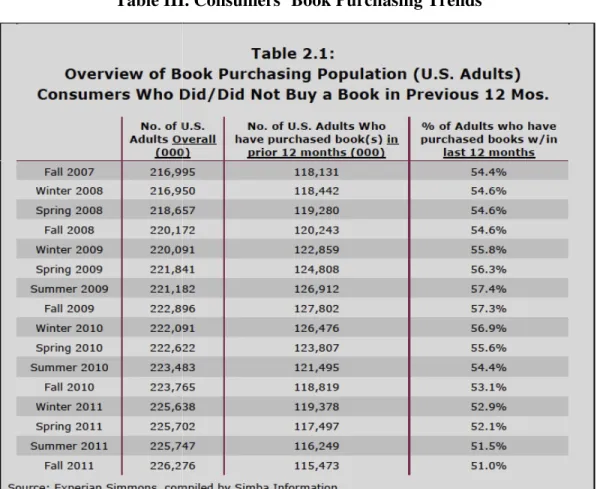
According to Hoover’s, “The typical bookstore customer is a highly educated, relatively affluent, married woman.” Statistically, women purchase more books than men, and book buying increases with education and income, but book buying occurs in nearly every demographic. As seen in table III, just over 50% of the US population buys print books at least once a year, and 20% of the population is e-book buyers
Table III.
ory accounts for 50% of the bookstores’ assets because bookstores are forced to hold high inventories to ensure that they have the products that consumers are looking for, exactly when they are looking for them (Hoover’s, 2013). One positive note for books that unsold books are usually able to be returned to the publishers for a full refund, which means that publishers are the ones who are absorbing this cost. However, there are still costs associated with purchasing these books, handling them, holding them as inventory, and then sending them
back, which an on demand printing bookstore model would eliminate.
According to Hoover’s, “The typical bookstore customer is a highly educated, relatively Statistically, women purchase more books than men, and book buying increases with education and income, but book buying occurs in nearly every demographic. As seen in table III, just over 50% of the US population buys print books at least once a year, and
book buyers (Norris, 2012a).
Table III. Consumers’ Book Purchasing Trends
ory accounts for 50% of the bookstores’ assets because bookstores are forced to hold high inventories to ensure that they have the products that consumers are looking
2013). One positive note for bookstores is that unsold books are usually able to be returned to the publishers for a full refund, which means that publishers are the ones who are absorbing this cost. However, there are still costs associated ing them as inventory, and then sending them
The percentage of US book buyers has been trending downwards recently, which can be attributed to the loss of physical stores, as well as the
book sellers. The marketing strategies that have been used in recent years, such as Barnes and Noble Member Program and Amazon Prime, target heavy book consumers, as do e
kind of person who is going to wa
enough books for the lower cost of the books to offset the cost of the e
book buyer who only buys a few books a year. Of the 120 million US ad
books, 58.9% purchase from bookstores, 30.2% online, 30.4% from department stores, and 5.6% from book clubs, according to Fall 2011 numbers
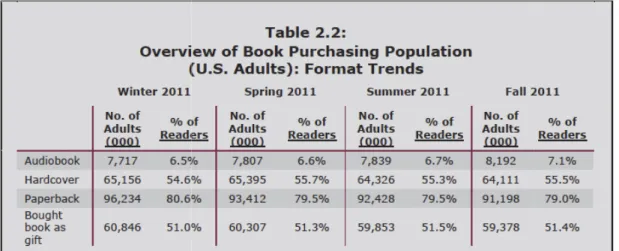
period across all channels, roughly 80% of book hardcover, and 51% purchased a book as a gift the appendix shows that 13.7% of book
year) and 4.6% are “heavy buyers” of hardcover books, meaning that the are more casual buyers, 56.3% and 44.9% respectively (Norris 2012
Table IV. Overiew of Book Purchasing Population
The percentage of US book buyers has been trending downwards recently, which can be attributed to the loss of physical stores, as well as the marketing strategies employed by major book sellers. The marketing strategies that have been used in recent years, such as Barnes and Noble Member Program and Amazon Prime, target heavy book consumers, as do e
kind of person who is going to want a dedicated e-reading device is someone who purchases enough books for the lower cost of the books to offset the cost of the e-reader, not your average
book buyer who only buys a few books a year. Of the 120 million US adults who purchase urchase from bookstores, 30.2% online, 30.4% from department stores, and 5.6% from book clubs, according to Fall 2011 numbers as seen in table IV. During the same time period across all channels, roughly 80% of book buyers purchased paperback books, 55%
rdcover, and 51% purchased a book as a gift, as shown in table I in the appendix
13.7% of book buyers are “heavy buyers” of paperback books (10+ per year) and 4.6% are “heavy buyers” of hardcover books, meaning that the majority of consumers are more casual buyers, 56.3% and 44.9% respectively (Norris 2012a).
Table IV. Overiew of Book Purchasing Population
The percentage of US book buyers has been trending downwards recently, which can be marketing strategies employed by major book sellers. The marketing strategies that have been used in recent years, such as Barnes and Noble Member Program and Amazon Prime, target heavy book consumers, as do e-readers. The
reading device is someone who purchases reader, not your average
ults who purchase urchase from bookstores, 30.2% online, 30.4% from department stores, and 5.6%
. During the same time buyers purchased paperback books, 55%
in the appendix. Table II in buyers are “heavy buyers” of paperback books (10+ per
History of the Competitive Landscape
During the 1990’s, chain bookstores were focused on expanding their superstores because they did not see Internet retailing, specifically Amazon, as a threat. These superstores were gaining huge market share so they continued to expand, but they were doing so at the expense of the independent bookstores. As Amazon gained market share, department stores entered the mix and began to carry popular books and bestsellers, but this was generally ignored since the bookstores
were still experiencing strong growth.
With the economic downturn in the early 2000’s, the chain bookstores began to close down their smaller storefronts because the revenue per square foot and operating profit couldn’t match their superstores. Borders’ went through several changes in leadership in a short period of time and each time created a new strategy on how to deal with these small storefronts, but Barnes and Noble was able to eliminate their small storefronts by 2011. Borders was drawing 13% of their revenue from these stores, while Barnes and Noble was drawing only 2%, which is why Borders was hit much harder by this loss. The two chains entered the e-commerce space in two different ways as well; Barnes and Noble set up a separate entity and later pulled it in as part of the main company, but Borders partnered with Amazon to handle their web sales, losing a large share of their customer base to Amazon. Meanwhile, the department stores were stealing the consumers who only bought a book every once in awhile, which made up a huge share of the market. These department stores were able to price books as loss leader items because they did not rely on book sales for their existence, and became the convenient place to buy a book as more and more bookstores closed down (Norris 2012b).
With the advent of Itunes, bookstores lost the revenue they used to get from music, leaving Borders’ tagline, “Books and Music,” meaningless. As e-books gained public acceptance, they began to steal revenue from their print counterparts because they are less
expensive and come out at the same time. The digitization of content began a trend for
Today, there are two major bookstore chains left i
A-Million, since Borders went bankrupt in 2011, and Amazon is the e
industry. Barnes and Noble has now focused on their superstores and college bookstores, as well as their NOOK e-reader. Barnes an
in revenue in 2012. Books-A-Million stores are mostly located in southern states and, unlike Barnes and Noble, are continuing to expand, mostly in response to Borders liquidation.
However, they are much smaller, with revenue of $453 million in 2012. Amazon, the internet giant, had media revenues just shy of $18 billion in 2011, and have not only been selling print books, but have been gaining market share with the Kindle e
the Kindle Lending Library to get more consumers to purchase an Amazon Prime membership. In addition to books and e-books, Amazon has been delving deeper into publishing, with several self-publishing programs, such as CreateSpace and Kindle Dir
publishing houses to build up the Amazon Publishing division. Clearly, Amazon has a lot of power in the industry and is looking to continue to expand
Industry Trends
According to Hoover’s, “US personal
newspapers are forecast to grow at an annual compounded rate of 3 2017,” as seen in figure I(Hoover’s
Figure I
Today, there are two major bookstore chains left in the US, Barnes and Noble and Books Million, since Borders went bankrupt in 2011, and Amazon is the e-commerce giant of the industry. Barnes and Noble has now focused on their superstores and college bookstores, as well
reader. Barnes and Noble is the largest bookseller in the US, with $7.2 billion Million stores are mostly located in southern states and, unlike Barnes and Noble, are continuing to expand, mostly in response to Borders liquidation.
are much smaller, with revenue of $453 million in 2012. Amazon, the internet giant, had media revenues just shy of $18 billion in 2011, and have not only been selling print books, but have been gaining market share with the Kindle e-reader, offering progr
the Kindle Lending Library to get more consumers to purchase an Amazon Prime membership. books, Amazon has been delving deeper into publishing, with several publishing programs, such as CreateSpace and Kindle Direct Publishing, and has purchased publishing houses to build up the Amazon Publishing division. Clearly, Amazon has a lot of power in the industry and is looking to continue to expand their market share.
According to Hoover’s, “US personal consumption expenditures on books, magazines, and newspapers are forecast to grow at an annual compounded rate of 3 percent between 201
(Hoover’s, 2013).
Figure I. Projected Industry Growth Rate
n the US, Barnes and Noble and Books-commerce giant of the industry. Barnes and Noble has now focused on their superstores and college bookstores, as well
d Noble is the largest bookseller in the US, with $7.2 billion Million stores are mostly located in southern states and, unlike Barnes and Noble, are continuing to expand, mostly in response to Borders liquidation.
are much smaller, with revenue of $453 million in 2012. Amazon, the internet giant, had media revenues just shy of $18 billion in 2011, and have not only been selling print
reader, offering programs such as the Kindle Lending Library to get more consumers to purchase an Amazon Prime membership. books, Amazon has been delving deeper into publishing, with several
ect Publishing, and has purchased publishing houses to build up the Amazon Publishing division. Clearly, Amazon has a lot of
However, sales have been increasingly moving online, with only half of revenue still coming from physical retail locations. The digital revolution is clearly taking hold of the industry, and it is important for bookstores to be successful in this channel if they wish to be a strong force in the market, as we saw with Borders and Barnes and Noble. While the digital trend is the most obvious, there are several other industry trends that are affecting bookstores that can hurt store sales or can be used to gain an advantage, if understood and applied correctly.
Between 2002 and 2012, pricing for trade books remained flat, as seen in tables III and IV in the appendix, as set by the publishers, making it difficult for bookstores to maintain their margins unless they increased volume, decreased discounts, or decreased overhead expenditures. This has caused many shopping mall bookstores to be closed down because the profitability of these stores declined as traffic to these stores decreased, and the superstore model proved to be much more profitable. Another difficulty that bookstores have been experiencing is seasonal cash flow. During the holiday and back to school season, bookstores generate most of their revenue and profit for the year, so if they have a slow winter season then the entire year is greatly affected. Not only must the winter season be capitalized on, but promotions and other efforts must be used to bring consumers into the store year-round.
Department stores, such as Costco, Target, and Walmart, have increasingly begun to sell books and now have a commanding market share. As seen in table IV, over 30% of book buyers have purchased a book from one of these stores because, while only bestsellers are sold through this channel, it is convenient and often less expensive than buying the same book from a
bookstore. These stores are able to price the books as loss leader items to encourage customers to come into the store, but this is taking business away from bookstores and devaluing books
overall as consumers come to expect lower prices. Bestsellers drive the infrequent consumer to bookstores, so by stopping a consumer from making the trip to the bookstore, they only buy the
friendly staff that is able to offer recommendations and improve the customer’s shopping experience is becoming a must as bookstores face greater competition.
The price sensitivity of consumers can also be seen in the growing popularity of used books. Amazon is the clear leader in this area, as they can buy and sell books between consumers from around the world at prices as low as one penny. This is devaluing books in consumers’ eyes
and not allowing authors and publishers to collect money for their work. As you can imagine, physical retail stores have been hurt by this trend as well, but several large chains have emerged, such as Half Price Books, that primarily sell used books at steep discounts. Half Price Books revenue grew 8% to $220 million in 2010, and other brick and mortar stores are rapidly expanding into this space (Rosen, 2012). It is clear that their success is proof that even price conscious consumers do prefer to shop in store and purchase physical copies of books.
Bookstores have also been increasing the amount of space that they dedicate to non-book items, such as gifts, children’s toys, and coffee. These products offer incremental revenue and can often be used to bring consumers into the store with brand names, such as Starbucks or Seattle’s Best. By offering these items, stores can offer consumers additional value that they won’t be able to find online or from an e-reader. Specialty bookstores have been succeeding, not only in offering non-book items, but in specializing their selections to target certain markets, such as religious, and offering a greater depth of books in that given area than a consumer would be able to find anywhere else. Another specialty service that has been gaining popularity is proprietary publishing. With the explosion of self-publishing, authors are realizing that they don’t have to go through big publishing houses to get their work published, and bookstores are capitalizing on this by allowing authors to publish straight through them, and gain more attractive margins in the process.
do it more conveniently than any other channel. There is still more room for growth in this area because “full-time college enrollment is projected to rise nearly 10 percent between 2010 and 2017” (Hoover’s, 2013).
Amazon
In 2012, Amazon’s revenue totaled over $61 billion worldwide, with nearly $20 billion of that
coming from media. According to Morgan Stanley estimates, Amazon will sell $4.5 billion worth of Kindle e-readers in 2013 and $3.8 billion of digital media (Del Rey, 2013). These numbers are projected to continue growing in the coming years as this online giant seeks to dominate the market. The e-reader revolution has taken hold and it is changing the way physical book carriers model their businesses. Since the start of 2012, for every 100 physical books ordered by Amazon clients, there have been 114 e-book downloads (Milliot, 2013). In the same year, the e-book division outgrew Amazon’s paperback sales 70% to 5% (Barnes & Noble, 2013). Across the pond, UK bookstore, Waterstones, reached a deal with Amazon to put Kindles in their stores so customers can browse the physical bookstore while also having the option to buy a Kindle (Lea, 2012). Additionally, the deal requires all Waterstones to have Wi-Fi access so that customers with Kindles can have access to e-books.
Amazon is unique in that they can sell new physical books, used books, readers, e-books, and offer publishing services as well; they are quickly becoming a force in every area of the industry. They have approximately 57,000 employees worldwide, operate 89 fulfillment centers as of May 2013, and 30% of their business comes from third party sales (Amazon, 2013). The typical margins Amazon makes on its new books are about 30% and slightly lower for used books, but Amazon has been known to sell its e-books at a loss in an attempt to gain market share. While they can afford to do this now, as they continue to expand and their fixed costs grow, they will have to begin charging more for shipping and Amazon Prime, which they are
already losing money on (Streitfield, 2013).
do not rely on book sales as a company, so they are able to sell them at a loss to gain market share if they choose to. They have been expanding their fulfillment center footprint, which reduces their shipping costs and allows them to put products in consumers’ hands faster. Being an online retailer and combined with their one-click ordering method, they offer extreme convenience by allowing consumers to have what they want show up at their door, without ever having to leave the house or set foot in a store. They do not experience the same inventory
constraints that physical retail stores experience, so they are able to have a much greater selection.
The disadvantages that online businesses like Amazon face in the marketplace are that it’s harder to build customer loyalty and they have no physical storefront. Having no physical storefront means that consumers have to wait to receive product, can’t browse in person with tangible products, and the customer shopping experience is much different. Amazon recognizes these problems and is making attempts to combat them, such as Amazon Prime and selling Kindles at a loss to build customer loyalty. They offer free two day shipping on many items and allow the user to look inside a digital version of the book to improve the shopping experience, but it still does not match a physical bookstore. Overall, they cannot provide additional value to consumers in the same way that a local store can.
Barnes and Noble
Barnes and Noble is the largest bookstore chain in the US and had nearly $7 billion in sales in 2013, but, unfortunately, they lost $158 million on those sales (Hoover’s, 2013). They operate 1,361 stores in the US, with roughly half of them being retail and the other half college
bookstores, as seen in table V. Their retail locations brought in 64% of total revenue, with 25% from college locations and 11% from the NOOK product line. The company’s gross profit margin for the year was 25%, but goes negative once operating expenses are taken into account.
If this is broken down further, it can be seen that their retail margins were 30%, 23% for college stores, and -24% for the NOOK (Barnes & Noble, 2013). The NOOK is failing to meet
Table V. Barnes and Noble Stores
Barnes and Noble’s average store size is 26,000 square feet, but they range anywhere from 3,000 up to even a massive 60,000 square feet (Barnes & Noble
are able to carry large inventories and stock up to 170,000 titles in a single location. They have phased out their smaller stores and focus on the superstore format because it is more profitable for them; sales average between $2
in revenue annually. These stores typically have a manager, two assistant managers, and between 20 to 50 full and part-time employees (Hoover’s
Barnes and Noble attributes its success a
physical locations are convenient for customers because they are placed in high
offer plenty of parking, and generally have extended shopping hours seven days a week. Because of the size of their stores, they are able to offer an extensive selection in store, as well as an even greater selection online (14 million titles in their database) or through the NOOK. They operate in all three of these channels, allowing them to identify with more customer
Table V. Barnes and Noble Stores
Barnes and Noble’s average store size is 26,000 square feet, but they range anywhere from 3,000 up to even a massive 60,000 square feet (Barnes & Noble, 2013). These superstores are able to carry large inventories and stock up to 170,000 titles in a single location. They have phased out their smaller stores and focus on the superstore format because it is more profitable for them; sales average between $250 and $350 per square foot and can generate over $5 million
annually. These stores typically have a manager, two assistant managers, and between time employees (Hoover’s, 2013).
Barnes and Noble attributes its success as a bookseller to several key factors. Their physical locations are convenient for customers because they are placed in
high-offer plenty of parking, and generally have extended shopping hours seven days a week. Because stores, they are able to offer an extensive selection in store, as well as an even greater selection online (14 million titles in their database) or through the NOOK. They operate in all three of these channels, allowing them to identify with more customers, no matter what
Barnes and Noble’s average store size is 26,000 square feet, but they range anywhere 2013). These superstores are able to carry large inventories and stock up to 170,000 titles in a single location. They have phased out their smaller stores and focus on the superstore format because it is more profitable 50 and $350 per square foot and can generate over $5 million annually. These stores typically have a manager, two assistant managers, and between
s a bookseller to several key factors. Their traffic areas, offer plenty of parking, and generally have extended shopping hours seven days a week. Because
stores, they are able to offer an extensive selection in store, as well as an even greater selection online (14 million titles in their database) or through the NOOK. They operate
their shopping preference is, and gives customers more convenience and choice. Barnes and Noble’s store design seeks to create a spacious, comfortable atmosphere that offers additional services, such as a cafe, toys and games department, music/DVD/BluRay department, and educational tools, to serve as a community meeting place. Another way they seek to be a community-meeting place is through the events that they hold. Each store plans author appearances, children’s storytelling hours, and discussion groups based on its specific
community to encourage customer loyalty. They are using their physical stores to sell and promote the NOOK in ways that Amazon can’t. The NOOK has a dedicated area in most stores where customers can see, feel, and experiment with the e-reader, as well as receive pre- and post-sale support from knowledgeable booksellers. Barnes and Noble does its best to give customers the best value by taking 30% off of suggested retail prices for bestsellers and 20% off certain titles in other categories.
Independent Bookstores
There are over 1,400 independent bookstore locations in the US, which approximately matches the number of chain stores, but independent stores only control 5% to 10% of the market (Norris, 2012b). While they are arguably the most important bookseller for the industry because they live or die based on their ability to meet consumer’s book buying needs, they have been under
tremendous pressure in recent years from bestsellers being sold at a loss by departments stores, smaller margins, and rising rent. Independent bookstores seem to attract or create a more engaged book buyer; their typical customers purchase six to nine books per year and those who purchase one to five are the least common. Most independent stores use social media and websites with an e-commerce capability to attract and keep customers and many have begun to sell e-books as well. While their e-book sales may be insignificant in comparison to Amazon or Barnes and Noble, the continued improvement in this area will be important for any book retailer who wishes to remain competitive in the market.
out to roughly $330 per square foot. The owner generally serves as the manager of the store and the store staff tends to be more experienced and knowledgeable, due to lower employee turnover. While most independents do have a website that they can sell books through, they often
outsource this to a third party provider, like Booksite.com.
An independent bookstore is preferred by some consumers because they offer more
personal service than other book retailers. Their staff is generally more knowledgeable and they are able to form relationships with customers because there is less employee turnover. They are able to more closely customize their selection to the needs of their local market or niche, and really be the neighborhood bookstore. Unfortunately, they are at a disadvantage when it comes to price because nearly every other retailer can price books lower. In general, independent stores have less selection because they carry much smaller inventories, but their selection is often very specialized and has titles you would not find elsewhere. And although independent bookstores have websites and are beginning to carry e-books, the platform and usability of site are extremely important and they often fall short of the big companies who have more resources to devote to website development. 88% of book buyers who have used the internet to buy a book in the last twelve months agree that they “return to web sites that make it easy to find what I need,” which is why it is crucial for any book retailer to have an effective online sales channel as well (Norris, 2012b).
The Espresso Book Machine
As stated in the introduction, the Espresso Book Machine (EBM) is a product of OnDemand Books that prints perfect bound paperback books in a few minutes. The digital catalogue of books is called EspressNet and holds over seven million titles, including books from
GoogleBooks, various major publishers, and self-published authors (Zerox, 2013). EspressNet also manages the purchase of books on any EBM, including royalty payments to the content
Figure II. Espresso Book Machine
Currently, books printed from the EBM follow the the publisher sets the price. Ideally, the store
customers the best deals. A short certain genre or topic, so that the
selection of titles are acquired.
The EBM has the basic technology and c
for print on demand retail stores because it can print quali
low cost, and has a digital server where all of the titles can be stored and purchased. However the major problem with the EBM right now is that the machine needs the rights to more titles. The majority of the titles on EspressNet right now are free books, so more deals must be made with publishers for mainstream titles. They currently do not offer any leasing options, so the machines must be purchased outright
Cost Breakdown of a Book
In table VI below, all prices are the median price for a typical, copyrighted 200 page book visual representation of this data can be seen in figure III.
Figure II. Espresso Book Machine
Currently, books printed from the EBM follow the agency pricing model, meaning that sher sets the price. Ideally, the store would like to control prices so that it can offer
short-term approach could be to gain rights to all of the content of a so that the business could appeal to a specific target market until a wider
The EBM has the basic technology and capabilities of a machine that would be
retail stores because it can print quality bound books quickly, at relatively low cost, and has a digital server where all of the titles can be stored and purchased. However
with the EBM right now is that the machine needs the rights to more titles. on EspressNet right now are free books, so more deals must be made with publishers for mainstream titles. They currently do not offer any leasing options, so the
outright for $85,000 each.
ll prices are the median price for a typical, copyrighted 200 page book visual representation of this data can be seen in figure III.
agency pricing model, meaning that ike to control prices so that it can offer
approach could be to gain rights to all of the content of a business could appeal to a specific target market until a wider
would be needed ty bound books quickly, at relatively low cost, and has a digital server where all of the titles can be stored and purchased. However, with the EBM right now is that the machine needs the rights to more titles.
on EspressNet right now are free books, so more deals must be made with publishers for mainstream titles. They currently do not offer any leasing options, so the
Table VI. Cost B
Figure III. Cost Breakdown of a Book
As can be seen from the cost breakdown above, an EBM printed book is competitive with other forms of books and the material cost will be reduced bu
seen is the additional cost to bookstores to source, carry, and discount each book (actual are 30% - 40% after discounts). T
publishers when 40% of their books do not sell (a weighted cost per book would be two thirds higher for each type of book) are not seen either
out the most cost, but consumers lose the ability to browse, which leads to more purchases. The Table VI. Cost Breakdown of Book Formats
Figure III. Cost Breakdown of a Book
from the cost breakdown above, an EBM printed book is competitive with other forms of books and the material cost will be reduced buying for a business. What is
is the additional cost to bookstores to source, carry, and discount each book (actual fter discounts). The additional printing, distribution and pulping costs to publishers when 40% of their books do not sell (a weighted cost per book would be two thirds
are not seen either. And from table VI, it is clear that e
out the most cost, but consumers lose the ability to browse, which leads to more purchases. The from the cost breakdown above, an EBM printed book is competitive with
ying for a business. What is not is the additional cost to bookstores to source, carry, and discount each book (actual margins
he additional printing, distribution and pulping costs to publishers when 40% of their books do not sell (a weighted cost per book would be two thirds
advantages of selling physical book over e
physical books because they value them more, which is positive for the industry, and they are much more likely to give them as gifts.
Conclusion
There are advantages and disadvantages to each current business model. Online stores are able to
have lower prices, a better selection,
have the physical locations to offer customer service/recommendations, and encourage browsing and gift buying. Chain bookstores offer good service and selection to encourage browsing, but the cost of running the business is too high. Independent bookstores offer great service, but do not have the size or scale to meet the needs of
business models, the aim is to make gains from both a consumer and busines
will offer consumers a convenient bookstore that will always have the book they want in stock, right when they want it. It will offer the service of an independent bookstore because of its smaller size and browsing capability of a chain
models will have greatly reduced overhead in the form of less inventory, a smaller retail space, and less employees. An overview of how these business models compare, from both a customer and business perspective, is shown in table VII below.
Table VII. Business Comparison
The EBM is the technology of choice for our bookstore model because it can print any book in minutes as long as it has the rights, but
to offer the selection envisioned. In addition, the store
advantages of selling physical book over e-books are that consumers are willing to pay more for ey value them more, which is positive for the industry, and they are much more likely to give them as gifts.
There are advantages and disadvantages to each current business model. Online stores are able to
have lower prices, a better selection, and more convenience with minimal overhead, but do not have the physical locations to offer customer service/recommendations, and encourage browsing and gift buying. Chain bookstores offer good service and selection to encourage browsing, but
running the business is too high. Independent bookstores offer great service, but do not have the size or scale to meet the needs of most of the market. By using one of the proposed
to make gains from both a consumer and business standpoint, as it will offer consumers a convenient bookstore that will always have the book they want in stock, right when they want it. It will offer the service of an independent bookstore because of its smaller size and browsing capability of a chain bookstore because of its selection. The following
will have greatly reduced overhead in the form of less inventory, a smaller retail space, An overview of how these business models compare, from both a customer pective, is shown in table VII below.
Table VII. Business Comparison
The EBM is the technology of choice for our bookstore model because it can print any ong as it has the rights, but the rights to more titles are still required
to offer the selection envisioned. In addition, the store would like to be able to control the pricing books are that consumers are willing to pay more for ey value them more, which is positive for the industry, and they are
There are advantages and disadvantages to each current business model. Online stores are able to
and more convenience with minimal overhead, but do not have the physical locations to offer customer service/recommendations, and encourage browsing and gift buying. Chain bookstores offer good service and selection to encourage browsing, but
running the business is too high. Independent bookstores offer great service, but do most of the market. By using one of the proposed
s standpoint, as it will offer consumers a convenient bookstore that will always have the book they want in stock, right when they want it. It will offer the service of an independent bookstore because of its
re because of its selection. The following will have greatly reduced overhead in the form of less inventory, a smaller retail space,
An overview of how these business models compare, from both a customer
SECTION III
ALTERNATIVES/SOLUTIONS
The extensive literature review was used to find out key industry information and to understand what it takes to successfully run a lean bookstore with the ability to print books on demand. Based off of what was discovered, four different business models have been created. While all of them are fundamentally based off of the same ideas, each of them is different in the target market the store will sell to and the overall feel of the store. Each bookstore model was broken down by brand, process, and financials. When determining how each model would be branded, the
following factors were looked at: store layout, customer experience, presentation to the customer, the customer process, and customer interaction with technology. Due to the amount and length of financial data for each model, these supporting tables, figures and sketches can be found in the appendix.
Airport Store
The first of the four models is the airport store. The layout of this store would have to be compact to be compatible with what small space is available in airports. At the start, this model would feature one EBM at the back of the store; demand may necessitate a second EBM. The EBM(s) would be flanked by bookshelves along the walls. In the center of the store would be a table with up to five tablets for customer browsing of OnDemand Books’ server for titles to print
on the EBM. At the front of the store would be a shelf facing out to the public with samples of books printed within the store.
The customer process in the airport model will feature an Express Checkout for those in a rush; an attachment to the tablet will allow the customer to pay for an EBM-printed book straight from the tablet. In addition to this Express Checkout, the airport model’s customer process will allow for the person casually strolling through the airport on a layover to wander into the store, pick up a tablet, take a seat, and browse through titles. This person can also find a knowledgeable staff member to discuss books with, or browse the selection of books on the shelves for purchase.
The customer’s interaction with technology will include the aforementioned use of tablets for casual browsing of titles for printing on the EBM, and use of the tablets to pay for purchases with credit cards. Additionally, customers can watch their book being printed on the EBM, which will serve as an attention grabber to passersby. The customer will experience a friendly and helpful staff with an adequate knowledge of pre-printed books stocked on the store’s shelves. The average customer will be able to come to this store to kill some time between flights, or buy a quick book if in a rush.
This model will appeal to travelers who want a book for their flight or trip and are dissatisfied with the limited choices currently available in airports. By storing titles digitally on the EspressNet Server, ideally any book will be available for print at conveniently located airport bookstores. This way, the model can serve the customer who buys books on impulse when faced with a surprise layover, while also serving the customer who plans on browsing around until finding a good book for their flight.
There will be one to two EBMs in a small airport storefront with one to three employees. Margins should be roughly 50% since we are not competing on price. Orders will be taken by a staff member through a store-provided tablet or through a mobile app. The product will be either pre-printed and on the bookshelves, or printed on demand by the EBM. Customers will be able to
Modernist Store
The modernistic bookstore model will be located where any bookstore can be found today, unlike the airport store. As a result, the layout of the store will be typical of those bookstores, but with a futuristic/modern twist. It will feature an open, spacious layout with plenty of seating and tables, and minimal amount of shelves. The goal of the layout is to look clean to maximize the effect and presentation of the store’s technology. The store must look clean, efficient, and be
without clutter.
The presentation to the customer will leave a lasting impression. It will have an
atmosphere atypical of a bookstore, and more akin to what an Apple or Windows store is today: hip, technologically up-to-date, and above all, a cool, “connected” place to be. The walls will be white with a hint of bright colors to accentuate the open layout, and the walls will be without hard corners to highlight the EBMs and other technology in the store (tablets, etc.). The focus of the employees will be to assist the customers only, not manning the register or moving product, etc.
In terms of the customer process, the customer will be able to browse books and purchase online through a variety of ways: from the app, in store, or for pickup and for delivery. The customer will be able to connect to the EspressNet Server from their homes or mobile devices, as well as the in-store tablets. This gives the customer maximum connect-ability away from the store, as they can send books to the queue to be printed for pickup or delivery. They can see when their book has finished printing on the device or mobile app from which they placed the order on.
The customer will be able to take advantage of the store’s technology in several ways. They can interact with the EBMs in store through the store’s tablets or the mobile app on their
connectivity; customers should have the ability to easily and quickly connect to fast internet at all times during their visit, once provided with a password by a staff member.
The overall customer experience will include a very knowledgeable staff combined with the EBM, readily available tablets, and a state of the art look and feel to the store. The bookstore of the future, this store will match age-old wisdom of the staff with new technology for a unique
bookstore experience like nothing before.
This bookstore model will target Millennials and technology-savvy people who enjoy books and reading, or just like trying new things. This store will blend the best of digitization (e-readers and the internet) with the benefits of a physical storefront. The app and website will be crucial to this business given our target market, as we will need to build relationships with consumers through technology and connecting them with books they otherwise would not have discovered.
Ideally, the store will feature three EBMs. The store size (1,000- 1,500 sq. ft.) will require only five to eight employees. Since book prices are set by the publisher, the margins on books will be 40-50% per sale. In regards to the order-taking system, orders can be taken from the website, app, or in store from the tablets. For the product-delivery system, books can be printed immediately within the store and picked up on the spot, stored for pickup at a later time, or be shipped to an address the same day upon request. The website and app will be the main mediums of product information communication, in addition to the employees. Several features such as in-app push notifications, emails, physical books in-store on the shelves, that recommend books in different categories on a weekly basis to keep customers interested and help them discover new content. The plan is to also introduce incentivized business functions, such as a 10% discount for user book reviews, to increase loyalty and help gain new customers, and a
membership program that will compete with Barnes & Noble and Amazon.
Hybrid Store
devoted to pre-printed books on shelves, while the other half will be space for EBMs, and a lounging area with tablets, tables and seating. The layout will resemble more of a typical bookstore that currently exists compared to the other proposed models.
In regards to the presentation of the store to the customer, the store design will be simple. It should look and feel similar to an independent bookstore (which offers physical browsing)
with the added benefits of the EBMs and tablets. Just like every other model proposed, this will feature a friendly and knowledgeable staff. As for the customer process, the customer can walk into the store, browse, and make purchases just as if at a normal bookstore. Also, the customer can browse the EspressNet Server on the tablets or mobile app, and make a purchase on the EBM. EBM purchases can be made from home, on the go, or in the store.
The customers interact with technology in the hybrid store model when using the tablets or EBMs in the store, by using their own devices (mobile app), and can access everything from home so long as they create an account with the store, enabling them to order books for print and pickup or delivery. With this model we are targeting people who already enjoy shopping at bookstores, but are looking for a better local bookstore or a novel experience. This store will be very similar to the bookstores that exist now, except with the added benefit of having an EBM. Since this model will be very similar to other bookstores that they are already familiar with, it will not be as difficult to gain acceptance, but it will be much harder to differentiate from the others. The store will feature two EBMs and will require six to nine employees because of the larger store footprint and the greater amount of inventory that must be handled. Because prices are set by the publisher the margins on books will be 40-50% per sale.
For this store, consumers will be able to browse and purchase books off the shelves, or browse the EBM on their own device or store provided tablets. Orders can be taken from the
for user book reviews, to increase loyalty and help gain new customers, and a membership program that will compete with Barnes & Noble and Amazon.
Minimalist Store
The minimalist bookstore model will be the smallest and most basic of the proposed stores, and will be able to be found in many places where there may not already be a bookstore. The store
layout and presentation will be simple, with an area for the EBM, another for bookshelves, and a small area for seating with tablets to browse. The store will not have a lot of extra features, but will instead focusing on everything that a customer is looking for in a bookstore and nothing more.
The store will feature a friendly and knowledgeable staff, which will be very important to this model, since the store does not offer very many other extras. The customer interaction and experience with our employees will be crucial in retaining a strong customer base. Due to the smaller size of the store and less features, customers will most likely spend less time in the store than the other proposed models, and will often come in to quickly grab a book and go. The customer will be able to browse the EspressNet Server on the tablets or mobile app, and make a purchase on the EBM. EBM purchases can be made from home, on the go, or in the store once they have an account with the store.
This model is targeting Millennials and tech-savvy people who enjoy books and reading, or even just trying new things. The model aims to blend the benefits of digitization with the benefits of having a physical storefront. Both the app and website will be crucial given the target market, as the model necessitates building relationships with consumers through technology and connecting them with books that they want to read and otherwise wouldn’t have found. There will be one EBM machines in a small bookstore (500 - 1,000 sq. ft.) with two to three
employees. Prices are set by the publisher currently, so are margins are 40-50% per sale.
addition to assistance from employees. For the product-delivery system, books can be printed immediately within the store and picked up on the spot, stored for pickup at a later time, or be shipped to an address the same day upon request. The website, app, and employees will be the main mediums of product information communication. The plan is to also introduce incentivized business functions, such as a 10% discount for user book reviews, to increase loyalty and help gain new customers, and a membership program that will compete with Barnes & Noble and
Amazon.
Statistical Testing/Performance Verification
For statistical testing, it was decided to target the least defined variable: the number of EBMs needed in each store. To do this, the financial projections built from market and consumer statistics were taken and used to structure a Monte Carlo simulation to account for the variability in customer demand and more accurately determine the profitability of each model. The
variables used in the simulation aimed to capture all of the sources of variability in serving the customers in a real world environment, where customer demand ebbs and flows and the store’s ability to serve them is variable as well. It also takes into account that customers are not willing to wait indefinitely and that there is a cost associated with this wait time. Although it is not a hard cost, it was quantified with this simulation. Additionally, the cost of having an EBM sitting unused was quantified because it is very expensive to have an additional machine in the store. The variables inputted into the simulation were: customer arrival rate, EBM service rate, number of EBMs, the time each customer is willing to wait to be served, queued customer waiting costs, cost of losing a customer, and idle EBM costs, as can be seen in figure IV. For each simulation, the mean for these variables were defined, based on market statistics and known machine capabilities, and the simulation automatically generated one thousand random “events,” which were either a customer arriving, purchasing a book, or losing a customer. The costs were automatically calculated, as well as the gross profit. A total of 23 simulations were run for the
Figure IV. Monte Carlo Simulation
The outputs of this simulation are the one thousand random events, which can all be seen in the spreadsheet, the number of customers in the store at any given moment, the amount of time since the last event, costs broken up into three sections, and the pro
sold. The total time of the simulation is calculated, in addition to the total cost of queued customers, idle machine time, and lost customers, as well as profit from books sold. By taking the projected profit from the simulation a
Figure IV. Monte Carlo Simulation – Airport Pessimistic One
The outputs of this simulation are the one thousand random events, which can all be seen in the spreadsheet, the number of customers in the store at any given moment, the amount of time since the last event, costs broken up into three sections, and the profit every time a book is sold. The total time of the simulation is calculated, in addition to the total cost of queued customers, idle machine time, and lost customers, as well as profit from books sold. By taking the projected profit from the simulation and subtracting the associated cost, the inflection point
Airport Pessimistic One
The outputs of this simulation are the one thousand random events, which can all be seen in the spreadsheet, the number of customers in the store at any given moment, the amount of
fit every time a book is sold. The total time of the simulation is calculated, in addition to the total cost of queued customers, idle machine time, and lost customers, as well as profit from books sold. By taking
for each model was found where the profit was maximized, with both a pessimistic and optimistic market estimation, to find the corre
Figure V. Number of EBMs N
Tools Used
Various surveys were used from both primary and secondary research to understand consumer trends and pick a starting location.
startup and operating costs, and then
consumer statistics of the target market in a given area, which in this case is San Diego (retail models) and SFO (airport model).
a different number of EBMs in stores and bookstore model. This allowed a more accurate accounting for variability in demand and service t
where the profit was maximized, with both a pessimistic and optimistic market estimation, to find the correct number of EBMs, as seen in figure V
Figure V. Number of EBMs Necessary for each Model
from both primary and secondary research to understand consumer trends and pick a starting location. Pricing and business costs were researched to figure out
and then a financial model was created to project profits based on target market in a given area, which in this case is San Diego (retail models) and SFO (airport model). A statistical model was crafted to analyze the effects of having
stores and to find the optimal number of machines for each store model. This allowed a more accurate prediction of profit and revenue, while
ity in demand and service times.
where the profit was maximized, with both a pessimistic and ct number of EBMs, as seen in figure V.
from both primary and secondary research to understand consumer to figure out to project profits based on the target market in a given area, which in this case is San Diego (retail
analyze the effects of having find the optimal number of machines for each