c
HETEROGENEOUS PARALLEL VIRTUAL MACHINE: A PORTABLE PROGRAM REPRESENTATION AND COMPILER FOR PERFORMANCE AND ENERGY
OPTIMIZATIONS ON HETEROGENEOUS PARALLEL SYSTEMS
BY
MARIA KOTSIFAKOU
DISSERTATION
Submitted in partial fulfillment of the requirements for the degree of Doctor of Philosophy in Computer Science
in the Graduate College of the
University of Illinois at Urbana-Champaign, 2020
Urbana, Illinois Doctoral Committee:
Professor Vikram S. Adve, Chair Professor Sarita V. Adve
Assistant Professor Sasa Misailovic
ABSTRACT
Programming heterogeneous parallel systems, such as the SoCs (System-on-Chip) on mo-bile and edge devices is extremely difficult; the diverse parallel hardware they contain exposes vastly different hardware instruction sets, parallelism models and memory systems. More-over, a wide range of diverse hardware and software approximation techniques are available for applications targeting heterogeneous SoCs, further exacerbating the programmability challenges. In this thesis, we alleviate the programmability challenges of such systems using flexible compiler intermediate representation solutions, in order to benefit from the perfor-mance and superior energy efficiency of heterogeneous systems.
First, we develop Heterogeneous Parallel Virtual Machine (HPVM), a parallel program representation for heterogeneous systems, designed to enable functional and performance portability across popular parallel hardware. HPVM is based on ahierarchical dataflow graph with side effects. HPVM successfully supports three important capabilities for programming heterogeneous systems: a compiler intermediate representation (IR), a virtual instruction set (ISA), and a basis for runtime scheduling. We use the HPVM representation to implement an HPVM prototype, defining the HPVM IR as an extension of the Low Level Virtual Machine (LLVM) IR. Our results show comparable performance with optimized OpenCL kernels for the target hardware from a single HPVM representation using translators from HPVM virtual ISA to native code, IR optimizations operating directly on the HPVM representation, and the capability for supporting flexible runtime scheduling schemes from a single HPVM representation.
We extend HPVM to ApproxHPVM, introducing hardware-independent approximation metrics in the IR to enable maintaining accuracy information at the IR level and mapping of application-level end-to-end quality metrics to system level “knobs”. The approximation metrics quantify the acceptable accuracy loss for individual computations. Application pro-grammers only need to specify high-level, and end-to-end, quality metrics, instead of detailed parameters for individual approximation methods. The ApproxHPVM system then auto-matically tunes the accuracy requirements of individual computations and maps them to approximate hardware when possible. ApproxHPVM results show significant performance and energy improvements for popular deep learning benchmarks.
Finally, we extend to ApproxHPVM to ApproxTuner, a compiler and runtime system for approximation. ApproxTuner extends ApproxHPVM with a wide range of hardware and software approximation techniques. It uses a three step approximation tuning strategy, a
combination of development-time, install-time, and dynamic tuning. Our strategy ensures software portability, even though approximations have highly hardware-dependent perfor-mance, and enables efficient dynamic approximation tuning despite the expensive offline steps. ApproxTuner results show significant performance and energy improvements across 7 Deep Neural Networks and 3 image processing benchmarks, and ensures that high-level end-to-end quality specifications are satisfied during adaptive approximation tuning.
To my family, for their love and support.
ACKNOWLEDGMENTS
There are many people that have supported me and made it possible for me to succeed during my Ph.D., and for that I am most grateful. First and foremost, I would like to thank my advisor, Professor Vikram Adve, for being my mentor during this important time, for investing time and effort in training me, and for asking all the hard questions as the closest collaborator to most research projects I was involved in. I would like to thank Assistant Professor Sasa Misailovic and Professor Sarita Adve for closely collaborating on ApproxHPVM and ApproxTuner. Finally, I want to thank all members of my Ph.D. committee for their valuable advice and insights towards improving this thesis.
I would like to thank Prakalp Srivastava for collaborating with me on Heterogeneous Parallel Virtual Machine (HPVM) and ApproxHPVM, and Hashim Sharif for collaborating with me on ApproxHPVM and ApproxTuner. My collaboration with them has been a very rewarding experience. I am thankful to all my co-authors on these projects: Muhammad Huzaifa, Keyur Joshi, Rakesh Komuravelli, Akash Kothari, Yasmin Sarita, Ben Schreiber, Matt Sinclair, Elizabeth Wang, Nathan Zhao, Yifan Zhao.
I want to thank all my lab mates in the research group of Prof. Vikram Adve, for providing a fun work environment and for the pleasure of discussing our research projects from multiple different perspectives that would help inspire solutions and work through problems. I am especially grateful to Hashim Sharif and Adel Ejjeh.
I want to thank my boyfriend, Theo, who has been with me in the same research group since the start of my Ph.D., and has supported me during many difficult and stressful times. My work has been supported by the National Science Foundation (NSF) under grant CCF 13-02641, by the Center for Future Architectures Research (C-FAR) - one of six cen-ters of Semiconductor Technology Advanced Research network (STARnet), a Semiconductor Research Corporation (SRC) program sponsored by Microelectronics Advanced Research Corporation (MARCO) and Defense Advanced Research Projects Agency (DARPA). Part of this work was also supported by DARPA through the Domain Specific System on Chip (DSSoC) program.
Most of all, I want to thank my family. Each of them, in their own unique way, was always there for me even though we live far away. I specifically want to mention my little brother, who was always proud of me, and although he is now somewhere I can’t reach him I hope to see him again some day. For their unconditional love and support during my Ph.D. and all my life, I am truly grateful and I am proud to dedicate this dissertation to them.
Finally, I want to express my deepest gratitude to Prof. Vikram Adve for his incredible understanding, patience and support through a very difficult time for me, my brother and my family. For helping me through that time and always being there for me when I needed someone to talk to, I am truly thankful to Theo, as well as Adel and Hashim.
TABLE OF CONTENTS
CHAPTER 1 INTRODUCTION . . . 1
1.1 Heterogeneous Systems . . . 1
1.2 Programmability Challenges of Heterogeneous Systems . . . 3
1.3 Summary of Related Work . . . 8
1.4 Approach . . . 9
1.5 Contributions . . . 17
1.6 Thesis Organization . . . 19
CHAPTER 2 RELATED WORK . . . 20
2.1 Programming Technologies for Heterogeneous Systems . . . 20
2.2 Approximate Computing . . . 25
CHAPTER 3 THE HPVM REPRESENTATION . . . 29
3.1 HPVM Program . . . 29
3.2 Dataflow Node . . . 30
3.3 Dataflow Edge . . . 32
3.4 Input and Output Bind . . . 34
3.5 Integration with Host Code . . . 34
3.6 HPVM Representation of Major Parallel Hardware Features . . . 35
CHAPTER 4 THE HPVM SYSTEM . . . 39
4.1 HPVM Virtual ISA and Compiler IR . . . 39
4.2 Compilation Strategy . . . 45
4.3 HPVM Runtime and Scheduling Framework . . . 51
4.4 Compiler Optimization . . . 53
CHAPTER 5 HPVM EVALUATION . . . 56
5.1 Experimental Setup and Benchmarks . . . 56
5.2 Portability and Comparison with Hand Tuning . . . 57
5.3 Evaluation of Flexible Scheduling . . . 58
5.4 Node Fusion Optimization Evaluation . . . 60
5.5 Conclusion . . . 60
CHAPTER 6 APPROXHPVM . . . 62
6.1 The ApproxHPVM Intermediate Representation . . . 62
6.2 System Workflow . . . 66
6.3 Code Generation . . . 67
CHAPTER 7 APPROXTUNER: A COMPILER AND RUNTIME SYSTEM FOR ADAPTIVE APPROXIMATIONS . . . 76 7.1 Motivating Example . . . 76 7.2 ApproxTuner . . . 78 7.3 Methodology . . . 87 7.4 Evaluation . . . 90
7.5 Sensitivity to Approximation Techniques . . . 96
CHAPTER 8 CONCLUSION AND FUTURE DIRECTIONS . . . 98
8.1 Conclusion . . . 98
8.2 Future Directions . . . 99
CHAPTER 1: INTRODUCTION
1.1 HETEROGENEOUS SYSTEMS
The combination of Moore’s law and Denard’s scaling enabled computer architects to develop new generations of single core processors that were faster compared to their prede-cessors due to containing a larger number of smaller transistors. Smaller transistors have higher operating frequency while power density remained constant. With the end of Denard’s scaling, as the size of the transistors decreased the power density increased, thus making it impossible to design single core processors with the same power density. Moore’s Law con-tinued to apply, but computer architects turned to multi-core architectures in order to utilize the available number of transistors [1]. However, this approach is eventually limited by power constraints [2], which eventually lead to the slowdown of Moore’s Law.
The slow down of Moore’s law and the end of Denard’s scaling has given rise to custom hardware components that deviate from the single core processors contained in traditional homogeneous systems. Heterogeneous computing systems, i.e. systems containing such com-ponents, are becoming increasingly popular in systems ranging from portable mobile devices to high-end supercomputers. Heterogeneous systems are attractive because the specialized computing elements they contain, e.g. GPUs, vector hardware, FPGAs, domain-specific ac-celerators, and ASICs can greatly improve energy efficiency, performance, or both compared to homogeneous systems. A study of a video encoder [3] demonstrates the significant poten-tial for energy efficiency improvements achievable when targeting specialized architectures. Additionally, domain specific accelerators enable additional performance or energy benefits by exploiting domain specific knowledge [4].
The term “heterogeneous system” is very broad, and its exact meaning should be inter-preted based on the context and the time of usage. For example, it may refer to a system including components that differ in micro-architecture, instruction set architecture (ISA), and execution model, such as a combination of a CPU, a GPU and/or special purpose ac-celerators, or simply refer to a system with cores with different architectural capabilities but same ISA and execution model, such as ARM’s big.LITTLE [5]. At the time of writing of this document, the term “heterogeneous system” commonly refers to systems with general purpose CPUs and GPUs, that may or may not be integrated on the same circuit. The system may include special purpose accelerators, that may be programmable. CPUs can execute the operating system and all tasks, including computationally-heavy tasks, but low end CPUs are better suited for traditional, serial workloads. GPUs or vector-enabled
multi-core CPUs handle the computationally heavy application code, mostly exploiting the present data parallelism. An example heterogeneous system is the Qualcomm Snapdragon 865 mo-bile System-on-Chip (SoC) [6]. It includes a Kryo 585 CPU [7], an Adreno 650 GPU [7], and accelerators, including a programmable Hexagon DSP [8] and special purpose accelerators for audio/video encoding and decoding.
Heterogeneous systems are widely used in a variety of systems, ranging from high-end supercomputers [9, 10, 11], to data centers [12], to mid-level GPU-based systems, to mobile devices and Internet of Things (IoT) devices at the edge of the network. These classes of systems utilize their compute capabilities for different kinds of applications, for example simulations of complex models in several domains (physics, biology, etc) in supercomputers, information retrieval in data centers, image processing in mid-level GPU-based systems, and a variety of applications such as face and speech recognition, computer vision, signal processing [13, 14, 15] depending on the mobile or IoT device. Computing at the edge is becoming increasingly important given the need for real-time data processing at the edge [16]. Edge computing complements cloud computing by doing some computations near the edge of the network, as a means to reduce the volume of transferred data and provide low latency computation. It is estimated that due to devices connected to the Internet that make up IoT, including the sensors and cameras, the amount of data generated will continue to grow, reaching 79.4 zettabytes of data in 2025 [17], increasing the need for computation near data. Therefore, heterogeneous systems on edge devices are an extremely important class of heterogeneous systems, and we expect this trend to continue.
On some of these classes of systems, the application domains they are utilized for are inherently error tolerant, i.e. small errors only introduce acceptable loss in the final out-put. This observation has led to the development of approximate computing techniques, novel hardware architectures and software optimizations that trade-off accuracy for gains in performance and energy [18].
1.1.1 Scope of Heterogeneous Systems for this Thesis
For the scope of this thesis, we will consider heterogeneous systems with multicore CPUs with vector extensions, GPUs, and programmable accelerators. As a use case, we will tar-get PROMISE [19], a programmable mixed-signal Machine Learning (ML) accelerator that achieves performance and energy benefits by performing a wide range of vector dot-product operations in the analog domain.
1.2 PROGRAMMABILITY CHALLENGES OF HETEROGENEOUS SYSTEMS
The wide utilization of heterogeneous systems has given rise to numerous programma-bility challenges. At a fundamental level, we believe these challenges arise from four root causes. Section 1.2.1 discusses the identified root causes, and section 1.2.2 the resulting programmability challenges.
1.2.1 Root Causes
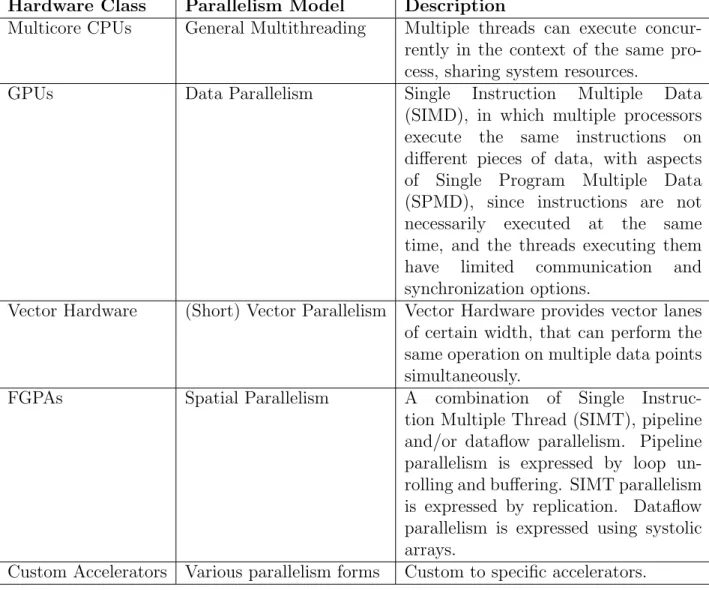
Diverse hardware parallelism models Different hardware targets expose different, and sometimes multiple, parallelism models. Studying various commonly used hardware targets, we categorize them into the broad hardware classes listed in Table 1.1, based on the paral-lelism model they expose. Table 1.1 includes a brief description of the exposed paralparal-lelism model.
In a heterogeneous system consisting of a combination of the above components, mul-tiple parallelism models may combine in synchronous or asynchronous execution, further increasing the complexity.
Diverse memory systems Differences in parallelism models naturally lead to differences in the underlying memory system. The identified hardware components above have memory systems ranging between cache-coherent memory hierarchies of various depths (two to three levels are common cases), scalar and/or vector register files, scratchpad memory utilized as private or local memory, SRAM blocks (block RAM), and other custom memory designs specialized to custom accelerators. Knowledge of the underlying memory system influences algorithm design and application developing.
The complexity increases further as hardware evolves and offers more parameterizable options to affect the performance, e.g., newer NVIDIA GPU architectures (as of NVIDIA Fermi [20]) provide 64KB scratchpad memory that is configurable (in certain partitions) between L1 cache and local memory, and NVIDIA Volta [21] further increases the allotted scratchpad to 128KB, configurable up to 96 KB of local memory.
Diverse hardware instruction sets Different hardware targets have diverse hardware instruction sets, which translates to different execution semantics and performance charac-teristics. The diversity in these features makes it especially difficult to achieve object-code portability.
Hardware Class Parallelism Model Description
Multicore CPUs General Multithreading Multiple threads can execute concur-rently in the context of the same pro-cess, sharing system resources.
GPUs Data Parallelism Single Instruction Multiple Data
(SIMD), in which multiple processors execute the same instructions on different pieces of data, with aspects of Single Program Multiple Data (SPMD), since instructions are not necessarily executed at the same time, and the threads executing them have limited communication and synchronization options.
Vector Hardware (Short) Vector Parallelism Vector Hardware provides vector lanes of certain width, that can perform the same operation on multiple data points simultaneously.
FGPAs Spatial Parallelism A combination of Single Instruc-tion Multiple Thread (SIMT), pipeline and/or dataflow parallelism. Pipeline parallelism is expressed by loop un-rolling and buffering. SIMT parallelism is expressed by replication. Dataflow parallelism is expressed using systolic arrays.
Custom Accelerators Various parallelism forms Custom to specific accelerators. Table 1.1: Hardware Classes
Diverse hardware approximation techniques There are multiple approximation tech-niques at the hardware level, that trade off accuracy at the application level for performance or energy benefits. Depending on the nature of each approximation technique, the “approx-imation knobs”, i.e. there exist (one or more) system-level tuning parameters that affect the application end-to-end behavior and need to be tuned to achieve the programmer in-tended application specification. The problem is further emphasized when approximation techniques are combined, and different approximation knobs must be tuned to achieve a certain application specification.
1.2.2 Programmability Challenges
Due to the diversities discussed above, programming heterogeneous systems is extremely challenging at multiple levels: parallel language designers, algorithm designers, application developers, compiler developers and hardware engineers must all reason about performance, scalability, and portability across many different combinations of diverse parallel hardware. We discuss the challenges that occur across all these different levels below.
Parallel Language Design It is difficult to design source-level languages to effectively program heterogeneous systems. For example, languages such as CUDA and OpenCL expose data parallelism through a kernel function that is replicated across the data that are to be processed. OpenCL also offers support for dataflow parallelism, targeting FPGAs, albeit through a union and not though a common set of interfaces. Other parallelism models are not specifically supported. Similarly, Streamit [22] supports streaming parallelism. Lime [23] supports dataflow parallelism. We observe that existing source languages only support one or two parallelism models. This creates a steep learning curve for the full utilization of each unique hardware combination in a heterogeneous system, and a prohibitively expensive barrier to overcome for the wide adaption of heterogeneous systems.
Algorithm Design Given the fact that the target hardware affects the exposed parallelism model and underlying memory model, it would be difficult to design a single algorithm, and thus develop a single version of an application, that would perform well across a wide range of diverse parallelism models with their associated underlying memory models. This issue is partially addressed by designing an algorithm that achieves good but not optimal performance or an algorithm that makes the common case fast, or by having multiple versions of an algorithm and selecting the optimal version when the target hardware and the required tuning parameters is known (install time, load time, or run time) [24]. We believe that a combination of the two would be needed to capture a wide range of heterogeneous parallel hardware, as it would be exceedingly difficult to provide optimal implementations for every algorithm for every available hardware target.
Application Development A programmer targeting a heterogeneous system is required to program each hardware component separately, in an appropriate language. This step requires a deep understanding of which application component needs to be mapped to which system hardware component, since the cost of reevaluating a wrong decision is significant.
Source Code Portability Due to the differences in targeted hardware components, any application code implementing a certain operation is subject to the algorithm design chal-lenge. Additionally, the task of compiling source code for an application component down to the hardware component that the respective algorithm is expected to be executed on is com-plicated due to the vast differences across heterogeneous systems, identified as root causes. Source code portability becomes exceedingly difficult due to the combination of these two factors.
Object Code Portability Heterogeneous systems include different combinations of hard-ware
• across different vendors of a hardware type, e.g., NVIDIA and ARM GPU.
• across a vendor’s family of devices, e.g., different generations or models of NVIDIA GPUs.
Object code portability is an optional, yet important goal for applications that are designed to be able to be executed on a wide range of target platforms that include varying com-binations of diverse hardware components. On the contrary, object code portability would not be required for an application that is developed targeting a predetermined system with an ahead-of-time known hardware configuration, e.g. a chemistry simulation developed and optimized for the hardware of the supercomputer scheduled to execute it.
Object code portability is important across devices of the same, and different vendors’ devices as well. Vendors must be able to ship a single object code for a broad range of target devices; this way, the same application package can be used to support all devices within that range. This is challenging due to the differences of the underlying hardware targets. The entire stack, including performance analysis and tuning tools, debugging tools, profiling tools, must support the entire (or at least, a large percentage of the) range of the available hardware, both within a single system is concerned, as well as the range of existing system configurations. This stack must be developed and maintained by vendors for each new hardware target and across generations, which can quickly become prohibitively expensive. Modern apps for mobile phones have used partial solutions (JVM and LLVM virtual ISAs for host CPUs on Apple and Android mobile devices respectively), and workarounds (e.g., custom native libraries for accelerators in the mobile SoCs for Android) to achieve object code portability on mobile devices. However, utilizing the specified hardware components through API calls - that are opaque - makes the offloaded operations not amenable to compiler optimizations along with the rest of the program. The APIs are not retargetable to
other accelerators, thus do not offer benefits should the target accelerator not be available on the target platform. Finally, the native library calls must be expressed explicitly by the programmer, a difficult task considering the number of different accelerators.
Performance Tuning Performance tuning becomes increasingly difficult as the number of tunable parameters increases. As the different hardware components expose different mem-ory hierarchies and parallelism models, the resulting performance models are more complex and less well understood. Additionally, as the number of different hardware components increases, performance tuning becomes prohibitively expensive.
Approximation Tuning On top of the hardware approximation techniques, multiple soft-ware approximation techniques also become available to the programmer as tools to trade off accuracy at the application level for performance or energy benefits. Similar to hardware techniques, software approximations also need to expose approximation knobs, software-or application-level, that affect the application end-to-end behavisoftware-or. Fsoftware-or a combination of hardware and software techniques, the pool of approximation knobs that the programmer is responsible for understanding and tuning may also be at different levels, application-level, software-application-level, and system-level. and deep understanding of all software and hardware approximation techniques, as well as the effect of their interactions is required. This is ex-tremely difficult, and also depending on the approximation technique or combination thereof may not be possible.
The programmability challenges described above also emerge, as expected, on heteroge-neous systems used for demanding computation tasks on edge computing, with the effect of further limiting the computational power on these already resource constrained systems. For example, deep learning inference tasks executing on edge devices are generally unable to fully utilize the available hardware. Instead application programmers tend to fall back to targeting the lowest common denominator, the heterogeneous system’s core processor. For example, inference tasks on the Facebook app utilize general, algorithmic optimizations that can target all processing environments for performance benefits, opting to use of accelera-tors only when there is little diversity or there is control over the system environment using virtual reality platforms [25]. Given the diversity of heterogeneous SoCs in mobile devices, this problem is extremely difficult to overcome: there is no standard mobile SoC to optimize for, and target hardware is extremely fragmented [25].
1.3 SUMMARY OF RELATED WORK
This section briefly discusses the compiler infrastructure that aims to address the pro-grammability challenges of heterogeneous systems. We also discuss systems developed in the domain of approximate computing, since it is extremely relevant in applications domains whose computation is allocated to heterogeneous systems. A detailed literature review is provided in chapter 2.
1.3.1 Virtual ISAs
An approach to address the programmability challenges of heterogeneous systems is to abstract the diversities that we identified as their root causes under a virtual layer. This layer effectively presents a hardware abstraction that is a uniform representation of the un-derlying hardware and is targeted by the layers higher on the software stack. Applications can be developed, compiled, and shipped targeting the instruction set of the virtual hard-ware, or virtual instruction set (Virtual ISA). Dedicated translators, or compiler backends, are responsible for translating from the Virtual ISA to the native ISA for execution on a supported device within the target family at install time or runtime, thus achieving porta-bility of “virtual object code” across the corresponding family of devices. Some widely used heterogeneous systems define virtual instruction sets spanning one or more families of de-vices, e.g., PTX for NVIDIA GPUs, HSAIL for CPUs and GPUs from several vendors and SPIR-V for devices running OpenCL.
Depending on the challenges that a virtual ISA is designed to solve, it abstracts away the relevant differences in the underlying hardware. For example, these virtual ISAs abstract away the differences in underlying ISAs, but not in parallelism models. Except for SPIR-V, which is essentially a lower-level representation of OpenCL for the compute kernels of the OpenCL device programs, these virtual ISAs are primarily focused on GPUs and do not specifically address other hardware classes, like vector hardware or FPGAs. That is due to the parallelism model they expose, which is primarily a “grid of kernel functions”. Moreover, none of these virtual ISAs address the challenges of compiler optimizations through the use of a compiler IR or serve as the basis of runtime scheduling.
1.3.2 Parallel Compiler IRs
Previous parallel compiler IR we know of (for example, [26, 27, 28, 29, 30]) do not aim to, or have different limitations in, targeting heterogeneous parallel systems, as described in
more detail in section 2.
1.3.3 Approximate Computing Frameworks
Many approximation techniques have been proposed, to improve performance or energy efficiency. Our work draws from the pool of approximation techniques, and focuses on managing them in a single framework for adaptive approximation tuning.
Existing systems for accuracy-aware optimizations do not provide a fully automated frame-work that is able to target multiple heterogeneous devices with diverse approximation choices without requiring programmer-guided low-level annotations. The ACCEPT [31] framework optimizes program computations given a source-level end-to-end quality metric, and can target diverse compute units. However, it does not introduce approximation information at the IR or virtual ISA level, which limits the approach to the specific source-level annotations used. It also does not attempt to provide software portability. EnerJ [32] presents a type system that separates approximate and precise data. Rely [33] and Chisel [34] introduced the idea of quantifiable reliability and accuracy at the program level. However, introducing approximation metrics as part of a new programming language is not conducive with our goal of program portability at the object code level, since applications need to be ported at the source-level.
Additionally, all these systems require programmer annotations at individual function level or lower to drive the approximation selection.
There also exist approximation driven adaptive systems [35, 36, 37, 38, 39, 40], that utilize one or a limited number of approximation techniques, to dynamically tune the approximation level utilized by an application in response to power or load variations. These systems, which we will describe in more detail in section 2, do not take into account object code portability, and they do not target heterogeneous hardware with diverse approximation opportunities.
1.4 APPROACH
To address the programmability challenges of heterogeneous systems, we identify a strat-egy that involves a three-part approach.
As a first step, we target heterogeneous systems that include hardware components that ex-pose different parallelism models, memory systems and hardware ISAs. Section 1.4.1 summa-rizes our approach to enhance the object code and performance portability of such systems. This work was done jointly, and equally, with Prakalp Srivastava ([email protected]), and appears in both our theses.
As a second step, we focus on heterogeneous systems that additionally include accelerators that expose approximation options. Section 1.4.2 describes the approach to exploit the performance and energy efficiency superiority of heterogeneous systems by extending our prior work for accuracy-aware optimizations. This work is lead by Hashim Sharif, and will be included in the theses of Hashim Sharif ([email protected]) and Prakalp Srivastava ([email protected]).
As a final step, we extend to heterogeneous systems at the edge. Section 1.4.3 describes our approach to address the challenges of performing computationally demanding tasks on the constrained edge devices, often under changing conditions. This work is done jointly, and equally, with Hashim Sharif ([email protected]) and will be included in both our theses.
1.4.1 Heterogeneous Parallel Systems
We believe that the object code and performance portability challenges of heterogeneous systems can be best addressed by developinga single parallel program representation flexible enough to support at least three different purposes:
1. Acompiler intermediate representation, for compiler optimizations and code generation for diverse heterogeneous hardware. Such a compiler IR must be able to implement a wide range of different parallel languages, including general-purpose ones like OpenMP, CUDA and OpenCL, and domain-specific ones like Halide and TensorFlow.
2. A virtual ISA, to allow virtual object code to be shipped and then translated down to native code for different heterogeneous system configurations. This requirement is essential to enable application teams to develop and ship application code for multiple devices within a family.
3. Arepresentation for runtime scheduling, to enable flexible mapping and load-balancing policies, in order to accommodate static variations among different compute kernels and dynamic variations due to external effects like energy fluctuations or job arrivals and departures.
We believe that a representation that can support all these three capabilities could (in future) also alleviate other programmability challenges of heterogeneous systems, specifically simplify parallel algorithm development and influence parallel language design, although we do not explore those in this work.
In this work, we propose such a parallel program representation, Heterogeneous Parallel Virtual Machine (HPVM), and evaluate it for three classes of parallel hardware: GPUs, SIMD vector instructions, and multicore CPUs. Our evaluation shows that HPVM can serve all three purposes listed above: a compiler IR, a virtual ISA, and a scheduling representation, as described below.
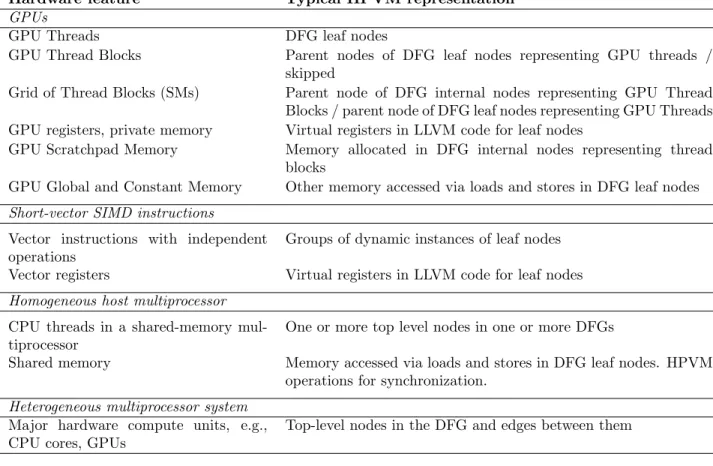
The parallel program representation we propose is ahierarchical dataflow graph with shared memory. The graph nodes can represent either coarse-grain or fine-grain computational tasks. In this work, we focus on moderately coarse-grain tasks (such as an entire inner-loop iteration). The dataflow graph edges capture explicit data transfers between nodes, while ordinary load and store instructions express implicit communication via shared memory. The graph is hierarchical because a node may contain another dataflow graph. The leaf nodes contain scalar computations. A graph node represents a static computation, and any such node can be “instantiated” in a rectangular grid of dynamic node instances, representing parallel instances of the computation. In this case, the incident edges of the node are instantiated as well, in order to capture the connections between the dynamic instances of the source and sink nodes.
The hierarchical dataflow graphs naturally capture all the important kinds of coarse-and fine-grain data coarse-and task parallelism in heterogeneous systems. In particular, the graph structure captures coarse-grain task parallelism (including pipelined parallelism in streaming computations); the graph hierarchy captures multiple levels and granularities of nested par-allelism; and the node instantiation mechanism captures either coarse- or fine-grain SPMD-style data parallelism.
We describe a prototype system (also called HPVM) that supports all three capabilities listed earlier. The system defines a compiler IR as an extension of the LLVM IR [41] by adding HPVM abstractions as a higher-level layer describing the parallel structure of a program.
As an example of the use of HPVM as a compiler IR, we have implemented an illustrative compiler optimization, graph node fusion,which operates directly on the HPVM dataflow graphs.
Node fusion achieves “kernel fusion”, and the graph structure makes it explicit when it is safe to fuse two or more nodes. Similarly, we find that the graph hierarchy is also an effective and portable method to capture tiling of computations, which can be mapped either to a cache hierarchy or to explicit local memories such as the scratchpads in a GPU.
To show the use of HPVM as a virtual ISA, we implemented translators for NVIDIA GPUs (using PTX), Intel’s AVX vector instructions, and multicore X86-64 host processors using Posix threads. The system can translate each HPVM graph node to one or more of
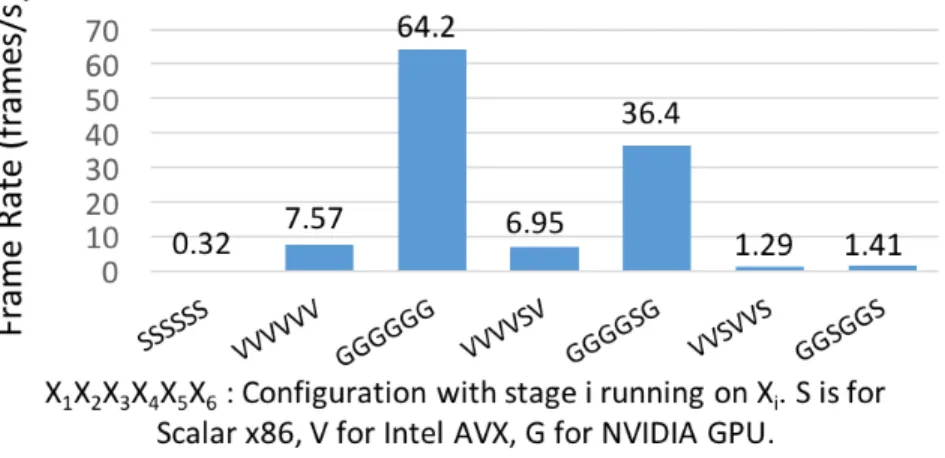
these distinct target architectures (e.g., a 6-node pipeline can generate 36 = 729 distinct code configurations from a single HPVM version). Experimental comparisons against hand-coded OpenCL programs compiled with native (commercial) OpenCL compilers show that the code generated by HPVM is within 22% of hand-tuned OpenCL on a GPU (in fact, nearly identical in all but one case), and within 7% of the hand-tuned OpenCL in all but one case on AVX.
Finally, to show the use of HPVM as a basis for runtime scheduling, we developed a graph-based scheduling framework that can apply a wide range of static and dynamic scheduling policies that take full advantage of the ability to generate different versions of code for each node. Although developing effective scheduling policies is outside the scope of this work, our experiments show that HPVM enables flexible scheduling policies that can take advantage of a wide range of static and dynamic information, and these policies are easy to implement directly on the HPVM representation.
1.4.2 A Compiler for Approximate Heterogeneous Parallel Hardware
This phase of our work extends to heterogeneous parallel systems with approximate hard-ware, in order to utilize approximate computing techniques (section 1.3) to achieve perfor-mance or energy benefits.
A given computational algorithm or kernel may benefit from multiple different approxima-tion techniques, and moreover, a realistic applicaapproxima-tion will contain several (or many) distinct kernels. Determining how best to map such an application to a modern heterogeneous sys-tem while achieving the best overall tradeoff between end-to-end application-level accuracy and performance or energy is an open research problem. Moreover, section 1.2 described theApproximation Tuning programming challenge. In the context of heterogeneous approx-imate hardware, this expresses itself as the fact that application developers and end users cannot be expected to specify error tolerances in terms of the system-level approximation knobs required by the various hardware approximation techniques, or even know about many of them. To target heterogeneous systems with approximate hardware we need automated mapping strategies that can translate application-level specifications (e.g., tolerable classifi-cation error in a machine learning appliclassifi-cation) to system-level knobs (e.g., neural network parameter precision or circuit-level voltage swings).
Optionally, for modern applications targeting a wide range of diverse systems, software portability is a requirement, not just at the source-code level but also the ability to ship software that can execute efficiently (as described in section 1.2.2). Modern applications for both desktop and mobile (e.g., smartphone or tablet) systems are almost always shipped by
application teams to end-users in a form that can execute on multiple system configurations (e.g., with different vector ISAs or GPUs) and even multiple hardware generations (e.g., across X86 processors). GPUs, for example, provide virtual instructions sets, e.g., PTX or HSAIL, to enable software to be shipped as ”virtual object code” that is translated to particular hardware instances only on the end-user’s system. This is a major challenge for approximate computing approaches because hardware-specific accuracy-performance-energy choices can make orders-of-magnitude difference in the performance and energy benefits achieved in exchange for relaxing accuracy. An important goal for real-world use of such approaches is to enable software to be shipped asportablevirtual object code, while deferring the hardware-specific aspects of accuracy-performance-energy optimizations to be performed after shipping [42] (e.g., on the end-user’s device or on servers in an “application store”).
In order to defer hardware-specific optimizations to install-time (or later), an appropriate virtual object code representation must include the necessary or relevant information to inform the decision. For accuracy-aware optimizations to benefit from a virtual object code representation, approximation information must be included at the virtual object code.
To that end, we extend HPVM to ApproxHPVM, a compiler IR and framework for accuracy-aware optimizations. ApproxHPVM automatically identifies approximable opera-tions, by allocating a user provided, high level and end to end accuracy metric, to operation-specific error budgets, and maps the identified approximable operations to fast, approximate hardware to achieve performance and energy benefits.
The ApproxHPVM IR extends the HPVM IR in two key ways, by including:
• domain-specific knowledge by incorporating high-level tensor operations as part of the IR.
• hardware-independent approximation metrics that quantify the acceptable accuracy loss for individual operations.
As ApproxHPVM does not incorporate any hardware-specific knowledge as part of the IR, it maintains the HPVM rationale of serving as a fully self-contained, hardware-agnostic virtual ISA that can be shipped and mapped to a variety of hardware platforms. This is enabled by partitioning the accuracy-energy-performance optimizations into a hardware-agnostic stage and a hardware-specific stage, where software can be shipped between the two stages. The approximation metrics are computed as part of the hardware-agnostic stage, and shipped as part of the virtual ISA, enabling object code portability for approximate application code.
The HPVM compiler has been extended with backends for two hardware targets for Ap-proxHPVM, PROMISE [19] , and NVIDIA GPUs through an optimized cuDNN/cuBLAS
runtime library, and with support for the ApproxHPVM high level tensor operations in the HPVM C/C++ frontend. ApproxHPVM programs can also be written in Keras [43], a popular neural-network library that can run on top of TensorFlow and Theano among other frameworks. Keras provides a simple, programmable interface for providing high-level descriptions of neural networks. We provide a Keras frontend that automatically generates the virtual ISA for ApproxHPVM programs.
Experimental results show significant gains, up to 9x performance speedups and up to 11.3x energy reduction, while staying within user-specified application-level quality metrics with high probability, for nine deep learning benchmarks and five convolution-based image processing benchmarks.
1.4.3 A Compiler and Runtime System for Adaptive Approximations
The final phase of our work specifically targets heterogeneous systems at the edge. We identify the following characteristics of these systems, whose combination is important for effectively targeting heterogeneous systems at the edge.
• Highly diverse and resource constrained: Section 1.2 discusses the programmability challenges of heterogeneous systems, and how they effectively limit the computational power of the already resource constrained edge devices.
• Amenable to approximation: The application domains often processed on such systems are inherently error tolerant, i.e. they can tolerate small amounts of error with accept-able resulting quality. This is extremely valuaccept-able when targeting edge systems, since the specific applications in these domains are highly compute-intensive, and may be far beyond the capabilities of even near- and medium-future edge compute hardware. Edge compute hardware, even with custom accelerators, is often too limited in compu-tational power, memory capacity, or energy capacity to support these computations.
• Varying conditions: When targeting edge devices, the varying conditions under which an application might be executing create additional complexities. Load variations, potentially caused by the need to execute different number of applications or an appli-cation under different quality requirements, and power constraints caused by battery, may alter the requirements for energy efficient execution of an application. These vari-ations can occur unpredictably in the uncontrolled environment of edge computing. Thus, to effectively target heterogeneous systems at the edge, we require a framework that abstracts away the diversity of the underlying hardware, enables energy efficient computation
through approximation optimizations, and provides an adaptive control mechanism to tune the approximation level in order to alter the achieved performance or energy benefits.
To that end, we propose ApproxTuner (an extension of ApproxHPVM), a portable opti-mizing compiler and runtime system that targets heterogeneous systems at the edge.
In order to address the programmability challenges, ApproxTuner is built on top of Ap-proxHPVM, and thus utilizes a portable virtual ISA and compiler.
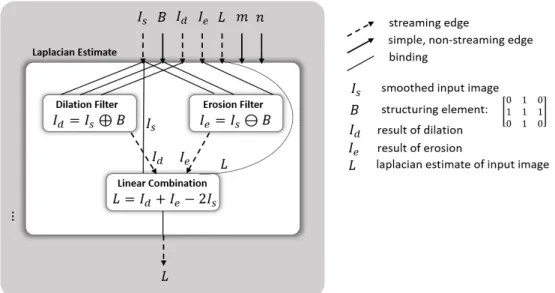
We identify tensor operations representative of the image processing domain and extend the ApproxHPVM IR and compiler infrastructure for the image processing domain. The framework enables the existing general purpose approximation techniques to be seamlessly used for the image processing tensor intrinsics, and we additionally implement an approxi-mation technique applicable to the image processing intrinsics.
ApproxTuner provides several software and hardware approximations for tensor opera-tions used in two different domains: convolutional neural networks and image processing. Moreover, the framework is extensible to add new approximation techniques.
Although a wide range of approximation techniques is important for targeting heteroge-neous systems at the edge, supporting several different approximations is in conflict with portability. This is because (a) autotuning is very expensive because the combined search space is large, but (b) ahead-of-time hardware-agnostic autotuning for the approximations is not conducive to performance portability since approximation choices are highly hardware-dependent.
Additionally, we find that software approximations present difficulties for approximation tuning. We identify that the accuracy impact of software approximations in ApproxTuner cannot be easily captured with simple attributes (e.g., L1 or L2 norms of output tensors, which are the error metrics in the IR). In particular, we observe that L1 and L2 norms work well when approximation behavior can be captured by independent random variation, such as external noise (e.g. PROMISE, low-voltage circuits, random bit flips). However, software approximations often display input sensitivity, thus their effect does not display random variation. We observe that the L1-L2 approximation metrics do not capture their effect on the computation (section 7.1). Thus combining software and hardware approximations in ApproxTuner cannot be achieved using the approximation parameters at the IR level, as approached by the ApproxHPVM work.
The ApproxTuner system addresses these challenges by decomposing the approximation tuning in three carefully designed steps: development-time,install-time, anddynamic adap-tive approximation tuning. Development-time tuning uses an autotuner to tune the available hardware-independent approximations, and constructapproximate Pareto-optimal curves for their parameter values. Install-time tuning measures the actual performance and energy of
the points in the approximate Pareto curve and updates the curve to reflect these measured values. For hardware-specific approximations (which are inherently non-portable), it also uses an autotuner to select and tune among the full set of software and hardware approxi-mations. The install-time stage produces an accurate Pareto-optimal curve for the particular hardware, in order to enable efficient dynamic tuning. Finally, at run time, approximation choices are periodically updated in response to changing resource variations, e.g., system load, battery capacity, or task deadlines, using the Pareto-optimal curve to select approxi-mation choices and parameter settings for each tensor operation.
The three step tuning strategy enables performance portability of application packages, while supporting both software and hardware approximation techniques. Performance porta-bility is a critical requirement for modern applications, since applications are expected to run efficiently on a wide range of systems. The shipped application package includes hardware-independent approximation methods, therefore they are applicable to any hardware target, and may be further refined at install time with install time tuning.
The install-time retuning phase can be prohibitively expensive on resource-constrained edge devices. To render the retuning feasible, we proposefederated autotuning. The federated autotuning process requires an interaction between a centralized server (e.g., an app store) and client devices, where each client performs a small fraction of the autotuning task and shares the partial results with the centralized server. The server caches the results gathered from the client devices and appropriately updates the Pareto curve of configurations for the target device. In this manner, each edge device only incurs a small fraction of the cost of install-time autotuning. Carefully designed search space pruning is also utilized to speed up install time tuning.
We evaluate ApproxTuner using benchmarks from the domains of machine learning and image processing. For 7 Deep Neural Network (DNN) benchmarks, we find that Approx-Tuner achieves geometric mean speedup of 1.9x and geometric mean energy reduction of 2x with only hardware-independent approximations. We also show that install-time tuning, which enables mapping to a machine learning accelerator, PROMISE, can improve these results to geometric mean speedup of 5.6x and geometric mean energy reduction of 5.9x. Similarly, for three image processing benchmarks, we achieve a geometric mean speedup of 2.14x and a geometric mean energy reduction of 2.4x. Finally, we show the adaptability of ApproxTuner through dynamic approximation tuning, which for our DNN and image pro-cessing benchmarks can deliver required speedups by varying performance and accuracy at runtime.
1.5 CONTRIBUTIONS
We summarize the contributions of this thesis, as a result of the approach described in 1.4.
Heterogeneous Parallel Systems I1 consider the object code and performance porta-bility challenges of heterogeneous parallel systems.
• I develop a parallel program representation (HPVM) for heterogeneous parallel systems based on a hierarchical dataflow graph with side effects, which captures essentially all the important kinds of task- and data-parallelism on heterogeneous systems.
• I implement an HPVM prototype system on top of a widely used compiler infras-tructure, LLVM, which historically has lacked any explicit support for heterogeneous parallel systems in the LLVM IR.
• I show that HPVM can be used to create an effective parallel virtual ISA for het-erogeneous systems by (a) using HPVM as a persistent representation of programs, and (b) by implementing translators from HPVM to three different classes of parallel hardware: GPUs, vector SIMD, and multicore CPUs.
• I show that HPVM can be used as an effective parallel compiler IR, that can support important optimizations like node fusion and tiling.
• I show that HPVM dataflow graphs can be used to support flexible static and dynamic scheduling policies, that take full advantage of the ability to translate individual HPVM graph nodes to multiple hardware.
Heterogeneous Parallel Systems with Approximate Hardware I2 extend to het-erogeneous parallel systems with approximate hardware.
• I extend the HPVM compiler infrastructure with high-level tensor operations plus hardware-agnostic approximation metrics that quantify the accuracy of unreliable and approximate computations. I have shown that ApproxHPVM IR can serve as a fully
1This work was done jointly, and equally, with Prakalp Srivastava ([email protected]), and appears in both our theses. We contributed equally to the design of the HPVM parallel program representation abstractions, implementation of HPVM prototype system on top of LLVM, and code generation. I lead the aspects of HPVM as a compiler IR and runtime representation.
2This work is lead by Hashim Sharif, and will be included in the thesis of Hashim Sharif ([email protected]) and Prakalp Srivastava ([email protected]). I contributed to the ApproxHPVM IR design, and lead its implementation as part of the HPVM compiler infrastructure.
self-contained virtual ISA, and so software can be shipped to achieve virtual object-code portability for approximable computations and allow deferred accuracy aware optimizations.
• I implement translators from ApproxHPVM to two hardware targets, PROMISE and an optimized cuDNN/cuBLAS runtime library for NVIDIA GPUs, extend the existing C/C++ HPVM frontend with support for the ApproxHPVM intrinsics, and contribute to the Keras frontend.
Heterogeneous Parallel Systems at the Edge Targeting heterogeneous systems at the edge, I3 make the following contributions:
• Several software and hardware approximations in a single framework: ApproxTuner is extended (from ApproxHPVM) with a range of software approximation techniques, now including both software and hardware approximations. A range of approximation techniques enables better optimization of a single application, as more combinations of the approximation techniques are available to provide accuracy and performance-energy benefits.
• Three-phase approximation tuning: I propose a novel three-phase approach to ap-proximation tuning that provides performance portability, retargetability to different compute units (with varying hardware-specific approximation knobs), and dynamic ap-proximation tuning, by splitting apap-proximation tuning into: a) selection of hardware-independent approximations at development-time, b) selecting hardware-specific ap-proximation options atinstall-time, and c) a fast approximation selection at runtime.
• Evaluation: ApproxTuner evaluation shows significant performance and energy ben-efits through hardware-independent approximations, that are significantly improved with the use of hardware-specific approximation techniques after install-time retuning. We also show that dynamic approximation tuning can deliver required speedups by varying performance and accuracy at runtime.
3This work is done jointly, and equally, with Hashim Sharif, and will also appear in his thesis. We contribute equally to the approximation techniques utilized in the ApproxTuner system and the three-step approximation tuning design. I lead the compiler implementation and runtime approximation tuning. Hashim lead the autotuning in general, specifically the install time tuning with the federated autotuning and other techniques to make expensive install-time autotuning practical. We both contribute to development time tuning.
1.6 THESIS ORGANIZATION
The rest of this document is organized in the following chapters: Chapter 2 gives context to this thesis by presenting an overview of the state of the art in the relevant domains. Chapter 3 presents the HPVM Intermediate Representation design, that aims to address the object code and performance portability challenges of heterogeneous systems. Chapter 4 presents the HPVM prototype implementation based on the HPVM IR design. The prototype system is a proof of concept, to show that the design in fact addresses the portability challenges of heterogeneous systems, and includes the implementations of HPVM as a virtual ISA, use of HPVM as a compiler IR, and as a basis for runtime scheduling. Chapter 5 includes the evaluation of the HPVM system in respect to the above. Chapter 6 presents ApproxHPVM, an extension to HPVM for approximation information at the IR level. Chapter 7 presents ApproxTuner, that addresses the programmability challenges of heterogeneous systems at the edge. Finally, Chapter 8 presents a summary of the contributions of this thesis and future directions of this work.
CHAPTER 2: RELATED WORK
This chapter provides a literature review of the state of the art in programming languages, compiler infrastructures, and runtime systems that aim to address the programmability challenges of heterogeneous systems, and techniques and systems developed in the emerging domain of approximate computing.
2.1 PROGRAMMING TECHNOLOGIES FOR HETEROGENEOUS SYSTEMS
There is a long history of work on dataflow execution models, programming languages, and compiler systems for homogeneous parallel systems [44, 45, 46, 47, 30, 48, 49, 50]. HPVM aims to adapt the dataflow model to modern heterogeneous parallel hardware. We focus below on programming technologies for heterogeneous systems.
Virtual ISAs: NVIDIA’s PTX virtual ISA provides portability across NVIDIA GPUs of different sizes and generations. HSAIL [51] and SPIR-V [52] both provide a portable object code distribution format for a wider class of heterogeneous systems, including GPUs, vectors and CPUs. All these systems implement a model that can be described as a “grid of kernel functions”, which captures individual parallel loop nests well, but more complex parallel structures are only expressed via explicit, low-level data movement and kernel coordination. This makes the underlying model unsuitable for use as a retargetable compiler IR, or for flexible runtime scheduling. Finally, it is difficult, at best, to express some important kinds of parallelism, such as pipelined parallelism (important for streaming applications or other accelerators), because all buffering, synchronization, etc., must be implemented explicitly by the program. Specifically, while the parallel pipeline stages can be expressed using different command queues, synchronizing every data transfer between every pair of pipeline stages requires buffer management, specified by the programmer, and use of explicit “events”. An event encodes an ordering between two operations, and is consumed upon occurrence. Therefore, a different event would be needed to be enqueued to capture all dependencies required to represent a pipeline per data transfer per stage.
In contrast, pipelined parallelism can be expressed easily and succinctly in HPVM (in addition to coarse- or fine-grain data-parallelism). Pipeline parallelism is captured naturally as part of the HPVM representation, and the implementation details such as buffering and synchronization are left to be handled by the system.
Compiler IRs with Explicit Parallel Representations: We focus on parallel com-pilers for heterogeneous systems. The closest relevant compiler work is OSCAR [26, 53, 27],
which uses a hierarchical task dependence graph as a parallel program representation for their compiler IR. They do not use this representation as a virtual ISA, which means they cannot provide object code portability. Their graph edges represent data and control de-pendencies, not dataflow (despite the name), which is well suited to shared memory systems but not as informative for non-shared memory. In particular, for explicit data transfers, the compiler must infer automatically what data must be moved (e.g., host memory to accel-erator memory). They use hierarchical graphs only for the (homogeneous) host processors, not for accelerators, because they do not aim to perform parallel compiler transformations for code running within an accelerator nor runtime scheduling choices for such code. KIM-BLE [54, 28] adds a hierarchical parallel program representation to GCC, while SPIRE [29] defines a methodology for sequential to parallel IR extension. Neither KIMBLE nor SPIRE make any claim to, or give evidence of, performance portability or parallel object code portability.
Delite Domain Specific Languages (DSLs) use the Delite compiler framework (described below) to define an IR for the new DSL, The IR is a sea of nodes representation; each node explicitly specifies its data and control dependencies, but otherwise is free to float. Nodes are simultaneously viewed in multiple ways: a generic layer representing a definition, a parallel layer called Delite ops, and a domain specific layer that contains the actual operation, e.g.
VectorPlus. The IR is optimized by viewing nodes at any layer, allowing for generic and domain specific operations to be applied at the same IR. The generated IR is domain specific and not general purpose like HPVM. However, the feature of simultaneous view of Delite IR in multiple ways would be useful as we extend the HPVM IR with domain specific information for the second phase of our work, in order to seamlessly allow both domain independent and domain specific optimizations.
HeteroIR [55] is an intermediate language that used to map high level programming models (e.g. OpenACC, with OpenARC [56]) to diverse heterogeneous devices. HeteroIR encapsu-lates the common accelerator operations in high level function calls, and during application execution the calls are dispatched to the appropriate target architecture API by the runtime system. However, the HeteroIR constructs only capture the host part of the program, the accelerator kernels are not part of the HeteroIR representation. In contrast, HPVM cap-tures the computation and data transfers as part of the dataflow graph, enabling analysis and potentially mapping to hardware components at different granularity.
AOMP [57] is AMD’s compiler that supports OpenMP and offloading to multiple GPU targets. It utilizes an LLVM-based IR, that represents OpenMP specific information instead of abstracting the parallel structure of the program using a uniform parallelism model.
Habane-ro-C [59], provide an abstraction of heterogeneous systems called Hierarchical Place Trees (HPT), which can be used to express and support flexible mapping of parallel programs. The HPT model supports co-allocation of data and computation at multiple levels of a memory hierarchy. It aims to address the diversity in memory systems of heterogeneous systems, but does not address the diversity in underlying instruction sets, therefore not addressing portability of object code through a representation usable as a portable virtual ISA.
In Tangram [60], a program is written in interchangeable, composable building blocks, called codelets. Codelets represent different, semantically equivalent, algorithmic or imple-mentation choices for an application code snippet. Tangram defines a set of transformations that allow for composition of new codelets. The compiler will optimize for the target archi-tecture by selecting or composing good codelets, and tuning the tunable parameters for the target architecture. Exploring algorithmic choices is orthogonal to, and can be combined with, our approach, since HPVM is a lower level representation.
Delite [61] is a compiler framework for developing compiled, embedded DSLs inside the programming language Scala. Delite DSLs construct an IR on which both generic and domain specific optimizations are performed and from which compilation is performed to target hardware. The Delite Execution Graph (DEG) encodes the dependencies between the computations in the program, and kernels are generated implementing the ops, or IR nodes, for different targets. Delite provides common parallel patterns and optimizations that can be reused across DSL implementations. To provide flexibility to run these ops on different hardware devices, Delite relies on the DSL developers to provide Scala, CUDA, OpenCL implementations of these computations as necessary for efficiency. HPVM on the other hand relies on the hardware vendors to provide platform specific implementation of computations in HPVM IR. The broader Delite approach can be combined with HPVM approach to ease burden on the DSL developers.
Multi-Level Intermediate Representation (MLIR) [62] is a compiler infrastructure aiming to unify the effort towards compilation for heterogeneous hardware and domain specific languages. The MLIR infrastructure defines an Intermediate Representation based on Static Single Assignment (SSA) form with nested instead of flat regions. It allows the definition of customizable Ops, organized within separate namespaces called dialects, representing the set of operations that are legal and supported for a domain. Compiler transformation can be defined within a dialect, or for all dialects when reasonable, e.g., inlining. MLIR Ops can represent different levels of abstraction. Thus, MLIR captures language abstractions at different levels, and operates on the principle of progressive lowering, sequencing compiler transformations to happen at higher abstraction levels before progressively moving to a lower abstraction level, effectively losing the information contained in the higher abstraction level.
HPVM can be implemented as a dialect of MLIR, defining Ops for the HPVM abstractions, and use translators to convert to available Dialects, e.g. GPU, SPIR-V, or other supported dialects with hardware support, thus utilizing the MLIR infrastructure for optimization and code generation for these targets. Approximation information may be introduced as well, as currently MLIR includes no approximation abstractions. Implementation of HPVM as an MLIR dialect would eliminate the need to directly use the dialects supported by the HPVM translators in order to target a range of parallel hardware. MLIR dialects could use HPVM, instead of going through separate individual dialects for each target hardware.
However, it is explicitly a non goal of the MLIR infrastructure to provide the runtime support required for the implemented Dialects, and thus runtime scheduling and approxi-mation tuning in HPVM and ApproxTuner systems would still be explicitly managed by our runtime. Thus, MLIR infrastructure can be used to implement HPVM as a dialect, which can benefit the code generation and optimization options of HPVM, but does not replace the HPVM’s capabilities as a Virtual ISA and a runtime representation.
Runtime Libraries for Heterogeneous Systems: Parallel Virtual Machine (PVM) [63] enables a network of diverse machines to be used cooperatively for parallel computation. De-spite the similarity in the names, the systems have different goals. What is virtualized in PVM are the application programming interfaces for task management and communication across diverse operating systems, to achieve portability and performance across homogeneous parallel systems. HPVM virtualizes the parallel execution behavior and the parallel hard-ware ISAs, to enable portability and performance across heterogeneous parallel hardhard-ware, including GPUs, vector hardware, and potentially FPGAs.
Several other runtime systems [64, 65, 66, 67] support scheduling and executing parallel programs on heterogeneous parallel systems. However, they do not address the challenge of object code portability.
Programming Languages: Source-level languages such as CUDA, OpenCL, OpenACC, and OpenMP all support a similar programming model that maps well to GPUs and vector parallelism. None of them, however, address object code portability and none can serve as a parallel compiler IR. They also make it difficult to express important kinds of parallelism, like pipelined parallelism. OpenCL also offers support for dataflow parallelism, targeting FPGAs, albeit through a union and not though a common set of interfaces.
PENCIL [68] is a programming language defined as a restricted subset of C99, intended as an implementation language for libraries and a compilation target for DSLs. Its compiler uses the polyhedral model to optimize code and is combined with an auto-tuning framework. It shares the goals of source code portability and performance portability with HPVM. However, it is designed as a readable language with high-level optimization directives rather
than as a compiler IR, per se, and it also does not address object code portability.
StreamIt [22] and CnC [69] are programming languages with a somewhat more general representation for streaming pipelines. For example, StreamIt filters are the basic unit of computation, and they can be composed using the following structures: Pipeline, SplitJoin, and FeedbackLoop. FeedbackLoop allows cycles to be introduced in the pipeline representa-tion, while the HPVM dataflow graph is acyclic. They, however, focus on stream parallelism, whereas HPVM supports both streaming and non-streaming parallelism. This is crucial when defining a compiler IR or a virtual ISA for parallel systems (of any kind), because most par-allel languages (e.g., OpenMP, OpenCL, CUDA, Chapel, etc.) are used for non-streaming parallel programs.
Legion [70, 71] is a programming model and runtime system for writing high-performance applications for distributed heterogeneous architectures. It provides abstractions for de-scribing the structure of program data in a machine independent way. Tasks can be defined hierarchically, i.e. a Legion program is a tree of tasks with a top level task and tasks can spawn subtasks. Tasks specify logical regions they will operate on, and define the privi-leges and coherence for each region. The Legion runtime maps logical regions to (one or more instances of) physical memory. Legion defines a memory model that provides control over data placement and partitioning on top of complex memory hierarchies in a machine independent way, which HPVM lacks. However, Legion focuses on data placement due to complex memory hierarchies of distributed heterogeneous memory systems where cost of communication dominates the cost of computation. It does not address the challenges of diversity in parallelism models or instruction sets, as code for leaf tasks (subtasks that do not spawn other tasks) is provided by the programmer for each target that the leaf task is expected to execute on.
Similarly, Sequoia [72, 73] provides rich memory abstractions to enable explicit control over movement and placement of data at all levels of a heterogeneous memory hierarchy. Specif-ically, machines are abstracted as trees of distinct memory modules defining their memory hierarchy. Sequoia programs abstractly describe hierarchies of tasks, with tasks specifying information about communication and working set of data. Computation is restricted to tasks that will eventually be mapped to the leaf level of the machine tree.
HPVM lacks these features, but does express tiling effectively and portably using the hierarchical graphs. In future, we aim to add richer memory abstractions to HPVM. We believe that HPVM could borrow ideas from Legion and Sequoia for that purpose, as briefly mentioned in section 8.2.
2.2 APPROXIMATE COMPUTING
Approximation-Aware Languages. EnerJ [32] presents a type system that separates approximate and precise data. The developer needs to annotate each variable in the source code as precise or approximate before the type system can ensure that the approximate data is never assigned to the precise variable. More recently, Decaf [74] performs type inference to reduce the developer annotation effort.
Rely [33] and Chisel [34] introduced the idea of quantifiable reliability and accuracy at the program level. They define function-level specifications that express the maximum probabil-ity with which the function can produce an inaccurate result. These specifications separate the optimization within the function from the uses of the function: the code that calls the function can rely on the specification, while the body of the function can be modified separately and Rely and Chisel can statically verify that those implementations satisfy the specification.
All these systems require programmer annotations at the source level. ApproxHPVM introduces the concept of quantifiable reliability at the IR level. Incorporating approximation metrics at the IR level provides a more portable alternative, since the metrics are preserved even after compiling the program and the approximation becomes a first-class citizen in a compiler workflow, which is able to interact with various front-end languages and hardware-specific features. ApproxTuner decouples software from hardware approximation tuning as part of its three step approximation tuning strategy, enabling hardware independent, development time software approximation options to be shipped as part of the virtual ISA and hardware-specific tuning to occur at install time, as well as dynamic approximation tuning.
Compiler-based Systems for Machine Learning. TVM [75] proposes a compiler framework that supports the compilation and optimization of machine learning workloads on multiple hardware targets. Similarly, Glow [76] and XLA [77] are also ML-based com-piler frameworks that leverage DNN-specific operations in the IR design, thereby facilitating domain-specific optimizations. As ApproxHPVM also leverages domain-specific information with the inclusion of high-level tensor intrinsics, it also facilitates such domain-specific op-timizations. None of these systems include approximation metrics in the IR design and hence do not provide the portability and flexibility offered by ApproxHPVM. While these existing systems provide support for precision-tuning to half-precision floating point (FP16) and 8-bit integer (INT8), ApproxHPVM provides more extensive support for approximation since it also allows for mapping computations to accelerators that provide performance-energy-accuracy trade-offs. Moreover, ApproxHPVM enables approximation mechanisms