Modified global k-means algorithm for clustering in gene expression
data sets
Adil M. Bagirov
Karim Mardaneh
Centre for Informatics and Applied Optimization, School of Information Technology and Mathematical Sciences,
University of Ballarat, Victoria, 3353, Australia, Email: [email protected]
Abstract
Clustering in gene expression data sets is a challeng-ing problem. Different algorithms for clusterchalleng-ing of genes have been proposed. However due to the large number of genes only a few algorithms can be applied for the clustering of samples. k-means algorithm and its different variations are among those algorithms. But these algorithms in general can converge only to local minima and these local minima are signifi-cantly different from global solutions as the number of clusters increases. Over the last several years differ-ent approaches have been proposed to improve global search properties ofk-means algorithm and its perfor-mance on large data sets. One of them is the global
k-means algorithm. In this paper we develop a new version of the globalk-means algorithm: the modified global k-means algorithm which is effective for solv-ing clustersolv-ing problems in gene expression data sets. We present preliminary computational results using gene expression data sets which demonstrate that the modifiedk-means algorithm improves and sometimes significantly results by k-means and global k-means algorithms.
1 Introduction
This paper develops an incremental algorithm for solving sum-of-squares clustering problems in gene expression data sets. Clustering in gene expression data sets is a challenging problem. Different algo-rithms for clustering of genes have been proposed (see, for example, (Medvedovic & Sivaganesan 2002, Ye-ung et al. 2001, YeYe-ung et al. 2003)). However due to the large number of genes only a few algorithms can be applied for the clustering of samples ((Bagirov et al. 2003)). As the number of clusters increases the number of variables in the clustering problem in-creases drastically and most of clustering algorithms become inefficient for solving such problems. k-means algorithm and its different variations are among those algorithms which still applicable to clustering of sam-ples in gene expression data sets. But k-means algo-rithms in general can converge only to local minima and these local minima may be significantly different from global solutions as the number of clusters in-creases. Recently the global k-means algorithm has been proposed to improve global search properties of
k-means algorithms ((Likas et al. 2003)). In this pa-per we develop a new version of the global k-means algorithm: the modified global k-means algorithm
Copyright c2006, Australian Computer Society, Inc. This pa-per appeared at The 2006 Workshop on Intelligent Systems for Bioinformatics (WISB2006), Hobart, Australia. Conferences in Research and Practice in Information Technology (CRPIT), Vol. 73. Mikael Bod´en and Timothy L. Bailey, Ed. Reproduc-tion for academic, not-for profit purposes permitted provided this text is included.
which is effective for solving clustering problems in gene expression data sets.
The cluster analysis deals with the problems of organization of a collection of patterns into clusters based on similarity. It is also known as the unsuper-vised classification of patterns and has found many applications in different areas. In cluster analysis we assume that we have been given a finite set of points
Ain then-dimensional space IRn, that is
A={a1, . . . , am}, whereai∈IRn, i= 1, . . . , m.
There are different types of clustering. In this paper we consider the hard unconstrained partition cluster-ing problem, that is the distribution of the points of the set A into a given number k of disjoint subsets
Aj, j = 1, . . . , k with respect to predefined criteria
such that: 1) Aj6=∅, j= 1, . . . , k; 2) AjT Al=∅, j, l= 1, . . . , k, j6=l; 3) A= k S j=1 Aj.
4) no constraints are imposed on clustersAj, j = 1, . . . , k.
The sets Aj, j = 1, . . . , k are called clusters. We
assume that each cluster Aj can be identified by its
center (or centroid)xj ∈IRn, j= 1, . . . , k. Then the clustering problem can be reduced to the following optimization problem (see (Bock 1998, Spath 1980)):
minimize ψ(x, w) = 1 m m X i=1 k X j=1 wijkxj−aik2 (1) subject to x= (x1, . . . , xk)∈IRn×k, (2) k X j=1 wij = 1, i= 1, . . . , m, (3) and wij = 0 or 1, i= 1, . . . , m, j= 1, . . . , k (4)
wherewij is the association weight of patternai with
clusterj, given by
wij=
n
1 if patternai is allocated to clusterj, 0 otherwise
and xj= Pm i=1wijai Pm i=1wij , j= 1, . . . , k.
Herek · kis an Euclidean norm andwis anm×k ma-trix. The problem (1)-(4) is also known as minimum sum-of-squares clustering problem.
Different algorithms have been proposed to solve the clustering problem. The paper (Jain et al. 1999) provides survey of most of existing algorithms. We mention among them heuristics like k-means algo-rithms and their variations (h-means, j-means etc.), mathematical programming techniques including dy-namic programming, branch and bound, cutting plane, interior point methods, the variable neighbor-hood search algorithm and metaheuristics like simu-lated annealing, tabu search, genetic algorithms (see (Al-Sultan 1995, Brown & Entail 1992, de Merle et al. 2001, Diehr 1985, Dubes & Jain 1976, Hanjoul & Peeters 1985, Hansen & Jaumard 1997, Hansen & Mladenovic 2001a, Hansen & Mladenovic 2001b, Koontz et al. 1975, Selim & Al-Sultan 1991, Spath 1980, Sun et al. 1994)). Since the number of genes in gene expression data sets are very large most of these algorithms cannot be applied for clustering of samples in such data sets.
The problem (1)-(4) is a global optimization prob-lem and the objective function ψin this problem has many local minima. However clustering algorithms based on global optimization techniques are not ap-plicable to even relatively large data sets. Algorithms which are applicable to such data sets can locate only local minima of the function ψ and these local min-ima can differ from global solutions significantly as the number of clusters increases. Another difficulty is that the number of clusters, as a rule, is not known a priori. Over the last several years different in-cremental algorithms have been proposed to address these difficulties. Results of numerical experiments show that an incremental approach allows one, as a rule, to locate a local solution close to global one. Consequently it can produce a better cluster struc-ture of a data set. The paper (Bagirov & Yearwood, 2006) develops an incremental algorithm based on nonsmooth optimization approach to clustering. The global k-means algorithm was developed in (Likas et al. 2003). The incremental approach is also discussed in (Hansen et al. 2004).
In this paper we propose a new version of the globalk-means algorithm for solving clustering prob-lems in gene expression data sets. In this algorithm a starting point for the k-th cluster center is com-puted by minimizing so-called auxiliary cluster func-tion. We present the results of numerical experi-ments with 6 gene expression data sets. These results demonstrate that the proposed algorithm improves solutions obtained by the global k-means algorithm and for some data sets this improvement is substan-tial.
The rest part of the paper is organized as follows: Section 2 gives a brief description ofk-means and the globalk-means algorithms. The nonsmooth optimiza-tion approach to clustering and an algorithm for the computation of a starting point is described in Sec-tion 3. SecSec-tion 4 presents an algorithm for solving clustering problems. The results of numerical experi-ments are given in Section 5 and Section 6 concludes the paper.
2 k-means and the globalk-means algorithms In this section we give a brief description of k-means and the globalk-means algorithms.
Thek-means algorithm proceeds as follows:
1. choose a seed solution consisting ofkcenters (not necessarily belonging to A);
2. allocate data points ai ∈ Ato its closest center and obtaink-partition of A;
3. recompute centers for this new partition and go to Step 2 until no more data points change clus-ter.
The effectiveness of this algorithm highly depends on a starting point. It converges only to a local solution which can significantly differ from the global solution in many large data sets.
The globalk-means algorithm proposed in (Likas et al. 2003) computes clusters successively. At the first iteration of this algorithm the centroid of the set
A is computed and in order to compute k-partition at the k-th iteration this algorithm uses centers of
k−1 clusters from the previous iteration. The global
k-means algorithm for the computation ofq≤m clus-ters in a data setAcan be described as follows. Algorithm 1 The globalk-means algorithm. Step 1. (Initialization) Compute the centroid x1 of
the setA: x1= 1 m m X i=1 ai, ai∈A, i= 1, . . . , m and setk= 1.
Step 2. Set k = k + 1 and consider the centers
x1, x2, . . . , xk−1 from the previous iteration.
Step 3. Consider each pointaofAas a starting point for thek-th cluster center, thus obtainingminitial so-lutions withkpoints (x1, . . . , xk−1, a); applyk-means
algorithm to each of them; keep the bestk-partition obtained and its centersx1, x2, . . . , xk.
Step 4. (Stopping criterion) If k=q then stop, oth-erwise go to Step 2.
This version of the algorithm is not applicable for clustering on middle sized and large data sets. Two procedures were introduced to reduce its complexity (see (Likas et al. 2003)). We mention here only one of them because the second procedure is applicable to low dimensional data sets. Letdi
k−1 be a squared
distance betweenai∈Aand the closest cluster center
among thek−1 cluster centers obtained so far. For eachai∈A we calculate the following:
ri= m
X
j=1
min{0,kai−ajk2−djk−1}
and we take the data pointal∈Afor which l= arg mini=1,...,mri
as a starting point for thek-th cluster center. Then
k-means algorithm is applied starting from the point
x1, x2, . . . , xk−1, al to find k cluster centers. In our
numerical experiments we use this procedure. It should be noted thatk-means algorithm and its variants tend to produce only spherical clusters and they are not always appropriate for solving cluster-ing problems. However applycluster-ingk-means algorithms we assume that clusters in a data set can be approx-imated byn-dimensional balls.
3 Computation of starting points
The clustering problem (1)-(4) can be reformulated in terms of nonsmooth, nonconvex optimization as fol-lows (see (Bagirov et al. 2002, Bagirov et al. 2003)):
minimize f(x) (5) subject to x= (x1, . . . , xk)∈IRn×k, (6) where f(x1, . . . , xk) = 1 m m X i=1 min j=1,...,kkx j−aik2. (7)
We call f a cluster function. Ifk > 1, the function
f is nonconvex and nonsmooth. The number of vari-ables in problem (1)-(4) is (m+n)×k whereas in problem (5)-(6) this number is only n×k and the number of variables does not depend on the number of instances. It should be noted that in many real-world data sets the number of instancesmis substan-tially greater than the number of featuresn. On the other hand in the hard clustering problems the co-efficients wij are integer, that is the problem (1)-(4)
contains both integer and continuous variables. In the nonsmooth optimization formulation of the clustering problem variables are continuous only. All these cir-cumstances can be considered as advantages of the nonsmooth optimization formulation (5)-(6) of the clustering problem.
Let us consider the problem of findingk-th cluster center assuming that the centersx1, . . . , xk−1fork−1
clusters are known. Then we introduce the following function: ¯ fk(y) = 1 m m X i=1 min dik−1,ky−aik2 (8)
where y∈IRn stands fork-th cluster center and
dik−1= min
kx1−aik2, . . . ,kxk−1−aik2 .
The function ¯fk is called an auxiliary cluster
func-tion. It has only nvariables. Consider the set
D=
y∈IRn :ky−aik2≥di k−1 .
¯
Dis the set where the distance between any its pointy
and any data pointai∈Ais no less than the distance between this data point and its cluster center. We also consider the following set
D0= IRn\D≡ {y∈IRn:
∃I⊂ {1, . . . , m}, I 6=∅:ky−aik< dik−1 ∀i∈I}.
The function ¯fk is a constant on the set D and its
value in this set is ¯ fk(y) =d0≡ m X i=1 dik−1, ∀y∈D.
It is clear that xj ∈ D for all j = 1, . . . , k−1 and
ai ∈D
0 for allai ∈A, ai 6=xj, j= 1, . . . , k−1. It
is also clear that ¯fk(y)< d0 for ally∈D0.
Any pointy∈D0can be taken as a starting point
for the k-th cluster center. The function ¯fk is non-convex function with many local minima and one can
assume that the global minimum of this function can be a good candidate to be the starting point for the
k-th cluster center. However it is not always possi-ble to find the global minimum of ¯fk in a reasonable time. Therefore we propose an algorithm for finding a local minimum of the function ¯fk.
For anyy∈D0 we consider the following sets: S1(y) =ai∈A:ky−aik2=dik−1 , S2(y) = ai∈A:ky−aik2< di k−1 , S3(y) = ai∈A:ky−aik2> di k−1 .
The setS2(y)6=∅for anyy∈D0.
The the following algorithm is proposed to find a starting point for thek-th cluster center.
Algorithm 2 An algorithm for finding the starting point.
Step 1. For eachai∈D
0TAcompute the setS2(ai),
its centerciand the value ¯fk
ai = ¯fk(ci) of the function ¯ fk at the pointci. Step 2. Compute ¯ fmink = min ai∈D 0TA ¯ faki, aj = arg minai∈D0TA ¯ faki, the corresponding centercj and the setS
2(cj).
Step 3. Recompute the setS2(cj) and its center until
no more data points escape or return to this cluster. Let ¯xbe a cluster center generated by Algorithm 2. Then the point ¯xis a local minimum of the function
¯
fk.
4 An incremental clustering algorithm In this section we describe an incremental algorithm for solving cluster analysis problems.
Algorithm 3 An incremental algorithm for cluster-ing problems.
Step 1. (Initialization). Select a tolerance > 0. Compute the centerx1∗∈IRn of the setA. Letf1∗ be the corresponding value of the objective function (7). Setk= 1.
Step 2. (Computation of the next cluster center). Letx1∗, . . . , xk∗ be the cluster centers fork-partition problem. Apply Algorithm 2 to find a starting point
yk+1,0∈IRn for the (k+ 1)-st cluster center.
Step 3. (Refinement of all cluster centers). Take
xk+1,0 = (x1∗, . . . , xk∗, yk+1,0) as a new starting
point, apply k-means algorithm to solve (k + 1)-partition problem. Letx1∗, . . . , xk+1,∗ be a solution to this problem andfk+1,∗be the corresponding value of the objective function (7).
Step 4. (Stopping criterion). If
fk∗−fk+1,∗ f1∗ <
It is clear that fk∗ ≥ 0 for all k ≥ 1 and the sequence{fk∗} is decreasing, that is,
fk+1,∗≤fk,∗ for all k≥1.
The latter implies that after ¯k >0 iterations the stop-ping criterion in Step 4 will be satisfied. Thus Algo-rithm 3 computes as many clusters as the data setA
contains with respect to the toleranceε >0.
The choice of the tolerance ε > 0 is crucial for Algorithm 3. Large values of can result in the ap-pearance of large clusters whereas small values can produce small and artificial clusters.
5 Results of numerical experiments
To verify the effectiveness of the proposed algorithm and to compare it with similar algorithms a number of numerical experiments with six gene expression data sets have been carried out on a Pentium-4, 2.0 GHz, PC. We also use multi-start k-means (MSKM) and global k-means (GKM) algorithms for comparison. 100 randomly generated starting points are used in MSKM. In tables below MGKM stands for the mod-ified global k-means algorithm. In tables we present the number of clusters (N), valuesf of the clustering function obtained by different algorithms and CPU time (t). We used the following gene expression data sets.
5.1 Data set 1
This data set is Boston Lung Cancer data set and was generated at the Dana Farber Cancer Institute. The data set consists of 12484 genes, 185 lung tumor sam-ples and 17 normal lung samsam-ples. Of these, there were 138 lung adenocarcinoma, 6 small-cell lung cancer, 20 carcinoid lung cancer and 21 squamous cell. Ex-pression profiles were generated using the Affymetrix GeneChip HG U95Av2. This data set can be ac-cessed from Cancer Genomics expression database at the Broad Institute of MIT and Harvard. Results for this data set are presented in Table 1.
Table 1: Results for Data set 1 N MSKM GKM MGKM f×1010 t f×1010 t f×1010 t 2 8.441 542.81 8.441 59.31 8.441 102.47 5 6.644 1652.08 6.769 240.39 6.712 415.58 10 5.703 2714.59 6.094 545.19 5.696 962.94 15 5.467 4086.98 5.556 862.45 5.177 1543.30 20 4.900 5016.28 5.041 1199.98 4.812 2150.46
Results presented in Table 1 demonstrate that MSKM algorithm produces better results when the number of clustersN ≤10. However MGKM outper-forms two other algorithms as the number of clusters increases. GKM requires less CPU time however its solutions are not good. MGKM requires significantly less CPU time than MSKM.
5.2 Data set 2
This is the Novartis multi-tissue data set. The data set includes tissue samples of four can-cer types with 26 breast,26 prostate, 28 lung, and 23 colon samples. There are 103 sam-ples all together and 1000 genes. This data set is available at: http://www.broad.mit.edu/cgi-bin/cancer/datasets.cgi. Results for this data set are presented in Table 2.
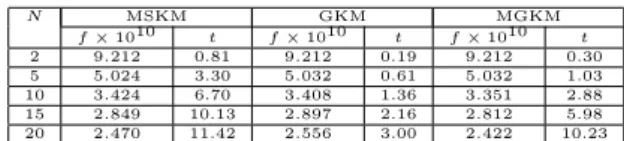
One can see from Table 2 that algorithms repform similar when the number of clusters N≤5. However
Table 2: Results for Data set 2 N MSKM GKM MGKM f×1010 t f×1010 t f×1010 t 2 9.212 0.81 9.212 0.19 9.212 0.30 5 5.024 3.30 5.032 0.61 5.032 1.03 10 3.424 6.70 3.408 1.36 3.351 2.88 15 2.849 10.13 2.897 2.16 2.812 5.98 20 2.470 11.42 2.556 3.00 2.422 10.23
GKM requires significantly less CPU time. MGKM produces better solutions than two other algorithms as the number of clusters increases. Again MGKM requires less CPU time than MSKM.
5.3 Data set 3
This is a leukemia data set with 5000 genes and 38 samples including 11 acute myeloid leukemia (AML)and 27 acute lymphoblastic leukemia (ALL) samples. The original data set is retrievable from: http://www.broad.mit.edu/cgi-bin/cancer/ datasets.cgi. Results are presented in Table 3. We calculate maximum 10 clusters because this data set contains only 38 samples.
Table 3: Results for Data set 3 N MSKM GKM MGKM
f×1010 t f×1010 t f×1010 t
2 7.880 3.06 8.137 0.58 7.880 0.67 5 5.537 8.17 5.837 2.02 5.729 2.64 10 4.104 10.47 4.399 4.59 4.271 8.19
Results from Table 3 show MSKM produces bet-ter solutions than two other algorithms, however it requires more computational time. MGKM produces better solutions than the GKM algorithm.
5.4 Data set 4
This data set includes 248 samples and 985 genes. Diagnostic bone narrow samples from pe-diatric acute leukemia patients corresponding to 6 prognostically important leukemia subtypes: 43 T-lineage ALL, 27 E2A-PBX1, 15 BCR-ABL, 79 TEL-AML1, 20 MLL rearrangements and 64 “hyperdiploid>50” chromosomes. The data set is available at: http://www.broad.mit.edu/cgi-bin/cancer/datasets.cgi. Computational results for this data set are presented in Table 4.
Table 4: Results for Data set 4 N MSKM GKM MGKM f×1013 t f×1013 t f×1013 t 2 2.777 7.47 2.777 0.97 2.777 1.81 5 1.939 20.44 1.939 3.55 1.939 6.81 10 1.671 36.44 1.685 7.86 1.626 15.20 15 1.570 51.67 1.555 12.34 1.480 25.14 20 1.534 60.36 1.473 17.02 1.364 36.09
For data set 4 all three algorithms give the same solutions when the number of clusters N ≤5. How-ever, for larger number of clusters MGKM outper-forms other two algorithms. GKM requires the least CPU time and MGKM requires less CPU time than MSKM.
5.5 Data set 5
This is a lung cancer data set which in-cludes 2000 genes and 139 adenocarcinomas, 21 squamous cell carcinomas, 20 carcinoids and 17 normal lung samples. This data set
is available at: http://www.broad.mit.edu/cgi-bin/cancer/datasets.cgi. Results are given in Table 5.
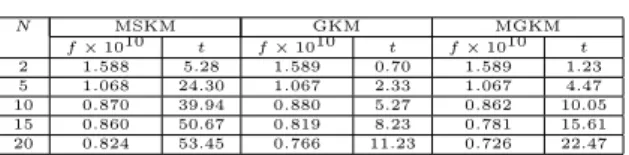
Table 5: Results for Data set 5 N MSKM GKM MGKM f×1010 t f×1010 t f×1010 t 2 1.588 5.28 1.589 0.70 1.589 1.23 5 1.068 24.30 1.067 2.33 1.067 4.47 10 0.870 39.94 0.880 5.27 0.862 10.05 15 0.860 50.67 0.819 8.23 0.781 15.61 20 0.824 53.45 0.766 11.23 0.726 22.47
Results presented in Table 5 demonstrate that al-gorithms produce almost the same solutions when the number of clustersN≤5. The algorithm MGKM sig-nificantly outperforms other algorithms as the num-ber of clusters increases. GKM requires the least CPU time and MGKM requires less CPU time than the al-gorithm MSKM.
5.6 Data set 6
This data set has 90 samples and 1277 genes. It contains 13 distinct tissue types: 5 breast cancer, 9 prostate, 7 lung, 11 colon, 6 germi-nal center cells, 7 bladder, 6 uterus, 5 periph-eral blood monocytes, 12 kidney, 10 pancreas, 4 ovary, 5 whole brain and 3 cerebellum. This data set is available at: http://www.broad.mit.edu/cgi-bin/cancer/datasets.cgi. Computational results for this data set are presented in Table 6.
Table 6: Results Data set 6 N MSKM GKM MGKM f×1011 t f×1011 t f×1011 t 2 1.554 2.16 1.589 0.20 1.582 0.36 5 1.040 7.06 1.064 0.69 1.065 1.23 10 0.655 14.28 0.651 1.52 0.633 2.69 15 0.526 23.58 0.461 2.44 0.453 4.86 20 0.476 29.78 0.352 3.38 0.349 8.27
Results from Table 6 demonstrate that for small number clusters MSKM works better than other al-gorithms, however GKM and MGKM produce better solutions as the number of clusters increases. MGKM is best for larger number clusters. MSKM is computa-tionally more expensive and GKM use the least CPU time.
5.7 Content of clusters
In this subsection we demonstrate the content of clus-ters produced by different algorithms and we use the notion of cluster purity to compare clusters. The no-tion of cluster purity is defined as follows:
P(Ai) = 100 1 nAi max j=1,...,l n j Ai,
where nAi =|Ai| is the cardinality of the clusterAi,
njAi is the number of instances in the clusterA
i that
belong to the true class jandl is the number of true classes. Then the total purity P(A) for the data set
A can be calculated as:
P(A) = nAiP(A
i)
m .
We used the data set 6 and calculated 30 clusters. Results are as follows.
• MSKM algorithm produced 13 empty, 6 mixed and 11 pure clusters with total purity P(A) = 64.44;
• GKM algorithm produced 27 pure and 3 mixed clusters with the total purity P(A) = 83.33. In three mixed clusters the results were as follows:
– Cluster 1 - 17 tumors: breast(1), lung(2), colon(2), germinal center cells (1), blad-der(1), uterus(2), kidney(3), pancreas(5); – Cluster 2 - 4 tumors: bladder(1), uterus(3); – Cluster 3 - 5 tumors: whole brain(2),
cere-bellum(3).
• MGKM algorithm produced 27 pure and 3 mixed clusters with the total purity P(A) = 85.56. In three mixed clusters the results were as follows:
– Cluster 1 - 14 tumors: breast(1), lung(2), colon(1), bladder(2), kidney(3), pan-creas(5);
– Cluster 2 - 3 tumors: colon(1), germinal center cells (1), bladder(1).
– Cluster 3 - 5 tumors: bladder(1), uterus(3), whole brain(1);
One can see that MGKM algorithm produces better clusters than two other algorithms.
6 Conclusions
In this paper we have developed the new version of the globalk-means algorithm, the modified globalk -means algorithm. This algorithm computes clusters incrementally and to compute k-partition of a data set it usesk−1 cluster centers from the previous it-eration. An important step in this algorithm is the computation of a starting point for the k-th cluster center. This starting point is computed by minimiz-ing so-called auxiliary cluster function. The proposed algorithm computes as many clusters as a data set contains with respect to a given tolerance.
We have presented the results of numerical exper-iments on 6 gene expression data sets. These results clearly demonstrate that the modified globalk-means algorithm proposed in this paper is efficient for solv-ing clustersolv-ing problems in gene expression data sets. It outperforms both the multi-start and global k -means algorithms as the number of clusters increases. However the proposed algorithm requires more com-putational efforts than the globalk-means algorithm.
Acknowledgement
This research was supported by the Australian re-search Council.
References
Al-Sultan, K.S. (1995), A tabu search approach to the clustering problem, Pattern Recognition, 28(9), 1443-1451.
Bagirov, A.M., Rubinov, A.M. & Yearwood, J. (2002), A global optimisation approach to clas-sification, Optimization and Engineering, 3(2), 129-155.
Bagirov, A.M., Rubinov, A.M, Soukhoroukova, N.V. & Yearwood, J. (2003), Supervised and unsu-pervised data classification via nonsmooth and global optimisation, TOP: Spanish Operations Research Journal,11(1), 1-93.
Bagirov, A.M. & Yearwood, J. (2006), A new non-smooth optimization algorithm for minimum sum-of-squares clustering problems, European Journal of Operational Research, 170(2), 578-596.
Bagirov, A.M., Ferguson, B., Ivkovic, S., Saunders, G. & Yearwood, J. (2003), New algorithms for multi-class cancer diagnosis using tumor gene expression signatures, Bioinformatics, 19(14), 1800-1807.
Bock, H.H. (1998), Clustering and neural networks, In: Rizzi, A., Vichi, M. & Bock, H.H. (eds), Advances in Data Science and Classification, Springer-Verlag, Berlin, pp. 265-277.
Brown, D.E. & Entail, C.L. (2001), A practical ap-plication of simulated annealing to the clustering problem, Pattern Recognition,25(4), 401-412. de Merle, O., Hansen, P., Jaumard, B. &
Mladen-ovic, N. (2001), An interior point method for minimum sum-of-squares clustering,SIAM J. on Scientific Computing,21,1485-1505.
Diehr, G. (1985), Evaluation of a branch and bound algorithm for clustering, SIAM J. Scientific and Statistical Computing, 6,268-284.
Dubes, R. & Jain, A.K. (1976), Clustering techniques: the user’s dilemma,Pattern Recognition,8, 247-260.
Hanjoul, P. & Peeters, D. (1985), A comparison of two dual-based procedures for solving the p-median problem, European Journal of Operational Re-search, 20,387-396.
Hansen, P. & Jaumard, B. (1997), Cluster analysis and mathematical programming, Mathematical Programming, 79(1-3),191-215.
Hansen, P. & Mladenovic, N. (2001a), J-means: a new heuristic for minimum sum-of-squares clus-tering, Pattern Recognition,4,405-413.
Hansen, P. & Mladenovic, N. (2001b), Variable neighborhood decomposition search, Journal of Heuristic,7, 335-350.
Hansen, P., Ngai, E., Cheung, B.K. & Mladenovic, N. (2001b), Analysis of global k-means, an in-cremental heuristic for minimum sum-of-squares clustering, submitted.
Houkins, D.M. , Muller, M.W. & ten Krooden, J.A., (2001b), Cluster analysis, In: Topics in Ap-plied Multivariate Analysis, Cambridge Univer-sity press, Cambridge.
Jain, A.K. , Murty, M.N. & Flynn, P.J. (1999), Data clustering: a review, ACM Computing Surveys, 31(3),264-323.
Jensen, R.E. (1969), A dynamic programming algo-rithm for cluster analysis, Operations Research, 17,1034-1057.
Koontz, W.L.G., Narendra, P.M. & Fukunaga, K. (1975), A branch and bound clustering algo-rithm, IEEE Transactions on Computers, 24, 908-915.
Likas, A., Vlassis, M. & Verbeek, J. (2003), The global k-means clustering algorithm, Pattern Recognition,36,451-461.
Medvedovic, M. & Sivaganesan, S. (2002), Bayesian infinite mixture model based clustering gene ex-pression profiles,Bioinformatics,18,1194-1206. Selim, S.Z. & Al-Sultan, K.S. (1991), A simulated annealing algorithm for the clustering, Pattern Recognition,24(10), 1003-1008.
Spath, H. (1991), Cluster Analysis Algorithms, Ellis Horwood Limited, Chichester.
Sun, L.X., Xie, Y.L., Song, X.H., Wang, J.H. & Yu, R.Q. (1994), Cluster analysis by simulated an-nealing,Computers and Chemistry,18,103-108. Yeung, K.Y., Fraley, C., Murua, A., Raftery, A.E. & Ruzzo, W.L. (2001), Model-based clustering and data transformations for gene expression data, Bioinformatics, 17,977-987.
Yeung, K.Y. , Medvedovic, M. & Bumgarner, R.E., (2003), Clustering gene expression data with re-peated measurements,Genome Biol.,4,R34.