FOI is an assignment-based authority under the Ministry of Defence. The core activities are research, method and technology development, as well as studies for the use of defence and security. The organization employs around 1350 people of whom around 950 are researchers. This makes FOI the largest research institute in Sweden. FOI provides its customers with leading expertise in a large number of fi elds such as security-policy studies and analyses in defence and security, assessment of dif-ferent types of threats, systems for control and management of crises, protection against and management of hazardous substances, IT-security an the potential of new sensors.
Methodological tools and procedures
for experimentation in C2 system
development - Concept development and
experimentation in theory and practice
PER WIKBERG, PÄR ANDERS ALBINSSON, DENNIS ANDERSSON, TORBJÖRN DANIELSSON, HELENA HOLMSTRÖM, MATTIAS JOHANSSON, MIRKO THORSTENSSON, MARIA-ELENA WULFF
FOI-R-- 1773 --SE Scientifi c report Command and Control Systems FOI
Defence Research Agency Phone: +46 13 37 80 00 www.foi.se Command and Control Systems Fax: +46 13 37 81 00
FOI-R--1773--SE
ISSN 1650-1942 Command and Control SystemsScientific report December 2005
Methodological tools and procedures for
experimentation in C2 system development - Concept
development and experimentation in theory and
practice
Per Wikberg, Pär Anders Albinsson, Dennis Andersson, Torbjörn Danielsson, Helena Holmström, Mattias
Johansson, Mirko Thorstensson, Maria-Elena Wulff
Administration of data
Data collection Feedback of results
Video Observers Questionnaires Registration of technical system Registration of GUI Registration of communication Interviews Analyse Data base Add new attributes Distribute instruments of measurement Compilation Analysis central Distributed data Etc.. Visualize data Visualize dynamical chain of events
Results from test of hypoteses
Documentation of complementary data New hypotheses while the test is in progress
P R O B L E M A N A L Y S I S R E S U L T S FEEDBACK Distributed groups Automatic classification of (some) data
Per Wikberg, Pär Anders Albinsson, Dennis Andersson, Torbjörn Danielsson, Helena
Holmström, Mattias Johansson, Mirko Thorstensson, Maria-Elena Wulff
Methodological tools and procedures for experimentation in
C2 system development - Concept development and
Issuing organization Report number, ISRN Report type
FOI – Swedish Defence Research Agency FOI-R--1773--SE Scientific report
Research area code
4. C4ISTAR
Month year Project no.
December 2005 E-7080
Sub area code
49 Interdisciplinary Projects regarding C4ISTAR
Sub area code 2
Command and Control Systems P.O. Box 1165
SE-581 11 Linköping
Author/s (editor/s) Project manager
Per Wikberg Mirko Thorstensson Per Wikberg
Per Anders Albinsson Maria-Elena Wulff Approved by
Dennis Andersson
Torbjörn Danielsson Sponsoring agency
Helena Holmström
Mattias Johansson Scientifically and technically responsible
Per Wikberg
Report title
Methodological tools and procedures for experimentation in C2 system development - Concept development and experimentation in theory and practice
Abstract
This report is the concluding documentation of the FOI-project Evolva which has been carried out between 2003 and 2005 with an objective to produce long-term knowledge about development and evaluation methodology serving to improve the command and control system of the armed forces, considering operational and technical as well as economical requirements. The project has had an inter-disciplinary constitution and the work has focused on
developing a domain relevant ”practice” based on the hypothetical-deductive approach to scientific investigation. The two major goals of the project have been to generate a body of research and to create an education package on research methods for officers. Important areas of work includes: 1) modeling as an approach to define experimental settings based on vaguely defined problems; 2) efficient data-collection techniques by exploiting network
technologies; 3) alternatives to ”formalized laboratory experiments” and “field exercises” as test environments; 4) alternatives to the written reports to transfer results to clients. The report is intended to be a position paper describing our approach to experimentation in order to facilitate future cooperation on this issue. The report describes our theoretical perspective. The practical applications of these theoretical principles are illustrated by a number of cases.
Keywords
Experimentation, Command and control, Method
Further bibliographic information Language English
ISSN 1650-1942 Pages 79 p.
Utgivare Rapportnummer, ISRN Klassificering
FOI - Totalförsvarets forskningsinstitut FOI-R--1773--SE Vetenskaplig rapport
Forskningsområde
4. Ledning, informationsteknik och sensorer
Månad, år Projektnummer
December 2005 E-7080
Delområde
49 Breda projekt inom ledning, informationsteknik och sensorer Delområde 2 Ledningssystem Box 1165 581 11 Linköping Författare/redaktör Projektledare
Per Wikberg Mirko Thorstensson Per Wikberg
Per Anders Albinsson Maria-Elena Wulff Godkänd av
Dennis Andersson
Torbjörn Danielsson Uppdragsgivare/kundbeteckning
Helena Holmström
Mattias Johansson Tekniskt och/eller vetenskapligt ansvarig
Per Wikberg
Rapportens titel
Metoder för utveckling och värdering av ledningssystem
Sammanfattning
Denna rapport är den sammanfattande dokumentationen av FOI-projektet Evolva som genomfördes under perioden 2003-2005. Syftet med projektet var att bygga upp långsiktig kunskap om utvecklings- och värderingsmetodik bidragande till att utveckla Försvarsmaktens ledningssystem med hänsyn till såväl operativa och tekniska som ekonomiska krav. I projektet ingick personal från flera olika kompetensområden. Arbetet fokuserade på att utveckla en domänspecifik praktisk tillämpning av vetenskaplig metod enligt den hypotetisk-deduktiva metoden. De två övergripande målen med projektet var en väldokumenterad forskningsbas samt kursmaterial för utbildning av officerare avseende utvärdering försöksmetodik. Viktiga arbetsområden för projektet har varit: 1) Modellering för att definiera försöksdesign. 2) Effektivisering av tekniker för datainsamling. 3) Alternativ till laboratorieexperiment och fältövningar som försöksmiljö för att studera ledning. 4) Alternativa sätt att kommunicera försöksresultat. Rapporten är avsedd som ett ”position paper” med syftet att kunna användas vid samarbete kring experiment. Rapporten beskriver vår teoretiska ansats och praktisk tillämpning illustreras med hjälp av ett antal case.
Nyckelord
Experiment och försök, Ledning, Metod
Övriga bibliografiska uppgifter Språk Engelska
ISSN 1650-1942 Antal sidor: 79 s.
Table of Contents
Preface ... 6
1 Introduction ... 7
1.1 Background ... 7
1.3 The aim and scope of the project and this report ... 8
1.4 Practical considerations... 9
1.5 Cooperation... 9
1.6 Project activities... 10
1.7 Comment to the reader... 10
2 Project goals... 11
2.1 Education package ... 11
2.2 Documented body of research... 12
3 Methodological approach ... 13
3.1 Background ... 13
3.2 The scientific method... 13
3.3 Military experimentation... 14
3.4 The focus of the project ... 15
3.4.1 Modeling of experimental design ... 16
3.4.2 Test environments... 16
3.4.3 Data collection ... 16
3.4.4 Feedback of results... 17
3.5 The technical approach ... 17
4 Modeling as a tool to define evaluation measures ... 19
4.1 Background. ... 19
4.2 Models as representations of empirical processes. ... 19
4.2.1 The representation theorem... 20
4.2.2 The uniqueness theorem... 20
4.3 Our approach of using modeling to define test design... 23
4.3.1 Business modeling ... 23
4.3.2 Measurement modeling... 24
4.4 Illustrative cases... 26
4.4.1 Case 4A: Measurement Model on effect of information structure on C2... 26
4.4.2. Case 4B: Modeling of future decision processes in C2 ... 29
5 Test environments ... 32
5.1 Background ... 32
5.2 Simulation and control in experimental design... 32
5.3 Our approach to developing test environments... 33
5.4 Illustrative cases... 35
5.4.1 Case 5A: Commercial software in a ranger command and control exercise ... 36
6 Data collection ... 41
6.1 Background. ... 41
6.2 Some foundations of measurement... 41
6.2.1 Measurement as representation... 41
6.2.2 Some problems associated with measurement... 42
6.3 Our approach to data collection. ... 43
6.4 Case 6: Development of data collection techniques in experimentation, Demo 05 H... 46
6.4.1 Data from participants... 46
6.4.2 Data from observers... 47
6.4.3 System data ... 47
6.4.4 Mission histories ... 48
6.4.5 Administration of hypotheses, data and conclusions... 48
7 Feedback of test results... 49
7.1 Background ... 49
7.2 A generic model for feedback... 49
7.3 Our feedback model ... 50
7.4 Illustrative cases... 51
7.4.1 Feedback of results during an experiment ... 51
7.4.1.1 Case 7A: Demo 05 V ... 52
7.4.2 Feedback of results during an After Action Review - AAR ... 53
7.4.2.1 Case 7B: AAR in Case Study at SkyddC... 56
7.4.3 Feedback of results during Post Mission Analysis (PMA) ... 57
7.4.3.1 Case 7C: Demo 05 V ... 58
7.4.4 Feedback of results in the final experiment conclusion... 58
7.4.4.1 Case 7D: Model-based documentation in a study of the C2 system of a division... 58
7.4.5 Feedback of results as lessons learned... 60
7.4.6 Feedback of result during a planning phase... 61
7.4.7 Feedback of results during a Pre-Action Presentation... 61
8 Conclusions and future work ... 62
8.1 Rationale of our work ... 62
8.2 Achieved goals... 63
8.3 Modeling of experimental design ... 63
8.4 Test environments... 64
8.5 Data collection ... 65
8.7 Future work... 68
8.7.1 An extended course on experimentation... 68
8.7.2 Methods and technology for experimentation in distributed settings... 69
9 References ... 71
Appendix 1. The project’s publications ... 78
1 International publications... 78
2 Scientific reports published at FOI ... 79
3 Memos published at FOI... 79
Preface
Evolva has been a three year research and development project at the Swedish Defence Research Agency (FOI), funded by the Swedish Armed Forces. The project has been a part of FoT area 4, C4ISR, and was initiated in January 2003 and ended in December 2005. The total budget has been ten million Swedish kronor. The ambition has been to develop knowledge on tools and procedures for development and evaluations of command and control systems. Thus, the focus of the project has been on methodological issues rather than generating knowledge on domains associated with command and control such as situation awareness or decision making.
We have employed an interdisciplinary approach with diverse competences, such as behavioral sciences, and technology and military operational analysis, to achieve the objectives of the project. Personnel from three departments at two of FOI’s divisions (Command and Control Systems and Defence Analysis) have participated. The following people have been members of the project group: Per Wikberg (project manager), Pär-Anders Albinsson, Dennis Andersson, Torbjörn Danielsson, Mattias Johansson, Helena Holmström, Mirko Thorstensson, and Maria Elena Wulff. In addition, Johan Stjernberger, Mia Löw, Liselotte Dahlén, and Malin Östensson also have been members of the project team part of the time.
In total, the project has arranged and/or participated in twelve experimentation studies. Besides this report, a total of fifteen scientific references have been produced by the project, three are FOI-reports and the rest are international publications. In addition, five memos and one article in FOI’s magazine “Framsyn” have been published. Another product of the project is a university course on research methods, tailored for officers working in development projects. The first batch of students completed the course in June 2005. Parts of the work of Evolva are also in included in a licentiate thesis (Albinsson, 2004) which was presented at Linköping University in December 2004.
We would like to thank the following people and organizations, for contributing to Evolva’s work: Bo Strangert and Jonas Wikman at the Communication Research Unit at Umeå University, Johan Lundin at the Swedish National Defence College, members of the Swedish Armed Forces’ programs LedSystM and LedSystP, the staff at the Swedish NBC Defence Centre and Norrland’s Dragoon Regiment K4, and The Singapore Armed Forces Centre for Military Experimentation.
Per Wikberg Project Manager
1 Introduction
1.1 Background
Experimentation (Alberts & Hayes, 2002) is an important feature of the Swedish Armed Forces’ transformation from being invasion focused to a flexible network-based defense founded on battle groups with an enhanced capability to participate in international operations (Swedish Defense Forces, 2002, 2005). Demonstrations and tests of new technology and methods are used to resolve uncertainties, test technical (and financial) feasibility, and illustrate alternative courses of action. The results are analyzed and assessed through study activities before deciding on continued development activities.
The transformation process was launched in 2002 with a number of interrelated programs controlled by the Armed Forces Head Quarter. The technological implementation process is lead by the Swedish Defence Material Administration (FMV) in the program ‘LedSystT’. Another important sub-program in the process is ‘LedsystM’, affiliated to the joint Forces Command (OPIL), which is responsible of development of command and control (C2) methods. ‘LedSystP’, is the third major sub-program aiming at developing the human resource management in integration with the development towards network-based defense. The first phase of this transformation process will end in 2006.
Evolva has been carried out between 2003 and 2005. Consequently, the LedSyst program has had a strong influence on our work. The ambition of this project has been to develop knowledge on tools and procedures to support this and forthcoming experimentation processes. The project has had an inter-disciplinary constitution with a mix of competences from behavioral science, engineering, and military-operation analysis.
1.2 The need of experimentation
As Alberts & Hayes notes, experimentation is an area of emerging competence rather than an area with a well-developed theoretical foundation and a mature practice. Is there any real need of developing such competence? Is not the “traditional way” of learning by doing in exercises without having a “scientific approach” good enough?
Historically, investments in military systems have often been of long term nature and thus research and system development had a perspective of decades in advance. Competence on implemented systems developed over time based on officers specializing on these systems and developing routine procedures. However, the last decades have shown that the lifecycle of systems tend to be drastically shortened. Such an example is the digital command and control systems developed and used by the different armed services during the nineties. Many of these systems are optimized for a cold war scenario with Sweden acting as a neutral state with a limited need of systems compatible with other nations C2-systems. Today the development focuses on a common system for all the services of the Armed Forces where Sweden acts as one of many nations in joint international operations. The consequence of this is that even though the systems are relatively newly developed and implemented, they can only be re-used partially.
We argue that the new defense implies a move away from the traditional static structures and towards a situation were constant change is the normal state. During the three years this project was
undertaken, the transformation process of the Swedish Defence Forces has changed focus. Instead of developing “demonstrators” in order to enhance strategic recapture of defense ability, the focus has changed to an ambition of combat ready battle groups for international operations. Rapid changes in tactics, tasks, technology, and organization create a demand of an enhanced ability to develop technical and organizational solutions. Consequently, competence can not just be based on routine. The only way to adapt to change is to try out solutions to handle these changes. Competence on change, the core of experimentation, will be a crucial factor in the process of establishing and maintaining these combat ready battle groups. Research and development must become a more integrated and natural part of the Defence Forces every day activities.
Developing competence on experimentation is thus of central importance. The narrowed time for experimentation on new solutions accentuate the Albert & Hayes (2002) notion that “The single most important consideration for those responsible for experimentation design, whether single experiments or campaigns, is to ensure current expertise is available to support the plan. Almost without exception, this will mean doctoral level (Ph.D.) training and a decade or more of experience in actually designing and conducting experiments. (…) “Bad experiments, which cloak weak or false knowledge in an aura of science, will make mischief, not music. At a minimum they will slow the process of understanding the impact of innovation on transformation (by forcing other research and experimentation to learn and demonstrate that they are wrong) and cost money (by encouraging investments that will not pay off as expected). At a maximum, bad experiments will lead to flawed mission capability packages (MCPs) that fail in the field”. (Albert & Hayes, 2002 pp 6-9).
1.3 The aim and scope of the project and this report
The overall objective of the project was to “produce long-term knowledge about development and
evaluation methodology, serving to improve the command and control system of the armed forces, considering operational and technical as well as economical requirements.”
The two major aims of the project have been:
• To generate a well documented body of research by publishing results from the studies on
methods conducted in the project. The purpose has been quality assurance of tools and procedures.
• To create a training and education package on research methods for officers working in
development projects. The purpose has been to make it possible to transfer knowledge about research methods to individuals responsible for experimentation in the defense forces.
Consequently, the scope has not been to accumulate knowledge on certain domains of command and control such as decision making or situation awareness. Again, this project has been a project on research methodology. However, as the project aims at developing test methodology, it has been found advisable to vary the problem formulations between tests. Problems studied include access to real-time information, automated sensor-information processing, delegation of command and control responsibility, and comparison of different ways to present a situational picture.
The aim of this report is to serve as a position paper describing our approach to experimentation in order to facilitate future cooperation on experimentation. The text is intended to give individuals engaged in other experimentation enterprises an outline of our theoretical and practical point of departure to tackle military experimentation. Consequently, the report is not a handbook on scientific method.
1.4 Practical considerations
The core activity has been to gain practical experience on experimentation. Therefore, a relatively large number of studies have been undertaken. To accomplish this, it has been necessary to seek cooperation with other projects and organizations. Pooling of resources has allowed us to carry out more studies. As a consequence, the role of the project has varied between different studies. However, a common feature of all studies has been an explicit aim to explore the areas of work defined for the project:
• Modeling of experimental design.
• Test environment.
• Data collection.
• Feedback of results.
The cooperating projects have normally had another purpose with the studies. A disadvantage with this circumstance has been that we have not been able to conduct a coherent experimental campaign (Alberts & Hays, 2002, 2005).
1.5 Cooperation
Over time, the project has cooperated with a wide range of projects and organizations:
LedSystM, which is responsible for development of command and control (C2) methods, has been a valuable client for our work. As a part of the demonstrator program, we have been able to test some of our ideas on research methodology in a series of experiments on command and control methods- and principles;
LedSystP has been the project that made it possible to initiate the course on research methods which was one of the aims of our project;
the Swedish Army’s Ranger Battalion, former Norrlands Dragoon Regiment, has given us opportunities to use real units in order to evaluate the possibility to use commercial software as low cost simulators as test environment;
the Swedish NBC Defence Centre in an experiment with the national NBC task force;
the Singapore Armed Forces’ Centre for Military Experimentation together with the 8th Singapore
Armour Brigade (8 SAB), 40th Battalion of the Singapore Armour Regiment (40 SAR), and the
Singapore Armed Forces’ TRADOC in an experiment prepared and conducted in the winter of 2005;
the Swedish War College. Cooperation during the Singapore experiment, experimentation in the command and control laboratory and participation in workshops and in seminars;
finally, several projects conducted at FOI: MARULK, GRU, LINK, KoLäge, NBC Demo, Commercial game technology for distributed learning and FoRMA. These projects have worked on issues related to the Armed Forces transformation process. More information is available on FOI’s website, www.foi.se.
1.6 Project activities
Twelve different experiments have been undertaken, most of them in cooperation with other projects and organizations.
A university course on research methods tailored for officers working in development projects have been initiated and carried out. A second course is planned for 2006.
Two workshops and three seminars have been conducted during the project.
Besides this report a total of 14 scientific references have been produced by the project. Three of these are FOI-reports and the rest are international publications. In addition, five memos and one article in FOI’s magazine “Framsyn” have been published. A list of the projects publications is included in chapter 2.
1.7 Comment to the reader
This is a report to summarize three years of work on developing procedures for experimentation. Consequently, the report is a position paper describing our approach in order to facilitate future cooperation on experimentation. Our intended reader is an individual with knowledge or interest in scientific methods and its application to experimentation. To make our approach explicit for our intended reader, we have briefly described our theoretical perspective in each section. To illustrate our practical application of the theoretical principles, a number of cases are included in the report. Readers more interested in practical application might focus on these sections.
This report is not a handbook on scientific method. For that purpose, we recommend Strangert 2005, written in Swedish, or Graziano & Raulin (2004). For project managers who need a guide to the rationale of experimentation in a military context, we recommend Alberts & Hayes books on experimentation (2002) and experimental campaigns (2005).
Chapter 2 of this report is an account on the two major goals of this project, a well documented research base, and a course on research method. Chapter 3 is a brief description of the methodological approach we recommend. The following four chapters present and discuss the four different areas of work identified for the project. A discussion in the final chapter concludes the report.
2 Project goals
The two major goals of the project have been:
• to create an education package on research methods for officers working in development
projects;
• to generate a well documented body of research by publishing results from the studies on
methods conducted in the project.
2.1 Education package
How should results from experimentation be brought back to the clients? This is an important issue for all research projects. A basic idea of commissioned research is that the results should be delivered in a way that enables the clients to put the recommendations to work in a practical sense. Our assumption was that this meant turning the results and experiences from our own research into an education package including theory and instructions for evaluation of command and control in real tasks and missions, exercises, demonstrations, and experimental studies. The target group was officers working in development projects within the Swedish Armed Forces. The aim was to create not only a ‘handbook of methodology’, but also to develop and customize practical and pedagogical principles. The reason was that, in order for a student to make real use of the knowledge acquired in such a course, the knowledge has to be concrete and practical. The people doing the hands-on work in military development projects need to understand, as well as be able to apply, the principles behind concepts like validity, reliability, measurement, etc. Such capabilities are necessary for carrying out and understanding qualified experimental and developmental work, and for communicating needs and results to the assigners.
During 2004-2005, Evolva, in collaboration with the Communication Research Unit at Umeå University, arranged a ‘trial run’ for a one-year distance education course on research methods. The course was partly commissioned and funded by the Swedish Armed Forces human resource development program LedSystP. Eight officers participated in this trial run. During the academic year 2005-2006, the ambition is to admit twelve students.
The goals of the course were to:
• develop personal skills and methodological competence to carry out experimentation in
development projects;
• contribute to quality assurance of the studies carried out by the students;
• establish general and sustainable competence about validation and verification of results.
The course was divided into two parts: “Scientific procedures in the design of development
projects” and “Research methods in a naturalistic context”. During the course, basic concepts and
principles of research methodology were covered. The concept of the education package was based on the idea that each participant had their own real study assignment (i.e. a development task or project which was a part of their regular work), to which they could apply the methodological concepts and principles that were taught on the course. The course required an average of eight hours work per week for one year. On completion the students were given ten university credit points.
The course outline was based on personal supervision throughout the development project. Supervision was given using a web based educational platform and regular meetings. The students’ examination included planning, conducting, and documenting their respective experimental studies, as well as presenting their work in a poster session and a written report.
Combining and integrating practical development projects and education make it possible to achieve good results at a relatively low cost. It also does not require the students to spend much time away from their regular work. In order to achieve this synergy, it is very important that the experimentation activities performed as a part of the course are relevant to the students’ real development tasks in their regular work. Another significant and positive effect of this integrating approach is that the development projects, in which the students carried out their studies, are provided with extra competence through the supervision on research design and methodology. A more thorough documentation of the course, along with an evaluation of the trial run of the course, is found in Wikberg, Strangert, & Danielsson (2005a & 2005b). For the compendium on research methodology which was produced and used on the course, see Strangert (2005). Both these publications are in Swedish. Besides the compendium, the folowing references were used at the course:
Alberts, D., & Hayes, R. (2002). Codes of best practice for experimentation. The Command and
Control Research Program, USA: CCRP publication series.
Alberts, D., & Hayes, R. (2005). Campaigns of Experimentation: Pathways to Innovation and
Transformation. The Command and Control Research Program, USA: CCRP publication
series.
Graziano, A. M., & Raulin, M. L. (2004). Research methods. A process of inquiry. 3rd ed. New
York: Longman.
Sandberg, L., & Sandberg, R. (2002). Elementär statistik. Stockholm: Studentlitteratur.
Silverman, D. (2001). Interpreting qualitative data. Methods for analyzing talk, text and
interaction. 2nd ed. London: Sage.
2.2 Documented body of research
Generally, the studies that Evolva has arranged and/or participated in have had multiple aims. One aim has always been to satisfy the client’s needs, in terms of exploring the identified problem area and presenting results related to the research questions. Another aim, which is the one that the project has focused on, has been the methodological problems of conducting experimentation. Examples of such problems are: “How should feedback of the results be given to the clients?”; “What are the conditions for using virtual computer game settings for command and control research purposes?”; and “How do people with different roles and backgrounds interact in a modeling session aiming to create a research design?”.
One of the project’s goals has been to generate a well documented body of research on methods and tools for developing military command and control systems. In practice, this has involved an ambition to present our results in international publications and at international conferences, in order to attain scientific quality assurance. A list of publications is presented in appendix 1.
3 Methodological approach
3.1 Background
Considering the high costs of developing military systems, the experimentation process should aim at a high degree of scientific rigor and professionalism. The experiment and development process — the road from conceptual thinking to implemented practice — is not without its challenges. We have addressed some of these challenges in our work, for example:
Vaguely defined research problems. The research problem is often relatively vague and not
theoretically well developed. The clients’ requirement on a planned experiment is usually described on a pragmatic level, such as ”we want to learn more about the service concept” or ”we would like to compare push and pull as principles for distribution of information”.
Time pressure and limited resources. Our experience is that the time available for preparing,
conducting, and documenting an experiment is very limited. In system development, and consequently in research supporting development, time is money.
Different demands from the involved parties. The same experiment is often used for several
different, sometimes conflicting, purposes. Furthermore, the complexity of command and control often makes it necessary to involve a cross section of domain competences. Consequently, different demands need to be unified in the experimental design.
Our work has focused on developing a ”practice” based on a scientific approach to conduct experimentation in the context of the Defence Forces’ progressive development of command and control. Such a practice should take into account circumstances such as those listed above and still maintaining a scientific rigor. The ambition is to be able to empirically test the organization’s ”best guesses” with a limited amount of resources in time, money, training, and technical aids still gaining knowledge from experimentation.
3.2 The scientific method
The golden standard of generating knowledge is of course the scientific method. Perhaps one of the most basic features of the scientific method is the distinction between two basic processes of research; discovery and justification (Reichenbach, 1938).
Discovery refers to the process of coming up with ideas that might be of interest for testing. One famous example is the case of Fleming who discovered that bacteria had died in contaminated petri dishes. This had most certainly happened before but it was Fleming that realized that it might be of significance. Consequently, the hypothesis that the mould, Penicillium Notatum, could kill bacteria
was tested. Fleming was awarded the 1945 Nobel prize in medicine for this discovery. The discovery process is basically a creative process and normally we do not refer to this process when we talk about the “scientific method”. However, this generation of hypotheses is of central importance for the development of knowledge. Insights, ideas, and assumptions must be formalized into hypotheses.
Justification refers to the process of empirically testing the hypotheses formulated in the discovery phase. Most people refer to the procedures undertaken in this process when they talk about the “scientific method”. The justification process might be viewed as a combination of:
1) Rationalism. Rules of scientific reasoning, including the formalized rules of logic and, more or less, accepted principles such as the principle of falsification (Popper, 1959); and
2) Empirism. Rules of which methods are acceptable in order to observe reality.
The mainstream application of these rules is the hypothetical-deductive method as described by Hempel (1952, 1965, & 1966) and Popper (1959). This approach is based on formulating and testing “best guesses”, or hypotheses, to answers of identified problems. The hypothetical-deductive method might be summarized in the following rules (Mårtensson & Nilstun, 1988):
A) The hypothesis H states that a certain condition will have the consequence C. For example, a new C2 is assumed to lead to a more efficient use of resources. If an empirical investigation reveals that this is not the case then the hypothesis is rejected as false. The conclusion is deductive, as the hypothesis is obviously not true in all cases.
B) If an investigation finds that empirical data supports the hypothesis, the hypothesis is tentatively accepted as true. The conclusion is only made on a preliminary basis. It might be rejected later as the conclusion is inductive. The investigation has only shown that the hypothesis is true in this case. C) In practice, the hypothesis H is tested in a certain context containing a set of circumstances Z1…Zn. If H is rejected, the cause might be found among the set of Z.
The scientific process is thus a process where ideas are formulated as hypotheses which then are tested empirically. Ideally, “good ideas” will be accepted while “bad ideas” and false assumptions will be rejected. The general conception is, however, that one single test is normally not enough to accept a hypothesis. Replication is a basic feature of science (Gratziano & Raulin, 1996). The hypothesis needs to be tested in different conditions, with different methods and by different researchers. As evidence accumulates the hypothesis will be accepted as being in accordance with the truth.
It must be mentioned that there are well established approaches to science which differs from the traditional approach described above. A discussion on this matter is, however, beyond the scope of this report.
The starting point to our work has been the mainstream application to science described above. The organizations’ ”best guesses” about what they think would be proper solutions on identified problems should be empirically tested or as Staw (1983) puts it ”… experimentally undertake the seemingly best course of action” (p. 426). Such an approach means a strive towards an “experimenting organization” (Campbell, 1969, 1974; Staw, 1983).
3.3 Military experimentation
As mentioned in section 3.1 hypotheses are tested in a certain context containing a set of circumstances which might affect the result. Military experimentation is normally conducted in a much more complex setting compared to the settings used in traditional laboratory experiments. We argue that there are basically two research traditions that might be applicable in evaluating and changing complex systems and behaviors in a natural context. Both traditions, multi-factor case studies and action research, take advantage of natural variance and uncertainty instead of reducing or excluding it (Strangert, 2005).
Case studies. Multi-factor case studies assume that the studied system, irrespective of its
complexity, has a reasonably simple structure which is possible to study and evaluate. Instead of using the “randomized assignment to treatments” and “laboratory control” models as research design, phenomena are studied in their real context. Measurement normally involves an array of different variables, thus using these as a set of indicators of the behavior of the phenomena in the studied context. As replication of studies might be a problem, generalization of findings is based on theoretical considerations (Yin, 1984, 1993). Examples of organizational development using case studies come from law, business, medicine, and public policy (Llewellyn, 1948; Stein, 1952; Towl, 1969, Windsor & Greanias, 1983). In a practical sense, case studies might be appropriate when different solutions are contrasted to each other such as comparing two command and control systems. A more thorough discussion and analysis of different action research programs is found in Yin (1984, 1993). An example of a case study conducted in Evolva is presented in Wikberg, Andersson, Berggren, Hedström, Lindoff, Rencrantz, Thorstensson, and Holmström (2004). The case study is also described in section 5.4.2 as case 5b.
Action Research. Action research is similar to experiments as it tries to manipulate the studied
system based on theoretical considerations. In the 1940’s, a tradition of research evolved which tried to solve real organizational problems and improve conditions by using carefully designed programs and interventions. Lewin (1952) described organizations as dynamic systems only possible to understand by using interventions; “if you want to study an organization try to change it”. Lewin also stressed the importance of having a model, ideally with predictive power, of how the
system works; “there is nothing as practical as a good theory”. Without a model the intervention
would be a random process, neither efficient nor ethical. The ‘action-research model’ is an iterative sequence of actions: theorizing, intervening, gathering data on the effects of the intervention, and then checking the theory prior to the next intervention. Whether or not the predicted consequences occur becomes a test of the initial theory. Other researchers have also influenced this school of ‘planned change’; Edgar Schein and Chris Argyris are perhaps the most well known. Examples of organizational development using action research as a cornerstone can be found in the mining industry (Gavin, 1984), health care (Shani & Eberhardt, 1987), or banking (Santalainen & Hunt, 1988). Action research might be appropriate in the successive development of a single solution; for example a new command and control process. A more thorough discussion and analysis of different action research programs is found in Weisbord (1987) or in French & Bell (1999). An example of a study based on an action-research approach is presented in section 7.4.1 as case 7a.
Undeniably, there are great similarities between the approaches, a series of case studies might be considered as an action-research approach and theoretical considerations are of course also important in action research. Both traditions allows for an experimental as well as an observational method. Our main point is that these two research traditions have addressed the theoretical and practical problems present in military experimentation. As the studies undertaken in the project have all comprised relatively complex sets of factors and circumstances, we have generally relied on these two research traditions. We will not expound the theoretical framework of these approaches further in this report. Instead we refer to the suggested references for further studies for those who might be interested.
3.4 The focus of the project
As mentioned, our work has focused on developing a ”practice” for experiment and development - the road from conceptual thinking to implemented practice – based on the scientific procedure described above. Much of the scientific process is theoretically and practically well developed and has not been the subject of
our work. For example, methods of data analysis are already a well developed domain and different
some aspects of the scientific procedure which we considered to be less well developed for experimentation on command and control:
• Modeling of experimental design.
• Test environment.
• Data collection.
• Feed back of results.
3.4.1 Modeling of experimental design
As mentioned in section 3.2, it is important to make assumptions and basic facts explicit before any empirical investigation. This ”problem analysis” corresponds to the ”discovery” phase of scientific investigation. In terms of the scientific method, this means to formalize these assumptions as hypotheses (or “best guesses”) possible to test empirically.
The traditional way to undertake this problem analysis in science is by studying relevant literature on the subject. However, this approach effectively excludes the clients from the problem analysis. It is the clients’ “best guesses” that should be tested and not the analysts’. In many cases there are also a lack of relevant research on command and control, especially if the problem is interdisciplinary. Finally, the literature-based problem analysis is time consuming. We argue that relevant literature should support, not be the core of, the problem analysis. We suggest an approach for problem analysis based on modeling where the relevant clients and domain competences are engaged. Our theoretical approach and experience of modeling of experimental design is presented in chapter 4.
3.4.2 Test environments
Every empirical investigation has to be undertaken in some context, i.e. a test environment. Choosing test environments when developing new command and control systems is an important issue. One basic feature of tests and experiments is to gain control of variables and factors by excluding, as far as possible, external influences outside the scope of the experiment. However, when developing new organizational solutions, it is often necessary to conduct experimentation in as real a setting as possible, making it impossible to control extraneous variables. We have especially explored the possibilities to use complements to laboratory experiments and exercises as test environments. In chapter 4, we present our theoretical approach and experience to balance the contradictory demands on realism and control of the test environment.
3.4.3 Data collection
Many methods for data collections are not applicable in applied commissioned research. For example, the time factor of analyzing video recordings is in between 10 to 1000, i.e. one hour of video takes between 10 to 1000 hours to administrate and analyze. We have tried to make data collection in a setting of distributed command and control systems as efficient as possible by using different technical solutions. To achieve this we have used MIND, which is briefly described in section 3.5, as a framework. Our theoretical approach and experience of data collection is presented in chapter 6.
3.4.4 Feedback of results
One challenge is how empirical findings from tests and experiments should be managed and used. The normal procedure within science to present results from experiments is to write reports. That procedure is quite time consuming and is thus often too slow to keep pace with the development process. Considering that decisions on how to proceed with a development project often need to be taken within a shorter time span, it must be possible to deliver the analysis of a test much quicker and more efficient.
A related challenge is to have those who “own the problem”, clients, engaged in the process of experimentation. Presumably, the active engagement in the process of designing, conducting, and documenting tests and experiments is the most efficient way to establish a relevant feedback of results. In chapter 7, we present our theoretical approach and experience of feed back of results from experimentation.
3.5 The technical approach
In our work we have used and developed a set of methods and tools, denominated the MIND system in order to make experimentation more efficient. MIND is a framework for computer supported reconstruction and exploration of distributed courses of events. The MIND framework was originally developed to support training, but in the scope of this project and some related projects MIND has been adapted and used to support feedback in an experimentation context.
The system supports data collection from a large amount of data sources. The captured dataset can then be explored through operations such as navigation, exploration, filtering, and synchronization. The MIND framework also provides data-presentation views that aim to make the data as informative as possible, considering the goals of the analyses. It is possible to synchronize and connect all data to a timeline. The key feature of the MIND framework is the ability to build replayable computer models of courses of events.
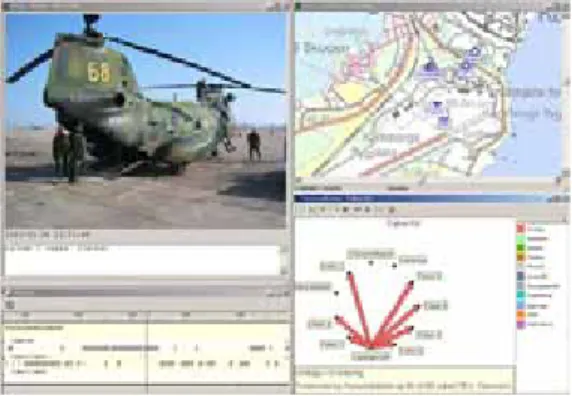
Figure 3:1. gives an example of how data from different sources can be processed and presented using MIND. The visualization shows the flow of events (unit movements and positions on geographical maps), snapshots of certain interesting events or actions (annotated photographs, videos, and textual observations), and communication (from radio networks or computerized communication systems). The visualization serves as a basis for exploration of the chain of events and thus the replayable model can serve as a documentation of the exercise.
Figure 3:1. A multimedia representation of a distributed
Traditionally, the MIND framework has focused on presenting and managing ‘objective’ process data. Supporting feedback of experimentation also necessitates the use of subjective data, such as participant questionnaires and retrospective interviews, and the possibility to connect these data to the MIND mission history. Therefore, we have tried widening the MIND framework to more efficiently incorporate subjective measures. Another issue has been to develop procedures to support hypothesis-driven experimentation.
4 Modeling as a tool to define evaluation measures
4.1 Background.
As we have argued in chapter 3, the initial modeling of the system to be studied is a crucial task in empirical evaluations. Development of complex systems should follow the same principle as science. Ideas and assumptions underlying efforts of changes of organizations and systems should be made explicit and tested empirically as early as possible in a developmental cycle. The alternative, that changes in an organizational system will be based on trial and error or collection of anecdotes, is of course possible but progress will be unsure, inefficient and relatively slow (Alberts & Hayes, 2005).
Normally modeling is referred to as a methodological tool which is used to structure phenomenon for a specific purpose. Thus, modeling can be used for an initial problem analysis. The procedure consist of some sort of group interview were the discussion is summarized by a graphical representation, a model with notations. One key issue is that it often required that clients, i.e. the “owners” of the problem, and domain experts are involved in the modeling process.
Modeling can thereby be said to have the purpose to give an initial outline of a certain problem area in order to create a foundation for the development of theories, structure variable values in order to construct simulations, be a part of the design process, be a problem identifying process etc.
In this context we have had the perspective that the purpose of the modeling is to explicitly translate the client’s assumptions of and approach to the problem into problem statements and hypotheses. An example of client’s is those responsible for the development of new command and control systems. The core in our modeling approach is that the modeling should produce a base for data collection about the stated problem i.e. it should include a definition concerning how the measure should be conducted. The result from this problem analysis, or modeling, represents the definition of the research design.
Methodological procedures includes extracting ideas from different kind of experts and users of a system and formalize these into a hypothetical model, in order to relatively fast be able to empirically test ideas and assumptions of importance for a developmental project. Seen in the context of science the use of modeling corresponds to the discovery phase.
4.2 Models as representations of empirical processes.
Modeling is the construction of a model, based on data from the systems analysis. There are several definitions of the term ‘systems analysis’, but a definition usually involves some kind of procedure (more or less formal) for collecting and organizing data about an empirical phenomenon. There is a variety of systems analysis techniques and approaches such as ‘task analysis’ (Annett et al., 1971; Drury et al., 1987), ‘job analysis’ (Harvey, 1991), ‘content analysis’ (Kolbe, 1991; Weber, 1990), ‘action analysis’ (Singleton, 1979), and ‘cognitive systems engineering’ (Hollnagel & Woods, 1983; Rasmussen, Pejtersen & Goodstein, 1994). Despite the fact that these techniques differ somewhat when it comes to perspectives and procedures, they are rather similar. They are related to a scientific style of analytically approaching a certain phenomenon, in order to treat or analyze reality as a systematically connected set of elements (Gasparski, 1991).
The following section is a brief summary of some theoretical bases of modeling. Readers primarily interested in practical applications of modeling of experiment design could move on to section 4.3. A basic prerequisite for using modeling to define design of empirical tests is that the resulting models are valid representations of reality. Krantz, Luce, Suppes and Tversky (1971) specify the necessary conditions for representing empirical systems in a scientific sense with a numerical measurement model through two theorems: 1. The representation theorem. 2. The uniqueness theorem.
4.2.1 The representation theorem.
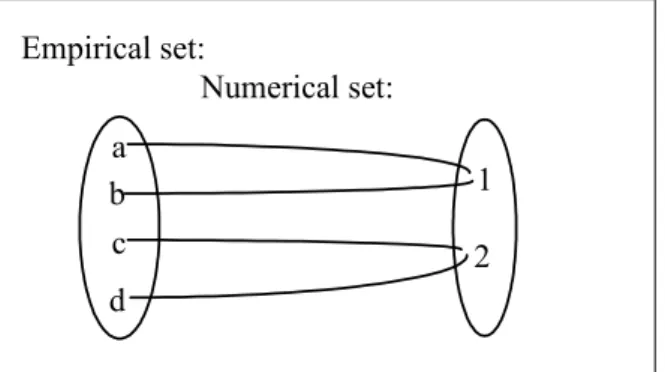
If a specific structure of relations in an empirical system is measurable it is possible to make a homomorphic reproduction of that empirical system into a formal and numerical system (Figure 4:1). a b c 1 2 Empirical set: Numerical set: d
Figure 4:1. Illustration of the representation theorem. The two empirical
objects ‘a’ and ‘b’ are represented by the formal and numerical entity ‘1’.
Several different specific empirical objects can be represented according to the theorem by one single numerical value or class. Several different objects can thus be devoted a summarizing variable value or category in order to express a certain quality which the different terms are judged to have in common. For example, a large number of individuals may be categorized into a fewer number of categories, for example ‘expert’ and ‘non-expert’. Consequently, a large empirical variety of relations and qualities may be reduced to a much simpler model with only a few variables.
It is possible to represent reality in a number of ways. A military unit can be represented numerically according to several principles; level of protection, level of training, command structure, etc. Thus, representing the empirical objects is not enough.
4.2.2 The uniqueness theorem.
The representation theorem calls for the relational structure in a chosen representation system to correspond to the relational structure in the empirical system. This puts a limit to the possible transformations between different representation models. If the empirical relation ‘R’ in Figure 4 implies that ‘b’ is twice the size of ‘a’ this means that only the numerical relation ‘r’ can represent this while relation ‘f’ is less suitable. If the empirical relation ‘R’ only implies that ‘b’ is of greater size than ‘a’, then it is possible to use both relation ‘r’ and ‘f’ according to the same reasoning. The uniqueness theorem therefore states that every empirical relation has a certain degree of uniqueness in permitted ways of representation in a numerical model.
a b 1 2 Representation R r
Empirical relation R Numerical relation
3 4
f Transformation
Numerical relation
Figure 4:2. Illustration of the uniqueness theorem.
The two theorems are part of measurement theory and numerical representation, but the same reasoning is also relevant for other forms of representation (Wikberg, 1997). Thus, it is also possible to map empirical relational structures into formal qualitative relational structures. For example, any ethnic language can be seen as a natural representation system to represent thoughts, happenings, processes, etc. The language as a representation system has different objects (words) and rules for relations (grammar) which are intended to represent and describe reality. The ethnic language can be translated to other ethnical languages as well as to formal predicate logic. If the empirical relation has a high degree of uniqueness, the number of possible transformations decreases. Based on this assumption, the distinction between quantitative and qualitative research is somewhat blurred as any given reality can be represented by a large or even infinitive number of models (Silverman, 2001).
As a consequence of the theorems above the model must be empirically specified to enable empirical evaluation, i.e. there has to be a definition of the set of empirical elements and the relations between them that corresponds to the model’s conceptual terms. Consider the example of a causal model (where A causes B) as shown in figure 4:3.
Conceptual terms
Figure 4:3. Example of a causal model
In order to measure and evaluate this model (figure 4:3), the following conditions have to be met (Wikberg, 1997):
There must be a set of elements, conceptual terms, explicitly defined:
(1) A is defined as 'A' . For example Commander is defined as ‘the individual responsible of the operation’.
(2) B is defined as 'B'
There must be a set of defined formal rules for relations between the elements which determine the possible combinations:
A affects B (i.e. A is the most significant factor, of several other possible factors, affecting B) B a b A Empirical manifestations
There must be a set of defined empirical elements and relations corresponding to the model: (1) ‘a’ is an empirical manifestation of 'A' (i.e. ‘a’ is the best, or most suitable, measure of 'A' within the context of the model)
(2) ‘b’ is an empirical manifestation of 'B' (i.e. ‘b’ is the best, or most suitable, measure of 'B' within the context of the model)
The example in figure 4:3 is a causal model. Other kinds of relations, such as mean-end or order, are of course possible.
4.3 Our approach of using modeling to define test design.
In our approach to use modeling of test design we have normally used two major types of models. The first type is a business model which describes the organization, technology or process to be used as a framework for the experimentation. The second type is a measurement model which defines the relevant factors to be measured, i.e. an operational definition of the actual research question.
4.3.1 Business modeling
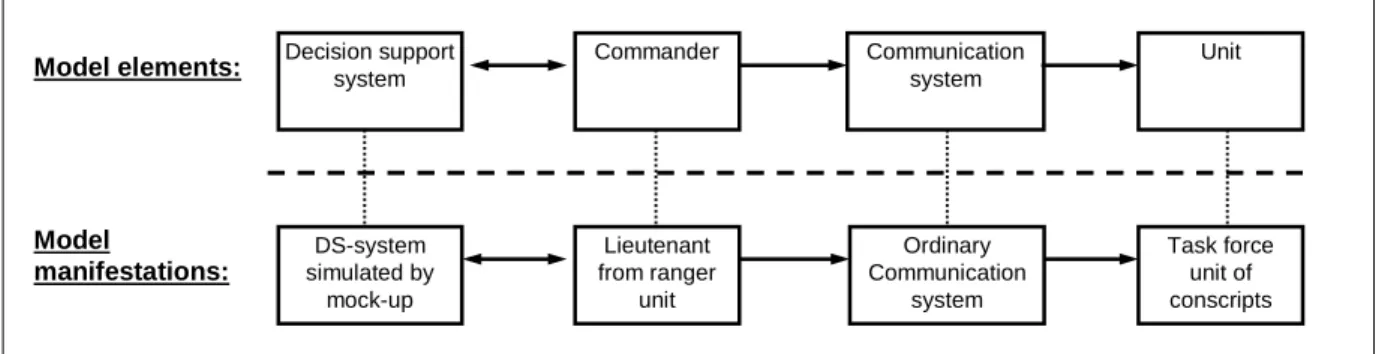
The business model is intended to give an outline of participants and systems included in the experimentation, the relation between them and the systems input and output. As shown in figure 4.3 it is of central importance that the manifestations, operationalisation, of the models elements are defined.
The main purpose is to specify the context in which the experimentation is conducted. The example illustrated in figure 4:4 can, despite that the underlying process might be extremely complex, give a fairly simple outline of the structure of the overall process.
Decision support system Commander Communication system Unit Model elements: DS-system simulated by mock-up Lieutenant from ranger unit Ordinary Communication system Task force unit of conscripts Model manifestations:
Figure 4:4. An example of a business model
Suppose that the model in figure 4.4 has been defined to describe the fundamental activities in using a new decision support system. An experiment derived from the model in figure 4.4 should at least consist of a commander, a decision support system, a communication system and a task force unit. The business model thus becomes a communicative aid when the experimental situation is created. The decision support system, indicated in figure 4:4, might be in an early stage of a developmental project. When this is the case it might be necessary to create a simulated system by using some sort of mock-up, for example paper models of user interface, physical mock-ups of equipment or more advanced computer based simulations.
Preferably, the test environment should as much as possible be represented by real systems and real personnel. In the case illustrated in figure 4:4, the communication system can be the one used on a day to day basis and the task force unit might consist of conscripts. As commander, the use of one whom might use the system in the future might be preferable. An experimental situation might of course include other essential aspects not described in the model, for example a tactical situation or a staff supporting the commander. However, in this particular case this was not considered as important for experimentation. What to include in the business model, and thereby in the experimentation or simulation, is practically more or less arbitrary. A more thorough discussion on test environments is found in chapter 5.
4.3.2 Measurement modeling
A business model is normally not sufficient as foundation to specify experimental design. For example, a study on command and control might focus on the expected improvement of organizational performance caused by the introduction of a new decision support system. Presumably, it is possible to regard these more or less explicitly stated expectations as hypotheses. What is the client’s “best guess” of what will happen?
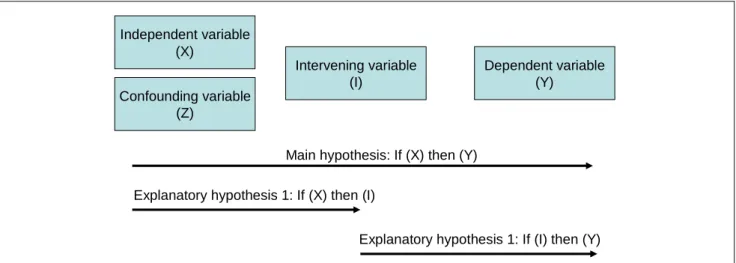
To formalize these expectations, a measurement model must be defined. In the measurement model, relevant factors of the actual research question are defined. The purpose of this model is to define hypotheses and/or research questions. As in the case of the business model it is essential that the manifestation, operationalisation, of the elements of the model is defined. The definition of how the elements in the model are made manifest constitutes the basis for the construction of instruments of measurement. The measurement model is basically a hypothesis tree with a number of generic elements (Figure 4:5).
Independent variable (X) Confounding variable (Z) Intervening variable (I) Dependent variable (Y)
Main hypothesis: If (X) then (Y) Explanatory hypothesis 1: If (X) then (I)
Explanatory hypothesis 1: If (I) then (Y)
Independent variable (X). The independent variable is the variable or factor whose levels are selected in order to
determine the effect of that variable on a dependent variable(s). Note that variable doesn’t necessarily mean a quantitative variable such as hours of sleep fatigue. It is possible to have different organizational or technological solutions compared. One typical independent variable is a ”new” work method compared with an ”old”.
Dependent variable (Y). The dependent variable is the particular measures used to reflect the effect(s) of the
independent variable. Which differences on performance will the “new” organizational or technological solution impose? As a result of the variation between conditions the dependent variables and are expected to vary.
Confounding variable (Z). It is normally not possible to create to exactly equivalent conditions in all aspects in
experimentation. Any variable other than the independent variable that might affect the dependent variable and consequently confound the result must be controlled by being eliminated, minimized, held constant, explicitly randomized or by using statistical control.
Intervening variable (I). A reasonable assumption is that several processes might be of importance between the stimuli
and response. Intervening variables reflects a hypothesized process to explain the relations between antecedent conditions (i.e. independent variable) and consequence events (i.e. dependent variables). (conditions and system outcome). A number of intervening variables might help explain why differences in effects between conditions occur.
Hypotheses. The model also presents the hypotheses to be tested. The main hypothesis is the (proposed) relationship
between the independent and dependent variables. It is also possible to define explanatory hypotheses which describe the assumed relations between independent variable and the intervening variable and the intervening variables and the dependent variables.
Several variables of each type might be included in the experiment design. In experimentation on command and control the dependent variable is typically a mix of several indicators that are supposed to give a “performance profile” of the studied organization or system. In the same way several possible intervening variables might be defined in order to explain variance in the dependent variable.
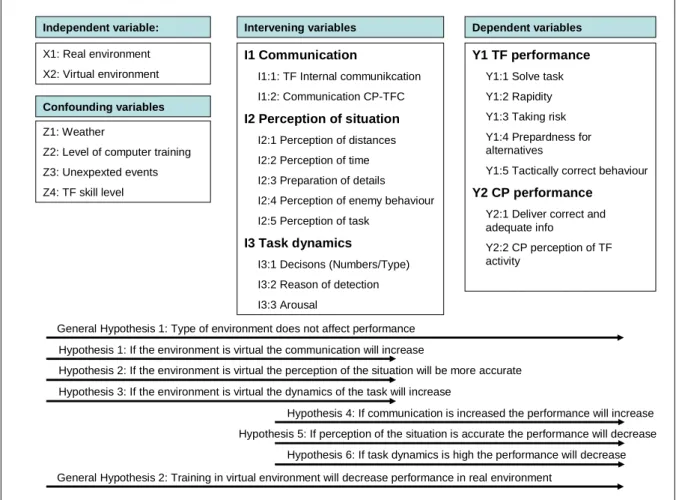
An example of a measurement model taken from a study performed in the autumn of 2004 (Wikberg, Andersson, Berggren, Hedström, Lindoff, Rencrantz, Thorstensson, & Holmström, 2004) is shown in figure 4:6. In this example two different setting of task environments were compared. One is a real physical environment. The other is an environment based on computer simulation using commercial PC-software. The initial research problem was to examine whether it was possible to use simulated environments on the soldier level in combination with real C2-systems to create an experimental setting to study command and control. The measurement model defines two major dependent variables: task force performance and command post performance that might vary between settings. Each of these variables consists of a set of sub-variables. Some confounding variables were also considered such as ‘weather’ and ‘task force skill level’ in analyzing the results. Consequently, these factors have also to be monitored. Finally some intervening variables where identified as possible explanations to any variation in the dependent variable. For example, is it differences in task dynamics or differences in communication pattern that explain any difference in performance between settings? This particular study is described later in this chapter in section 4.4.2. as case 4b.
X1: Real environment X2: Virtual environment
Z1: Weather
Z2: Level of computer training Z3: Unexpexted events Z4: TF skill level
I1 Communication
I1:1: TF Internal communikcation I1:2: Communication CP-TFC
I2 Perception of situation
I2:1 Perception of distances I2:2 Perception of time I2:3 Preparation of details I2:4 Perception of enemy behaviour I2:5 Perception of task
I3 Task dynamics
I3:1 Decisons (Numbers/Type) I3:2 Reason of detection I3:3 Arousal
Y1 TF performance
Y1:1 Solve task Y1:2 Rapidity Y1:3 Taking risk Y1:4 Prepardness for alternatives
Y1:5 Tactically correct behaviour
Y2 CP performance
Y2:1 Deliver correct and adequate info
Y2:2 CP perception of TF activity
Independent variable: Intervening variables Dependent variables
Confounding variables
General Hypothesis 1: Type of environment does not affect performance Hypothesis 1: If the environment is virtual the communication will increase
Hypothesis 2: If the environment is virtual the perception of the situation will be more accurate Hypothesis 3: If the environment is virtual the dynamics of the task will increase
Hypothesis 4: If communication is increased the performance will increase Hypothesis 5: If perception of the situation is accurate the performance will decrease
Hypothesis 6: If task dynamics is high the performance will decrease General Hypothesis 2: Training in virtual environment will decrease performance in real environment
Figure 4:6. An example of a measurement model.
Data on each of the variables were collected from a variety of data sources. Data collection is somewhat beyond the scope of this chapter. In chapter 6 we will present more thoroughly our
approach to data collection. However, again it must be emphasized that definition of instruments of measurement is an integrated part of the measurement modeling.
A final note on measure modeling is the importance of level of scale. Scale type is important because it defines which analyses are possible, or at least permitted, to carry out. As will be discussed in chapter 6 on data collection, the operation of measurement is a relation-preserving function which should translate an empirical structure into an abstract structure. The scale levels; nominal, ordinal, interval and ratio scales, defines the “precision” of measurement and thus also the precision of the translation. For example, it is not possible to conclude whether something is twice as good based on a measurement using an ordinal scale as an ordinal scale represents order between objects (and not interval or ratio between objects). This issue is briefly introduced in section 6.2.1. To anyone familiar with inferential statistics this is nothing new as it is a part of the basic of statistics. The pragmatic problem is rather to explain the restrictions of different measures to clients in the modeling phase. For example, the precision of measures might not be good enough to tell how long it takes to make a decision for a division staff.
4.4 Illustrative cases
Two cases are presented in order to illustrate the use of modeling to define experimentation design. The first case, 4A, describes modeling of an experimental staff exercise. The modeling includes a business model with definition of exercise set up and a measurement model with variables to measure and corresponding hypotheses. The purpose of the study was to compare two possible information structures.
The second case, 4B, describes modeling of an explorative study. The purpose was to come up with a proposition of a new decision making model. The model was used to manage the discussion during two war gaming exercises. The aim was to generate hypotheses about future decision making processes.
4.4.1 Case 4A: Measurement Model on effect of information structure on C2.
A study was performed in the context of the Swedish Armed Forces’ demonstrator program which aims at reshaping and adapting the defence from an invasion focused to a flexible network based
defence(Swedish Armed Forces, 2002). The study was performed on two occasions and focused on
how the C2 process is influenced by which information structure is chosen. The first study was performed in autumn of 2003, DEMO 03 H, and a replicate was conducted during May 2004, DEMO 04 V.
The basis of the experimental design were outlined in a business model and a measurement model in a series of group modeling sessions with participants from the Armed Forces and FOI. The starting point for the modeling session was a hypothetical chain of effects defined by LedSystM, the project responsible for development of command and control (C2) methods in the armed forces transformation process. The assumption was that “role based but shared situational information” creates an “a mutual situational awareness”. The more mutual a situational awareness is the less effort is needed to achieve decentralized coordinated action. Thus, a mutual situational awareness in turn facilitates coordination and even self synchronization. Better opportunities of coordination will make it possible to achieve what is called “command and control superiority”. The hypothetical chain of effects is shown in figure 4:7.