Rationality, Pragmatics, and Sources Peter J. Collins
PhD Thesis Psychological Sciences Birkbeck, University of London
This thesis is my own work. All collaborative aspects are appropriately indicated at the relevant points.
Abstract
This thesis contributes to the Great Rationality Debate in cognitive science. It introduces and explores a triangular scheme for understanding the relationship between rationality and two key abilities: pragmatics – roughly, inferring implicit intended utterance meanings – and learning from sources. The thesis argues that these three components – rationality, pragmatics, and sources – should be considered together: that each one informs the others. The thesis makes this case through
literature review and theoretical work (principally, in Chapters 1 and 8) and through a series of empirical chapters focusing on different parts of the triangular scheme. Chapters 2 to 4 address the relationship between pragmatics and sources, focusing on how people change their beliefs when they read a conditional with a partially reliable source. The data bear on theories of the conditional and on the literature assessing people’s rationality with conditionals. Chapter 5 addresses the relationship between rationality and pragmatics, focusing on conditionals ‘in action’ in a framing effect known as goal framing. The data suggest a complex relationship between pragmatics and utilities, and support a new approach to goal framing. Chapter 6 addresses the relationship between rationality and sources, using normative Bayesian models to explore how people respond to simple claims from sources of different reliabilities. The data support a two-way relationship between claims and source information and, perhaps most strikingly, suggest that people readily treat sources as ‘anti-reliable’: as negatively correlated with the truth. Chapter 7 extends these experiments to test the theory that speakers can guard against reputational damage using hedging. The data do not support this theory, and raise questions about whether trust and vigilance against deception are prerequisites for pragmatics. Lastly, Chapter 8 synthesizes the results; argues for new ways of understanding the relationships between rationality,
pragmatics, and sources; and relates the findings to emerging formal methods in psychology.
Table of Contents Table of Contents ... 5 List of Figures ... 11 List of Tables ... 16 Acknowledgements ... 19 1 Theory Chapter ... 20
1.1 The Rationality Debate ... 22
1.1.1 Psychological Positions on Rationality. ... 23
1.1.2 Detecting (Ir-)rationality in Experiments ... 34
1.2 Pragmatics and Rationality ... 37
1.2.1 Defining Pragmatics ... 37
1.2.2 Pragmatics and Theories of Rationality ... 45
1.2.3 Pragmatics and Experiments on Rationality ... 47
1.3 Sources ... 64
1.4 Prospectus ... 72
2 Conditionals and Testimony ... 74
2.1.1 Conditionals in the psychology of reasoning ... 76
2.1.2 Conditionals in Psycholinguistics ... 82
2.1.3 Conditionals and Pragmatics ... 82
2.1.4 Testimony ... 86
2.1.5 Towards an experimental method ... 87
2.2 Experiment 2.1: effect of assertion ... 90
2.2.1 Methods ... 90
2.2.2 Results & Discussion ... 93
2.3.1 Method ... 97
2.3.2 Results & Discussion ... 99
2.4 Experiment 2.3: effect of source expertise ... 104
2.4.1 Method ... 104
2.4.2 Results & Discussion ... 106
2.5 Experiment 2.4: replicating the effect of source expertise ... 109
2.5.1 Method ... 109
2.5.2 Results & Discussion ... 110
2.6 General Discussion ... 114
3 Conditionals, Testimony, and Interval Estimates ... 120
3.1 Experiment 3.1: Assertion and Interval Estimates ... 120
3.1.1 Method ... 120
3.1.2 Results and Discussion ... 123
3.2 Experiment 3.2: Expertise and Interval Estimates ... 130
3.2.1 Method ... 130
3.2.2 Results & Discussion ... 130
3.3 General Discussion ... 137
4 Independent Testimony, Priors, and a Model of Testimonial Conditionals ... 140
4.1.1 Multiple Testimony ... 140
4.1.2 Priors ... 142
4.2 Experiment 4.1: Independent testimony ... 144
4.2.1 Method. ... 144
4.2.2 Results ... 145
4.3 Experiment 4.2: Priors, Assertion, and the probability of the
antecedent ... 149
4.3.1 Methods ... 149
4.3.2 Results & Discussion. ... 151
4.4 Experiment 4.3: Priors, Expertise, and the probability of the antecedent ... 154
4.4.1 Method ... 154
4.4.2 Results & Discussion ... 154
4.5 Experiment 4.4: Priors, Assertion, and the probability of the consequent ... 157
4.5.1 Methods ... 157
4.5.2 Results & Discussion ... 158
4.6 Experiment 4.5: Priors, Expertise, and the probability of the consequent ... 160
4.6.1 Methods ... 160
4.6.2 Results & Discussion ... 161
4.7 General Discussion ... 163
4.7.1 Modelling testimonial conditionals ... 166
4.7.2 Probabilities and Beyond ... 180
4.7.3 The meaning of the conditional ... 182
5 Framing and utility conditionals ... 188
5.1.1 Prospect Theory and the Asian Disease Paradigm ... 189
5.1.2 Towards goal framing ... 190
5.1.4 Towards an experimental paradigm: utilities in argumentation and pragmatics ... 201 5.2 Experiment 5.1 ... 206 5.2.1 Methods ... 208 5.2.2 Results ... 211 5.2.3 Discussion ... 216 5.3 Experiment 5.2 ... 218 5.3.1 Methods ... 218 5.3.2 Results ... 219 5.3.3 Discussion ... 225 5.4 Experiment 5.3 ... 230 5.4.1 Methods ... 231 5.4.2 Results ... 232 5.4.3 Discussion ... 236 5.5 General Discussion ... 239
6 Testimony and Source Reliability ... 244
6.1.1 Introducing Testimony ... 244
6.2 Experiment 6.1: Belief change ... 254
6.2.1 Method ... 254
6.2.2 Results & Discussion ... 258
6.3 Experiment 6.2: Replicating belief change ... 263
6.3.1 Methods ... 263
6.3.2 Results & Discussion ... 264
6.4 Experiment 6.3: Reliability change ... 266
6.4.2 Results & Discussion ... 267
6.5 Experiment 6.4: Replicating reliability change ... 269
6.5.1 Methods ... 269
6.5.2 Results & Discussion ... 269
6.6 Experiment 6.5: Story version ... 272
6.6.1 Methods ... 274
6.6.2 Results & Discussion ... 275
6.7 General Discussion ... 278 7 Evidential Language ... 287 7.1 Experiment 7.1 ... 290 7.1.1 Methods ... 290 7.1.2 Results ... 292 7.1.3 Discussion ... 294 7.2 Experiment 7.2 ... 294 7.2.1 Methods ... 295 7.2.2 Results ... 296 7.2.3 Discussion ... 298 7.3 Experiment 7.3 ... 298 7.3.1 Methods ... 298 7.3.2 Results ... 299 7.3.3 Discussion ... 301
7.4 Experiment 7.4: Shield Hedges ... 302
7.4.1 Methods ... 302
7.4.2 Results ... 303
7.5 General Discussion ... 305
7.5.1 Conclusions ... 311
8 General Discussion ... 313
8.1 The Experimental Data Recapitulated ... 313
8.1.1 Conditionals and Testimony ... 313
8.1.2 Utility Conditionals ... 315
8.1.3 Testimony and Source Reliability ... 317
8.1.4 Evidential Language ... 317
8.2 Redefining the relationships ... 318
8.2.1 Pragmatic intrusion into argumentation ... 321
8.2.2 Argument in pragmatics ... 327
8.2.3 Pragmatics as rational social action ... 338
8.3 Conclusions ... 343
List of Figures
Figure 1.1. The Triangular Scheme ... 21
Figure 1.2. Crupi's model ... 34
Figure 2.1. Mean rating of P(Antecedent) by condition; error bars are standard error ... 94
Figure 2.2. Mean rating of P(Consequent) by condition; error bars are standard error ... 95
Figure 2.3. Mean rating of Conditional Probability by condition; error bars of standard error ... 96
Figure 2.4. Mean P(Antecedent) by condition; error bars are standard error ... 99
Figure 2.5. Mean P(Consequent) by condition; error bars are standard error ... 101
Figure 2.6. Mean Conditional Probability by condition; error bars are standard error ... 102
Figure 2.7. Mean P(Antecedent) by condition; error bars are standard error ... 106
Figure 2.8. Mean P(Consequent) by condition; error bars are standard error ... 107
Figure 2.9. Mean Conditional Probability by condition; error bars are standard error ... 108
Figure 2.10. Mean P(Antecedent) by condition; error bars are standard error ... 110
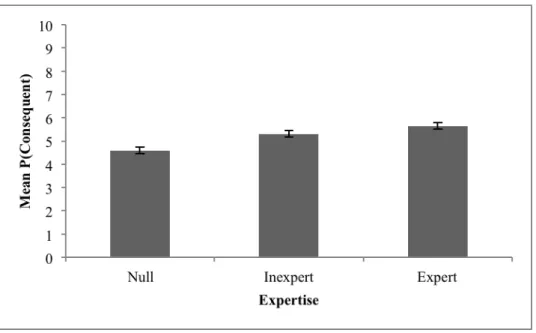
Figure 2.11. Mean P(Consequent) by condition; error bars are standard error ... 112
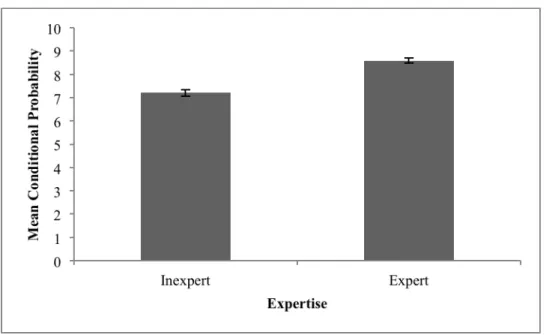
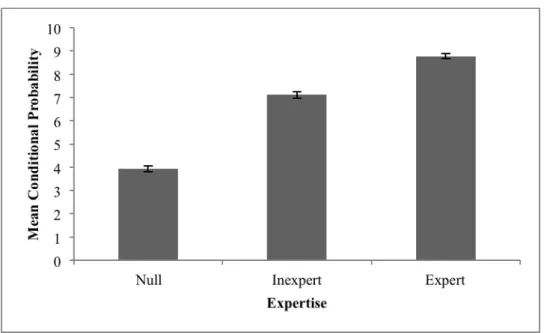
Figure 2.12. Mean Conditional Probability by condition; error bars are standard error ... 113
Figure 2.13. Simple Bayesian belief network for a conditional ... 117
Figure 3.1. Illustrative slider for exact estimate of P=.5 ... 121
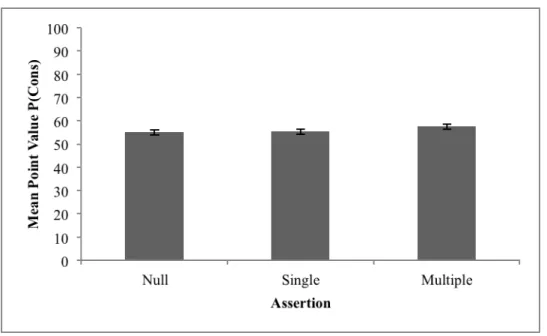
Figure 3.3. Mean point value of P(Antecedent) by condition; error bars are standard error ... 123 Figure 3.4. Mean slider range by condition; error bars are standard error ... 124 Figure 3.5. Mean point values of P(Consequent) by condition; error bars are standard error ... 125 Figure 3.6. Mean range of P(Consequent) by condition; error bars are standard error ... 126 Figure 3.7. Mean point values of Conditional Probability by condition; error bars are standard error ... 127 Figure 3.8. Mean range of Conditional Probability by condition; error bars are
standard error ... 128 Figure 3.9. Mean point values of P(Antecedent) by condition; error bars are standard error ... 131 Figure 3.10. Mean slider ranges for P(Antecedent) by condition; error bars are standard error ... 132 Figure 3.11. Mean point values of P(Consequent) by condition; error bars are
standard error ... 133 Figure 3.12. Mean slider ranges for P(Consequent) by condition; error bars are standard error ... 134 Figure 3.13. Mean point values for Conditional Probability by condition; error bars are standard error ... 135 Figure 3.14. Mean slider ranges for Conditional Probability by condition; error bars are standard error ... 136 Figure 4.1. Mean Conditional Probability by condition; error bars are standard error ... 145
Figure 4.2. Effect of Assertion and Prior on P(Antecedent); error bars are standard
error ... 151
Figure 4.3. Effect of Prior and Expertise on P(Antecedent); error bars are standard error ... 155
Figure 4.4. Effects of Prior and Assertion on P(Consequent); error bars are standard error ... 158
Figure 4.5. Effects of Prior and Expertise on P(Consequent); error bars are standard error ... 161
Figure 4.6. Bayesian belief network from Bovens and Hartmann (2003) ... 166
Figure 4.7. Baseline Bayesian belief network for experimental data ... 169
Figure 4.8. Comparison Bayesian belief network for experimental data ... 174
Figure 5.1. Argument convincingness by frame; error bars are standard error ... 211
Figure 5.2. Descriptive data by Utility and Frame. Circles are data points for positive frames; triangles are data points for negative frames. The solid line is the regression for positive frames; the dotted line for negative frames. Shading represents the standard error. ... 215
Figure 5.3. Descriptive data by Utility and Frame. Circles are data points for positive frames; triangles are data points for negative frames. The solid line is the regression for positive frames; the dotted line for negative frames. Shading represents the standard error. ... 220
Figure 5.4. Posterior distributions of mean utilities of taking medicine (left) and not taking medicine (right) ... 222
Figure 5.5. Posterior distributions of mean utilities of undergoing surgery (left) and not undergoing surgery (right) ... 223
Figure 5.6. Posterior distributions of means of utilities for risk of minor infection decreasing (left) and not decreasing (right) ... 224 Figure 5.7. Posterior distributions of mean utilities for risk of major illness
decreasing (left) and not decreasing risk (right) ... 224 Figure 5.8. Mean utilities by condition; error bars are standard error ... 232 Figure 6.1. Mean belief change by reliability; error bars are standard error ... 261 Figure 6.2. Posterior distribution of effect size of beilef change from reliable sources. ROPE from -.1, to .1; dotted lines are 95% HDI ... 261 Figure 6.3. Posterior distribution of effect size of belief change from unreliable sources. ROPE from -.1 to .1; black bar depicts 95% HDI ... 262 Figure 6.4. Mean belief change by reliability; error bars are standard error ... 264 Figure 6.5. Posterior distribution of effect size of belief change from reliable sources. ROPE from -.1 to .1; black bar depicts 95% HDI ... 265 Figure 6.6. Posterior distribution of effect size of belief change from unreliable sources. ROPE from -.1 to .1; black bar depicts 95% HDI ... 265 Figure 6.7. Mean change in reliability by expectedness; error bars are standard error ... 267 Figure 6.8. Posterior distribution of effect size of reliability change from expected claims. ROPE is -.1 to .1; black bar depicts 95% HDI ... 268 Figure 6.9. Posterior distribution of effect size of reliability change from unexpected claims. ROPE is -.1 to .1; black bar depicts 95% HDI ... 268 Figure 6.10. Mean reliability change by expectedness; error bars are standard error ... 270 Figure 6.11. Posterior distribution of effect size of reliability change from expected claims. ROPE from -.1 to .1; black bar depicts 95% HDI ... 270
Figure 6.12. Posterior distribution of effect size of reliability change from
unexpected claims. ROPE from -.1 to .1; black bar depicts 95% HDI ... 271
Figure 6.13. Mean belief by expectedness; error bars are standard error ... 276
Figure 6.14. Posterior distribution of effect size of difference between expected and null conditions. ROPE from -.1 to .1; black bar depicts 95% HDI ... 277
Figure 6.15. Posterior distribution of effect size of difference between unexpected and null claims. ROPE from -.1 to .1; black bar is 95% HDI ... 277
Figure 6.16. Posterior distribution for effect size of difference between expected and unexpected conditions. ROPE from -.1 to .1; black bar depics 95% HDI ... 278
Figure 7.1. Mean change scores by condition; error bars are standard error ... 293
Figure 7.2. Mean change scores by condition; error bars are standard error ... 297
Figure 7.3. Mean change score by condition; error bars are standard error ... 299
Figure 7.4. Mean claim strength; error bars are standard error ... 301
Figure 7.5. Mean change scores by condition; error bars are standard error ... 303
Figure 7.6. Mean claim strength (manipulation check); error bars are standard error ... 304
List of Tables
Table 2.1. Truth table of material conditional ... 77
Table 2.2. Defective truth table ... 78
Table 2.3. Fixed effects of Assertion on P(Antecedent) ... 95
Table 2.4. Fixed effects of Assertion on P(Consequent) ... 96
Table 2.5. Fixed effect of Assertion on Conditional Probability ... 97
Table 2.6. Fixed effect of Assertion on P(Antecedent) ... 100
Table 2.7. Fixed effect of Assertion on P(Consequent) ... 101
Table 2.8. Fixed effects of Assertion on Conditional Probability ... 103
Table 2.9. Fixed effects of Expertise on P(Antecedent) ... 107
Table 2.10. Fixed effects of Expertise on P(Consequent) ... 107
Table 2.11. Fixed effects of Expertise on Conditional Probability ... 108
Table 2.12. Fixed effects of Expertise on P(Antecedent) ... 111
Table 2.13. Fixed effects of Expertise on P(Consequent) ... 112
Table 2.14. Fixed effects of Expertise on Conditional Probability ... 113
Table 3.1. Fixed effects of Assertion on point values of P(Antecedent) ... 124
Table 3.2. Fixed effects of Assertion on slider ranges of P(Antecedent) ... 125
Table 3.3. Fixed effects of Assertion on point values of P(Consequent) ... 126
Table 3.4. Fixed effects of Assertion on slider ranges for P(Consequent) ... 127
Table 3.5. Fixed effects of Assertion on Conditional Probability ... 128
Table 3.6. Fixed effects of Assertion on ranges for Conditional Probability ... 129
Table 3.7. Fixed effects of Expertise on point values of P(Antecedent) ... 131
Table 3.8. Fixed effects of Expertise on slider ranges for P(Antecedent) ... 132
Table 3.10. Fixed effects of Expertise on slider ranges for P(Consequent); error bars
are standard error ... 134
Table 3.11. Fixed effects of Expertise on point values for Conditional Probability ... 135
Table 3.12. Fixed effects of Expertise on slider ranges for Conditional Probability .... 136
Table 4.1. Fixed effects of Assertion on Conditional Probability ... 146
Table 4.2. Fixed effects and confidence intervals of single assertion for the point-estimate studies ... 147
Table 4.3. Fixed effects of Prior, Assertion, and Interaction ... 152
Table 4.4. Fixed effects of Assertion at low prior ... 152
Table 4.5. Fixed effects of Assertion at high prior ... 153
Table 4.6. Fixed effects of Prior, Expertise, and Interaction on P(Antecedent) ... 155
Table 4.7. Fixed effects of Expertise on P(Antecedent) at low prior ... 156
Table 4.8. Fixed effects of Expertise on P(Antecedent) at high prior ... 156
Table 4.9. Fixed effects of Prior, Assertion, and Interaction on P(Consequent) ... 159
Table 4.10. Fixed effects of Assertion on P(Consequent) at low prior ... 159
Table 4.11. Fixed effects of Assertion on P(Consequent) at high prior ... 160
Table 4.12. Fixed effects of Prior, Expertise, and Interaction on P(Consequent) ... 162
Table 4.13. Fixed effects of Expertise on P(Consequent) at low prior ... 162
Table 4.14. Fixed effects of Expertise on P(Consequent) at high prior ... 163
Table 4.15. Conditional probability table for Bovens Hartmann network ... 167
Table 4.16. Conditional probability table for node B ... 170
Table 4.17. Conditional probability table for node Rep X ... 170
Table 4.18. Conditional probability table for Rep X ... 174
Table 5.1. Utilities for goal frames. ... 206
Table 5.3. Counts for antecedent utilities ... 213
Table 5.4. Counts for consequent utilities; 'Minor Protection' is protection against a minor infection, 'Major Protection' against a life-threatening illness ... 214
Table 5.5. Fixed effects of Utility, Frame, and Interaction on Convincingness ... 216
Table 5.6. Fixed effects of the full additive model ... 216
Table 5.7. Fixed effects of Frame, Utility, and Interaction ... 221
Table 5.8. Fixed effects for full additive model. ... 221
Table 5.9. Parameters for model with interaction ... 234
Acknowledgements
Some words of thanks are due. Firstly, thanks are due to Professor Ulrike Hahn for her tremendous supervision over the past three years – for her remarkable support and encouragement. I would also like to thank Professor Mike Oaksford for helpful discussion of the results of data from Chapters 2 to 4. Since these chapters resulted from collaborative work, I would like to thank these collaborators: Dr Karolina Krzyżanowska and Professors Stephan Hartmann and Gregory Wheeler. Dr Jean-François Bonnefon provided invaluable suggestions during the planning of the studies in Chapter 5, and gave stimulating feedback on the results in that chapter. Chapter 6 resulted from collaborative work with Dr Ylva von Gerber and Professor Erik Olsson; they, also, deserve thanks. I have benefitted from fruitful discussions on both conditionals and pragmatics with Drs Karolina Krzyżanowska and Niels
Skovgaard -Olsen, and from helpful advice on mixed-effects modelling from Dr Henrik Singmann and Danielle Pessach. Ruben Zamora gave invaluable help and advice with the web experiments, and Joe Miele, of MTurk Data, posted the web experiments on Mechanical Turk with great efficiency. I also gratefully acknowledge financial support from the Bloomsbury Doctoral Training Centre and experimental funding from the Alexander von Humboldt Foundation and the Swedish Research Council. Last – but by no means least – I thank Matt Evans for constant love and support, and for well-timed advice to ‘Have a word with [myself]!’
1 Theory Chapter
The question ‘How rational are we?’ has stimulated a rich debate in cognitive science. Cognitive scientists argue over the norms that define optimal behaviour; over whether we form and revise our beliefs optimally; over whether we act
optimally to achieve our goals; and over whether we are educable (Stanovich, 2012). This thesis will contend that rationality is inextricably linked with two abilities: pragmatics - our ability to interpret utterances, including their implicit speaker-intended meanings; and our ability to respond to information that we receive from sources, where sources are understood as other people or institutions that are intentionally giving information. The novelty is not in suggesting a role for
pragmatics and sources: the existing literature has already suggested as much. The novelty is, rather, to stress the deep relationship among the three components: rationality, pragmatics, and sources. The thesis will contend that much can be learnt by treating these components together: indeed, that we lose valuable insights if we consider the components separately.
Throughout, this thesis will refer to a triangular scheme to guide discussion. Figure 1.1 shows this scheme.
Figure 1.1. The Triangular Scheme
The figure represents the three components and the two-way relationships among them. The arrows can be taken to represent both conceptual connections and
strategies: for example, because rationality and pragmatics are fundamentally linked, the study of rationality is illuminated by considering pragmatics and, likewise, the study of pragmatics is illuminated by considering rationality.
This thesis will present both conceptual arguments and empirical data to make the case for this triangular scheme. The thesis is structured around four sets of experiments. The experiments offer novel data which illustrate a different aspect of the triangular scheme. The experiments also contribute to four independent debates in cognitive science: on learning conditionals from testimony; on utility conditionals; on models of testimony; and on evidential language. The experiments are tied
together by the triangular scheme.
This introductory chapter will introduce the rationality debate in cognitive science and how the two other components, pragmatics and sources, bear on this debate. The chapter will inevitably be slanted towards topics on which there is extensive data: principally, rationality in general, and the relationship between
rationality and pragmatics. This slant reflects the state of the literature, not the importance of the components.
1.1 The Rationality Debate
Rationality arises as a topic across psychology. Given this wide potential range, some focus is needed. Consider, for instance, ideal observer models of
perception, where formal models of optimal performance are specified and compared with human behaviour (for discussion, see Hahn, 2014). Similar rational models exist for numerous other domains, such as categorization (Anderson, 1991b) and language acquisition (Perfors, Tenenbaum, & Regier, 2011). Rationality also bears on the definition and treatment of mental disorders (Graham, 2014). But its most familiar territory is a cluster of related sub-disciplines: the psychology of judgment and decision making (see, e.g., Newell, Lagnado, & Shanks, 2015); the psychology of reasoning (see, e.g., Manktelow, 2012); and the psychology of argumentation (see, e.g., Hahn & Oaksford, 2007). It is these disciplines which will be the focus of this thesis.
When assessing rationality – whatever normative standards we choose – the crucial evidence is not momentary successes and failures but systematic rationality or irrationality. In other words, the key question is our underlying competence. Establishing our competence requires abstracting away from performance imitations, such as memory capacity1, tiredness, and so on (Stein, 1996). Contemporary
psychology seems to assume what Stein (1996, p. 12) calls the Irrationality Thesis:
1 Note the tension with accounts which factor in computational limitations (see the
section on Bayesianism and Rational Analysis). One way to try to reconcile these
approaches is to distinguish between hard computational limits, such as absolute limits on working memory, and contextual problems, such as those caused by tasks with heavy working-memory load.
our competence systematically diverges from normative principles. The meat of the debate is the extent of this divergence.
1.1.1 Psychological Positions on Rationality.
We can classify the most prominent theories by the normative frameworks that they endorse2 and their degree of optimism about rationality (V. Crupi, personal communication, September 5, 2016).
The Standard Picture.
Probably the dominant normative framework is the ‘Standard Picture’ (Stein, 1996): the correct norms are the ‘rules of logic, probability and so forth’ (Stein, 1996, p. 4). The Standard Picture has shaped much of the literature surveyed below.
Implicit in the framework is the understanding that ‘logic’ and ‘probability’ refer to classical accounts: classical propositional and predicate logic, and probability governed by the Kolmogorov axioms (Kolmogorov, 2013; for discussion of
classical probability and an alternative, see Busemeyer & Bruza, 2012). Implicit, too, is the inclusion of prescriptions from decision theory: in particular, the maximization of expected utility. For Stein (1996) refers extensively to a decision-making
literature which typically proceeds by assessing adherence to the axioms of choice, full adherence to which would imply maximization of expected utility (Stanovich, 2016).
Bayesianism. There are many and varied Bayesian models within cognitive science: too many to address individually. But many of these models are drawn
2 This section is inspired by Vincenzo Crupi’s lecture series, ‘Norms versus
Reasoning’, delivered from September 5th to September 9th, 2016, at the International Rationality Summer Institute, in Aurich, during which Crupi identified the leading relevant theories and classified them according to the norms endorsed and the degree of optimism about rationality. I largely preserve Crupi’s choice of theories, but add my own analysis of
together in the account of Oaksford and Chater (e.g. 2007, 2009), which they call ‘Bayesian Rationality’. Bayesian Rationality assumes the Standard Picture of rationality. Norms are stated in terms of probabilities, understood as subjective degrees of belief (Oaksford & Chater, 2007; on different interpretations of
probability, see, e.g., Hacking, 2001). This preference for probability does not imply a conflict with logic-based approaches, since probability and logic are tightly
connected (see, e.g., Busemeyer & Bruza, 2012). Indeed, the Bayesian probabilistic account can be seen as a generalization of logic to handle real-world uncertain reasoning (Oaksford & Chater, 2009b). With this broader account, Bayesian Rationality allows a unified treatment of judgment, decision making, inductive and deductive reasoning, and argumentation (Oaksford & Chater, 2009a,b).
Bayesian Rationality draws heavily on the program of rational analysis (see, e.g., Anderson, 1990, 1991a). As presented in Oaksford and Chater (2007, p. 32), rational analysis comprises the following steps:
1. Specify precisely the goals of the cognitive system.
2. Develop a formal model of the environment to which the system is adapted.
3. Make minimal assumptions about computational limitations.
4. Derive the optimal behaviour function give 1-3 above. (This requires formal analysis using rational norms, such as probability theory and decision theory).
5. Examine the empirical evidence to see whether the predictions of the behaviour function are confirmed.
6. Repeat, iteratively refining the theory.
The framework has a crucial normative component, but judges norms only after considering goals, environment and computational limitations.
Bayesian Rationality makes a largely optimistic assessment of rationality. In various domains, after rational analysis, people’s competence is said to approximate rational principles (e.g. Oaksford & Chater, 2007, 2009). For instance, there have been striking reassments of apparent irrationality in deductive and syllogistic reasoning (Oaksford & Chater, 1994; Oaksford, Chater, & Larkin, 2000) and informal argumentation (Hahn & Oaksford, 2007). Nevertheless, irrationality is not simply explained away. Indeed, it is explicitly acknowledged that ‘people’s ability to deal with verbally (or, in the case of probabilities, numerically) specified reasoning problems…is extremely limited and subject to error’ (Oaksford & Chater, 2007, p. 13) and that their probabilistic reasoning is primarily qualitative rather than
quantitative (Oaksford & Chater, 2009). Consequently, there is no need to dispute classic findings demonstrating irrationality, such as conservativism in belief revision (e.g. Phillips & Edwards, 1966), in precisely the domains where one might expect a rational Bayesian agent to excel. Rather such findings arguably show that, in Bayesian terms, people respond to evidence in qualitatively appropriate, but quantitatively inappropriate, ways (Hahn & Harris, 2014). Thus, in Stein’s (1996) terms, even optimistic Bayesianism is a variant of the Irrationality Thesis.
Mental Logic and Mental Models. These two approaches are both inspired by classical logic, and largely focus on the psychology of reasoning. Mental logic takes a syntactic (i.e. rule-based) approach to reasoning, developed from natural deduction,
a method of formal-logical proof (e.g. Braine & O’Brien, 1991; Braine & O’Brien, 1998; Rips, 1994; on natural deduction, see, e.g., Arthur, 2011). Although mental logic assumes formal logic as a standard, there is no direct correspondence between formal and mental logical rules. Unlike formal logic, for instance, Braine and O’Brien’s (1991) mental logic does not license modus tollens (if p then q; not q; therefore not p). Such inferences still occur, but through strategic thinking by able reasoners (Manktelow, 2012). Other differences occur because of processing constraints: reasoning can break down because of schema complexity (Braine & O’Brien, 1991) or the number of rules called on (Rips, 1994). Similarly, contextual information can change the accessibility of rules. For example, when the context is permission being granted, denial of the antecedent becomes more accessible (‘if p, then q; therefore if not p, then not q’; see Braine & O’Brien, 1991).
Mental Models Theory takes a more semantic (or content-based) approach. The theory resists summary, because it continues to undergo substantial changes3. But a stable point is that Mental Models Theory assumes classical logic as a normative standard: ‘to be rational is to be able to make deductions – to draw valid conclusions from premises. A valid conclusion is one that is true in any case in which the premises are true’ (Johnson-Laird, Khemlani, & Goodwin (2015, p. 201). Non-normative patterns routinely arise, the reasons for which recall Mental Logic above. Firstly, there are differences in representation. Mental models are concrete representations of particular situations, and are economical. People initially represent only true information, leaving them prone to certain fallacies, known as illusory
inferences (Johnson-Laird, Khemlani, & Goodwin, 2015). People may flesh out models fully, but this ability depends on factors such as age, intelligence, and working-memory load, the latter being a function of the number of models invoked (Manktelow, 2012). Reasoning is also modulated by content, context and knowledge (Johnson-Laird & Byrne, 2002; Johnson-Laird, Khemlani, & Goodwin, 2015). People can add information to models, such as causal relations between the antecedents and consequents of conditionals (Johnson-Laird & Byrne, 2002), and they can use their background knowledge to eliminate models. For instance, on representing ‘Pat visited Milan or she visited Italy’, people will eliminate the
possibility that Pat visited Milan and not Italy (Johnson-Laird, Khemlani & Goodwin, 2015). Actual concrete reasoning can be far richer than the prescriptions of formal logic (Johnson-Laird & Byrne, 2002).
Dual-process Theories. It has been a dominant trend in the psychology of judgment, decision making and reasoning to posit two types of processing, referred to as Type 1 (System 1) and Type 2 (System 2). This approach assumes the Standard Picture, and argues for considerable mismatch between norms and actual behaviour. The distinction between Type 1 and Type 2 plays a major role in accounting for this mismatch. The distinction can be fleshed out in numerous ways (for discussion, see Evans & Stanovich, 2013, and especially Stanovich, 2012). There are, however, some emerging commonalities (Stanovich, 2012). Type 1 thinking corresponds to The Autonomous Set of Systems (Stanovich, 2005): systems which operate autonomously, have their own triggering stimuli, and are not under higher level
3 Compare, for instance, the treatment of logical connectives in Johnson-Laird &
Byrne (1991), Johnson-Laird & Byrne (2002) and Johnson-Laird, Khemlani, and Goodwin (2015)(see, also, Baratgin et al., 2015, and Evans & Over, 2004, for critical discussion).
cognitive control (Stanovich, 2012). Type 1 processing also tends to be fast and computationally cheap, and can operate in parallel (Stanovich, 2012). In contrast, Type 2 processing is not autonomous, and tends to be slow, computationally expensive and serial (Stanovich, 2012).
For dual-process theories, individual differences are key to assessing rationality. Type 1 processing is largely uniform, excepting pathological variation, such as autism, agnosia and alexia (Stanovich, 2012). Type 1 processing provides a baseline of (ir-)rationality: behaviours that work well in some contexts but give rise to systematic biases in others (for discusion of these contexts, see Kahneman & Klein, 2009). In contrast, Type 2 processing is markedly varied. People can show profound differences in fluid intelligence, that is, in their ability to solve novel problems (Stanovich, 2012). They also show profound differences in reflective thinking: for instance, in their tendency to gather information and think extensively before reaching a conclusion; judge degrees of evidence and avoid absolute
judgments; and predict consequences and consider their likely costs and benefits. These thinking dispositions – and fluid intelligence – are given much credit for determining an individual’s rationality, since both contribute independently to performance on standard decision and judgment problems (Stanovich, 2012). But crucial, too, is the balance between Type 1 and Type 2 processing4. On this, the literature differs, but leading accounts emphasize that Type 2 processing is slow, effortful, and lazy (Evans & Stanovich, 2013; Kahneman, 2011; Stanovich, 2012; Stanovich & West, 1999).
4 Note, though, that some accounts, such as Thompson (2010), caution that
Beyond the Standard Picture.
By no means all psychological theories cleave to the Standard Picture of rationality. There are ample opportunities to diverge from classical logic, probability and decision theory.
Stenning and van Lambalgen. A leading theory gives logic, or rather logics, a central role in the psychology of reasoning (Stenning & Lambalgen, 2012), but these are not the classical logics of the Standard Picture. Logical reasoning is taken to be ‘simultaneously formal and relative to a domain’ (Stenning & van Lambalgen, 2012, p. 19). Logical reasoners must first reason to an interpretation of the task in hand, and then reason from that interpretation. Reasoning to an interpretation amounts to parameter setting, the parameters being a choice of formal language, its semantics, and its definition of validity (Stenning & van Lambalgen, 2012, p. 25). For example, the interpretation would be classical logic if the chosen formal logic is recursive and truth-functional, with a bivalent semantics, and with validity understood as true on all models (Stenning & van Lambalgen, 2012). But bivalence could be dropped, resulting in a trivalent or even fuzzy logic (Stenning & van Lambalgen, 2012). Reasoning from an interpretation amounts to deriving valid conclusions as defined by the selected logic.
For Stenning and van Lambalgen (2012, p. 7), ‘reasoning is everywhere’ and interpretation is key. Consequently, many cases of apparent irrationality can, in principle, be explained away by invoking a different logic. The use of these logics can be empirically supported by evidence from, for example, Socratic questioning (for discussion, see Stenning and van Lambalgen, 2012). It is less clear that these different logics can be normatively supported. We might suggest, for instance, that reasoning can be modelled in many contexts as deductive reasoning with exceptions:
that is, reasoning of the form ‘If P and No Exceptions, then Q’. But if such a logic is to be normatively binding, it will need a comprehensive normative theory of what counts as an exception. We do not have a promising theory (Hahn & Hornikx, 2016).
Stenning and van Lambalgen (2012) are comparatively optimistic about human reasoning, but acknowledge the following failings. Firstly, we may fail to reason consistently from our own interpretation. Secondly, our primary skill may be in credulous reasoning – that is, in identifying a single interpretation that would make a speaker’s utterances true, as in discourse comprehension. Although we can be good at more sceptical reasoning – that is, in identifying conclusions which are true on all interpretations – we may require supportive contexts, which are absent in typical experiments on reasoning (for discussion, see Stenning & van Lambalgen, 2012, p. 357). Thirdly, we may be unaware of the interpretive process – of our ability to manipulate interpretations – and may consider too few interpretations.
Fast and Frugal Heuristics. This approach, pioneered by Gerd Gigerenzer and colleagues (see, e.g., Gigerenzer, 2000, 2010, 2015; Gigerenzer & Selten, 2002; Gigerenzer, Todd, & Group, 1999), focuses on judgement and decision making and, like Stenning and van Lambelgen (2012), rejects a role for content-free norms. The research program aims to identify people’s ‘adaptive toolbox’, their stock of ‘heuristics’ or simple solutions to a problem which require little information (Gigerenzer, 2010). While standard economic models assume that, for a given decision, people have a utility function which they attempt to optimize, heuristic models assume that people satisfice, that is, find a solution that is just good enough (see, e.g., Gigerenzer, 2010; Katsikopoulos, 2014). Heuristic models are assessed for their ecological rationality: the researcher asks when – in what environments – the
heuristics are successful. In other words, the implied standard is simply what works in context.
The program is largely optimistic about rationality because of the apparent ecological rationality of heuristics, but it is a qualified optimism. An especially successful heuristic is the 1/N heuristic: the common investing strategy to divide an investment equally into a certain number of assets. This heuristic was tested against 14 optimization models in a simulation study (DeMiguel, Garlappi, & Uppal, 2009). No optimization model consistently outperformed the heuristic. To outperform it, the optimization models needed 3,000 months’ data for a portfolio with 25 assets, and 6,000 months’ data for a portfolio with 50 assets (DeMiguel, Garlappi & Uppal, 2009). Nevertheless, there are limits to rationality. At least under conditions of uncertainty, satisficing requires less information, does not need an optimal solution to exist, and is computationally cheaper (Gigerenzer, 2010). However, there may be circumstances (principally, decision making under risk5) where more classical strategies, such as optimization, are appropriate (Gigerenzer, 2010). Here, the
program would have to accept that people may fail to optimize: that they fall short of normative behaviour. Even in decision making under uncertainty, though, the program implicitly acknowledges a shortfall. The research program has an applied dimension - the design of novel heuristics for helping people to solve problems better (Gigerenzer, 2010) – which presupposes that people are not perfectly rational.
5 In his lecture, ‘The Ecological Rationality of Heuristics’, at the International
Rationality Summer Institute, Gigerenzer (personal communication, September 6, 2016) recently stressed that the conclusions of the ‘Fast and Frugal Heuristics’ program apply principally to decision making under uncertainty, and not to decision making under risk. Gigerenzer argued, however, that decision making under uncertainty is the larger, more
No Norms.
As we have seen, there are diverse positions, in psychology, on how to define rationality and how rational people are. This diversity has led some to question the usefulness of the rationality debate. Elqayam and Evans (2011) argue for a
reorientation of cognitive science away from norms and towards pure description of people’s behaviour. Elqayam and Evans complain of an arbitration problem: for (almost) any single experimental test of rationality, there will be competing norms available; and the choice between these norms is both not obvious and not obviously part of psychology. Take, for instance, the Wason selection task, in which people are asked to test a rule such as ‘If there is an A on one side of a card, then there is a 2 on the other side’ (Wason, 1960). Should we apply the norms of propositional logic or of Bayesian information selection (see, e.g., Oaksford & Chater, 1994)? This question does not seem intrinsically psychological. Elqayam and Evans argue, further, that a focus on norms has led to damaging biases in research on thinking, such as the historical focus on logic and deduction in the psychology of reasoning. Norms, they suggest, may only be of interest if we aim, not just to study, but to improve thinking.
This position has, unsurprisingly, proved controversial, and has been met with persuasive responses. A straightforward response is that norms are debated in precisely those areas which we most likely want to improve: our judgments, decision making, reasoning and so on. It is no coincidence that research in these areas has heavily influenced ‘nudge’ programs internationally (for discussion, see Bonnefon, 2013; Gigerenzer, 2015; Thaler & Sunstein, 2009). More substantively, there is a robust argument that norms are, in fact, stimulating and productive. Douven (2011), for instance, gives the example of belief revision. If our goal is long-term accuracy,
then we should update our beliefs in a Bayesian fashion. Do we do so? And if not, why not? Here, considering norms suggests a distinctive research program. Similarly Hahn (2011, 2014) argues that norms can guide our interpretation of behaviour. A given behaviour is compatible with many possible models. We can narrow the search space for these models if we make the reasonable assumption that ‘the cognitive system is trying to do something sensible’ and consider optimal models and approximations to them (Hahn, 2014, p. 10). A useful analogy, here, is with ideal-observer analysis in the study of perception, where an optimal model is specified, compared with human behaviour, and then refined iteratively by building in capacity limitations (Hahn, 2014).
This thesis will take the position that considering norms and rationality can, indeed, be richly productive, especially when using the framework in the following section. The thesis will also adopt Crupi’s (personal communication, September 5, 2016) response to the arbitration problem. We can grant that the study of rationality involves frequent cases of clashing norms. We can grant, too, that psychology is not the natural place for deciding between these norms, this being more naturally the business of philosophy (Crupi & Girotto, 2014). But a solution to the problem is implicit in the way this section has been framed: as the rationality debate within cognitive science. Cognitive science is inherently interdisciplinary, and includes both psychology and philosophy. Through interdisciplinary work and a division of labour, empirical research on rationality can proceed alongside conceptual work on the arbitration problem. The following section will outline Crupi’s model for how such research can proceed. Crupi’s model also prepares the ground for the introduction of pragmatics.
1.1.2 Detecting (Ir-)rationality in Experiments
In his lecture series ‘Norms versus Reasoning’, Vincenzo Crupi sketched a framework for assessing rationality in experimental tasks (see, also, Crupi & Girotto, 2014). The framework links norms and behaviour in a way that will prove invaluable for this thesis. Consider Figure 1.2 below.
A
A* C*
C Theory
Observation
Figure 1.2. Crupi's model
The framework distinguishes between an observational and a theoretical level. At the observational level is the actual experiment. Participants are presented with a set of premises - the experimental instructions and materials - which they interpret in some way. These interpreted premises correspond to A in the diagram above. From these premises, participants derive conclusions and make their response using the options supplied in the experiment (e.g. a rating on a Likert-style scale, the selection of a one option in a forced choice, and so on). This response corresponds to C in the diagram above. The descriptive task is to develop a model to account for the transition from
premises, A, to response, C. The theoretical level is where rationality is determined. Here there are premises, A*, and conclusions, C*. The normative task is to assess whether C* can correctly be derived from A*. To assess this, we need a normative system, generally specified in a formal language such as classical logic or the probability calculus. Consequently A* and C* are specified in the chosen formal language. In many cases, there will, as Elqayam and Evans (2011) observe, be a choice of norms; there will, in other words, be an arbitration problem. This choice will generally require philosophical, rather than psychological, argumentation (Crupi & Girotto, 2014).
In the Crupi framework, to adjudicate on rational behaviour in an experiment, we must consider the following questions (for discussion, see Crupi & Girotto, 2014). Has the appropriate normative framework been selected (the arbitration problem)? Assuming these norms, have they been correctly applied? Is there (mis-)match between participants’ and experimenters’ understanding of the premises (task instructions and materials)? Is there (mis-)match between participants’ and
experimenters’ understanding of the conclusions (responses)? As Crupi and Girotto (2014) argue, these questions have generated productive debate in the psychological literature. We saw above that the arbitration problem has arguably stimulated
considerable research and aided in the selection of correct models. Considering norm application has stimulated research on pseudo-diagnosticity (e.g. Crupi, Tentori, & Lombardi, 2009; Tweney, Doherty, & Kleiter, 2010). Considering premise (mis-)match lies behind Oaksford and Chater’s (1994) analysis of the Wason selection task: they suggest that participants interpret the conditional rule as referring to the conditional probability, not as a material conditional (for discussion, see Crupi & Girotto, 2014). Lastly, considering conclusion (mis-)match lies behind the extensive
debate on the conjunction fallacy and how people interpret the apparently simple sentences ‘Linda is a bank-teller’ and ‘Linda is a bank-teller and a feminist’ (e.g. Hertwig, Benz, & Krauss, 2008; Hertwig & Gigerenzer, 1999; Jarvstad & Hahn, 2011; Tentori & Crupi, 2012; Tentori, Crupi, & Russo, 2013; Tversky & Kahneman, 1983).
The Crupi framework highlights the importance of interpretation.
Researchers do not generally present participants with premises and conclusions, stated in some formalism, and assess which conclusions participants endorse. Instead, researchers typically present experiments in natural language, and even tasks that are primarily non-linguistic need instructions in natural language (for discussion, see Lee, 2006). Interpretation features in the diagram above in the linking of A and A*, and C and C*, with arrows. These arrows reflect an evidential requirement for studies on rationality: the interpretations of participant and experimenter should match. Importantly, interpretation is neutral with respect to the chosen norms. That is, whichever norms a researcher might select, s/he must consider whether his/her
interpretation of the task, premises and conclusions matches that of participants. The Crupi framework raises the question of what interpretation means. In a broad sense, to interpret the language in an experiment, participants must apply much of their linguistic competence. At a minimum, they must map the written or spoken words onto morphology, word meanings, and syntax. Having such
competence is a basic prerequisite for performing an experimental task, but this dependence is somewhat trivial. More interesting is the dependence on
understanding the meaning of the utterances that comprise the experimental
materials. At this point we introduce the second component in the triangular scheme: pragmatics.
1.2 Pragmatics and Rationality6 1.2.1 Defining Pragmatics
What do utterances mean? Meaning is typically separated into two components: semantics and pragmatics. The latter is especially important to
rationality. Defining the two terms is not a simple matter (for discussion, see, Huang, 2007; Levinson, 1983), but a single watertight definition is not crucial for this thesis. It will suffice to adopt a working definition, constructed from the following common distinctions.
Sentence meaning vs. utterance meaning: semantics concerns the meanings of words and how these meanings compose to form the meanings of sentence, whereas pragmatics concerns the meaning of utterances.
When a sentence is issued in an actual context, it becomes an utterance (Levinson, 1983, p. 18). Trivially, the sentence ‘It will rain today’ acquires a different meaning when uttered on different days. But what aspects of the context are particularly important? Utterances are actions at a given time and place and they are, crucially, intentional actions by a speaker, which gives rise to the second distinction.
Sentence meaning vs. speaker meaning: semantics is sentence meaning; pragmatics is speaker meaning.
Although the sentence ‘This thesis is fascinating’ expresses a high degree of interest in a particular thesis, it can be intended ironically and, cued by appropriate
intonation, the opposite meaning will be understood (example based on Levinson, 1983, p. 17). Mention of irony brings us to a third distinction (for discussion, see, e.g., (Korta & Perry, 2015) .
Literal vs. non-literal meaning: semantics is literal meaning; pragmatics is non-literal meaning.
This distinction has intuitive appeal, although a formal definition of literalness is far from straightforward (Recanati, 2004). By ‘non-literal’ is meant not just figurative language, such as metaphor and irony, but any meaning which goes beyond the content of what is said. A final distinction draws on differences in the abilities underlying semantics and pragmatics (for discussion, see B. Clark, 2013; Sperber & Wilson, 1995).
Decoding vs. inference: Semantics is decoding meaning; pragmatics is inferring it.
This distinction takes the hearer’s perspective; for the speaker’s, replace ‘decoding’ with ‘encoding’ and ‘inferring’ with ‘implying’. These four distinctions are
complementary, and can straightforwardly be combined into the following working definition:
Semantics: decoding (encoding) the meaning of words, sentences, and utterances7.
Pragmatics: inferring (implying) the implicit, speaker-intended meaning of an utterance.
The definition of pragmatics excludes non-literalness because of the complexities of defining the term robustly (Recanati, 2004). In many cases, pragmatic meanings will be intuitively non-literal.
This working definition makes pragmatics heavily reliant on theory of mind, a point which already indicates the close relationship between pragmatics and
information about message sources (speakers). It has been a widespread view since Grice (1957) that successful communication depends on intention recognition. The intention in question is the speaker’s intention towards an addressee: for instance, in the case of assertion, the speaker intends the addressee to believe the asserted proposition. This intention is overt: it is supposed to be recognized by the hearer. How to formalize such communicative intentions is widely debated (see, e.g., Breheny, 2006; Clark, 1996; Grice, 1957; Schiffer, 1972; Sperber & Wilson, 1995; Strawson, 1964). By consensus, though, overtness is paramount (Korta & Perry, 2015), and communication is taken to depend on at least first-order, perhaps also second-order, theory of mind (Breheny, 2006; Sperber & Wilson, 1995).
Although intention recognition helps to pin down communication, it does not explain how people actually go about deriving pragmatic meanings. Grice (1975) offered a plausible account, which gives insight into how experimental materials might be understood. The Gricean account comprises an overarching Cooperative Principle and attendant Maxims of Conversation. The following principle and maxims can be construed as descriptions of both how a hearer expects the speaker to behave and of a speaker’s conversational aims.
Cooperative Principle: “Make your conversational contribution such as is required, at the stage at which it occurs, by the accepted purpose or direction of the talk exchange in which you are engaged.” (Grice, 1975, p. 45)
Maxims: Quantity:
7 Including ‘utterances’ here may seem surprising, but semantics must presumably
1. Make your contribution as informative as required (for the current purposes of the exchange)
2. Do not make your contribution more informative than required.
Quality: Super-maxim, “Try to make your contribution one that is true” 1. Do not say what you believe to be false
2. Do not say that for which you lack adequate evidence
Relation: Be relevant
Manner: Super-maxim, “Be perspicuous” 1. Avoid obscurity of expression
2. Avoid ambiguity
3. Be brief (avoid unnecessary prolixity) 4. Be orderly
(Grice, 1975, pp. 45-46) A speaker can choose to observe or ostentatiously flout the maxims to generate an implicit proposition, or implicature. For example:
Maxim Observed
A: I’ve just run out of petrol.
B: Oh, there’s a garage just around the corner. Implicature: A may obtain petrol there. Maxim Flouted
A: Let’s get the kids something to eat. B: Okay, but I veto I-C-E-C-R-E-A-M.
Implicature: B would rather not mention ice cream directly in case the children then demand some.
(Levinson, 1983, p. 104). Although Grice’s (1975) framework is suggestive and influential, it is
imperfect. The imperfections suggest a more minimal, psychologically plausible account. Grice himself does not appear to have viewed his account as definitive (B.
Clark, 2013) or psychological (Noveck & Reboul, 2008). His framework can account well for qualitative data (for discussion, see Huang, 2007; B. Clark, 2013); but it does so at the expense of some vagueness (B. Clark, 2013). For instance, Grice does not define relevance here. Even so, pragmatic analyses tend to cite the Maxim of Relation or the Maxim of Quantity to the exclusion of the other maxims, giving rise to accusations of redundancy (B. Clark, 2013). Consequently, prominent successors to Grice have reduced his framework by fleshing out the notion of
relevance (Sperber & Wilson, 1995) or quantity (Horn, 1984, 1989, 2004). While the original Gricean framework has inspired psychological research (e.g. Surian, Baron-Cohen, & Van der Lely, 1996), more minimal, more psychologically specific successors have proved more stimulating (e.g. Breheny, Ferguson, & Katsos, 2013; Breheny, Katsos, & Williams, 2006; Geurts, Katsos, Cummins, Moons, &
Noordman, 2010; Noveck & Reboul, 2008; Noveck & Sperber, 2004). There are numerous other theories in pragmatics (e.g. Levinson, 2000) and semantics (e.g. Jaszczolt, 2007; Kempson, Meyer-Viol, & Gabbay, 2000), but these also tend to be more minimal than Grice’s framework. For present purposes, we do not need to decide on a pragmatic theory; it suffices simply to note the kind of mentalistic assumptions that underpin pragmatics.
While pragmatic theories have become more streamlined, the purview of pragmatics has increased considerably. Pragmatics intrudes still further into the interpretation of any utterance, including experimental materials. For Grice,
semantics contributed what is said8 - the conventional content of an utterance – and
although pragmatics could leak into conventional content, through reference assignment for indexical expressions, such as pronouns, and the resolution of ambiguity, pragmatics’ primary business was calculating implicatures9 (see, e.g., B. Clark, 2013; Grice, 1975). Subsequently, researchers have argued that pragmatics contributes far more profoundly to what is said. For instance, a commonplace word such as ‘fresh’ can have a great many meanings, as witnessed by collocations such as ‘fresh shirt’, ‘fresh vegetables’, ‘fresh bread’, ‘fresh air’, and ‘fresh idea’ (Wilson & Carston, 2007). One response is that words are radically ambiguous and require heavy pragmatic work to disambiguate them; another, perhaps more plausible response is that word meanings are adjusted ad hoc (Wilson & Carston, 2007). This issue will receive a more detailed treatment in Chapter 2, where potential effects on reasoning are discussed.
As we have seen, pragmatics connects with sources (speakers) through theory of mind, at least in the relative shallow sense of interpreting utterances using
somewhat generalized assumptions about speakers’ behaviour (e.g. conversational maxims). Deeper social knowledge is also implicated, drawing pragmatics and sources still closer together. This social knowledge can take the form of facts about social institutions such as promises, marriages, courtroom behaviour, and so on (see, e.g., Austin, 1965; for discussion, see Korta & Perry, 2015). More importantly, for present purposes, recent theories suggest that, when hearers interpret an utterance, they also refer to deeper, more stable attributes of the speaker. Hilton (1995)
suggests that Gricean maxims are linked to character traits, providing information in
8 For theoretical discussion of ‘what is said’, see Carston (2008) or Recanati (2002,
both directions. For example, respecting the maxims makes a speaker appear
cooperative; and knowledge about the speaker’s character can help the hearer decide whether a speaker is respecting a maxim. Hilton gives the example of an
underwhelming reference for a job. Should we infer that the reference is meant as a non-recommendation? This inference will likely be strengthened if we know that the referee is usually helpful and generous with praise. But the referee’s pragmatic behaviour may, in turn, affect our assessment of their cooperativeness, likeability, and so on.
More recently still, two theories have proposed a strong link between pragmatics and source reliability. This link will be especially prominent in
subsequent chapters. Sperber et al. (2010) argue that pragmatics is supported by a tendency towards epistemic vigilance. Hearers take an initially trusting stance, being prepared to update their beliefs in response to speakers’ statements; but they monitor speakers’ trustworthiness, and the content of messages, to guard against deception and misinformation. In formal linguistics, McCready (2014) makes a similar case, arguing that pragmatics depends on cooperation, which in turn depends on trust. On his view, speakers are careful to manage their reputations, to maintain sufficient levels of cooperation. If speakers’ reputations and trust drop low enough, then cooperation – hence, pragmatics – ceases.
These considerations suggest an important link between pragmatics and the stable attributes of a speaker: in the terminology of this thesis, between pragmatics and sources. This link is underexplored, with one notable exception. Empirical work
9 We can understand ‘implicatures’, here, to include both metaphors and irony,
though see, for example, Wilson and Carston (2007) for an alternative pragmatic account of metaphors.
has tended to focus on shallow theory of mind, in which intended meanings are inferred using rather generalized assumptions about speakers’ behaviour. A different approach is taken by Harris, Corner, and Hahn (2013). They explored the
phenomenon of ‘damning with faint praise’, taking the example, familiar from above, of an underwhelming reference. If a reference describes an applicant for a
mathematics course only as ‘polite and punctual’, then it would certainly be
underwhelming: so underwhelming, in fact, that it could be taken as a warning not to admit the applicant. Harris, Corner, and Hahn formalized this example as an
argument from ignorance: since there is no evidence to show that the referee thinks that the applicant is a good mathematician, we conclude that he is not. Harris, Corner, and Hahn predicted that the strength the strength of this inference depends on the expertise of the source (referee). They found supporting experimental evidence. Participants read a recommendation letter for a maths course, and rated how strongly they believed that the candidate should be admitted. Ratings decreased for the
underwhelming ‘polite and punctual’ reference but only when the source was the applicant’s maths tutor, not when it was merely the applicant’s personal tutor. Here, source expertise determined whether participants inferred that the reference was a non-recommendation and decreased their ratings.10
A picture emerges, then, of a pragmatics that is social, mentalistic and inferential, and that is fundamental to interpreting utterances, be they utterances in natural conversations or in psychological experiments. Pragmatics, on this account, is a key component in Crupi’s framework for assessing rationality in psychological
10 Note that Harris, Corner, and Hahn also explicitly represent a pragmatic inference
as an argument, an approach which assumes a close link between pragmatics and argumentation.
studies. Pragmatics imposes ‘evidential requirements’ on such studies (Lee, 2006, p. 194): it is crucial to ‘[get] the communication right’ before proclaiming irrationality (Schwarz, 1996, p. 5). This is not to say that pragmatics will allow us to explain away all apparent irrationality, but rather that ‘we need to ensure that our
experiments do not produce the phenomena for reasons that are unlikely to hold in daily life’ (Schwarz, 1996). In other words, pragmatics allows us to test the
robustness of the evidence for irrational behaviour. 1.2.2 Pragmatics and Theories of Rationality
Now that we have a clearer picture of pragmatics, we can consider how it features in the theories of rationality discussed above. This process is not
straightforward, because the theories adopt different and, in some cases, remarkably vague definitions of pragmatics.
Perhaps the closest to the present definition is Oaksford and Chater’s approach (2007, 2009), which invokes pragmatics to explain a mismatch between their model and data on conditional inference. Although Oaksford and Chater seem to take a broadly Gricean view of pragmatics, their Bayesian Rationality also meshes well with new Bayesian approaches which promise rich treatments of pragmatic phenomena (Frank & Goodman, 2012; Franke & Jäger, 2016; Goodman & Lassiter, in press; Goodman & Stuhlmüller, 2013). The link between Bayesian rational and psycholinguistic models needs further exploration.
Other theories invoke pragmatics to explain more fundamental mismatches between basic theoretical predictions and the data. For instance, both Mental Logic and Mental Models assume some kind of Gricean (or post-Gricean) pragmatics. Both also accommodate knowledge about social situations (Braine & O’Brien, 1991; Johnson-Laird & Byrne, 2002), perhaps embodied in pragmatic-reasoning schemas
(Braine & O’Brien, 1991). But since their pragmatics includes broader general knowledge, it is a pragmatics so broad that it is hard to imagine a general, predictive account. For instance, when Mental Models Theory is implemented computationally, pragmatics, in the form of general knowledge, is simply written into the
computational model for a specific context (Johnson-Laird & Byrne, 2002). For example, a computational model will specify that wet matches will not light, to cancel an inference from ‘A match is struck’ to ‘The match will light’. Although this strategy is successful in individual cases, it is ad hoc and unlikely to generalize.
Still other theories invoke pragmatics to explain why apparent irrationality occurs. In dual-process theories, pragmatics is typically labelled a Type 1 process (Stanovich & West, 2000), a decision which is surprising given the ample evidence that pragmatic inferences are effortful and can be disabled by cognitive load
(Noveck & Reboul, 2008) and resemble rational arguments (Macagno & Walton, 2013). Nevertheless, in dual-process theory, pragmatics is a cause of biased
reasoning. Lastly, the Fast and Frugal Heuristics program uses pragmatics to explain away irrationality: pragmatics is part of social, hence ecological, rationality, and is one way to reduce uncertainty (Gigerenzer, 2010, 2015)11.
This thesis takes a different strategy from the theories above. It does not invoke pragmatics to explain away problematic data for a given theory or position on rationality; rather, it argues that pragmatics and rationality are fundamentally –
11 Missing from this discussion is the approach of Stenning and van Lambalgen
(2012). It is unclear how pragmatics fits with their account. Stenning and van Lambalgen posit specialist logics for mentalistic inference. Pragmatics could correspond to one such logic. But pragmatics is also relevant for what they call credulous reasoning - finding a single interpretation that makes the speaker’s utterances true – which sounds decidedly pragmatic. Lastly, a crucial notion is reasoning to an interpretation: selecting the appropriate logic for the task in hand. This reasoning, too, could be considered pragmatic.
indeed, inextricably – linked. The thesis follows Crupi (personal communication, September 5, 2016) in arguing that considering pragmatics is a precondition for establishing irrationality in an experiment, and it follows Schwarz (1996) and Lee (2006) in arguing that pragmatics tests the robustness of apparent irrationality. But it will argue, in later chapters, that there is a deeper connection between pragmatics and rationality that justifies treating the two together.
The next section will discuss empirical studies that use pragmatics to test the robustness of apparent irrationality. The aim is to present, not an exhaustive survey, but a sample of diverse studies which show how pragmatics has tended to feature in the literature on (ir-)rationality.
1.2.3 Pragmatics and Experiments on Rationality
The psychologists Denis Hilton (1995) and Norbert Schwarz (1996) have done much to emphasize the importance of considering pragmatics when assessing rationality. Experiments, they observed, are communicative situations of a peculiar kind. Experimental tasks differ substantially from communication in daily life. For reasons of experimental control, instructions, questions and response options have standardized wordings; and, if asked, experimenters will generally not help to clarify their meanings, for fear of introducing confounds (Schwarz, 1996). In such contexts, participants may rely even more on general pragmatic expectations than they would in daily life (Schwarz, 1996). Given that experimenters will often covertly behave in non-cooperative ways – for instance, by providing deliberately misleading or
irrelevant information (Hilton, 1995; Schwarz, 1996) – pragmatics has the potential to explain much of the variance in experimental tasks. Only once this variance is accounted for can we pronounce on rationality. This section will review major