Kettering University Kettering University
Digital Commons @ Kettering University
Digital Commons @ Kettering University
Mechanical Engineering Presentations And Conference Materials Mechanical Engineering 6-2000
Development and Implementation of Mechatronics Education at
Development and Implementation of Mechatronics Education at
Kettering University
Kettering University
Jeffrey Hargrove
Follow this and additional works at: https://digitalcommons.kettering.edu/mech_eng_conference
Session 1566
Development and Implementation of Mechatronics Education
at Kettering University
Jeffrey B. Hargrove Kettering University
Abstract
The Mechanical Engineering Department at Kettering University has completed development of a significant new component of education in mechatronics. The work began in the fall of 1997 as the principal part of an award for “Instrumentation and Laboratory Improvement” by the Division of Undergraduate Education of the National Science Foundation. It has culminated with the successful implementation of two undergraduate courses in mechatronics, two mechatronics laboratories and a website to support the educational endeavors of the
mechatronics students. As will be described in this paper, the first course and its laboratory exercises are designed specifically to provide the students with meaningful experiences in the applications of mechatronics design principles. The knowledge gained in this first course will be applied in the second course, where the fundamental focus is to provide a complete
experience in the innovation, design and fabrication of a new mechatronic product. This is all done in a team environment. The long-term goal is to integrate business management students into the product development team to provide marketing support.
I. Introduction
The consumer and industrial world of today is one where the demand for products and machines that have extraordinary functionality is increasing dramatically. Indeed, the consumer routinely expects devices that possess smartness, adaptability and other forms of sophistication. The key to any device of this nature is the integration of sensing, actuating and control technologies. Mechatronics is an engineering philosophy that not only incorporates these strategies, but also seeks to optimize the functionality of a device at the onset of design. The word mechatronics originated in Japan in the late sixties1. The design philosophy’s popularity rapidly spread to Europe and now is becoming a strong emphasis at universities2 and in industry throughout the United States.
P
Kettering University, formerly GMI Engineering & Management Institute, has an eighty-year history of educating exceptionally talented and motivated engineers. Central to its success is Kettering’s unique full cooperative education experience. This world-renowned trademark of Kettering University requires all students to alternate 12-week semesters between school and industry throughout their undergraduate experience. The outcome of this program is
engineering graduates that are firmly rooted in the foundations of engineering, and are also well prepared for innovation and leadership in all aspects of industry.
For Kettering University’s mechanical engineering graduates, who have traditionally been placed in positions of leadership in machine and product design, the need to have knowledge in the application of the electronics, sensors, control strategies, computing capabilities and
actuating technologies inherent to mechatronics is absolutely critical. The expectations and demands of today’s consumer clearly dictate that. However, in developing an educational component of mechatronics at Kettering, it was kept in mind that the rigors of electrical and mechanical engineering education represent only the beginning of the integration of
mechatronics.
Undoubtedly, the explosion of mechatronic devices can at least be partially attributed to the plentiful, inexpensive and functional microcontroller. Indeed, in an earlier experiment in mechatronics education at Kettering, a 1994 Buick LeSabre was studied and ten different microprocessor-controlled mechatronic applications were identified3. The application of these devices is indeed a very simple matter, especially in light of software and hardware development tools designed to aid in the process. It is a goal that mechanical engineering students completing the mechatronics courses at Kettering University leave with a firm belief that incorporating microcontroller technology in mechatronic designs is to be considered a routine thing.
In developing mechatronics for mechanical engineering students at Kettering University, it was kept in mind that the core curriculum already contains components that are sometimes
considered to be “mechatronics” in some programs. Specifically, the ME core curriculum at Kettering already has a course named Instrumentation Laboratory (ME-204) where measurement instrumentation and signal conditioning circuitry is explored through the use of a number of sensing devices. Further, there are core courses in Systems (ME-402) and Controls (ME-450). All of these certainly contain elements consistent with mechatronics.
It was therefore resolved to develop the mechatronics courses to enhance the education already gained in earlier core courses. It was determined that the embodiment of mechatronics at Kettering would place a central emphasis on the microcontroller. This clearly provides a means of integrating knowledge previously gained, and does it in a setting where the student is learning the application of microcontroller technologies as the fundamental control device of a
mechatronic system. Similar approaches are noted at other educational institutions4. Further, as will be made clear in this paper, the inception of a mechatronics course at the final senior
semester level provides an opportunity to explore aspects of innovation, new product
development, intellectual property issues and marketing. To do this in the most effective way
possible, it was determined to team-teach the second course with business-oriented faculty. P
II. Development of the Mechatronics Laboratories
The NSF-ILI proposal, “Development of a New Multidisciplinary Undergraduate Mechatronics Laboratory”, was submitted in 1996 and accepted for funding in June 1997. With the financial support of NSF, matched by Kettering University, two laboratories were developed: the
“Mechatronics Laboratory – Hardware and Software Development Center” and the
“Mechatronics Laboratory – Prototype Development Center”. Both of these labs were designed to function in ways to support the needs of students in the new mechatronics courses.
The Hardware and Software Development Center serves to provide students with individual lab stations for developing the electronics and controls of mechatronic devices. Laboratory
experiences that are designed to teach students how to interface sensors and actuators to
microcontrollers, and then further program the microcontroller to function as desired, are carried out in this laboratory. Further, as advanced students develop their innovative mechatronic products, they will again use this laboratory’s facilities.
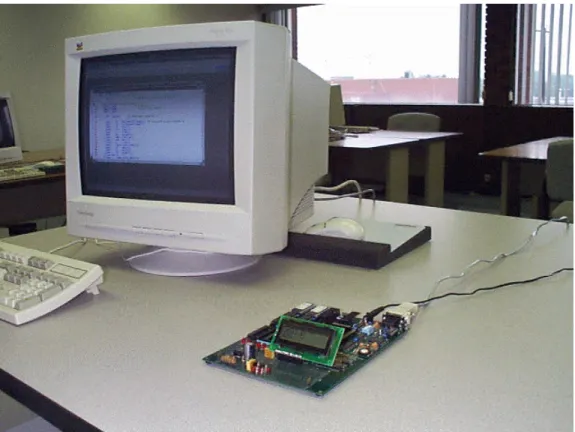
Each of the room’s 15 laboratory stations is equipped with a 200 MHz Pentium PC interfaced to a Toshiba TLCS-900H Microprocessor Trainer and Evaluation Board. This arrangement is shown in Figure 1. These boards are driven by C-based software development tools on the PCs. This software permits the student to develop microcontroller programs with standard C
language, de-bug and compile their code, and easily download to the microcontroller on the TLCS-900H boards.
Figure 1 - PC and Toshiba TLCS-900H Microprocessor Trainer and Evaulation Board
P
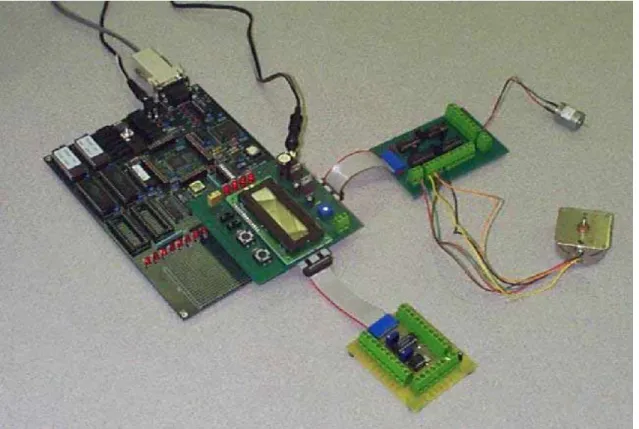
To further support the students, learning-specific printed-circuit boards were designed and fabricated. All of these boards connect directly to the TLCS-900H. First, an interface board was developed that has a dot-matrix LCD, several switches, LEDs for output status indication, and an adjustable power supply. Secondly, an output driver board was developed specifically for interfacing actuators. This board includes ten 100-mA drivers for actuating devices such as solenoids, relays, etc. It also has four H-bridge drivers for controlling DC motors. All of these drivers are further capable of powering stepper motors. Finally, a third board was designed and developed that allows easy interface to sensing devices, with on-board signal conditioning circuitry such as op-amps and filters. Figure 2 shows the TLCS-900H board, with the interface, driver and signal conditioning boards hooked to it. All of this is interfaced to a PC. Further background on these boards, including their design and utility, will be detailed in an
accompanying paper5.
Figure 2 - Toshiba TLCS-900H with Learning-Specific Boards Attached
The Prototype Development Center is a room directly adjacent to the Hardware and Software Development Center. This room serves to provide the students an area to work on the
fabrication of their mechatronic product, and is especially suited to developing the electronic hardware. The lab has two electronics workstations, each with an oscilloscope (HP 54615B), function generator (HP 33120A), DMM (HP 34401A), universal counter (HP 53131A) and a variable DC power supply (HP E3630A). Further, the lab has a universal programmer (Logical Devices, Inc. ChipMaster 6000), solder stations, and a very large supply of electronics
components, sensors and actuators. Examples of sensors available in this lab for student
P
projects include proximity sensors, hall-effect sensors, ultrasonic transducers and photodiodes, just to name a few. Actuators include stepper motors, DC motors, a selection of solenoids and a number of other specialty devices.
III. Development of Web-Based Learning Tools
To support the learning process, as well as fulfill other objectives, an Internet website was developed for the Mechatronics Laboratories at Kettering University. The URL for this site is:
http://www.kettering.edu/~jhargrov/mechatrn/mechatrn.htm
In addition to providing information about the nature of mechatronics, the students taking the classes routinely use a number of links. For example, all course information for the classes is present. Additionally, software code that is used as a “starting point” for laboratories is made available for download. Troubleshooting tips for de-bugging student’s software is available, and a C programming tutorial link6 is provided. This is especially useful since most of the students currently taking the mechatronics courses, and hence developing software code, have never taken a course in C programming. However, this has not proven to be a hindrance to them. Further, students in other courses at Kettering University utilize the Mechatronics Laboratories website. For example, students in Instrumentation (ME-204) are required to complete a design project at the end of the course that deals with instrumentation applications in a real-life problem. These students are encouraged to routinely use the “Links to Other Sites of Interest” on the mechatronics website to assist in researching their projects. Doing so not only creates an awareness of the mechatronics courses for these students, but since the Instrumentation course is a part of the core curriculum, having the students visit the mechatronics website assures that all mechanical engineering students are at least exposed to the concept of mechatronics.
IV. Development of ME-480 Applied Mechatronics
The first course in the mechatronics sequence is ME-480 “Applied Mechatronics”. It is offered in the winter and spring semesters. The objective of this course is to provide an introductory exploration of devices and design issues associated with the integrated nature of mechatronics. The utilization of sensors, actuators and electronic control in mechanical systems is included, with a particular emphasis on the role and application of microcontrollers. Additional emphasis in the final weeks of the course is placed on the formation of “mechatronic product development teams”. These teams, in preparation for the follow-up course ME-482 “Mechatronic Product Development”, envision and complete preliminary design on a new mechatronics-based product. The course is thus designed to provide knowledge and skill necessary to understand technologies and design philosophies behind mechatronic devices. An additional objective is to develop this knowledge at a level commensurate with that necessary to provide leadership in a mechatronic product engineering team.
ME-480 Applied Mechatronics is a lab/lecture course, with 2 hours of lecture and 4 hours of laboratory each week. Prerequisites by topic include basic analog and digital circuits, instrumentation, and systems modeling. The present textbook used for the course is
P
“Introduction to Mechatronics and Measurement Systems” by M. Histand and D. Alciatore, WCB McGraw-Hill, 1999. There is presently no specific lab manual. Each lab is given to the students as a handout. It should again be pointed out that some lab materials are provided on the website each week.
An outline of the course is provided:
Week 1 Introduction to Mechatronics
Overview of mechatronic devices and the design of integrated systems Emerging markets
Week 2 Introduction to Microcontrollers (architecture, input/output interfacing,
programming languages, terminology)
Week 3 Basic Sensors Technologies (overview, signal types, interfacing to
microcontrollers, analog-to-digital conversion, protection circuits)
Week 4 Signal Conditioning I: Diodes and Transistors (relationship to sensing
technologies, voltage regulation, design considerations)
Week 5 Signal Conditioning II: Op-Amps and Filters (relationship to sensing
technologies, circuit considerations)
Week 6 Microcontrollers: Outputs and Actuators (digital and analog outputs
and characteristics, driver devices, actuating devices)
Week 7 Actuators (stepper motors, DC motors, pulse-width-modulation,
H-bridge driver, design considerations)
Week 8 Transitioning to Real Microcontrollers (hardware considerations,
power supplies, software considerations) Week 9 Mechatronic Case Studies (applications)
Week 10-12 Mechatronic Product Development Project
In addition, a number of lab experiences have been developed to accompany ME-480 Applied Mechatronics. The goal is to provide an opportunity to apply knowledge gained in lecture in a hands-on environment. Each laboratory (except the first) requires the use of the TLCS-900H Microprocessor Trainer and Evaluation Board, and involves aspects of mechatronics such as utilization of sensors and actuators, along with programming the microcontroller to acquire signals and interpret results for control of the system. Demonstration of successful completion of each phase of the lab experience is required, except for the first lab, which requires a detailed report to be submitted. A total of 5 lab experiments are listed. Because of the nature of the labs, multiple weeks are required to complete them.
Lab 1 Reverse Engineering of a Mechatronic Device – a popular hand-held “bass
fishing” game is reverse engineered to gain and understanding of the fundamentals of mechatronic devices. Students observe the functionality, and then envision the sensing, actuating and control devices before opening the game and discovering the real methods.
Lab 2 Introduction to Microcontroller Programming – an understanding of the
board is gained. Fundamental programming and compiling techniques are completed using the software provided in the development package.
Programming exercises to control the LCD display, control the state of LEDs based on switch inputs, and the development of a “smart” switch are
completed.
Lab 3 Introduction to Sensor Inputs – a spring-scale device is provided that
consists of a mechanical arm attached to the shaft of a linear-taper rotary potentiometer. The student is to develop a digital scale using this apparatus, which involves the modeling of the A/D counts from the potentiometer as a function of weight. Functionality required of the device includes the ability to tare, report in ounces or grams based on switch input, and provide the user a set of instructions if needed.
Lab 4 A Mechatronic Vending Machine – this multi-week project requires the
student to devise a way of sensing the value of a coin passed down a slot and reject a steel “slug”. An algorithm is written to count how much money has been inserted and control the selection of goods available in the “vending machine”. In later weeks, the control of actuators to release the goods and sort the coins is accomplished. Sensors used include photointerruptors and hall-effect sensors, while actuators such as solenoids and stepper motors are applied.
Lab 5 Control of Actuators – gives the student more opportunity to explore the
operation and control of actuating devices. The student is required to write code to generate pulse sequences to operate a unipolar stepper motor, control an H-bridge driver for use with a DC motor, and generate
pulse-width-modulated signals. A mirror rotated by a DC motor, used in conjunction with a laser-diode module, is controlled to generate visual patterns. Further, as is the case with all lab experiences, user-friendly interfaces must be
accomplished with the use of the LCD modules. V. Development of ME-482 Mechatronic Product Development
The second course in the mechatronics sequence, ME-482 Mechatronic Product Development, is a follow-up to ME-480 Applied Mechatronics. At the end of ME-480, students begin
preliminary design of a new mechatronic product they have envisioned. ME-482 now provides them with a venue to fabricate that design and study the aspects of innovation and product development routinely encountered in the field. Thus, the primary objective of ME-482 is to provide a course in which product development teams design, fabricate and complete
preliminary marketing requirements for a new mechatronic product. The ultimate goal is to integrate engineering students and marketing-oriented students into product development teams. Ideally, ME-482 faculty will collaborate in a team-taught environment, where an engineering faculty person and a business faculty person work together. Topics of market analysis, intellectual property protection, capitalization and design for manufacturing are currently explored. Advanced topics in mechatronics, including microcontroller technologies, smart materials and intelligent systems, fuzzy logic controls and microelectromechanical systems are explored. All students receive these lectures, whether engineering or business-oriented. The
P
primary goal of this course is to guide cross-disciplinary student teams to develop prototype mechatronic products and give students experience in working in such environments.
ME-482 Mechatronic Product Development is a lab/lecture course with 2 hours of lecture and 4 hours of laboratory each week. It is held in the summer and fall semesters each year. The prerequisite for the course is to have taken ME-480 Applied Mechatronics in the previous semester. There is no textbook currently being used for this course. Because of the project orientation of the course, there are no structured laboratory experiences. An outline of the course is provided:
Week 1 Mechatronic Design Philosophy Review
Week 2 Student Presentations of Product Designs – oral reports Week 3 Innovation and New Products
Product Development Cycle Week 4 Market Analysis
Advanced Simulation Techniques (Mechatronic Systems)
Week 5 Intellectual Properties: Introduction to Patents and U.S. Patent Office Programs
Intellectual Properties: Writing a Patent Application Week 6 Sources of Capital
Design for Manufacturing / Disassembly Week 7 Team Progress Reports – oral reports
Week 8 Advanced Topics in Microprocessor Technology (chip-on-board devices, ASICs, power management techniques)
Advanced Topics in Sensor Technologies Week 9 Advanced Topics in Actuators
Smart Materials and Intelligent Systems Week 10 Fuzzy Logic Controllers
Microelectromechanical Systems (MEMS) and Nanotechnology Week 11 Special Lecture Topics
Week 12 Public Presentation of New Products
The culmination of the course is to provide an opportunity for the product development teams to publicly present their new products. It is required that proper intellectual property protection has been initiated. Possible venues for doing this are being considered. One such possibility is to provide an opportunity for the students to give poster-session presentations during Kettering University’s Industrial Symposium, which is held in the fall of each year and attracts
approximately 150 representatives from industry throughout the United States.
To support the funding of student product development, a grant has been received from the National Collegiate Inventors and Innovators Alliance. Also, a private endowment has been started to help support student entrepreneurial efforts that may arise from their efforts during the product development phase of their mechatronics education at Kettering University. A
description of a student project is provided below, as an example of the types of projects
VI. Student Project: Interactive Toy Race Track
In this project, a student team developed a toy racing track that features mechatronic obstacles and hazards, much reminiscent of the very popular car / driver video games of today. These obstacles are either user-controllable, providing for multi-player games, or can be
microprocessor controlled so that random interaction occurs and a one-person player thus competes against the computer. Further, the microprocessor tracks the number of laps that has occurred for each car and the times for each lap, providing a means of computing and displaying speed data and other information relevant to the competition. The students have also disclosed in patent documents a number of other interactive features that the racing system could employ, and note that many of these could be embodied as devices considered as “accessories” that could be added to the system selectively.
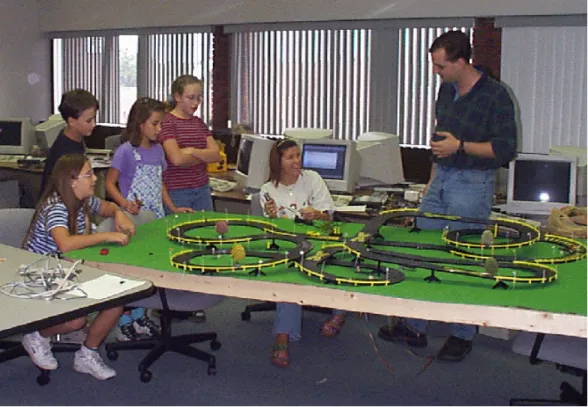
Figure 3 shows members of the student team (the two individuals on the right side of the image) demonstrating their prototype to children visiting Kettering University. These children then had a chance to play with the toy and were very excited by its fast-paced, interactive nature.
Figure 3 - Kettering University students demonstrate their interactive racing track to a group of visiting children
VII. Summary
The Mechatronics Laboratories at Kettering University have been specifically designed to support a very broad and innovative educational experience in mechatronics, as embodied in the
P
courses ME-480 Applied Mechatronics and ME-482 Mechatronic Product Development. In addition to providing facilities for learning through structured laboratory experiences, the labs support open-ended mechatronic product development experiences as well. Workstations are equipped with microcontroller hardware and software development tools, and a fabrication laboratory is provided to build supporting circuits for mechatronic devices. This strong component of hands-on learning integrates knowledge gained in previous courses in the ME core curriculum, as well as new material covered in the lecture portions of the supporting mechatronics courses. Additionally, Internet based support and enhancement has been
accomplished through a dedicated website. All of this is in fulfillment of commitments made as part of an NSF sponsored award for development of mechatronics education at Kettering
University.
VIII. Acknowledgments
The author would like to thank the faculty and administration of Kettering University for its support in developing the mechatronics component of education in the Mechanical Engineering Department. The financial support of the National Science Foundation, the National Collegiate Inventors and Innovators Alliance, and to private donors is gratefully acknowledged. Further, the support of Toshiba America Electronics Corporation in providing their TLCS-900H Microprocessor Trainer and Evaluation Boards is specially acknowledged.
Bibliography
1. Histand, M. B. and Aliciatore, D. G., “Introduction to Mechatronics and Measurement Systems”, WCB McGraw-Hill, 1999.
2. Hsu, Tai-Ran. “Development of an Undergraduate Curriculum in Mechatronics Systems Engineering”,
ASEE Journal of Engineering Education, April 1999.
3. Mariappan, J. & Berry, J. “Mechatronics at GMI”, Mechatronics 1996, San Francisco, pp. 78-83, 1996 4. Helm, J.D. & McNeill, S.R., “Teaching Microprocessors to Mechanical Engineers”, presented at the
Stanford University Workshop on Mechatronics Education, July 21-22, 1994.
5. Hargrove, J. B. and Stokes, T. J., “Mechatronics Education at Kettering University: Development of Learning-Specific Hardware and Software”, to be presented at the 2000 ASEE Annual Conference, St. Louis, July 18-21, 2000.
6. URL: http://www.swcp.com/~dodrill/; Coronado Enterprises.
JEFFREY B. HARGROVE
Jeff Hargrove is currently an Assistant Professor of Mechanical Engineering at Kettering University in Flint, Michigan. His research interests include smart materials and structures, mechatronics and biomedical engineering. He has developed and implemented the mechatronics curriculum at Kettering University, and is actively working to integrate mechatronics into the mechanical design curriculum. Dr. Hargrove received a B.S. degree in Electrical Engineering (1987) and an M.S. degree in Mechanical Engineering (1992) from GMI Engineering & Management Institute and a Ph.D. from Michigan State University in 1997.
P