Fall/Winter 2012 Volume 19 / No. 2
NEUROENDOCRINE CLINICAL CENTER
BULLETIN
Reassessing Growth Hormone Deficiency in the
Child-to-Adult Transition
S
ince initial descriptions in the late 1950s of growth hormone (GH) treatment for children with short stature (1), the clinical use of GH has evolved substantially. Once extracted from cadaveric pituitary glands and administered in thrice weekly doses only to children with severe short stature (“pitu-itary dwarfism”), GH is now widely available via recombinant DNA technology and is used in both children and adults for a variety of indications (see Table).The expanding use of GH reflects a broadened understanding of its important metabolic effects beyond statural growth. Growth hormone is lipolytic and is anabolic to bone and muscle. As a result, indi-viduals with growth hormone deficiency (GHD) have relatively greater body fat mass, with preferential accumulation of visceral fat, as well as decreased lean mass and relatively reduced bone mass (2).
GH replacement reverses these abnormalities in both children and adults. Moreover, GH plays a sig-nificant role in cardiovascular health. Individuals with GHD exhibit dyslipidemia, elevated systemic inflammatory markers, higher carotid intima-media thickness (cIMT), and abnormal endothelial function compared to the general population, and GH treat-ment ameliorates these abnormalities (3).
Consequently, it is now well-accepted that GH treatment for GHD is appropriate not only in child-hood to maximize growth, but also throughout adult-hood to optimize body composition, bone health, and cardiovascular health. GHD diagnosed in childhood does not always persist into adulthood, however, so the completion of statural growth in childhood is a period at which GH is generally stopped, the diagno-sis of GHD reassessed, and GH replacement reinstat-ed at adult doses for those individuals who demon-strate persistent GHD on retesting.
Why Does Childhood Diagnosis of GHD Require Confirmation in Adulthood?
The need to reassess the diagnosis of GHD after com-pletion of statural growth is based on several studies demonstrating that, upon retesting in adulthood, from 30-60% of individuals diagnosed with GHD in
adulthood (4-6). This is particularly true of children diagnosed with isolated, idiopathic GHD, of whom up to 70% have normal GH secretion in adulthood (6). Although some of these cases may be due to a “tran-sient GHD of childhood,” there is no clear evidence of such an entity. Rather, the discrepancy between diag-nosis of GHD in childhood and adulthood is likely related to the challenges surrounding diagnosis of GHD in childhood. In cases of multiple pituitary hor-mone deficiency and/or known pituitary pathology, the diagnosis of GHD is relatively straightforward.
By contrast, the evaluation of otherwise healthy children with short stature for isolated GHD is consid-erably more difficult. For children whose height and/or growth velocity are low enough to warrant diagnostic evaluation, provocative GH tests have his-torically been considered “gold standard.” In the pediatric population however, GH stimulation testing is fraught with uncertainty and demonstrates low reproducibility. Whereas GH stimulation testing in adults is relatively standardized, there is no uniform method for provocative GH testing in children.
A variety of diagnostic stimuli, including clonidine, arginine, L-dopa, and glucagon, are utilized in a vari-ety of institution-specific testing protocols, some of which combine agents and others of which adminis-ter single agents on separate testing days. Moreover, several factors, including pubertal status and adiposi-ty, influence GH response to provocative agents, but there is no standard algorithm to account for these factors in the interpretation peak GH results. In spite of these issues, a uniform cutoff of peak GH less than 10mcg/L in response to 2 or more provocative agents is currently used in the United States to define GH deficiency.
It is important to note that this cutoff was histori-cally lower, 5mcg/L to 7mcg/L, and has paradoxihistori-cally risen as GH assays have become more sensitive. As a consequence, an increasing number of children with short stature – many of whom may not be truly GH deficient – receive a diagnosis of GHD. Consequently, completion of vertical growth in children diagnosed with GHD provides an opportunity to discontinue GH and re-examine the diagnosis.
2 FALL/WINTER 2012
Reassessing Growth Hormone
...continued from page 1Who Should Be Re-evaluated and How?
The 2011 Endocrine Society Clinical Practice
Guideline, Evaluation and Treatment of Adult Growth Hormone Deficiency, provides clear guidance regard-ing re-evaluation of GHD in young adulthood (3). For individuals with established pathology including genetic mutations associated with GHD or embry-ologic or acquired lesions causing multiple pituitary hormone deficits, a low IGF-I value at least 1 month after discontinuation of GH therapy is sufficient to confirm GHD and reinitiate treatment.
By contrast, patients with isolated GHD or GHD plus only one additional pituitary hormone deficiency should be re-evaluated with provocative testing even in the presence of abnormal pituitary MRI findings. This recommendation is based on evidence that, even with embryologic pituitary defects such as ectopic neurohypophysis, patients with isolated GHD in childhood may have normal GH responses in adult-hood (7).
As growth hormone releasing hormone (GHRH) is not currently commercially available in the United States, retesting is recommended with insulin toler-ance test (ITT) or glucagon (7). Studies utilizing the insulin tolerance test in young adults during the transi-tion period have supported the use of a peak GH cutoff between 5-6mcg/L (8). For the glucagon test, stud-ies in the general adult population suggest a peak GH cutoff of 3mcg/L (9, 10), but further data are needed to con-firm this as an appropriate cut-off for the transition age group.
What is the Appropriate Timing of Re-evaluation?
GH treatment in children is generally discontinued when either growth velocity decreases to <1cm/year or bone age reaches 14-15y in girls or 16-17y in males. Because long-term exogenous GH treatment may suppress endogenous GH secretion just as glucocorti-coids suppress adrenal function, a period off of GH treatment is advisable before retesting. Data are not available to define the necessary interval between dis-continuation of treatment and re-testing; consensus statements recommend at least 1 month off of GH before re-evaluation of GH secretory capacity (7, 11).
What is the Evidence for Timely Re-initiation of GH Replacement in Young Adulthood?
Since adolescence is a time of evolving body compo-sition and accrual of bone mass, the timely re-initia-tion of GH therapy in those with persistent GHD may be necessary to preserve normal age-related changes in body composition, strength, and bone density. A number of studies have addressed this question and most have demonstrated adverse consequences of prolonged GH discontinuation in adolescents who prove to have persistent GHD on re-testing in adult-hood.
With regard to body composition, fat mass – par-ticularly abdominal fat – increases in GHD patients off GH treatment to a significantly greater degree than in controls, whereas measures of lean mass and strength appear to plateau in those with GHD, in con-trast to continued increase in controls of the same age (12, 13). Similarly, bone mineral density appears to be lower in those with persistent GHD who have a long period off of therapy, whereas restarting GH treat-ment increases bone density (14, 15). In addition to body composition and bone health, lipid parameters appear to deteriorate off of therapy and normalize on GH replacement (12). Further study is needed to determine if there may be adverse cardiovascular effects of prolonged discontinuation of GH during the transition period.
Taken together, evidence supports timely retesting of GH secretory status, and, for those with persistent GHD, prompt re-initiation of GH treatment in order to preserve body composition and maximize the gains in strength and bone mass that occur in young adult-hood.
Dr. Takara Stanley has no relevant financial relationships to disclose.
FDA Approved Indications for Growth Hormone Therapy GH Deficiency
AIDS Wasting
Chronic Renal Insufficiency (with growth impairment) Idiopathic Short Stature
Noonan Syndrome Prader Willi Syndrome Short Bowel Syndrome SHOX deficiency
Small for Gestational Age (with short stature)
Turner Syndrome References
1. Raben MS. J Clin Endocrinol Metab. 1958; 18(8):901-3. 2. Beshyah SA, et al. Clin Endocrinol. 1995; 42(2):179-89. 3. Molitch ME, et al. J Clin Endocrinol Metab. 2011; 96(6):1587-609. 4. Juul A, et al. J Clin Endocrinol Metab. 1997; 82(4):1195-201. 5. Maghnie M, et al. J Clin Endocrinol Metab. 1999; 84(4):1324-8. 6. Tauber M, et al. J Clin Endocrinol Metab. 1997; 82(2):352-6. 7. Leger J, et al. J Clin Endocrinol Metab. 2005; 90(2):650-6. 8. Secco A, et al. J Clin Endocrinol Metab. 2009; 94(11):4195-204. 9. Berg C, et al. European J Endocrinol. 2010; 162(3):477-82. 10. Yuen KC, et al. J Clin Endocrinol Metab. 2009; 94(8):2702-7. 11. Clayton PE, et al. European J Endocrinol. 2005; 152(2):165-70. 12. Johannsson G, et al. J Clin Endocrinol Metab. 1999; 84(12):4516-24. 13. Hulthen L, et al. J Clin Endocrinol Metab. 2001; 86(10):4765-70. 14. Underwood LE, et al. J Clin Endocrinol Metab. 2003; 88(11):5273-80. 15. Shalet SM, et al. J Clin Endocrinol Metab. 2003; 88(9):4124-9.
SAVE THE DATE
March 20 – March 24, 2013
MASSACHUSETTS GENERAL HOSPITAL AND
HARVARD MEDICAL SCHOOL CME PRESENT
CLINICAL ENDOCRINOLOGY: 2013
The Fairmont Copley Plaza, Boston, Massachusetts
For over three decades this course has provided
practicing endocrinologists and other healthcare providers with a
comprehensive review and update of recent literature in clinical
endocrinology. The faculty consists of staff endocrinologists at the
Massachusetts General Hospital and Harvard Medical School
as well as nationally-renowned guest lecturers, all selected for their
teaching and clinical skills. A comprehensive syllabus is provided.
For additional information contact:
Harvard Medical School Department of Continuing Education
By mail: Harvard MED-CME, P.O. Box 825, Boston, MA 02117-0825
By telephone: 617-384-8600
To view a PDF of the course: http://cme.med.harvard.edu/cmeups/pdf/00332585.pdf
To view the Registration and Program information, go to:
4 FALL/WINTER 2012
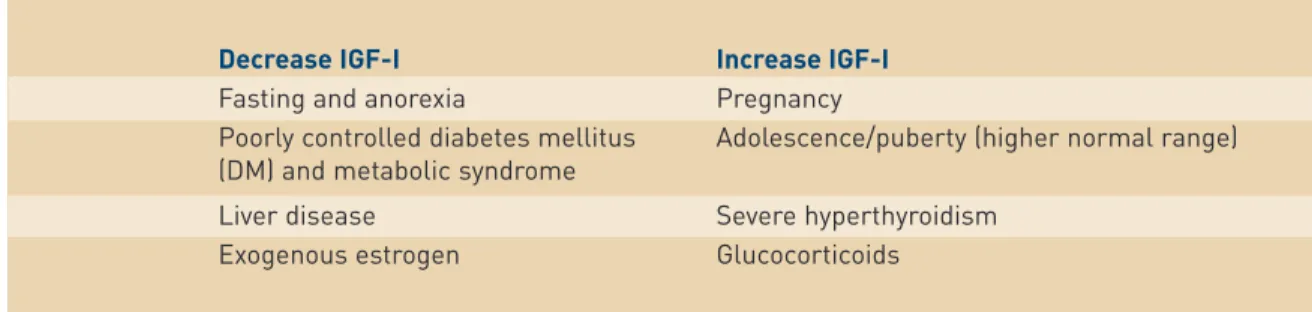
Decrease IGF-I Increase IGF-I
Fasting and anorexia Pregnancy
Poorly controlled diabetes mellitus Adolescence/puberty (higher normal range) (DM) and metabolic syndrome
Liver disease Severe hyperthyroidism Exogenous estrogen Glucocorticoids
Controversies in the Clinical Management of Acromegaly:
Five Commonly Asked Questions
Lisa Nachtigall, M.D.
1. When there is discordance between IGF-I
and nadir growth hormone (GH) level by oral
glucose tolerance test (OGTT) following surgical
therapy for acromegaly, how should the patient
be treated?
In a patient with acromegaly who has been treated with primary surgical therapy, and presents post-operatively with discordant biochemical results, clini-cal evaluation is warranted when considering
whether or not to treat with medication and the man-agement plan should be individualized accordingly (Brzana). In a patient with no signs or symptoms of active disease, the patient may be observed and bio-chemical testing may be repeated. Pituitary MRI should also be followed for any evidence of tumor growth. If there is a trend toward increasing values of either GH or IGF-I or evidence of progression in tumor size or in symptoms and signs of acromegaly, then medical therapy should be considered. In a case of mild elevation of IGF-I or GH, cabergoline
monotherapy may be a useful first line option (Moyes). A somatostatin analog is the preferred initial choice of treatment for patients with higher GH or IGF-I levels or if tumor remnant is a concern (Melmed).
There are additional variables that should be con-sidered in the case of discordant IGF-I and GH values regarding conditions, unrelated to GH secretion, which can affect these values:
Optimal Timing of Post-operative Testing
Since GH has a short half life, it may be appropriately evaluated days to a week after surgery. IGF-I has a long half-life and it may take many weeks to reach the nadir at which it plateaus post-operatively.
IGF-I Assay challenges
Assays with incorrect or suboptimal assay-specific normative data for reference range may report an IGF-I result as high that is not truly high. In this case,
repeating the IGF-I in a trusted lab may be helpful. In addition, IGFBP interference complicates assay tech-nique; there are unresolved issues with international standardization, and lack of consensus regarding the procedures used when collecting and storing samples all of which may contribute to unreliable IGF-I meas-urements (Frystyk, Clemmons).
Conditions influencing IGF-I and GH concentrations There are some pitfalls in testing of both GH and IGF-I in which clinical conditions, some of which are not directly related to pituitary GH secretion, may impact the measurement of serum levels (Freda). If any of these factors are present, they may cause discordant results. These factors are shown in Tables 1 and 2.
2. Does pretreatment with somatostatin analogs
improve surgical outcomes?
While many retrospective studies show mixed results, 2 randomized prospective studies report a benefit (Mao, Carlsen). However, there are limitations in both studies that impact the interpretation of the results. In the first study (Carlsen), 26 patients received pre-treatment (PT) with 20 mg octreotide LAR monthly for 3 months and 50 % were cured vs. 25 patients who went directly to surgery of whom 16 % were cured. There are 3 caveats that limit the usefulness of this study. First, the baseline IGF-I in PT group was lower. Secondly, IGF-I was obtained 3 months post-opera-tively, which was 3 months after last dose of the long acting somatostatin analog and based on the pharmokinetics of the drug, the drug may still have had effect after 3 months. Finally, these results were not significant when GH level plus IGF-I levels were used to define cure. In the second study (Mao), 49 patients received pretreatment (PT) with 30 mg lan-reotide slow release every 1-2 weeks for 4 months; 49 % were cured vs. 49 patients who went directly to sur-gery among which only 9 % were cured. This study design had appropriate post-operative timing of IGF-I measurement (at least 4 months since the last
somatostatin analogue injection), making a residual drug effect unlikely. However, the limitations of this study are that cure was based only on IGF-I and that the surgical cure rate for the direct surgery group was significantly lower than has been reported, even among less experienced surgeons (Gittoes). Therefore, it is difficult to draw conclusions on the true benefit of pretreatment based on either of these prospective studies.
Since there is inconclusive evidence for a benefit of pretreatment with somatostatin analogs on surgi-cal cure or surgisurgi-cal complication rate, whether or not to treat a patient pre-surgically with medications is a decision made on a case by case basis depending on tumor size and location, severity and duration of acromegaly, the neurosurgeon’s and patient’s prefer-ences and other individual concerns. It is reasonable to consider pretreating a patient who is poorly con-trolled with long standing disease who may have air-way compromise from soft tissue swelling in order to avoid respiratory difficulties peri-operatively, but there are no specific data validating this approach.
3. Should medical therapy for acromegaly be
withdrawn prior to radiation therapy (RT)?
There are no prospective randomized trials evaluating whether the concomitant use of somatostatin analogs at the time of RT is a negative predictor of biochemi-cal normalization. However, 2 retrospective studies suggest that use of GH tumor suppressive therapy with dopamine agonists or somatostatin analogs at the time of radiation administration negatively corre-lated with biochemical remission of disease and increased the time to hormonal normalization (Pollock, Landolt). Based on these studies, some cen-ters recommend withholding GH suppressive therapy prior to radiation. Specific information on how long to withdraw these drugs prior to radiation is lacking but it may be advisable for those patients who can safely withhold cabergoline or long acting somato-statin for at least month to do so, based on the retro-spective data. Pegvisomant, on the other hand, would not be expected to inhibit RT efficacy since it does not directly suppress tumors but data about this are not available.
4. Is GH replacement therapy appropriate for
patients cured of acromegaly who have growth
hormone deficiency?
There is considerable evidence that GH replacement improves many clinical parameters in patients with growth hormone deficiency, and it has been an FDA-approved indication for this since 1996. However, many of the early studies did not include patients with acromegaly. More recently, it has been shown that GH replacement improves body composition, cardiovascular risk markers and quality of life (QOL) in patients with acromegaly (Feldt-Rasmussen, Norrman, Miller). However, the safety of GH replace-ment in this population has not been fully established and data beyond 2 years of replacement are not yet available. Caution is advised in prescribing GH to such patients, especially those with increased cardio-vascular risk.
5. What are the recommendations for patients
with acromegaly who are pregnant or desire
fertility?
Pregnancy outcomes in patients with acromegaly are generally good, in part because high estrogen levels decrease IGF-I, possibly by altering GH signaling (Cheng, Caron). In fact, while normal women have increased IGF-I levels during pregnancy, IGF-1 con-centrations in women with acromegaly tend to be lower during pregnancy compared to baseline levels prior to pregnancy (Caron). However, there are risks, particularly in patients with active disease including gestational diabetes (4/59) and hypertension (8/59) which are associated with poor control of GH and IGF1(Caron). Rare tumor enlargement has been reported in macroadenomas (3/27) (Caron). No med-ical therapy for acromegaly has been approved for use during pregnancy. However, in most cases, GH-sup-pressive therapy can be safely withdrawn after con-ception (Caron). The excon-ceptions are patients who have persistent IGF-I elevation, particularly those with complications such as diabetes or hypertension. Both dopamine agonists and somatostatin analogs cross the placenta (Caron) while transplacental pas-sage of pegvisomant is either absent or minimal (Brian). Safety data on cabergoline use in pregnancy
Table 2 Pitfalls in GH Suppression: False Positive OGTT
High GH and Low IGF-I High GH and Normal or High IGF-I Fasting and anorexia Pregnancy
Diabetes mellitus Puberty (higher normal range) Liver disease Severe hyperthyroidism Exogenous estrogen
6 FALL/WINTER 2012 References
Brian SR, et al. J Clin Endocrinol Metab. 2007; 92(9):3374-7. Brzana JA, et al. Pituitary. 2012; 15:562-70.
Carlsen S, et al. J Clin Endocrinol Metab. 2008; 93:2984-90. Caron P, et al. J Clin Endocrinol Metab. 2010; 95:4680-7. Cheng S, et al. Clin Endocrinol. 2012; 76:264-71. Clemmons D, et al. Clinical Chemistry. 2012; 57:555–9. Feldt-Rasmussen U, et al. Eur J Endocrinol. 2002; 146: 67–74. Freda P, et al. Pituitary. 2003; 6:135-40.
Frystyk J, et al. Growth Hormone & IGF Research. 2009; 20:8-18. Gittoes NJ, QJM. 1999; 92:741-5.
Gryberg M, et al. J Clin Endocrinol Metab. 2010; 95:4518-25. Landolt AM, et al. J Neurosurg. 1998; 88:1002–8.
Mao ZG, et al. Eur J Endocrinol. 2010; 162:661-6.
Melmed S, et al. J Clin Endocrinol Metab. 2009; 94:1509-17. Miller KK, et al. J Clin Endocrinol Metab. 2010; 95:567-77. Moyes VJ, et al. Eur J Endocrinol. 2008; 159:541-5. Norrman, et al. J Clin Endocrinol Metab. 2008; 93: 2531–8. Pollock, et al. J Neurosurg. 2007; 106:833-8.
in acromegaly and other pituitary tumors is reassuring but not conclusive. While good outcomes have been described with somatostatin analogs, the number of patients studied is small (Cheng, Caron) and microso-mia has been reported in association with somatostatin analogs use (Caron). Pegvisomant use during pregnan-cy has only been reported in 2 cases, both with good outcomes (Cheng, Brian) but should be avoided in the absence of studies evaluating its safety during pregnancy.
Preconception biochemical control should be achieved prior to fertility treatment. The ovulatory dis-turbances associated with acromegaly and approach to infertility in women with acromegaly who desire fertili-ty are summarized in Table 3 (Gryberg).
Dr. Lisa Nachtigall serves as the PI on a research grant to the MGH Neuroendocrine Unit from Ipsen and has per-formed occasional consulting for Pfizer and Ipsen.
Physicians’ Pituitary Information Service (PPIS)
Physicians with questions may contact the PPIS at 617-726-3965 or 1-888-429-6863
e-mail pituitary.info
@
partners.org
The PPIS has received educational grant support from Corcept Therapeutics and Ipsen Biopharmaceuticals, Inc. Table 3 Acromegaly and Ovarian Dysfunction
Causes of ovarian dysfunction Treatment Hyperprolactinemia Cabergoline or bromocriptine
Hypogonadotropic hypogonadism Ovulation induction: clomiphene, gonadotropins Hyperandrogenism Metformin
Reversal of hyperprolactinemia (if present) and/or GH excess may improve hyperandrogenism
References
Brian SR, et al. J Clin Endocrinol Metab. 2007; 92(9):3374-7. Brzana JA, et al. Pituitary. 2012; 15:562-70.
Carlsen S, et al. J Clin Endocrinol Metab. 2008; 93:2984-90. Caron P, et al. J Clin Endocrinol Metab. 2010; 95:4680-7. Cheng S, et al. Clin Endocrinol. 2012; 76:264-71. Clemmons D, et al. Clinical Chemistry. 2012; 57:555–9. Feldt-Rasmussen U, et al. Eur J Endocrinol. 2002; 146: 67–74. Freda P, et al. Pituitary. 2003; 6:135-40.
Frystyk J, et al. Growth Hormone & IGF Research. 2009; 20:8-18. Gittoes NJ, QJM. 1999; 92:741-5.
Gryberg M, et al. J Clin Endocrinol Metab. 2010; 95:4518-25. Landolt AM, et al. J Neurosurg. 1998; 88:1002–8.
Mao ZG, et al. Eur J Endocrinol. 2010; 162:661-6.
Melmed S, et al. J Clin Endocrinol Metab. 2009; 94:1509-17. Miller KK, et al. J Clin Endocrinol Metab. 2010; 95:567-77. Moyes VJ, et al. Eur J Endocrinol. 2008; 159:541-5. Norrman, et al. J Clin Endocrinol Metab. 2008; 93: 2531–8. Pollock, et al. J Neurosurg. 2007; 106:833-8.
RESEARCH STUDIES AVAILABLE
Patients may qualify for research studies in the Neuroendocrine Clinical Center. We are currently accepting the following categories of patients for screening to determine study eligibility. Depending on the study, subjects may receive free testing, medication and/or stipends.
SUBJECTS STUDIES CONTACT 617-726-3870
Adults with GHD • Diagnostic testing for GHD Karen Pulaski Liebert, RN
Beverly MK Biller, MD Adolescent and young adult athletes • Investigating impact of hormonal alterations on menstrual Madhu Misra, MD
function and bone density Anne Klibanski, MD
Kathryn Ackerman, MD Obese adolescent girls • Investigating impact of growth hormone on body fat distri- Madhu Misra, MD
bution and metabolic function Anne Klibanski, MD
Adolescent girls with anorexia nervosa • Investigating the impact of new therapies on bone density Madhu Misra, M Anne Klibanski, MD Kathryn Ackerman, MD
Women with anorexia nervosa • New therapies Karen K. Miller, MD
• Cross-sectional bone density study Anne Klibanski, MD
Pouneh Fazeli, MD Elizabeth Lawson, MD Women ages 18-40 with a history • Investigating hormones and brain circuitry Elizabeth Lawson, MD
of anorexia nervosa involved in appetite Anne Klibanski, MD
Men and women with active or • Quality of life Karen K. Miller, MD
treated acromegaly • Cross-sectional bone density study Pouneh Fazeli, MD
Girls and women with current anorexia • Investigating genetics of appetite-regulating and stress Elizabeth Lawson, MD
nervosa or a history of anorexia nervosa, hormones Karen K. Miller, MD
ages 10 and up Anne Klibanski, MD
Madhu Misra, MD Healthy girls and women, ages 10 and up • Investigating genetics of appetite-regulating Elizabeth Lawson, MD
and stress hormones Karen K. Miller, MD
Anne Klibanski, MD Madhu Misra, MD Healthy normal-weight and obese men • Effect of oxytocin on caloric intake Elizabeth Lawson, MD
Healthy normal-weight women • Cross-sectional bone density study Pouneh Fazeli, MD
Anne Klibanski, MD Healthy slightly overweight men • Investigating the effects of fasting on adipose tissue Pouneh Fazeli, MD
and women distribution
Obese women • Cross-sectional bone density study Pouneh Fazeli, MD
Anne Klibanski, MD Obese men • Investigating the effect of growth hormone treatment on Hideo Makimura, MD
skeletal muscle mitochondria
Obese men and women • Investigating the effect of acipimox, a medication to Hideo Makimura, MD decrease free fatty acids, on skeletal muscle mitochondria
HIV positive men and women with • Assessment of coronary artery atherosclerosis Steven Grinspoon, MD and without metabolic • Growth hormone and growth hormone releasing hormone Janet Lo, MD
abnormalities • Assessment of long-term GHRH Katie Fitch, FNP
• Assessment of eplerenone on metabolic abnormalities Takara Stanley, MD • Assessment of menopausal transition Suman Srinivasa, MD • Statin therapy for coronary plaque Markella V. Zanni, MD • Assessment of effects of Quad therapy on coronary plaque
Adults with moderate-to-severe psoriasis • Assessment of cardiovascular and metabolic health Markella V. Zanni, MD
about to be started on etanercept (Enbrel) by Steven Grinspoon, MD
SUPERVISING STAFF
Endocrinology:
Anne Klibanski, MD Chief, Neuroendocrine Unit Beverly MK Biller, MD Pouneh K Fazeli, MD Steven K Grinspoon, MD Elizabeth A Lawson, MD Janet Lo, MD Hideo Makimura, MD, PhD Karen K Miller, MD Lisa B Nachtigall, MD Nicholas A Tritos, MD, DSc Markella V Zanni, MD Neurology: Thomas N Byrne, MD Neurosurgery: Robert L Martuza, MD Chief, Neurosurgical Service Brooke Swearingen, MD Nicholas T Zervas, MD
Radiation Oncology:
Jay S Loeffler, MD Chief, Radiation Oncology Helen A Shih, MD Psychiatry: Gregory L Fricchione, MD Hadine Joffe, MD Pediatric Endocrinology Madhusmita Misra, MD, MPH Takara L Stanley, MD
Massachusetts General Hospital Zero Emerson Place, Suite 112 Boston, Massachusetts 02114
A HArvArd MedicAl ScHool TeAcHing AffiliATe
SERVICES AVAILABLE
Facilities
The Neuroendocrine Center is located on the 1st floor (Suite 112) of Zero Emerson Place at the Massachusetts General Hospital. A test center is available for complete outpatient diagnostic testing, including ACTH (Cortrosyn) stimulation; insulin tolerance; oral glucose tolerance and growth hormone stimulation testing. Testing for Cushing’s syndrome can also be arranged, including bilateral inferior petrosal sinus ACTH sampling for patients with ACTH-dependent Cushing’s syndrome.
Neuroendocrine Clinical Conference
A weekly interdisciplinary conference is held to discuss all new patients referred to the Neuroendocrine Center and to review patient management issues. It is a multidisciplinary conference, attended by mem-bers of the Neuroendocrine, Neurology, Neurosurgery, Psychiatry and Radiation Oncology services. Physicians are welcome to attend and present cases.
Physicians’ Pituitary Information Service (PPIS)
Physicians with questions about pituitary disorders may contact the PPIS at (617) 726-3965 within the Boston area or toll free at (888) 429-6863, or e-mail to [email protected].
Scheduling
Outpatient clinical consultations can be arranged by calling the Neuroendocrine Center Office at (617) 726-7948.
In 2012, the MGH Neuroendocrine Clinical Center Bulletin was supported in part by unrestricted educational grants from: LG Life Sciences and Chiasma. Dr. Biller, Editor of the Neuroendocrine Clinical Center Bulletin, has served as the primary investigator on research grants to the Neuroendocrine Unit from Corcept, Novartis and Novo Nordisk and occasionally consults for Novartis, Novo Nordisk, Pfizer, and Ipsen.