On the roots of Hosoya polynomial of a graph
M.H.REYHANIa,S.ALIKHANIb,M.A.IRANMANESHb
a
Department of Mathematics, Yazd Branch, Islamic Azad University, Yazd, Iran b
Department of Mathematics, Yazd University, 89195-741, Yazd, Iran
(ReceivedAugust 10, 2013; Accepted August 20, 2013)
ABSTRACT
Let G = (V, E) be a simple graph. Hosoya polynomial of G is )
v , u ( d ) G ( V } v , u
{ x
= ) x , G (
H , where, d(u ,v) denotes the distance between vertices u
and v. As is the case with other graph polynomials, such as chromatic, independence and domination polynomial, it is natural to study the roots of Hosoya polynomial of a graph. In this paper we study the roots of Hosoya polynomials of some specific graphs.
Keywords: Hosoya polynomial, root, path, cycle.
1.
I
NTRODUCTIONA simple graph G = ( V, E ) is a finite nonempty set V(G) of objects called vertices together with a (possibly empty) set E(G) of unordered pairs of distinct vertices of G called edges. In chemical graphs, the vertices of the graph correspond to the atoms of the molecule, and the edges represent the chemical bonds.
The Hosoya polynomial of a graph is a generating function about distance distributing, introduced by Hosoya [10] in 1988 and for a connected graph G is defined as:
, x
= ) x , G (
H d(u,v)
) G ( V } v , u {
Where d (u ,v) denotes the distance between vertices u and v. This polynomial has computed for some nano-structures, e.g. [3, 16]. The Hosoya polynomial has many chemical applications [7, 8, 9]. Especially, the two well-known topological indices, i.e. Wiener index and hyper-Wiener index, can be directly obtained from the Hosoya polynomial.
The Wiener index of a connected graph G is denoted by W(G), is defined as the
). v , u ( d = ) x , G ( W ) G ( V } v , u {
The hyper-Wiener index is denoted by WW(G) and defined as follows:
). v , u ( d 2 1 ) v , u ( d 2 1 = ) G ( WW 2 ) G ( V } v , u { ) G ( V } v , u {
Note that the first derivative of the Hosoya polynomial at x=1 is equal to the Wiener index: . | ) ) x , G ( H ( = ) G (
W x=1
Also we have the following relation:
. | ) ) x , G ( xH ( 2 1 = ) G (
WW x=1
Graph polynomials are a well-developed area useful for analyzing properties of graphs. For some graph polynomials, their roots have attracted considerable attention, both for their own sake, as well for what the nature and location of the roots imply. Woodal [17] explored the zeros and zero-free regions of chromatic and flow polynomials. Also, the zero distribution of chromatic and flow polynomials of graphs and characteristic polynomials of matroids have been examined by Jackson [12]. Also the zeros of independence polynomials have been studied in [2, 4]. Finally the roots of domination polynomial has considered in some papers, e.g. [1, 5].
In this paper we study the roots of Hosoya polynomial of specific graphs. We denote the roots of Hosoya polynomial of graph G by Z(H(G,x)).
2.
M
AINR
ESULTSIn this section we consider some specific graphs and obtain the roots of their Hosoya polynomials. Let Sn,Pn and C denote the star, path and cycle with n n vertices,
respectively. A simple calculation gives the following theorem:
Theorem 1.
1. x (n 1)x.
2 1 n = ) x , S (
H n 2
2. H(Pn,x)=xn12xn2...(n1)x.
3. H(C2n,x)=(2n)(xx2xn1)nxn.
Theorem 2 . For n3,
}. n 2
2 {0, = )) x , S ( H (
Z n
Proof. It follws from Theorem 1(i). ■
Here we state the following theorem:
Theorem 3 . ([14]) Let f(z)=anzn an1zn1a0, aiR,i=1,,n be a
polynomial with real coefficients satisfying a0a1an >0. Then, no zeros of f(z)
lie in {zC,|z|<1}.
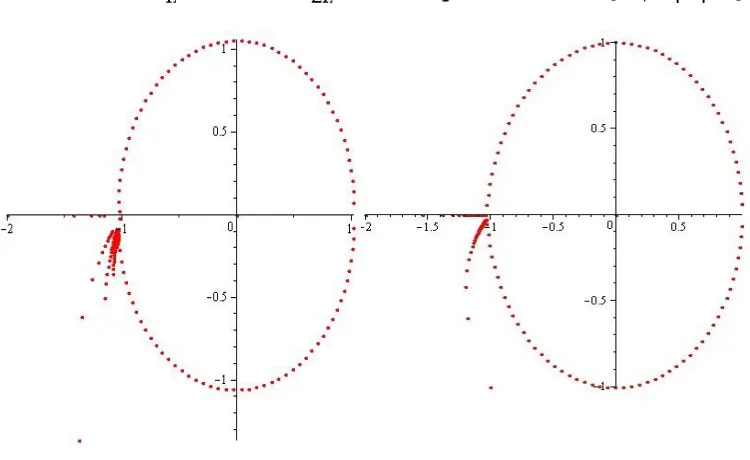
The following theorem is an consequence of Theorem 3, see Figure 1.
Theorem 4 . H(Pn,x) and H(C2n,x) do not possess zeros in {zC,|z|<1}.
Figure 1. Roots of Hosoya polynomial of P100 and C200, respectively.
We recall that the n-th root of unity are roots n i k 2
e
of equation xn 1. Now we state and prove the following theorem:
Theorem 5 . Let f(z)=azn azn1aza, a0, be a complex polynomial. All
zeros of f(z) lie on the unit circle.
), w z ( a = 1 z
1) z
( a = ) z (
f n i
1 = i 1
n
where w denotes the (n1)-th root of unity. Since all roots of unity lie on the unit circle,
so we have the result. ■
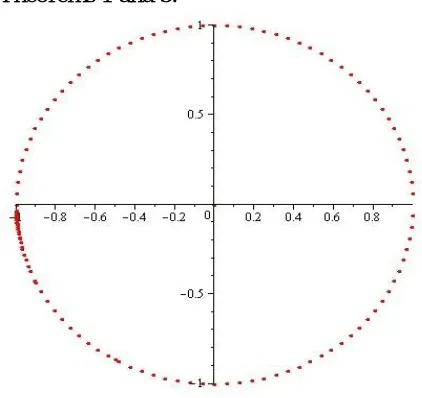
Corollary 1: All roots of H(C2n1,x)lie on the unit circle.
Proof. It follows from Theorems 1 and 5. ■
Figure 2. Roots of H(C201,x).
Figure 2 shows roots of H(C201,x). We need the following theorem:
Theorem 6 . ([13]) Let f(z)=anzn an1zn1a0, aiR, be a polynomial with real coefficients. All zeros of f(z) lie in the closed disk {zC,|z|r} where r>1 denotes
the largest positive root of the equation (z21)(|an|z|an1|)2222 =0, and
2 1 2 1 j n j n n
1 = j
2 ( (a a ) )
2 1
=
.
Theorem 7. All zeros of H(C2n,x) lie in the closed disk {zC,|z|2.77321}.
Proof. By Theorem 6, since we have an =n and ai = 2n, (1in1), so 2 = 2n.
2.77321. So, we have the result as desired. ■
The join G1G2 of two graph G1 and G with disjoint vertex sets 2 V1 and V a2 nd
edge sets E and 1 E is the graph union 2 G1G2 together with all the edges joining V and 1
2 V .
Theorem 8 . Let n and i m be order and size of graphs i G i (i=1,2), respectively. Then
. ) m m ( 2 n 2 n n n m m 0, = )) x , G G ( H ( Z 2 1 2 1 2 1 2 1 2 1
Proof. Since H G G x m n x E G E G x x mnx
) (| ( )| | ( )|) ( 1) 2 2 ( = ) ,
( 1 2
2 2
1 (see
[15]), we have the result. ■
The following corollary is an immediate consequence of Theorem 8:
Corollary 2.
1. The roots of Hosoya polynomial of complete bipartite graph Km,n is
. 2 m 2 n mn 0, = )) x , K ( H (
Z m,n
2. The roots of Hosoya polynomial of wheel graph Wn is
. 1) n ( 2 1 n n 2 2 0, = )) x , W ( H ( Z n Proof.
1. Since Km,n =KmKn , we have the result by Theorem 8.
2. Since Wn =K1Cn1, we have the result by Theorem 8. ■
composition) of G and H, and can be thought of as the graph arising from G and H by substituting a copy of H for every vertex of G. We need the following theorem:
Theorem 9. ([15]) Let G1 and G2 be two graphs of order m and n, respectively. The
Hosoya polynomial of G1[G2] is
1) x ( x | ) G ( E | m x 2 n m ) x , G ( H n = ) x ], G [ G (
H 1 2 2 1 2 2
Corollary 3. Let G1 and G2 be two graphs of order m and n , respectively. The only
common root of H(G1,x) and H(G1[G2],x) is
2 n | ) G ( E |
| ) G ( E |
2
2 .
Proof. Let be a common root of H(G1,x) and H(G1[G2],x). Therefore by Theorem 9
we have |E(G )| = |E(G )| 2
n
2 2
. So we have the result. ■
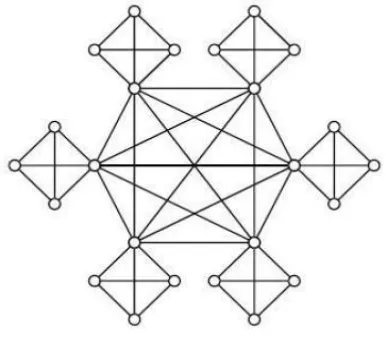
Here we shall consider the roots of Hosoya polynomial of another specific graph. Consider the graph Km and m copies of K . The graph n Q(m,n) is obtained by
identifying each vertex of Km with a vertex of a unique K (see [6]). We have shown the n
graph Q(6,4) in Figure 3.
Figure 3. Q(6,4).
3 2 2
2 m(m 1)(n 1) x
2 1 x 1) n 1)( m ( m x 1) n n m ( m 2 1
The following theorem is about roots of Hosoya polynomial of Q(m,n):
Theorem 11 . All non-zero roots of H(Q(m,n),x) are complex.
Proof. By Theorem 10 we have the following equation:
0. = 1) n n m ( x 1) n 1)( m 2( x 1) n 1)( m
( 2 2 2
It is easy to see that =4n(n1)3(m1), where is the discriminant of the quadratic
equation. Since m,nN, we have <0. Therefore we have the result. ■
We have seen that there are graphs whose their nonzero roots of Hosoya polynomial are complex. We think that the following problem has worth to consider:
Problem. Characterize graphs whose nonzero roots of their Hosoya polynomial have are complex.
A
CKNOWLEDGEMENTThe authors would like to express their gratitude to the referee for her/his careful reading and helpful comments.
R
EFERENCES1. S. Akbari, S. Alikhani, M. R. Oboudi and Y.H. Peng, On the zeros of domination polynomial of a graph, Contemporary Mathematics, American Mathematical Society, 531 (2010) 109115.
2. S. Alikhani, Y.H. Peng, Independence roots and independence fractals of certain graphs, J. Appl. Math. Computing, vol. 36, no. 1-2 (2011) 89100.
3. C. Eslahchi, S. Alikhani, M.H. Akhbari, Hosoya polynomial of an infinite family of dendrimer nanostar, Iran. J. Math. Chem. Vol. 2, No. 1 (2011) 7179.
4. J. I. Brown, C.A. Hickman, R.J. Nowakowski, On the location of roots of independence polynomials. J. Algebr. Comb. 19 (2004) 273–282.
5. J. Brown and J. Tufts, On the roots of domination polynomials, Graphs Combin., (2013) DOI 10.1007/s00373-013-1306-z.
subgraphs, arXiv:1212.3179v1 [math.CO].
7. E. Estrada, O. Ivanciuc, I. Gutman, A. Gutierrez, L. Rodrguez, Extended Wiener Indices. A New Set of Descriptors for Quantitative Structure-Property Studies, New J. Chem., 22 (1998) 819823.
8. I. Gutman, S. Klavzar, M. Petkovsek, P. Zigert, On Hosoya polynomials of benzenoid graphs, MATCH Commun. Math. Comput. Chem., 43 (2001) pp. 4966. 9. I. Gutman, Y. Zhang, M. Dehmer, A.Ilic, Altenburg, Wiener, and Hosoya
Polynomials, preprint.
10.H. Hosoya, On some counting polynomials in chemistry, Discrete Appl. Math., 19
(1988) pp. 239257.
11.H. Hosoya, A Newly Proposed Quantity Characterizing the Topological Nature of Structural Isomers of Saturated Hydrocarbons, Bull. Chem. Soc. Japan 44 (1971) 23322339.
12.B. Jackson, Zeros of chromatic and ow polynomials of graphs, J. Geometry 76
(2003) 95109.
13.S. Kakeya, On the limits of the roots of an algebraic equation with positive coefficients. Tôhoku Math. J., 2 (1912) 140–142.
14.V.V. Prasolov, Polynomials, Springer- Verlag Berlin Heidelberg, (2004).
15.D. Stevanović, Hosoya polynomial of composite graphs, Discrete Math. 235 (2001) 237244.
16.S. Xu and H. Zhang, Hosoya polynomials of TUC4C8(S) nanotubes, J. Math.
Chem., 45 (2009) 488–502.