© 2013. N.T. Renukadevi & Dr. P. Thangaraj. This is a research/review paper, distributed under the terms of the Creative Commons Attribution-Noncommercial 3.0 Unported License http://creativecommons.org/licenses/by-nc/3.0/), permitting all non-commercial use,
Global Journal of Computer Science and Technology
Graphics & Vision
Volume 13 Issue 4 Version 1.0 Year 2013
Type: Double Blind Peer Reviewed International Research Journal Publisher: Global Journals Inc. (USA)
Online ISSN: 0975-4172 & Print ISSN: 0975-4350
Performance Evaluation of SVM – RBF Kernel for Medical Image
Classification
By N.T. Renukadevi & Dr. P. Thangaraj
Bannari Amman Institute of Technology, Tamilnadu
Abstract -
An approach for automatic classification of computed tomography (CT) medical images is
presented in this paper. A vast amount of CT images are produced in modern hospitals due to
advances of multi-slice Computed Tomography (CT) Scan which handles up to 64 slices per scan.
So, an input image based automatic medical image retrieval system is now a necessity. In this paper,
Coiflet wavelets are used to extract feature from the CT images. The extracted features are then
classified using Support Vector Machine (SVM) with Radial Basis Function (RBF). The performance of
SVM for varying parameters is investigated.
Keywords :
content based image retrieval (CBIR), computed tomography (CT), coiflet wavelets,
support vector machine (SVM), radial basis function (RBF).
GJCST-F Classification:
I.5.m
Performance Evaluation of SVM RBF Kernel for Medical Image Classification
Performance Evaluation of SVM – RBF Kernel for
Medical Image Classification
N.T. Renukadevi α & Dr. P. Thangarajσ
Abstract - An approach for automatic classification of computed tomography (CT) medical images is presented in this paper. A vast amount of CT images are produced in modern hospitals due to advances of multi-slice Computed Tomography (CT) Scan which handles up to 64 slices per scan. So, an input image based automatic medical image retrieval system is now a necessity. In this paper, Coiflet wavelets are used to extract feature from the CT images. The extracted features are then classified using Support Vector Machine (SVM) with Radial Basis Function (RBF). The performance of SVM for varying parameters is investigated.
Keywords : content based image retrieval (CBIR), computed tomography (CT), coiflet wavelets, support vector machine (SVM), radial basis function (RBF).
I.
I
ntroductionith the technological in advances of digital imaging, large collections of medical images are generated and stored in the medical databases. X-ray, CT, MRI, PET, ultrasound images are a major source of anatomical and functional information needed for diagnosis, research and teaching. The need to search data collections efficiently requires good image retrieval systems [1]. The Content Based Image Retrieval (CBIR) motivated by rapid growth of digital image databases requires efficient search schemes. Rather than describing an image by text, an image query is described using one or more example images in such systems. Low level visual features such as color, texture, shape, etc., are automatically extracted to represent images.
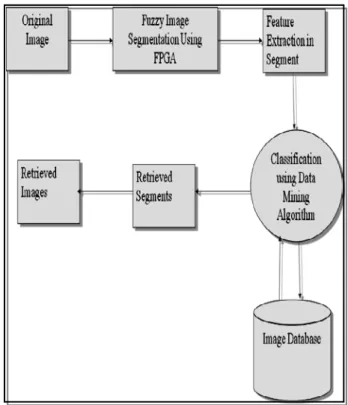
Initial image retrieval was similar to text retrieval with images being annotated manually by keywords [2, 3] involving manual labor and inconsistency [4]. CBIR overcame these difficulties through the use of automatically extracting feature from images thereby ensuring that image retrieval from databases using features like color, texture, shape was possible. Image retrieval is part of image processing and the latter includes image enhancement, compression and interpretation. Figure 1 shows image retrieval block diagram. Various CBIR methods using low level image features like histogram, color layout, texture and image
analysis in the frequency domain including Fast Fourier Transform (FFT) and Wavelets [5-7] were proposed. Similarly classification algorithms like Naïve Bayes classifier, Support Vector Machine, Decision tree induction algorithms and Neural Network based classifiers were also studied extensively.
Future medical information systems will play important roles in clinical decision making providing similar pathological conditions in a medical image thereby helping physicians view significant images for improved decisions. CBIR effectively retrieves images from databases based on query input that can be either an anatomical region or pathological image. In this work it is proposed to investigate medical images obtained through Computer Tomography (CT).
Figure 1 : Block diagram for image retrieval process Computerized tomography uses X-rays and a computer to create detailed body image. CT scan images are called tomograms having more detail than standard X-rays. A CT scan produces images of structures within the body like internal organs, blood vessels, bones and tumours [8]. The various types of CT scans that help investigate particular body areas include:
W
Global Journal of Computer Science and Technology Volume XIII Issue IV Version I
15 (DDDDDDDD ) Year 013 2 F
Author α: Assistant Professor, Dept. of Computer Technology Kongu
Engineering College Perundurai, Erode, Tamilnadu. E-mail : [email protected]
Author σ : Professor, Dept. of CSE, Bannari Amman Institute of
• Head scans, which can check for suspected brain tumours and arterial bleeding/swelling; head scans also investigate the brain after a stroke (when blood supply to a part of the brain is cut).
• Abdominal scans can detect tumours and diagnose conditions causing internal organs like liver, kidneys, pancreas, intestines or lungs, to become enlarged or inflamed.
• Vascular scans assess conditions affecting blood flow to various parts of the body. Bone scans assess bone injuries and disease, especially the spine.
In this paper, CBIR to retrieve diagnostic cases similar to the query medical image is investigated. Features are extracted from the medical images using Coiflet wavelets and classification accuracy of retrieval is evaluated using Naïve Bayes and Support Vector Machine. The rest of the paper is organized as follows: Section 2 reviews some the studies available in the literature. Section 3 details the methodology, section 4 reports the results and section 5 concludes the paper.
II.
R
elatedW
orksLiu, et al., [9] developed a novel texture feature, based on Support Vector Machines (SVM) termed texture correlogram and useful for high-level image classification. To solve binary classification drawbacks initially, SVM classifier frame is used. A novel technique was developed using a hierarchical structure to deal with the training data set’s multiple classes. Texture correlogram is framed to attain spatial distribution information. The proposed classification and texture features are more efficient/ effective than the other existing methods for high level classification. The proposed method achieves improved classification accuracy and an additional benefit is SVM classification tree’s hierarchical structure reveals interclass relationships. This can be used to explore relationships among high-level concepts further.
Gosselin, et al., [10] compared classification tasks of two organizers. One-class and two-class SVM are used to discriminate data in the firstmethod and in the second method classes are modelled on the basis of Gaussian Mixture. As user searched categories are not structured, better CBIR context adaptation is discriminative to classifiers like SVM. An adaptation is proposed concerning the specifics of CBIR classification. Experiments were performed on a common database. Application of algorithm kernel tuned specific database feature vectors easily. Kernel-based techniques are preferred due to EM complexity and each techniques benefits/limitations are discussed.
Mueen, et al., [11] proposed a novel image classification technique using multi-level image features and progressive machine learning technique, SVM. In medical image classification existing methods unite
various local or global features used separately. In the proposed method, three levels of global features (different medical images of chest, hand x-ray images with the difference in their structure and gray scale contrast), local (to differentiate between various organs and body parts requires regional features) and pixel (providing excellent classification results in the medical domain) are obtained and united in a big feature vector. Experiments were undertaken to validate its efficiency. The proposed method’s recognition rate combining feature vector is 89%. Principal Component Analysis (PCA) decreased the large dimensional feature vector. The proposed method was also compared with two classifiers K-Nearest Neighbour (K-NN) and SVM performance.
Li, et al., [12] suggested a novel machine learning method called multi-training SVM (MTSVM). Relevance feedback (RF) based on support vector machines (SVMs) are used widely in CBIR. However, a deprived performance of SVM-based RF scheme is seen as the number of labelled feedback samples is little. This occurrence is due to 1) small-size training sets possess optimal hyper plane perceptive to training exemplars causing instability in SVM classifier; and 2) as feature dimension is bigger than the training sample’s size, kernel technique is in-effective. The proposed MTSVM merges advantages of co-training method and a random sampling technique in feature space. The above problems are lessened by the proposed MTSVM method. Experiments were conducted on a 20 000 images set to validate the proposed method. Results reveal that the method improves performance compared to conventional SVM-based RFs in a constant manner regarding standard deviation and precision which are implemented to examine the RF method’s robustness and effectiveness.
Chen, et al., [13] increased CBIR retrieval performance through the use of relevance feedback methods using linear/quadratic estimators. To evaluate sustenance of target images in excessive dimensional feature space involving lower number of training samples is an issue when using relevance feedback. The proposed method is founded upon one-class SVM in nonlinearly transformed feature space suiting a tight hyper-sphere based on the positive exemplars involving main target images. To deal with nonlinearity in the target image allocation neatly, a kernel is used and better generalization ability is supported by SVM’s regularization term. The proposed method is tested both on real-world images and synthesized data for authentication. Promising results are seen in both cases and hence, the proposed method is advantageous to tune parameters like use of the Gaussian and regularisation term potency.
2 Year 013 2 16
Global Journal of Computer Science and Technology Volume XIII Issue IV Version I
(DDDDDDDD
)
F
III.
M
aterials andM
ethodsDaubechies [14] designed Coiflets which are discrete wavelets having scaling functions with vanishing moments. Coiflet wavelets are near symmetric with the wavelet functions have N/3 vanishing moments and N/3-1 scaling functions. The function Ψ has 2N moments equal to 0 and the function φ has 2N-1 moments equal to 0. The support of length of both functions is 6N-1 [15].
The coifN Ψ and φ has more symmetric than the dbNs. Regarding support length, coifN has to be compared to db3N or sym3N. With regard to the number of vanishing moments of Ψ, it is more similar to db2N or sym2N.
If s is a sufficiently regular continuous time signal, for large j the coefficient
,
, j k
sφ is approximated by 2 j/2
( )
2 js k
− −
If s is a polynomial of degree d, d ≤ N - 1, then the approximation becomes equality. This property is useful when calculating the difference between an expansion over the φj k, of a given signal and its
sampled version.
a) Support Vector Machine (SVM)
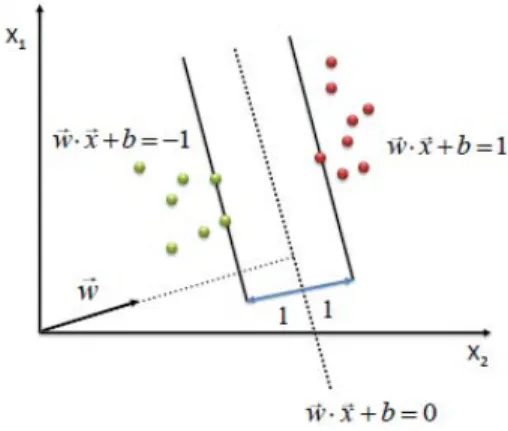
SVM maps features non-linearly into n dimensional feature space when provided with a feature set capable of being represented in space. When a kernel is introduced with high computation in the SV Malgorithm, the inputs are in the form of scalar products; then the classification is achieved by solving as follows. The issue is translated into a convex quadratic optimization problem and a clear answer being attained by convexity [16]. In SVM, an attribute is a predictor variable and a feature is a transformed attribute. A set of features describing an example is in the form of a vector. The features vectors define the hyper plane. Optimal hyper plane is constructed by the SVM with the aim to separating vector clusters with a class of attributes on one side of the plane and with different attributes on the other. The margin represents the distance between hyper plane and support vectors. SVM analysis tries to positions the margin in such a way that space between it and support vectors are maximized. Figure 2 shows a simplified SVM process overview.
Figure 2 : Support vector machine
Given a training set of
(
x yi, i)
, 1,2,....i lwhere ni
x ∈R andy∈ −
{ }
1, 1l, SVM solves the optimizationproblem [17] of: , , 1 1 min 2 l T i w b i w w C ξ +
∑
= ξ Subject to:(
T( )
)
1 i i i y wφ x +b ≥ −ξandξi≥0.The function φ maps the vectors xiin higher dimensional space. C>0 is penalty parameter of the error term.
Lagrangian methodis used to solve the optimization model, which is similar to the method for solving optimization problems in a separable case. The dual variables Lagrangianis maximized as follows:
( )
1 , 1 1 . 2 m m D i i j i j i j i i j Max L y y x x α α =∑
= α −∑
=α α Subject to: 0≤αi ≤C i 1,..,= mand1 0. m i i i y α = =
∑
To compute the optimal hyper plane, a dual LagrangianLD (α) is maximized as regards non-negative
αi subject to constrains 1 0
m
i i
i=αy =
∑
and 0≤αi≤C. The penalty parameter C, now the upper bound on αi, is userdetermined.
A kernel function is defined as
(
,)
( )
T( )
i j i j
K x x =φ x φ x .
The Radial Basis function is given as follows:
(
)
(
2)
, exp , 0
i j i j
K x x = −γ x −x γ>
Proper parameter setting in the kernels increases SVM classification accuracy. There are two
parameters to be determined in the SVM model with the RBF kernel: C and gamma (γ). The gamma parameter automatically defines the distance which a single training example can reach, with low values meaning ‘far’ and high values meaning ‘close’. The C parameter
Global Journal of Computer Science and Technology Volume XIII Issue IV Version I
17 (DDDDDDDD ) Year 013 2 F
gives the trade-off of training examples misclassification against decision surface simplicity. Lower C values ensure a smooth decision surface while higher C values attempts to classify training examples accurately. Experiments are carried out to evaluate SVM performance through variations of the Gamma and C parameters.
IV.
R
esults andD
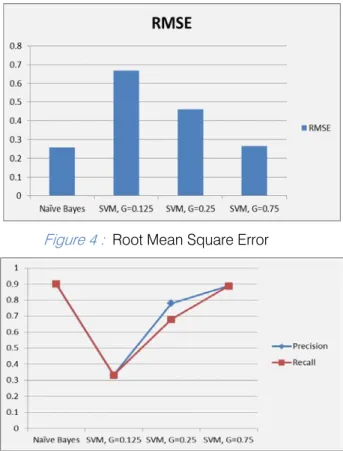
iscussionExperiments were conducted using 150 CT scans images of brain, chest and colon. Features were extracted using Coiflet wavelet. Experiments were for SVM-RBF was conducted with C value maintained at a constant value of 0.125 and Gamma value is varied (0.125, 0.25, and 0.75). All the experiments were conducted for 10-fold cross validation. The classification accuracy and the root mean square error (RMSE) achieved for Naïve Bayes and SVM is tabulated in Table 1. Figure 3 shows the classification accuracy and Figure 4 show the RMSE.
Table 1 : Classification Accuracy and RMSE Classifier Classification Accuracy % RMSE Naïve Bayes 90 0.2582 SVM, G=0.125 33.33 0.6667 SVM, G=0.25 68 0.4619 SVM, G=0.75 88.67 0.265
Figure 3 : Classification Accuracy Table 2 : Precision Recall and F-Measure
Classifier Precision Recall F-Measure
Naïve Bayes 0.9 0.9 0.9
SVM, G=0.125 0.333 0.333 0.299 SVM, G=0.25 0.779 0.68 0.675 SVM, G=0.75 0.887 0.887 0.886
Figure 4 : Root Mean Square Error
Figure 5 : Precision and Recall
It is observed from the Table and Figures that the varying of the parameter Gamma has a significant effect on the classification accuracy and the RMSE. Also, higher value of Gamma leads to efficient performance of the SVM. The best classification accuracy was obtained for Gamma value of 0.75. Though, Naïve Bayes achieves the best classification of 90%. Table 2 tabulates the precision and recall achieved.
V.
C
ONCLUSIONIn this study, a method of classification of CT images is presented. Features were extracted using Coiflet wavelet. Experiments were for SVM-RBF was conducted with C value maintained at a constant value of 0.125 and Gamma value is varied (0.125, 0.25, and 0.75). All the experiments were conducted for 10-fold cross validation. Experimental results show that the varying of the parameter Gamma has a significant effect on the classification accuracy and the RMSE. Also, higher value of Gamma leads to efficient performance of the SVM. The best classification accuracy was obtained for Gamma value of 0.75. Naïve Bayes achieves the best classification of 90%. Further work is required by optimizing the SVM to improve classification accuracy.
R
eferencesR
éférencesR
eferencias1. Müller, H., Michoux, N., Bandon, D., & Geissbuhler, A. (2004). A review of content-based image retrieval
2 Year 013 2 18
Global Journal of Computer Science and Technology Volume XIII Issue IV Version I
(DDDDDDDD
)
F
systems in medical applications-clinical benefits and future directions. International journal of medical informatics, 73(1), 1-24.
2. Zhou, X. S., & Huang, T. S. (2002). Unifying keywords and visual contents in image retrieval. Multimedia, IEEE, 9(2), 23-33.
3. K. Barnard and D. Forsyth, “Learning the Semantics of Words and Pictures,” Proc. Int’l Conf. Computer Vision, vol. 2, IEEE CS Press, Los Alamitos, Calif., 2001, pp. 408-415.
4. Rui, Y., Ortega, M., Huang, T. S., & Mehrotra, S. (1999). Information retrieval beyond the text document. Library Trends, 48(2), 455-474.
5. Gudivada, V. N., & Raghavan, V. V. (1995). Content based image retrieval systems. Computer, 28(9), 18-22.
6. Laaksonen, J., Oja, E., Koskela, M., & Brandt, S. (2000, November). Analyzing low-level visual features using content-based image retrieval. In Proceedings of the 7th International Conference on Neural Information Processing (ICONIP'00), Taejon, Korea (pp. 1333-1338).
7. Yue, J., Li, Z., Liu, L., & Fu, Z. (2011). Content-based image retrieval using color and texture fused features. Mathematical and Computer Modelling, 54(3), 1121-1127.
8. Kalender, W. A. (2011). Computed tomography. Wiley-VCH.
9. S. Liu, H. Yi, L.-T. Chia, and D. Rajan, “Adaptive Hierarchical Multiclass SVM classifier for Texture -based Image Classification,” in Proceedings of
ICME, pp. 1190-1193, 2005.
10. P. Gosselin, M. Najjar, M. Cord, and C. Ambroise. Discriminative classification vsmodeling methods in CBIR. In IEEE Advanced Concepts for Intelligent Vision Systems (ACIVS), Brussel, Belgium, September 2004.
11. A. Mueen, M. Sapian Baba, and R. Zainuddin. Multilevel feature extraction and x-ray image classification. J. Applied Sciences, 7(8):1224 -1229, 2007.
12. Li, J., Allinson, N., Tao, D., and Li, X. 2006. Multitraining support vector machine for image retrieval. IEEE Transactions on Image Processing 15, 11, 3597–3601.
13. Y. Chen, X. Zhou, and T.S. Huang, “One-Class SVM for Learning in Image Retrieval,” Proc. IEEE Int’l Conf. Image Processing, pp. 815-818, 2001.
14. Ingrid Daubechies, Ten Lectures on Wavelets, Society for Industrial and Applied Mathematics, 1992.
15. G. Beylkin, R. Coifman, and V. Rokhlin (1991),Fast wavelet transforms and numerical algorithms, Comm. Pure Appl. Math., 44, pp. 141-183.
16. B. E. Boser, I. Guyon, and V. Vapnik. A training algorithm for optimal margin classifiers. In Proceedings of the Fifth Annual Work shop on
Computational Learning Theory, pages 144-152. ACM Press, 1992.
17. Jrad, N., Congedo, M., Phlypo, R., Rousseau, S., Flamary, R., Yger, F., &Rakotomamonjy, A. (2011). sw-SVM: sensor weighting support vector machines for EEG-based brain–computer interfaces. Journal of neural engineering, 8(5), 056004.
Global Journal of Computer Science and Technology Volume XIII Issue IV Version I
19 (DDDDDDDD ) Year 013 2 F
This page is intentionally left blank
2 Year 013 2 20Global Journal of Computer Science and Technology Volume XIII Issue IV Version I
(DDDDDDDD
)
F
© 2013 Global Journals Inc. (US)