
Volume 2007, Article ID 25409,8pages doi:10.1155/2007/25409
Research Article
View Influence Analysis and Optimization for
Multiview Face Recognition
Won-Sook Lee1and Kyung-Ah Sohn2
1School of Information Technology and Engineering, University of Ottawa, Ottawa, Canada K1N6N5 2Computer Science Department, Carnegie Mellon University, Pittsburgh, PA 15213-3891, USA
Received 1 May 2006; Revised 20 December 2006; Accepted 24 June 2007
Recommended by Christophe Garcia
We present a novel method to recognize a multiview face (i.e., to recognize a face under different views) through optimization of multiple single-view face recognitions. Many current face descriptors show quite satisfactory results to recognize identity of people with given limited view (especially for the frontal view), but the full view of the human head has not yet been recognizable with commercially acceptable accuracy. As there are various single-view recognition techniques already developed for very high success rate, for instance, MPEG-7 advanced face recognizer, we propose a new paradigm to facilitate multiview face recognition, not through a multiview face recognizer, but through multiple single-view recognizers. To retrieve faces in any view from a registered descriptor, we need to give corresponding view information to the descriptor. As the descriptor needs to provide any requested view in 3D space, we refer to it as “3D” information that it needs to contain. Our analysis in various angled views checks the extent of each view influence and it provides a way to recognize a face through optimized integration of single view descriptors covering the view plane of horizontal rotation from−90◦to 90◦and vertical rotation from−30◦to 30◦. The resulting face descriptor based on multiple representative views, which is of compact size, shows reasonable face recognition performance on any view. Hence, our face descriptor contains quite enough 3D information of a person’s face to help for recognition and eventually for search, retrieval, and browsing of photographs, videos, and 3D-facial model databases.
Copyright © 2007 W.-S. Lee and K.-A. Sohn. This is an open access article distributed under the Creative Commons Attribution License, which permits unrestricted use, distribution, and reproduction in any medium, provided the original work is properly cited.
1. INTRODUCTION
Face recognition techniques have started to be used as com-mercial products in the last few years, especially on the frontal images, but with certain constraints such as indoor environment, controlled illumination, and small degree of facial expression as can be seen in many literatures, for ex-ample, in a classic survey paper by Samal and Iyengar [1]. Face recognition is composed of two main steps, registration and retrieval. We register a person’s face in a certain form, and we retrieve the person’s face out of many people’s faces. One problem we want to raise in this paper is what is the op-timized way to determine how many views and which angle we need to register the person to retrieve the person in any angle. As an effort to make more practical systems, various researches have been performed to detect and recognize faces in arbitrary poses or views. However, those approaches using statistical learning methods [2–4] reveal limitation to satisfy practically acceptable recognition performance. Novel view generation using 3D morphable model approach [5] shows
quite reasonable success rate in many different views, but it still depends on the database of 3D generic models to build the linear interpolation of a given person and also it needs high computational costs with very complicated algorithms behind. Recently, 3D face model from direct 3D scanning could be used for face recognition [6–8], but the successful reconstruction is not always guaranteed in real time and the recognition rate is not yet as good as the 2D-image-based face recognition. In addition, the acquisition of the data is not always as easy as images and we still need more robust and stable sensing equipment to get meaningful recognition applications. In short, multiview face recognition has still a lot lower recognition rate compared to single view recogni-tion.
2
−1 −0.5 0.5 1
x −1 −0.5 0
0.5 1 z −1
−0.5 0 0.5 1
y
Region of quasi-0◦ horizontal view
Region of quasi-30◦ horizontal view
View region recognized by the given image v
Figure1: Single view recognition of the view-sphere surface.
(0.3, 0.32)
(0.7, 0.32)
−30◦
−20◦
−10◦
0◦
10◦
20◦
30◦
−90◦ 0◦ 90◦
Figure 2: Eye positions on view mosaic of faces from 108
ren-dered images of 3D facial mesh models. Left eye position keeps (0.7, 0.32) for positive horizontal rotation while right eye position does (0.3, 0.32) for negative horizontal rotation when width and height of the image are considered as 1.0.
descriptor, causes problems to recognize other views. Never-theless, it still allows nearby frontal views recognizable with desirable success rate.
In this paper, we present a novel face descriptor based on multiple single-view recognition, which aims to contain multiview 3D information of a person to help for face recog-nition in any view. In this scenario, we save or register the face descriptor as unique information of each person, and when we have a query face image in arbitrary view, we can identify the person’s identity by comparing the registered descriptors with the one extracted from the query image. To retrieve such 3D information of a face to be recognizable in any view, we propose a method to extend the traditional 2D-image-based face recognition to 3D by combining multiple single views. We take a systematic extension to build 3D information us-ing multiviews and perform optimization of the descriptor in respect of the number and the choice of views to be regis-tered. In the following sections, we first describe the concept of multiview 3D face descriptor, and then show how to op-timize multiple single views to build 3D information using our newly proposed “quasiview” concept, an extended term of quasifrontal, which measures the influence power of a cer-tain view to nearby views. Experimental results then follow.
(a) Five subregion definitions on View (0◦, 0◦)
(b) Two subregion definitions on View (80◦, 0◦)
Figure3: Subregion definition depending on views superimposed
on the center face of our database.
2. MULTIVIEW 3D FACE DESCRIPTOR
The new descriptor we propose is called multiview 3D face descriptor, which is supposed to have sufficient 3D informa-tion of a face by describing the face as a mosaic of many one-views as shown inFigure 1. This multiview 3D face de-scriptor aims to cover any view between horizontal rotation from−90◦ to 90◦ and vertical rotation from−30◦ to 30◦.
We note the range of such horizontal and vertical views as [−90◦· · ·90◦] and [−30◦· · ·30◦], respectively. The
nota-tion of [·] is used to refer the range while (·) used for a posi-tion.
There are a few issues we encounter for the extension of the conventional single view descriptor to multiview version.
(i) DB collection for training/test:there are not yet enough data to be used for research on multiview face recogni-tion. Most face database such as PIE, CMU, and YALE has been built mainly for frontal views even though nonfrontal face images are more usual.
(ii) Multiview face detector:to recognize a person from face images, we first need to detect faces on photographs, which is a rough alignment process.
(iii) View estimator:the view of the facial images should be estimated.
(iv) Face alignment: faces are then aligned in predefined lo-cation.
(v) Feature extraction: we extract features possibly de-pending on views.
(vi) Descriptor optimization:we intend to produce efficient descriptor containing views on horizontal rotation [−90◦· · ·90◦] and vertical rotation [−30◦· · ·30◦].
Normalized face
imagef(x,y)
Subregionkparts
fi(x,y) of the image
Fourier transform
F(u,v) F(u,v) Fj(u,v) Fj(u,v) j=1,. . .,k
x1h xh2 x1j x2j
PCLDA
projectionPh1
PCLDA
projectionPh2
PCLDA
projectionP1j
PCLDA
projectionP2j
Vector normalization
y1h yh2 y1j y2j
LDA projectionP3f LDA projectionP3j
Zh Zi
Quantization Quantization j=1,. . .,k
Holistic Fourier feature jth subregion Fourier feature
Figure4: Feature extraction used for multiview 3D face descriptor.
simple integration ofNuniformly distributed single view de-scriptors. If we register every 10◦apart, that is, if we use ev-ery face image 10◦apart for our descriptor, we have to reg-ister 19×7 views to cover the view space of horizontal ro-tation [−90◦· · ·90◦] and vertical rotation [−30◦· · ·30◦].
Then this very na¨ıve descriptor would result in size 133× sin-gle view descriptor size, which becomes too big to be used in practice. Moreover, we could take advantage of the possibility that some view regions might have larger coverage than oth-ers so that we may need smaller number of views to describe those regions. While the descriptor optimization is one of the important steps for transition from single view to multiview face descriptor, there has not been until now any published result in this direction to the best of our knowledge. Here, we aim to make use of our learning from frontal-view face descriptors that a registered front view can be used to re-trieve nearby frontal views (quasifrontal) with high success rate. Hence, we extend the concept of quasifrontal to qua-siview and introduce some useful terms as follows.
(1) View mosaic. Mosaic of views 10◦apart covering hor-izontal rotation [−X◦· · ·X◦] and vertical rotation
[−Y◦· · ·Y◦]. Here we chooseX=90 andY =30. It
can be visualized as shown inFigure 2. This view mo-saic is corresponding to any view (i.e., 3D) of a per-son wherever the face is at least half. It is used later on to check “quasiview” for each view in the view mosaic.
(2) Quasiview with error rate K. It is an extension of quasifrontal, from the frontal view to general views. For instance, quasiviewVqof a given (registered) view
V with error rateK means that faces on viewVqcan be retrieved using a registered face in viewV with ex-pected error rate less than or equal toK. This will be explored inSection 5
3. LOCALIZATION OF FACES IN MULTIVIEW
To use face images for training or as a query, we need to extract and normalize facial region. According to common practice, positions of two eyes are used for normalization such that the normalized image contains enough informa-tion of the face but excludes unnecessary background. The detailed localization specification is defined as follows.
(1) Size of images: 56×56.
(2) Positions of two eyes in the front view are on (0.3, 0.32) and (0.7, 0.32) when width and height are considered as 1.0. Here (, ) is used for (x,y) coordinates where the numbers are between 0 and 1.
(3) Left eye position of the positive horizontal rotation keeps (0.7, 0.32) while right eye position of the nega-tive rotation does (0.3, 0.32).
(4) Vertical rotation has the same eye positions as the ones on zero vertical rotation images.
Figure 2 summarizes the view mosaic of resulting local-ized images for our view space of horizontal rotation [−90◦· · ·90◦] and vertical rotation [−30◦· · ·30◦].
4. FEATURE EXTRACTION
(0.3, 0.32)
(0.7, 0.32)
0 20 40 60 80 100 120
0 10 20 30 40 50 60 70 80 90
h(degree)
Error rate 0.2
Error rate 0.05
(a) Horizontal rotation
(0.3, 0.32)
(0.7, 0.32)
0 20 40 60 80 100 120
−60 −40 −20 0 20 40 60
v(degree)
Error rate 0.2
Error rate 0.05
(b) Vertical rotation
Figure5: Quasiview sizes with horizontal and vertical rotations. Thex-axis in (a) and (b) represents the degree of horizontal and vertical
rotation, respectively, and they-axis shows the number of neighboring views which could be recognized by registering the view inx-axis when allowed certain error rate (0.02 for blue plot, and 0.05 for red plot).
−30◦
−20◦
−10◦
0◦
10◦
20◦
30◦
−90◦−80◦ −60◦ −40◦ −20◦ 0◦ 20◦ 40◦ 60◦ 80◦ 90◦
Trained view with holistic (5 features) + 5 subregions (5 features) Trained view with holistic (5 features) + 5 subregions (2 features) Trained view with holistic (5 features) + 2 subregions (5 features) Registered
view
Figure6: Views used for training and registration. 13 representative quasiviews are selected and used for training, and hence for registration.
The number of used features (especially, the features for subregions) also varies depending on the view.
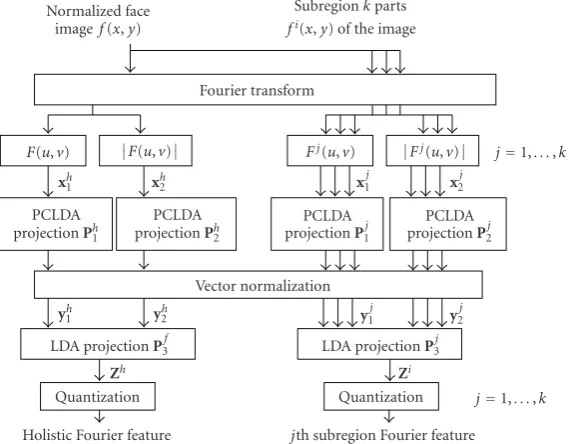
For our experiment, MPEG-7 AFR is modified to adapt to be multiview. AFR basically extracts features both in Fourier space and luminance space. In the Fourier space, features are extracted from the whole face, and luminance space extracts features from both the whole face and five subregions on the face as shown in Figure 3(a). We sim-plify, but also extend, this feature extraction algorithm to ourSubregion-based LDA on Fourier spacefor multiview pur-pose. The biggest differences between the MPEG-7 AFR and our model are (i) feature extraction in luminance space is removed in our model; (ii) the subregion decomposition, which was in luminance space, is now in Fourier space and (iii) the number and positions of subregions are defined de-pending on a given view, for example, for new frontal views, we use the same five subregions as used in AFR, but for near profile view, we only use two subregions as shown in
−80 −60 −40 −20 0 20 40 60 80
(0◦, 0◦)
−40
−30
−20
−10 0 10 20 30 40
(a)
−80 −60 −40 −20 0 20 40 60 80
(60◦, 0◦)
−40
−30
−20
−10 0 10 20 30 40
(b)
−80 −60 −40 −20 0 20 40 60 80
(30◦, 30◦)
−40
−30
−20
−10 0 10 20 30 40
(c)
−80 −60 −40 −20 0 20 40 60 80
(30◦,−30◦)
−40
−30
−20
−10 0 10 20 30 40
(d)
−80 −60 −40 −20 0 20 40 60 80
(80◦, 30◦)
−40
−30
−20
−10 0 10 20 30 40
(e)
−80 −60 −40 −20 0 20 40 60 80
(80◦,−30◦)
−40
−30
−20
−10 0 10 20 30 40
(f)
−80 −60 −40 −20 0 20 40 60 80
(80◦, 0◦)
−40
−30
−20
−10 0 10 20 30 40
(g)
Figure7: Representation of quasiviews. Thex-axis andy-axis indicate the horizontal rotation from−90◦to 90◦and the vertical rotation
from−40◦to 40◦, respectively. Big yellow spots represent the registered views and small red spots indicate corresponding quasiviews with error rate 0.05. The rectangles are the view region of interest in horizontal rotation [0◦· · ·90◦] and vertical rotation [−30◦· · ·30◦].
5. QUASIVIEW
Graham and Allinson [13] have calculated the distance be-tween faces of different people over pose to predict the pose dependency of a recognition system. Using the average Eu-clidean distance between the people in the database over the pose angles sampled, they predicted that faces should be
0 10 20 30 40 50 60 70 80 90 Horizontal rotation
−30
−20
−10 0 10 20 30
Ve
rt
ic
al
ro
ta
ti
o
n
Figure 8: The region covered by 7 quasiviews in the view
mosaic of horizontal rotation [0◦· · ·90◦] and vertical rotation
[−30◦· · ·30◦] with error rate 0.05. Registration with 7 views covers 93.93% of the view space, which means that we can retrieve faces in any view represented in this plot from the registered descriptor within allowed error rate 0.05.
Note that they have checked only horizontal rotation of hu-man heads.
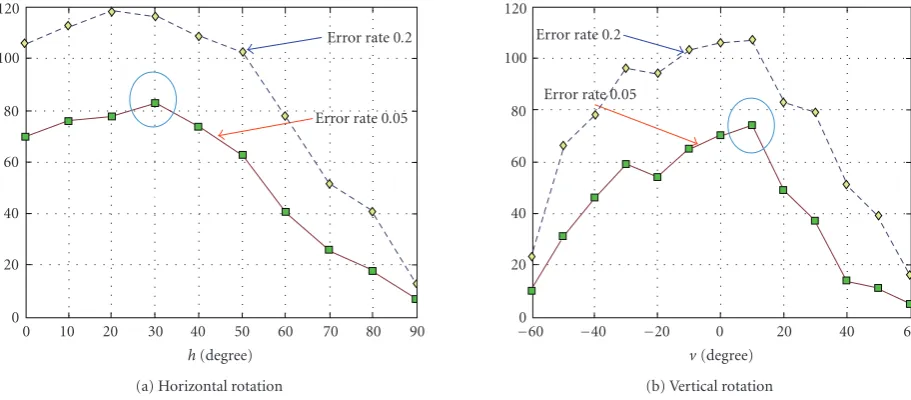
We use the new concept of “quasiview” corresponding to the conventional “quasifrontal,” which is a measurement of the influence of a registered view for recognition. To prove that quasiview size depends on the view, we performed ex-periments of quasiview inspection with accepted error rate 0.05, that is, we inspect the range of views that would be rec-ognizable within error rate 0.05 given a view for registration.
Figure 5shows how the quasiview size varies with pure hori-zontal or vertical rotations of a head. To make fair compari-son between different views, we extracted 24 holistic features (without using subregion features) for each view. And im-ages of nearby views are also included in the training of cer-tain view (i.e., in obcer-taining the PCLDA basis for each view). So for horizontal rotation, 9 views (the view of interest +8 nearby views) are used for training each view from (0◦, 0◦) to (70◦, 0◦), 8 training views for the view (80◦, 0◦), and 7 train-ing views for the view (90◦, 0◦). For vertical rotation, 9 train-ing views are used for each view from (0◦,−40◦) to (0◦, 40◦),
8 training views for the views (0◦,−50◦) and (0◦, 50◦), and 7
training views for the views (0◦,−60◦) and (0◦, 60◦).Figure 5
is obtained before adding neighboring images in training.
Figure 6can be helpful to understand which training views are used for each registered view while it reflects our result after optimization.
Figure 5shows our quasiview measurements with syn-thetically created (rendered) images of 108 3D facial mod-els by rotating them into various angles. We counted the number of nearby views which could be recognized when we registered a certain view using two kinds of accepted error rates 0.02 and 0.05. The result in Figure 5(a) shows very similar pattern with the graph showing the average distance between faces over view described in Graham and Allinson’s paper [13]. The views (20◦, 0◦) ∼ (30◦, 0◦) have both the biggest quasiview size and the biggest Euclidean distance between the people in eigenspace among views
Figure 9: An example of registration. The views are needed in
the registration step to recognize a face in the 93.93% of the view space where horizontal rotation [0◦· · ·90◦], vertical rotation [−30◦· · ·30◦], and their combined rotation of a head are allowed.
It means that we can retrieve a face in various poses within allowed error rate 0.05 when we register only 7 views in a condition that a given face is symmetric.
(0◦, 0◦), (10◦, 0◦),. . ., and (90◦, 0◦). Figure 5(b)shows that the views (0◦, 0◦)∼(0◦, 10◦) have the biggest quasiview size among views (0◦,−60◦), (0◦,−60◦),. . ., and (0◦, 60◦). The
views of heading downward have bigger quasiview size than ones of heading upward and it makes us guess that it might be easier to recognize people when they look downward more than they look upward.
6. DESCRIPTOR OPTIMIZATION
Based on our study to check the quasiview size on horizontal and vertical rotated heads, we now optimize the multiview 3D face descriptor by choosing several representative views and recording the corresponding view specific features to-gether. We have used the following selection criteria for reg-istration views: we register views (i) with bigger quasiview size for cost effect; (ii) which appear a lot in practice through target environment analysis, for example, ATM, door access control; (iii) considering efficient integration of quasiviews covering the big region in view-mosaic; (iv) and which are easy to register or easy to obtain. This choice is empirical and we focus on covering the bigger range of face views with more efficient face view registration. Remembering that our features are extracted from PCLDA projections, we can select the dimension of resulting features as we want. Hence, we can also use variable feature numbers depending on the view. If a view is easy to obtain for registration, but not so frequently appear in practice, then we can use a smaller number of fea-tures. More important views get bigger feature numbers.
In generating descriptors, training is considered as a step to create space basis and matrix transform for feature extrac-tion and as menextrac-tioned inSection 5, many views are trained for one registered view to increase the retrieval ability and reliability. If we can embed more information in the step of training, the registration can be done with smaller informa-tion. For example, for the registered view (30◦, 0◦), we use 9 surrounding views (10◦, 0◦), (20◦, 0◦), (30◦, 0◦), (40◦, 0◦), (50◦, 0◦), (30◦,−20◦), (30◦,−10◦), (30◦, 10◦), (30◦, 20◦) for
for 5 subregions are extracted producing 15 dimensional vec-tor. If a view is close to profile, we use 5 holistic features and 5 features for 2. For details for our experiment, see Figures3
and6. For one view, one image is selected.
In the experiment for multiview descriptor optimization with rendered images from 3D facial models of 108 indi-viduals, half of the images were used for training and the other half were used for test. We show some examples of quasiview inFigure 7which shows the influence of each rep-resented view. Big yellow spots are the views for registra-tion and small red spots indicate corresponding quasiviews with allowed error rate 0.05. Therefore, the region covered by small spots surrounding a big spot indicates the influence of the registered view (the big spot). For example, when we register the very front view (the left most one in the middle row inFigure 7), the horizontally 30◦-rotated and vertically 20◦-rotated views also could be recognized with error rate 0.05.
Through experiments with various combinations of qua-siviews, a set of optimal views could be selected to create final multiview 3D descriptor. An example of such possible descriptor from the rendered images contains 13 views with 240-dimensional feature vector as shown inFigure 6. With the allowed error rate 0.05, this descriptor was able to retrieve the rendered images in the test database from 93.93% of the views in view mosaic of horizontal rotation [−90◦· · ·90◦]
and vertical rotation [−30◦· · ·30◦].Figure 8shows the
cov-ered region of the views by the selected 7 views (right half of the view space which corresponds to positive horizontal ro-tation) considering the symmetry of the horizontal rotation.
Figure 9shows an example which face views are needed for registration to recognize the face in almost any pose. The 7 views are to be registered to recognize a face in the 93.93% of the view space where horizontal rotation [0◦· · ·90◦], verti-cal rotation [−30◦· · ·30◦], and their combined rotation of
a head are allowed. It means that we can retrieve a face in various poses within allowed error rate 0.05 when we reg-ister only 7 views in a condition that a given face is sym-metric. For a reference, when we allowed error rate of 0.1, it covers 95.36% of the view space, 97.57% for error rate 0.15, and 97.98% for error rate 0.2. For the experiment, the test-ing views are situated at intervals 5 degrees while a 10-degree interval is used for training.
As a reference, the MPEG-7 AFR [9,10] has 48 dimen-sions with error rate 0.3013 and 128 dimendimen-sions with ror rate 0.2491 for photograph images. Here we used the er-ror rate of ANMRR (average normalized modified retrieval rank), the MPEG-7 retrieval metric, which indicates how many of the correct images are retrieved as well as how highly they are ranked among the retrieved ones. Details about AN-MRR can be found in MPEG related documents like [14].
7. CONCLUSION
We have shown how the single-view face descriptor could be extended to multiview one in efficient way by checking the size of quasiview, which is a measure of the view influence. For the experiment, the 3D facial mesh models of 108 sub-jects are used and their rendered images are used for training
and test with 50/50 ratio. Only 13 views could be chosen as registered views throughout our optimization. This descrip-tor in 240 dimensions is able to retrieve images of 93.93% views of total region of view mosaic of horizontal rotation from −90◦ to 90◦ and vertical rotation from −30◦ to 30◦
within error rate 0.05.
The aim of this new descriptor is to be used to extract a face in any view by containing compact 3D information by optimization for how many and which views are to be regis-tered. The extension to multiview is not very costly in terms of number of registration views thanks to the quasiview anal-ysis. Even though we have used a specific face descriptor for the experiment, the potential of this method enables us to include any available 2D face recognition methods by show-ing how to combine them in optimized way by checkshow-ing qua-siview size. Ongoing research includes new feature extraction methods for profile views and missing view interpolation in the registration step.
REFERENCES
[1] A. Samal and P. A. Iyengar, “Automatic recognition and anal-ysis of human faces and facial expressions: a survey,”Pattern Recognition, vol. 25, no. 1, pp. 65–77, 1992.
[2] S. Z. Li, L. Zhu, Z. Q. Zhang, A. Blake, H. J. Zhang, and H. Shum, “Statistical learning of multi-view face detection,” in
Proceedings of the 7th European Conference on Computer Vision (ECCV ’02), vol. 4, pp. 67–81, Copenhagen, Denmark, May 2002.
[3] Y. Li, S. Gong, and H. Liddell, “Support vector regression and classification based multi-view facedetection and recognition,” inProceedings of the 4th IEEE International Conference on Au-tomatic Face and Gesture Recognition, pp. 300–305, Grenoble, France, March 2000.
[4] G. Shakhnarovich, L. Lee, and T. Darrell, “Integrated face and gait recognition from multiple views,” inProceedings of the IEEE Computer Society Conference on Computer Vision and Pattern Recognition (CVPR ’01), vol. 1, pp. 439–446, Kauai, Hawaii, USA, December 2001.
[5] V. Blanz and T. Vetter, “Face recognition based on fitting a 3D morphable model,”IEEE Transactions on Pattern Analysis and Machine Intelligence, vol. 25, no. 9, pp. 1063–1074, 2003. [6] A. M. Bronstein, M. M. Bronstein, and R. Kimmel,
“Expression-invariant 3D face recognition,” inProceedings of the 4th International Conference on Audio- and Video-Based Biometric Person Authentication (AVBPA ’03), vol. 2688 of Lec-ture Notes in Computer Science, pp. 62–69, Guildford, UK, June 2003.
[7] D. M. Gavrila and L. S. Davis, “3-D model-based tracking of humans in action: a multi-view approach,” inProceedings of the IEEE Computer Society Conference on Computer Vision and Pattern Recognition (CVPR ’96), pp. 73–80, San Francisco, Calif, USA, June 1996.
[8] K. W. Bowyer, K. Chang, and P. Flynn, “A survey of approaches and challenges in 3D and multi-modal 3D + 2D face recog-nition,”Computer Vision and Image Understanding, vol. 101, no. 1, pp. 1–15, 2006.
[9] A. Yamada and L. Cieplinski, “MPEG-7 Visual part of eXper-imentation Model Version 17.1,” ISO/IEC JTC1/SC29/WG11 M9502, Pattaya, Thailand, March 2003.
ISO/IEC JTC1/SC29/WG11 M9178, Awaji, Japan, December 2002.
[11] W.-S. Lee and K.-A. Sohn, “Face recognition using computer-generated database,” inProceedings of Computer Graphics In-ternational (CGI ’04), pp. 561–568, IEEE Computer Society Press, Crete, Greece, June 2004.
[12] W.-S. Lee and K.-A. Sohn, “Database construction & recogni-tion for multi-view face,” inProceedings of the 6th IEEE Inter-national Conference on Automatic Face and Gesture Recognition (FGR ’04), pp. 350–355, IEEE Computer Society Press, Seoul, Korea, May 2004.
[13] D. B. Graham and N. M. Allinson, “Characterizing virtual eigensignatures for general purpose face recognition,” inFace Recognition: From Theory to Applications, H. Wechsler, P. J. Phillips, V. Bruce, F. Fogelman-Soulie, and T. S. Huang, Eds., pp. 446–456, Springer, Berlin, Germany, 1998.
![Figure 9: An example of registration. The views are needed in[It means that we can retrieve a face in various poses within allowederror rate 0.05 when we register only 7 views in a condition that athe registration step to recognize a face in the 93.93% of theview space where horizontal rotation [0◦ · · ·90◦], vertical rotation−30◦ · · ·30◦], and their combined rotation of a head are allowed.given face is symmetric.](https://thumb-us.123doks.com/thumbv2/123dok_us/890061.1586428/6.600.58.288.70.226/registration-allowederror-condition-registration-recognize-horizontal-combined-symmetric.webp)
