R E S E A R C H
Open Access
Adaptive visual target tracking algorithm
based on classified-patch kernel particle
filter
Guangnan Zhang
1,2,3, Jinlong Yang
3*, Weixing Wang
1, Yu Hen Hu
4and Jianjun Liu
3Abstract
We propose a high-performance visual target tracking (VTT) algorithm based on classified-patch kernel particle filter (CKPF). Novel features of this VTT algorithm include sparse representations of the target template using the label-consistent K-singular value decomposition (LC-KSVD) algorithm; Gaussian kernel density particle filter to facilitate candidate template generation and likelihood matching score evaluation; and an occlusion detection method using sparse coefficient histogram (ASCH). Experimental results validate superior performance of the proposed tracking algorithm over state-of-the-art visual target tracking algorithms in scenarios that include occlusion, background clutter, illumination change, target rotation, and scale changes.
Keywords:Visual target tracking, K-singular value decomposition, Sparse coding, Dictionary learning, Particle filter
1 Introduction
Visual target tracking (VTT) [1–15] is a key enabling technology for numerous emerging computer vision applications including video surveillance, navigation, human-computer interactions, augmented reality, higher level scene understanding, and action recognition among many others. It is a challenging task because the visual observations often suffer from interference due to occlu-sion, scale and shape variation, illumination variation, background clutter, and related factors.
VTT differs from conventional tracking task in that the observation at each time instant is a video frame and the motion trajectory is confined to the spatial coordi-nates in each frame. On the other hand, like the conven-tional tracking, a VTT algorithm is divided into the prediction phase and an update phase. In the prediction phase, a motion model is incorporated to predict the tar-get location based on current estimate. In the updated phase, a maximum likelihood (ML) estimate of the tar-get location is sought based on observations made in the current frame. Then, an updated target position is de-cided based on predicted location and the ML estimated
position. These location predictions and estimations are traditionally realized using sequential Bayesian estima-tion algorithms such as Kalman filters or particle filters.
Based on how the ML estimation of target location is realized, current VTT algorithms may be categorized into two families: discriminative algorithms versus gen-erative algorithms [5]. Discriminative methods detect the presence of a tracked object using a pattern classification approach with the objective to distinguish the fore-ground target from the backfore-ground. For example, the multiple instance learning (MIL) [6] method puts all ambiguous positive and negative samples into bags to learn a discriminative model for visual target tracking. Generative methods detect the tracked object by search-ing for the region most resemblsearch-ing to the target model, based on templates or subspace models. In [7], a robust fragments-based tracking method is proposed to handle partial occlusions or pose changes. Every patch votes on the possible positions and scales of the target in the current frame by comparing the intensity histogram against the corresponding histogram of each image patch. However, a static appearance model of the target cannot adapt to rapid appearance changes of the target. Incremental learning visual tracking (IVT) algorithm [8] handles the problem of changing target appearance. In the template update process, a forgetting factor is * Correspondence:[email protected]
3School of Internet of Things Engineering, Jiangnan University, Wuxi 214122, China
Full list of author information is available at the end of the article
introduced to ensure that less modeling power is wasted fitting older observations. Visual tracking decomposition (VTD) algorithm [9] is proposed to handle the appear-ance and motion changes of the target occur at the same time. In the tracking process, the observation model is decomposed into multiple basic observation models that can cover different specific target appearances. The motion model is also represented by combining mul-tiple basic models that cover different motion types. Then two types of basic models are used to construct the multiple basic trackers to handle a certain change of a target.
Tracking algorithms based on the sparse model have attracted great interests lately. Mei et al. [10,11] formu-lated visual target tracking as a sparse approximation problem in the particle filtering (PF) framework [12,13]. Using a dictionary of image patches, the target template can be represented as a weighted linear combination of very few (hence sparse representation) image templates in the dictionary. The sparse representation can be esti-mated by solving an l1-norm regularized least squares
(LS) problem. In [14], a real-time robust l1 tracker is
proposed by adding anl2-norm regularization to the
co-efficients associated with the trivial templates, and an ac-celerated proximal gradient (APG) method is employed to speed up the problem solving. Multi-task tracking (MTT) is proposed [15] as a multi-task sparse learning problem in a PF framework. The particles are modeled as linear combinations of dictionary image templates, and the interdependencies between particles are exploited to improve the tracking performance. In [5], an adaptive structural local sparse appearance model is proposed to locate the target more accurately by consid-ering the spatial information of the target based on an alignment-pooling method. Moreover, the incremental subspace learning and sparse representation are com-bined to update the template, which can adapt to the ap-pearance change of the target with less possibility of drifting. When the target exhibits dramatic appearance changes, a collaborative model is proposed [16] that combines a sparsity-based discriminative classifier and a sparsity-based generative model. With this appearance model, both holistic updates and local representations are considered. Moreover, the latest observations and the original template are used to update the model and adapt to the appearance change while mitigating the drift problem.
Most of the dictionaries based on the sparse represen-tation theory are constructed directly by the samples of the template base or obtained by the clustering method with some constraints. The image templates in the dic-tionary often lack the ability of discrimination. More-over, the templates updated by the same update scheme cannot adapt to the changes of the foreground and the
background of the target. To address these concerns, in this work, we propose an adaptive visual target tracking algorithm based on classified-patch kernel particle filter (CKPF), which has the following advantages:
(a) Classified patches and low-dimensional dictionary are considered in the CKPF. Note that low-dimensional dictionary and classification parameters (CP) are learned by the label-consistent K-SVD (LC-KSVD) [17,18] technique. To the best of our knowledge, this is the first work to extend the LC-KSVD approach to exploit the intrinsic structure among the patches of the visual target. The image patches in the dictionary trained using LC-KSVD will be more discriminative to classify foreground from the background, and the obtained low dictionary can reduce the computational burdens.
(b) The anti-occlusion sparse coefficient histograms (ASCHs) [16] are merged in CKPF to enhance the ability of anti-occlusion. If the reconstructed error of one patch is bigger than the threshold, the patch will be marked as occluded, and the corresponding sparse coefficients were displaced with zero to reduce the negative influence.
(c) Gaussian kernel density (GKD) of the learned patches is considered to make the proposed algorithm more stable. The reason is that the importance of each patch is considered in the structure of candidate template according to the distance close to the center of the template.
(d) An adaptive template update scheme is developed to adapt to the target appearance changes improving the robustness of the tracker. It is because the appearance of the target often changes significantly due to the disturbance of illumination changes, occlusion, rotation, and scale variation. When the target is occluded, the arrived template usually cannot describe the real target effectively. Therefore, the weight of the arrived template should decrease at this time. Otherwise, the weight should increase due to the accurately estimate of the arrived template without other disturbance factors.
template update scheme is proposed to adapt to the tar-get appearance changes.
The remainders of this paper are organized as follows. In Section 2, we summarize the details of the proposed adaptive visual target tracking algorithm based on CKPF. An overview of the LC-KSVD is presented. Meanwhile, adaptive template update scheme is developed and dis-cussed. In Section 3, extensive simulation results com-paring our proposed algorithm against existing visual target trackers are reported and the implications of these results are discussed. Conclusions and future works are presented in Section4.
2 Methods
2.1 Overview of the algorithm
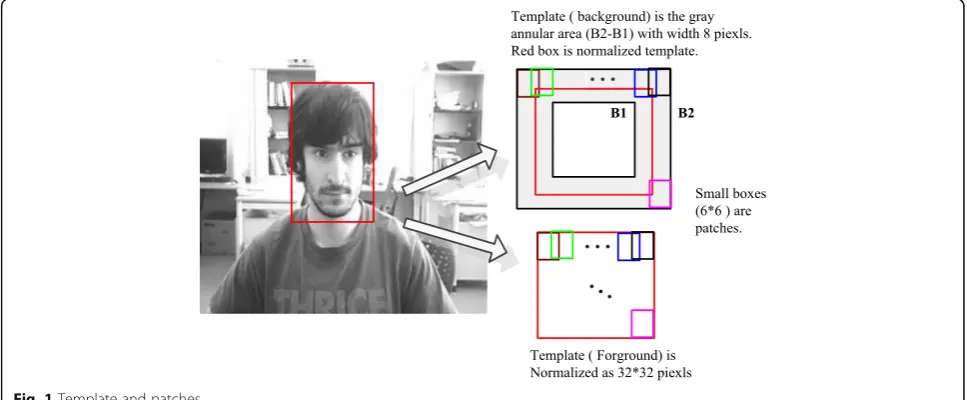
As shown in Fig. 1, the target is represented as a rect-angular template in each frame, and the target template will be scaled to 32 × 32 pixels (big red boxes on the right). Candidate target region will also be scaled at the same ratio before further processing. Pixels within the template are assumed to be positive samples of the tar-get. A 4-pixel wide strip surrounding the template is de-fined as the background whose edges outside and inside of the target template are denoted by B1 and B2, i.e., the gray annular area (B2-B1) with width 8 pixels are the background area. A patch is defined as a 6 × 6 square.
Np= 196 image patches (positive samples) will be ex-tracted from the template (foreground, target), and
Nn= 196 patches will be extracted from the back-ground as negative sample. These extracted image patches are regularly distributed over the foreground or the background regions respectively with overlaps as needed. Together, the positive-labeled patches resent the target and the negative-labeled patches rep-resent the background.
Each patch is raster-scanned and converted into a 36 × 1 vector. Hence, there are 196 vectors labeled with + 1 (positive samples) and 192 vectors labeled with 0 (negative samples). We denote the total number of patchesN= 392. A label-consistent, kernel singular value decomposition (LC-KSVD) algorithm will be applied to both the 196 positive vectors and the 196 negative vec-tors and select a subset of 50 vecvec-tors from each of them to form a labeled dictionary. This dictionary consists of 50 vectors with positive (+ 1) labels and 50 vectors with negative (0) labels. Let K= 100, the dictionary may be represented by a 36 ×KmatrixD. The dictionary will be estimated from the initial frame where the target to be tracked is specified for the tracking algorithm. It will re-main unchanged until template update operation is performed.
The LC-KSVD algorithm also yields a sparse represen-tation of each patch (36 × 1 vector) as a weighted com-bination of the 100 vectors selected in the dictionary. Two constraints are imposed on the potential sparse representations: (a) (discriminative constraint) Sparse vectors corresponding to foreground (or background) patches should have similar representation. This is rep-resented by a discriminative parameter matrixAK×K. (b) (classification constraint) Class labels (+ 1, 0) can be reproduced from weighted linear combination of the sparse representation. This is represented by a 2 ×K
classification parameter matrix W. In addition to the sparse representation of each foreground and back-ground patches, represented by a K×N matrix X, the LC-KSVD algorithm can estimate the dictionary D, the discriminative parameter matrixAand the classification parameter matrixWsimultaneously.
Given the dictionary D and sparse representation of the template X, tracking begins by moving into the next
frame. A kernel particle filter is applied to generate 100 potential target positions at (k+ 1)th frame according to the particle representation of the state transition prob-ability p(xk+ 1|xk) such that E(xk+ 1|xk) =xk where xk = {xk,yk,θk,sk,αk,βk} is the state vector of the target at the kth frame. The assumption is that the target motion may be described by an affine transformation, for ex-ample, (xk,yk) is the target position,θk,sk,αk, and βkare the rotation angle, the scaling factor, the aspect ratio, and the angle of inclination, respectively. We also as-sume p(xk+ 1|xk) has a Gaussian distribution where the covariance matrix is selected based on prior knowledge of the tracking task.
Each particle corresponds to a candidate target template. Then, 196 image patches are extracted, and corresponding sparse representationX’are evaluated using LC-KSVD and the libraryD. A kernel density weighted sparse coefficient similarity score (SCSS) then will be applied to produce an estimate of the likelihood probability between the sparse representation of the templateXand the current template candidate X’. The kernel density weightings place more weight on image patches that are closer to the center of the template and less weight on image patches on peripherals of the template. The location of the best-matched template will be designated as new target position.
Before moving into the next frame, the tracking algo-rithm may also adaptively update the template when oc-clusion of the target is detected. This is accomplished by using a sparse coefficient histogram matrix (SCHM) [16] to estimate the level of occlusion of the target. If so, the algorithm uses the newly estimated template, or a weighted linear combination of the estimated template and an initial template depending on the percentage of patches that are deemed occluded. With the newly updated template, the algorithm moves to the following frame.
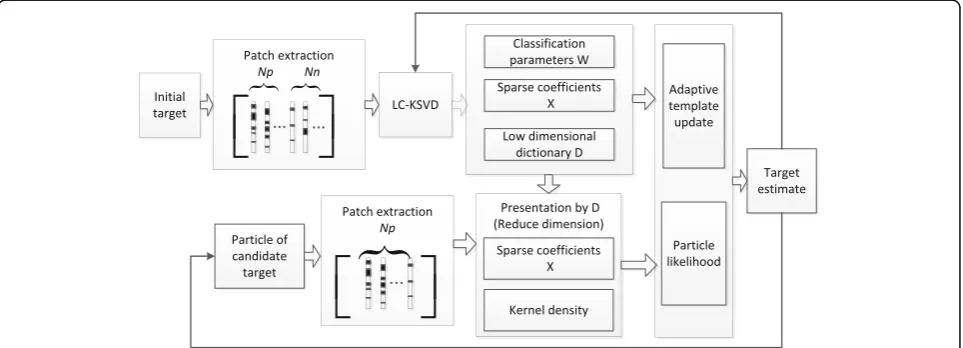
A block diagram summarizing above overview of the pro-posed algorithm is depicted in Fig.2. It has an initialization phase where a low-dimensional label-consistent dictionary Dof image patches will be estimated, and the sparse repre-sentationXas well as classification parametersWof indi-vidual patches are also computed. Next, the kernel density-based particle filter (KPF) algorithm generates can-didate templates in the following frame. For each cancan-didate template, the likelihood score will be evaluated, and the maximum likelihood estimate of the target position will be computed. This is followed by an adaptive template update phase where occlusion of the target is detected.
2.2 Theoretical backgrounds
2.2.1 LC-KSVD
The LC-KSVD dictionary learning algorithm [17, 18] in Fig. 2 can simultaneously train an over-complete low-dimensional dictionary and a linear classifier, i.e., the ob-tained dictionaries have both reconstructive and discrim-inative abilities. The objective function is expressed as
D;W;A;X
h i ¼ arg min D;W;A;X Y
−DX k k2
2þαkQ−AXk 2 2
þβkH−WXk22; s:t: ∀i;k kxi 0≤T0 ð1Þ
where Y ¼ fyigNi¼1∈Rn
N denotes the input sample
set, X= [x1,x2,⋯,xN]∈RK×N denotes the coefficient matrix, D = [d1,d2,⋯,dK]∈Rn×K denotes the low-dimensional dictionary matrix containing K≪N proto-type sample-atoms for columns fdjgKj¼1, andT0denotes
the degree of sparsity. Q∈RK×N denotes the sparse codes with discriminative power ofYfor classification.A
is a linear transformation matrix, which can transform the original sparse codes to be most discriminative in
sparse feature space. kQ−AXk22 denotes the discrim-inative sparse code error, which forces the samples with same class label to have the similar sparse repre-sentations. kH−WXk22 denotes the classification error,
W is the classification parameter matrix, and H is the class label of input samples. α and β are the scalars controlling the relative contribution of the corre-sponding terms [18].
The K-SVD method [19] can be used to obtain the op-timal solutions for all the parameters simultaneously. Specifically, Eq. (1) can be rewritten as
D;W;A;X
h i ¼ arg min
D;W;A;X Yffiffiffi α p Q ffiffiffi β p H 0 @ 1 A− pDffiffiffiffiffiffiαA
β p W 0 @ 1 AX 2 2
; s:t: ∀i;k kxi 0≤T
ð2Þ
Let Ynew ¼ ðYT; ffiffiffi α p
QT;pffiffiffiβHTÞT , D new ¼ ðDT;pffiffiffiαAT;pffiffiffiβWTÞT, then Eq. (2) can be expressed as
Dnew;X
h i¼ arg min Dnew;X
Ynew−DnewX
k k2
2
; s:t: ∀i;k kxi 0≤T
ð3Þ
Then Dnew can be obtained by using the K-SVD
method, i.e., D, A, and W are learned simultaneously. More descriptions about LC-KSVD can refer to [17,18].
In Eq. (1), the learned dictionary can be better used to represent the target due to the constraint terms. The discriminative sparse code error can force the samples with same class to have the similar sparse representa-tions, which can enlarge the difference between classes of training data. Moreover, the classification error can effectively train a classifier to identify the foreground and background of the target.
2.2.2 Sparse coefficient histogram and occlusion detection The patches of the target can be represented by using the obtained low dimensional dictionary D and the sparse coefficient of each patch can be used to construct the histogram matrix. However, some patches in the candidate target may be occluded, and the coefficient histogram cannot express the feature of candidate target accurately. As a result, the target cannot be estimated accurately. Taking this problem into account, the occlu-sion detection strategy [16] is employed according to the reconstruction error of each patch. And then the sparse coefficient histogram can be updated according to the occlusion detection results.
Assume thatξidenotes the sparse coefficient vector of theith patch, we have
min
ξi
yi−Dξi k k2
2þλ ξk ki 1 ð4Þ
The sparse coefficient histogram matrix can be estab-lished by concatenating the sparse coefficient vector ξi, i.e.,ρ¼ ½ξ1;ξ2;…;ξNp. If the target is partially occluded,
then some of the patches of the target are occluded, and their corresponding sparse coefficients will be meaning-less, which makes the sparse coefficient matrix ρunable to express the candidate target well, causing big recon-struction error. Therefore, we introduce an occluded tar-get detective mechanism to identify the occluded patches and their corresponding sparse coefficients.
It is defined that if the reconstructed error of each patch is bigger than the threshold, the patch will be marked as occluded, and then the corresponding sparse coefficient vector is reset to zero. The candidate histo-gram matrix after occlusion detection is defined as φ =ρ⊙o, where ⊙ denotes the element-wise multiplica-tion.o∈RðKpþKnÞNpdenotes the matrix of occluded detec-tion, and oi is the element of the matrixo, and can be defined as:
oi¼ 01;;otherwiseεi<ε0
ð5Þ
where εi¼ kyi−Dtξi tk22 denotes the reconstructed error of theith patch. Note that only the positive patches are used to compute the reconstructed error, therefore Dt denotes the dictionary which only consists of the set of positive patches from the learned dictionary D, ξi_t de-notes the corresponding sparse coefficient vector of Dt, and ε0 denotes the threshold of reconstructed error of
each patch. Ifεi≥ε0, then theith patch be considered as
occluded and the corresponding coefficient vector is set as zero.
2.3 Classified-patch kernel particle filter
Given the observation set of target y1 :k= {y1,y2, …,yk} up to thekth frame, the target state xkcan be extracted via the maximum posterior estimation, i.e., ^xk¼ arg
max
xi k
pðxikjy1:kÞ, where xik denotes the state of the ith
sampled particle of the kth frame. The posterior prob-ability pðxi
kjy1:kÞ can be inferred by the Bayesian
recur-sion, i.e.,
p xikjy1:k
∝p ykjxk
Z
p xð kjxk−1Þp xk−1jy1:k−1
dxk−1
ð6Þ
wherep(yk|xk) denotes the observation model.p(xk|xk−1)
utilized to model the target motion between two consecu-tive frames. The state transition is formulated asp(xk|xk−
1) =N(xk;xk−1,Σ), whereΣis a diagonal covariance matrix
whose elements are the variances of the affine parameters.
The observation model p(yk|xk) denotes the likelihood of the observation yk at state xk. It plays an important role in robust tracking. In this paper, we aim to construct a robust likelihood model having the anti-occlusion ability and foreground target identifica-tion ability by merging the similarity of sparse coefficient histograms [16] and the classification information. Moreover, we consider the spatial information of each patch by using the isotropic Gaussian kernel density, which can keep the stability of the proposed algorithm for visual target tracking.
The likelihood of thelth particle is expressed as
pl¼ XNp
i¼1
k y
l k−ci
h
2
!
Mlk;iLlk;i ð7Þ
whereMlk;iandLlk;idenote the likelihood of classification and the similarity function of the target histograms
be-tween the candidate and the template. kðkylk−ci
h k 2
Þ de-notes the isotropic Gaussian kernel density, where ci denotes the center of the ith patch, and yl
k denotes the center of thelth particle in the kth frame. It means the distance between the patch and the candidate particle is considered, i.e., the patches far away from the center of the target will be assigned smaller weights, which can weaken the disturbance of the patches on the edge of the target.
According to the histogram intersection function [16, 20], the similarity function of the ith patch of the lth particle is defined as
Llk;i¼ X
min φl k;i;ψi
ð8Þ
where φl
k;i and ψ
i denotes the sparse coefficient
histo-grams of the candidate target and the target template, respectively. Template histogram is computed only once for each image sequence. Moreover, the comparison be-tween the candidate and the template should be carried out under the same occlusion condition. Therefore, the template and the ith candidate share the same matrix o of occluded detection.
The likelihood of classification of the ith patch of the
lth particle is defined as
Mlk;i¼ cos∠ Wφlk;i;Γ
ð9Þ
whereφlk;i is the sparse coefficient vector of the candidate patch. Γ denotes the base vector of target classification,
i.e., Γ= [1, 0]T, cos∠ðα;βÞ ¼jααjjββj denotes the bearing of two vectors.
The bigger the number of patches belonging to the candidate particle is, the better the target appearance can be described. Because the selected patches may be from target templates or background templates. There-fore, if the patch belongs to the target, we should give it a bigger weight than that belong to the background.
2.4 Adaptive template update
In the tracking process, the appearance of the target often changes significantly due to the disturbance of illu-mination changes, occlusion, rotation, scale variation, and so on. Therefore, we need to update the template appropriately. However, if the template is updated too frequently by using new observations, the tracking re-sults are easy to drift away from the target due to the accumulation of errors. Especially, when the target is oc-cluded, the latest tracking result cannot describe the real target well, which will cause the later estimated targets to be lost. On the contrary, if tracking with fixed tem-plates, it is prone to fail in dynamic scenes as it does not consider inevitable appearance change.
In this paper, we propose an improved template histo-gram update scheme by combining the histohisto-gram of the first frame and the latest estimated histogram with the variableμ, i.e.,
^
ψn¼ μψ
þð1−μÞ^φn; On<O0
^
ψn‐1; otherwise
ð10Þ
where μ¼e‐ð1‐OnO0Þ denotes the weighting parameter,
which can adaptively adjust the update template to adapt to the change of the target appearance. ψ^n denotes the update template histogram, ψ and φ^n denote the tem-plate histogram of the first frame and the latest estimate, respectively. On¼#Patch#Patchocc denotes the occlusion degree of the current tracking results. #Patchocc and #Patch denote the number of the occluded patches and the total patches. O0 is a threshold of the degree of occlusion.
Moreover, to avoid frequent template update, we detect the occluded state every five frames, i.e., we update the template every five frames.
may be disturbed by some factors, such as illumination and occlusion, the arrived template may be inaccurate, hence the weight of the template should decrease, while the weight of the first frame template should increase.
3 Experiment results
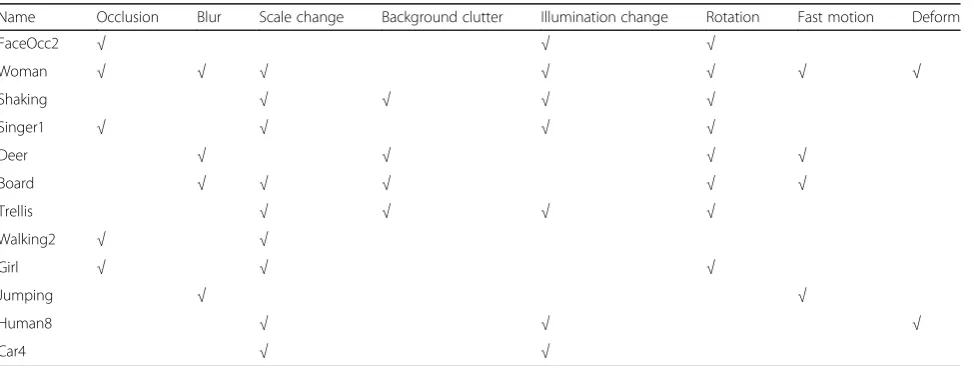
To verify the effectiveness of the proposed algorithm, some challenging sequences from the public dataset of video target tracking [1] (http://cvlab.hanyang.ac.kr/
tracker_benchmark/datasets.html) are used to evaluate
the performance of the proposed algorithm. The main challenging features of the data are described in Table1, including the interference of occlusion, background clut-ter, illumination change, target rotation, scale change, motion blur, etc. The proposed algorithm is compared with eight state-of-the-art benchmark tracking algo-rithms, including multiple instance learning (MIL) [6], compressive tracking (CT) [21], robust fragments-based tracking (FRAG) [7], incremental visual tracking (IVT) [8], visual tracking decomposition (VTD) [9], L1 tracker using accelerated proximal gradient (L1APG) [14], multi-task sparse learning tracking (MTT) [15], and local sparse appearance model and K-selection (LSK) [22]. The experiments are implemented on computer with Intel Core 2.4 GHz, i7-4700HQ processor with 8 GB RAM. The software tool is MATLAB 2014a and the l1 minimization problem is solved with the SPAMS
package [23]. For each sequence, the location of the tar-get is manually labeled in the first frame.
The learned low-dimensional dictionary consists of 50 positive templates and 50 background templates which are from the sampled templates by LC-KSVD dictionary learning. In the framework of PF, 100 candidate particles are sampled according to the same partition patch method, and the most similarity candidate particle is extracted as the estimated target. Set the threshold of the occlusion degree asO0= 0.8 in Eq. (10).
3.1 Qualitative evaluation
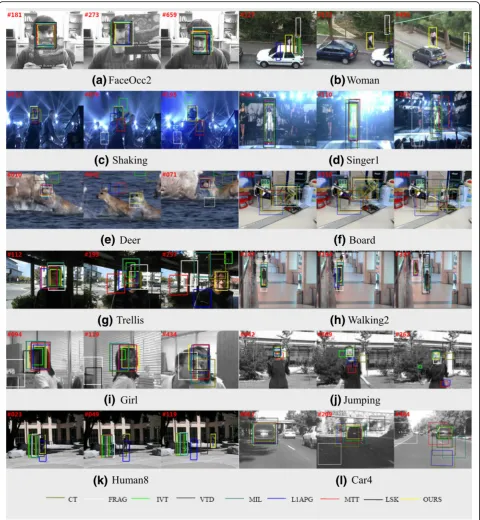
Figure 3 shows the tracking results of different algo-rithms when the target undergoes heavy occlusion, illu-mination variation, background clutter, rotation, scale change, fast motion, and motion blur.
3.1.1 Occlusion and illumination variation
In order to demonstrate the anti-occlusion and anti-illumination-variation performances of the proposed algorithm, some challenging video sequences are used in this experiment. Especially in (a) FaceOcc2 and (b) Woman sequences, the targets are heavily occluded or long-time partial occluded. However, the proposed algo-rithm can extract the targets accurately. The reason is that the local detection strategy for occlusion and illu-mination changes as well as the adaptive template up-date scheme are employed, which can easily describe and detect the variations of the local details of the tar-gets and help to decrease the influence of the distur-bances including occlusion, illumination change, rotation, etc. Moreover, the Gaussian kernel density of the patches is considered in the CKPF, which considers the global information of the local patches, improving the tracking performance. Taking the 181th, 273th, and 659th frames in FaceOcc2 sequences as examples, the target is occluded heavily by the book and the hat; the proposed algorithm has the highest tracking accuracy. In the 127th, 172th, and 495th frames in the Woman sequences, the target is partial occluded by the car and disturbed by the background clutters; some of the benchmark algorithms cannot estimate the target accur-ately with heavily position drift, while the proposed algorithm can successfully track the target throughout the entire sequences.
In (c) Shaking and (d) Singer1 sequences, there exists large illumination variation, and partial scale
Table 1The features of the video sequences
Name Occlusion Blur Scale change Background clutter Illumination change Rotation Fast motion Deform
FaceOcc2 √ √ √
Woman √ √ √ √ √ √ √
Shaking √ √ √ √
Singer1 √ √ √ √
Deer √ √ √ √
Board √ √ √ √ √
Trellis √ √ √ √
Walking2 √ √
Girl √ √ √
Jumping √ √
Human8 √ √ √
change, the benchmark algorithms FRAG, IVT, MTT, and CT cannot extract the target correctly following with heavily drift. LSK and MIL have good estimated results, but the proposed algorithm and the VTD approach have better tracking results. For the VTD algorithm, the observation model is decomposed into multiple basic observation models that can cover
different specific target appearances, which can adapt to the illumination changes; however, it is hard to deal with the scale variation problem of the target while the proposed algorithm can do it adaptively. Therefore, in the Singer1 sequences, its tracking re-sults are worse than those of the proposed algorithm due to the scale variation of the targets.
(a)
(b)
(c)
(d)
(e)
(f)
(g)
(h)
(i)
(j)
(k)
(l)
Fig. 3Tracking results of different algorithms.aFaceOcc2.bWoman.cShaking.dSinger1.eDeerfBoard.gTrellis.hWalking2.iGirl.jJumping.
3.1.2 Background clutter
In the video sequences of (f ) Board, (e) Deer, and (c) Shaking, the targets are disturbed by some background clutters, especially in Board sequences; the background is complex and there exists partial target rotation and fast motion. L1APG, MTT, and IVT cannot extract the target correctly due to the use of the fixed global model, while the proposed algorithm employs the local patch features to describe the details of the target, and the LC-KSVD method is introduced to learn dictionaries and train the classification parameters simultaneously, which can decrease the influence of the background dis-turbance. In the 42th frame of the Deer sequence, there is another deer in the background. Most of the algo-rithms have the results with largely drift due to the clut-ter disturbance. However, the proposed algorithm obtains an accurate result; the reason is that the set of background models is considered simultaneously and ef-fectively updated in the tracking process.
3.1.3 Rotation and scale change
In (i) Girl and (f ) Board sequences, there exists heavily target rotation. In the 94th and 119th frames of the Girl sequences, the girl turns around. It is clear that heavily drift exists in the results obtained by FRAG and LSK, while the proposed algorithm can adapt to the case of target rotation due to the use of the effectively update strategy, which considers the initial target model and the last estimate target model simultaneously. In the 434th frame of the Girl sequences, the face of the girl is oc-cluded by the man and the scale makes a little change during the process of target rotation; the proposed algo-rithm also obtains a good tracking result. From the Board sequences, we can draw the same conclusions, in which the proposed algorithm has a good performance of target tracking under the scenario with target rotation and scale variation.
Moreover, in the Singer1 sequences, it is clear that the scale of the target changes heavily; the proposed algo-rithm can obtain accurate results, because the scale par-ameter skis estimated simultaneously in the implement process of CKPF.
3.1.4 Fast motion and motion blur
In (j) Jumping and (e) Deer sequences, there exists fast motion of the target and motion blur. For the Jumping sequences, L1APG, LSK, and MTT cannot extract the target correctly due to the motion blur, while the pro-posed algorithm has a good tracking result. In the 109th and 262th frames of the Jumping sequence, fast motion and motion blur make some of the benchmark algo-rithms have heavily drift results, while the proposed al-gorithm has good results. The reason is that the background templates are considered to restrain the
influence of the background, and the updated positive template can adapt to the case with motion blur. From the Deer sequences, we can conclude the same conclusions.
3.2 Quantitative evaluation
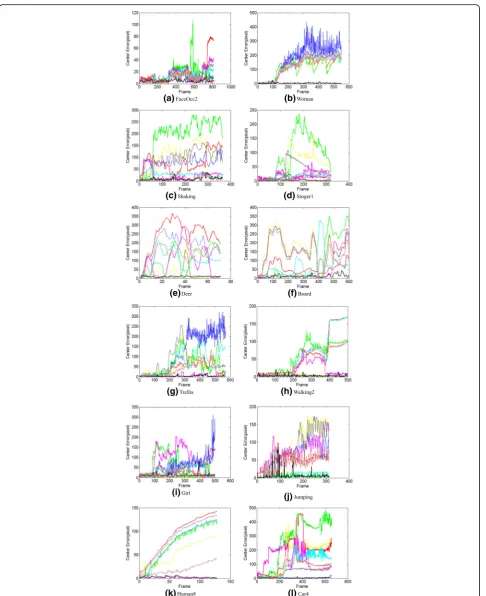
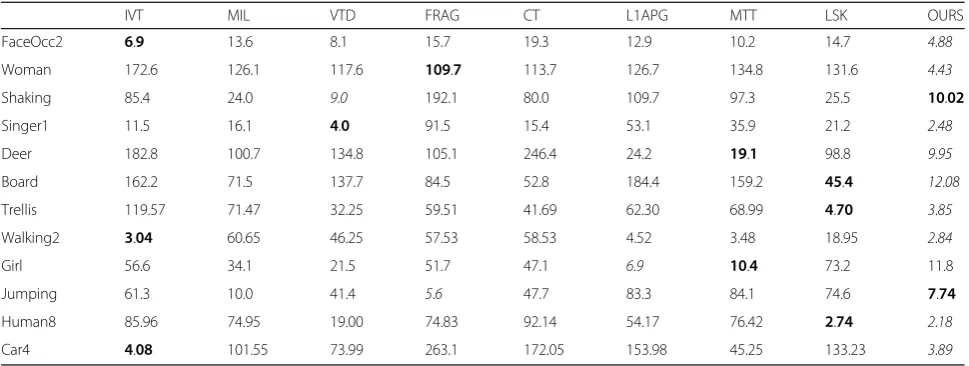
Two evaluation criteria are employed to quantitatively assess the performance of the proposed algorithm. One is average center location error (ACLE), and the other is tracking success rate (SR). Figure 4 shows the relative position error (in pixels) between the center and the tracking results. ACE is defined as the average relative position error. Assume the tracking result isRr, and the
ground truth is Rg, then SR is defined as ϒ= (Rr∪Rg)/
(Rr∪Rg). Tables2and3give values of ACLE and SR for
different tracking algorithms.
As can be seen from Fig. 4, the proposed algorithm has a better performance than those of the benchmark algorithms. The tracking result of each frame is accurate and the curve of the error is stable without high chan-ging. While part of the benchmark algorithms are insta-ble, and have big errors between some frames due to different disturbances.
From Tables2and3, it is clear that the proposed algo-rithm can adapt to most of the video sequences with the best and second best results except the (i) Girl se-quences. The performance of the proposed algorithm can be attributed to the detailed description of the local patches by the LC-KSVD dictionary learning and adap-tive template update scheme. Moreover, the Gaussian kernel density of the patches as the global information is considered in CKPF. The algorithm of VTD can also adapt to the scenarios with illumination change and lightly occlusion (e.g., Shaking and Singer1); the reason is that the appearance change is considered in the target template, but its performance decreases when the rota-tion and the morota-tion blur happen on the targets (e.g., Deer, Board, and Jumping). L1APG has a good perform-ance on the Girl sequence; the reason is that the last tracking result is used directly as the updated template, which can effectively adapt to the Girl sequence with the turn of the girl. However, it cannot extract the target correctly due to the motion blur and illumination vari-ation, such as in (f ) Board, (j) Jumping, (c) Shaking, and (l) Car4 sequences. For the Girl sequences, the tracking result of the proposed algorithm is not the best, but it is only slightly below the L1APG and MTT algorithms.
3.3 Discussion of adaptive parameterμ
(a) (b)
(c) (d)
(e) (f)
(g) (h)
(i)
(k)
(j)
(l)
Fig. 4Position errors (in pixel) between the center and the tracking results.aFaceOcc2.bWoman.cShaking.dSinger1.eDeer.fBoard.gTrellis.
constant values (e.g., 0.1, 0.4, 0.7, and 0.9) of the weight-ing parameterμ of Eq. (10) are compared to those with adaptive parameter value, and these are demonstrated in Table4.
As can be seen that there are different values of ACLEs and SRs by choosing different constant values of μ, and smaller value ofμ(e.g., 0.1) gets higher accuracy for the first 200 frames FaceOcce2 sequences, while big-ger value ofμ(e.g., 0.9) gets higher accuracy for the first 170 frames Woman sequences. The reason is that the variations of the target appearance are small during the 1st frame to 140th frame of FaceOcce2 sequences, and the updated templates mainly rely on the latest tem-plates. But the target appearances are severely occluded between 141st and 190th fames; the updated templates more rely on the template of the first frame. Therefore, it is noted that the differences of the tracking accuracy are small with different values of μ for this sequences.
But for the Woman sequences, the target appearances are slightly disturbed by the background clutters between 36th and 170th frames, and there only exists partial occlusion between 106th and 165th frames. Therefore, most of the updated templates mainly rely on the latest frame templates, and the bigger value ofμgets better results. While for the proposed algorithm with adaptive weight parameter, it is clear that it can obtain an ideal tracking result without manually setting the par-ameter values.
4 Conclusion
In this paper, we present an adaptive visual tracking algo-rithm based on CKPF. The template sets constructed by the local patch features from both foreground and back-ground of the target are used to learn the dictionaries sim-ultaneously. The low-dimensional dictionary and target classification parameters are trained by using the LC-KSVD dictionary learning. To robustly decide the final tracking states, an adaptive template update scheme is de-signed, and the classification information, the target candi-date histogram, and the Gaussian kernel density are merged to form CKPF. The effectiveness of the proposed algorithm is experimentally demonstrated by comparing with 8 state-of-the-art trackers on 12 challenging video se-quences, and experimental results show that the proposed
Table 2Average center location error (in pixel). The best and second best results are shown in italic and bold
IVT MIL VTD FRAG CT L1APG MTT LSK OURS
FaceOcc2 6.9 13.6 8.1 15.7 19.3 12.9 10.2 14.7 4.88
Woman 172.6 126.1 117.6 109.7 113.7 126.7 134.8 131.6 4.43
Shaking 85.4 24.0 9.0 192.1 80.0 109.7 97.3 25.5 10.02
Singer1 11.5 16.1 4.0 91.5 15.4 53.1 35.9 21.2 2.48
Deer 182.8 100.7 134.8 105.1 246.4 24.2 19.1 98.8 9.95
Board 162.2 71.5 137.7 84.5 52.8 184.4 159.2 45.4 12.08
Trellis 119.57 71.47 32.25 59.51 41.69 62.30 68.99 4.70 3.85
Walking2 3.04 60.65 46.25 57.53 58.53 4.52 3.48 18.95 2.84
Girl 56.6 34.1 21.5 51.7 47.1 6.9 10.4 73.2 11.8
Jumping 61.3 10.0 41.4 5.6 47.7 83.3 84.1 74.6 7.74
Human8 85.96 74.95 19.00 74.83 92.14 54.17 76.42 2.74 2.18
Car4 4.08 101.55 73.99 263.1 172.05 153.98 45.25 133.23 3.89
Table 3Success rate. The best and second best results are shown
in italic and bold
IVT MIL VTD FRAG CT L1APG MTT LSK OURS
FaceOcc2 0.73 0.68 0.74 0.66 0.61 0.68 0.75 0.64 0.82
Woman 0.16 0.17 0.16 0.16 0.14 0.17 0.18 0.17 0.74
Shaking 0.03 0.43 0.71 0.08 0.10 0.08 0.04 0.46 0.65
Singer1 0.59 0.39 0.53 0.23 0.38 0.32 0.37 0.37 0.87
Deer 0.03 0.13 0.06 0.17 0.04 0.62 0.62 0.27 0.6
Board 0.15 0.46 0.22 0.55 0.50 0.11 0.16 0.65 0.83
Trellis 0.25 0.25 0.46 0.29 0.34 0.20 0.22 0.66 0.71
Walking2 0.76 0.29 0.33 0.28 0.27 0.78 0.81 0.47 0.75
Girl 0.17 0.40 0.56 0.45 0.31 0.74 0.67 0.31 0.62
Jumping 0.12 0.53 0.13 0.68 0.05 0.15 0.10 0.07 0.66
Human8 0.06 0.12 0.30 0.10 0.04 0.16 0.10 0.69 0.74
Car4 0.88 0.26 0.37 0.19 0.22 0.26 0.45 0.15 0.89
Table 4Discussion of constant and adaptive parameterμ. The
best results are shown in italic
Evaluation criteria
μ
0.1 0.4 0.7 0.9 Adaptive
FaceOcc2 1~200 frames
ACLE 4.48 4.53 4.65 4.81 4.59
SR 0.85 0.85 0.84 0.84 0.84
Woman 1~170 frames
ACLE 15.66 5.80 4.39 4.32 2.87
algorithm has a better tracking performance than some benchmark methods in the scenarios with the interference of occlusion, background clutter, illumination change, tar-get rotation, and scale change. However, the computation cost is high; in the future, we would like to improve the computational efficiency by considering the reverse-low-rank representation scheme [24], and some optimal particle pruning schemes.
Abbreviations
APG:Accelerated proximal gradient; ASCH: Anti-occlusion sparse coefficient histograms; CKPF: Classified-patch kernel particle filter; CP: Classification parameters; CT: Compressive tracking; GKD: Gaussian kernel density; IVT: Incremental learning visual tracking; LC-KSVD: Label-consistent K-singular value decomposition; LS: Least squares; LSK: Local sparse appearance model and K-selection; MIL: Multiple instance learning; ML: Maximum likelihood; MTT: Multi-task tracking; PF: Particle filtering; VTD: Visual tracking decomposition; VTT: Visual target tracking
Acknowledgments
The authors would like to thank the Editor and anonymous reviewers for their constructive suggestion.
Funding
Natural Science Foundation of Jiangsu Province (Nos. BK20181340, BK20130154), National Natural Science Foundation of China (Nos. 61305017, 61772237), and The Cyber-Physical Systems program of the U.S. National Science Foundation (CNS 1329481).
Availability of data and materials
All data and material are available.
Authors’contributions
JY initiated the project. GZ, JY, and JL designed the algorithms, performed the experiments, and drafted the manuscript. WW and YH participated in the proposed method and analyzed the experiment results. All authors read and approved the final manuscript.
Competing interests
The authors declare that they have no competing interests.
Publisher’s Note
Springer Nature remains neutral with regard to jurisdictional claims in published maps and institutional affiliations.
Author details
1College of Information Engineering, Chang’an University, Xi’an 710064, China.2School of Computer Science and Technology, Baoji University of Arts and Science, Baoji 721076, China.3School of Internet of Things Engineering, Jiangnan University, Wuxi 214122, China.4Department of Electrical and Computer Engineering, University of Wisconsin–Madison, Madison, WI 53706, USA.
Received: 31 August 2018 Accepted: 6 January 2019
References
1. Y. Wu, J. Lim, M.H. Yang, Object tracking benchmark. IEEE Trans. Pattern Anal. Mach. Intell.37(9), 1834–1848 (2015).
2. M. Kristan, J. Matas, A. Leonardis, et al., inProceedings of the IEEE international conference on computer vision workshops. The visual object tracking vot2015 challenge results (2015), pp. 1–23.
3. H. Fan, J. Xiang, Robust visual tracking with multitask joint dictionary learning. IEEE Trans. Circuits Syst. Video Technol.27(5), 1018–1030 (2017). 4. H. Li, Y. Li, F. Porikli, Deep track: learning discriminative feature
representations online for robust visual tracking. IEEE Trans. Image Process.
25(4), 1834–1848 (2016).
5. X. Jia, H.C. Lu, M.H. Yang, inProceedings of IEEE Conference on Computer Vision and Pattern Recognition. Visual tracking via adaptive structural local sparse appearance model (IEEE Computer Society Press, Los Alamitos, 2012), pp. 1822–1829.
6. B. Babenko, M.H. Yang, S. Belongie, inProceedings of IEEE Conference on Computer Vision and Pattern Recognition. Visual tracking with online multiple instance learning (IEEE Computer Society Press, Los Alamitos, 2009), pp. 983–990.
7. A. Adam, E. Rivlin, I. Shimshoni, inProceedings of IEEE Conference on Computer Vision and Pattern Recognition. Robust fragments-based tracking using the integral histogram (IEEE Computer Society Press, Los Alamitos, 2006), pp. 798–805.
8. D.A. Ross, J. Lim, R.S. Lin, et al., Incremental learning for robust visual tracking. Int. J. Comput. Vis.77(1–3), 125–141 (2008).
9. J. Kwon, K.M. Lee, inProceedings of IEEE Conference on Computer Vision and Pattern Recognition. Visual tracking decomposition (IEEE Computer Society Press, Los Alamitos, 2010), pp. 1269–1276.
10. X. Mei, H.B. Ling, inProceedings of IEEE 12th International Conference on Computer Vision. Robust visual tracking using L1 minimization (IEEE Computer Society Press, Los Alamitos, 2009), pp. 1436–1443.
11. X. Mei, H.B. Ling, Y. Wu, et al., inProceedings of IEEE conference on computer vision and pattern recognition. Minimum error bounded efficient L1 tracker with occlusion detection (IEEE Computer Society Press, Los Alamitos, 2011), pp. 1257–1264.
12. M.S. Arulampalam, S. Maskell, N. Gordon, et al., A tutorial on particle filters for online nonlinear/non-Gaussian Bayesian tracking. IEEE Trans. Signal Process.50(2), 174–188 (2002).
13. S.P. Zhang, H.X. Yao, X. Sun, et al., Sparse coding based visual tracking: Review and experimental comparison. Pattern Recogn.46(7), 1772–1788 (2013).
14. C.L. Bao, Y. Wu, H.B. Ling, et al., inProceedings of IEEE Conference on Computer Vision and Pattern Recognition. Real time robust L1 tracker using accelerated proximal gradient approach (IEEE Computer Society Press, Los Alamitos, 2012), pp. 1830–1837.
15. T.Z. Zhang, B. Ghanem, S. Liu, et al., inProceedings of IEEE Conference on Computer Vision and Pattern Recognition. Robust visual tracking via multi-task sparse learning (IEEE Computer Society Press, Los Alamitos, 2012), pp. 2042–2049.
16. W. Zhong, H.C. Lu, M.H. Yang, inProceedings of IEEE Conference on Computer Vision and Pattern Recognition. Robust object tracking via sparsity-based collaborative model (IEEE Computer Society Press, Los Alamitos, 2012), pp. 1838–1845.
17. Z.L. Jiang, Z. Lin, L.S. Davis, inProceedings of IEEE Conference on Computer Vision and Pattern Recognition. Learning a discriminative dictionary for sparse coding via label consistent k-svd (IEEE Computer Society Press, Los Alamitos, 2011), pp. 1697–1704.
18. Z.L. Jiang, Z. Lin, L.S. Davis, Label consistent K-SVD: learning a discriminative dictionary for recognition. IEEE Trans. Pattern Anal. Mach. Intell.35(11), 2651–2664 (2013).
19. M. Aharon, M. Elad, A. Bruckstein, K-SVD: An algorithm for designing Overcomplete dictionaries for sparse representation. IEEE Trans. Signal Process.54(11), 4311–4322 (2006).
20. J.X. Wu, J.M. Rehg, inProceedings of IEEE 12th International Conference on Computer Vision. Beyond the Euclidean distance: creating effective visual codebooks using the histogram intersection kernel (IEEE Computer Society Press, Los Alamitos, 2009), pp. 630–637.
21. K.H. Zhang, L. Zhang, M.H. Yang, inProceedings of the 11th European Conference on Computer Vision. Real-time compressive tracking (IEEE Computer Society Press, Los Alamitos, 2012), pp. 864–877.
22. B.Y. Liu, J.Z. Huang, L. Yang, et al., inProceedings of IEEE Conference on Computer Vision and Pattern Recognition. Robust tracking using local sparse appearance model and K-selection (IEEE Computer Society Press, Los Alamitos, 2011), pp. 1313–1320.
23. J. Mairal, F. Bach, J. Ponce, et al., Online learning for matrix factorization and sparse coding. J. Mach. Learn. Res.11(1), 19–60 (2010).