JETIR1706072 Journal of Emerging Technologies and Innovative Research (JETIR) www.jetir.org 358
FABRICATION OF MAGNESIUM BASED
COMPOSITES USING FRICTION STIR
PROCESSING
Chamanjeet Singh1, Baljinder Ram1, Amandeep Singh2
1Department of Mechanical Engineering, Punjabi University, Patiala
2Mechanical Engineering Department, BBSBE College, Fatehgarh Sahib.
Abstract--Magnesium has gathered extensive approval in the manufacturing of light weight composites, which require a high strength to weight ratio. Compared to as-cast magnesium, friction stir processing is an emerging solid state processing in which the hardness is increased and casting defects get reduced as compared to as cast base material. This process uses non consumable tool to generate friction heat in the surface. The FSP parameters such as tool pin profile, speed and reinforcement particle plays a major role in the deciding stir zone quality. In the current investigation an attempt is made to understand the effect of tool rotation speeds
(1000,1200 and 1400 rpm), single/double pass and the reinforcement particles such as Silicon carbide (SiC), Alumina (Al2O3),
Chromium(Cr), Silicon powder (SiP) on properties of pure magnesium based composites fabricated by FSP. A cylindrical pin tool was used with a pin diameter 5 mm, pin length of 4 mm and a shoulder diameter of 20 mm. The process was run at constant transverse speed of 40 mm/min. The considerable changes in the hardness, impact strength and tensile strength properties were obserevd in the stir region zone.
Keywords– Friction stir processing; pure magnesium; microstructure; mechanical properties.
1. INTRODUCTION
Pure magnesium is very light metal, it is one-third lighter than aluminum, and two-thirds lighter than steel. The lighter weight of magnesium structures resulted into improvement in fuel efficiency in auto sector. Magnesium is a silvery-white non-ferrous metal that is as an alloying constituent for several metals. It is the lightest of the entire the metals and as well as the sixth most available metal on earth. The increase in the applications of magnesium alloys in the automotive industry, aerospace engineering, etc. resulted into increase in the research development of magnesium based materials in the world. To reduce green house gas emissions have been directing the researcher to work on the development of lightweight materials. Magnesium matrix metal composites (MMMCs) have been gaining significantly importance as lightweight materials due to their good specific strength, high cast-ability, high machine-ability, sufficient damping capacity, and its availability. They are the class of metal matrix composites composed of
magnesium as matrix material with the purpose of reinforced with short fiber, monofilaments or particles resembling (ZrO2, Cu,
Y2O3, SiC, Al2O3, Cr, CNTs) and the rest. The possibility to which a certain positive feature is present in MMCs can be improved
by selecting the appropriate type and amounts of reinforcements. The various methods used to fabricate the composites can be classified into solid state, liquid state and vapors deposition methods. The method of fabrication magnesium matrix composite are friction stir processing, stir casting process, squeeze casting, spray forming, pressure less infiltration techniques etc. [1-8].
2. FRICTION STIR PROCESSING
Friction stir processing (FSP) is a capable for plastic deformation technology that is based on friction stir welding (FSW). A few features of friction stirring produces low amount of local heat generation, high strain rate tremendous plastic flow of matrix material and formation of fine grains with random miss-orientation of grain boundaries in stirred region. In FSP, a non-consumable rotating tool with a specific shoulder and pin profile is inserted into the base matrix material, where the stirred region is to be opened, and required to pass throughout adjacent to a given pathway, creating a fine grain recrystallized microstructure in the region of the new stir region (onion-ring) [6-13].
3. EXPERIMENTS
Commercially available Al2O3, SiC, Cr, SiP powder (99.9%) and pure magnesium plate (Length: 80mm, Width: 80mm, Thickness:
Fig. 1 Vertical milling machine
The FSP tool was prepared HRc 62 steel and had a cylindrical profile shoulder (20 mm) with a cylindrical pin shape (5mm) . The tool probe length wide-ranging according to the thickness of matrix material, it should be half width of work piece and shoulder be supposed to contact with surface of matrix material to be processed. A groove was cut with 2mm width and 5mm depth on the magnesium matrix material and channel or groove was placed at the edge of pin in the advancing side and center
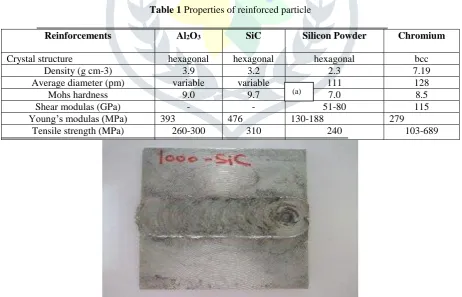
of the matrix plate. The groove was filled with different particle (SiC, Al2O3, Cr, and SiP), the properties of which are shown
in table 1 and enclosed with a cylindrical tool that simply had a shoulder to avoid the constituent part from being displaced out of the channel or groove. The particles powder is mixed with kerosene oil so that they cannot remove in air from plate while during operation and appropriate mixing in the matrix. The FSP parameter such as constant tool travelling speed (40mm/min) and rotation speed were (1000, 1200, 1400 rpm) respectively. In this manner, a total of 12 plate FSP passes with different reinforcement and speed were carried out on the work-piece. The friction stir processed plates are shown in Fig. 2.
Table 1 Properties of reinforced particle
Reinforcements Al2O3 SiC Silicon Powder Chromium
Crystal structure hexagonal hexagonal hexagonal bcc
Density (g cm-3) 3.9 3.2 2.3 7.19
Average diameter (pm) variable variable 111 128
Mohs hardness 9.0 9.7 7.0 8.5
Shear modulas (GPa) - - 51-80 115
Young’s modulas (MPa) 393 476 130-188 279
Tensile strength (MPa) 260-300 310 240 103-689
JETIR1706072 Journal of Emerging Technologies and Innovative Research (JETIR) www.jetir.org 360
Fig. 2 FSPed plate of (a) Mg/SiC at (1000 rpm), (b) Mg/Cr at (1000 rpm)
4. RESULTS AND DISCUSSION
5.1 IMPACT RESULTS: The impact strength of the composite improved by embedding of different powder in the matrix material. FSPed specimen both reinforced and base matrix were tested to find out impact strength deviation in which investigation explain that material bends, deformed and does not entirely broken down as fragile material. Impact strength of FSPed specimens was measured in stirred region zone by providing notch in processed zone and base plate also. It has been found that FSPed zone having
better impact strength (11.5) than base plate (2 joule). The Al2O3 FSPed region have high impact strength as compare to silicon
carbide particles as shown in Fig. 3.
Fig. 3 Effect of Speed and Reinforcement on Impact strength
5.2 HARDNESS RESULTS
Friction stir processed sample plates show better hardness than base metal because processed plate having fine grain microstructure which is responsible for increase hardness than unprocessed base plate. The hardness of pure magnesium and 12 FSPed plates sample were measured with the help of Rockwell hardness machine. On each composite 3 trails were performed for hardness, and then mean of these values was taken. The mean hardness values of base magnesium hardness test was 32 HRB. Graphs shows that the
SiC and Al2O3 gives the higher hardness value in the stirred region at lowest Speed (1000 rpm) as compare to higher speed (1400
rpm). The hardness of FSPed region is improved than base material and it can be increased up to 65 HRB which is 50% more than the base material as shown in Fig. 4.
0 2 4 6 8 10 12
Silicon Carbide Alumina Chromium Silicon Powder
Im
p
ac
t
Stre
n
g
th
(
Jo
u
le)
Reinforcement particles
Effect of speed and reinforced on Impact strength
Speed (1000 rpm)
Speed (1200 rpm)
Speed (1400 rpm)
Fig. 4 Effect of Speed and Reinforcement on Hardness
5.3 TENSILE RESULTS
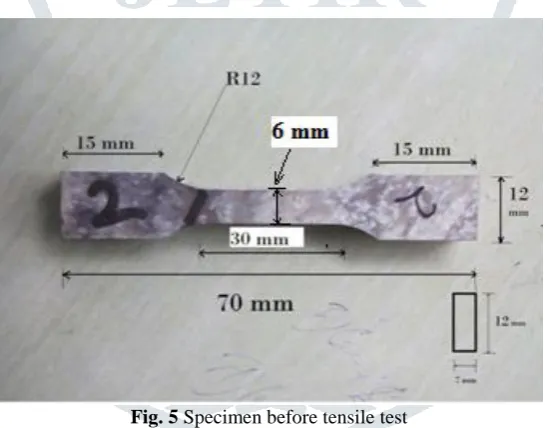
The tensile samples were cut using wire EDM in which defines the size of the tensile section as shown in Fig. 5. The dimensions were preferred to construct certain that the gage segment of the tensile section was in the center of the three sections. The tensile strength pure magnesium and 12 FSPed samples were measured by Universal testing machine and test is basic mechanical test where a carefully set is loaded in a very controlled conduct while measuring the practical load.
Fig. 5 Specimen before tensile test
The speed and reinforcements particle is the main parameter that affects the tensile strength of the composite. In figure shows that as the tensile strength increase from 148 to 205 MPa. The base material tensile strength was 125 MPa.
0 10 20 30 40 50 60 70
Silicon Carbide Alumina Chromium Silicon Powder
Har
d
n
es
s(
HR
B
)
Reinforcement particles
Effect of speed and reinforcement on hardness
Speed (1000 rpm)
Speed (1200 rpm)
JETIR1706072 Journal of Emerging Technologies and Innovative Research (JETIR) www.jetir.org 362 6. CONCLUSION
The Friction Stir Processing to fabricate magnesium based composite was proposed, and the reinforcement particle dispersed pure magnesium was successfully produced. The microstructure (scattering of the reinforced particles) and hardness, impact strength and tensile property of the FSPed region were observed and measured. The obtained results can be summarized as follow:-
1. Magnesium composites are successfully fabricated by using various speeds (1000, 1200, 1400 rpm), and reinforced particle
(SiC, Al2O3, Cr, SiP).
2. Mechanical classification revealed an increase in Hardness, Impact strength and UTS of pure magnesium with the addition
of reinforcements. The hardness of FSPed region is better than base material and it can be increased up to 65 HRB which is 50% more than the base material. The impact strength (2 to11 Joule) and tensile strength (148 to 205 MPa) can also be improved in FSPed region. The optimum values of impact, hardness and tensile strength was observed in FSPed region at tool rotation speed of 1000rpm and constant transverse speed 40mm/min.
REFERENCES
[1] Nemoto, S. (2002) “Introduction to Magnesium Lightest Structural Metal Material’’, Kogyo Chosakai Publishing Inc, Vol. 14,
pp. 39-49.
[2] Jayaraman, J. and Raghunath, B. (2012) “Recent Development and Challenges in Synthesis of Magnesium Matrix
Nano-Composites”, Journal of Latest Research in Science and Technology Vol. 1, No. 2, pp. 164-171.
[3] Cao, X.; Jahazi, M.; Immarigeon, J.P.; Wallace. W. Review of laser welding techniques for magnesium alloys. J. Mater.
Process. Technol. 2006, 171, 188–204.
[4] Vilaca,P., Quintino, L. (2013) “Linear Friction Based Processing Technologies for Aluminum Alloys”,PhD Thesis, Technical
University of Lisbon, Vol. 10, pp. 55-64.
[5] Morisada,Y., Fujii. (2006)“MWCNTs/AZ31 surface composites fabricated by friction stir processing”, Material Science
Engineering, Vol. 419, pp.344–348.
[6] Christener,B. and Sylva,G.(1996) “Friction Stir weld developments for aerospace application”,Science direct composite, Vol.4,
pp.79-85.
[7] Lee, W.B., Lee, C.Y.; B. (2006) “Microstructures and wear property of friction stir welded AZ91 Mg/SiC particle reinforced
composite”, Composite Science Technology, Vol. 66, pp.1513–1520.
[8] Darras, B.,Kishta, E. 2012 “Submerged friction stir processing of AZ31 magnesium alloy”, Material Design, Vol. 47, pp.133–
137.
[9] R. S. Mishra and Z. Y. Ma: ‘Friction stir welding and processing’, Mater. Sci. Eng. R, 2005, 50R, 1–78.
W. M. Thomas, K. I. Johnson and C. S. Wiesner: ‘Friction stir welding recent developments in tool and process technologies’, Adv. Eng. Mater., 2003, 5, (7), 485–490.
[10] R. Nandan, T. DebRoy and H. K. D. H. Bhadeshia: ‘Recent Advances In Friction Stir Welding Process, Weldment Structure And Properties’, Prog. Mater.Sci., 2008, Vol. 53, pp.980–1023.
[11] Hassan, G. (2002) “Development of High Strength Magnesium Based Composites using Elemental Nickel Particulates as
Reinforcement”, Journal of Materials Science, Vol. 37, pp. 2467-2474
[12] S. Larose and P. Wanjara (2012) “Review of Tools for Friction Stir Welding and Processing”, Maneyon behalf of the Institute,
Vol.51, NO. 3, pp 250-261.
[13] Kumar, A., Kumaraswamy. (2013) “An Influence Of Reinforcements (Sic And Al2O3) And Rotational Speed On Wear And