R E S E A R C H
Open Access
Blockchain-based orchestration of
distributed assets in electrical power
systems
Jonas Schlund
FromThe 7th DACH+ Conference on Energy Informatics Oldenburg, Germany. 11-12 October 2018
Correspondence:jonas.schlund@fau. de
Computer Networks and Communication Systems, Friedrich-Alexander-University Erlangen-Nürnberg, Martensstraße 3, 91058 Erlangen, Germany
Abstract
For historical reasons, power systems are designed, controlled and operated centrally. A coordination of the rising number of increasingly heterogeneous, small-scale and citizen- or company-owned assets is not possible with this approach, especially not in the distribution system. The goal of the PhD project presented in this extended abstract is to find out how well distributed approaches perform in orchestrating distributed assets in future power systems from a holistic point of view in comparison to centralized approaches. The research questions are defined and the planned methodology of the project is presented. The most promising use cases in this context are identified, the concept of a decentralized virtual power plant is proposed as a new use case for providing flexibility with small-scale assets and the first ideas for an evaluation framework are presented. Next steps in the project are refining the evaluation framework and evolving the yet existing lab setups. Once these are completed, simulation models can be developed and the main research questions can be answered in detail.
Keywords:Decentralized power supply, Distributed ledger technology, Blockchain, Cellular concept, Renewable energies
Introduction
Our society depends on a reliable power supply. Therefore, the electrical power system (EPS) is traditionally planned and operated hierarchically and centrally. However, this does not reflect the increasingly decentralized and volatile energy landscape. The rising number of highly heterogeneous actors in the EPS results in an increased total complexity of the system. Many of the newly installed distributed assets generating renewable electricity are owned by citizens or small companies and are thus not controlled centrally.
A bottom-up approach like the cellular concept (Benz et al., 2015) is able to face the increasing complexity in the system. According to the cellular concept, locally limited areas consisting of electrical producers, consumers and storages form an energy cell. Many of these cells form a larger cell, in which the individual cells organize themselves and balan-cing is done at the lowest possible level. In this context many recent studies and publica-tions attribute a high potential to peer-to-peer (P2P) approaches based on distributed ledger technologies (DLTs) (BDEW Bundesverband der Energie und Wasserwirtschaft e.V.,
2017; Dütsch & Steinecke,2017; Merz,2016). Therefore, we investigate if and how an or-chestration of assets in the EPS is possible according to the cellular concept and based on DLTs, such as blockchains (Nakamoto, 2008). This extended abstract presents the current stage of my according PhD project including the definition of the research question, related work, the proposed methodology, first results and a conclusion.
Research question
Assuming the hypothesis that a distributed approach is desired in order to (self-) co-ordinate distributed assets in the EPS for political or philosophical reasons or owner preferences, the central research question (RQ) of this research project is: (How) can distributed assets in a future EPS empowered by renewable energies and storages be or-chestrated in a distributed wayand in particularhow well perform blockchain-based ap-proaches in this context in comparison to centralized apap-proaches? In order to answer this question the central research question is split into the following subquestions.
RQ1:Which are the use cases of interest?
RQ2:Which metrics are of importance in order to quantify how well blockchain-based approaches suit the selected use cases? How are these metrics formally defined and quantified?
RQ3:Can the use cases with their quality of service requirements be realized with blockchain-based approaches? If yes, which possible different blockchains designs are most suitable and how do the different designs influence the determined metrics?
RQ4:How well perform and how large is the extra effort of blockchain-based approaches in comparison to a centralized approach for the selected use cases from a holistic point of view? Which type of blockchain is most suitable?
As shown in Fig.1, the final subquestion builds upon the previous RQs and aims for a comprehensive answer of the central research question given at the beginning of this sec-tion. The costs of disintermediation in the identified use cases in RQ1 are evaluated in a quantitative way applying the metrics defined in RQ2 and considering the results from RQ3.
Related work
The earliest and probably best-known blockchain-based local energy market (LEM) project isThe Brooklyn Microgrid (Mengelkamp et al.,2018a). This pilot was followed by research projects like theLAMPproject (Mengelkamp et al.,2018b). The new project
Pebbles aims for an integration of grid friendliness in LEMs (Allgäuer Überlandwerk GmbH, 2018). The Enerchain project tackles large-scale electricity trading in Europe (Merz, 2016). The Energy Web Foundation aims at accelerating blockchain technology across the energy sector. Therefore, they build upon Ethereumand develop a downward compatible blockchain suitable for energy related applications (Energy Web Foundation, 2018). The TokenNRGcoin(Mihaylov et al.,2014) enables decentralized electricity trad-ing as well but in addition allows for demand response. Equally, Power Ledger (Power Ledger,2018) provides a decentralized platform for P2P electricity trading.
In terms of evaluation metrics considering blockchain technology a good starting point is offered in (Wüst & Gervais, 2017). Furthermore, a performance analysis for private blockchains is presented in (Pongnumkul et al., 2017) and first benchmarks considering private blockchains are described in (Dinh et al.,2018). They conclude that there is still a big performance gap between blockchains and current databases.
This PhD-project bases upon preliminary research concerning simulation of and algo-rithms for an efficient and decentralized provision of ancillary services by conventional virtual power plants (VPPs) with a central information technology (IT) infrastructure (Schlund & German,2017; Schlund et al.,2017; Schlund et al.,2018a). The project intends to analyze existing and think of new use cases, to develop an unbiased evaluation frame-work for such use cases, to identify the most suitable blockchain designs and to quantify the extra effort of a blockchain-based approach in comparison to centralized approaches for the most promising use cases. Therefore, it complements and fits in well in the overall picture.
Proposed methodology
The general idea of the PhD-project is to simulate the use cases of interest with differ-ent blockchain networks in order to evaluate them according to a defined evaluation framework and to use prototypical implementations for the validation of the simulation models. Therefore, the proposed methodology consists of a theoretical and an empirical part. The theoretical part includes literature reviews, an analysis of current research de-velopments and analytical work. In the quantitative part, prototypical implementations and experimental test runs are used for data collection and extensive simulation and modeling is used for studying the use cases. In order to mind both IT and EPS layer probably hybrid simulation including discrete and continuous simulation will be used. An overview of the proposed methods for answering the RQs is visualized in Fig.1.
First results
In this section RQ1 is partially answered and first ideas considering RQ2 are summarized.
RQ1: Identification of the use cases of interest
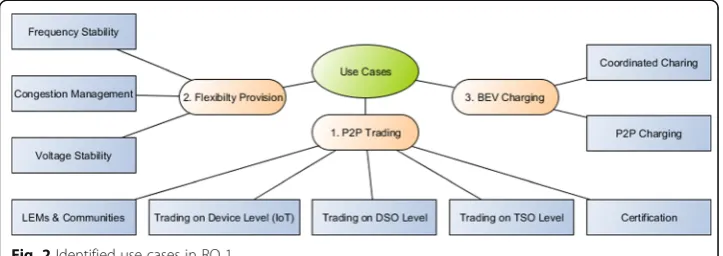
Considering RQ1, use cases of interest have been identified as visualized in Fig. 2. The use cases are clustered into three subgroups presented successively in the following.
moment and in which recent studies see a high potential, mainly because local trade is currently not possible due to the complexity in current electricity trading processes. Specifying, the use cases of interest are electricity trading on different levels, each with different requirements. The most investigated use case at the moment is LEMs (or communities), in which P2P trading (or sharing) is facilitated between end consumers or producers in a locally limited area. The same concept is also applicable on other levels, from device level up to distribution system operator (DSO) or transmission sys-tem operator (TSO) level. Besides trading the electricity, trading of certificates of origin or CO2emissions is also possible. This is mainly motivated by the properties of
block-chains considering transparency and immutability.
The second subgroup is the provision of flexibility as an ancillary service for the EPS. In comparison to the market-based approaches summarized under P2P electricity trading, this approach faces the need for flexibility in the EPS in a more straightforward way. So far, such flexibility is either provided by central power plants, which will become less in numbers in future, or by centrally controlled VPPs. A new blockchain-based approach for such services is a decentralized virtual power plant (DVPP), which is a self-organized VPP and thus without the need for a central operator. This way there are no costs for an always-online TTP and the participants can profit from the full economic benefit. The DVPP has thus the potential of organizing and mobilizing small-scale distributed flexibil-ity sources, which are not part of a VPP and do not have access to a flexibilflexibil-ity market so far. In analogy to a VPP, possible applications are frequency or voltage stability or conges-tion management. Such a DVPP is currently implemented in our lab and a pre-stage of is published in (Schlund et al.,2018b).
The last identified subgroup is battery electric vehicle (BEV) charging. This is chosen as it is expected that the share of BEVs will increase drastically in the next years and because uncoordinated charging might cause problems in distribution grids. A TTP is undesirable as there are many different charging station operators and energy pro-viders involved. As of today, problems already exists considering the interoperability between different providers.
RQ2: First ideas for an evaluation framework
So far, two different classes of metrics have been identified: quantitative metrics, which can be derived by means of the simulations and qualitative metrics, which only play a secondary role in the PhD project. The main metrics for the quantitative evaluation of the suitability of the bockchain-based approaches are:
thegeneral performancefrom the point of view of the EPS
theinvestment and operational expensesfrom the point of view of the IT system thescalability
thelevel of decentralization
In total, the cost of disintermediation is valuated by restraints in performance, add-itional holistic costs and limitations in scalability. In addition to the quantitative evalu-ation, the subordinate qualitative metrics are the security of the EPS, data integrity, transparency and privacy. These are the first ideas considering the evaluation frame-work. However, the metrics need to be formally defined to be able to quantify and evaluate them at a later stage of the PhD-project. This formal definition is the next step in the PhD-project.
Conclusion and outlook
This extended abstract describes the current stage of my PhD-project. The aim is to provide a foundation for deciding how to orchestrate distributed assets in a future electrical power system empowered by renewable energies and storages under the hypothesis that a central control is not desirable. Specifically, the main research question is to investigate how large the necessary extra effort of distributed approaches based on blockchain technology is com-pared to a centralized approach from a holistic point of view. An overview of the related work is given and this project is placed in the research landscape. Planned and partly already applied methodologies are literature reviews, lab setups and hybrid simulation.
The use cases of interest are identified as different P2P electricity markets, distributed flexibility provision, BEV charging and its coordination. With a DVPP, a concept for self-organized distributed flexibility provision is proposed. However, the DVPP imple-mentation still needs to be formally described, refined and analyzed more in detail. Be-sides that, a second lab setup of a peer-to-peer electricity market with a focus on grid-friendly operation is currently in work. First ideas for an evaluation framework are provided here, its formal definition is still pending. Considering blockchain design, per-missioned blockchains or hierarchical hybrid public and consortial proof-of-authority multi-chains seem promising at the current stage of the project. Next steps are investi-gating analytical relationships between blockchain designs and the quantitative evalu-ation metrics and building simulevalu-ation models, which will be used in the last step to extensively answer the central research question.
Abbreviations
BEV:Battery electric vehicle; DLT: Distributed ledger technology; DSO: Distribution system operator;
DVPP: Decentralized virtual power plant; EPS: Electrical power system; LEM: Local energy market; P2P: Peer-to-peer; RQ: Research question; TSO: Transmission system operator; TTP: Trusted third party; VPP: Virtual power plant
Acknowledgements
Thanks to Prof. Engel for insightful shepherding and to Prof. German for the supervision.
Funding
This work is funded by the Bavarian State Ministry of Science and the Arts in the framework of the Centre Digitisation.Bavaria (ZD.B). Publication costs for this article were sponsored by the Smart Energy Showcases - Digital Agenda for the Energy Transition (SINTEG) programme.
About this supplement
Author’s contributions
This is a single-authorship paper. All work was done by the author. The author has written, read and approved the final manuscript.
Competing interests
The author declares that he has no competing interests.
Publisher’s Note
Springer Nature remains neutral with regard to jurisdictional claims in published maps and institutional affiliations.
Published: 10 October 2018
References
Allgäuer Überlandwerk GmbH: Peer-to-peer Energiehandel Auf Basis Von Blockchains. 2018;https://pebbles-projekt.de/ Accessed 2018-06-22
BDEW Bundesverband der Energie und Wasserwirtschaft e.V.: Blockchain in der Energiewirtschaft. 2017
Benz, T., Dickert, J., Erbert, M., Erdmann, N., Johae, C., Katzenbach, B., Glaunsinger, W., Müller, H., Schegner, P., Schwarz, J., Speh, R., Stagge, H., Zdrallek, M.: VDE Studie: Der zellulare Ansatz. 2015
Dinh TTA, Liu R, Zhang M, Chen G, Ooi BC, Wang J (2018) Untangling blockchain: a data processing view of blockchain systems. IEEE Trans Knowl Data Eng 30(7):1366–1385.https://doi.org/10.1109/TKDE.2017.2781227
Dütsch G, Steinecke N (2017) Use cases for Blockchain Technology in Energy and Commodity Trading. PricewaterhouseCoopers GmbH
Energy Web Foundation: Tobalaba Client. 2018;https://github.com/energywebfoundation/energyweb-clientAccessed 12 March 2018
Mengelkamp E, Gärttner J, Rock K, Kessler S, Orsini L, Weinhardt C (2018a) Designing microgrid energy markets: a case study: the Brooklyn microgrid. Appl Energy 210:870–880.https://doi.org/10.1016/j.apenergy.2017.06.054
Mengelkamp E, Gärttner J, Weinhardt C (2018b) Decentralizing energy systems through local energy markets: the LAMP-project. Multikonferenz Wirtschaftsinformatik, MKWI 2018, Lüneburg, pp 924–930
Merz M (2016) Potential of the Blockchain technology in energy trading, de Gruyter, Berlin, Germany
Mihaylov M, Jurado S, Avellana N, Moffaert KV, de Abril IM, Nowe A (2014) Nrgcoin: Virtual currency for trading of renewable energy in smart grids, 11th International Conference on the European Energy Market (EEM14), pp 1–6.https://doi.org/10. 1109/EEM.2014.6861213
Nakamoto S (2008) Bitcoin: A Peer-to-Peer Electronic Cash System.https://bitcoin.org/bitcoin.pdf. Accessed 17 Jan 2018 Pongnumkul S, Siripanpornchana C, Thajchayapong S (2017) Performance analysis of private blockchain platforms in varying
workloads, 2017 26th International Conference on Computer Communication and Networks (ICCCN), pp 1–6.https://doi. org/10.1109/ICCCN.2017.8038517
Power Ledger (2018) Whitepaper.https://cdn2.hubspot.net/hubfs/4519667/Documents%20/Power%20Ledger%20Whitepaper. pdf. Accessed 12 Mar 2018
Schlund J, Ammon L, German R (2018b) ETHome: Open-source Blockchain Based Energy Community Controller, Proceedings of the Ninth International Conference on Future Energy Systems. e-Energy‘18. ACM, New York, NY, USA, pp 319–323.
https://doi.org/10.1145/3208903.3208929 http://doi.acm.org/10.1145/3208903.3208929
Schlund J, German R (2017) A control algorithm for a heterogeneous virtual battery storage providing FCR power, 2017 IEEE International Conference on Smart Grid and Smart Cities (ICSGSC), pp 61–66.https://doi.org/10.1109/ICSGSC.2017. 8038550
Schlund J, Steber D, Bazan P, German R (2017) Increasing the effciency of a virtual battery storage providing frequency containment reserve power by applying a clustering algorithm, 2017 IEEE Innovative Smart Grid Technologies - Asia (ISGT-Asia), pp 1–8.https://doi.org/10.1109/ISGT-Asia.2017.8378430
Schlund J, Steinert R, Pruckner M (2018a) Coordinating e-mobility charging for frequency containment reserve power provision, Proceedings of the Ninth International Conference on Future Energy Systems. e-Energy‘18. ACM, New York, NY, USA, pp 556–563.https://doi.org/10.1145/3208903.3213892 http://doi.acm.org/10.1145/3208903.3213892