R E S E A R C H A R T I C L E
Open Access
Does tiotropium lower exacerbation and
hospitalization frequency in COPD patients:
results of a meta-analysis
Ann Van den Bruel
1,2*, Jeannine Gailly
1,3, Mattias Neyt
1Abstract
Background:International guidelines recommend long-acting bronchodilators in patients who remain symptomatic despite adequate treatment with short-acting bronchodilators. The purpose of this study is to estimate the effect of tiotropium, a long-acting anticholinergic inhalant, on exacerbation and hospitalisation frequency.
Methods:Electronic databases (Medline, Embase, INAHTA, CRD databases, and the Cochrane Library) were searched for randomised controlled trials, comparing tiotropium to placebo, or other bronchodilators. Outcomes were the exacerbation frequency and hospitalisation frequency. Data were pooled using the generic inverse variance method for continuous outcomes.
Results:Nine studies reported comparisons with placebo (n = 8), ipratropium (short-acting anticholinergic inhalant, n = 1), and salmeterol (long-actingb2-agonist inhalant, n = 1). Only two studies reported adequate concealment of allocation. Tiotropium reduces the number of exacerbations per patient year by 0.31 (95% CI 0.46- 0.17) compared to placebo, and by 0.23 (95% CI 0.31- 0.15) compared to ipratropium. A significant difference in exacerbation frequency between tiotropium and salmeterol was found (-0.16; 95% CI -0.29 - -0.03) based on approximations of the results of one study.
The number of hospitalisations is reduced by 0.04 (95% CI 0.08- 0.01) per patient year compared to placebo and by 0.06 (95% CI -0.09 - -0.03) per patient year compared to ipratropium.
Conclusions:Statistically significant but clinically small effects were found for tiotropium compared to placebo and ipratropium. The comparison with salmeterol is significant for exacerbation frequency but not for hospitalisation frequency. Publication bias may be present.
Background
Tiotropium (Spiriva®) is a once-daily inhaled long-acting anticholinergic bronchodilator, used for the maintenance treatment of COPD. Next to tiotropium, other long-act-ing bronchodilators are salmeterol, arformoterol and formoterol, both b2-agonists. International guidelines
recommend long-acting bronchodilators in patients who remain symptomatic despite adequate treatment with short-acting bronchodilators [1].
Previous meta-analyses on tiotropium have focused on the proportion of patients having at least one
exacerbation or COPD-related hospitalisation, and found that tiotropium significantly lowers both out-comes compared to placebo or ipratropium[2,3]. How-ever, results were significantly influenced by the duration of follow-up[4]. This is not surprising, as patients may have several events during follow-up and the likelihood of having at least one exacerbation or COPD-hospitalisation increases with time[5]. Also, treat-ment is more likely to reduce the number of exacerba-tion or COPD-related hospitalisaexacerba-tions, rather than keeping patients totally exacerbation-free and out of the hospital.
The goal of this study was therefore to estimate the efficacy of tiotropium on exacerbation frequency and COPD-related hospitalisation frequency.
* Correspondence: [email protected]
1Belgian Health Care Knowledge Centre (KCE), Brussels, Belgium Full list of author information is available at the end of the article
Methods
Literature search
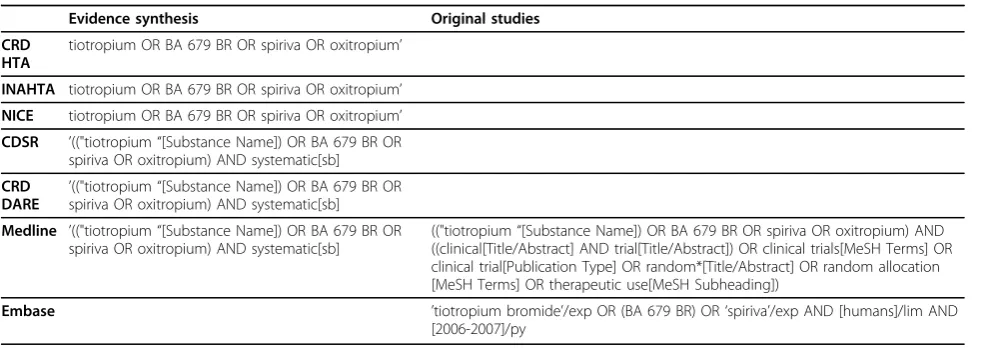
The systematic review was iterative: good-quality sys-tematic reviews were searched first; the original studies included in these systematic reviews were complemen-ted with studies published up until November 2008. Databases searched were Medline, Embase, INAHTA, CRD HTA, NICE, the Cochrane Database of Systematic Reviews (CDSR), and CRD DARE. All search terms used are listed in table 1.
In addition to published studies, attempts were made to identify unpublished studies by searching the FDA http://www.fda.gov/cder/index.html and EMEA websites http://www.emea.europa.eu/htms/human/epar, clinical trial registries, contacting known experts in the field and the manufacturer of tiotropium.
Selection criteria
Randomised controlled trials with a follow-up of at least 12 weeks after randomisation were eligible if they included a population with stable COPD (no exacerba-tion one month prior to study entry), and compared tio-tropium to placebo, ipratio-tropium bromide or long-acting b2-agonists, on exacerbation and COPD-related
hospita-lisation frequency. Quality of systematic reviews was assessed using the checklist for systematic reviews of the Dutch Cochrane Centre http://www.cochrane.nl. Only reviews with a sensitive search strategy in several data-bases, and explicit criteria for inclusion and exclusion were eligible. Original studies were assessed for quality using the tool described in the Cochrane Handbook of Systematic Reviews. Original studies were not excluded based on quality assessment. No language restrictions were applied.
Eligibility of studies was assessed by two researchers independently (AVDB, JG). Disagreement was resolved by consensus.
Analysis
The results of the studies were extracted from the papers by two independent researchers (AVDB, JG). Authors and the drug’s manufacturer were contacted in case of missing data.
Outcomes were the number of exacerbations per patient year and the number of hospitalisations per patient year.
Data were pooled using the fixed effects model using the generic inverse-variance approach when no hetero-geneity was apparent (I2≤ 25%)[6]. In all other cases, a random effects model was used.
Funnel plots were constructed when five or more stu-dies were available for one specific comparison and one particular outcome. Publication bias was statistically tested using the Egger’s test when ten or more studies were available.
All analyses were performed with Review Manager version 4.2[7].
Results
Included studies
The search for systematic reviews identified five studies in the CDSR database, 11 studies in Medline, six in the CRD DARE database and six in the CRD HTA database. Of these, four were potentially relevant based on title and abstract[2,3,8,9]. One study was excluded,[9] because it was not based on a systematic search. In con-trast, the quality of the two Barr reviews[2,3,8,9] and the Rodrigo review[2,3,8,9] was very good. However, only one systematic review included trials with a minimum duration of 12 weeks,[8] which was thus included in our study.
The search for original studies was limited to studies published after the literature search of the Barr review (2005). Discarding duplicates, a total of 353 studies were identified in Medline and Embase. After applying
Table 1 Search terms
Evidence synthesis Original studies
CRD HTA
tiotropium OR BA 679 BR OR spiriva OR oxitropium’
INAHTA tiotropium OR BA 679 BR OR spiriva OR oxitropium’
NICE tiotropium OR BA 679 BR OR spiriva OR oxitropium’
CDSR ’(("tiotropium“[Substance Name]) OR BA 679 BR OR spiriva OR oxitropium) AND systematic[sb]
CRD DARE
’(("tiotropium“[Substance Name]) OR BA 679 BR OR spiriva OR oxitropium) AND systematic[sb]
Medline ’(("tiotropium“[Substance Name]) OR BA 679 BR OR spiriva OR oxitropium) AND systematic[sb]
(("tiotropium“[Substance Name]) OR BA 679 BR OR spiriva OR oxitropium) AND ((clinical[Title/Abstract] AND trial[Title/Abstract]) OR clinical trials[MeSH Terms] OR clinical trial[Publication Type] OR random*[Title/Abstract] OR random allocation [MeSH Terms] OR therapeutic use[MeSH Subheading])
inclusion and exclusion criteria on title and abstract, 25 studies were potentially relevant. After assessment in full text, seven studies were included in the final review [10-16]. No report on tiotropium was found on the EMEA site, whereas the FDA published an approval review in 2004 including six clinical trials, correspond-ing to three published studies, already captured by our literature search.
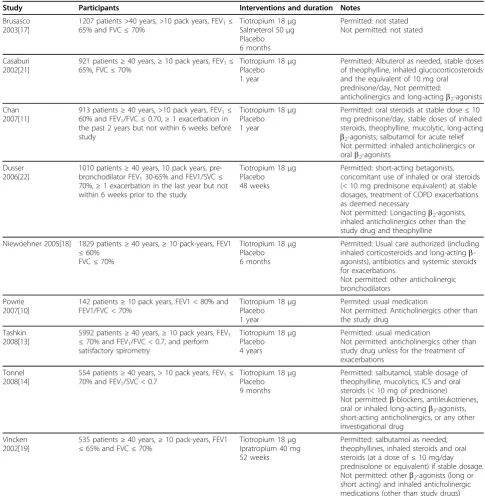
In summary, adding the more recent studies to those already included in the review by Barr et al., 16 studies were eligible of which nine reported data that were used in the analyses presented here (see Figure 1 for flow chart of literature search). A description of the charac-teristics of each study is provided in table 2, and quality assessment is summarised in figure 2.
Overall, studies were very alike with similar inclusion and exclusion criteria. Patients were at least 40 years old, had smoked at least 10 pack years and suffered from moderate to severe COPD. The patients’mean age ranged from 63.6 to 77.4 years, the baseline FEV1
ran-ged from 36% predicted to 51% predicted.
Duration of the study varied between six months (n = 2), nine months (n = 1), 12 months (n = 5), and 48 months (n = 1). This last study was also the largest study, including 5992 patients[13].
Concomitant medication was specified in all studies except in one[17]. No study allowed the use of other anticholinergic medication. All studies allowed short-acting b2-agonist medication, long-acting b2-agonists
were allowed in four studies, inhalant glucocorticoster-oids and oral glucocorticosterglucocorticoster-oids in all studies, with a maximum dose specified for the latter.
Only two trials[13-15,18] reported adequate conceal-ment of allocation and most studies did not perform an intention to treat analysis for all outcomes reported. Although all studies reported to be double blind, imply-ing blindimply-ing of both patient and treatimply-ing physician, not one study described blinded assessment of the outcome. All studies were sponsored by the pharmaceutical com-pany marketing tiotropium or the comparator drug, and analyses were performed by the pharmaceutical com-pany in two cases.
Meta-analyses
Studies were identified that compared tiotropium (long-acting anticholinergic) to placebo, ipratropium (short-acting anticholinergic), and salmeterol (long-acting b2-agonist).
Exacerbation frequency
Most studies defined exacerbations as at least one or two new or increased respiratory symptoms, such as cough, wheeze, dyspnoea, chest congestion, shortness of breath or sputum production, that necessitate a change in treatment. Two studies used a purely symptom-based definition not necessarily leading to a change in treat-ment[10,19].
For exacerbation frequency, expressed as the number of exacerbations per patient year, results from nine stu-dies were available, of which seven compared tiotropium with placebo and one each with ipratropium and salmeterol.
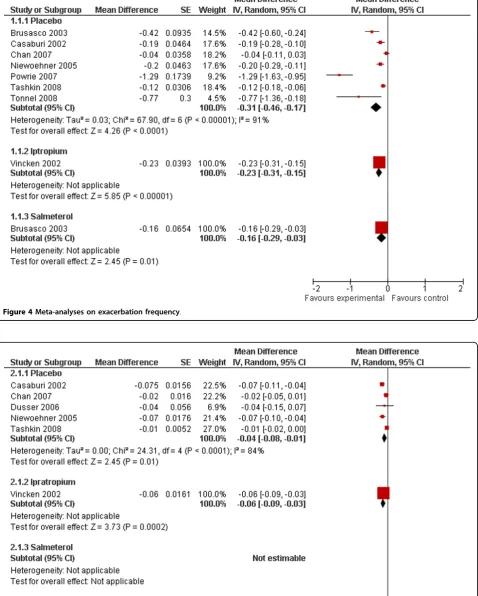
The pooled mean difference between tiotropium and placebo was -0.31 exacerbations per patient year (95% CI -0.46 - -0.17).(Figure 3) However, heterogeneity was
substantial (I2 91.2%), mainly caused by one study[10]. This study reported a markedly higher exacerbation fre-quency in the control group than the other studies (2.46 versus 0.83-1.05 exacerbations per patient year), possibly caused by the purely symptom-based definition of an exacerbation. Heterogeneity decreased slightly after exclusion of this study (I2 = 79%), with a pooled mean difference of -0.19 (95% CI -0.28 - -0.09) exacerbations per patient year.
Compared to ipratropium, tiotropium reduced the exacerbation frequency with 0.23 (95% CI -0.31 - -0.15) exacerbation per year. Of note, the two studies compar-ing tiotropium with salmeterol both reported non-signif-icant p-values. However, one study[20] did not detail the exact results, nor were they obtained after contact with the corresponding author and the drug’s manufacturer (sponsor of the trial). Consequently, only one study was included in the analysis, resulting in a mean difference
Table 2 Characteristics of included studies
Study Participants Interventions and duration Notes
Brusasco 2003[17]
1207 patients >40 years, >10 pack years, FEV1≤ 65% and FVC≤70%
Tiotropium 18μg Salmeterol 50μg Placebo 6 months
Permitted: not stated Not permitted: not stated
Casaburi 2002[21]
921 patients≥40 years,≥10 pack years, FEV1≤ 65%, FVC≤70%
Tiotropium 18μg Placebo 1 year
Permitted: Albuterol as needed, stable doses of theophylline, inhaled glucocorticosteroids and the equivalent of 10 mg oral
prednisone/day, Not permitted:
anticholinergics and long-actingb2-agonists
Chan 2007[11]
913 patients≥40 years, >10 pack years, FEV1≤ 60% and FEV1/FVC≤0.70,≥1 exacerbation in the past 2 years but not within 6 weeks before study
Tiotropium 18μg Placebo 1 year
Permitted: oral steroids at stable dose≤10 mg prednisone/day, stable doses of inhaled steroids, theophylline, mucolytic, long-acting b2-agonists; salbutamol for acute relief Not permitted: inhaled anticholinergics or oralb2-agonists
Dusser 2006[22]
1010 patients≥40 years, 10 pack years, pre-bronchodilator FEV130-65% and FEV1/SVC≤ 70%,≥1 exacerbation in the last year but not within 6 weeks prior to the study
Tiotropium 18μg Placebo 48 weeks
Permitted: short-acting betagonists, concomitant use of inhaled or oral steroids (< 10 mg prednisone equivalent) at stable dosages, treatment of COPD exacerbations as deemed necessary
Not permitted: Longactingb2-agonists, inhaled anticholinergics other than the study drug and theophylline
Niewoehner 2005[18] 1829 patients≥40 years,≥10 pack-years, FEV1
≤60% FVC≤70%
Tiotropium 18μg Placebo 6 months
Permitted: Usual care authorized (including inhaled corticosteroids and long-actingb -agonists), antibiotics and systemic steroids for exacerbations.
Not permitted: other anticholinergic bronchodilators
Powrie 2007[10]
142 patients≥10 pack years, FEV1 < 80% and FEV1/FVC < 70%
Tiotropium 18μg Placebo 1 year
Permited: usual medication
Not permitted: Anticholinergics other than the study drug
Tashkin 2008[13]
5992 patients≥40 years,≥10 pack years, FEV1
≤70% and FEV1/FVC < 0.7, and perform satisfactory spirometry
Tiotropium 18μg Placebo 4 years
Permitted: usual medication
Not permitted: anticholinergics other than study drug unless for the treatment of exacerbations
Tonnel 2008[14]
554 patients≥40 years, > 10 pack years, FEV1≤ 70% and FEV1/SVC < 0.7
Tiotropium 18μg Placebo 9 months
Permitted: salbutamol, stable dosage of theophylline, mucolytics, ICS and oral steroids (< 10 mg of prednisone) Not permitted:b-blockers, antileukotrienes, oral or inhaled long-actingb2-agonists, short-acting anticholinergics, or any other investigational drug
Vincken 2002[19]
535 patients≥40 years,≥10 pack-years, FEV1
≤65% and FVC≤70%
Tiotropium 18μg Ipratropium 40 mg 52 weeks
of 0.16 exacerbations per patient year (95% CI 0.29 --0.03).(Figure 3) Although the paper reported a non-sig-nificant p-value, we obtained a signon-sig-nificant 95% CI, most likely caused by differences in rounding in the derivation of the standard error from the p-value. Detailed results are presented in Figure 4.
COPD-related hospitalisation frequency
Six studies reported sufficient information on hospitali-sation frequency to be included in the meta-analysis, five comparing with placebo[11,13,18,21,22] and one with ipratropium[19].
The difference in hospitalisation frequency with pla-cebo was -0.04 per patient year (95% CI -0.08 - -0.01), and with ipratropium -0.06 (95% CI -0.09 - -0.03).(Fig-ure 3) The frequency in the control group ranged from 0.150-0.250 per patient year. Two studies comparing tio-tropium with salmeterol reported non-significant
p-values, but no exact results. Again, these could not be obtained after contacting authors and manufacturer. (Detailed results Figure 5)
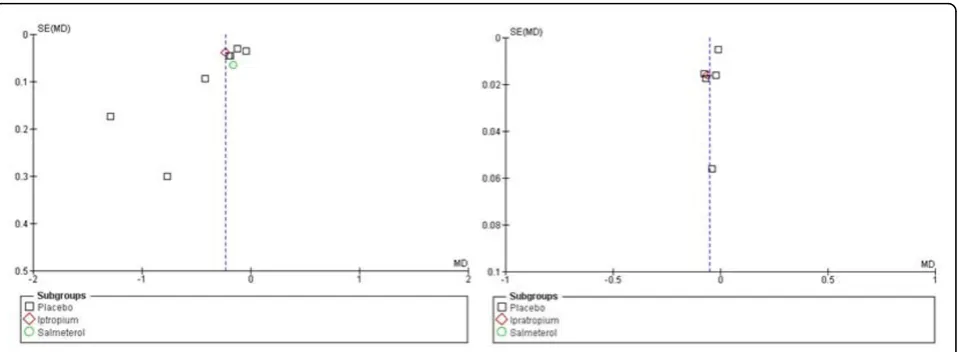
Publication bias
Funnel plots were constructed, but formal testing was not possible because less than 10 studies were available for either comparison (Figure 6). The funnel plot on exacerbations showed asymmetry, suggesting a lack of studies reporting less favourable results.
Discussion
Tiotropium lowers the number of exacerbations per patient year significantly by 0.31 (95% CI -0.46 - -0.17) exacerba-tions/year compared to placebo, and by 0.23 (95% CI -0.31 - -0.15) exacerbations/year compared to iptratropium.
Compared to salmeterol, we found a statistically sig-nificant difference of 0.16 (95% CI -0.29 - -0.03)
Figure 2Quality assessment of included studies.
Figure 4Meta-analyses on exacerbation frequency.
exacerbations/year based on one single study. However, this comparison was reported as non-significant by the original authors and may be significant in our analyses because of the approximations we had to use. In addi-tion, a second study reporting a non-significant differ-ence but not detailing the results could not be included in the analyses. For these reasons, this result should be treated with great caution.
In addition, there was a statistically significant effect on the number of hospitalisations per patient year of 0.04 (95% CI -0.08 - -0.01) compared to placebo, and 0.06 (95% CI -0.09 - -0.03) compared to ipratropium.
The robustness of these findings is influenced by the relative moderate quality of the individual studies - only two studies reported adequate concealment of alloca-tion- and evidence for publication bias was found.
A recent meta-analysis by Kesten et al. (2009)[23] comparing tiotropium to placebo found a smaller differ-ence of -8.90 (95% CI -11.0- (-6.83)) per 100 patient years. This study is not based on a systematic review of the literature, but used all phase III and IV studies in the Boehringer database.
In a recent network meta-analysis, combining both direct and indirect evidence on different bronchodila-tors, long-acting anticholinergics, long-actingb2-agonists
and the combination of long-acting b2-agonists and
inhaled corticosteroids were found to significantly reduce the number of patients with at least one exacer-bation but without significant differences between them, [24] which is consistent with our findings.
Our study has some limitations. Publication bias may be present, by which studies with less favourable results are not published[25] and consequently not included in the analyses. Our meta-analysis was further limited by the fact that not all results were available for inclusion,
although attempts were made to obtain all data. Conse-quently, the analyses for salmeterol are incomplete. In addition, the quality of the original studies was not opti-mal. Especially the uncertainty on allocation conceal-ment increases the risk of bias. Finally, we were not able to analyse results according to COPD severity. It might be possible that some patients would benefit more from treatment with tiotropium than the general COPD population. An individual patient data analysis might be able to explore the influence of patient characteristics on efficacy.
Conclusion
Patients taking tiotropium experience 0.3 exacerbations less per year compared to placebo and 0.2 compared to iptratropium. Compared to salmeterol, tiotropium users experience 0.16 exacerbations less per year, although this result should be treated with caution due to incom-plete results and approximations.
In addition, the number of hospitalisations per patient year is reduced by 0.04 compared to placebo. No effect was found compared with salmeterol. The results may be influenced by flaws in design and publication bias.
Note
The corresponding author (AVDB) confirms that she had full access to all the data in the study and had final responsibility for the decision to submit for publication.
Acknowledgements
The study was not externally funded.
Author details 1
Belgian Health Care Knowledge Centre (KCE), Brussels, Belgium.2Academic Centre for Primary Care, KULeuven, Leuven, Belgium.3CEBAM, Belgian Centre for Evidence Based Medicine, Leuven, Belgium.
Authors’contributions
AVDB designed the protocol, performed the searches, selection, data extraction and analyses, and drafted the manuscript. JEG performed the selection and data extraction, and revised the manuscript. MAN assisted in designing the protocol and revised the manuscript. All authors read and approved the final manuscript.
Competing interests
AVDB, JEG and MAN all state that they have no conflicts of interest that could inappropriately impact their work.
Received: 12 January 2010 Accepted: 21 September 2010 Published: 21 September 2010
References
1. Global Initiative for Chronic Obstructive Lung Disease (GOLD):Global Strategy for the Diagnosis, Management, and Prevention of Chronic Obstructive Pulmonary Disease.2007 [http://www.goldcopd.org]. 2. Barr RG, Bourbeau J, Camargo CA, Ram FSF:Inhaled tiotropium for stable
chronic obstructive pulmonary disease.Cochrane database of systematic reviews (Online)2005, CD002876.
3. Rodrigo GJ, Nannini LJ:Tiotropium for the treatment of stable chronic obstructive pulmonary disease: a systematic review with meta-analysis. Pulm Pharmacol Ther2007,20:495-502.
4. Neyt M, Van den Bruel A, Gailly J, Thiry N, Devriese S:Tiotropium in the Treatment of Chronic Obstructive Pulmonary Disease: Health Technology Assessment.Health Technology Assessment KCE reports 108C Brussels: Belgian Health Care Knowledge Centre (KCE) 2009.
5. Schermer TRJ, Saris CGJ, van den Bosch WJHM, Chavannes NH, van Schayck CP, Dekhuijzen PNR, van Weel C:Exacerbations and associated healthcare cost in patients with COPD in general practice.Monaldi archives for chest disease = Archivio Monaldi per le malattie del torace/ Fondazione clinica del lavoro, IRCCS [and] Istituto di clinica tisiologica e malattie apparato respiratorio, Universita di Napoli, Secondo ateneo2006, 65:133-140.
6. Higgins JPT, Thompson SG, Deeks JJ, Altman DG:Measuring inconsistency in meta-analyses.BMJ (Clinical research ed)2003,327:557-560.
7. The Nordic Cochrane Centre:Review Manager (RevMan).Book Review Manager (RevMan). (Editor ed.^eds.), Version 4.2 for Windows editionCity: The Cochrane Collaboration 2003.
8. Barr RG, Bourbeau J, Camargo CA, Ram FSF:Tiotropium for stable chronic obstructive pulmonary disease: A meta-analysis.Thorax2006,61:854-862. 9. Kesten S, Jara M, Wentworth C, Lanes S:Pooled clinical trial analysis of
tiotropium safety.Chest2006,130:1695-1703.
10. Powrie DJ, Wilkinson TM, Donaldson GC, Jones P, Scrine K, Viel K, Kesten S, Wedzicha JA:Effect of tiotropium on sputum and serum inflammatory markers and exacerbations in chronic obstructive pulmonary disease.Eur Respir J2007,15:15.
11. Chan CK, Maltais F, Sigouin C, Haddon JM, Ford GT, Group SS:A randomized controlled trial to assess the efficacy of tiotropium in Canadian patients with chronic obstructive pulmonary disease.Canadian respiratory journal: journal of the Canadian Thoracic Society2007,14:465-472. 12. Freeman D, Lee A, Price D:Efficacy and safety of tiotropium in COPD
patients in primary care–the SPiRiva Usual CarE (SPRUCE) study. Respiratory research2007,8:45.
13. Tashkin DP, Celli B, Senn S, Burkhart D, Kesten S, Menjoge S, Decramer M, Investigators US, Schiavi E, Figueroa Casas JC, Rhodius E, Gene R, Benito Saenz C, Giugno E, Di Bartolo C, De Salvo MC, Abbate E, Lopez AM, Steinfort C, Peters M, Carroll P, Simpson G, Freiberg D, Fogarty P, Watts R, Wheatley J, Vetter N, Burghuber O, Hesse C, Flicker M, Kahler C,et al:A 4-year trial of tiotropium in chronic obstructive pulmonary disease.The New England journal of medicine2008,359:1543-1554.
14. Tonnel AB, Perez T, Grosbois JM, Verkindre C, Bravo ML, Brun M, Tiphon Study Group, Adam B, Aldegheri C, Almandoz J, Angebault M, Arab S, Arfi T, Arvin-berod C, Assouline P, Audouin H, Balde M, Baumann J, Becquemin MH, Becu M, Bellier M, Bensa A, Berchier MC, Bergoin C, Beurey A, Bic JF, Bodez T, Boisserie-Lacroix V, Botrus P, Boudoux L, Boukhana M,et al:Effect of tiotropium on health-related quality of life as a primary efficacy endpoint in COPD.International journal of chronic obstructive pulmonary disease2008,3:301-310.
15. Wedzicha JA, Calverley PM, Seemungal TA, Hagan G, Ansari Z, Stockley RA, Investigators I:The prevention of chronic obstructive pulmonary disease exacerbations by salmeterol/fluticasone propionate or tiotropium bromide.American journal of respiratory and critical care medicine2008, 177:19-26.
16. Magnussen H, Bugnas B, van Noord J, Schmidt P, Gerken F, Kesten S: Improvements with tiotropium in COPD patients with concomitant asthma.Respiratory medicine2008,102:50-56.
17. Brusasco V, Hodder R, Miravitlles M, Korducki L, Towse L, Kesten S:Health outcomes following treatment for six months with once daily tiotropium compared with twice daily salmeterol in patients with COPD.Thorax 2003,58:399-404.
18. Niewoehner DE, Rice K, Cote C, Paulson D, Cooper JAD Jr, Korducki L, Cassino C, Kesten S:Prevention of exacerbations of chronic obstructive pulmonary disease with tiotropium, a once-daily inhaled anticholinergic bronchodilator: a randomized trial.Annals of internal medicine2005, 143:317-326.
19. Vincken W, van Noord JA, Greefhorst APM, Bantje TA, Kesten S, Korducki L, Cornelissen PJG, Dutch/Belgian Tiotropium Study G:Improved health outcomes in patients with COPD during 1 yr’s treatment with tiotropium.Eur Respir J2002,19:209-216.
20. Briggs DD Jr, Covelli H, Lapidus R, Bhattycharya S, Kesten S, Cassino C: Improved daytime spirometric efficacy of tiotropium compared with salmeterol in patients with COPD.Pulm Pharmacol Ther2005,18:397-404. 21. Casaburi R, Mahler DA, Jones PW, Wanner A, San PG, ZuWallack RL,
Menjoge SS, Serby CW, Witek T Jr:A long-term evaluation of once-daily inhaled tiotropium in chronic obstructive pulmonary disease.Eur Respir J 2002,19:217-224.
22. Dusser D, Bravo ML, Iacono P:The effect of tiotropium on exacerbations and airflow in patients with COPD.Eur Respir J2006,27:547-555. 23. Kesten S, Celli B, Decramer M, Leimer I, Tashkin D:Tiotropium HandiHaler
in the treatment of COPD: a safety review.International journal of chronic obstructive pulmonary disease2009,4:397-409.
24. Puhan MA, Bachmann LM, Kleijnen J, Ter Riet G, Kessels AG:Inhaled drugs to reduce exacerbations in patients with chronic obstructive pulmonary disease: a network meta-analysis.BMC medicine2009,7:2.
25. Begg CB, Berlin JA:Publication bias and dissemination of clinical research.Journal of the National Cancer Institute1989,81:107-115.
Pre-publication history
The pre-publication history for this paper can be accessed here: http://www.biomedcentral.com/1471-2466/10/50/prepub
doi:10.1186/1471-2466-10-50
Cite this article as:Van den Bruelet al.:Does tiotropium lower exacerbation and hospitalization frequency in COPD patients: results of a meta-analysis.BMC Pulmonary Medicine201010:50.
Submit your next manuscript to BioMed Central and take full advantage of:
• Convenient online submission
• Thorough peer review
• No space constraints or color figure charges
• Immediate publication on acceptance
• Inclusion in PubMed, CAS, Scopus and Google Scholar • Research which is freely available for redistribution