International Journal of Pharmaceutical Research&Allied Sciences, 2018, 7(3):183-188
Research Article
ISSN : 2277-3657
CODEN(USA) : IJPRPM
Application of Microcapsule Technology on Urea Coating Formulation Using
Polystyrene/Polycaprolactone Bio-Blend Polymer Matrix and Its Effectiveness
in Planta on Allium porrum L.
Elfi Sahlan Ben
1, Dira Pratiwi Kastianingsih
1, Khairinisa Septiana
1, Muslim Suardi
1,2,
Netty Suharti
1, Syukri Arief
3, Rika Sari Lalfari
3, Winta Triana
1, and Akmal Djamaan
1*1Faculty of Pharmacy, University of Andalas, Padang, Indonesia.
2School of Pharmacy, University of Mohammad Natsir Bukittinggi, Indonesia
3Department of Chemistry, Faculty of Sciences, University of Andalas, Padang, Indonesia
_____________________________________________________________________________________________
ABSTRACT
The application of microcapsule technology on urea coating formulation using polystyrene-polycaprolactone, PS-PCL, as a bio-blend polymer matrix and its effectiveness test in planta has been studied. The conventional urea fertilizer so far has been wasteful and inefficient because of being washed by the rainwater, evaporation, and degradation by the sunrise. This study aimed to create microcapsules of urea granules formulation using PS-PCL polymer and evaluate its effectiveness in planta on Allium porrum. Urea microcapsules obtained from previous work was produced by the solvent evaporation method containing: urea, bio-blend (PS-PCL), chloroform, liquid paraffin, and Span 80. The effectiveness of urea microcapsules test was evaluated by RAK method in 2 treatments. The observed parameters were the height, the number of leaves, and the fresh weight of the plant. The results showed that the granular microcapsules preparation was successfully produced with a sphericalshape. There was no statistical difference in the administration of conventional urea and urea microcapsules on the height (p> 0.05) and the number of leaves (p>0.05), but there was a significant difference on the weight of the plant (p<0.05). No statistical difference was observed after the administration of the conventional urea at a dose of 1 g/plant compared with urea microcapsules at the half dose of 0.5 g/plant on the heightand the number of plant leaves, while a significant difference was observed on the weight of fresh plants (p<0.05).
Keywords: Microcapsules, urea, effectiveness, in planta
_____________________________________________________________________________________________
INTRODUCTION
The conventional urea fertilizers which have been used in agriculture have proved ineffective in their application to the crops. Around of 20 to 70% of urea used would pollute the environment due to the leaching and evaporation processes. It would be as a source of pollution and eutrophication, and can cause green house effects. Only around 30% of urea is absorbed by the plant. It would also increase the cost due to the fact the fertilizers should be used several times [1,2,3,4].
on these findings, further research in the application of urea microcapsules formulated using bioblend PS/PCL matrix related with release test in planta, and evaluate its effectiveness on the plants.
MATERIALS AND METHODS
Materials used were: Urea (PT Pupuk Sriwijaya, Indonesia), Urea (Merck, Germany), Biopolymer Polycaprolactone (Aldrich Chemical), Polystyrene (Styrofoam-waste), Span 80 (PT Brataco, Indonesia), Liquid Paraffin (PT Brataco, Indonesia), Chloroform, n-hexane, Para-dimethylaminobenzaldehyde, HCl pa, ethanol, soil media, welsh onion (Allium porrum L) and distilled water.
Preparation of Urea Granule Microcapsules
Microcapsules were prepared based on a bioblend formula using PCL: PS (1: 2). The microcapsules formula obtained from the previous study was usedas shown in Table 1[7].
Table 1. Formulation of PS-PCL Coated Urea Microcapsules
No Materials Amount
1. Urea (g) 1
2. Bioblend
(PS-PCL) (g) 1.333- 0.666
3. Choroform (mL) 40
4. Span 80 (mL) 2
5. Liquid Paraffin (mL) 200
The solution of PCL and PS in chloroform was added with urea. The mixture was added slowly dropwise to the suspension of Span 80 in liquid paraffin while stirring at a rate of 700 revolutions per minute for 6 hours, until chloroform completely evaporated. Microcapsules formed were collected by decantation method, and washed with n-hexane until they got free from all of the liquid paraffin and Span 80, then filtered and dried at room temperature. Evaluation of Urea Granule Microcapsules Produced and Its Effectiveness on planta
SEM (Scanning Electron Microscopy) evaluation was performed to observe the shape and morphology of the produced microcapsules. The samples were placed on aluminum holder samples at a thickness of 10 nm. The shape and surface morphology of the microcapsules were observed at various magnifications using an SEM (Phenom pro-X, Nederlands). The voltage was set at 5 kV, and the current was set at 12 mA.
The evaluation of urea microcapsules preparation on plants was conducted on welsh onion (Allium porrum L.) using 1-week old plant seeds. The experimental design was arranged in a Randomized Block Design (RAK) with 2 treatments (n=3). Welsh onion was treated with conventional urea at a dose of 1 g per plant, and urea bioblend coated microcapsules equalled to 0.5 g urea per plant. The observations of the plants were performed in terms of the plant height, the number of leaves, and the fresh plant weight.
The plant height was measured in cm after 7 days of treatment, and the measurement was continued every 7 days until 10 weeks. The number of leaves was counted at day 7 after planting, and the counting was continued every 7 days until week 10. The fresh weight of the plant in gram was carried out 10 weeks after planting. The influence of the treatments on the plant growth was analyzed using the F test. The statistical analysis was continued by Duncan's Multiple Range Test (DMRT), if the previous analysis was significantly different (p<0.05).
RESULTS AND DISCUSSION
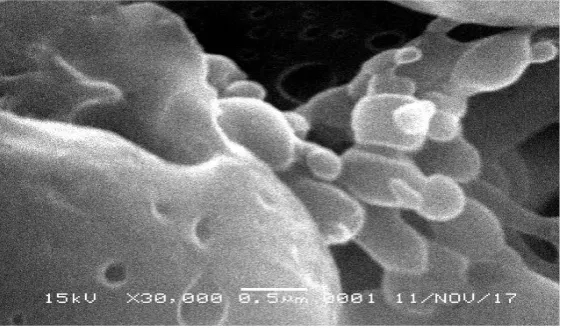
Figure 1. Scanning Electron Micrograph of urea PS-PCL coated microcapsules at a magnification of 30.000 times.
Figure 2. Scanning Electron Micrograph of placebo PS-PCL coated at a magnification 1.000 times.
Figure 1 shows the surface morphology of the PS-PCL microcapsules of urea as a core material. The surface morphology at the magnification of 30.000 times showed a coating portion comprising PS and PCL as an outer layer of urea with sphericalshape as an active substance [7]. This was in accordance with the findings of the previous team work by the same authors in 2015. The coating layer, in this case, PS-PCL on the outer layer of the microcapsules served as a mass transfer barrier. The characteristics of PS and PCL were relatively non-polar or lipophilic that could inhibit the penetration of water across the biopolymer layer. The barrier would slowerthe diffusion of water into the microcapsules, and decrease the release of active substances of urea into the environment medium [8,10]. It would also minimize the ammonia volatilization from urea to enhance nitrogen efficiency of urea leading to reduce the negative impact on the environment.
Figure 2 shows the Scanning Electron Micrograph of microcapsules without the active substances of urea. The surface morphology of the microcapsules, in general, appeared to be almost identical to PS-PCL urea coated microcapsules as shown in Figure 1. The obtained PS-PCL coated microcapsulesshowed the irregularity in shape, and there were pores in some parts of the microcapsules [7]. These findings might be due to an inappropriate drying process that damaged the coating layer and formed pores in it.
river water and/or other sources of surface water. This condition not only caused using fertilizer ineffective but also affected the environment negatively. In other hands, urea could be decomposed or evaporated. Based on the discussion above, it could be assumed that the effectivities of using 0.5 gram urea in coated microcapsules equalled to 1 gram conventional urea. This finding was in accordance with the results of several researchers. Only 30% of urea would be absorbed by plants, and 20-70% of the used urea would pollute the environment due to the leaching and evaporation processes. In another perspective, using urea coated microcapsules would not give the negative impact on the environment because of the minimal amount of urea released into the environment, thus no or minimal pollutant was released. A problem may arise in the production of microcapsules considering the production cost. It can be minimized by using cheap raw materials e.g waste PS or styrofoam, and mass production. PS-PCL is a bioblend polymer that could be decomposed easier compared to PS alone. It would also be an environmental friendly fertilizer. In addition, in the preliminary condition, the ability of plants in absorbing nutrition was minimum because the abundant urea was dissolved in the soil, on the other hand, not so much plant roots were available to absorb the nutrients.
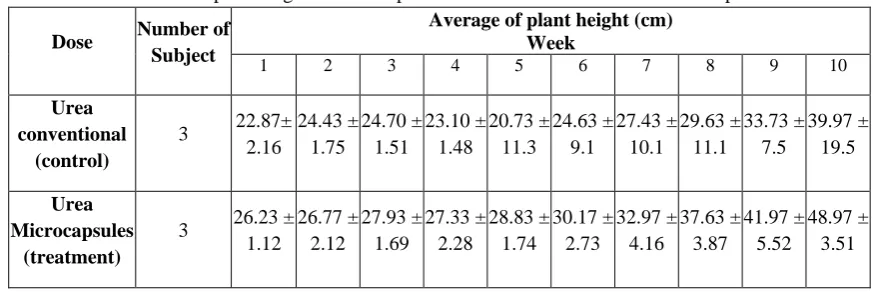
Table 2. The plant height of Allium porrum L after treatment of urea microcapsules
Dose Number of
Subject
Average of plant height (cm) Week
1 2 3 4 5 6 7 8 9 10
Urea conventional
(control)
3 22.87±
2.16 24.43 ± 1.75 24.70 ± 1.51 23.10 ± 1.48 20.73 ± 11.3 24.63 ± 9.1 27.43 ± 10.1 29.63 ± 11.1 33.73 ± 7.5 39.97 ± 19.5 Urea Microcapsules (treatment)
3 26.23 ±
1.12 26.77 ± 2.12 27.93 ± 1.69 27.33 ± 2.28 28.83 ± 1.74 30.17 ± 2.73 32.97 ± 4.16 37.63 ± 3.87 41.97 ± 5.52 48.97 ± 3.51
Table 3. The effect of urea microcapsules treatment on the plant Allium porrum L on the average number of the leaf of plants, observed every week
Group Number of
subject
Average of leaves number Week
1 2 3 4 5 6 7 8 9 10
Urea conventional
(control)
3 1.33 ±
0.58 1.33 ± 0.58 3.67 ± 0.58 4.33 ± 1.15 5.67 ± 1.53 5.67 ± 1.53 7.33 ± 3.79 8.67 ± 4.04 10 ± 3.46 8.33 ± 4.93 Urea Microcapsule
(treatment) 3 1± 0.00 1.33 ± 0.58 3.33 ± 0.58 4.33 ± 1.53 6.33 ± 2.52 7± 3.00 8.67 ± 3.06 9.67 ± 4.04 11 ± 500 11.67 ± 5.03
Table 4. The effect of urea microcapsules treatment on Allium porrum L plant on the average fresh plant weight before planting and after harvesting
Group Number of subject
Average of fresh plant weight (gram)
Before planting After harvest
Urea conventional
(control) 3 12.7± 0.74 49.57± 33.39
Urea Microcapsul
Table 3 shows the average number of leaves observed every week after the treatment of the plant with conventional urea and bioblend coated urea microcapsules. The two treatments tended to show varied results. Several weeks after the treatment, it was observed that the average number of leaves on conventional urea was higher than urea microcapsules. Furthermore, at week 5 to 10, the average number of leaves on urea microcapsule increased significantly with an average leaf number of 11.67 at week 10, much higher than that of conventional urea. There was no significant effect of using conventional urea and bioblend coated urea microcapsules (p>0.05). There were similar effects to those occurring in the plants’ height.
Table 4 shows the observation results after the treatment with conventional urea and urea bioblend coated microcapsules on the fresh weight. The average plant’s fresh weight was higher up to 2 times than conventional urea (p<0.05). It could be concluded that there was a significant difference between the provision of conventional urea and urea microcapsules to fresh weight of the plant.
In general,this microcapsule technique can be used for the manufacturing of urea slow release fertilizer with better results, which would be more efficient than using conventional urea fertilizer in order to enhancethe nutrient efficiency. In addition, it can also reduce the time and human resources because of no repetition in the fertilization process leading to save the cost of using fertilizers. Table 2, 3, and 4 indicate that there was no significant difference in plant height and number of leaves, but there was a significant difference on the fresh plant weight. It could be assumed that this finding would increase the crop yield considering that the thickerleaves would lead to the higher fresh plant weight.
CONCLUSIONS
The granular microcapsules have been successfully produced with a spherical shape. The evaluation of using conventional urea and bioblend coated urea microcapsules on the Allium porrum L crop showed that there was no significant effect on the plant height (p>0.05) and the number of leaves (p>0.05), but there was a significant effect on the fresh weight of the plant (p<0.05). There was no significant difference using conventional urea at a dose of 1 gram/plant compared to bioblend coated urea microcapsules at a half dose of 0.5-gram urea equivalent/plant on the height and number of plant leaves. There was a significant effect of using conventional urea and bioblend coated urea microcapsules on the weight of fresh plants (p<0.05). Using urea PS-PCL bioblend coated microcapsules was more efficient, effective, and more environmental friendly.
ACKNOWLEDGMENT
The authors would like to deliver a special appreciation to the Rector of Universitas Andalas for the financial support based on Professor Research Grant of University of Andalas, Fiscal Year 2017, under Contract Number: 17/UN.16.17/PP.HGB/LPPM/2017, Prof. Dr. Elfi Sahlan Ben research grant.
REFERENCES
1. Chien S. H, Prochnow L. I, Cantarella H. Recent developments of fertilizer production and use to improve nutrient
efficiency and minimize environmental impacts. Advances in Agronomy. 2009. 102: 267-322.
2. Suherman, AnggoroD.D. Producing slow release urea by coating with starch/acrylic acid in fluid bed spray drying.
International Journal of Engineering Technology. 2011:11(6):62-66.
3. Costa M. M, Cabral-Albuquerque E. C, AlvesT. L, Pinto J. C, Fialho R. L. Use of polyhydroxybutyrate and ethyl
cellulose for coating of urea granules. Journal of Agricultural and FoodChemistry. 2013: 61(42):9984-9991.
4. Xiaoyu N, Yuejin W, Zhengyan W, Lin W, Guannan Q, Lixiang Y. A novel slow-release urea fertilizer: Physical and
chemical analysis of its structure and study of its release mechanism. Biosystems Engineering.2013:115(3).
5. Guo M, Liu M, Hu Z, Zhan F, Wu L. Preparation and properties of a slow release NP compound fertilizer with
superabsorbent and moisture preservation. Journal of Applied Polymer Science. 2005: 96:2132–2138.
Netty Suharti, Salman S, Febriyenti, Erizal Zaini, Muslim S, E S Ben, Djamaan A. Effect of Bioblend Polystyrene/ Polycaprolactone and Polystyrene/Starch Utilization toward Coating Thickness and Release of Active Substance from Urea Granule. Der Pharma Chemica, 2016: 8(11):83-87.
6. Djamaan A, Monica R, Asiska P.D, Suardi M, Ben E.S, Erizal Z. The Use of Biopolymer of
Poly(3-hydroxybutyrate) as Matrix of Urea Slow Release Fertilizer. Journal of Chemical and Pharmaceutical Research. 2015: 7(7) :558-563.
7. Muslim S, Salman, Fitriani, Suharti N, Erizal Z, Febriyenti, Aldi Y, Akmal D., Use of Bioblend Polystyrene/Starch
for Coating Urea Granules as Slow Release Fertilizer. Journal of Chemical and Pharmaceutical Research. 2015:7(11):478-484.
Coating Material. Journal of Chemical and Pharmaceutical Research. 2017: 9(11):81-86.
9. Netty Suharti, Salman, Muslim S, Dwisari D, Febriyenti, Idris, and Akmal D. Coating of Urea Granules for Slow