Smart Toll Collection System based on IoT
P. S. Hanwate Narin Meher
Assistant Professor UG Student
Department of Computer Engineering Department of Computer Engineering NBNSSOE, Pune, India NBNSSOE, Pune, India
Ashlesh Mandke Manoj Nikam
UG Student UG Student
Department of Computer Engineering Department of Computer Engineering NBNSSOE, Pune, India NBNSSOE, Pune, India
Manan Mehta
UG Student
Department of Computer Engineering NBNSSOE, Pune, India
Abstract
The use of automated toll collection system in many metropolitan cities would be an efficient step towards the overcrowding of the city highways in heavy congestion of traffic. As we all know, transportation is the strength of our country’s economy. There are various implementation, protocols in wireless sensor network such as leach-c and components such as RFID, NFC thus enabling reduction in operation costs and motivating cashless transactions. In case of manual toll collection system time consumption is much far worse as well as fuel depletion and most important is the environment, the amount of air pollution that is created at the toll booth site is at high level, so our developed system will reduce time wastage and not only reduce air pollution but also conserve fuel. The sole purpose of this paper is to reduce the hardships caused by manual toll collection system and pass the subject’s vehicle through toll barrier in a matter of few seconds without halt.
Keywords: RFID, Arduino, Stolen vehicle, Internet of Things (IoT), congestion, E-Wallet, Digital India
________________________________________________________________________________________________________
I. INTRODUCTION
Each and every day more and more vehicles are increasing rapidly and the graph of the rate of buying vehicles is exponential, which has become a major problem at the site of toll booths due to heavy traffic causing endless number of problems such as high petrol/diesel consumption leading to depletion of hydrocarbon deposits below earth’s crust and also death causalities due to heavy traffic. The sole purpose of this paper is to motivate cashless transactions by installing automated e-toll collection system and the technology that we used is the use of RFID readers/tags. Basically to tackle this problem, the use of RFID tags that must be uniquely fixed onto subject’s vehicle and RFID reader module must be fixed at e-toll tooth. When a subject’s vehicle passes through the gate, the reader will detect an incoming frequency of 125 kHz of the RFID tag and read a unique no that has been assigned by govt. authority and the toll fee will be deducted from linked bank a/c or the e-wallet of system. This system is capable of saving time as well as fuel conservation which can save a lot of individual’s economy. This particular system is far much better and very efficient towards people as they will not stay in a long and lengthy queue thus automated e-toll system will eliminate the hardships of people parking vehicles in a long queue. RFID has the potential of eliminating corruption at local level and also reduce operational costs as well as errors in human operations. WSN’s i.e. wireless sensor networks are basically used in different scenarios such as home, office, healthcare, agriculture and also at toll collection plaza which can capture and transmit data from all incoming vehicles and outgoing vehicles because of their consistent and distinctive properties [2][6].
II. LITERATURE SURVEY
The ATC system in the paper “A review on automated toll collection system” the two types of study were compared namely the RFID based study and Leach-C based study showed promising and efficient way to develop the system but it also showed us lack of a point where the Leach-C system worked on digital image processing where the number plate of subject’s vehicle was scanned using high-tech camera. Using the RFID based implementation and eliminating the DIP based implementation to make system better time efficient.
The review was done of the paper “Automated toll collection system using RFID” Enlighted us the various components that can used while developing our own system in time saving and in efficient way so as to make a hybrid system that is mentioned in the paper “A review on automated toll collection system”.
“A Survey in Image Mining” showed a path towards machine learning and data mining concepts and helped us in mining databases in the form of people’s feedback.
The survey done in the paper named ATC turned out to be good step for developing ATC as we tried the best option in choosing the components in terms of reducing operation costs, time saving, flexible and also added the theft detection module in our system enabling security on high alert and detecting of stolen vehicles. During the period of learning and reviewing we also tried in improving and eliminating the costs of GSM kits embedded on the micro-controller board by replacing by use of private SMS gateway or govt. running GSM Company, which has reduced the operation cost much and has made our system more independent of using GSM kit.
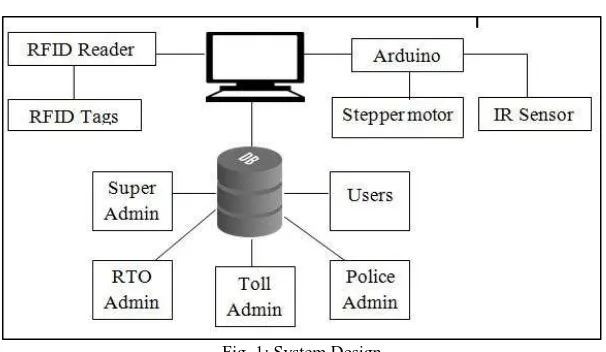
The Following diagram shows the block diagram of the Automated Toll Collection system. This block diagram contain both software and hardware components.
III. EXPERIMENTAL SETUP
Fig. 1: System Design
This diagram gives the overall design view of the system and how the components are connected and different modules in it. Modules in the system can access the data from the database.
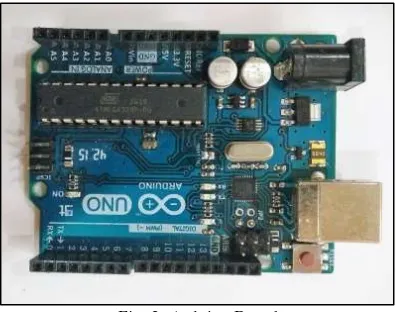
Our system contain different hardware module as follow: Arduino Uno Microcontroller
RFID reader and Tags IR Obstacle Sensor Stepper motor
Different Software Modules as follow: Super Admin
RTO Admin Toll Admin Police Admin User
IV. HARDWARE MODULES
Arduino Uno
Fig. 2: Arduino Board
RFID Reader and Tags
RFID Reader we used in our system is EM-18 RFID reader module. This reader operated on 125KHz which contain on-chip antenna which can be powered with 5V power supply. This Reader is attach to computer or any microcontroller but in our system we connected it to the computer through which it communicate with arduino board. Communication range of reader is 2-10 cm. Tags contain the information which is read when it is tap on the reader.
Fig. 3: RFID Reader and tags
IR Sensor
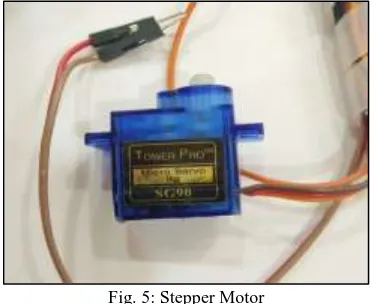
This IR sensor is used to sense the car passing through the toll booth. Accordingly the stepper motor will work. Transmitter emit infrared radiation if obstacles is present it get reflected back to sensor which is receive through the receiver. It is connected to the Arduino board.
Fig. 4: IR Sensor
Stepper Motor
Fig. 5: Stepper Motor
V. SOFTWARE MODULES
Super Admin
In our system there is Super Admin which looks after the others Admin in the system. It can look for the collection done at the different toll booth where our system is implemented. This admin is handled by government authority. We can add new plaza and also can define the different charges for the vehicles. This admin is basically used to track the records of the different plaza.
RTO Admin
This is admin present at the RTO office which is used to register new vehicle which will be assign new RFID tag. The Basic information of the user are taken like Vehicle number, vehicle type , chassis number, owner address, owner mobile number, email-id, etc. Owner is provided with username and password which he/she can used to recharge its account as our system is based on E-wallet.
Toll Admin
This is used at the toll booth side this is used to check the collection record. This keep the track of each and every record since the system is implemented.
Police Admin
This module is used by police authority which is used for registration of stolen vehicle of the owner. If the stolen vehicle is detected on any of the toll booth then it is notified on this module. User can also view which are the vehicles register as stolen.
Working:
First user has to create a new account through web page. User should enter exact and precise values of vehicle number and unique chassis number so as to identify uniquely. Then at the RTO admin side, the newly created user will be assigned a unique RFID card by which he/she can perform transactions. This RFID assignment is done by the RTO admin on windows application which is RTO admin’s personal computer.
The next step is to setup a toll booth. This is done by the super admin. Super admin creates a toll booth for a particular highway, assigns a user name and password to the toll admin and tax for every type of vehicle. For example different taxes for three wheeler, four wheeler, heavy vehicles etc. are assigned.
At toll booth, a toll admin is logged in. Toll booth system is responsible for valid or invalid transactions. Toll admin is given access to the transaction history and logs. But the admin is not able to change the logs, it can only be altered by super admin.
At toll booth when a vehicle arrives, the unique RFID tag attached to the vehicle is red by the RFID reader placed at the toll booth. When a reader reads the tag attached to a vehicle it automatically detects the vehicle and the corresponding toll tax is deducted from the users E-wallet. After the successful transaction the barrier at the toll booth will open and an IR sensor placed after the barrier will sense the presence of vehicle after crossing the barrier and then the barrier will be lowered down. In case of government vehicle (police) or emergency vehicle (ambulance) then that vehicle will be registered as VIP during the vehicle registration by the RTO admin. Whenever a VIP vehicle arrives at the toll booth it will not be charged and will be allowed to pass through without disruption. If the user doesn’t have sufficient balance then negative amount till ₹ -300 is added to the user’s wallet. If the amount goes beyond ₹ -300 then the vehicle is not allowed to pass through the barrier until he refills his wallet. On successful transaction, user will get a notification on his registered mobile number.
A record of vehicles passed daily from every registered toll booth is maintained on daily basis. This record gives precise values like which vehicle at what time on which day of the year passes through a particular toll booth. Another attribute, which shows if that vehicle is returned to that same toll booth within 24 hours, if yes then accordingly the amount will be deducted. This report is only accessible to the super admin. The main purpose of doing so is to avoid the intermediate alterations done by the corrupt government or private bodies. This super user authentication can be used to calculate the yearly tax collected.
VI. RESULT
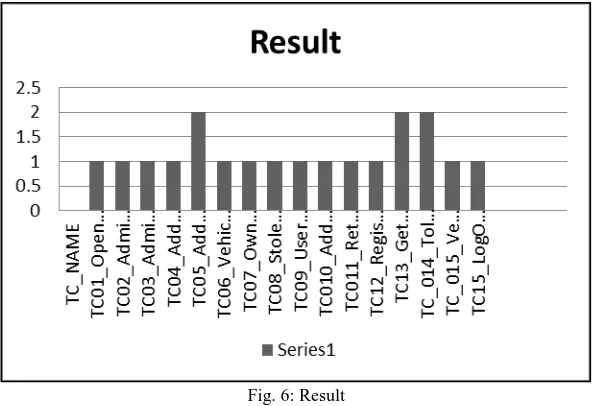
Following bar graph shows the system modules are in pass and fail status which satisfies objectives and expected and as well as actual results.
Fig. 6: Result
VII. CONCLUSION
The sole purpose of this paper was to promote cashless transactions under Digital India initialization by Hon. Prime Minister Shri Narendra Modi. Smooth trafficking at the toll plaza site corruption less transactions as well as reducing air pollution, stagnant long queue traffic will be reduced. We also concluded in implementing theft detection module in our project and also our system showed promising results in achieving daily toll transactions and submitting reports directly to Govt. authority.
Future Scope:
Range coverage between tollbooth and RFID tags can be increased so that the tap on system can be replaced by active RFIDs. Basically, the SQL-DB servers that are running are hosted on local system but they can be replaced by using cloud that can be helpful in handling databases and server loads.
Using data mining concepts we also can improve our system in data analysis report and use semi-supervised machine learning [5].
ACKNOWLEDGEMENT
We would like to express our gratitude towards our guide Asst. Prof. P. S. Hanwate sir for his kind co-operation and encouragement which helped us in completion of this project. During the period of learning and implementing, he supported us in every aspect. He was the one who helped and motivated us to propose research in this field and inspired us with his enthusiasm on research, his experience and his lively character. Our thanks and appreciations also go to project members in developing the project and people who have willingly helped us out with their abilities.
REFERENCES
[1] Jayapriyaa. CT, Y. Bevish Jinila,” Secured Short Time Automated Toll Fee Collection for Private Group Transportation”, IEEE Sponsored 2J/d International Conference on Innovations in Information, Embedded and Communication systems (ICIIECS)2015
[2] Amol Dhumane, Rajesh Prasad, Jayashree Prasad, “Routing Issues in Internet of Things: A Survey”, Proceedings of the International MultiConference of Engineers and Computer Scientists 2016 Vol I, IMECS 2016, March 16 - 18, 2016, Hong Kong.
[3] P. S. Hanwate, Narin Meher, Ashlesh Mandke, Manoj Nikam, Manan Mehta “A Review on Automated Toll Collection System” IJSTE - International Journal of Science Technology & Engineering | Volume 3 | Issue 06 | December 2016
[5] Ashlesh N. Mandke, Dr Rajesh S. Prasad “A Survey of Image Mining & its Applications” International Engineering Research Journal (IERJ), Volume 2 Issue 6, 24th December 2016.
[6] Amol Dhumane, Rajesh Prasad, Jayashree Prasad “An Optimal Routing Algorithm for Internet of Things Enabling Technologies” International Journal of Rough Sets and Data Analysis (IJRSDA) 2017.