www.ijres.org Volume 4 Issue 12 ǁ December. 2016 ǁ PP.01-05
Information Recognition of Unsupported Sleepers Based on the
ICA
Zhuang Chao, Zheng Shu Bing, Zhang Bo
College Of Ur Ban Railway Transportation, Shanghai University Of Engineering Science,Shanghai ,China
ABSTRACT: Independent component analysis is a new method of blind source separation, which processes object is a set of mixed signal source independent by linear combination generated. And it’s final objective is to separate the separate signal components from the mixed signal. To study the effect of different unsupported sleeper situations on the sleeper dynamic response in the vertical direction., the vehicles-track vertical coupled dynamic model was established. Analysis the dynamic response changes of the track structure caused by the sleeper hanging, the results show that: the blind source separation method based on ICA can be effectively used to deal with the wheel acceleration signal.
Key words: blind source separation, dynamics, independent component, signal
INTRODUCTION
As an important component of track structure, the sleeper suffers from the rail’s isotropic pressure and
elasticly spreads on the bed, besides, maintains the track geometry effectively [1]. However, as results of the incomplete consistent sleeper ballast characteristics, uneven subgrade filling, influence bed surface roughness
and load eccentricity and so on, not only are subgrade and ballast slowly sinking due to vibration so that the gap
appears between the sleeper and the sleeper ballast, but also a considerable part of sleeper is not fully support or
completely suspended.
Olsson [2] and others measured it and found that the voided sleeper is extremely common. The gap between the sleeper and ballast varied in different end of the same sleeper. And in different seasons, the vacant
amount of the same sleeper is different.
Voided sleeper commonly exists [3]. Sleeper will not transfer the forces which come from the steel rail to track bed after sleeper being partly or completely suspended. And this would lead to the problems such as
sleeper damages, the growth of the rail corrugation, the damage of rail fastener and rail gasket failure [4]. It
would increase workload and cost of line maintenance. And more serious time might cause a serious derailment
accident.
At present, analyzing the impact on vehicle and track sleeper is mainly by experiment and numerical
simulation methods. Through the experiment and numerical analysis. Grassie [ 5] hold that when sleepers are dangling, the wheels and track are not smooth, so the Sleepers are easily crushed. Ishida[ 6 ]are also believe that when sleepers are dangling, the fatigue life of rail welding will be greatly reduced.
The principle of the ICA algorithm
The ICA problem can be simply described. Assuming that a total of N sensors is picked up to N
observation signals xi,i= 1,2,…,N, Each observation signals is the linear mixture of the independent source of
signals , such as
X
A
*
S
. Among them,1 2
[
,
,
]
TN
X
x x
x
and1 2
[
,
,
]
TM
S
s x
s
are themixed signal vector and source signal vector. A is unknown mixed matrix of
N
*
M
. When the source S andindependent source signals, such as
S
ˆ
=W·X. What is hope to be able to approach to the real source signal. Thekey problem can be solved better to create an independent judgment criterion and a corresponding algorithm of
separating the results through the ICA method. The different Independent judgment criteria is oppose to the
different separation algorithm and is widely used in the fast ICA algorithm which is based on negative entropy -
Fast ICA.
The central limit theorem shows that a random quantity is composed of many independent random sum,
as long as the independent means and variances of random quantity are limited, then regardless of distribution of
independent random quantity, random quantity will close to gaussian distribution. So you can use the non
gaussian (or gaussian) metrics of separation results to monitor the independence of separation results. When the
separation results reach non gaussian peak (or gaussian reaches the weakest), it shows that the separation of
each independent component has been completed. For the random quantity y of a probability density function
p(y), the negative entropy is defined as
( )
(
Gauss)
( )
Ng y
H y
H y
Type: yGauss have the same variance of gaussian random quantity with y; H(·) as the information entropy of a random variable, and there are
( )
( ) l g ( )
H y
p y
p y dy
But, in practice, the calculation of Ng (y) need to know the probability density distribution function, it
is obviously impractical for blind source separation problem. In view of this, the literature [7] gives a kind of
approximate formula to measure the separation results with non gaussian, namely
2( )
[
( )
(
Gauss) ]
Ng y
E G y
E G y
Type: E(·) is the average computing; G(·) equal to nonlinear function:
1 1
1
1
l g cosh(
)
G u
a u
a
,
2 2
exp(
u
/ 2)
G u
etc, and
1
a
1
2
. The concept of formula is simple, the formula has fast operation and robustness. What’s more, the formula can measure the result of the separation of non Gaussian to identify whether complete separation process [7].FastICA algorithm firstly remove the average of mixed signal x and bleach processing signal vector
x
with unit covariance, and then look for separation matrix
W
to accomplish independent component extraction. The extracted process is also a process of iterative approximation. A simple inductive FastICA separationprocess is as follows:
1)The mean removal and bleaching processing of mixed signals; 2)Selecting randomly initial separation matrix with unit variance;
3)Calculating
(
)
(
)
T T
x
x
W
E
GW
E G W
x
W
;4)Fixing separation matrix:
W
W
/
W
.
( )
ˆ( )
s t
W
x t
If the source signal contains multiple independent components, you can repeat the process of separation, have to pay attention to that:①each extraction of an independent component, must be subtracted from the mixed signal of this component, so repeat until all the independent components of complete separation;②In the case where only the mixed signals are known and the mixing matrix and the source signals are unknown, the order of the source signals and the true amplitudes can not be solved. This is easily seen from the mathematical model of the problem of blind separation.
Vehicle vibration data acquisition
The vehicle-track vertical coupling dynamics model mainly refers to the car body model including the car, the bogie and the wheelset, including the rail model of rail, Floating slab, sleeper and track bed;The vertical contact force between wheel and rail is obtained by Hertz nonlinear elastic contact theory, and the contact relationship between wheel and rail is obtained, and the vehicle-track vertical coupling dynamic model is shown in the figure.
Car body
bogie
wheel set
rail
Floating
slab
Car body
bogie
wheel set
rail
Floating
slab
The vehicle model is a multi-rigid body model with half-car, including 1 body, 2 bogies and 4 wheelsets.The vehicle is modeled as a multi-rigid body system running at speed v on the track structure, which fully reflects the The bogie has three degrees of freedom of ups and downs, side rolls and nods. Each wheel pair has two degrees of freedom of ups and downs and side rolls, totally 10 degrees of freedom. The motion equation of the vehicle system can be referred to [15].
The mathematical expression of the power spectral density of the track irregularity is determined by using the US orbital spectrum as the excitation. By selecting the appropriate state vector, the vehicle differential equation is transformed into the state space equation, and the numerical integration is carried out.The acceleration of wheelset is obtained by using the track irregularity power spectrum of the US 6-class track as an example, the vehicle speed is 200km / h, and the sampling frequency is 10000HZ.
III. ICA-BASED ANALYSIS PROCESS
To use the theory of ICA to denoise, we must at least construct a signal with the source signal has the same sampling point of the relevant signal, the signal can be translated after the signal source, but also a pure ship noise signal.So that the two signals can be constructed using the above two methods of denoising.
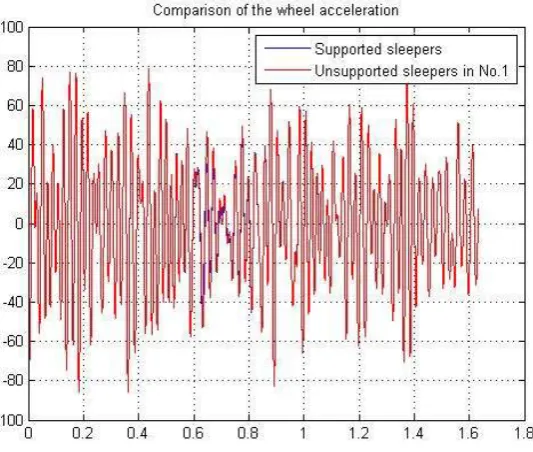
Fig. 1 two signal before separation
Figure 1 displays the analysis of two signals before separation. The red one represents the signal about unsupported sleepers, The blue one represents the signal about supported sleepers. Firstly, the blind source separation of ICA is used to separate the two signals shown in Figure 1. The results are shown in figure 2.
Fig. 2 two signal after separation (Waveforms)
The results before and after separation are shown. One of the uncertainties in the blind source separation is the order of the uncertainties and the other is the signal amplitude of the uncertainties. In Figure 1 and Figure 2, the signal amplitude of unsupported sleepers before and after separation is obviously different. In fact, the signals of supported sleepers before and after separation are also significantly different. In Figure 2 the first picture shows the results of supported sleepers after the blind source separation in No.1.
IV. CONCLUSION
In this paper, blind source separation is performed by using Fast ICA method. The test results show that the ICA-based blind source separation method can be used to deal with wheel acceleration signals, which are reliable and accurate, and can effectively reflect the situation of unsupported sleepers.
At present, with the rapid construction development of China's high-speed railway, the technology about track maintaining and testing need to be improved urgently. The public works departments should strengthen the Inspection and management of unsupported sleepers and eliminate timely to ensure the safe run of high-speed trains.
ACKNOWLEDGEMENTS
This project is sponsored by Shanghai University of Engineering Science Innovation Fund for Graduate Student(No.15KY1003).
REFERENCE
[1]. CHEN Xiu-fang .Railway engineering [ M] .Beijing :China Architecture &Building Press , 2005. [2]. Olsson E L, Zackrisson P.Long -term measurement results[ R] .Sweden :Borlänge , 2002.
[3]. Auguetin S, Gudehus G, Huber G, et al. Numerical model and laboratory tests on settlement of ballast track [ M] . Berlin: Springer Verlag , 2003:317-336.
[4]. ISHIDAM, MOTOT, KONOA, etal. Influence of Loose sleeper on track dynamics and bending fatigue of railwelds[J]. Quarterly Report of RTRI, 1999,40(2): 80-85.
[5]. Grassie S L, Cox S J.Dynamic response of railway track with unsupported sleepers [ J] .Transport Engineering , 1985, 199(2):123 -135 .
[6]. Ishida M , Moto T, Kono A, et al.Influence of loose sleeper on track dynamics and bending fatigue of rail welds [ R] . Quarterly Report of RTRI , 1999 , 40(2):80-85.