Vol. 06, Issue 10(Oct. 2016), ||V2|| PP 61-68
Studies of Physical Properties Changes of Epoxy Compositions
Including Elastomeric Polyurethanes Prepared With Different
Polyols
Daeyeon Kim,Taehee Kim, BongkukSeo
*, Choong Sun Lim
*Center for Chemical Industry Development, Korea Research Institute of Chemical Technology, 45, Jongga-ro, Yugok-dong, Jung-gu, Ulsan 44412, Republic of Korea*To whom correspondence should be addressed
Abstract: Elastomeric polyurethanes (PUs) were synthesized and added to epoxy resin. This was done to com-pensate for the brittleness of the epoxy resin. The PUs, which comprisesoft segments and hard segments, are often used as a toughener for an epoxy resins. Different types of polyols such as polycarbonate diol, polybuta-diene diol, polypropylene glycol, and polytetrahydrofuranhave been used to change the soft segments of the PUs. The modified soft segments of the PUs were added to the epoxy resin in order to see how the modified soft segment changed the physical properties of the epoxy resin compositions. The results showed that theintroduc-tionof PUs into the epoxy compositions composed with bisphenol A epoxy resin and dicyandiamide curing agent lowered both tensile and flexural strength in general, but significantly increased the impact strength of the cured epoxy composition including ether-type polyol-PUs. Scanning electron microscopy was used to confirm the improved impact resistance by studying the phase separation of the PU in the cured epoxy resins. Further-more, the existence of polyether polyol-PU in epoxy resin afforded high lap shear strength for steel sub-strates.Specifically, the epoxy resin containing polytetrahydrofuran-PUshowed three times higher T-peel strength than that of epoxy neat resin (i.e., resin without any toughening agent). The results showed that PUcan be used to toughen epoxy resins.
Keywords: Polyurethane, Epoxy resin, Adhesive, Physical property, Adhesive property
I.
INTRODUCTION
Epoxy resin is one of the most popular thermosetting polymersthat are used in wide-ranging industrial fields such as adhesives, coatings, composites, and electronics[1-3].Cured epoxy resin provides excellent me-chanical properties, higher chemical resistance, and lesser shrinkage strain than other thermosetting resins in molding processes. Also, the curing reaction of the epoxy resin does not generate any water as a by-product [4]. However, epoxy resins have certain disadvantages as well, such as short workability time by forming a gel, yel-lowing of the cured resins, and high brittleness causing breakage on impact.Althoughepoxy resins show poor adhesion with hydrophobic polymer or crystalline polymer substrates, epoxy resinshave been studied for the preparation of high-performance adhesives with high toughness by introducing rubber or thermoplastic polymer as a toughener [5,6]. Elastomeric polyurethanes(PUs) with urethane (-NH-CO-O-) functional groups are one of themost common polymeric tougheners that can compensate for the brittleness of the epoxy resins.Pusare com-posed of a soft segment made of an alkyl long chain and a hard segment comprising a relatively short chain of diisocyanate. The mechanical properties of the Puscan be modified byreacting different types of polyols with diisocyanatesor chain extenders [7,8].Also, polyols can be classified aseither polyester or polyether types [9-11]. Polyester polyols can be applied to PU to improve its mechanical properties and abrasion resistance, and po-lyether polyols can be used to afford high elastic properties to PU.Aromatic or aliphatic diisocyanates function as hard segments of PU and form peptide bond with the hydroxyl group of polyols, resulting in the restriction of rotation of the molecule.Elastomeric PUs are used as adhesives or additives of adhesives to impart toughening effects to the resin [12]. The PUs, which aremiscible with epoxy resins,enhance the toughening properties by causing phase separation owing to the high-temperature curing process. For the purpose of enhancing toughness of epoxy matrix, four different types of polyols were used to prepare PUs with different physical properties. Previously, we studied the toughening effects of the PUs in two pot epoxy compositions composed with cycloa-liphatic epoxy resin (celloxide 2021P) and methylhexahydrophthalic acid curing agent[13].
measured to determine the relation between the mechanical and adhesion properties resulting from the tough-ness change of the epoxy compositions.
II.
EXPERIMENTAL
1.1. Materials
Polycarbonate diol (PCD) was purchased from Nippon Polyurethane. Polybutadiene diol (PBD) was ob-tained from Mirae Tech. Polypropylene glycol (PPG), polytetrahydrofuran (PTHF),isophoronediisocyanate (IP-DI),dibutyltindilaurate (DBTD), and 2-allylphenol (2-AP) were purchased fromSigma-Aldrich. Diglycidyl ether of bisphenol A (DGEBA, EPIKOTE 828) was obtained from Momentive. Dicyandiamide(DICY)and 1,1-dimethyl-3-phenyl urea (fenuron) werebought from Air Product Co. All reagents were used further purifications.
1.2. Preparation of polyurethanes
The PUs were synthesized with the method described in the patent[14]. Four different types of polyols (PBD, PPG, PTHF, and PCD) were individually reacted with isophoronediisocyanates (IPDI) at 80 ℃ to pro-duce their corresponding elastomeric PUs. The terminal –NCO of the PUs, on both sides of the polymer, was capped with 2-AP to stabilize the final PU. The PU prepared was analyzed with Fourier transform infrared spec-troscopy (FT-IR) to confirm that there was no remaining –NCO at 2270 cm-1.
1.3. Preparation of epoxy compositions
The formulation data used is presented in Table 1. Reference epoxy resin comprised bisphenol A epoxy resin and a DICY curing agent. The curing temperature was adjusted by fenuron to make the reaction occur at 170 ℃ for 2 h. The mixtures were blended in a reactor equipped with a vacuum pump and a mechanical stirrer (Eurostar digital, IKA) at 70℃and 400 rpm for 50 min.
1.4. Characterizations
Gel permeation chromatography (GPC; 1260 Infinity series, Agilent Technologies) was used to analyze the molecular weight of prepared elastomeric polyurethanes. The peak of –NCO terminal group of the polyure-thanes shown at 2270 cm-1 was monitored with fourierinfrared (FT-IR) (Nicolet 6700/Nicolet Continuum). Dif-ferential scanning calorimeter (DSC, Q2000, TA Instruments)was used to determine the reaction activation energy (Ea) of the epoxy compositions made of different types of PUs. The main aim was to determine whether the different polyols would affect the stability of the cured resins.The experiments were carried out using a dy-namic method by running DSC at heating rates of 2, 5, 10, and 20 K/min from 25 ℃ to 250 ℃. The dynamic thermal properties of the cured epoxy resins were characterized with dynamic mechanical analysis (DMA, Q800, TA Instruments). The cured resins were used to make a test specimen of size 60 × 12 × 3 mm.The analysis was conducted with a dual cantilever probe at 1 Hz of frequency and 10m of amplitude at a heating rate of 5℃/min in the temperature range of 30–200℃.The tensile strength of the cured plastics was determined using a universal testing machine (UTM, model 5982, INSTRON). All testing and conditioning procedures were carried out as ASTM D-638. The flexural strength and modulus were obtained according to ASTM D 790M using a 3-point bending at a crosshead speed of 1.2 mm/min. The impact strength was measured with an Izod impact tester (CEAST 9050, INSTRON) according to ASTM D 256. The fractured test specimen obtained from Izod impact tests were studied using scanning electron microscopy (SNE-3000M, SEC). Also, lap shear strength was deter-mined by pullingouttest specimenprepared by bonding two SPRC 440 substrates (101 × 25 × 1.6 mm) with each epoxy composition by overlapping 12.7 mm. The test was performedasASTM D 1002 method with UTM at a cross-head speed of 1.3 mm/min. The T-peel strength test specimen having T-shape was prepared by applying each epoxy compositionbetweentwo SPCC substrates (150 × 25 × 0.8 mm).The tests were conducted by UTM according to ASTM D-1876 at a cross-head speed of 254 mm/min. The test specimen for determining the adhe-sive performance was cured at 170℃ for 30 min after epoxy compositions were applied on the substrates.
III.
RESULTS AND DISCUSSION
Elastomeric Puswere prepared by using the four different polyols (Fig. 1),withthe same molecular weight of 2,000g/mol and a similar range of number average molecular weight (Mn) of 7,000~9,000 g/mol (PB;9,200, PolyTHF; 7,150, PPG; 8,151, PCD; 9,026).Pusare known to form round particles that can be useful for absorbingthe impacts in the cured epoxy resin.The changed soft segments in PU are predicted to bring about toughening effects when it is added into epoxy resin compositionsfollowed by curing at high temperatures.
−ln 𝛽
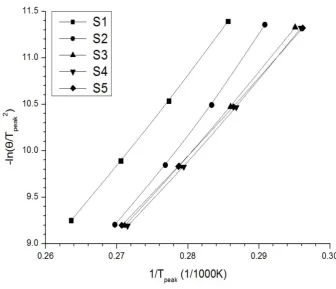
𝑇𝑝𝑒𝑎𝑘 = 𝐸𝑎 𝑅𝑇𝑝𝑒𝑎𝑘 − ln
𝐴𝑅
𝐸𝑎 (1)
(Where β is the heating rate (K/min), and Ea is the activation energy (kJ/mol)).
Fig.2 shows the shift of Tpeakcaused by changingthe heating rates from low temperature to high temperature. Fig.3 displays the plot of-ln (θ/Tpeak
2
) vs (1/Tpeak) to obtain activation energy as a slope of the linear line. The calculated activation energies for the compositions are presented in Table 2. The activation energies of epoxy compositions with PU were lower than that of EP, except for the composition comprising PCD-PU. The results indicate that the curing reaction of epoxy resin and amine curing agent requires lower energy when PU is added into the epoxy composition.
The physical properties such as tensile or flexural strength of epoxy compositions with PUs prepared with different polyols were compared by curing each composition at 170 ℃ for 30 min (Fig. 4 and 5). Fig. 4 shows that the tensile strength of epoxy compositions with PUs was lower than that of epoxy composition with-out PU (EP). The tensile strength of PBD-EP and PTHF-EP sharply decreasedas shown in Fig. 4. This may have resulted from the elastic properties of PUthat providesflexibility, resulting in the reduction of the brittlenessof the cured epoxy matrix. PUs prepared with polyether polyols such as PPG, PTHF, or PBD decreasedthe tensile strength of the epoxy matrix because of theirbetter rubber properties than those of PU prepared with PCD.
The effects of PUs in the epoxy matrix were further observed by measuring the flexural strength of the cured epoxy matrixescontaining PUs. Fig. 5a shows that the flexural strength of all epoxy matrices, except for PCD-EP,was 16–26% lower than that of the reference epoxy composition. Hence, introduction of PU containing polyether polyol affords flexibility to the epoxy matrix. On the other hand, PU having a rigid polyester polyol enhancesthe flexural strength of the epoxy matrix so that the matrix can endure higher stress. The polyester functional group of PCD-PU restrains the rotation of polyester bonded with –NCO and causes the formation of less flexible geometry that improvesthe stiffness. Fig. 5b shows the flexural modulus of each epoxy composition. PCD-EP shows a higher modulus than those of other compositions. Hence, it supports the claim that polyester-PU can improve the stiffness of the epoxy matrix, while polyetherpolyester-PUs are capable of increasing the flexibility to reduce the brittleness of the matrix.
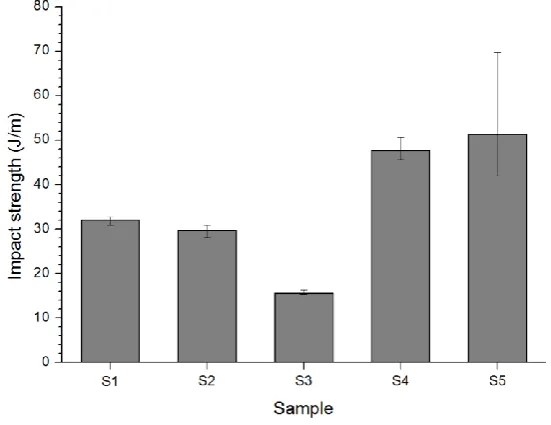
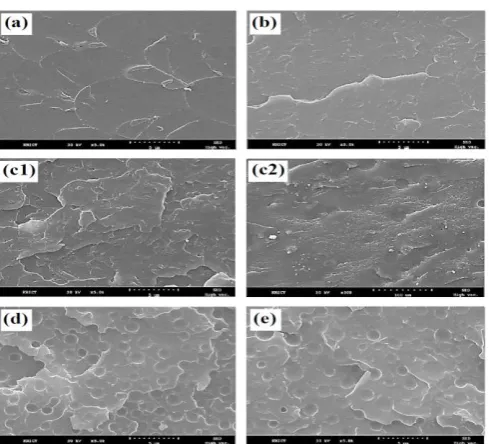
Fig. 6 shows the results of Izod impact tests of cured epoxy compositions. The epoxy compositions containing polyether-PU showed three times higher impact strength than those of PCD-EP or EP. The results were considered that the flexibility of the polyetherPUs lowers the brittleness of the epoxy matrix to enhance the impact resistance. The fractured surface of the impact test specimen was observed by SEM (Fig. 7).Fig. 7d and 7eshow thatthe phase-separated 1–2 mPU particlesor holes left by the removal of PU particles from the shock are arranged. The round particles are able to absorb impacts from the outside or distribute the impact to prevent crack formation. However, the phase-separated PU particles are not observed on the surface image of PCD-EP or EP. The absence of PU particles on the images explains the low impact resistance of these matrixes. Besides, the fractured image of PBD-EP shows that there are no micro particles of size 1-2 mbeneficial to absorb im-pacts in Fig. 7c1. Instead, larger particles (10–50 m) with smaller surface area in the limited areaare formed as shown in Fig. 7c2. Therefore, the impact resistance of PBD-EP was relativelylower than that of PPG-EP or PTHF-EP.
IV.
CONCLUSIONS
In conclusion, four Pushaving different soft segmentswere prepared to improve the mechanical proper-ties and adhesion performance of epoxy compositions. To synthesizethe PUs, the polyols species were changed while diisocyanate and capping agent were fixed.The results showed that the addition of PUs into the epoxy composition reduced the reaction activation energy during the curing process and provided flexibility to the cured epoxy composition, except for the rotation-restrained polyester PU. The low flexural strength of the epoxy compositions with polyether PU were owing to the rubber properties of the PUs. Low flexural strength of the epoxy compositions can help improve theirapplication as adhesives, even though such low flexural strength is not suitablefor preparing epoxy composites. In contrast, polyester PU increased the flexural strength of epoxy composition. The results of impact strengthtests showed that polyether PUs increased the toughness of the epoxy compositions by forming microparticles, as observed in the SEM images of the fractured surface. The results of lap shear strength and T-peel strength showed that polyether PUs improved the adhesion proper-ties. Specifically, PTHF-EP made the T-peel strength three times as high as that of EP.
V.
ACKNOWLEDGEMENT
Authors appreciate Mr. Jin-Hong Kim’s help for careful reading of the paper.
REFERENCES
[1] J.I. Moon, Y.H. Lee, H.J. Kim, S.M. Noh, J.H. Nam, M.S. Kim, J.K. Kim, J.H. Kim, J. Adhesion In-terf.,12, 99(2011).
[2] B.L. Zhang, G.L. Tang, K.Y. Shi, Y.C. You, Z.J. Du, J.F. Yang, J. Huang, Eur. Polym. J.,36, 205(2000). [3] R. Thomas, S. Durix, C. Sinturel, T. Omonov, S. Goossens, G. Groeninckx, P. Moldenaers, S. Thomas,
Polymer,48, 1695(2007).
[4] S.G. Hong, C.K. Chan, ThermochimicaActa,417, 99(2004).
[5] T. Ashida, A. Katoh, K. Handa, M. Ochi, J. Appl. Polym. Sci.,74, 2955(1999). [6] S. He, K. Shi, J. Bai, Z. Zhang, L. Li, Z. Du, B. Zhang,Polymer,42, 9641(2001).
[7] B.Y. Jeong, J.M. Cheon, J.W. Chun, D.Y. Mok, H.M. Lee, J. Adhesion Interf.,10, 169(2009). [8] K.H. Jin, U.R. Cho, Elastom. Compos.,49, 31(2014).
[9] R. Gogoi, M.S. Alam, U.K. Niyogi, Int. J. Res. Eng. Tech.,2, 393(2013). [10] A.A. Beltran, L.A. Boyaca, Lat. Am. Appl. Res.,41, 75(2011).
[11] L. Zhang, X. Ding, Y. Ou, Am. J. Chem. Appl.,1, 7(2014).
[12] D.Y. Mok, I.S. Kim, D.H. Kim, G.N. Kim, Elastom. Compos.,47, 318(2012).
[13] T.H. Kim,D.Y. Kim,S.H. Kang,B.K.Seo,C.S. Lim,Toughening epoxy compositions with polyurethanes tougheners,Sci. Adv, Mater., 2016;Manuscript accepted for publication.
[14] R. Mulhaupt, J.H. Powell, C.S. Adderley, W. Rufenacht, U. S. Patent 5,278,257 (1994) Jan 11.
[15] Cascaval CN, Rosu D, Mija AM, Rosu L., Kinetics of the curing reaction of selected epoxy resin-amine systems.Polimery 2006; 51: 199–205.
[16] W.S. Ahn, H.S. Lee,Elastom. Compos.,48, 161(2013).
[17] B.K. Min, D.R. Park, W.S. Ahn,Korean Chem. Eng. Res.,47, 169(2009). [18] J.J. Park,Trans. Electr. Electron. Mater.,13, 204(2012).
[19] M.G. Abiad, O.H. Campanella, M.T. Carvajal, Pharmaceutics,2, 78(2010)
TABLE CAPTIONS Table 1. Formulations of the epoxy compositions
Table 2. Calculated activation energy of each epoxy composition Table 3. Initial storage modulus and tan of each composition
Table 1. Formulations of the epoxy compositions
Composition Sample no.
S1 S2 S3 S4 S5
Polyurethane - 20
(PCD PU) 20 (PBD PU) 20 (PPG PU) 20 (PTHF PU)
Epoxy resin 100 100 100 100 100
Curing agent 10 10 10 10 10
Accelerator 1.3 1.3 1.3 1.3 1.3
Table 2. Calculated activation energy of each epoxy composition
Sample no. Heating rate (°C /min) Activation energy (kJ/mol, Ea)
2 5 10 20
S1 148.1 160.7 171.5 183.3 97.0
S2 140.6 151.5 161.5 172.9 101.9
S3 134.6 147.6 158.4 170.6 89.1
S4 133.5 146.4 157.5 170.0 87.4
S5 133.2 147.0 158.6 171.3 83.4
※ Unit = degree Celsius (°C)
Table 3. Initial storage modulus and tan of each composition Sample no. Initial storage modulus (MPa) Tan (°C)
S1 3257 155.0
S2 3689 105.9
S3 2387 126.2
S4 2560 131.4
S5 2648 132.6
FIGURE CAPTIONS
Fig. 1. A reaction scheme illustrating the PU synthesis. Fig. 2. DSC data of PTHF-EP with different heating rates. Fig. 3. Plot of -ln (θ/Tpeak
2
) vs (1/Tpeak) for each epoxy composition. Fig. 4. Tensile strength for different epoxy-PU formulations.
Fig. 5. Flexural data of each composition: (a) flexural strength, (b) flexural modulus. Fig. 6. Impact strength obtained by Izod impact test for each cured epoxy composition.
Fig. 7. Fractured surface images observed by SEM (a) S1, (b) S2, (c1) S3-x5000, (c2) S3-x300, (d) S4, (e) S5. Fig. 8. DMA data of epoxy compositions: (a) storage modulus, (b) tan data.
Fig. 9. Results of adhesion performance of epoxy compositions: (a) single lap shear strength, (b) T-peel strength.
Fig. 2. DSC data of PTHF-EP with different heating rates.
Fig. 4. Tensile strength for different epoxy-PU formulations.
Fig. 5. Flexural data of each composition: (a) flexural strength, (b) flexural modulus.
Fig. 7. Fractured surface images observed by SEM (a) S1, (b) S2, (c1) S3-x5000, (c2) S3-x300, (d) S4, (e) S5.
Fig. 8. DMA data of epoxy compositions: (a) storage modulus, (b) tan data.