Page 187 www.ijiras.com | Email: [email protected]
The Impact Of Computer Assisted Language Learning Lab On
Enhancing The Performance Of ESL Students
Mrs. Roshni Michael Bhakre
ESL Lecturer,
Scientific College of Design Oman
I. INTRODUCTION
A. RESEARCH BACKGROUND
The role of computers in this academic era is really undeniable. Computers are part of our daily life; they can encroach into academy level as they form inseparable part of this educational system. In the last decade, writing classes is one of the educational environments in our language classes which are highly influenced by computers. The prevalent word processing usage software has the most important role in writing classes that totally differ from writing during chat rooms (Zaini and Mazdayasna, 2014). That type of software not only changed the learner’s way of text production but also they provide fast and automated feedback for the learners to improve their performance doing such writing tasks. Computer assisted language learning (CALL) focuses on two main areas;
Development of learners work processing skills and text based learning usage
Graphic organizer supports the process of writing. Word processing showed positive impact in terms of text quality and quantity, writer’s attitudes and text length as well
as in revision quality (Pennington, 2004). Understanding the CALL scope is not very complicated by the advancement constraint in the hardware and software as well as computer literacy increase among both learners and teachers. Thirty years ago, CALL was constrained to the exercise of on screen writing with the sample graphics. Currently, CALL interactions are more alike including, communication, video, sounds and animation all over the internet chat lines, emails and local area network (Beatty, 2003). The new language learning which is specially designed for non native learners of English as second language (ESL) as well as English as a foreign language (EFL) that is gaining acceptance all over the globe, so as a result it got quite encouraging in educational system.
Abstract: Teaching English has always been a challenging task to the instructors, especially when teaching the ESL students. As a result, use of technology and computer assisted tools has widely increased among academicians and educational institutions across the globe. This research will investigate in detail the impact that Computer Assisted Language Learning Lab, established at the Scientific College of Design, Muscat, Oman on enhancing the English Speaking skills and performance of students. A survey has been conducted with 150 ESL students studying at the Scientific College of Design, Muscat and statistical analysis has been applied on the collected primary data. The results reveal that CALL Lab facilities do enhance the English language skills of non-native English speaking students studying at the Scientific College of Design.
Page 188 www.ijiras.com | Email: [email protected] Source: Hafiz, (2013)
Figure 1: Preferred resources in ELT
The above figure 1 illustrates the resources that is highly preferred in the English learning and teaching, they are web based lessons 5 % use, internet 8 % use, projector 50 % use, multimedia aids 70 % and Software 70%.
Many researchers use CALL for ESL teaching and learning, so that they gain more exposure using the computers mainly for word processing, drills, spreadsheets and also for the extent of interest research and used in problem solving. The practical experience of teaching computer skills to learners, gives a positive effect for both learners and teachers by enhancing their performances in the process of learning and writing (Egbert, et al 2002).
CALL software is very unique and equipped with various programs to use in the language setting for the teachers. Even if the teachers have limited skills in using the CALL software, they gain knowledge quickly with its best features, degree of success in making positive impact in learners learning skills and its effectiveness in gaining computer technology experience (Hubbard, 2006).
According to Lu (2006), the potentiality of the internet in the educational system is not fully explored and so many educational institutions are not making use of it, but after entering into the informative age the technological use and teaching English as a second language have kept its foot print in educational system strongly. Thus teacher’s involvement in the CALL software in education technology has brought students to attain high level of knowledge, improves the learner’s academic achievement and technologically integrated. Therefore learners are now actively participating in the learning and writing process and gaining encouragement to be creators as well as explorer of language learning than a recipient of it (Lee, 2000).
B. RESEARCH QUESTION:
What is the impact of CALL Lab on enhancing the performance of General Foundation Programme level three students studying at Scientific College of Design, Oman?
II. LITERATURE REVIEW
A. EXISTING STUDIES
Liu and Huo (2007) studied about CALL in China. CALL has delivered better results in most of the universities in China. CALL has helped the learning of English language with higher potential. CALL software has played an important role to manage the language learning with the advent of networked computers and the multimedia. Moreover, technology has played an important role in the adoption of CALL in the learning process. The successful CALL application has entailed a large investment in the facilities. Habbard (2006) has evaluated the CALL software. Language learning potential, learner fit, meaning focus, authenticity, positive impact and practicality are some of the criteria significantly linked with the CALL software. In meaning
focus, the extent to which the attention of learners has directed towards the language meaning. Authenticity refers to the correspondence degree between the activity of learning and target interest with language activities to learners out of the classroom. Checklists, methodological framework and SLA research based approaches are some of the three major approaches related to the evaluation of CALL software. Learner training seems to be a significant part of CALL software implementation. The CALL software has provided the learners with some training so that they can make better decisions when working in independent manner. Further, this has employed a cyclical approach making ongoing training effective. It has used collaborative debriefings to motivate students to reflect on their process of learning after using the software.
Villada (2009) study focused on CALL evaluation for early foreign language learning. Multivocality, contextualization and interpretation have followed by the proposition which may also provide a framework for future evaluation of CALL. The CALL evaluation has created the complex relationship with the elementary education and it may integrate within the program of teacher education effectively. CALL software has met the following requirements such as pedagogical validity, adaptability of curriculum, efficiency and effectiveness. Moreover, the description of product, technical features, procedures of activity, learner and teacher fit and summary including evaluation are some of the generic parameters used for the evaluation of software (Burston, 2003). Moreover, the preliminary considerations, pedagogical consideration and adaptability to computer medium are the three important aspects of this CALL software (Calico, 1983).
Crusan (2011) has evaluated CALL with the integrated approach to effectiveness research in CALL. Learner fit, authenticity, practicality, control of learner, error correction and feedback are some of the different criteria that played a potential role in the enhancement of performance of ESL students. CALL is used to deliver variety of resources through a variety of different approaches of teaching. Chien (2011) analyzed the effects of CALL instruction on the acquisition of passive grammatical forms by post-secondary ESL students. CALL has created an impact on grammar skills in the beginning of EFL (English as a foreign language) learners. The author has predicted that there has been no significant difference in the acquisition of the passive grammatical forms acquisition for ESL students taught in a conventional classroom setting when compared to those taught by CALL. CALL software has the tendency to provide the essential social interaction which is crucial for learning as a regular classroom instruction and these are also capable of providing to students successively. It can be analyzed that each individual student using CALL software would get equal opportunity to interact with the program and receive instant feedback from it.
Page 189 www.ijiras.com | Email: [email protected] learning potential acts as the central criterion in the evaluation
of CALL. Hegelheimer and Tower (2004) studied about using CALL in the classroom. They also have analyzed the interactions of students in an authentic classroom. The video capturing materials on studies have not based on multimedia CALL, but they represent an input modification in at least one sense. The time and proficiency may have a significant effect on the use and the effectiveness of such options in CALL software. The teachers can develop tasks linked with the CALL software that also encourages the use of interaction options effectively. Moreover, interaction options accessing has found to be an active predictor for success in terms of answering questions within the software correctly. The screen layout, timing, control options, user input, input judging, feedback and help options are number of subcategories linked with CALL software created a significant impact on the learners. Learning style, management of classroom, linguistic objectives, language skills, language difficulty, program difficulty, content, learner variables and syllabus are some of the elements of learner fit which are closely related with each other. At last, CALL evolution seems to be situation-specific and its central consideration is language learning potential. This can also be evaluated both empirically and judgmentally.
B. CONCEPTUAL FRAMEWORK
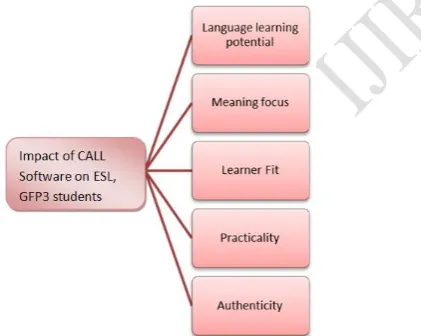
The following figure illustrates the conceptual framework to study the impact of CALL Lab on enhancing the performance of ESL students with specific reference to the Scientific College of Design, Muscat, Oman.
Figure 2: Conceptual framework for the impact of CALL Lab on enhancing the performance of GFP3 students- study with
specific reference to Scientific College of Design, Muscat, Oman
III. RESEARCH METHODOLOGY
Research paradigm model is the effort by the expert's data collection, which will be engaged around the gathering of the thoughts, assumptions and the qualities in the examination. The research paradigm model will be of two genuine sorts: positivism and interpretivism. The positivism is the quantitative framework and will rely upon the estimations of the associations of the factors (Denzin and Lincoln 1994). The
aim of the study is to investigate the impact of CALL Lab on enhancing the performance of ESL Students. The sample will be the ESL students from the General Foundation Program, Level 3, at Scientific College of Design.
This research makes usage of the positivist system. The research will take after the overview since the appropriate responses must be in a numerical structure. Many investigators explains that positivism is said to have balanced here in the investigation of the way that this research intends to test an expected hypothesis of examination by analyzing and collection of quantifiable data as information and numbers.
As shown by Fetterman (1989), an investigation technique is the framework for the gathering of new information. This is named by the framework done by the expert. Quantitative examination approach and the subjective investigation system are the two sorts of strategies. The examination philosophy followed in this investigation is quantitative investigation. The quantitative study uses numerical strategies and information. It tends to be relied on numerical estimation of wary parts of occasion. In quantitative examination, the work of the researcher is to find out analyze and burden is taken to amass the experts from guaranteeing the data through individual venture with the review subjects (Freeman 1998).
The research design is the speculative structure that incorporates the examination procedure and the method for examination to be driven. The review arrangement structure is the blue print for estimation, gathering and information examination. This research takes after the descriptive research design. Descriptive examination agreements with all that can be measured or coordinated. Descriptive examination is for the most part done at the circumstances when a researcher needs to have arithmetical thoughts of factors in the examination.
Sampling techniques is the arrangement or strategy that helps the examiner to pick the strategy to gather the information from the immeasurable sampling outline. It is divided into probability sampling and non-probability sampling technique. This examination takes after the strategy for likelihood sampling technique. The consequences of the pilot will be assessed whether the information gathered utilizing the survey are adequate to answer the proposed research inquiries of the review or need to do any progressions. From that point forward, with the required changes, last review will be done utilizing the close-ended surveys. The sample size of the study is 150 students of Scientific College of Design, Muscat, Oman.
The research gathers the primary and secondary information for the investigation of data. The gathered information will be assessed by methods for factual apparatuses and applications like straight forward rate investigation, chi square test and relationship tests. The examination will be done utilizing SPSS. The study furthermore, takes after the approval strategies like validity and reliability.
IV. ANALYSIS AND DISCUSSION
Page 190 www.ijiras.com | Email: [email protected] and majority of the total 150 students are observed to be
Omani and only few percentage 3 % were found to be non – Omani. The next important factor that was discussed was regarding the age group of the students and it has been observed that 63.3 % of the students were between the age group of 18 -25 years and the next important factor that was discussed in the survey was regarding the gender and it has been inferred that majority of the students were female and only 0.7 % of the total 150 students were male.
A language laboratory is nothing but a facility or a class room that is organized by the management of the college where students make use of the technology to learn English language. It has been noted that the concept of language lab was made possible by the phonograph, which was invented by Thomas Edison in 1877 which permits reproduction and recording of sounds. The very first language learning lab facility was named as The University of Grenoble’s language learning facility which was found in the year 1908. Analog cassette tapes was initially used by the students in which they played the recordings of the native speakers on repeat mode and listened to the pronunciation, sentences and phrases and also the entire dialogues through headset in order to understand and learn the language. Later in the 80’s with increased usage of computer and development in technology a lot of advancement was made in the language lab facility for the betterment of the students.
From the survey conducted on 150 students studying at Scientific College of Design, Oman, it is evident that the language lab facility has improved the student’s performance in reading a language, in addition the language learnt by the students helps them to use that particular language outside the class. The CALL LAB facility strongly motivates and encourages the students to read and learn English language and it is said to have strong impact on the students. The Language that is learnt with the help of CALL LAB is authentic in its quality and it is proved to be learner’s fit. The students also stated that the online Call activities helps the students by giving them immediate feedback and also quick response which again benefits the students who are making use of this CALL LAB facilities. Majority of the students have suggested that such CALL LAB facilities not only helps them in reading the English language, grammar and vocabulary but also simultaneously it helps the students to remember the rules and strategies that are followed in grammar, pronunciation and vocabulary. 1CALL Lab enhanced my performance in learning English
19It helps me to use the language outside
of class
1CALL Lab enhanced my performance in learning English
Pearson Correlation 1 .505**
Sig. (2-tailed) .000
N 150 150
19It helps me to use the language outside of class
Pearson Correlation .505** 1
Sig. (2-tailed) .000
N 150 150
**. Correlation is significant at the 0.01 level (2-tailed). Table 4.1
7CALL online activities give me immediate feedback and response which is very useful for me
8CALL strongly motivates me tolearn English
7CALL online activities give me
immediate feedback and response which is
very useful for me
Pearson Correlation
1 .799**
Sig. (2-tailed) .000
N 150 150
8CALL strongly motivates me to learn English
Pearson Correlation
.799** 1
Sig. (2-tailed) .000
N 150 150
**. Correlation is significant at the 0.01 level (2-tailed).
Table 4.2
Statements
N Mean
Std. Deviation
16The CALL Lab duration of 2 hours per week is enough to complete all the online activities in reading, grammar and listening
150 1.71 .619
17The headphones and monitors are suitable for the CALL Lab
150 2.09 .941
14CALL Lab helps me to learn different strategies in grammar, reading and listening
150 3.49 .873
9Language learning in the CALL Lab helps me to remember the rules in grammar,
vocabulary, and pronunciation
150 3.50 .880
15 CALL Lab creates a positive learning experience for me
150 3.51 .880
6CALL lab helps to adapt our own self-paced learning
150 3.57 .992
2Do you think that, use of CALL is an advantage in learning English
150 3.61 1.122
3CALL lab helps to improve our abilities and preferences
150 3.62 1.072
10The online instructions for the activities are clear and easy to understand
150 3.65 .851
4CALL lab helps me in my learning styles 150 3.70 .954
8CALL strongly motivates me to learn English
150 3.77 .972
18The instructor is supportive and helpful in the CALL Lab
150 3.77 1.071
1CALL Lab enhanced my performance in learning English
150 3.77 1.287
13The online activities are at an appropriate level
150 3.79 .959
19It helps me to use the language outside of class
150 3.80 1.043
11CALL lab provides exercise for learning all the four skills in English language
150 3.82 .927
5CALL lab allows me to control my own learning progress and process
150 3.83 1.028
7CALL online activities give me immediate feedback and response which is very useful
for me
150 3.92 1.090
12The online activities helps me to focus my attention towards one skill at a time
150 3.95 .992
Valid N (list wise) 150
Page 191 www.ijiras.com | Email: [email protected] V. CONCLUSION
Language Lab or CALL LAB is generally a visual narration or audio-visual tapes that are used as a modern tool to teach a particular language to the students. Such language lab facilities are said to be set up in universities, schools and academic institutions to improve the process of teaching language to the students.
CALL LAB that was used in the past was said to be very outdated in terms of technology and it is after the invention of the computers that these language labs developed. Without a language lab it will not be possible for an instructor to teach a foreign language to a set of 30-40 students within an hour. In the past, Analogue tapes and cassettes were used by the students in order to learn the phrase, sentence, pronunciation by playing the tapes on repeat mode and then follow the same way that was spoken by the native speaker on the cassettes.
There are various advantages of setting up a language lab because it offers the students facilities like recording their own voice and play it back in order to know how well they speak and also provides self-access for independent learning which includes access to resources outside the class. It has been proven that such language lab helps, encourages and motivates students to read language in a better way and the immediate feedback received helps the students in rectifying their mistakes and the language lab also offers the facility to the teachers to alter and modify the materials based on the students’ requirements. The modern language lab is said to create positive learning experience for the students and helps them to remember the vocabulary, pronunciation and rules in grammar. The language lab helps the students to concentrate on one skill at a time and also facilitates the students to learn all the four skills of the English language. The online instructions via CALL LAB are highly helpful for the learners to read English language through modern language lab. A. RECOMMENDATIONS
From this study conducted at the Scientific College of Design, Oman it is understood that the modern language lab has highly benefitted the GFP3 students to learn English language and understand the rules of grammar, pronunciation and also enhanced the vocabulary of the students while learning the language. The following suggestions can help the universities and the academic institutions to improvise the facilities in the CALL LAB for the betterment of the students, Language lab facilities have to be made compulsory in all the colleges and the universities for the betterment of the language learning process of the students.
The universities and institutions have to incorporate all the recent developments in technology in the language lab for improvising the technical facilities inside the CALL LAB.
VI. RESEARCH LIMITATIONS AND FUTURE SCOPE
The study takes into consideration exclusively the impact of Call Lab facilities in enhancing the English Language skills of the students who are non-native English speakers.
However, there are other external and internal factors as well that would impact English learning performance of students which in future could be empirically explored in order to get better and improvised results. The findings of this study is limited to Scientific College of Design, Muscat, and the sample size is restricted to 150 students. Therefore, this study could be further extended to other educational institutions across the Middle East and also other parts of the world in order to make a comparison of factors that impact English learning skills of ESL students across various geographic locations.
REFERENCES
[1] Beatty. K, 2003, Applied linguistics in action: CALL, London pearson
[2] Burston, J. (2003). Software selection: A primer on source and evaluation. CALICO Journal, 21, 29-40. Retrieved December 1, 2008, from https://calico.org/ page.php?id=5
[3] CALICO. (1983). Wanted: Courseware reviewers and reviews. CALICO Journal, 1, 53-54. Retrieved De¬cember 1, 2008, from https://calico.org/page.php? id=5
[4] Chien Y C (2011), Effects Of Computer-Assisted Language Learning (CALL) Instruction On The Acquisition Of Passive Grammatical Forms By Post-Secondary English As A Second Language (ESL) Students, Retrieved from: http://etd.fcla.edu/CF/ CFE0003970/Chien_Ya-Chi_201108_EdD.pdf
[5] Denzin, N. K., & Lincoln, Y. S. (Eds.). (1994). Handbook of qualitative research. Thousand Oaks, CA: Sage. [6] Egbert. J, et al 2002 The Impact Of Call Instruction On
Classroom Computer Use: A Foundation For Rethinking Technology In Teacher Education, Language Learning & Technology, 6(3), pp. 108-126.
[7] Fetterman, D. M. (1989). Ethnography: Step by step. Newbury Park, CA: Sage.
[8] Fielding, N. G., & Fielding, J. L. (1986). Linking data. Beverly Hills, CA: Sage.
[9] Hafiz. K, (2013), An investigation into CALL in English language teaching through language laboratory, IOSR, 6(6), pp. 8-14.
[10] Hegelheimer V and Tower D (2004), Using CALL in the classroom: Analyzing student interactions in an authentic classroom, Elsevier: System, Vol-32, pp 185-205.
[11] Hubbard P (2006), Evaluating CALL Software, Retrieved from: http://web.stanford.edu/~efs/calleval.pdf
[12] Hubbard. P, 2006, evaluating CALL software, CALICO, pp. 1-26.
[13] Leakey J (2011), Evaluating Computer-Assisted Language Learning: An Integrated Approach to Effectiveness Research in CALL, Language Learning and Technology, 16 (2), pp 35-37.
Page 192 www.ijiras.com | Email: [email protected] [15] Liu M and Huo H (2007), Computer Assisted Language
Learning (CALL) in China: Some Common Concerns, Asian EFL Journal.
[16] Lu. S, (2006) Barriers on ESL CALL Programs in South Texas, MERLOT Journal of Online Learning and Teaching, 2(3), pp. 158-168.
[17] McMurry, B L (2012)., "Evaluation in Computer-Assisted Language Learning", All Theses and Dissertations, Retrieved from: http://scholarsarchive.byu.edu/cgi/ viewcontent.cgi?article=4305&context=etd
[18] Pennington. M, 2004 Electronic media in second language writing: an overview of tools and research findings. In S. Fotos and C. M. Browne (Eds.), New Perspectives on CALL for Second Language Classrooms, pp. 69-92.
[19] Villada E G (2009), CALL Evaluation for Early Foreign Language Learning: A Review of the Literature and a Framework for Evaluation, CALICO Journal, 26 (2), pp 363-389.
[20] Zaini. A and Mazdayasna. G, 2014, The Effect of Computer Assisted Language Learning on the Development of EFL Learners’ Writing Skills, Social and Behavioral Sciences 98, pp. 1975 – 1982.
[21] Freeman, D. (1998). Doing teacher research: From inquiry to understanding. Boston, MA: Heinle & Heinle. [22] Brown, J. D. (2004). Research methods for Applied