Performance Analysis of Fuzzy C-Means
Clustering using Multichannel Decoded Local
Binary Pattern
V. Alan Gowri Phivin1 , A.C. Subhajini2
1
Research Scholar, 2 Assistant Professor, Department of Computer Applications, Noorul Islam Centre For Higher Education,Kumaracoil, Tamilnadu, India.
Abstract
The construction of large database with thousands of data storage and image acquisitions have
been facilitated with developments. Suitable
information system requires proper handling of these datasets in efficient manner. Content-Based Image Retrieval (CBIR) is commonly used system to handle these datasets and on the basis of image substance the images that are related to the user given query for which the CBIR extracts the images from large image databases. The goal of feature extraction is to obtain the most relevant information from the original data and represent that information in a lower dimensionality space. Local Binary Pattern (LBP) based descriptors have been used for the purpose of image feature description. Local binary pattern has widely increased the popularity due to its simplicity and effectiveness in several applications. We used adder- decoder based two schemas for the mixture of the LBPs from over one channel. Finally, Calculate feature vector to form a single feature vector. Clustering the image using Fuzzy C-means clustering under semi-supervised framework.The experiments square measure executed over six benchmark color texture image databases. The performance of the proposed descriptors improved for three input channels and also in the RGB color space. The performance of mdLBP is also superior to non-LBP descriptors. It is pointed out that mdLBP outperforms the state-of-the-art descriptors over large databases.
I.INTRODUCTION
In modern days, image plays an important role in every field such as business images, satellite images, and medical images and so on. The main challenge to manage large image databases and retrieve the similar images without fully searching the overall database every time. This leads to great savings in time. However, they are also discovering that the process of locating a desired image in a large and varied collection can be a source of considerable frustration. The problems of image retrieval are becoming widely recognized. Hence, the search for solutions become an active area increasingly. CBIR is the process of retrieving images from a database or library of digital images according to the visual content of the images.
In other words, it is the retrieving of images that have similar content of colors, textures or shapes. Images have always been an inevitable part of human communication and its roots millennia ago. Images make the communication process more interesting, illustrative, elaborate, understandable and transparent. In CBIR system, it is usual to group the image features in three main classes: color, texture and shape. Ideally, these features should be integrated to provide better discrimination in the comparison process. Color is the most common visual feature used in CBIR, primarily because of the simplicity of extracting color information from images.
To extract information about texture and shape feature are more difficult and costly tasks, usually performed after the initial filtering provided by color features. Many applications require simple methods for comparing pairs of images based on their overall appearance. For example, a user may wish to retrieve all images similar to a given image from a large database of images. Color histograms are a best way to this problem, the histogram describes the gray-level or color distribution for a given image, they are computationally efficient, but generally insensitive to small changes in camera position. Color histograms also have a little restrictions. A color histogram provides no spatial information; it merely describes which colors are present in the image, and in what quantities. In addition, color histograms are perceptive to both compression artifacts and changes in overall image brightness. For the design of histogram based method the main things we require are appropriate color space, a 1color quantization scheme, a histogram representation, and a similarity metric. A digital image consists of a set of pixels. Each pixel represents a color. Colors can be represented using different color spaces depending on the standards used by the researcher or depending on the application such as
Red-Green-Blue (RGB), Hue-Saturation-Value
(HSV), YIQ or YUV etc.
II. RELATED WORKS
images such as medical, signature, nature, satellite images and so on. Thus the high demand is on the storage, organization and searching of digital images. The main challenge of researchers in this field is to retrieve the similar images from huge database based on user requirements.
Metty Mustikasar [1] and others proposed a method, in this method from local histogram the images are reclaimed based on color featuring. In this method the image is automatically divided into equal sized nine sub blocks. By enumerating the HSV color space into the 12x6x6 histogram the color of each and every sub-block can be exported. In this classification the similarity measure can be calculated using Euclidean distance and City block distance. G.H. Liu and J.Y Yang [2] proposed A Histogram Searching Algorithm. In this work, the image is transformed into the desired color space. To generate a grid code via vector quantization, the feature vector derived from the color histograms of the image are used. To improve retrieval speed in vector space indexing can be performed. Lining Zhang, Lipo Wang [3] proposed a new BDA method identified as generalized BDA (GBDA) for CBIR. BDA aims to extract the most discriminative positive information from negative samples. It defines the between-class scatter by resorting to inter class close neighbourhood sample. S.Liao [4] proposed Dominant Local Binary Pattern (DLBP). DLBP assures that by approaching on one side they could be able to characterise the dominant patterns on different textured images. Using the circularly symmetric Gabor filter many global features are extracted also responses encapsulate the special associations between isolated pixels. This method achieves the maximum classification in different types of texture databases and image conditions. Chuen-Horng Llin and Rong-Tai Chen [5] proposed diversity linking Pixel of Scan Patterns (DBPSP).Here, three image features are proposed for image recovery. First and second image features are based on color and texture features, called colour co-occurrence matrix. Colour histogram for K-mean is the third image feature which is based on colour distribution. DBPSP calculates the diversity linking pixels and converts to possibility of the incident on entire image. The drawbacks of existing system are
• Increases the dimensionality of the model
• Classification problem
• Losing information because of the process of quantization
• Inefficient search and retrieval
III. PROPOSED WORK
In the research community texture based image
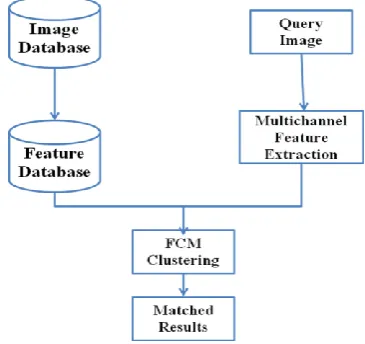
description is now very common. Recently, for the principle of image feature description local pattern based descriptors have been used. Due to its ease and efficiency in several applications Local Binary Pattern (LBP) has widely attained popularity. To recognize the LBP , many other LBP variants are used for gray scale images, that means normally only one channel can be performed well. But in real situations the ordinary color images are required to be differentiate which are having more than two channel. For its efficient image feature and simplicity LBP is usually used. It is adopted with feature description over three channels of the images (Red, Green and Blue channel). In the situation of color LBP, simply concatenated LBP histogram of each channel, there is no cross-channel co occurrence information. In order to capture the cross-channel co-occurrence information to some extent. In this paper, we introduce two multichannel decoded local binary patterns namely multichannel adder local binary pattern (maLBP) and multichannel decoder local binary pattern (mdLBP). The local information of multiple channels have been utilized on both maLBP and mdLBP on the basis of the adder and decoder concepts. For images belonging to the same class, the image indexing process is optimized using data clustering techniques. Using image retrieval experiments over ten databases having images of natural scene and color textures, the proposed methods are evaluated. The block diagram of proposed system is in figure 1.
Figure 3.1: Block Diagram of FCM Clustering method
In this part, we are proposing two multichannel decoded local binary pattern approaches namely multichannel adder based local binary pattern (
maLBP) and multichannel decoder based local binary pattern (mdLBP )and this is to utilize the local binary pattern information of multiple channels in efficient manners. The number of input channels c≥2 is applied to multichannel adder and decooder and produced c+1 and 2c number of outputs respectively.
ℛ of any pixel It (x ,y ) for x ∈ [1, u] and y ∈ [1,v] are defined as Itn(x ,y ) where n∈[1,N]. According to the definition of the Local Binary Pattern, LBPt(x,y) for a particular pixel (x ,y ) in tth channel is generated by computing a binary value LBPtn(x.y), given by the following equation,
(1)
Wherever,
(2)
Then f n is a weighting function described by the equation ,
fn = (2)(n-1) , ∀ n ∈ [1,N ] (3)
We must established N values, LBPtn(x,y) aimed at a specific pixel (x,y) consistent toward all neighbor Itn(x ,y ) of tth channel. Currently we relate the propose idea of multichannel LBP adder then multichannel LBP as decoder through as, LBPtn(x,y)|∀ t∈ 1, equally the c
input channels. Contract, the multichannel adder created local binary pattern maLBPnt1(x,y) then multichannel decoder based local binary pattern
maLBPnt2(x,y) remain the productions of the multichannel LBP adder and multichannel LBP decoder respectively, where t1∈[1,c+1] and t2∈[1,2c
]. Since the values of LBPtn(x,y) are in the binary values (0 or 1). Therefore, the values of maLBPnt1(x,y) and maLBPnt2(x,y), are binary format produced by the multichannel adder maMn(x.y) and multichannel decoder map mdMn (x.y) respectively related to each neighbors n of pixel (x ,y).
Figure3.2: The confined nationals (𝑥, 𝑦) of a midpoint pixel 𝐼𝑡𝑥, 𝑦 now 𝑡th network now glacial
direct scheme aimed at 𝑛∈ [1, 𝑁] also 𝑡∈ [1, 𝑐].
The adder decoder map table of maMn(x ,y) and
mdMn(x ,y) aimed at c=3 are shown in Table 1 is taking 4 and 8 discrete values respectively. The equations of maMn(x,y) and mdMn( x,y) are following as,
(4)
(5)
The multichannel adder centered local binary pattern
maLBPnt1(x, y) aimed at pixel (𝑥, 𝑦) from multichannel adder maMn(x ,y) then 𝑡1 is calculated as,
(6)
Also, the multichannel decoder centered local binary pattern maLBPnt2(x, y) aimed at pixel (𝑥,𝑦)
after multichannel decoder chart 𝑚𝑑𝑀n(𝑥,𝑦) then 𝑡2 is calculated as,
(7)
TABLE I
Multichannel adder centered local binary pattern and multichannel decoder centered local binary pattern remain assumed through combining the histograms of
𝑚𝑎𝐿𝐵𝑃𝑠 then 𝑚𝑑𝐿𝐵𝑃𝑠 over each output channel is
known as,
The method of calculation of 𝑚𝑎𝐿𝐵𝑃 and
𝑚𝑑𝐿𝐵𝑃 feature descriptor of an image is illustrated in
Calculate histograms of each maLBP and mdLBP based binary patterns.
Figure 3.4:An illustration of the computation of the adder/decoder binary patterns, and adder/decoder
decimal values for 𝑐 = 3 and 𝑁 = 8
Concatenate these histograms to form a particular feature vector i.e., concatenated histogram. Finally, Fuzzy C means clustering is performed then the image is retrieved based on the similar image present in database.
A. Input - Image: At first, feature vector is mined from each input image and saved in database. Now system will mined image structures for this query.
B. Output- Retrieve Matched Images: This module will display thecorresponding images to the operator founded arranged clustering. The RGB value of the query image is related with all RGB values of the file images. Images are gathered created arranged their similarity stages.
C. Local Binary Pattern: Convert Image to Binary Bit Value. LBP is used for mine description over each Red, Green and Blue channel of the image.
D. Feature Extraction: Two multichannel decoded local binary pattern methods i.e. Consumes the local binary pattern information of multiple channels in effectual conducts. Records of output channels are created by means of via multichannel adder and decoder respectively.
Figure3.4:Flowchart of computation of MADLBP feature
vector and MDLBP feature vector of an image from itsRed (R), Green (G) and Blue (B) channels and combined the feature vector and apply FCM
clustering
1. Multichannel Adder: Multichannel adder based local binary patterns for the middle pixel , is calculated. Adder arrangements having for 𝑡1∈ [1,4].
2. Multichannel Decoder: Multichannel decoder based local binary patterns for the middle pixel , is calculated. Adder patterns having for n∈ [1,8] Relating the adder and decoder change the inter channel de-correlated data is acquired.
E. FCM Clustering:The histogram output channel of
adder and decoder is calculated. Clustering is
performed mainly the image collections that are maximum related are clustered collected. Images in the clusters are arranged in a descendent instruction created and then the images arranged their similar ideals. Image is related with all images present in folder basis of the similar image present in database.
IV. EXPERIMENTS AND RESULTS
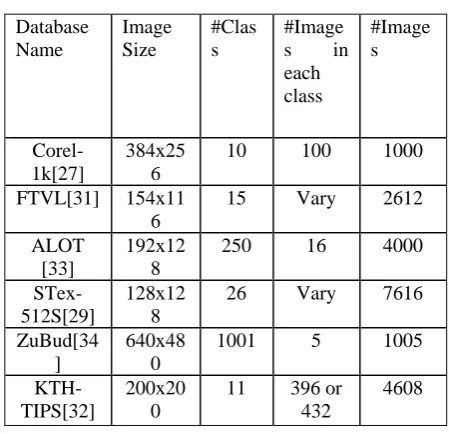
In this paper, we are conducted extensive CBIR experiments over databases containing the color images of natural scenes, textures, etc. The number of images, number of categories, number of images in each category and image resolutions used in the experiments are mentioned in Table II. The images of a category of a particular database are semantically similar. For example, the Corel-1k database consists of 100 images from different categories namely “Buildings‟, “Buses‟, “Dinosaurs‟ etc.
Table II Image Database
Database Name
Image Size
#Clas s
#Image
s in
each class
#Image s
Corel-1k[27]
384x25 6
10 100 1000
FTVL[31] 154x11
6
15 Vary 2612
ALOT [33]
192x12 8
250 16 4000
STex-512S[29]
128x12 8
26 Vary 7616
ZuBud[34 ]
640x48 0
1001 5 1005
KTH-TIPS[32]
200x20 0
11 396 or
432
4608
score measured using different distances between the query image and database images. If the returned image is from the category of the query image, then we say that the system has appropriately retrieved the target image, else, the system has failed to retrieve the target image.
The performances of different descriptors are investigated using ARP and ARR. To demonstrate the effectiveness of the proposed approach, we compared our results of Multichannel Adder and Decoder Local Binary Pattern (i.e. maLBP & mdLBP) with existing methods such as Local Binary Pattern (LBP). In content based image retrieval, the main task is to find most similar images of a query image in the whole database. We used each image of any database as a query image and retrieved NR most similar images.
(10)
Where ℂ is the total number of categories in that database, and are the average precision and average recall respectively for a particular category of that database and defined as follows for ith category,
(11)
Where ℂ is the number of images in the ith
category of that database, Pr and Re are the precision and recall for a query image and defined by the followingequation
(12)
Where NS is the number of retrieved similar images, NR is the number of retrieved images, and ND
is the number of similar images in the whole database.
A. Implementation
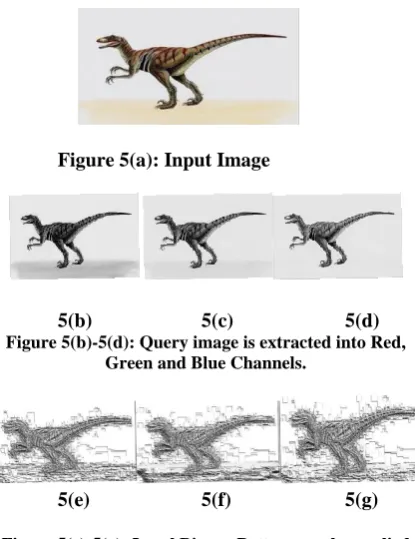
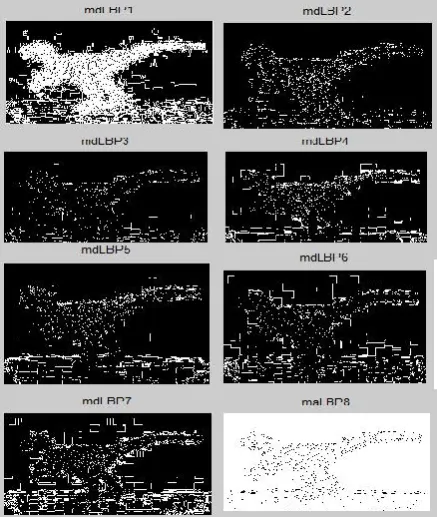
An illustration of the adder output channels and decoder output channels are presented in the Figure. 5 for an example image. An input image in RGB color space (i.e. 𝑐 = 3) is shown in Figure 5(a). The corresponding Red (R), Green (G) and Blue (B) channels are extracted in the Figure 5(b) 5(c) and 5(d) respectively. Three LBPs corresponding to the Figure 5(b-d) are portrayed in the Figure 5(e-g) for R, G and B channels respectively. The four output channels of the adder and eight output channels of the decoder are displayed in Figure 5(h) and Figure 5(j) respectively. It can be perceived from the Figure 5 that the decoder channels are having a better texture differentiation as compared to the adder channels and input channels while adder channels are better differentiated than input channels. In other words, we can say that by applying the adder and decoder transformation the inter channel de-correlated information among the adder and decoder channels increases as compared to
the same among the input channels. The images are grouped most similar are clustered together using fuzzy c- means clustering . Query Image is compared with all images in the folder arranged the base of the comparison of their color feature space.
Figure 5(a): Input Image
5(b) 5(c) 5(d)
Figure 5(b)-5(d): Query image is extracted into Red, Green and Blue Channels.
5(e) 5(f) 5(g)
Figure 5(e)-5(g): Local Binary Pattern can be applied over the Red , Green and Blue Channels.
Figure 5(h): Output Channel of adder is extracted from Local Binary Pattern
Figure 5(j): 8- Output Channel of decoder is extracted from Local Binary Pattern
Figure 5(k): Feature Vector of mdLBP
Figure 5.1: Retrieved Images
The behavior of proposed multichannel based descriptors is also observed by conducting an experiment with varying number of input channels (𝑐). For 𝑐 = 3, all three channels Red (R), Green (G) and Blue (B) are used whereas for 𝑐 = 2, three combinations are considered; 1) (R, G), 2) (R, B) and
3) (G, B). The image retrieval experiments are performed over Corel-1k databases as depicted in Fig. In this experiment, 20 images are retrieved using maLBP and mdLBP with (R, G), (R, B), (G, B) and (R, G, B) input channels and ARP (%) is computed to demonstrate the performance.
V. PERFORMANCE ANALYSIS
We have performed extensive image retrieval experiments over six databases of varying number of categories as well as varying number of images per category to report the improved performance of proposed multichannel decoded local binary patterns. We have reported the results using average retrieval precision (ARP), average retrieval rate (ARR), average precision per category (AP) and average recall per category (AR) as the function of number of retrieved images (NR). Figure 6.1 shows the ARP vs NR plots for LBP, maLBP and mdLBP descriptors over Corel-1k. The ARP values for each NR∈ [1,10] using decoder based mdLBP descriptor are higher than other descriptors over each database. Figure 6.2 shows the ARP vs NR plots for LBP, maLBP and mdLBP descriptors over Corel-1k
Figure 6.1: The performance comparison of proposed maLBP and mdLBP descriptor with existing approaches
LBP
VI. CONCLUSION
In this paper, two multichannel decoded local binary patterns are introduced namely multichannel adder local binary pattern (maLBP) and multichannel decoder local binary pattern (mdLBP). Basically both maLBP and mdLBP have utilized the local information of multiple channels on the basis of the adder and decoder concepts. The proposed methods are evaluated using image retrieval experiments over ten databases having images of natural scene and color textures. The results are computed in terms of the average precision rate and average retrieval rate and improved performance is observed when compared with the results of the existing multichannel based approaches over each database. From the experimental results, it is concluded that the maLBP descriptor is not showing the best performance in most of the cases while mdLBP descriptor outperforms the existing state-of-the-art multichannel based descriptors. It is also deduced that Chi-square distance measure is better suited with the proposed image descriptors. The performance of the proposed descriptors is much improved for three input channels and also in the RGB color space. The performance of mdLBP is also superior to non-LBP descriptors. It is also pointed out
that mdLBP outperforms the state-of-the-art
descriptors over large databases.
Experiments also suggested that the
introduced approach is generalized and can be applied over any LBP based descriptor. The increased dimension of the decoder based descriptor slows down the retrieval time which is the future direction of this research. One future aspect of this research is to make the descriptors noise robust which can be achieved by using the noise robust binary patterns over each channel as the input to the adder/decoder.
REFERENCES
[1] Metty Mustikasari, Sarifuddin Madenda, “Content Based Image Retrieval Using Local Color Histogram”, International Journal of Engineering Research ,Volume No.3, Issue No.8, pp : 507-511, 2014. [2] G.H. Liu and J.Y. Yang, “Content-based image retrieval using
color histogram,” Pattern Recognition, vol. 46, no. 1, pp. 188-198, 2013.
[3] Lining Zhang, Lipo Wang And Weisi Lin, “Generalized Biased Discriminant Analysis For Content-Based Image Retrieval”-2012
[4] Chuen-Horng Lin And Rong-Tai Chen, “A Smart Content-Based Image Retrieval System Content-Based On Color And Texture Feature”-2008
[5] S.Liao, M.W.K. Law, and A.C.S. Chung, “Dominant local binary patterns for texture classification,” IEEE Transactions
on Image Processing, vol. 18, no. 5, pp. 1107-1118, 2009.
[6] Hassan Farsi, Sajad Mohamadzadeh ,Colour and texture feature-based image retrieval by using Hadamard matrix in discrete wavelet transform 2013.
[7] Yan Liang, Le Dong, Shanshan Xie, Na Lv and Zongyi Xu, “Compact feature based clustering for large-scale image retrieval, 2014
[8] Chuen-Horng Lin and Rong-Tai Chen, “A smart content-based image retrieval system based on color and texture feature, 2008.
[9] P.S. Hiremath and Jagadeesh Pujari, “Content Based Image Retrieval using Color, Texture and Shape features. “,2017. [10] Dengsheng Zheng, Aylwin Wong, Maria Indrawan, Guojan
Lu, “Content based Image Retrieval Using Gabor Texture Feature “, 2001.
[11] Guang-Hai Liu, Jing-Yu Yang, ZuoYong Li, “Content-based image retrieval using computational visual attention model, ”2014
[12] T.W.Chiang and T.-W. Tsai, “Content-based image retrieval using multiresolution color and texture feature”, 2016 [13] Ali Montazer, Davar Giveki, “Content based image retrieval