Shape and Texture based Palm Print
Recognition System for Biometric
identification
Srushti Kureel1 , Praveen Kumar2 Mtech Scholor1, Assistant Professor2
Department of Electronics & Communication Engineering, Trinity Istitute of Research & Technology, Bhopal
Abstract. Biometric systems are widely used in access control and security-based applications. The goal of the biometric system is to utilize physical and/or behavior characteristics to identify/verify the subject of interest. There are so many biometric systems that are based on physical and/or behavioral properties such as the face, iris, speech, keystroke, palmprint, retina, etc. Among these, the palmprint-based biometric system that has been investigated for over 15 years has demonstrated its applicability as a successful biometric modality. It shows a unique feature that can be obtained using texture features which are present due to the presence of palm creases, wrinkles, and ridges. Furthermore, the palmprints can be captured using low-cost sensors with a very low-resolution imaging.
In this paper we propose a novel scheme for palmprint recognition using a shape and Texture based feature analysis obtained from Statistical Image Features. The palmprint image is characterized by a rich set of features including principal lines, ridges, and wrinkles. Thus, the use of an appropriate texture descriptor scheme is expected to capture this information accurately.
Keywords: Image Processing, biometric, texture,
recognition, palmprint, fingerprint, authentication, Collectability, extraction
I. INTRODUCTION
Authentication is the process the validating the user who is attempting to gain access to a system. Traditional authentication and authorization system were based on password and keys. These passwords were hard remember and could be easily stolen and the unauthorized person can easily gain access to the system[1]. Usage of biometrics get rid of all these insecurities. Biometric form of authentication is safer because biometrics of an individual cannot be stolen and there is no need to remember any passwords.
Biometric authentication relies on the unique biological characteristics of individuals to verify the identity for securing access to a system. Generally individuals are identified based on physiological and behavioral characteristics. The behavioral characteristics include signature, voice, keystroke dynamics and giant. The physiological characteristics are finger and palm prints, iris and retina scans, hand, face and ear geometries, vein and nail bed etc [ 1] [2] [4]. Automated methods of verifying or recognizing
the authenticity of a person is based on such characteristics of individuals. Among these, the most popular characteristics are the finger, palm prints and iris scans. Biometric systems are increasingly found in many places such as airports, banks, and hospitals etc., human traffic and to maintain a secure environment.
The Palm print recognition is one of the most necessary applications of the biometric based authentication systems. Traditionally, ID card or Passwords have been used for applications, ranging from airport security, attendance marking, prevent from access to restricted areas, online banking. These types of identity recognition methods exhibits serious disadvantages, as the security issues are still at stake [1]. In biometrics, person identification is uniquely done on the basis of the person’s behavioral/physical attributes. For access control applications, biometric based technologies can be used. Biometric methods are becoming the backbone of highly secure person identification and verification alternatives. As the security breaches and transaction frauds are increasing, the need for new technologies that provide high security is very much essential. The major advantage of biometric methods over existing methods, are unique for each person and cannot be time varying. The palmprint recognition system works by taking the person’s palm as a biometric tool for authenticating and identifying person’s identity. Palmprint patterns are a very reliable and accurate biometric that require minimum cooperation from the user for extraction. The devices with low resolution can easily capture the palmprint which also contains additional features namely ridges, flexion creases and secondary creases of the palmprint. Therefore the palmprint recognition system can be very much useful for everyone and it does not require any personal information of the user and less expensive also.
after preprocessing the palmprint images. Later, the features of the captured image are compared with the stored data base. The methods for low resolution palmprint images (75 or 150dpi) are very much evident. The methods for extracting the features of the low resolution palmprint image include different edge detection techniques. Then principal component analysis or linear discriminant analysis is used to reduce their dimensionality. To compare the reduced features, distance measures or classifiers are used. The features namely singular points and minutiae are also extracted for palmprint images which have high resolution (500dpi).
Figure 1: Online Palmprint Image
Figure 2: Offline Palmprint Image
Figure 3: Features of Palmprint Image
II. PROPOSED METHODOLOGY
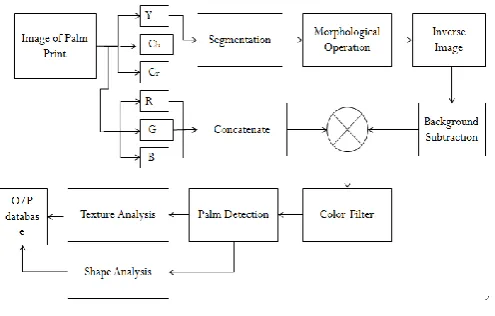
Figure 4: Flow chart of Proposed Methodology
Procedure of Proposed Methodology:
(1) Palm print is obtained using image acquisition technique then Pre-processing of Palmprint is done.
(2) First of all Image is converted into its complementary image of Y, Cb, Cr channel.
(3) Red colour is dominating channel due to its illuminance hence red channel of the image is chosen for the processing.
(4) Image segmentation is performed in order to extract the separate pattern. After that morphological operation is carried out to get features of the image.
(5) Background image is obtained by applying the inverse on the image. Hence palm print is gathered.
(6) Texture analysis and shape analysis is performed to get the features of the image like Average gray level, Average contrast, Measure of smoothness Measure of uniformity, Entropy, Static Moment & Centroid.
(7) KNN classifier and Euclidean distance is used to classify the image and to evaluate the accuracy.
III DESIGN & IMPLEMENTATION
There are 5 basic steps that are implemented in designing of
palmprint recognition system.
3. Texture analysis 4. Feature extraction 5. Matching
III.I Image capturing
In this first step, we collect image samples from different users. Then for each sample image, we obtain the central portion of palm because this portion of palm (i.e. palm region) is discriminatory for different person. Thus this pre-processing is required before feature extraction and coding step. Preprocessing operations are filtration operation on images of palm. Here we commonly remove background noise having low-frequency, normalize image intensity for every pixel, remove any existing reflection, and mask some portions of images. Therefore during pre-processing of image we enhance data images before to computational processing.
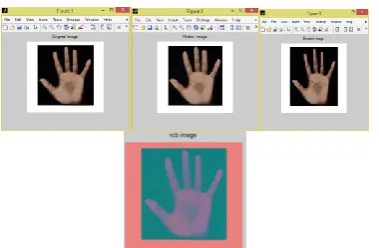
Figure 5: (a) Original Image (b) Dilated Image (c) Eroded Image (d) RCB Image
Figure 6: (a) 1st Property (b) 2nd Property (c) Third Property
III.II Shape Analysis
For shape analysis different edge detection technique is applied and it is seen that sobel edge detection technique is providing the better result. Then segmentation is carried out and centroid feature is
extracted for every image which is saved in the data base as a feature matrix.
Figure 7: Different Edge detection Technique (a) Roberts (b) Prewitt (c) Log (d) Sobel
Figure 8: Segmented Image
III.III Texture Analysis
For the Texture Image First of all ROI is extracted from the image. ROI of palm print can be represented in 2D array of M*N. It is defined as vector in the Eigen space method. Now, all palm vector of training set used to represent the principle components of the Eigen vectors of the co-variance matrix. Those Eigen vector define the subspace of the palm print, which are called "Eigen palms".
Method for extraction of ROI has the following important steps.
1. Separate the fingers from palm.
2. Identify two valley points first between ring and little finger and second between middle and index finger.
3. According to two valley points rotate the image and
finally correct position of image.
Figure 9: ROI of different sample Image
III.IV Feature extraction
After dataset pre-processing various features are extracted from processed palm image. Following are the extraction of feature from palm print.
1. Average gray level
2. Average contrast
3. Measure of smoothness Measure of uniformity,
4. Entropy
5. Static Moment &
6. Centroid
III.V Feature Matching
For available two data sets, we use an algorithm to match and find the percentage of similarity between them. Feature of test image and training images are extracted using above method. To perform the best matching of test image, the measuring is done on the basis of distance to locate the similar points of two palm prints. The nearest neighbor differentiator gives the ideas to determine the distance of input image with the image that is already present in database. ROI is always same for same user palm. Thus ROI is also one of the most important features of palm print image identification and all of the other features are present in this palm region. To extract ROI according to the location and segmentation, it reduces the difficulty in image matching and improves robustness of matching algorithm. The processing on extracted feature vectors is done by K- Nearest Neighbor (KNN) classifier. The KNN classifier is used to compute minimum difference in feature vectors of a user with existing database sample.
IV RESULT & DISCUSSION
On the basis of proposed methodology the palmprint is implemented for the biometric application process. The outline of the process can be seen from the below described pedagogy:
Figure 10: Outline of the Implemented work
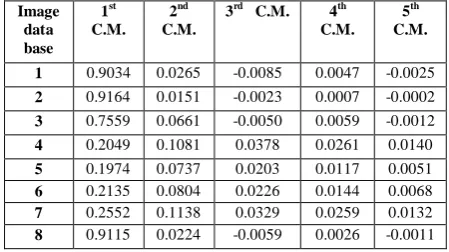
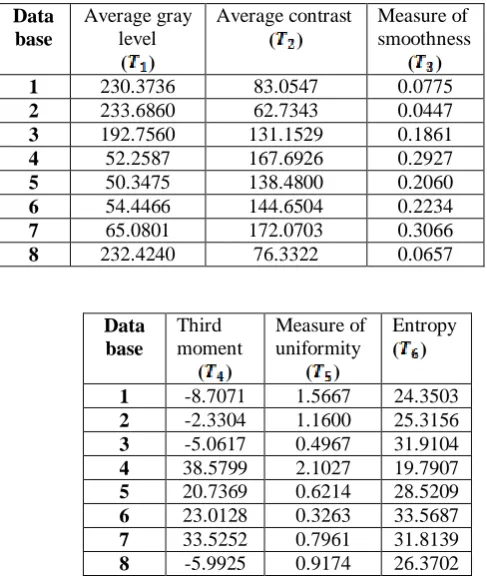
Extracted feature for different samples has been tabulated below and these features are matched with the palmprint using KNN Method.
Table 1: Texture analysis Features
Image data base
1st C.M.
2nd C.M.
3rd C.M. 4th C.M.
5th C.M.
1 0.9034 0.0265 -0.0085 0.0047 -0.0025
2 0.9164 0.0151 -0.0023 0.0007 -0.0002
3 0.7559 0.0661 -0.0050 0.0059 -0.0012
4 0.2049 0.1081 0.0378 0.0261 0.0140
5 0.1974 0.0737 0.0203 0.0117 0.0051
6 0.2135 0.0804 0.0226 0.0144 0.0068
7 0.2552 0.1138 0.0329 0.0259 0.0132
Table 2: Feature extraction (Central moment) from the data base Data base Average gray level ( ) Average contrast ( ) Measure of smoothness ( ) 1 230.3736 83.0547 0.0775 2 233.6860 62.7343 0.0447 3 192.7560 131.1529 0.1861 4 52.2587 167.6926 0.2927 5 50.3475 138.4800 0.2060 6 54.4466 144.6504 0.2234 7 65.0801 172.0703 0.3066 8 232.4240 76.3322 0.0657
Data base Third moment ( ) Measure of uniformity ( ) Entropy ( )
1 -8.7071 1.5667 24.3503 2 -2.3304 1.1600 25.3156 3 -5.0617 0.4967 31.9104 4 38.5799 2.1027 19.7907 5 20.7369 0.6214 28.5209 6 23.0128 0.3263 33.5687 7 33.5252 0.7961 31.8139 8 -5.9925 0.9174 26.3702
Table 3: Centroid of the Image from data base
Image data base X- coordinate Location Y –coordinate Location
1 105.6345 117.9048
2 97.2337 129.1437
3 114.9445 108.6358
4 115.5634 130.2694
5 46.0867 48.3846
6 37.9235 56.4943
7 48.4265 47.7662
8 58.5056 40.0257
When the accuracy is calculated for the test image and training image it is found that the accuracy rate is 99.63%.
VI CONCLUSION
In current scenario where we are living in the information age, because of advent of the technology there is a situation like information explosion. Images have giant share in this information. To access the large image archives more précised retrieval techniques are needed for finding relatively similar images.
In this research paper, we proposed a modified approach using colour, shape and texture based feature extraction. In our proposed approach, we provide
better accuracy with less complexity in recognition of palm print. In this proposed technique first we pre-process the palm print database because central part of palm (palm region) is discriminatory for different person. Then we extract ROI (Region of Interest) and remove other portion of palm area and pre-process it for further feature extraction. Various features based on shape, colour and texture are extracted from the pre-processed image and best matching is performed on existing database template.
This research is done on small database but in future this can be implemented on large database to check its accuracy and its complexity for real large implementation.
REFERENCE
[1] N. Frykholm. Passwords: Beyond the terminal
interaction model, 2000. University of Umea.
[2] Miller G. A., “The magical number seven, plus or minus two: some limits on our capacity for processing information”, Psychological Review, 63:81–97, 1956. [3] Salil Prabhakar Anil K. Jain and Lin Hong, “A
multichannel approach to fingerprint classification”,
IEEE Transactions on Pattern Analysis and Machine Intelligence, 21(4):348–359, 1999.
[4] Salil Prabhakar Sharath Pankanti and Anil K. Jain, “On the individuality of fingerprints”, IEEE Transactions
on Pattern Analysis and Machine Intelligence,
24(8):1010–1025, 2002.
[5] D. Zhang and W. Shu, “Two novel characteristics in palmprint verification: Datum point invariance and line feature matching Pattern Recognition”, 32(4):691–702, 1999.
[6] David Zhang Wenxin Li and Zhuoqun Xu, “Palmprint
identification by fourier transform. International
Journal of Pattern Recognition and Artificial
Intelligence”, 16(4):417–432, 2002.
[7] Ding Tianhuai Su Xiaosheng, Lin Xirong, “Palmprint
feature extraction based on wavelet transform”,
Tsinghua Univ (Sci and Tech), 43(8):1049– 1051, 1055, 2003.
[8] K.C. Fan C. C. Han, H. L. Cheng and C. L. Lin,
“Personal authentication using palmprint features
Pattern Recognition”, (Special issue: Biometrics),
36(2):371–381, 2003.
[9] David Zhang Wai Kin Kong and Wenxin Li.
“Palmprint feature extraction using 2-d gabor filters”, Pattern Recognition, 36:2339–2347, 2003.
[10] Jun ying Gan and Dang pei Zhou, “A novel method
for palmprint recognition based on wavelet
transform”, IEEE Proceedings of International
Conference on Signal Processing (ICSP2006),
volume 3, 2006.
[11] Kuanquan Wang Xiangqian Wu and David Zhang,
“Palmprint texture analysis using derivative of
gaussian filters” In The IEEE Proceedings of
International Conference on Computational
Intelligence and Security (ICCIS2006), volume 1,
pages 751–754, 2006.
[12] Michael M. Bronstein Alexander M. Bronstein and Ron Kimmel “Three dimensional face recognition”,
International Journal of Computer Vision, 64(1):5–
30, 2005.
[13] Yossi Zana and Jr Roberto M. Cesar, “Face
recognition based on polar frequency features”,
ACM Transactions on Applied Perception, 3(1):62–
82, 2006.
Palm Print based Biometric Identification System”,
Proceedings of the 2015 2nd International
Symposium on Physics and Technology of Sensors, 8-10th March, 2015, Pune, India.
[15] Gaurav Jaswal, Ravinder Nath, Amit Kaul, “Texture based Palm Print Recognition using 2-D Gabor Filter
and Sub Space Approaches”, 2015 International
Conference on Signal Processing, Computing and
Control (2015 ISPCC).
[16] M. L. Anitha, K.A. Radhakrishna Rao, “An Efficient
Approach for Classification of Palmprint images
using Heart Line Features”, International Conference
on Emerging Research in Electronics, Computer
Science and Technology – 2015.
[17] Aishwarya D, Gowri M, Saranya R K,” Palm Print
Recognition Using Liveness Detection Technique”,
2016 Second International Conference on Science
Technology Engineering and Management
(ICONSTEM).
[18] Saranraj S, Padmapriya v, Sudharsan S, Piruthiha D
and Venkateswaran N, “Palm Print Biometric
Recognition based on Scattering Wavelet
Transform”, 978- 1-4673-9338-6 , IEEE WiSPNET
2016 conference.
[19] Afsal. S, Rafeeq Ahamed. K, Jijo Jothykumar,
Shabeer Ahmed, Farrukh Sayeed, “A Novel
Approach for Palm print Recognition using Entropy
Information Features”, 978-1-4673-9338-6, IEEE
WiSPNET 2016 conference.
[20] Shivkant Kaushik, Rajendra Singh, “A New Hybrid Approch for Palm Print Recognition in PCA Based
Palm Print Recognition System”, 2016 5th
International Conference on Reliability, Infocom
Technologies and Optimization (ICRITO) (Trends
and Future Directions), Sep. 7-9, 2016, AIIT, Amity University Uttar Pradesh, Noida, India
[21] R. Raghavendra and Christoph Busch, “Texture based
features for robust palmprint recognition: a
comparative study”, Springer 2015.
[22] BOUCHEMHA Amel, DOGHMANE Nourreddine,
“Level Feature Fusion of Multispectral Palmprint
Recognition using the Ridgelet Transform and OAO
Multi-class Classifier’, 978-1-4673-5200-0/13, IEEE
2013.
[23] Xin Wu, Zhigang Zhao, Danfeng Hong ,Weizhong
Zhang, Zhenkuan Pan, Jiaona Wan, “A Palmprint
Recognition Algorithm Based On Binary Horizontal
Gradient Orientation and Local Information
Intensity”, 978-1-4799-2565-0/13, IEEE, 2013.
[24] Ruifang Wang, Daniel Ramos, Julian Fierrez and Ram P. Krish, “Automatic Region Segmentation for
High-resolution Palmprint Recognition: Towards
Forensic Scenarios”, IEEE 2014.