A HELLENISTIC
DEPOSIT AT CORINTH
During the excavation of the Corinthian Agora in the spring of 1933, a closed deposit of the Hellenistic period, containing terracotta figurines and other objects, was found at the eastern end of the South Stoa. While most of the objects possess a certain individual interest, they form a rather relmarkable collection, and for this reason their publication as a unit has seemed desirable.
The South Stoa, an exceptionally long and prominent structure, which in Greek times extended along the entire south side of the Agora, had the unusual feature of a double row of small rooms behind its colonnade.' These rooms, the front row of which was used as shops, the back as adjoining storerooms, have proved a highly fruitful source of stratified objects. The deposit under 'discussion here was discovered in Shop III, counting from the east. In the prelinminary report of the excavation it was stated that " a deposit of terracotta figurines and shields was discovered mixed with a red fill and resting directly on hardpan. Some of the terracottas were packed against the foundations for the Greek partition walls." 2 In addition to these objects there were forty-seven identifiable bronze coins, two terracotta lamps, a terracotta thymiaterion, two clay loom-weights, and a few miscellaneous objects. When the prelinminary account was written it was thought that this deposit might provide the
terilninus post queiii for the erection of the South Stoa. Whether or not this proves
to be the case, the problem of the date of this building lies outside the scope of the present study, and the deposit is to be considered here solely per se. Its relation to the chronology of the Stoa, if there was a vital connection, will be discussed in the publication of the building.3
Concerning the date of the deposit, the most useful clues are of course furnished by the coins. In so far as they are to be relied upon, they fix the time of the formation of the deposit as not later than the third quarter of the third century before Christ. From the following list it will be observed that most of the coins (all bronze), from Corinth or nearby towns, are of indefinite period, but the fortunate inclusion of the four royal pieces gives us narrower limits.
1 See A.J.A., XXXVII, 1933, pp. 555 f., fig. 1.
2 Oscar Broneer in A.J.A., XXXVII, 1933, p. 559.
' A second deposit containing almost identical figurines (see following article by Broneer,
Figure 7), in some cases from the same moulds, but no shields, coins, or other objects, was fotund in 1937 at some distance to the north of the South Stoa, in the catch-basin of a curious raised circular pavement (A.J.A., XLI, 1937, p. 551). In much poorer condition than the figurines of the larger deposit, they were once burned, and are so fragile that they crumible at a touch.
Hesperia, XI, 2
American School of Classical Studies at Athens is collaborating with JSTOR to digitize, preserve, and extend access to
Hesperia
35 Corinth . .400-146 B.C.
2 Corinth ... 300-242 B.C.
3 Sicyon .ca. 400-300 B.C.
2 Argos . . ... 350-228 B.C.
1 Troezen.. 370-300 B.C.
1 Macedonian, Demetrios Poliorcetes 306-283 B.C.
2 Macedonian, Antigonos Gonatas .. 277-239 B.C.
1 Egyptian, Ptolemy III, Euergetes .. 247-222 B.C.
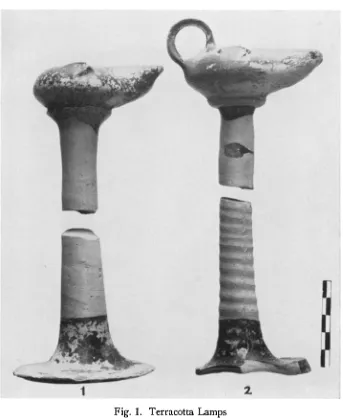
The two lamps (Fig. 1), next in importance as chronological evidence, are very nearly alike-a variation on Type IX,j which " cannot be earlier than the third cen- tury and should probably be dated about the middle of the century." 5 They are wheel-
made, of a fine buff-colored fabric, and partially covered with a fine glaze which has flaked off here and there. No. 2 has a grooved vertical strap-handle, No. 1 is without a handle, and both were supported on high stands whose exact height is now lost. It is possible that the preserved stands do not belong to the two lamps, and in the case of No. 2 this seems quite likely (observe the spiral effect on the stand, lacking on the part attached to the lamp). The small knob which appears on the right side of each lamp was a common Hellenistic feature.6 During the glazing of the lamps, which was effected by dipping, they were held by the centre of the support, as the spot of glaze on the stem of No. 2, probably from the finger of the glazer, shows.
With the date of the deposit now reasonably well fixed, its contents in general may be described. The largest group of objects consists of terracotta figurines, of which there are about fifty fairly complete, and a large number of small fragments. In subject matter they form a somewhat heterogeneous lot, but in fabric they are quite uniform and undoubtedly of local make. Their clay is not the clay of the "Potters' Quarter," which is a fine and durable buff, yellowish or green substance, but a reddish, friable material of which most of the Corinthian figurines of the Hellenistic period were made. A fire in which a few of the figurines suffered has reduced the clay to a still more fragile condition. A chalky white slip, covered with chalky pigment, is present on every figurine.
In the subjects represented the figurines for the most part follow well-worn paths. As early as the sixth century we find at Corinth banqueting figures, reliefs repre- senting horse and rider, and in the fifth century the stelai with helmet and twisting snake. The treatment accorded such wvell-known subjects is, however, sometimes unusual in these third century pieces.
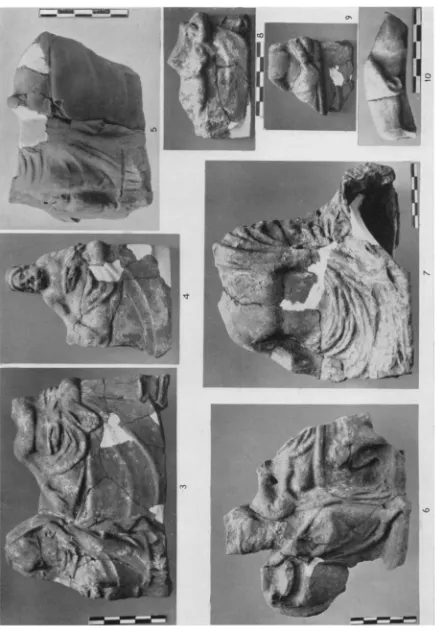
The banqueting figures from this deposit (Nos. 3-10, Fig. 2) surpass in size, elaboration, and interest any figurines of the type found at Corinth. Of the nine pieces fairly well preserved, three show a woman seated at the man's feet; two others
4Broneer, Corinth IV, ii, p. 49 and fig. 24.
A HELLENISTIC DEPOSIT AT CORINTH 107
once did. Outside of this deposit very few Corinthian figurines have this feature, although elsewhere it was common.7
Nos. 3, 4, and 5 are very nearly alike (the first and last probably from the same
Fig. 1. Terracotta Lamps
mould). A bearded man, with long locks of hair hanging about his face, reclines on an elaborately draped couch, a cushion under his left elbow. He wears a polos and
7E. g., Tarentum (Winter, Die Typen der figiirlichen 7'errakotten, I, p.. 203, nos. 3, 4, 5; Attica (Winter, I, p. 196, no. 3). Examples in which the woman reclines beside the man (e. g., Winter, I, p. 196, no. 40, from Athens), or is embraced by him (Winter, I, p. 197, no. 2, from Myrina), are unknown at Corinth, nor is there a single relief in which more than two figurines are represented
--- - ---
N p,!,| - li RIIl E 1
---| -- N IN '"
A HELLENISTTC DEPOSIT AT CORINTH 109
a himation covers his body from the waist downward, and in his left hand he holds a bowl while his right hand rests on his knee. At the foot of the couch is seated a woman who leans slightly away from him in a gracefutl position. She wears a chiton and a himnation, and holds a large oenochoe against her right knee, waiting to pour from it into the man's bowl. In No. 3 the modelling of the figurine is sharp and clear, showing considerable retouching. In back, the upper part was filled out by hand to correspond with the front; the lower part was untouched. No. 4 is similar in this respect. No. 5 was hastily retouched and instead of delicate folds above the woman's feet, as in No. 3, there is a series of rude scratches. This is not the result of the deterioration of the mould, but is clearly carelessness.8 It is supported behind by a strut which projects in the middle. Trraces of color remain only on No. 3: pink on the flesh portions, pink on the drapery of the couch, and red on its lower border. No. 6 is the most elaborate of all the reclining figures. What remains is only the lower end of the couch, with a woman seated upon it, the knees of the man, and a huge amphora at her right, but even this fragment holds much of interest. The man reclines in the usual fashion; in his right hand, which appears at the preserved upper right edge of the relief, he held some object over his companion's arm. While the nature of this is obscure, it might possibly be a snake. The womlan, not relaxed as in Nos. 3-5. but sitting bolt upright, and facing front, wears a long chiton pulled tight across her breasts, and perhaps a himation. In her right hand she seems to hold part of her garment; her left is concealed in drapery. The large vessel was evidently the source of refreshment, but for dipping, not pouring, as was the oenochoe in Nos. 3-5. Beside the cotich, which alone among Corinthian examples is undraped, stands a three-legged table supporting various objects, presumably food, the outlines of
which are no longer distinguishable. The back of the figurine has a support in
the centre projecting at right angles from top to bottom. No traces of the flesh color remain, but considerable pigoment is preserved in the woman's dress. The appearance of the figurine is unusually sculptural. Most compositions of this size tend, perforce, to simplify detail and omit unessential features. Here, on the contrary. the coroplast has tried to incltude in his composition elements which in other cases are left to be inferred from general knowledge, i. e., from sculpture, and as a result so much is included that the details are obscured. No. 7 is so fragmentary and the surface so damaged that it is now notable chiefly for its size. The himation, on which nuch retouching was done, covers the figure's left shoulder and arm, and is carried around the front of the body under the right arm. The head was made separately and set into a depression in the neck. The back, with a small circular vent, was added by hand, and folds of drapery indicated on it. When complete the figure must have stood about forty centimetres high, really a small piece of sculpture rather than a
S
large figurine. It seems likely that stich a large figure would have had a woman seated at the foot of the couch, but of this there is no evidence remaining. The rest of the reclining figurines, represented by Nos. 8, 9, and 10, are the normal Corinthian type: small, modest in conception and size, and withouLt detail. The man is alone without any attendant woman. The figure reclines on the left side, the lower part of the body covered with a himation, the left arm resting on a cushion, a kantharos (No. 8) or a patera (No. 10) held in his right hand. The couch may be draped in various ways (cf. Nos. 8 and 9). The backs of the figurines are flat or slightly concave, and there is no evidence of retouching. A few traces of color remain; on No. 8 brick-red for the flesh, pink for the cotuch, in No. 9 red for the couch, on No. 10 brick-red for the flesh, lighter red for the couch.9 In a deposit published many years ago and presumed to be of the fourth century, was found a figurine from the same mould as No. 8,10
and indeed this, as well as the following figurines, seems a little early in style for the middle of the third century. But since the same moulds were used during long periods, there is little possibility of dating these persistent types more accurately. Probably to be associated with the figure of a banqueter is a small, rather thick disk (not illustrated), which is smooth on one surface, rough on the other. This was very likely a dish to be fastened to the hand of a large reclining figure. In the case of large figures, such plastic attributes were often added.
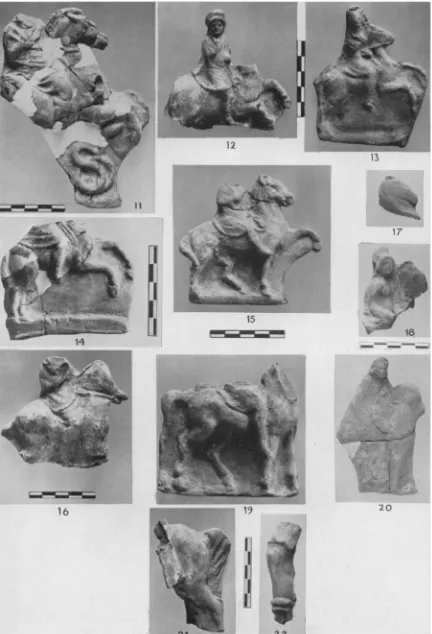
The "rider reliefs " have a fairly long history at Corinth. They were not manu- factured in the Potters' Quarter at the west of the city, but in some other factory whose location is as yet unidentified. They were preceded by the hand-made horse- and-rider, which claims a considerable antiquity, and which continued to be made even long after the same subject was produced as a relief by the use of a mould. By the time of this deposit, however, the hand-modelled figurine had practically vanished. The dozen figurines or fragments of rider reliefs which appear in the deposit (Nos,
11-22, Fig. 3) show considerable variation and illustrate the futility of attempting to trace the development of such figurines. While the reliefs, presumably, are all of the same period, they descend almost as if by regular steps from the elaborate and realistic No. 11 to the poor and lifeless No. 20. This considerable variation in the quality of the pieces, natural enotigh in a deposit of larger proportions, is here some- what surprising. No. 11 was cast in extremely high relief and all its details are unusually clear. It is covered with a white slip and also shows traces of a pinkish red color on the horse and on the flesh of the rider. The horse is a spirited animal prancing high with both forelegs off the ground' as if trying to escape the snake coiling beneath its belly. In contrast to this activity the rider is calmness itself. He or she, dressed in a chlamys which, reaching to the knee, conceals the body and the
9 For the rest of No. 9 cf. the reclining figurine at the lower right cornler of Fig. 7 in Broneer's article.
right arin and wearing high boots, sits in an easy pose, the head tutrned to the side, facing the spectator. This rather ludicrous contrast is the natural result of the con- ventionalizing of a once meaningfutl and realistic representation. The rider is probably male, but the missing head, preserved in a similar figurine found in the deposit in the catch-basin (see note 3) seems rather feminine. A border was added by hand around the back of the figurine.
No. 12 is a smaller version of No. 11. Here much of the horse is missing, but the rider is well preserved, and color remains on most of the figurine. It is entirely covered with a white slip and the usual chalky pigments. The horse is painted a bright pink, with a red harness; the rider's face and legs are brownish red, the background a dull black. The rider's garment is similar to that of No. 11, but the head is different from that preserved in the parallel figurine shown at the left in Fig. 7 on p. 148, and the features appear somewhat more masctuline. The hair is dressed in a roll over the forehead, and partially covered by a cap. Neither on this, nor on any of the succeeding figurines, is a trace of a snake to be seen. The casting of this figurine was neatly done; the mould was sharp and the details carefully worked.
No. 13 presents a sharp contrast, for although complete, and identical in stubject with No. 12, it was made from a poor and worn mould."1 Slight traces of pink paint over a white slip are visible on the rider's flesh and on the horse's harness. No. 14 is a fragment of a figurine very similar to Nos. 12 and 13. The chlamys of the rider is arranged in a slightly different fashion, and the raised border at the bottonm of the relief, scarcely noticeable in No. 13, is here quite pronounced. No. 15 shows a horse standing on three legs, with only the left foreleg raised. There are traces of red on the rider's body and black on- the background. While the rider is still as placid as in the other figurines, the horse is extremely spirited, with inflated nostrils and a bulging eye, well-defined body musculature, and the tail swingiing around to cover the right flank. The figure is not really a relief, for it is hollow, with a back added on and a
circular vent. No. 16, in spite of its very high relief, is only a poor imitation of No. 15. Faint traces of color remain., A back was added to the figure, and there seemis to have been a vent. The fragmentarv No. 17 is another example of the degeneration of the type. The horse's head, held stiffly back on the neck, has no features visible except the mouth and a slight protrtusion to indicate the eye. No. 18 is probably the only figurine in the deposit in which the rider is nude to the waist and has a chlamnys wound around his lower right arm. A polos is worn on. the head. The specimen is very fragmentary, but we know from similar figurines found elsewhere at Corinth that the horse stood on all four feet, in a stiff yet rather lifelike pose. A similar pose appears in No. 19, in which, however, the chlamys covers the body of the rider as far as the knees. The flesh of the rider and the horse's harness show traces of pink,
A HELLENISTIC DEPOSIT AT CORINTH 113
while the background is black. No. 20, with its hazy outlines and poor clay, represents the ultimate degeneration of the rider relief. The white slip is still partially preserved, showing that its original appearance cannot have been much better. No. 21 may once have been a very fine piece. Larger in scale than the other figurines (its original height at least 0.20 m.), it was really a free-standing figure and not a relief. The horse faces left, as it rarely does in these figurines, and seems to be standing still or advancing slowly. The edge of a saddle cloth shows at the fracture. The tail, projecting at right angles from the body, hangs down behind the left rear hock, and the hairs are rendered impressionistically by the use of an instrument. A fragment of a human leg (No. 22) from the same deposit may belong to the same figurine. The rider wears a chiton covering the thigh, and a high boot with an elaborate rolled top and flaps such as occur often in figures of Artemis. Nos. 21 and 22 are both brightly colored: the horse's body brick-red, the saddle cloth pink, the background black. The rider's leg is a light salmon color and the boot bright red.
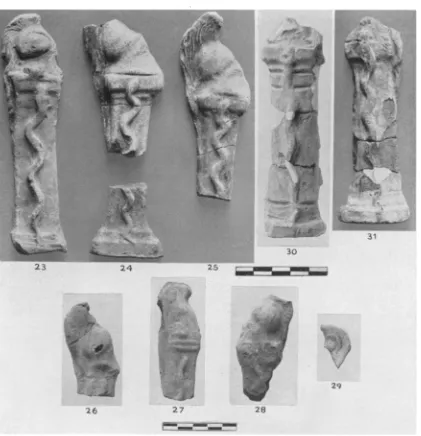
There is naturally less variety among the snake-and-helmet stelai than among the other figurines. While the type was well known at Corinth,12 it was not manu- factured in the Potters' Quarter, and there is no evidence that it existed before the fifth century. The nine specimens found in the deposit (Nos. 23-31, Fig. 4) are with few exceptions similar to others from Corinth. Nos. 23, 24, 25, 26, and 27 are alike except for differences in quality. Upon a stele with double or single mouldings at top anad bottom rests a plumed Corinthian helmet, facing to the right. The back of the plaque is flat. A white slip covers the whole surface; the plutme is painted red. No. 25 is distinguished by having the hairs of the plume standing out in a rather unusual manner, apparently running up instead of down. Nos. 26 and 27 exhibit the inevitable relaxation of the standard of manufacture, and in No. 27 the snake is hardly more than a wavy ridge which does not reach the moulding at the top of the stele. In No. 28 the type is similar except that the helmet faces left. This is also
the case with the tiny fragment No. 29, the plume of which differs from the others
in having a central boss. Nos. 30 and 31, which together form a distinct variety, are unfortunately incomplete. Although much alike, they were not made from the same mould. Convex in front instead of flat, they have deep grooves outlining the
mouldings, and probably represented columns rather than stelai. The helmnet in both
cases faced left.
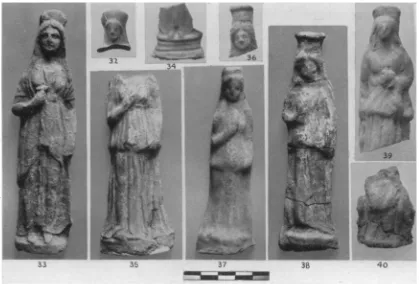
A large group of figurines is that representing women standing with some offer- ing in one hand (Nos. 33-39, Fig. 5). This type began with the Kore figurine, so common in archaic Greece, and persisted through many vicissitudes, even after its
12 Elsewhere it seldom occurs. At Tarentum the theme is found in an interesting variation
fostering art had long died. In the deposit, with the exception of the fragmentary No. 32, a late degeneration of the archaic Kore,'3 we find the Hellenistic version of this subject. Most of the eleven specimens are fragmentary, and in every one the
r~~~~~~~~~~~~~~~~~~~~~~~~~~~~~~~~~~~~~~~~~~~~~~~~~~~~~~~~~~~~~~~~~~~~~~~~~~~~~~~~~~~~~~~~~~~~s
Fig. 4. Terracotta Figurines: Stelai
object held in the hand is indefinite of outline and only dimly distinguishable. The archaic Kores, 'in contrast, always hold clearly recognizable offerings. This vagueness
:3It is made of light buff clay covered with a white slip and with traces of red on the poios.
A HELLENISTIC DEPOSIT AT CORINTH 115
may have been deliberate, if the objects had lost their peculiar significance and were intended to represent offerings in general, not an attribute of a particular deity.
No. 33 (height, 0.138 m.), the most striking and the finest of these figures, is made of unusually friable clay, but still retains traces of a white slip and of red on the hair, blue on the garment. The rather long-legged figure stands in a somewhat slouching attitude on a low plinth, wearing a chiton with thick fold between the legs,
Fig. 5. Terracotta Figurines: Maidens with Offerings
over it a shawl bound at the waist and falling belo'w in a triangular form. The hair hangs loosely on her shoulders, and a low polos is worn on the head. While the left hand loosely grasps the drapery at the side, the right is raised to support some object- a cup, a flower? The back is hollow. The figurine is well modelled, with considerable retouching,.especially on the drapery. One other fragment of an exactly similar figurine was found. The fragmentary No. 34 (height, 0.041 in.) was probably much
retouching. The object held in the hand is perhaps a pine cone. No. 38 is similar except for a higher polos, and perhaps an object carried in the left hand as well as in the right. In No. 39 (height, 0.106 m.) the position is reversed: the right hand hangs at the side, holding a vase ( ?); the left, raised to the breast, contains an un- identifiable object. A bag, or some drapery, hangs from the left arm near the hand. The extremely poor mould from which the figure was made and the lack of retouching
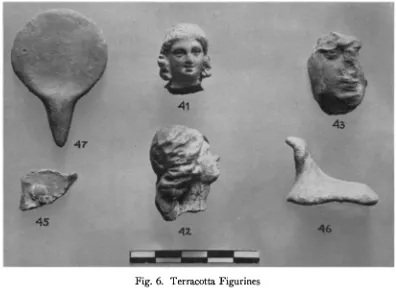
Fig. 6. Terracotta Figurines
has resulted in vagueness like that of No. 37. The remaining specimens are still more fragmentary and show no features which do not appear in Nos. 33-39. No. 40
A HELLENISTIC DEPOSIT AT CORINTH 117
us had fate been kinder. No. 41 is probably a child's head. The delicate features smile gently; the hair, parted in the centre, curls in impressionistic locks about the cheeks. On the flesh traces of red paint appear over a white slip. The back of the head, added by hand, is rough, and a fracture on top may indicate that a hat was worn. A typical Hellenistic product, the figure shows the charm of the period em- phasized to good effect.
No. 42 (height, 0.037 in.) with the left
side of -the face broken off , still preserves
traces of red on hair and lips, over the usual _ white slip. The delicate features, the wide-set
eyes, the small mouth are all characteristic of g
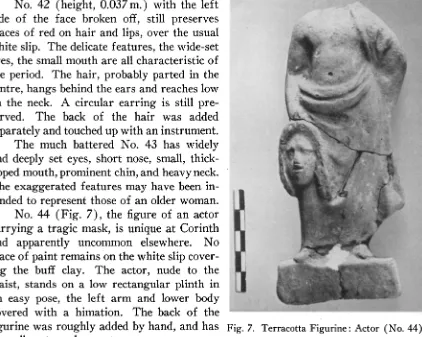
the period. The hair, probably parted in the centre, hangs behind the ears and reaches low on the neck. A circular earring is still pre- served. The back of the hair was added separately and touched up with an instrument. The much battered No. 43 has widely and deeply set eyes, short nose, small, thick- lipped mouth, prominent chin, and heavy neck. The exaggerated features may have been in- tended to represent those of an older woman. No. 44 (Fig. 7), the figure of an actor carrying a tragic mask, is unique at Corinth l and apparently uncommon elsewhere. No trace of paint remains on the white slip cover- ing the buff clay. The actor, nude to the waist, stands on a low rectangular plinth in an easy pose, the left arm and lower body covered with a himation. The back of the
figurine was roughly added by hand, and has Fig. 7. Terracotta Figurine: Actor (No. 44)
a small rectangular vent.
An interesting but hopelessly fragmentary piece is No. 45 (Fig. 6), a relief on a very small scale. A white slip covers the entire surface, and the background is bright pink. The fragment shows a youth facing right, holding one hand or some object before his face. Without a single edge of the relief preserved, speculation on its nature is futile.
lower end, is the usual type; only occasionally was an effort made to imitate, in these terracotta models, the delicate forms of the bronze mirrors.
More unusual than the figurines are the terracotta votive shields found in this deposit. They are of various types, and differ greatly in size, but all save one are circular.1' The exception is a small almond-shaped shield (No. 48, Fig. 9) of the so-called Gallic or Galatian type, probably made in a mould, of buff clay which was burned at some tinme and is now extremely friable. It was evidently made exactly to imitate a real shield, with a heavy rib thickened in the nmiddle along the vertical axis, and a deep groove around the edge. The back is rough and uneven.a
Nos. 49-53 (Fig. 8) are examples of a type falmiliar at Corinth in Hellen'istic contexts.16 About 0.09 n. in diameter and rather thick, they are made of the usual buff clay and covered with a chalky white slip. They were mould-made, Nos. 49 and 50 probably in the same mouild, Nos. 51 and 52 in another mnould. In each the centre is slightly convex and the border flat. A wreath ending in fillets, painted red, stands out in relief on the outer surface. In Nos. 51 and 52 the leaves of the wreath are visible; in the others they are not shown. In Nos. 49 and 50 the ends of the fillets are moulded; in Nos. 51 and 52 they are painted, and in both the latter the outlines of wreath and fillet are indistinct. No. 53 was cast in a very poor mould. The backs of all the shields are concave and rather rotugh. No means of holding the shield is indicated, and there are no suspension holes.
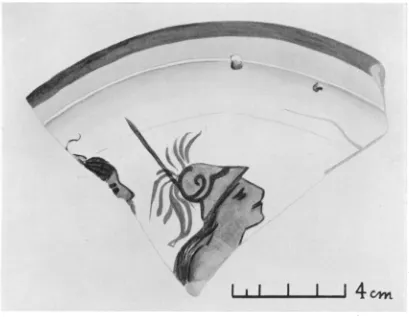
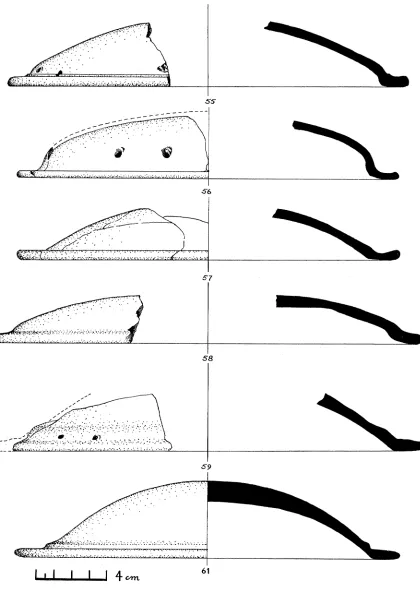
Besides these tiny moulded shields a group of eleven'large circular wheel-mlade shields was found (Nos. 54-62, Figs. 8, 9). As appears in their profiles (Fig. 11), they are similar in shape, with only subtle variations which have no chronological significance. Their diameters range from 0.207 m. to 0.25 m., with a tendency toward the larger dimension. Characteristic of all is the convex centre bounded by a flat or nearly flat border. None is perfectly symmetrical, but one or two (e. g., No. 61) show a considerable delicacy of profile; others seem to have been produced by a hand less sure. Many of the shields have two suspension holes at the junction of border and boss; in the rest we may assume such holes to have been originally present. The clay varies from a light buff to a rather coarse red color, the outer surface invariably covered with a white slip. Upon this slip designs and figures are painted in the same chalky paint which appears on the figurines. The probable original appearance of the shields is shown in Fig. 10, a restored watercolor sketch (by Marian Welker) of No. 55 (Fig. 9).
14 For a fuller discussion of the circular shield, see G. Lippold, " Griechische Schilde"
(Miinchener archiologische Studien), pp. 442 f.
15 For figurines of warriors carrying similar shields, see Winter, Typen, II, pp. 384, 385 (from
Kertch, Myrina, Caere).
16 Terracotta reliefs showing a "hero" standing beside a horse and wearing a shield of this
A HELLENISTIC DEPOSIT AT CORINTH 119
_ _ B S " " .
* I I _ - E _l I | i .-
l 11 l_ lE | l I l q .
. . , _ I _ | , I I - . . _ I _ . , | I
. . l | l s
. . . l l l s
s- * l | I I ! |
_ . . , " I ..
. -
| | | l i l E
ll l Xs
| I , i
I . I
I |
_ l .4 I
_ I |
_ Il
I I .-
_ E
_
_
_ l s
_ l s
_ I i-
s-
_
__
-
..a. ,.,.<; .,>,<S,
:-4' R' ':-:',3: ^ S^v l ... S
X, |
_ gS
'.,Sv.... s S"s';':'.'
_''g_
_
E_
.,, , w-9 :, w*,,, S,,: _, ,},
' e SES ^' ,,,? - . :,..S SsKE ses S se S i-sa*RNwhRs . _
_,
_
.,'s SS":;'9gS,<w. .fi> . i': s SS,R9t.,/ ,S>54S.SSe-
_._ g__
;FfivOst vS89;vxgR@9S$wsiai.?x
ULN-
4~
W8
A HELLENISTIC DEPOSIT AT CORINTH 121
None of the shields has a well-preserved surface, but in most cases the nature of the design can at least be determined. Nos. 54 (Fig. 8) and 55 (Fig. 9) offer the clearest representations (although the figures appear very dimly on the photographs, they are hardly more visible on the shields themselves). On the former, within a red border, two warriors are fighting. The figure at the left (in Fig. 8 the shield
il~~~~~~~~~~~~~~~~~~~~~- _10 iI, i MRe4 .f;
Fig. 10. Watercolor of Terracotta Shield
,56
59
Lj
4
IA HELLENISTIC DEPOSIT AT CORINTH 123
his long hair is brown. The same brown is used for the decoration on his yellow helmet, the plume of which is painted red, but in a shade slightly different from that used for the flesh. Behind the helmet appears the tip of his spear. Only slight traces of his tunic are visible. The woman's face is yellow, a variation on the traditional
white. Her hair is drawn into a topknot. The scene probably represented a woman
bidding farewell to her husband as he goes off to the wars. A red border encircles the edge of the shield.
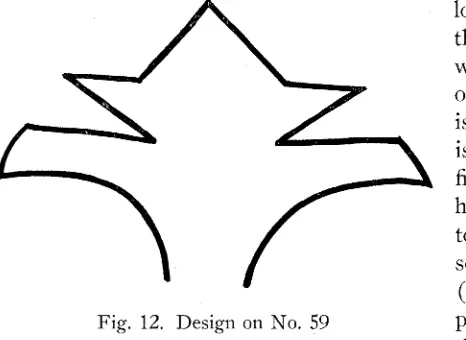
The very fragmentary No. 56 (Fig. 11) and another piece with similar profile seem to preserve portions of helmets which were doubtless on the heads of warriors. On No. 56, which lacks a red border, there are remains of two figures: at the left appears a warrior's plume, in the centre an upright spear, and at the right some object painted in blue and red. On the other piece is part of a helmet with a yellow and pink crest, outlined in black. The fragment which remains of No. 57 (Figs. 8, 11) shows a red border around the edge, and the lower part of a brown horse galloping to the left, perhaps trampling on a figure which appears hazily at the lower right, or rearing above it. The whole picture is indistinct. No. 58 (Figs. 8, 11 ), which is unusually flat in profile, has a row of fillets, painted in blue-black and red, hanging from a rope within the cus- tomary border. At the upper right is some object painted yellow. On No. 59 (Fig. 11), a small fragment with two
Fig. 12. Design on No. 59 pinkish-red borders, one on the rim of
the shield, the other at the edge of the central part, is a design in black which faintly appears as in the rough sketch shown in Fig. 12. Can it perhaps be a standard?
Another small fragment (not illustrated) has a narrow stripe of red on the rim, another around the edge of the central part, and a third within the central area just above a wide groove made while the clay was soft.
represent the donors of the shield. No. 61 preserves much of the shield, but little of the drawTing. Within the red border appear faint traces of a single figure facing to the right, with flesh painted red, dressed in a long pink garment. This is the only shield which seems to have no suspension holes. If they existed at the side which is now missing, the figure would have been askew when the shield was suspended.
I The tiny fragment No. 62 (Fig. 9) is the only piece wAhich bears any letters. It is part of a rim which instead of the usual red border had an inscription painted in black. The two remaining letters E N are almost certainly to be restored as
[caVE&qK] Ev.
Among the remains of ancient painting, so little of which has been left us, it is hard to find a close parallel for these painted shields. Similar shields have often been found in much earlier contexts,17 but contemporary examples are rare. They are perhaps most like the terracotta shields discovered at Centuripe.18 Although mnuch larger than those from Corinth, they are similar in shape and in the technique used for the painting. On them are represented female figures or Nikes. The narrowest chronological limits that can accurately be assigned the Centuripe pieces are the last three centuries before Christ, more definite dating depending solely on stylistic criteria; it is likely, however, that these ambitious creations are somewhat later than the Corinth shields. From the fact that parallels are so hard to adduce, and from the obvious deficiencies of the technique, it is apparent that such shields never could have become widely popular. WVhile the Centuripe and Corinth shields probably were not isolated phenomena, it is tunlikely that many more have been discovered.
The remaining objects from the deposit are of a miscellaneous nature. The nmost important is No. 63 (Fig. 13), a small terracotta thymiaterion (height, 0.084 m.) of the usual buff Corinthian clav, made of two sections joined together in a rather intricate way. The upper part, a shallow cup, was set into a hollow stand, and the two parts fastened together in such a way that the joint is invisible from the outside. The whole object is covered with a chalky white slip extending even into the interior of the stand. The decoration is in red: a border around the inside of the top, another on the outside around the bottom, and three red star-like flowers on the sides. This little incense-burner shows not the slightest traces of use, a fact which may have some bearing on the nature of the deposit. If it had been used the white slip would surelyr
17 Cf. D. Burr, " A Geometric House and a Proto-Attic Votive Deposit," in Hesperia, II, 1933,
pp. 609 f. (late seventh century B.C.). Onle of these bears a painted figure of a horse and rider; and
others have only stripes or geometric designs. See also A. Newhall, " The Corinthian Kerameikos," in A.J.A., XXXV, 1931, pp. 27 if. (round shields, some painted, some with relief designs, usually with handles). Also Helbig, in Jahreshefte, XII, 1909, pp. 45 f. (terracotta votive shields found at Menidi and Tanagra).
18 G. Libertini, Centuripe, p. 169, nos. 38 (diameter, 0.35 in.), 39 (diameter, 0.24 m.), and
pl. LXIV; Richter, " Polychrome Vases from Centuripe," Metropolitan Musett Studies, II, 1929-
A HELLENISTIC DEPOSIT AT CORINTH 125
have been damaged in some way. Thymiateria of this sort have been discovered at Delos (dating ca. 100 B.C.)19 and elsewhere. The similarity in technique to the con-
temporary lagynoi has been pointed out.20
The two conical loom-weights found in the deposit (Fig. 13) are dissimilar both in shape and in date. No. 64 is made of fine reddish buff clay, and has a single sus- pension hole. The lower part is bevelled to a point about one fourth the height of the weight. Just above the bevelling is an oval stamp, punched while the clay was soft, bearing a representation of a loom-weight; below the bevelling and directly beneath
~~~~~~~~~~~Igl
Fig. 13. Thymiaterion and Loom-weights
the first stamp is another, rectangular, with the letters MEAI in relief. This com- bination of stamps is extremely common on Corinthian loom-weights. No. 65 is made of fairly fine buff clay covered with a slip of finer clay, and also has a single hole. The lower part is bevelled to a point about one third the height of the weight, and just above the bevelled portion is a rectangular stamp bearing the letters AAM. This was of course impressed before the weight was baked, and at the same stage a small punch was rolled over the surface directly above the stamp to form rather vague outlines resembling the letters M N. The stamp AAM is found on no other Corinthian weight, and I know of none anywhere else. Between the time of the making of No. 64 and that of No. 65 there are at least fifty years and possibly a hundred. While the shape of the conical loom-weight did not change in any essential way from the fifth century to the Roman period, there were subtle changes which are not only perceptible but datable. On the basis of a study of hundreds of Corinthian loom-
9 W. Deonna, Delos, XVIII, pp. 377 ff. and pl. CV.
weights2'1 it is almost certain that No. 64 can not have been manufactured later than 300 B.C., and it may have been made as mtuch as fifty years before then. No. 65,
on the other hand, is of the same period, i. e., ca. 250 B.C., as the rest of the objects
in the deposit. The criterion for dating is the gradual rise of the bevelled portion of the weight. At first non-existent, it gradually works its way toward the top of the weight until in the first century after Christ the veight beconmes pear-shaped rather than conical. The survival of a loom-weight of ani earlier period in this deposit is not surprising, for these objects are almost indestructible and were often used over long periods.
The only remaining item of interest in the deposit was a small astragalus moulded of transparent blue glass (length, 0.018 in.). It is a beautiful little object (not illus- trated) which imitates very accurately the natural bone. While glass astragali were common enotugh elsewhere,22 this is the only one which has appeared at Corinth, where real knucklebones were most commnonly used.
It is diffictult to draw conclusions as to the nature of this deposit, for its strange provenience offers no reliable basis on which to assert that this was refuse from a factory, a temple, a dwelling, or a shop. Of these possibilities the first can easily be eliminated. Factory sweepings contain misfired fragments, unfinished fragments, imioulds. No such pieces were found in the deposit. The second possibility cannot be disposed of quite so simply, for although sonme of the objects appear to be non-religious in character, the large majority is of the sort that is usually connected with the cult of a hero: banqueting figures, riders, stelai, shields, snakes. The nature of this cult is discussed by Oscar Broneer in the article immniediately following. The objects in the deposit, however, while they nmay have been intended for use in a sanctuary, almost certainly never reached their destination. The thvmiaterion is without any traces of use, and the figurines, insteadl of being broken into small pieces and charred, as was usually done when discarding votives, are reasonably complete and most are untouched by fire. Moreover, and most important, the coins are quite out of place in a favissa. Fifty-four authentic, negotiable coins would hardly have been discarded from a sanc- tuary. They formed no hoard; they were scattered throughout the deposit.
Although the deposit is p)erhaps not wholly unintelligible as the contents of a p)rivate collection, obvious difficulties at once appear: the location of the collection and the presence of the coins nmust be explained.
The possibility which uintil now seems the most reasonable, that this grotup of objects formed the stock in trade of a shop, would be greater if a larger number of figutrines and nmore duplicates had been found. But a small shop selling votive offerings
21 To be published in a forthcoming volume of Corinth, Results of Excavations Condutcted by?
7The American School of Classical Studies at Athenis.
A HELLENISTIC DEPOSIT AT CORINTH 127
is not unlikely to have been located in the South Stoa, conveniently close to adjacent sanctuaries.
Nevertheless, until the publication of the South Stoa is completed it would be premature to fix definitely upon any theory regarding the relation of the deposit to the building in which it was discovered. The second deposit of similar figurines, discussed by Oscar Broneer in this number of Hesperia (p. 150), may give the clue to the ultimate purpose of the terracottas, but it does not explain their presence in a shop of the South Stoa. Further study of the topography of the puzzling eastern end of the Agora may lead to a final solution of this problem.
GLADYS R. DAVIDSON