COMAPARISON OF CRYPTOGRAPHIC
ALGORITHMS FOR CLOUD COMPUTING
Deep Kumar Sharma
1, Amrita Kaur
2, Anjali Gangwar
3,
Priyanka Pradhan
41,2,3,4
Software Engineering, SRMSCET, Bareilly, (India)
ABSTRACT
Cloud computing is a set of services in the IT, provided to a customer over a network and these services are
delivered by third party. The use of cloud computing increasing day by day and the number of users also
increases because of its attractive features and easy services. The increase in number of users increases the
security issues. The security is very important factor in the cloud computing. The aim of this paper is to tell
about the best security technique; here we discuss about the two encryption algorithms AES and DES. To
compare these algorithms we show that which the best algorithm for cloud are computing.
Keywords: AES (Advanced Encryption Standard) Technique, Cloud Computing, DES (Data
Encryption Standard) Technique
.I. INTRODUCTION
Cloud computing security is the set of control-based technologies and policies designed to hold to regulatory fulfillment rules and protect information, data applications, and infrastructure associated with cloud computing use.
There are four main type of cloud, proper security in these and other potentially vulnerable areas have become a priority for organizations contracting with a cloud computing provider.
Fig. 1- Types of Cloud Computing
storage in cloud computing offers so many benefits to users: a) It provides unlimited data storage space for storing user’s data.
b) Users can access the data via internet, from everywhere in the world not on a single machine.
c) We do not buy any storage device for storing our data and have no responsibility for local machines to maintaining data [1].
II. SECURITY CHALLENGES
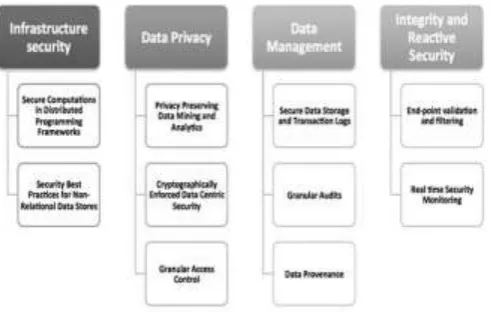
There are many security challenges in the cloud computing, so because of these challenges we need the, Security algorithms. In this session we discuss about these challenges
Fig. 2- Security Challenges in Cloud Computing
Are:-
a) Infrastructure security. b) Data Privacy.
c) Data management.
d) Integrity and reactive Security.
III. CRYPTOGRAPHY
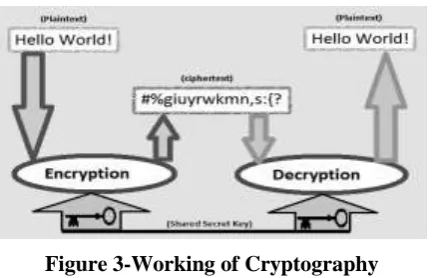
Figure 3-Working of Cryptography
There are many security algorithms in the cryptography, but here we discuss only about the two basic algorithms:-
1) DES. 2) AES.
1) DES (Data Encryption Standard)
DES was developed as a standard for communications and data protection by IBM research team. DES is a broadly-used method of data encryption using a secret key. DES originated at IBM in 1977 and was adopted by the U.S. Department of Defence. It is precise in the ANSI X3.92 and X3.106 standards and in the Federal FIPS 46 and 81 standards. There are 72 quadrillion or other promising encryption keys that can be used. For each given message, the key is selected at random from among this huge number of keys. Both the sender and the receiver must know and use the same private key. DES applies a 56-bit key to each 64-bit block of data. The method can run in several modes and involves 16 rounds or operations [4].
Figure 4 - Encryption
and decryption
with DES
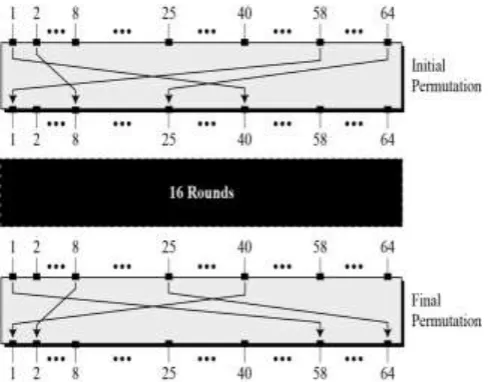
The encryption process is made of two permutations (P-boxes), which we call initial and final permutations, and sixteen Feistel rounds.
Fig. 6 - Initial and Final Permutation Steps in DES
Fig. 7 - Initial and Final Permutation Table
The 58th bit of input x will be the first bit of output IP(x), the 50th bit of x is the second bit of IP(x), etc. Steps of DES:-
Get the Plaintext. Get the Password.
Convert the Characters into binary form.
Derive the Leaders (L1 to L16) from the Password.
Apply the Formula to get the encrypted and decrypted message.
2) AES(Advanced Encryption Standard)
The AES is a symmetric-key block cipher published by the National Institute of Standards and Technology (NIST) in December 2001. for the encryption of electronic data. AES is a latest cryptographic algorithm that can be used to defend electronic data. Exclusively, AES is an iterative, symmetric-key block cipher that can use keys of 128, 192, and 256 bits, and encrypts and decrypts data in blocks of 128 bits (16 bytes). Unlike public-key ciphers, which use a pair of public-keys, symmetric-public-key ciphers use the same public-key to encrypt and decrypt data. Encrypted data returned by block ciphers have the same number of bits that the input data had. Iterative ciphers use a loop structure that repeatedly performs permutations and substitutions of the input data [5].
Fig. 8 - General design of AES encryption cipher
Fig. 9 - Data units used in AES
To provide security, AES uses four types of transformations: The sub bytes step
The Shift Rows step mixing
key-adding
1) The Sub Bytes step
In the Sub Bytes step, each byte in the state is replaced with its entry in a fixed 8-bit lookup table, S; bij =
S(aij).While performing the decryption, Inverse Sub Bytes step is used, which requires first taking the affine
transformation and then finding the multiplicative inverse (just reversing the steps used in Sub Bytes step).
and fourth row is 1 byte, 3 bytes and 4 bytes respectively—this change only applies for the Rijndael cipher when used with a 256-bit block, as AES does not use 256-bit blocks. The importance of this step is to avoid the columns being linearly independent, in which case, AES degenerates into four independent block ciphers.
Fig. 11 – Shift Rows Steps
3) The Mix Columns step
In the Mix Columns step, each column of the state is multiplied with a fixed polynomial c(x).
Fig. 12 - Mix Columns Steps
4) The Add Round Key step
In the Add Round Key step, each byte of the state is combined with a byte of the round sub key using the XOR operation (⊕).
IV. COMPARISON BETWEEN AES AND DES
Here we compare Data Encryption Standard (DES) and Advance Encryption Standard on the following factors that are based on different parameters and a comparative study between DES and AES is done by the nine factors, Which are key length, cipher type, block size, developed, cryptanalysis resistance, security, possibility key, possible ACSII printable character keys, time required to check all possible key.
Table .1 Comparison between AES and DES
V. CONCLUSION
In this paper, there is a proportional study between DES and AES were done. Here the theoretical analysis is done for DES and AES algorithms. On the basis of that comparison it was concluded that AES algorithm consumes least encryption and decryption time as compared to DES algorithm.
REFERENCES
[1] Neha jain, Gurpreet kaur, ―Implementing DES algorithm in cloud for data security‖, in VSRD-IJCSIT, VOL-2(4), 2012, 316-321.
[2] Shraddha soni, Himani agrwal, Dr.(Mrs.) Monisha sharma, ―Analysis and Comparison between AES and DES cryptographic algorithm,‖ in IJEIT-2012.
[3] Shraddha soni, Himani agrwal, Dr.(Mrs.) Monisha sharma, ―Analysis and Comparison between AES and DES cryptographic algorithm,‖ in IJEIT-2012.
[4] Mrs.Aruna A, Ms.Suganya N, Ms.KeerthanaAnandhi N, Ms.Priyanka A, ―Assured Data Transfer under Auditing in Distributed Circumstances,‖ IJSRP, Volume 3, Issue 4, April 2013 1 ISSN 2250-3153 [5] Mrs.Aruna A, Ms.Suganya N, Ms.KeerthanaAnandhi N, Ms.Priyanka A, ―Assured Data Transfer under