154 | P a g e
TITLE - REGENERATIVE POWER GENERATOR
Prof.S V Deshpande ¹,Vishal Navnath Wadavkar², Vikas Vikas Sawant³
1
Asst. Professor, Dept.of Mechanical Engg,GSMCOE, Balewadi, Pune, (India)
2,3
Student, B.E Mechanical Engineering, GSMCOE, Balewadi, Pune, (India)
ABSTRACT
The regenerative power generator gives net power output which is more than the conventional generator. The
regenerative arrangement is capable to produce electric power by using faraday law of electromagnetic induction
principle along with conventional generator. In regenerative power generator, the new regenerative arrangement of
install on extended part of shaft. Extend part shaft up to quite affect on current efficiency of power plant. A light
weight non-metal circular disc (Ring) fixed on middle position of shaft with 4 Aluminum or shielding metal chips
laterally fixed on compact circular disc (Ring). A base frame for holding a non-ferrous metal circular ring is
installed around the circular disc (ring) at middle position of shaft between generator and turbine impeller. The
circular ring hold the 'U' shape type of magnets (bend end faces of magnet appear as poles are opposite of each
other with air gap) as the magnetic field of magnets easily break by Aluminum metal chips. The 4 'U' shape
magnets suspended along inner periphery of circular ring, out of two of them parallel and remaining two are
perpendicular to axis of rotation of shaft, the each magnet having copper coil winding wounded along the surface.
When the shaft rotates, also circular disc rotates with Aluminum metal chips, as chips passing through the 'U' shape
magnetic field then time variant magnetic flux generates the EMF (DC voltage) in copper coil according to faraday
law of electromagnetic induction. Avoiding the eddy current and air friction losses, thus system made compact,
hence regenerative arrangement yield more power output than conventional generator.
Keywords
:
Regeneration, Power Output, Electromagnetic Induction, EMF,
I INTRODUCTION
Since realizing the application of electricity, the various methods have been used to generate electricity.
Now-a-days, we are producing major electric power from nuclear, thermal, wind mills, hydroelectric power plants by using
electromagnetic generator. The electromagnetic generator coverts the mechanical power into electric power using
principle of faraday law of electromagnetic induction.
The operating principle of electromagnetic generator was discovered in the years1831-1832 by Michael faraday. The
faraday given the first experimental demonstration on August 29, 1831, then the principle was later called as
155 | P a g e
1820, demonstrated that electric currents produce a magnetic field. Faraday noted this and in 1821, he experimentedon the theory that, if electric currents in a wire can produce magnetic fields, then magnetic fields should produce
electricity.
In the paper of 1831in which he described his discovery of electromagnetic induction, he presented law in the terms of wire
cutting the magnetic curves or magnetic line of force which defined as follow (17, p.281, 114), Faraday told the line
of magnetic forces, modified by using juxtaposition of poles, which would be depicted by iron fillings; or those to
which a very small magnetic needle would iron tangent. In 1845 he gave the definition with the following words,
(1.7, p.595, 2149); Faraday said, “But before I proceed to them, I will define the meaning, I shall have occasion to
use: thus, by line?/magnetic force, or magnetic line, mean that exercise of magnetic which is exerted in the lines
usually called magnetic curves and equally exists as passing from or to magnetic poles or forming concentric circles
round an electric current. The faraday began to mention the magnetic field in his publication presented to royal
society in 1845 and published in 1846 (7,p. 608, 2247).
The faraday in 1852 published paper (7, p.758, 3071 I) faraday told, A line of magnetic force may be defined as that
line describe by very small needle, it is so moved in correspondent to its length, that the line along which if a
transverse wire be moved in either direction, there is no tendency of formation of current in wire, If moved in any
other direction coincides with direction of magnecrystallic axis of crystal of bismuth, which is carried in either
direction along it. The direction of these lines about and amongst magnets and electric current is easily represented
and understood; A clear definition of faraday understood by a magnetic field appeared in paper read in 1850 at the
royal society and published in 1851(7, p.690, 2806). The faraday magnetic field may be taken as any portion of
space traversed by lines of magnetic power and magnetic power can be visualized by iron fillings. It is interesting to
note that faraday mainly from 1851 onwards, considered the line of magnetic power (7, p.759.30571).
In 1830, Joseph Henry (1797-1878), discovered that a change in magnetism can make currents flow, but he failed to
publish this. In 1832 he described self-inductance - the basic property of inductor. In recognition of his work,
inductance is measured in henries. The stage was then set for the encompassing electromagnetic theory of James
Clerk Maxwell. The variation of actual currents is enormous. Therefore, the time starts to build the generator by
using above principles of Faraday and Henry. The dynamo was the first electrical generator capable of delivering
power to industry. The dynamo uses the electromagnetic induction to convert mechanical rotation into direct current.
An early dynamo was built by Hippolyte pixie in 1832. Though the series of discoveries, the dynamo was succeeded
by many later inventions especially the DC generator, AC alternator which were capable of generating current. In
1871, when Gramme introduced his motor and generator, that the electric generator was used commercially. By
1872, Siemens and Halske of Berlin improved on Gramme's generator, by producing the drum armature. Other
improvements were made, such as the slotted armature in 1880 but by 1882, Edison had completed the design of the
156 | P a g e
Nikola Tesla was envisioned a world without poles and power lines. Tesla's system triumphed to make possible thefirst large-scale harnessing of Niagara Falls with the first hydroelectric plant in the United States in 1886. With the
DC generator being in operation by 1882, it was not long before the first direct-current central power station built in
the United States, in New York, was in operation in 1882. Around this period however, the scientists were still
active, as they realized that with DC current, they could not transmit it over long distances. Nikola Tesla, was
experimenting on generators and he discovered the rotating magnetic field in 1883, which is the principle of
alternating current. This rotating magnetic field changes in opposite directions fifty times a second and is called 50
Hertz. The alternating current generator has a rotating magnetic field and is referred to as a A.C. current. The
direction current generator generates current in the one direction hence DC current. He then developed plans for an
induction motor, that would become his first step towards the successful utilization of alternating current.
In 1885, George Westinghouse, head of the Westinghouse Electric Company, bought the patent rights to Tesla's
poly phase system of alternating current. In America, in 1886 the first alternating current power station was placed
in operation, but as no AC motor was available, the output of this station was limited to lighting. Although Tesla
developed the poly phase AC induction motor in 1883, it was not put into operation until 1888 and from then on,
this AC motor became the most commonly used motor for supplying large amounts of power.
The alternating current generating system is known simple forms Michael faraday original discovery of magnetic
induction of electric current, but there are mechanical power losses of rotation, also the problem associated with
above power generation that efficiency in power generation is low. Hence there is need for simple, efficient method
for giving more output power than traditional electricity generation system. The embodiments of present invention
are shown in figure, which shows conversion of the mechanical power into electrical power by physically coupling
with generator and regenerative apparatus arrangement at middle position of shaft for generating time variant
magnetic flux that yields electricity. The cost of utilizing new regenerative arrangement along with conventional
generator is not much more than the conventional generator, that’s reason regenerative power generator efficient
over conventional electricity producing system.
II OBJECTIVES
To utilize the existing electricity generation system for continuous improvement in power output.
To find economic energy producing system.
Approach towards the need of searching constant energy source.
III FARADAY LAW OF ELCTROMAGNETIC INDUCTION
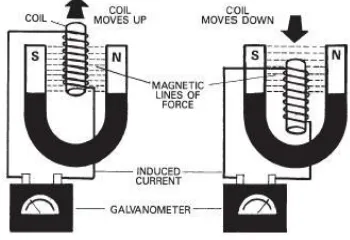
In 1831, Michael Faraday showed that a changing magnetic field can induce an emf in a circuit. Consider a
157 | P a g e
above the center axis of the wire loop, as shown in Figure. When the magnet is held stationary, there is no current inthe loop, even if the magnet is inside the loop. However, when the magnet is brought near (or pulled away from) the
loop, the ammeter needle deflects indicating an induced current in the loop produced by an induced emf. From these
observations, Faraday concluded that there exists a relationship between the induced current/emf and the changing
magnetic field.
The results of his experiments are now referred to as Faraday’s Law of Induction. In general, Faraday’s Law states
that an induced emf (E) along any closed path in a magnetic field is equal to the rate at which the magnetic flux
sweeps across the path. The closed path can be thought of as the surface within the path that the magnetic field
intercepts. Quantitatively,
E = − dΦB/ dt - (1)
where ΦB is the magnetic flux through the closed path, expressed as ΦB =RB·dA. If the loop enclosing the area A
lies in a uniform magnetic field B, then the magnetic flux is equal to BA cos(θ), and thus the emf can be written as
E = − d /dt (BA cos (θ)) - (2)
Fig 3.1 shows when change of magnetic field voltage is induced in galvanometer
Fig 3.2 shows the change of magnetic field of U shape magnet
1) First law of electromagnetic induction
Whenever the magnetic flux linked with a circuit changes, an EMF is induced in it.
158 | P a g e
Whenever a conductor cuts magnetic flux, an EMF is induced in that conductor.2) Second law of electromagnetic induction
The magnitude of induced EMF is equal to the rate of change of flux linkages.
3.1 LENZ’S LAW
Whereas Faraday’s Law defines the magnitude of the voltage induced in a coil placed in a changing magnetic field, lenz law defines the polarity (direction) of the induced voltage. When the current through a coil changes, an induced
voltage is created as a result of the changing electromagnetic field, and the direction of the induced voltage is such
that it always opposes the changes
IV LIST OF MATERIALS
SR.NO. MATERIALS QUANTITY
1) Generator 1
2) Motor / Impeller 1
3) Basement frame for holding Non-ferrous metal Circular ring 1
4) Compact Circular disc 1
5) Aluminum or shielding material chips 4
6) 'U' shape magnet (bend end faces As poles of magnet appear opposite
Of each other with air gap)
4
7) copper coil windings 4
8) Ammeter/ Multimeter (power Output measuring device) 2
9) LED bulbs/ power lines 4
10) Battery source for storing Electricity 2
V NOMENCLATURE
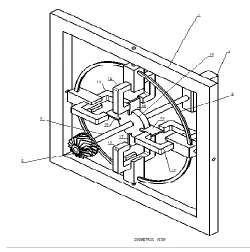
1- Basement frame
2- Impeller
3- Shaft
4- Generator
159 | P a g e
6- POMD2 Power output measuring device 2
7- Power line to POMD 1
8- Power line to POMD 2
9- Non - ferrous metal circular ring
10- Compact Circular disc
11- Power collecting lines
12,13,14,15, - U-shaped magnets with copper coil winding 1,2,3,4
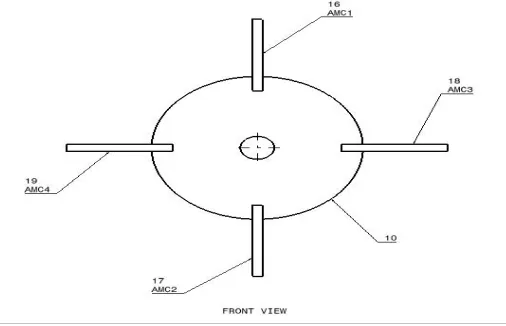
16,17,18,19, - AMC1, AMC2, AMC3, AMC4 Aluminum metal chips
20,21,22,23 - Power lines of magnets 1,2,3,4
VI CONSTRUCTION
Drawing shows the embodiments of invention. The starting point of system is impeller which drives the shaft means
produced mechanical energy as mechanical power. The impeller requires enough speed to system run up and
running operation of power plant. The shaft is connecting element which is physically coupled with generator for the
purpose of converting mechanical power into electric power. Where I slight increase the length of shaft for installing
new regenerative apparatus arrangement. The new apparatus arrangement consists the non-metal compact circular
disc with Aluminum metal chips fitted on disc body; both should be laminated for avoiding the heat losses.
The compact circular disc should be mounted stationary on the middle position of shaft between impeller and
generator. The basement frame created to providing stationary support to non-ferrous metal circular ring , the circular
ring can rigidly hold the magnets by using holding elements along the inner periphery of circular ring . The circular
ring holds two magnets parallel and two are perpendicular to the axis of rotation of shaft .The 4‘U’ shape magnets
with bend end faces of magnets as the poles of magnet appears opposite of each other with the some constant air gap
in poles are used in regenerative arrangement. The magnet having copper coil winding wounded along the surface.
The coil changes the shape during the operation that’s reason coil is bind to the magnet. The electric power
producing device either AC or DC generator .
The system shows AC generator . The generator and basement frame installed in stationary position. The output
power lines of copper coils connected to power collecting lines, further the power collecting lines electrically
connected to power output measuring device. The generator is electrically connected to power output measuring
160 | P a g e
Fig .6.1 shows the Layout diagram of regenerative power generator
Fig 6.2 shows the Front view of circular disc
161 | P a g e
VII WORKING
Further description is given on the embodiments present in the invention occupying with the following figure.
Fig7. 1Shows ‘U’ shape magnet with its magnetic field shown by magnetic line of force.
(Where magnet having bend end faces appears as poles are exactly opposite of each other with air gap)
Fig .7.2 Shows ‘U’ shape magnet with copper coil winding
U’ shape magnet with copper coil winding which shows the magnetic field with air gap, hence there is no voltage
induced.
1) U-shaped magnets with copper coil winding 1,2,3,4
2) CCW – Copper coil winding
162 | P a g e
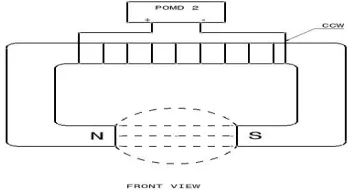
Shows ‘U’ shape magnet with copper coil winding in which magnetic line of force broken by Aluminum metalchips. The figure shows induced voltage in copper coil winding.
1) AMC - Aluminum metal chips
2) POMD2 - Power output measuring device 2
Fig 7.4 shows the Isometric view of regenerative power generator
The power transfer mechanism is positioned to transfer energy by the shaft to generator and circular compact disc by
physical contact. When impeller rotates the shaft means the system start up running operation, the circular disc also
rotates along with shaft. The Aluminum metal chips are laterally fitted on disc body. The size of the chips slight less
than the air gap between poles of magnet. The chips are continuously moves along with shaft between poles of
magnet by the continuous movement of chips break the magnetic field of magnets, that’s reason time variant
magnetic flux is generates which induces the EMF in copper coils. The system consist four magnets, the power lines
of each magnet connect to power collecting lines. The power collecting lines connected to the power output
measuring devices which shows power output of regenerative arrangement.
The generator converts the mechanical power into electricity. The power output measure against the load on shaft.
By installing regenerative arrangement, the load on shaft increases that causes decrease in the output power of
generator, the generator electrically connected to the power output measuring devices through the power lines.
When I take collectively power output this new regenerative arrangement and conventional generator gives net
power output more than the conventional generator arrangement. Which is formulate as
163 | P a g e
That’s why we realize that the regenerative power generator is capable to produce net power output more than theconventional electricity producing system
VIII METHODOLOGY
For calculating power output of regenerative power generator, we comprising the
Following
1. Power output of conventional generator
2. Net power output of conventional generator and regenerative power generator.
Measuring the power output generator by using multimeter, we get power output in voltage, then
Finding electric current output by using following formulas
1) I (Electric Current) = 746*HP
E*efficiency* P.F
P.F – power factor
T – Torque output
2) Power output – VI
V- Voltage induced.
I – Electric current
3) P (Power output) = T*W
Then we conclude, P1 is the power produced by conventional generator
P2 is Power output of regenerative arrangement ( It is the collection of power from each magnet of regenerative arrangement)
Pnet is Net power produced regenerative power generator
Pnet = power produced by conventional generatorP1 + power out. regenerative arrangementP2
Hence, Pnet > P1
IX CONCLUSION
The present invention relates to an advance method and creative apparatus arrangement for converting mechanical
energy into a useable electric power output. The regenerative power generator is economic for electric power
generation. This system should have compact apparatus arrangement for avoiding eddy current and air friction
losses. The surface of working component like compact circular disc and Aluminum metal chips should be
laminated for avoiding heat losses. The size of the regenerative power generator can be varying with power
requirement. The given apparatus arrangement can be effective for all type of power plants like thermal, wind mills,
164 | P a g e
The present invention uses the ‘U’ shape magnets with copper coil winding. The shape of copper coil can changeduring operation; this is undesirable for generator performance, avoiding this you have to bind the winding along
magnet surface. The compact circular disc and chips are made up of light weight and non-ferrous metal material like
Aluminum. The output of given generator system varies with performance parameters like strength of magnet,
number of metal chips, number of turns in copper coil, weight of compact disc and chips etc.
When I implement this new arrangement on rotating shaft then the output of conventional generator decreases, but I
realize that the new apparatus arrangement generates electric power output from time variant magnetic flux. Thus by
implementing this new arrangement power output of conventional generator decreases. When I take collectively
power output this new regenerative arrangement and conventional generator gives net power output more than the
conventional generator arrangement. Hence regenerative power generator is capable to produce more power than
conventional generator.
10. ACKNOWLEDGEMENT
It gives us a great pleasure to present the project entitled “
Regenerative power generator”. Apart from our efforts, the success of project work depends largely on the encouragement and the guidelines of many others.We take this opportunity to express our gratitude to people who has success in the work. We would like to show our
greatest appreciation to Prof S V Deshpande from his support and help.
We felt motivated and encouraged every time, without his encouragement and guidance this project would not be
easy to complete. It gives me pleasure to express our sincere gratitude towards Prof. DR P. A. Makasare (HOD- Department of Mechanical Engineering) Encouragement inspired us to take up this project.
REFERENCE
Jo
urnal Papers:
[1] D.E. Tilley, Exceptions to flux rule for electromagnetic induction, Am.J. phys.36, 458 (1968)
[2] A. Nussbaum, faraday’s law of paradox, phys. Educ.7, 231 (1972)
[3] D.K.cheng, fundamentals of engineering electromagnetism (Addison-Wesley co, New York, 1993)
[4] Linear motion electric power generator, John A. Konotchick, US 5347186 Sep. 13, 1994
[5] Variable speed operation of generators with rotor – speed feedback in wind power application, Eduard Muljadi,
C.P. Butterfield, Paul Migliore, NREL (TP-441-8169, January 28- Feb 2, 1996.
[6] The method of generating electricity by Luciano Vasija, Joseph L. Perdomo, US 6236118 B1, May 22, 2001.
[7] Dynamotor electric generator 11/009798 Electric generator patent application 11-009798 by Robert William
Jackson, USA. December 4/2003.
165 | P a g e
[9] A.K.T.ASSIS, J.E.A.A. Ribeiro and A. Vannucci, The field concepts of Faraday’s and Maxwell in: Institute ofphysics Gleb, Wataghin, university of capinas, institute of state university of sao Paul USP, 2009
[10] Electric power generation from moving vehicles, Matthew R. Bailey, Jacob B. Angelo, Michael L.Gotcher, US
0298222 A1, Dec.8,2011.
[11] Linear faraday induction generator for generation of electrical power from ocean wave kinetic energy and
arrangement, Reed E. Phillips, US 8629572 B1 Jan.14, 2014.
Books
[1] Experiment on faraday’s law of induction, second edition. Electromagnetic field theory fundamentals by Bhag