4330
Construct Validity And Reliability Of Empathy
Scale On Students
Muhammad Arga Syafiza, Fatwa Tentama, Muhamad Hasan Abdillah
Abstract: The purpose of this study is to analyze the construct validity and reliability of empathy and to examine the dimensions and indicators that make up this construct. Empathy is measured by four dimensions, namely empathic concern, personal distress, fantasy and perspective taking. The population in this study were all grade VII students who were in Muhammadiyah 1 Prambanan Middle School. The sample in this study were 60 students. The sampling technique used is quota sampling. The data collection method uses empathy scale. Research data were analyzed using Structural Equation Modeling (SEM) through the SmartPLS version 3.0 program. Based on the results of data analysis, the dimensions and indicators that form the construct of empathy are declared valid and reliable. The dominant dimension that reflects the construct of empathy is empathic concern with a loading factor of 0.978. The weakest dimension reflects the empathy construct is personal distress with a loading factor of 0.908. This shows that all dimensions and indicators are able to reflect and shape the construct of empathy, thus the measurement model can be accepted because the theory that describes the construct of empathy fit with empirical data obtained from the subject.
Keywords: Construct Validity, Construct Reliability, Empathy, Empathic Concern, Fantasy, Personal Distress, Perspective Taking
————————————————————
1
INTRODUCTION
Individual behavior is generally guided by social norms or rules of unwritten social behavior [1]. These social norms guide individual behavior in various types of interpersonal situations, such as social dilemmas [2]. Social dilemmas are situations where personal interests conflict with the interests of others or long-term public interests [3]. One consequence of social dilemmas is an increase in actions that can lead to increased conflict [4]. Some researchers have tried to identify strategies that can reduce this possibility, one of the behavioral strategies that can be applied include generosity or empathy [5], [6]. Empathy is one of the traits needed to interact [7]. Empathy is seen as an important component of various types of social relationships [8]. It helps individuals to achieve higher quality in socializing [9]. The concept of empathy in students is seen as an intellectual process involving at least two individuals with the ability to understand and the capacity to communicate that understanding back to the recipient in a non-judgmental way [10], [11], [12], [13], [14], [15]. However, some researchers consider that there are still many students who lack communication skills, caring philosophies, and concepts of empathy [16], [17]. Low empathy has been associated with several negative outcomes, such as aggressive behavior, bullying and disobedience [18], [19]. Empathy is an important factor that influences the conduciveness of student interactions with other students and teachers [20]. The results of observations made at Muhammadiyah 1 Prambanan Junior High School showed that some students joked during class hours, which made the classroom atmosphere not conducive during the learning process. Also during class time when the teacher has to erase the blackboard which is still full of writing from the previous lesson, no students take the initiative to help erase the blackboard so that the teacher himself erases the blackboard.
Other observations were found when a teacher was carrying enough textbooks, some students who were nearby seemed just to say hello but did not offer help to the teacher. Empathy is an emotional process of an adaptive orientation system that functions to help individuals determine priorities [21]. Empathy can be a powerful mechanism to motivate generous behavior that helps individuals effectively cope with negative interaction situations that might lead to an increase in tolerance and cooperation [22]. Empathy is needed to encourage prosocial behavior and is often referred to as social glue in relationships [23]. Empathy represents the basic ability of emotional regulation that enables individuals to build social bonds [24]. Individuals tend to reduce or even avoid behaviors that lead to aggression when they have high empathy [25]. Empathy plays a core role in social interaction because of its broad effects on behavior, expanding social relationships, improving interpersonal communication, helping to reduce mental stress and physical suffering [26]. Empathy as a positive emotional response oriented to the welfare of others in need [27]. Several studies have found that individuals with empathy tend to have better generous behavior [28], and also allow individuals to be more obedient in following positive advice from others [29]. In addition, a high level of empathy is associated with the improvement of wider social relationships, meaning that the nature of empathy allows individuals to be more accepted by others [30]. The concept of empathy was first introduced by Titchener, who was an aesthetic expert in the mid-19th century. The term empathy is an adaptation of the German word Einfühlung. The word Einfühlung describes "knowing emotionally, by feeling emotional resonance [31]. At the end of the 19th century, psychologist Theodore Lipps [32], expanded this concept to" emotionally feel the experience of others. "Some experts argue that the discussion of empathy may even originate from "the beginnings of philosophical thought" [33]. In spite of this vast history, definitions of empathy have evolved along with the many studies that try to conceptualize based on certain fields, such as clinical, social, and educational fields [34], [35]. Empathy as the ability to understand the emotions, feelings, and reactions of others and communicate these understandings to others effectively [36]. Empathy refers to the ability of individuals to put themselves in the shoes of others by sharing their feelings without hurting anyone's feelings [34]. Empathy is the ability to understand the ___________________________________
• Muhammad Arga Syafiza, Master in Psychology Ahmad Dahlan University, Yogyakarta, PH-081328004844. E-mail: [email protected].
• Fatwa Tentama, Master in Psychology Ahmad Dahlan University,
Yogyakarta, PH-081904100008. E-mail:
4331 emotions of others by sharing feelings and experiences [37]. It
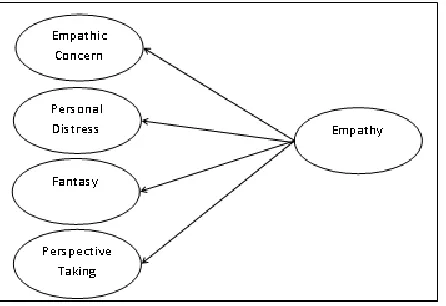
is an expression of the deep emotion that often arises spontaneously in response to witnessing or even reading the emotions of others [38]. The concept of empathy is described as an insight that an individual has about the lives of others that enables individuals to understand the circumstances and reality of other people's life situations [39]. Empathy is a behavioral element that is very important to understand in various contexts and can play a key role in providing information on moral judgment [40]. The formation of empathy is influenced by at least four factors: (a) emotional intensity, how often an individual engages his emotions in helping others; (b) the quality of individual relationships with others; (c) personal characteristics (such as age, sex, personality, past experience); and, (d) context, namely certain situations that allow spontaneous empathy to emerge [40]. Some experts agree on empathy as a multidimensional concept. Firstly, empathy is seen as an effective response to others and can include emotional problems; both empathies involves cognitive dimensions in which individuals adopt or share perspectives; thirdly empathy is related to modulating emotions that lead to self-integration which can cause negative effects such as confusion, anxiety, and depression [34]. A study conducted by Davis [42] to develop a measure of empathy based on dimensions consisting of 1) Perspective taking, is the tendency of individuals to adopt the psychological point of view of others spontaneously (feel what others experience). This ability can facilitate smoother and more useful interpersonal relationships. 2) Fantasy, is an individual's tendency to imagine his feelings based on what others have experienced. This ability allows individuals to display physiological and psychological arousal. 3) Empathic concern, is the tendency of individuals to care about the negative experiences of others. This ability enables individuals to engage in behaviors and emotions that are beneficial to others (actions that reflect caring). 4) Personal distress, is an individual's tendency to orient himself based on the negative experiences of others. The multidimensional conceptual framework of empathy consisting of empathic concern, personal distress, fantasy, and perspective taking can be seen in Figure 1.
Figure. 1. Conceptual model of empathy
Based on Figure 1 above, the hypothesis in this study is the empathic dimensions of concern, personal distress, fantasy, and perspective taking together are able to form empathy constructs. One approach that can be used in testing the construction of a measuring instrument is Confirmatory Factor
Analysis (CFA), which is one of the main approaches in factor analysis. Confirmatory Factor Analysis (CFA) can be used to test the dimensions of a construct. This test is used to measure the model so that it can describe the dimensions and indicators of behavior in reflecting latent variables namely empathy by looking at the loading factor of each dimension that forms a construct. Confirmatory Factor Analysis (CFA) is also used to test the construct validity and construct reliability of the indicators (items) forming latent constructs [43]. Confirmatory Factor Analysis (CFA) used in this study is the second order Confirmatory Factor Analysis (2nd Order CFA), a measurement model that consists of two levels. The first level of analysis is carried out from the dimensions to the indicators, and the second analysis is carried out from the latent construct to its dimensions [44]. The description that has been described above shows that empathy is an important psychological attribute for every student to have, both in the setting of the school environment and the wider social environment. Given the importance of empathy, the formulation of the problem in this study are: 1) Is the empathy scale valid and reliable?; 2) Are empathic dimensions of concern, personal distress, fantasy, and perspective taking able to form empathy constructs? The purpose of this study is to analyze the validity and reliability of the empathy construct and to examine the dimensions and indicators that make up the empathy construct.
2 RESEARCH METHOD
2.1 Population, Sample and Sampling Technique
The population in this study were all grade VII students who were in Muhammadiyah 1 Prambanan Middle School. The sample in this study were 60 students. The sampling technique used is quota sampling.
2.2 Data Collection Method
Empathy in this study was measured using an empathy scale with a differential semantic model. The researcher arranged the empathy scale by referring to the empathy dimensions proposed by Davis [42], namely empathic concern, personal distress, fantasy, and perspective taking. Examples of items from each dimension can be seen in the following table:
TABLE1
SAMPLE ITEMS OF EMPATHIC CONCERN DIMENSION
When there’s a friend in need of help, I …
Help 5 4 3 2 1 Ignore
Come to them 5 4 3 2 1 Do nothing
TABLE2
SAMPLE ITEM OF PERSONAL DISTRESS DIMENSION
When there are friend being scolded by the teacher, I…
Do nothing 5 4 3 2 1
Try to defend them
Keep patient 5 4 3 2 1 Feel angry
4332
SAMPLE ITEM OF FANTASY DIMENSION
When I see people suffering, I...
Feel pity 5 4 3 2 1 Happy
Care 5 4 3 2 1 Don’t care
TABLE4
SAMPLE ITEM OF PERSPECTIVE TAKING DIMENSION
When having different opinion, I...
Accept the
opinion 5 4 3 2 1
Reject the opinion
Listen 5 4 3 2 1 Don’t listen
The indicators that reflect each dimension are as follows:
TABLE5
BLUEPRINT OF THE EMPATHY SCALE
Dimension Indicator Item
Number Total
Empathic concern
a. Encourage others who are struggling
b. Being able to feel the pain of others
1,2,3,4,5,6 6
Personal distress
a. Feeling helpless or powerless to do something
b. Feeling worried or afraid of something
7,8,9,10,
11,12 6
Fantasy
a. Being able to carry the atmosphere to someone's suffering
b. Able to imagine yourself in the position of others
13,14,15, 16,17,18 6
Perspective taking
a. Able to consider other people's opinions
b. Being able to take another person's point of view
19,20.21,2 2,23,24 6
Total 24 24
2.3 Construct Validity and Construct Reliability
To test the validity and the reliability of the construct, this study used the outer model testing through the smartPLS 3.0 program. Validity testing consists of tests of convergent validity and discriminant validity. The convergent validity can be seen from the loading factor value > 0.5 and the value of Average Variance Extracted (AVE) > 0.5 [45], while the discriminant validity can be seen from comparing the roots of Average Variance Extracted (AVE) between dimensions in which it must be higher than correlation with other dimensions [45]. Reliability testing consists of Cronbach alpha test and composite reliability > 0.7 [45].
2.4 Data Analysis
Analysis of the data used in this study is the SmartPLS version 3.0 program with the 2nd Order CFA. PLS is a variance-based structural equation analysis (SEM) that can simultaneously test measurement models to test the construct validity and reliability.
3 RESULT
The results of the analysis of the outer model test conducted on the construct of empathy using smart PLS 3.0 shows that the construct meets the validity and reliability. The output
image of the outer model can be seen in the following image:
3.1 The Construct Validity Test Result
3.1.1 Convergent Validity
The empathy construct can be declared valid because it meets the criteria, namely through convergent validity which shows that the loading factor value > 0.5 can be seen in the following table:
Figure. 2 Outer model of empathy scale
TABLE6
THE VALUE OF LOADING FACTOR (VARIABLE-DIMENSION)
Dimension Loading Factor Explanation
Empathic concern 0.978 Valid
Personal distress 0.908 Valid
Fantasy 0.913 Valid
Perspective taking 0.945 Valid
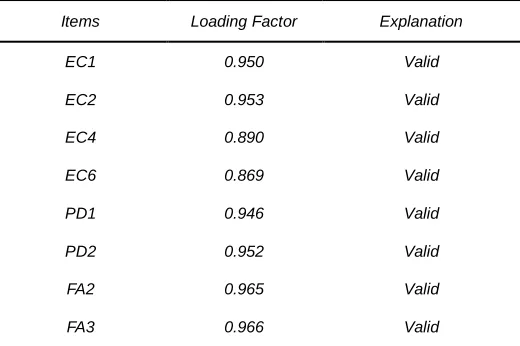
Based on the test of convergent validity on the outer model, it was found that the loading factor value of the dimensions to the indicators is > 0.5 shown in table 7.
TABLE7
THE VALUE OF LOADING FACTOR (DIMENSION –AITEM)
Items Loading Factor Explanation
EC1 0.950 Valid
EC2 0.953 Valid
EC4 0.890 Valid
EC6 0.869 Valid
PD1 0.946 Valid
PD2 0.952 Valid
FA2 0.965 Valid
4333
PT1 0.930 Valid
PT3 0.894 Valid
PT4 0.927 Valid
Convergent validity test results show the value of Average Variance Extracted (AVE) > 0.5. The Average Variance Extracted (AVE) value of the empathy construct is 0.838, and the Average Variance Extracted (AVE) value of each dimension can be seen in table 8.
TABLE8
THE AVE VALUE OF EMPATHY VARIABLE
Dimension AVE Value Explanation
Empathic
concern 0.840 Valid
Personal
distress 0.901 Valid
Fantasy 0.932 Valid
Perspective
taking 0.844 Valid
3.1.2 Discriminant Validity
The results of discriminant validity test show that the root value of the Average Variance Extracted (AVE) in each dimension is higher than the value of the Average Variance Extracted (AVE) root in other dimensions so that the discriminant validity criteria are met. The root value of the Average Variance Extracted (AVE) empathy variable can be seen in table 9.
TABLE9
AVERAGE VARIANCE EXTRACTED (AVE)
ROOT VALUE OF EMPATHY
Dimension EC PD FA PT
EC 0.916 0.862 0.906 0.903
PD 0.862 0.949 0.850 0.878
FA 0.906 0.850 0.965 0.889
PT 0.903 0.878 0.889 0.919
3.2 Construct Reliability Test
The reliability test results have been fulfilled based on the Cronbach alpha value and composite reliability that is > 0.7. These results can be seen in the following table:
TABLE10
THE VALUE OF CRONBACH ALPHA AND COMPOSITE RELIABILITY
Variable Cronbach Alpha
Composite
Reliability Annotation
Empathy 0.981 0.983 Reliable
4 DISCUSSION
Based on the results of the analysis of construct validity and construct reliability that has been done, it is known that all dimensions and indicators that form the construct of empathy in students can be declared valid and reliable. Thus, all
dimensions and indicators can reflect student empathy. The most dominant dimension which reflects student empathy is the dimension of empathy concerning with a loading factor of 0.978 which has indicators such as "being able to feel the pain of others, compelled to help others who are struggling". Meanwhile, the weakest dimension in reflecting student empathy is the personal distress dimension with a loading factor of 0.908 which has indicators such as "feeling helpless or powerless to do something, feeling worried or afraid of something".The concept of empathy is considered important in many fields of psychology in different contexts, a study developing empathy instruments used in nurses towards patients with reference to the cognitive and affective dimensions [46]. Cognition is the dimension that distinguishes empathy from sympathy when experiencing empathy the individual can position himself in the conditions experienced by others, whereas individuals who experience sympathy only feel concerned without being able to unite their emotions [47]. This dimension is very suitable when applied in nurse settings, the Cronbach alpha coefficient obtained from this dimension is 0.850 [48]. Studies on empathy that refer to the dimension of Davis [42] have been carried out to test how much the reliability coefficient is obtained, some researchers including Jeong [49], which measures empathy in students obtained a Cronbach alpha coefficient of 0.715. Hampes [50], got a Cronbach alpha of 0.810 in college students. Meanwhile, this study obtained a Cronbach alpha of 0.981, thus some of these studies showed that the empathy dimension consisting of empathic concern, personal distress, fantasy, and perspective taking was still relevant as a reference for the preparation of empathy instruments. The results of this study provide an overview of the validity and reliability of empathy constructs in Muhammadiyah 1 Prambanan Middle School students so that researchers can then use the results of this study as a reference in measuring student empathy.
5 CONCLUSION
Based on the results of the analysis and discussion, it can be concluded that the construct of empathy has fulfilled good validity and reliability, and all dimensions and indicators can significantly form empathy. The most dominant dimension that reflects the construct of empathy is empathic concern, and the weakest dimension reflects the construct of empathy is personal distress. In this study an empathy scale measurement model was formed that was in accordance with empirical data obtained from subjects at the study site.
6 ACKNOWLEDGEMENT
The author would like to thank Ahmad Dahlan University and the Master of Psychology Programme University of Ahmad Dahlan for supporting the implementation of this research.
7 REFERENCES
[1] M. Perugini, M. Gallucci, F. Presaghi, and A.P.
Ercolani, ―The Personal Norm of
Reciprocity,‖ European Journal of Personality, vol.17, no.4, pp. 251-283, 2003.
4334 Basic Books, 2005.
[4] N.L. Kerr, A.C. Rumble, E.S. Park, J.W. Ouwerkerk, C.D. Parks, M. Gallucci, and P.A. Van Lange, ―How Many Bad Apples Does it Take to Spoil The Whole Barrel?: Social Exclusion and Toleration For Bad
Apples,‖ Journal of Experimental Social
Psychology, vol.45, no.4, pp. 603-613, 2009.
[5] Klapwijk and P.A. Van Lange, ―Promoting Cooperation and Trust in" Noisy" Situations: The Power of Generosity,‖ Journal of Personality and Social Psychology, vol. 96, no.1, pp. 83-103, 2009.
[6] P.A. Van Lange, J.W. Ouwerkerk, and M.J. Tazelaar, ―How to Overcome the Detrimental Effects of Noise in
Social Interaction: The Benefits of
Generosity,‖ Journal of Personality and Social Psychology, vol.82, no.5, pp.768-780, 2002.
[7] M. Neumann, J. Bensing, S. Mercer, N. Ernstmann, O. Ommen, and H.P. Pfaff, ―Analyzing the Nature and Specific Effectiveness of Clinical Empathy: A Theoretical Overview and Contribution Towards a Theory-Based Research Agenda,‖ Patient Education and Counseling, vol.74, no.3, pp. 339–346, 2009. [8] W.J. Reynolds, and B. Scott, ―Empathy: A Crucial
Component of the Helping Relationship,‖ Journal of Psychiatric and Mental Health Nursing, vol.6, no.5, 363-370, 1999.
[9] W.J. Reynolds and B. Scott, ―Do Nurses and Other Professional Helpers Normally Display Much Empathy?,‖ Journal of Advanced Nursing, vol.31, no.1, pp. 226–234, 2000.
[10]G. Ancel, ―Developing Empathy in Nurses: An in Service Training Program,‖ Archives of Psychiatric Nursing, vol.20, no.6, pp. 249–257, 2006.
[11]S.E. Finn, ―The Many Faces of Empathy in Experiential, Person-Centered, Collaborative Assessment,‖ Journal of Personality Assessment, vol.91, no.1, pp. 20–23, 2009.
[12]M. Gillespie and B. McFetridge, ―Nurse education- the Role of the Nurse Teacher,‖ Journal of Clinical Nursing, vol.15, no.5, pp. 639–644, 2006.
[13]J. Halpern, ―Groupthink and Caregivers’ Projections: Addressing Barriers to Empathy,‖ Journal of Clinical Ethics, vol. 20, no.1, pp. 75–78, 2009.
[14]C. Kelly, ―Student’s Perceptions of Effective Clinical Teaching Revisited,‖ Nurse Education Today, vol. 27, pp. 885–892, 2007.
[15]J. Williams, and T. Stockley, ―Empathy and Nurse Education,‖ Nurse Education Today, vol. 30, no.8, pp. 725–755, 2010.
[16]McGregor, ―Enacting Connectedness in Nursing Education: Moving from Pockets of Rhetoric to Reality,‖ Nursing Education Perspectives, vol.26, no.2, pp. 90–95, 2005.
[17]G.R. Smith, ―Health Disparities: What Can Nursing Do?,‖ Policy, Politics and Nursing Practice, vol. 8, no. 4, pp. 285–291, 2007.
[18]R.P. Ang and D.H. Goh, ―Cyberbullying Among Adolescents: The Role of Affective and Cognitive Empathy, and Gender,‖ Child Psychiatry and Human Development, vol.41, no.4, pp. 387-397, 2010. [19]S. Salmon, ―Teaching Empathy: The PEACE
Curriculum,‖ Reclaiming Children and Youth, vol.12, no.3, pp. 167–173, 2003.
[20]M. Yazgan and E. Özgen, ―A Case Study on Empathic Tendency of Academicians in the Context of Interpersonal Relations,‖ Journalism, vol.7, no.1, pp. 46-52, 2017.
[21]J. Decety, ―The Neural Pathways, Development and Functions of Empathy,‖ Current Opinion in Behavioral Sciences, vol.3, pp.1-6, 2015.
[22]C.D. Batson and N. Ahmad, ―Empathy‐Induced Altruism in a Prisoner's Dilemma II: What if the Target of Empathy Has Defected?,‖ European Journal of Social Psychology, vol.31, no.1, pp. 25-36, 2001. [23]S. Baron-Cohen and S. Wheelwright, ―The Empathy
Quotient: An Investigation of Adults with Asperger Syndrome or High Functioning Autism, and Normal Sex Differences,‖ Journal of Autism and Developmental Disorders, vol. 34, no.2, pp. 163-175, 2004.
[24]N. Naor, S.G. Shamay-Tsoory, G. Sheppes, and H. Okon-Singer, ―The Impact of Empathy and
Reappraisal on Emotional Intensity
Recognition,‖ Cognition and Emotion, vol.32, no.5, pp. 972-987, 2018.
[25]D.C. Jensen and L.B. Pedersen, ―The Impact of Empathy—Explaining Diversity in Street-Level Decision-Making,‖ Journal of Public Administration Research and Theory, vol.27, no.3, pp. 433-449, 2017.
[26]J. Decety, ―The Neurodevelopment of Empathy in Humans,‖ Developmental Neuroscience, vol.32, no.4, pp. 257-267, 2010.
[27]C.D. Batson, N. Ahmad, D.A. Lishner, and J. Tsang, Empathy and Altruism. In C.R. Snyder and S.J. Lopez, (Eds.), Positive psychology, Oxford.: Oxford University Press, 2002.
[28]M. Hojat, D.Z. Louis, F.W. Markham, R. Wender, C. Rabinowitz, and J.S. Gonnella, ―Physicians’ Empathy and Clinical Outcomes for Diabetic Patients. Academic Medicine, vol.86, no.3, pp. 359-364, 2011. [29]E. Vermeire, H. Hearnshaw, P. Van Royen, and J.
Denekens, ―Patient Adherence to Treatment: Three Decades of Research. A Comprehensive Review,‖ Journal of Clinical Pharmacy and Therapeutics, vol.26, no.5, pp. 331-342, 2001.
[30]N. Telle and H. Pfister, (2012). ―Not Only the Miserable Receive Help: Empathy Promotes Prosocial Behavior Toward the Happy,‖ Current Psychology: A Journal for Diverse Perspectives on Diverse Psychological Issues, vol.31, no.4, pp. 393-413, 2012. [31]L. Wispé, ―The Distinction Between Sympathy and
Empathy: To Call Forth a Concept, A Word is Needed. Journal of Personality and Social Psychology, Vol. 50, No.2, pp. 314-321, 1986. [32]T. Lipps, ―Einfühlung, Innere Nachahmung und
Organenempfindungen. Revue Philosophique de la France Et de l'Etranger, vol.56, pp. 660-661, 1903. [33]E. Stotland, K.E. Matthews, S. Sherman, R.O.
Hansson, and B.Z. Richardson, Empathy, Fantasy and Helping. Beverly Hills.: Sage, 1978.
[34]J. Decety and P.L. Jackson, ―The Functional Architecture of Human empathy,‖ Behavioral and Cognitive Neuroscience Reviews, vol.3, no.2, pp. 71-100, 2004.
4335 How, When and Why?,‖ Trends in Cognitive
Sciences, vol.10, no.10, pp. 435-441, 2006.
[36]O.T.M. Miller-Keane and M.T. O’Toole, Miller-Keane Encyclopedia and Dictionary of Medicine, Nursing and Allied Health. A Book. 7th ed. Philadelphia.: Saunders, 2003.
[37]D.A. Lishner, C.D. Batson, and E. Huss, ―Tenderness and Sympathy: Distinct Empathic Emotions Elicited by Different Forms of Need,‖ Personality and Social Psychology Bulletin, vol.37, no.5, pp. 614-625, 2011. [38]J. Alsup, A Case for Teaching Literature in the
Secondary School: Why Reading Fiction Matters in an Age of Scientific Objectivity and Standardization. London.: Routledge, 2015.
[39]E.A. Segal, ―Social Empathy: A Model Built on Empathy, Contextual Understanding, and Social Responsibility that Promotes Social Justice,‖ Journal of Social Service Research, vol.37, no.3, pp. 266-277, 2011.
[40]K. Westberg, C. Stavros, F. Farrelly, and A.C. Smith, ―Fan Empathy as a Response to Athlete Transgressions,‖ Sport Management Review, pp.1-17, 2019.
[41]T. Singer and C. Lamm, ―The Social Neuroscience of Empathy,‖ Annals of the New York Academy of Sciences, vol.1156, no.1, pp. 81-96, 2009.
[42]M.H. Davis, ―A Multidimensional Approach to Individual Differences in Empathy. Journal of Southern African Studies, vol.10, pp. 85-104, 1980. [43]Ghozali and H. Latan, Partial Least Squares
Concepts, Techniques, and Applications of SmartPLS
2.0 M3 for Empirical Research (in
Indonesia). Semarang: Diponegoro University Publisher Agency, 2012.
[44]H. Latan, Structural Equation Modeling Concepts and Applications using LISREL 8,80 (in Indonesia). Bandung: Alfabeta, 2012.
[45]H.M. Jogiyanto, The Concept and Application of Variance-Based Structural Equation Modeling in Business Research (in Indonesia). Yogyakarta: UPP STIM YKPN, 2011. [46]H. Spiro, ―What is Empathy and Can it be Taught?,‖
Academia and Clinic, vol.116, no.10, pp. 843-846, 1992.
[47]J. Decety and P.L. Jackson, ―A Social-Neuroscience Perspective on Empathy,‖ Current Directions in Psychological Science, vol.15, no.2, pp. 54-58, 2006. [48]M. Di Lillo, A. Cicchetti, A.L. Scalzo, F. Taroni, and M.
Hojat, ―The Jefferson Scale of Physician Empathy: Preliminary Psychometrics and Group Comparisons in Italian Physicians,‖ Academic Medicine, vol.84, no.9, pp.1198-1202, 2009.
[49]H. Jeong, ―Critical Thinking Disposition, Problem Solving Process, and Empathy Among Nursing Students,‖ Advanced Science and Technology Letters, vol. 103, pp. 44-48, 2015.