5773
Automatic Plastic
Waste
Segregation
And
Sorting
Using
Deep Learning Model
Meeradevi, Sharavana Raju K., Vigneshkumaran
Abstract: In urban areas, solid waste is produced high in percentage. In waste management, segregation of recyclable wastes is a major role. Till now, human intervention is needed to manually segregate these waste materials. This proposed paper describes a system to collect different types of plastic bottles and to perform classification and sorting of the bottles. To identify the plastic bottles instead of using sensors, image processing using machine learning algorithm is proposed in this paper. First step is acquisition of plastic bottle Images and features are extracted by using SURF algorithm. Then the features of bottles are given to the conventional neural network classifier for classification and identified for type of bottle class. The proposed design provides accurate identification of bottle and effective recycling in low cost. This system will ensure effective automated waste management and will speed up the process of segregation without any human intervention.
Keywords: Convolutional neural network (CNN), Deep learning, Image classification, Plastic bottles recycling, Segregation
————————————————————
I
INTRODUCTION
Volume of waste generation is growing rapidly year by year. Recycling is necessary for a sustainable society. Plastic bottles are thrown away by the people once it is used . Recycling also helps to cut down the amount of trash thrown into landfills. Recycling method is used for plastic waste materials which are not allowed in most of the developing countries. In recycling mechanism, segregation and recycling processes requires facilities to segregate garbage waste by hand or use a series of large machines to separate the wastes. It can also be monitored by the humans. To minimize the human effort to separate plastic bottles, this paper proposes a solution to classify different types of plastic bottles by acquiring the images of plastic bottles once if it is put into the device. Segregating plastic bottles are important task for recycling purpose because all types of plastic bottles are not made up by same quality of plastic materials. So by segregating it, the recycling will become easier. In this paper, CNN network is used to predict the category of bottle dataset class in which bottle belongs to PP (Polypropylene) , HDPE (High Density Polyethylene) and PET (Polyethylene Terephthalate) type of plastic materials. This paper briefly describes the previously used classification system techniques in section 2. Discussion about the proposed system is given in Section 3. In section 4, the results are discussed and analyzed. Section 5, discusses about conclusion and future work.
II RELATED WORK
Li Sun , Cheng Zhao and Zhi Yan [2019 ] discussed a weakly supervised learning approach which was able to learn a deep convolutional neural network from unlabeled Red Green Blue Depth(RGBD) images. The nuclear waste was radioactive comprises common object such as plastic bottles. In this
approach, bounding-box annotations are not required. Though the performance of this depth-Net was lower, the substantial improvement was then obtained by using multi-modal DCNNs. This paper proposed a novel weakly-supervised deep learning approach (DCNN-GPC) for detection and recognition of nuclear waste objects. This approach was based on deep learning and also able to detect and categorize unknown waste objects. From a practical perspective, this approach was trained using minimal annotated data by propagating minimal labels to large-scale unlabeled data. Lolith Gopan and R. Aarthi [ 2018] worked on the field of machine vision and established detection mechanism in many fields. Artificial intelligent architectures performs key role to discuss about the problems [4]. In this paper realization of Deep Convolutional Neural Network (DCNN) have being considered on indoor environment to classify categories of bottle objects [7]. Qiurui Wang , Chun Yuan , and Yan Liu [2019] Combined Convolutional Neural Networks (CNNs) with Conditional Random Fields (CRFs). It achieves great success among recent object segmentation methods [8]. Firstly, CNN's can extract not use of high level features; those are much dissimilar to the features to be extracted on the primates visual cortex. Secondary, Combined CNN's can set up links between features of the input and output prediction labels in this method. In this paper, by using CNNs for low-level feature extraction and a Structured Random Forest (SRF)-based border ownership detector for high-level feature extraction, which are similar to the outputs of primate's secondary visual cortex (V2). Compared to the CRF model, an improved Conditional Boltzmann Machine (CBM), which has a multi-channel visible layer, is proposed to model the relationship between predicted labels, local and global contexts of objects with multi-scale and multilevel features [8].
III PROPOSED
SYSTEM
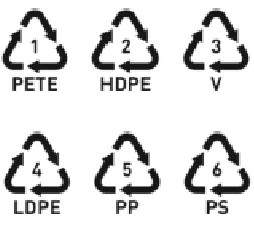
In this system , predicting the category of classes to which the waste bottles belongs to, using Deep Learning algorithm. Convolutional Neural Networks (CNN) is used to classify the incoming plastic bottle image into some of the classes such as water, juice, syrup bottles. Plastics types are shown in the Fig.1. There are PP , HDPE and PET. These types of plastic material bottles are used for segregation and sorting. Feature extraction method is used to detect the features of the object in the image and to calculate its feature vector . This
______________________
Meeradevi, Kongu Engineering College, Perundurai, Erode.
Vigneshkumaran, Kongu Engineering College, Perundurai, Erode.
5774 feature vectors are used for train and test the neural network
model.
Fig. 1. Types of Plastics
3.1 Collection of Datasets
The data acquisition process was done since there are no publicly available datasets pertaining of plastic materials. However, dataset images accurately exhibit the state of recycled plastic bottles. This is unlikely in recycled plastic materials treated as waste because images are crushed, damaged, crumpled, etc. The dataset contains images of recycled objects process resulted in a collection of three classes of datasets are Polypropylene, Polyethylene Terephthalate & High Density Polyethylene contains 900 images. Each class contains 6 different type of bottles which summed up to 16,200 images. These are further divided into train images and test images which are essential for training a CNN model. The data acquisition process involved using a white poster board and black poster board as a background and taking pictures of plastic bottles and recycling around homes, schools and colleges. The light level and poses for each photo is not the same, which introduces variation in the dataset. Fig.2 shows some of the sample classes. Dataset images involved rotation of the image in all angles, minimum to maximum brightness control of the image, random translation of the image, random scaling of the image, and random shearing of the image. This type of image augmentation is chosen to account for the multiple orientations of recycled material to maximize the dataset size.
Fig. 2. Some Sample classes for PP, PET and HDPE
3.2 Feature Extraction
A CNN contains of a sequence of convolutional layer along with max-pooling layers, activation layer and each layer has connected with its previous layer. Figure.4 represents the design of CNN model. It is a general, hierarchical feature extractor which will map input image pixels depth into a feature vector. This will be classified by several fully connected layers in the next step. Feature Extraction is used to extract the number of features in a dataset images by creating new features from the existing ones (and then discarding the original features). These extracts set of features should then be able to summarize most of the information contained in the original set of features. In the Fig.3 feature extraction on deep learning techniques. In this way, a summarized form of the original features can be found from a combined original dataset.
Fig. 3.Feature Extraction on Learning Techniques
Speeded Up Robust Features (SURF) is used for image recognition comprise of three steps - extract of features, feature description and matching of features. SURF algorithm extracts the local concentrated features of the image using Hessian matrix-based approach and distribution-based descriptor. SURF approximates Laplacian of Gaussian (LoG) with Box Filter. Advantage of this similar method is that, convolution with box filter can be simply calculated with the help of integral images. Since SURF is scale with rotation invariant algorithm, it can extract features in presence of rotation, scaling and partial distortion of the test image. It's developed for the matched key points of the bottle.
3.3 Conventional Neural Networks
5775 Fig 4.Design of CNN Model
All adjustable parameters are optimized by minimizing the misclassification by reducing the error over the training set. Each convolutional layer of CNN performs a 2D convolution of its input maps with a filter of different size 3 x 3, 5 x 5, 7 x 7. The subsequent activations of the output maps are given by the total of the past convolutional responses which are gone through a non-linear activation function. Max pooling layer will perform the dimensionality reduction. The output of a thin layer is given by the most extreme activation over non-covering rectangular areas. Max-pooling makes location invariance and down-samples the image along every direction over bigger neighborhood. Filter size of convolutional along with max pooling layers are selected in such a way that fully connected layer can combine the output into a one dimensional vector. The last layer will always be fully connected layer which contains one output unit for all class. Here rectification linear unit is used as the activation function. Furthermore, it will be deciphered as the likelihood of a specific input image having a place with that class. Stochastic gradient is used to train data along with negative likelihood criterion as loss function.
IV METHODOLGY
Deep learning (DL) is a branch of artificial intelligence that gives to the system, which can capability to teach them self without any programmed. Here machine is trained to identify different kind of objects. Image of object is given to machine as an input and processor tells whether it is the same object or not. Before the DL era, features were manually picked and designed and then followed by a classifier. The revolutionary part of ML is that features are mostly learned automatically from the training data using Convolutional Neural Network (CNN). The use of CNN makes a classifier powerful in the process of image recognition.
4.1. Design of CNN Model
Every object detection has an image classification on it, the development of a CNN based object detector became necessary. There were two problems that needed to be overcome though first, CNN based image classifiers were computationally very expensive compared traditional techniques like HAAR cascades. The layers used for image classification are Conv2D is the layer to convolve the image into multiple images Activation is the activation function. MaxPooling2D is used to max pool the value from the given size matrix and same is used. Again use of Conv2D and MaxPooling2D layers alternatively used. Then, Flatten is used to flatten the dimensions of the image obtained after convolving it. Is used to make this a fully connected model and is the hidden layer. Dropout is used to avoid overfitting on the dataset. Dense is the output layer contains only one neuron which decide to which category image belongs.
4.2. Deep Learning Libraries and Frameworks
Tensorflow: TensorFlow is an open-source machine intelligence library platform for numerical computation using data flow structures. TensorFlow was created and is maintained by the Google Brain team within Google’s Machine Intelligence research organization for Deep Learning. It is currently released under the Apache 2.0 open-source license. TensorFlow is designed for large-scale distributed training and testing inference. Connecting nodes in the graph represent mathematical operations, while the graph edges represent the multidimensional data arrays (tensors) communicated between them. The distributed TensorFlow architecture contains distributed master services with kernel implementations. These includes standard operations including mathematical functions, array manipulation, flow of control and state management operations written in C++. TensorFlow was designed for use both in research and development with production systems. It can run on CPU systems and mobile devices and large-scale distributed systems of hundreds of nodes.
Keras: Keras is an Neural Network library written in Python language that runs on framework called TensorFlow. It is described to be modular, fast and easy to use. Keras does not handle low-level computation. Instead, by using another library to perform function, named as Backend. So Keras is high-level API wrapper for the low-level API, capable of running on the frameworks of TensorFlow or Theano. Keras High-Level API handles the way for make defining models, defining layers and set up multiple input and output models. In this level, Keras also compiles model with loss and optimizer functions, training process with fit function.
Theano: Theano is one of the Python library frameworks. It allows users to determine, optimize, and appraise deep learning models efficiently. It is integrated with NumPy, numerical libraries in Python and supports efficient symbolic differentiation. Theano used to provides a high state level of APIs for deep learning. The design source of Theano seems to provide a computer algebra system taken away the aspect of an optimizing compiler. Thus, customized C codes of major mathematical operations can be generated by Theano to facilitate complex mathematical computation. e.g. DL, to approximate the performance of C programming language.
4.3. Flow Chart of Image Classification
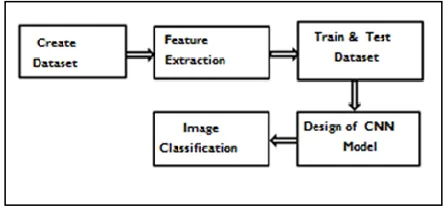
The working process of image classification based on the CNN is shown on the Fig.5. Object detection algorithms typically use extracted features and learning algorithms to recognize instances of an object category. It is commonly used in applications such as classification of images with localization, object segmentation and object detection.
5776
4.4. Training the Networks
After the network has been structured for object detection application with all parameters, then it is ready for training. The classical stochastic gradient descent algorithm is used for training the network. After each iteration, the network converges by reducing the error rate. The loop will terminate when it reaches a minimum error rate. Here it is 0.02. The network weight are adjusted subsequently in each iteration from initial value based on result until it converges to a value. The weight value for each object is recorded in a backup file. The weight is further used to detect the object.
4.5. Testing the Networks
The pre-trained weight which is obtained from the training phase is used in the testing phase. The input image is allowed to pass through all layers of the neural network and parameters are obtained. These values are crosschecked with the pretrained weight and identify the one which gives maximum matching with the classes. The system will consider the label to which it is closely matched.
V
RESULT
AND
DISCUSSION
A. Feature Extraction
In this project a cascade of classifiers on dense features computed at different scales around grid points. The output of these classifiers is combined using different weighting schemes to detect an object from the image. The combination of the classifiers boosted the results but no single scheme result out and trained on all the features gave us the best performance, which shows that the different features extracted at different scales are required for efficiently detecting an object and the learning algorithm can do the best job of selecting which feature is appropriate and its scale accordingly. Feature extraction is done by the surf algorithm as shown in the Fig 6.
Fig.6.Feature Extraction from Bottle Dataset
B. CNN Classification
The CNN classification implemented in Google’s TensorFlow using Keras, which provides a high level of abstraction over TensorFlow. All the images in the dataset were resized to 64x64 before feeding as input to the network. The network was constructed as shown on Table 1 CNN Layers for image classification.
Table- I: CNN Layers for Classification
Layers Description
Layer 0 Input Image of size 64x64x3.
Layer 1 Convolution with 32 filters of size 3x3 with stride 2 Layer 2 Max Pooling with size 2x2 filter, stride 2
Layer 3 Convolution with 32 filters of size 3x3 with stride 2 Layer 4 Max Pooling with size 2x2 filter, stride 2
Layer 5 Flattening
Layer 6 Dense with size 2x2 filter, stride 2
The loss has been computed using binary cross- entropy and the optimizer used is RMS prop. The CNN was trained for around 6.5 hours on AMD processor. The train/validation split was 600 images per class and 50 epochs were used. As augmented samples are used for inputs even if increasing the dataset size, images were highly correlated. This could have resulted in overfitting of the data. The problem of overfitting was solved by modulating the entropy capacity of the network. Some of information stored in the model. A model that can store lot of information has the potential to be more accurate but it also ends up storing irrelevant features. In this case, used a very small CNN with few of the layers and few of the filters per layer along data less number of dataset are used without any data augmentation and dropout of 0.5.
Fig.7. Output Predictions of Validation Data
Finally sample image of the bottle given to the convolutional neural network . Test of the image can be takes place on each layer of the neural network . It contains 50 epochs with operations of 40 steps for each epoch. It classify the class of the input image and gives the result of image classifier. In the Fig.7 output prediction of validation data is obtained.
Table- II: Predictive Score for each Class Name of
set
Class Type
No.of Images
Predictive Score
Accuracy Rate (%)
Set A PP 150 0.79344 70.01
Set B PP 150 0.83973 93.77
Set C PP 150 0.98848 76.43
Set D PP 150 0.85512 85.81
Set E PP 150 0.84871 94.76
Set F PP 150 0.89337 92.02
Set G PET 150 0.94442 79.98
Set H PET 150 0.86836 85.45
Set I PET 150 0.97903 81.75
Set J PET 150 0.93429 86.01
Set K PET 150 0.96003 83.11
Set L PET 150 0.97955 94.43
Set M HDPE 150 0.88652 99.63
Set N HDPE 150 0.89786 93.76
Set O HDPE 150 0.98430 91.02
Set P HDPE 150 0.94437 99.63
Set Q HDPE 150 0.87358 72.11
Set R HDPE 150 0.97510 98.75
5777 layer from applying twice the same pattern. In the Table II
Predictive score for each class is given. In the Table III Accuracy, Loss and Precision rate of different types and of bottles are shown.
Table- III: Results of Train and Validation CNN
Parameters PP PET HDPE
Validation Accuracy 97.2 88.5 94.6 Validation Loss 6.8 11.1 8.4 Train Accuracy 93.8 90.7 81
Train Loss 6.2 9.3 19
In the Fig.8 results of train and validation of CNN model are shown in graph.
Fig.8.Validation data for PP,PET & HDPE
VI
CONCLUSION
AND
FUTURE
WORK
Recognition and detection of bottles has been done using deep learning algorithm. The features were extracted from the images and calculated the feature vector through feature descriptors using Surf algorithm. The CNN provided the classification average accuracy of 93.4% for plastic bottle datasets. Hence, the deep learning framework were more accurate than the machine learning and neural networks. The usage of the Deep learning models gives good result for bottle identification. Furthermore, this work may be extended to all types of plastic materials.
REFERENCES
[1] Janusz Bobulski and Mariusz Kubanek B , (2019) Institute of Computer and Information Sciences, Czestochowa University of Technology, “ Waste Classification System Using Image Processing and Convolutional Neural Networks” , Springer International Publishing, Vol 56, LNCS 11507, Pp. 350–361.
[2] Jayanthi N and Indu S , (2017) “Comparison of Image Matching Techniques” , Department of Electronics and Communication Engineering Delhi Technological University, Delhi, India , International Journal of Latest Trends in Engineering and Technology , Vol.(7) Issue(3), Pp. 396‐401.
[3] Li Sun , Cheng Zhao , Zhi Yan, Pengcheng Liu , Tom Duckett , And Rustam Stolkin, (2019) “A Novel Weakly-Supervised Approach for RGB-D-Based
Nuclear Waste Object Detection” , IEEE Sensors Journal, Vol. 19, No. 9, pp. 3487-3500.
[4] Lolith Gopan and R. Aarthi , (2018) “ A Vision Based DCNN for Identify Bottle Object in Indoor Environment” , Computational Vision and Bio Inspired Computing, SPRINGER Journal, Vol 28 , pp 447-456.
[5] Marloun Sejera, Joseph Bryan Ibarra, Anrol Sarah Canare, Lyra Escano, Dianne Claudinne Mapanoo, John Phillip Suaviso , (2016) “Standalone Frequency Based Automated Trash Bin and Segregator Of Plastic Bottles And Tin Cans” , IEEE Sensors Journal, vol. 1. no. 1. pp. 11 – 24.
[6] Jangtjik, K. A., Yeh, M.-C., & Hua, K.-L. (2016).“Artist-based Classification via Deep Learning with Multi-scale Weighted Pooling”
[7] Proceedings of the 2016 ACM on Multimedia Conference - MM ’16.
[8] Aref, M. M., & Mattila, J. (2018). “Deep Learning of Robotic Manipulator Structures by Convolutional Neural Network” Ninth International Conference on Intelligent Control and Information Processing (ICICIP).
[9] Qiurui Wang , Chun Yuan , and Yan Liu , (2019) “Learning Conventional Neural Network for Image Segmentation” , IEEE Transactions On Multimedia, Vol. 21, No. 7
[10]Takuya Kiyokawa , Keita Tomochika, Jun Takamatsu, And Tsukasa Ogasawara , (2019) “Fully Automated Annotation With Noise-masked Visual Markers For Deep-learning-based Object Detection”, IEEE Robotics And Automation Letters, VOL. 4, No. 2.
[11]Mohd Helmy Abd Wahab , Aeslina Abdul Kadir , Mohd Razali Tomari , Mohamad Hairol Jabbar , (2014) “Smart recycle bin” , IEEE journal , vol. 5, no. 4, pp. 483-494 [12]Pushpa M. K, Aayushi Gupta, Shariq Mohammed
Shaikh, Stuti Jha, Suchitra.V, (2015)“Microcontroller Based Automatic Waste Segregator ”, International journal of innovative research in Electrical, Electronics, Instrumentation and Control Engineering Vol. 3, issue 5,