IJEDR1702183
International Journal of Engineering Development and Research (www.ijedr.org)1095
USE OF GSM TECHNILOGY TO
CONTROL THE SPEED OF STEPPER
MOTOR
Srushti Chafle1, S wati B handarkar2 De partment of Elec trical Engineering,
Datta meghe Institute of Engineering technology and research , Sawangi(Meghe),Wardha
Abstract:-Stepper motor is found in a l ot of applic ations such as c omputer peri pher als, business, mac hines, pr ocess control, mac hine tools and r obotics. Especi ally in different are as of robotics, process control like silicon pr ocessing, in Nuclear labor ator y, I.C. B ondi ng and Laser tri mming applicati on, it is necessary to contr ol stepper motor fr om remote places. In this paper, the design aspects of an embe dde d de vice which can contr ol ste pper motor by sending a s pecific message from a mobile phone are presente d. This controller is extre mely handy at place where we have to contr ol the ON and OFF swi tching of the de vice but no wire d connec tion to that place avail able. GS M contr oller stepper motor is automatic control system which is capable of receiving a set of c ommand instruc tions from any place where GS M signals are available in the for m of Shor t Message Service and perfor m the necessary acti on like start, stop and spee d c ontr ol.
Keywords:-Short massage services (SMS), Global System for Mobile Communication (GSM), Proteus software, keil software, AT command.
I.INTRODUCTION
IJEDR1702183
International Journal of Engineering Development and Research (www.ijedr.org)1096
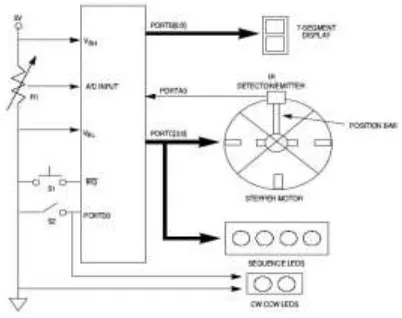
Fig. 1: Introductory Diagra mII S TEPPER MOTOR
Highlight advantage of stepper motors ma ke it in the civ ilian application of a wide range of industrial control. Stepper motor control system is an impo rtant component of the system, through its output electrical pulse signal to achieve position control [3]. A stepper motor is brushless, synchronous electric motors that can be device full rotation in to a large nu mber o f step. Stepper motor provides means of positioning and speed control without the use of feedback sensor. The basic operation of a stepper motor allo w the shaft to move a precise number of degree .Stepper motor speed and the angle of rotation are decided by the input pulse rate and the total number of pulse. Stepper motor operate differentia l fro m DC brush motor, which rotates when voltage is applied to their termina l.
FUNDAMENTALS OF OPERATION
The stepper motor uses the theory of operation for the magnets to make the motor shaft turn a precise distance, when a pulse of electricity is provided. When no power is applied , the residual magnetism in the rotor magnets will cause the rotor to align one set of its magnetic poles with the magnetic poles of one of the stator magnets. This means that that rotor will have 24 possible detent positions. When the rotor is in a detent position, it will have enough magnetic force to keep the shaft fro m mov ing to the next position. This is that makes the rotor feel like it is clicking fro m one position to the next as you rotate the rotor by hand with no power applied. When power is applied, it is directed to only one of the stator pairs of wind ing, which will cause the winding pair to become a magnet. One of the coils for the pair will become the North Po le, and the other will beco me the South Pole. When this occurs, the stator coil that is the North Pole will attract the closest rotor tooth that has the opposite polarity, and the stator coil that is the South pole will attract the closest rotor tooth that has the opposite polarity. When current is flowing through these poles, the rotor will now have a much stronger attraction to the stator winding, and the increase torque is called the holding torque.
III. A BRIEF INTRODUCTION OF GS M S IM300 MODEM
IJEDR1702183
International Journal of Engineering Development and Research (www.ijedr.org)1097
communicat ion interfaces for computer. The MODEM is the soul of such module. SIM300 is an Trainband GSM/ GPRS engine that works on frequencies EGSM 900M Hz, DCS 1800M Hz and PCS 1900 MHz SIM 300 provides GPRS mu lti-slot class 10 capability and supports the GPRS coding schemes.BRIEF INTR ODUCTION OF AT C OMMAND
Command Descripti on
AT Check if seria l interface and
GSM mode m is wo rking.
ATE0 Turn echo off, less traffic on
serial line.
AT+CNMI Display of ne w incoming
SMS.
AT+CPMS Selection of SMS me mory.
AT+CM GF SMS string format, how they
are co mpressed.
AT+CM GR Read new message fro m a
given me mo ry location.
AT+CM GS Send message to a given
recipient.
AT+CM GD Delete message.
IV. A B REIF INTRODUCTION TO MICROCONTROLLER
A Microcontroller is a single chip that contains the processor (the CPU), non -volatile me mory for the program (ROM or flash), volatile me mo ry for input and output (RAM), a cloc k an I/ O control unit.
AT89S52 MICROCONTR OLLER
The AT89S52 is a low power, high performance CMOS 8-b it mic rocontroller with 8K byte of in-system programmab le flash me mory. The device is manufactured using Atmel’s high-density non-volatile me mo ry technology and is compatible with the industry slandered 80C51 instruction set and pim out. The on chip flash allo ws the program to be reprogrammed in system or by conventional non volatile me mo ry programmer by combin ing 8-bit CPU. The At89S52 is a powerful mic rocontroller wh ich provides a highly flexible and cost effective solution to many e mbedded control application .
The AT89S52 provides the following slandered features
1. 8K bytes of flash
2. 256 bytes of RAM
IJEDR1702183
International Journal of Engineering Development and Research (www.ijedr.org)1098
4. 2 data pointer5. Three 16 bits time r/counter, a six-vector two level interrupt architecture, serial port and clock c ircu itry.
The additional feature of AT89S52 makes it a powerfu l microcontrolle r for application that requires pulse width modulation high speed I/O and up/down counting capabilities such as motor control
The pin d iagra m feature of 8051 showed all of the I/ O pins unique to microcontrolle r.
IJEDR1702183
International Journal of Engineering Development and Research (www.ijedr.org)1099
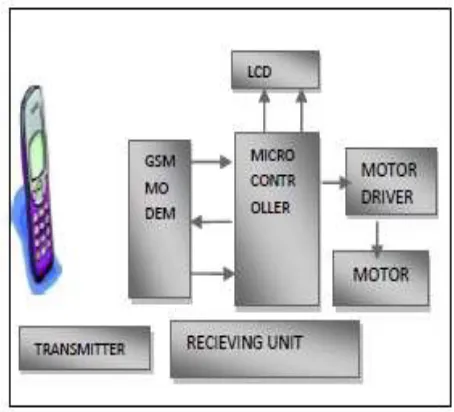
V. S YS TEM ARCITECT UREFig. 3: System Architecture
VI. WORKING
In this project, we are using the GSM technology. A microcontrolle r is a sma ll co mputer on a single integrated circuit consisting of a re lative ly simple CPU co mbine with support functions such as timer etc. Microcontrollers are use in auto matically controlled product and devices such as remote controls, office machines, power tools and toys. The LCD displays the current op eration of the system. The mic rocontroller is use to control the relay drivers depending upon the software program. Major ro le of this project is to receive the SMS to speed control of stepper motor. Initia lly, the SMS is receive fro m the person authorized to use this set up by the GSM mode m (SIM300 MODEM) and is transferred to the microcontroller devices kit with the help of a MAX230 chip. As per the AT command given by the mic rocontroller to the modem, the control signal is extracted and is use to control the devices connected to it. We have to convert the ,,septets” of the phone to ,,octets” because the microcontroller needs the bytes with 8 bits length. All this process is necessary to decode the message from SMS. A program is loaded into microcontroller devices kit and then the circuit is connected to the modem. The microcontroller now tries to read the SMS fro m the first me mory location of the mode m and keeps trying again until the modem receives any ( programmed for every one second). Before imp le menting the control single part of the SMS, the mode m e xtracts the number fro m the SMS and verifies if this number has the access to control the device or not. For controlling the devices, the message will be sending in he xadecimal format. The he x data in converted into binary and the particular output is enabled. We have connected LEDs to the ports of mic rocontroller to show the output and their status indicates whether the ports are set to ,,ON” or ,,OFF”. And speed control like send the message in text format like MOTOR SPEED LOW, MOTOR SPEED M EDIUM and MOTOR SPEED HIGH for stepper motor.
IJEDR1702183
International Journal of Engineering Development and Research (www.ijedr.org)1100
VII. RUS ULTThe stepper motor rotates clockwise and anticlockwise as per the the given command in SMS. SM S send by the sender and it receives by the receiver and the speed of the stepper motor is controlled.
VIII. CONCLUS ION
In This paper we have discussed the low cost, secure, ubiquitously accessible re motely controlled speed control of stepper motor is introduced. The approach dis cuss in this paper is control the speed of stepper motor through massage. Stepper motor control is use in many of industrial purpose, home security and in nuclear powe r laboratory. If we have to control the stepper motor fro m re motely then this project is very useful because of low cost.
The GSM technology capable solution has proven to be controlled remotely, provide industrial security has achieve the target to control diffe rent industrial appliances re motely using the SMS based system.
The data is feed in the mic rocontroller in the form of co mmand and mobile and microcontroller is interface and AT command is given for mobile co mmunication. When the SMS is receive by the mode m is read by the controller is further work is done by the controller as per the command given in the SMS i.e. start , stop, reverse ,forward command.
IX. REFFERENC ES
[1] Que Ngoc Le and Jae-Wook Jeon ,Me mber,IEEE” Neural-Network -Based Low-speed-
Damping Controller for Stepper Moor Withan FPGAt”IEEE Transaction on industrial Electron ics, VO, 57 NO. 9,
September 2010.
[2] Authors- Sagarika Pa l, Niladri S. Tripathy, “Re mote Position Control System of Stepper Motor Using DTMF
Technology”, International Journal of Control and Automation Vol. 4 No. 2, June, 2011.
[3] Mandeep Singh Walia “The Stepper motor control using 89C51 microcontroller”, International Journal of
Microelectronics, electronics for you October 2004
[4] Andrew j. Blauch, Mark Bodson ,John chiasson “High speed parameter estimation stepper of motor”, IEEE
trans on control system technology vol 1 no.4 December 1993
[5] Zhang Yajun, Chen Long, Fan Lingyan, “ A design of elevator positioning control system model”,IEEE Int.