IJEDR1802019
International Journal of Engineering Development and Research (
www.ijedr.org
)
99
Design and implementation of wireless sensor
network for estimating fire environment
Snehal Maruti Bagade/Gaikwad1, Prof. Mahesh S. Mathpati2 1MEstudent, 2Assistant Professor
1,2SVERI, s College of Engineering, Pandharpur Maharastra, India
_____________________________________________________________________________________________________
Abstract - Now days wireless sensor network (WSN) is one of the widely growing technologies, with the large application area. Wireless sensor networks node consists of microcontroller, for the processing purpose, sensors which are used for sensing the physical quantities such as temperature, humidity, pressure, gases, flames of fire etc. and transceiver for the communication. These more number of nodes for the network, with communication with each other, forms the WSN. WSN have wide range of application areas, such as environmental, industrial, agriculture, forest, commercial, cracker industries etc. Fire is one of the most greatest damaging factors which can take place in any place such as in the forest, in industries, as in agriculture or in commercial places. Fire can damage environment as well as human life. Hence the system is required to detect the fire at early stage.
Index terms - wireless sensor networks (WSN), fire, sensor node, analog to digital converter (ADC), Global system for mobile communication (GSM)
_____________________________________________________________________________________________________
I. Introduction:
As we know the fire is very dangerous for the environment as well as human life, different fire accidents taken place day to day life in which the loss of lives and property taken place. Fires destroy biodiversity directly and have more indirect long-term impacts including the encouragement of fire and pioneer species. It has been suggested that the dark carbon dust emitted by the fires is not good for health of the people as well as for the environment. Hence there is requirement of a system which can detect the fire in early stage. Wireless sensor networks are the technology in which nodes are used to detect the physical quantities and send such a data to the control cabin, where the operator observes the parameter value. If the parameters value is above the threshold then the operator knows that some problem is taken place. Hence the WSN consists of number of nodes. In this paper I am explain the required components for node, and also develop the node for fire environment monitoring purpose. The first part of the paper explains what are node and its requirements, as per the fire monitoring system. The node which is consists of sensing unit, processor and the communication unit. The second part of the paper explains the block diagram and components which are used to develop the system.
II. Part 1:
In this project the WSN is used for fire monitoring. Fire is such a disaster which can take place at anywhere, any time. WSN is such system which can be used for fire monitoring at early stage. The wireless sensor networks are consists of number of nodes. The nodes collect the physical quantities and send this information to the control cabin.
Fig. 1
The nodes of the WSN are battery power. The node is consists of sensors, processing unit such as microcontroller and the communication unit. There may be different sensors as per the requirement used to sense the physical quantities. The sensed quantities are sending to the analog to digital converter (ADC), which is mostly inbuilt in microcontroller. The microcontroller converts the quantities into digital values and processes them as per program. These values are saving into the memory of the controller. This data is send to the control cabin through the communication unit.
IJEDR1802019
International Journal of Engineering Development and Research (
www.ijedr.org
)
100
Fig.2III. Part 2:
In this project WSN is used for fire monitoring, as we know that the fire is very hazardous, taken place anywhere at any time. Fires occur due to any reason such as short circuit, cylinder blast, chemical reaction, cracker blasts, forest fire, carelessness of peoples etc. Along with fire detection the safety of people working at that spot is also important. Hence along with fire detection the safety system is also important.
Fire is believed to be based on three elements being present: fuel, heat and oxidizer. To detect the fire, Fire sensor is used to sense the fire. The node must sense the temperature of the surrounding. Hence the temperature sensor is used in the system. The gas sensor is used to sense the presence of carbon dioxide in the surrounding environment. To observe the presence of any person in the area the security sensor i.e. TSOP sensor is used. If any person is detected in the area during fire, then we can also communicate with the authority about the presence of human in fire area. The temperature sensor, gas sensor, security sensor i. e. TSOP sensor, LDR sensor, these all sensors sense the required physical quantities and send them to the processing unit which is the microcontroller. The all sensed data processed by the microcontroller and send to the control cabin through the communicating unit i.e. transceiver, where the operator observe the received data.
The safety of the human being at fire place is more important. Fire taken place then peoples at that place must be alerted. Hence the alarm system is used. When the fire taken place or temperature exceeds the particular limit the alarm is on. If the temperature of the work place is increased then to control it DC fan is activated by microcontroller. According to the sensing quantities of LDR sensors the lights are get on as per requirement. The block diagram of the system is shown in fig.3.
Fig. 3
IV. Components:
The components used in this project are different types of sensors, GSM modem, microcontroller and different devices. Sensors used are LM35 temperature sensor, temperature and humidity sensor (dht11), MQ2 gas sensor, 3190 LDR sensor, SKU: DFR0076 flame sensor, TSOP48 sensor and MQ 135 sensor.
A. Sensors:
1. Temperature Sensor:
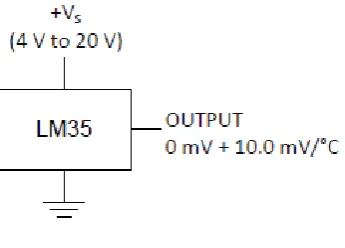
LM35 sensor is precision integrated circuit temperature devices with an output voltage is linearly proportional to the centigrade temperature. This sensor has the full range from-550C to 1500C. LM35 is suitable for remote applications with low self heating. This device operates with single power supplies or with plus and minus supplies.
Sensors
Microcontroller
Communication
unit
Processor
Memory
A
D
IJEDR1802019
International Journal of Engineering Development and Research (
www.ijedr.org
)
101
Fig 4 lm352. Temperature + humidity sensor(dht11):
DHT11 digital temperature and humidity sensor is a composite Sensor contains a calibrated digital signal output of the temperature and humidity. To ensure that the product has high reliability and excellent long-term stability. The sensor includes a resistive sense of wet components and NTC temperature measurement devices. The features of the device are low cost, long-term stability, relative humidity and temperature measurement, excellent quality, fast response, strong anti-interference ability, long distance signal transmission, digital signal output, and precise calibration.
Fig. 5 DHT sensor
3. Gas Sensor:
The Grove - Gas Sensor (MQ2) module is useful for gas leakage detecting in home and industry. It can detect H2, LPG, CH4, CO, Alcohol, Smoke, and Propane. Based on its fast response time. Measurements can be taken as soon as possible. Also the sensitivity can be adjusted by the potentiometer. The features of MQ2 are Wide detecting scope, Stable and long life, Fast response and High sensitivity.
Fig. 6 MQ2 gas sensor
4. LDR sensor:
The spectral responses of the LDR sensor similar to the human eye, which are consists of two cadmium sulphide photoconductive cells. The cell resistance is inversely proportional to light intensity. This sensor has wide range of application area in both analog and digital applications.
5. Fire sensor:
The flame sensor SKU: DFR0076 is used to detect the fire or other wavelengths at 760nm to 1100n light. The operating temperature of the sensor is -250C to 850C. The detection range is 20cm to 100cm.
6. Security sensor:
TSOP sensor is IR miniaturized IR receiver modules for infrared remote control systems. It consists of photo detector and pre amplifier in one package. It has improved immunity against HF and RF noise.
7. MQ135 sensor:
Sensitive material of MQ135 gas sensor is SnO2, which with lower conductivity in clean air. When the target combustible gas exist, The sensor’s conductivity is more higher along with the gas concentration rising. MQ135 gas sensor has high sensitivity to Ammonia, Sulfide and Benze steam, also sensitive to smoke. This sensor is used for smoke detection. It is with low cost and suitable for different application.
B. GSM Modem :
IJEDR1802019
International Journal of Engineering Development and Research (
www.ijedr.org
)
102
then 850MHz and 1900MHz bands are used. GSM is a wide area network, hence as per wireless sensor networks cover the large area as per application GSM is a suitable technology for communication.Fig. 6 SIM800C GSM modem
The GSM module used is SIM800C, which is tiny in configuration, is a quad-band GSM/GPRS module works on frequencies 850MHz, 900MHz, 1800MHz and 1900MHz. SIM800C has the very tiny configuration which satisfies all the space requirements as per application. It is designed with power saving technique, which is the main requirement in our project. SIM800C have the different operating modes such as GSM/GPRS Sleep, GSM Idle, GSM Talk, GPRS Standby, GPRS Data, power down, minimum functionality mode. Hence power is used as per our requirement.
The operating temperature of the SIM800C is -400c to +850c, which are suitable for this project. The weight is 1.3g only. The GSM modem initialization is also a main task. GSM is initialized at the starting by sending the AT to the modem. If GSM is on then it sends “OK” as replay. Hence we found the GSM modem. GSM we used for sending the messages in emergency cases. Hence for the SMS purpose it is initialized by AT+CMGF=1. The command AT+CMGF=1 is a text command mode.
C. Microcontroller:
The microcontroller used for developing the WSN for fire detection is PIC16F877A. PIC is a peripheral interface controller, most popular due to low cost, wide availability, large user base, serial programming, re-programmable flash memory capability. 10 bit up to 8 channel analog to digital converter is available with the controller. Memory is low power high speed flash/EEPROM technology with 100,000 erase/write cycle Enhanced Flash program memory and typical 1,000,000 erase/write cycle Data EEPROM memory typical. Single supply of 5V is usable. Power saving sleep mode is available i.e. low power consumption. To develop the system I have to interface the different sensors to the controller, different devices such as alarm, water sprinkler, light and the communication unit GSM.
Programming PIC16f877A:
Wireless sensor network based fire detection is the system mainly based on sensed data by the sensors and to send this data to the control cabin. Hence analog to digital converter come in picture. PIC16f877A has an inbuilt ADC, which has 8 inputs for this device. We have to interface temperature, humidity, fire, gas, and light and security sensor to this ADC. The sensed analog values by sensors which act as input to ADC gives 10 bit output results hence declare Adin_res=10. We have to get the contentious sensed data, hence this ADC has feature to operate when the device in the sleep mode, only select the ADC clock as internal RC oscillator Adin_tad=FRC. The Universal Synchronous Asynchronous Receiver Transmitter (USART) module is one of the two serial I/O modules. To operate in full duplex mode the asynchronous mode is used by declaring the Hserial_TXSTA = %00100100, with transmit enabled with high baud rate. The Hserial_RCSTA = %10010000, with continuous receiver enabled. There is a one key define in program. When Key have value from 0, 1, 2 then it displays the different physical quantities one by one. When key is 0 then it declares Humidity as HUM and Temperature as T1 in 0C and T2 as in F. When key is 1 then it declares MQ2 in ppm and MQ135 in ppm. When key is 2 then declare the counting of persons. When key is 3 then it make 0 by interrupt handler.
V. Results:
When the system goes on it continuously sense the environmental parameters and display their value on the LCD screen. When the light intensity is greater than 400 then relay1 gets high else it is low. The lamp is connected to the relay 1.When fire is detected then message “Alert fire detected” is send along with the all received parameter values. When fires is detected then relay 2 is high where water sprinkler is on and alarm is also on to notice the peoples about the fire. When the gas level is greater than required then message “Alert gas detected” is send.
Conclusion:
Fire is very dangerous for humans, animals; environment and also loss of property take place. Wireless sensor networks for fire detection; this system is very useful for early fire detection. Hence this system based on wireless sensor network detects the fire in early stage and also gives information of fire through the message to the respective authority. Also it tries to give protection from the fire by using the alarm and water sprinkler. Also the continuous data of physical parameters is also display by the system. Hence it is helpful for the authority and also the peoples at the work station.
References:
1. Fire Accident Detection and Prevention monitoring System using Wireless Sensor Network enabled Android Application M. Samarasimha Reddy and K. Raghava Rao Indian Journal of Science and Technology, May 2016 2. Forest Monitoring and Wild land Early Fire Detection by a Hierarchical Wireless Sensor Network by
IJEDR1802019
International Journal of Engineering Development and Research (
www.ijedr.org
)
103
3. Energy Efficient Wireless Sensor Network For Polyhouse Monitoring Suprotim Sinha Majumdar, Marut Pattanaik andJV Alamelu European Journal of Advances in Engineering and Technology, 2015
4. Cracker industry Fire monitoring System Over cluster based WSN By-K.Aanandha Saravanan, N.VigeshPrasanna et.al. Journei of Engg. And applied science 2014
5. Wireless Sensor Network for Oil & Gas Industry Tallita Sobral Silicon reef2012
6. Wireless Sensor Networks for Fire Emergency and Gas Detection Amro Qandour, Daryoush Habibi and Iftekhar Ahmad Centre for Communication Engineering Research (CCER) 2012
7. Wireless sensor network-based fire detection, alarming, monitoring and prevention system for Bord-and-Pillar coal mines Sudipta Bhattacharjee Pramit Roy Soumalya Ghosh Sudip Misra Mohammad S.Obaidat 2012
8. Wireless Sensor Network Applications: A Study in Environment Monitoring System Mohd Fauzi Othman, Khairunnisa Shazali International S ymposium on R obotics and Intelligent Sensors 2012
9. Wireless Sensor Network based Fire Monitoring and Extinguishing System in Real Time Environment P. N. Narendra Reddy, P. I. Basarkod, S. S. Manvi Int. J. Advanced Networking and Applications 2011
10. Long distance wireless sensor networks applied in coal mine Yuan, Zhang Shen Wang Quan-fu Song Pei The 6th International Conference on Mining Science & Technology 2009
11. Design and Implementation of Automatic Fire Alarm System based on Wireless Sensor Networks Lei Zhang, and Gaofeng Wang International Symposium on Information Processing 2009