A COMPARATIVE STUDY OF
PATTERN SYNTHESIS OF
NONUNIFORM CIRCULAR ARRAYS
USING FIREFLY, BAT AND CUCKOO
SEARCH ALGORITHMS
T Pavani1 Dr. G.S.N. Raju2 Dr. P.V. Sridevi2
1. Research Scholar, Department of ECE, Andhra University college of Engineering, Visakhapatnam, Andhra Pradesh, India, [email protected]
2. Professor, Department of ECE, Andhra University college of Engineering, Visakhapatnam, Andhra Pradesh, India, [email protected]
Abstract-In the present work, a design problem of nonuniform circular array antennas to achieve minimum
sidelobe level and high directivity with beam width constraint is presented. The three most recent nature inspired metaheuristics: Firefly (FA), Bat and Cuckoo search (CS) algorithms are used to determine an optimum set of excitation amplitudes and antenna inter element separations. Three different instances of the circular array deign problem is considered. Radiation Patterns are computed and numerical results obtained with each algorithm are presented. A comparative evaluation of the three proposed algorithms regarding their applicability as numerical optimization techniques is illustrated.
Keywords: Sidelobe reduction, Beam width, Firefly Algorithm, Bat and Cuckoo Search.
1. Introduction
Multiple antennas can be arranged in various geometrical configurations to form an antenna array with highly directive radiation pattern. Linear antennas are limited in their steering capability. This limitation is overcome by the use of planar antenna arrays. Circular array antenna is one of the array configurations of very practical use among all other antenna arrays present in modern day. It consists of number of elements with uniform or nonuniform spacing arranged along perimeter of a circle [1].
A circular antenna is the best choice when steering through 360o of azimuth is required. The advantage of circular antenna array over linear antenna array is that it does not have any edge elements. Thus directional patterns synthesized by this geometry can be electronically scanned in the azimuthal plane without significant change in the beam shape. Also, the circular arrays have been preferred in the applications where mutual coupling can limit the performance. So, the circular arrays have been used for many years in high frequency band for both communication and direction finding. For those advantages, design of circular antenna array by different methods is being encouraged in present days. A circular antenna array possesses various applications in sonar, radar, mobile and commercial satellite communication systems. They can be used for beam forming in the azimuth plane for example at the base stations of the mobile radio communication systems as the components for signal processing [2].
Early significant contribution in this area was the synthesis of Dolph-Chebychev type of pattern using a single circular ring [3]. A Taylor type distribution of radiation pattern was obtained by the use of concentric rings in [4]. The ring arrays have been investigated for obtaining azimuthal pattern with low sidelobes in [5]. Based on Taylor’s formulation, extensive numerical results were obtained by Hansen in [6]. An extension of Dolph-Chebychev synthesis technique to circular array of antennas has been presented in [7].
Panduro et al. first applied metaheuristic algorithms in the circular array antenna design problem [8]. Genetic algorithm (GA) is employed to maximum sidelobe level reduction along specific beam width. For similar purpose, Shihab achieved better results as compared to GA by applying Particle Swarm Optimization (PSO) algorithm [9]. Later, Panduro worked on the design of scannable circular arrays by comparing three population based optimization algorithms - PSO, GA, and DE. The algorithms were compared on a single representation of the design problem by optimizing current amplitudes and phase perturbations [10]. In [11] Khodier and Al-Aqeel reported a study of antenna array design using PSO. Along with amplitudes and positions, the optimized phases of elements have been obtained.
Invasive weed optimization (IWO) is used for designing nonuniform circular arrays with optimized performance with respect to SLL, directivity , and null control in a scanning range [0o, 360o][14]. Singh and Kamal employed BBO for the optimization of nonuniform circular antenna arrays [15]. Basu and Mahanti presented a performance comparison between three different evolutionary optimizers to design circular array with optimized spacing [16]. Recently, for the first time, Firefly algorithm is applied for the synthesis of circular antenna array to obtain better sidelobe suppression [17].
However, synthesis of radiation patterns from nonuniform circular array using FA, Bat and CS algorithms to reduce sidelobes with beam width constraint has not been reported so far. Therefore, in the present work, a comparative evaluation of FA, Bat and CS in the performance to design circular antenna arrays is presented. The synthesis of nonuniform circular array of isotropic radiators is carried out to generate radiation pattern with minimum sidelobe level (SLL) and maximum directivity while first null beam width is not allowed to exceed the subsequent values obtained with uniform circular array. A comparison of Firefly (FA), Bat, and Cuckoo search (CS) for the design of circular arrays is presented. In this case, the behavior of the array factor for the design of circular arrays considering the optimization of the amplitudes and antenna element separations for a maximum performance in terms of SLL and directivity.
The rest of the paper is organized as follows: In section 2, array geometry and mathematical formulation of the array factor is presented. Moreover cost function is given. A brief description of FA, Bat and CS is given in section 3. Based on these models, numerical results are provided in section 4 and finally the paper is concluded in section 5.
2. Formulation of circular antenna array design problem
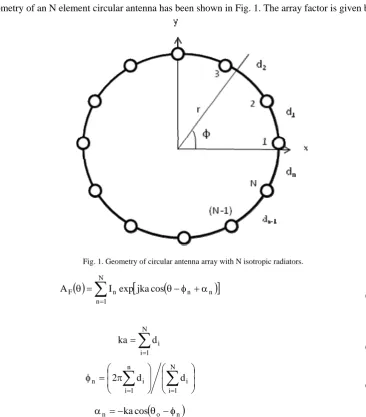
The geometry of an N element circular antenna has been shown in Fig. 1. The array factor is given by
Fig. 1. Geometry of circular antenna array with N isotropic radiators.
N
1 n
n n n
F I expjkacos A
(1)
Where
N
1 i
i d ka
(2)
N
1 i
i n
1 i
i
n 2 d d
(3)
o n
n kacos (4)
k = 2π/λ= phase constant,
θ = angle of incidence of a plane wave, λ = signal wavelength,
N=total number of elements in the array. Normalized power patterns in dB can be expressed as
max F
F 10
A A log 20 P
(5)
Let θo be the angle where global maximum is attained in θ= [-π, π]. As the objective of optimization is to minimize the sidelobe level of the array pattern by adjusting the parameters while first null beam width (FNBW) is kept within some specified constraints. Thus the following cost function is used.
u F F to subject
SLL max t cos
(6)
Where F is the first null beam width of the pattern produced by the array considered for optimization. Fu is the resultant values obtained with the uniform circular array. Evolutionary algorithms are used to optimize the antenna array shown in Fig 1.
3. Nature Inspired Metaheuristic Algorithms
The state-of-the-art nature-inspired metaheuristic algorithms for global optimization, includes ant and bee algorithms, bat algorithm, cuckoo search, firefly algorithm, differential evolution, genetic algorithms, harmony search, particle swarm optimization, simulated annealing and support vector machines.However in the present work, application of firefly, bat and cuckoo Search algorithms is considered. Firefly algorithm is inspired by behavior of fireflies, bat algorithm is based on the echolocation behavior of bats while in cuckoo search, pattern corresponds to a nest and similarly each individual attribute of the pattern corresponds to cuckoo egg.
3.1. Firefly algorithm
FA is the one of the latest swarm intelligence metaheuristics. In which the search algorithm is inspired by the flashing behavior of fireflies and the phenomenon of bioluminescent communication. The flashing light helps fireflies for finding mates, attracting their potential prey and protecting themselves from their predators. The main algorithm’s principle is that each firefly moves towards brighter and more attractive locations by the flashing light intensity that associated with the objective function of problem is considered [18].
The development of firefly algorithm was based on three idealized rules:
Each firefly attracts all other fireflies with weaker flashes regardless of their sex.
Attractiveness is proportional to their brightness and decreases as the distance among them increases. The brightness of a firefly is affected or determined by the distribution of the objective function. For a maximization problem, brightness can simply be proportional to the value of the cost function. Other forms of brightness can be defined in a similar way to the fitness function in genetic algorithm.
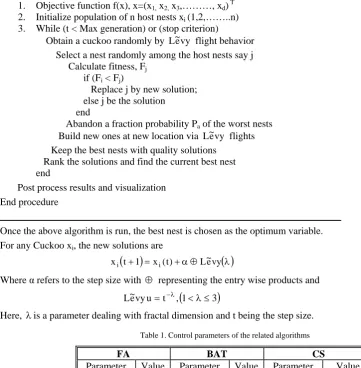
The basic steps of the FA can be summarized as the pseudo code. Begin
Initialize algorithm parameters max generation, α, βo, γ
1. Create initial population of n fireflies x= (x1, x2, x3… xD) T within D dimensional search space 2. Objective function f(x), x= (x1, x2, x3,………, xD) T
3. Determine Ii at xi determined by f(xi) 4. While (t < maxgeneration)
For i=1 to n (all n fireflies) For j=1 to n (all n fireflies) if (Ij > Ii)
Move firefly i towards j in D dimension end if
Evaluate new solutions and update light intensity end for j
end for i
Rank the fireflies and find the current best end while
In this algorithm, each firefly has a location x= (x1, x2, x3… xD) T in a D-dimensional search space. Light intensity I(x) (or) attractiveness β(x), which are proportional to an objective function f(x) [16].
3.2 Bat algorithm
Bat-inspired algorithm is a metaheuristic optimization algorithm developed by Xin-She Yang in 2010. This bat algorithm is based on the echolocation behavior of micro bats with varying pulse rates of emission and loudness [19]. It is the first algorithm of its kind to use frequency tuning.
The implementation of algorithm is based on three idealized rules: All the bats use an echolocation to sense the distance.
Each virtual bat flies randomly with a velocity vi at position (solution) xi with a varying frequency or wavelength and loudness Ai. As it searches and finds its prey, it changes
frequency, loudness and pulse emission rate r. Search is intensified by a local random walk. Loudness varies from a large to a minimum constant value.
Begin
1. Initialize algorithm parameters max generation, Ai, ri, Qi.
2. Create initial bat population (x1, x2, x3… xd) T and initial velocities vi 3. Objective function f(x), x= (x1, x2, x3,………, xd) T
4. Determine pulse frequency fi at xi 5. While (t < maxgeneration)
Generate new solutions by adjusting frequency, updating velocities and locations if (rand > ri)
Select a solution among best solutions
Create local solution around selected best solution end if
Generate new solutions by flying randomly if (rand < Ai & f (xi) < f(x (current best solution)) Accept the new solutions
Increase ri and reduce Ai end if
Rank the bats and find the current best end while
Post process results and visualization End procedure
3.3 Cuckoo search algorithm
Cuckoo search (CS) is an optimization algorithm developed by Xin-she Yang and Suash Deb in 2009. The algorithm is inspired by the reproduction strategy of cuckoos. At the most basic level, cuckoos lay their eggs in the nests of other host birds, which may be different species. The host bird may discover that the eggs are not it’s own and either destroy the egg or abandon the nest all together. This has resulted in the evolution of cuckoo eggs which mimic the eggs of local host birds [20]. To apply this as an optimization tool, yang and Deb used three idealized rules.
Each cuckoo lays one egg at a time, and dumps it in other in a randomly chosen other cuckoo’s nest; The optimum nest with high quality eggs will carry over to the next generations;
The probability with which a host cuckoo searches for an alien egg isPa
0,1. If found, the host bird will abandon its nest or discard the egg.1. Objective function f(x), x=(x1, x2, x3,………, xd) T 2. Initialize population of n host nests xi (1,2,……..n) 3. While (t < Max generation) or (stop criterion)
Obtain a cuckoo randomly by L~evy flight behavior Select a nest randomly among the host nests say j Calculate fitness, Fj
if (Fi < Fj)
Replace j by new solution; else j be the solution end
Abandon a fraction probability Pa of the worst nests Build new ones at new location via L~evy flights Keep the best nests with quality solutions
Rank the solutions and find the current best nest end
Post process results and visualization End procedure
Once the above algorithm is run, the best nest is chosen as the optimum variable. For any Cuckoo xi, the new solutions are
t1
x (t)L~evy
xi i (12)
Where α refers to the step size with representing the entry wise products and
1 3
, t u vy e ~
L (13)
Here, is a parameter dealing with fractal dimension and t being the step size. Table 1. Control parameters of the related algorithms
FA BAT CS
Parameter Value Parameter Value Parameter Value Population 40 Population 40 Population 40 Generations 200 Generations 200 Generations 200
α, γ 0.2, 1 α 0.9 Pa, β 0.25, 1.50
4. Results
The first and most important parameter in pattern synthesis of antenna array is the sidelobe level (SLL) that is desired to be as low as possible. Three instantiations of the design problem are solved by using FA, Bat, and Cuckoo search algorithms. Arrays with 8, 10, 12 elements are considered. The values of parameters were used for each algorithm to solve all three simulation examples are listed in Table 1. The FNBW assumed to be a constant, corresponding to a uniform circular array with uniform 0.5λ spacing between the elements. Each individual is in general represented by two vectors of real numbers. One vector of real numbers restricted to be on the range [0, 1], i.e. I = [I1, I2, I3…IN] and another one restrained on the range [0, 1λ] i.e. d= [d1, d2, d3…dN]. Excitation current phases are fixed at zero degree.
Table2 Parameters obtained for uniform circular antenna arrays (uniform inter-element separation).
N FNBW(O) SLL(DB)
8 70.27 -7.9 10 55.85 -7.9 12 46.26 -7.9
A. 8-element circular array antenna
Table 3. Comparison of results for 8 element circular array.
N FA Bat CS
Amplitude Spacing(λ) Amplitude Spacing(λ) Amplitude Spacing(λ)
1 0.2535 0.9959 0.4558 1.0000 0.4679 0.3165 2 0.3909 0.7368 0.3162 0.5838 0.3896 0.4174 3 0.7438 0.9250 0.6240 0.6691 1.0000 1.0000 4 0.8867 0.5465 1.0000 0.9449 0.3741 0.1647 5 0.2114 0.8410 0.5735 0.8294 0.7663 0.2640 6 0.3819 0.7371 0.6024 0.8092 0.4562 0.6412 7 0.4820 0.5108 0.7355 0.6998 0.7338 0.2987 8 0.8863 0.5185 0.9792 0.9277 0.9476 0.7667
B.10-element circular array antenna
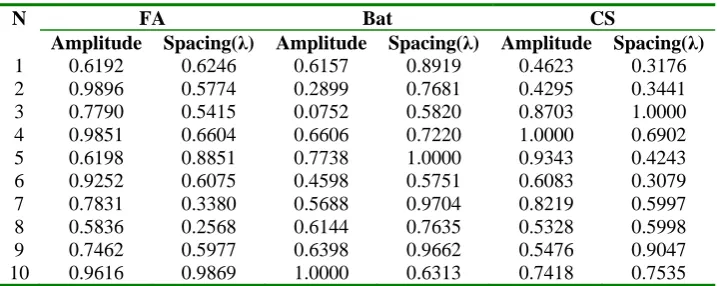
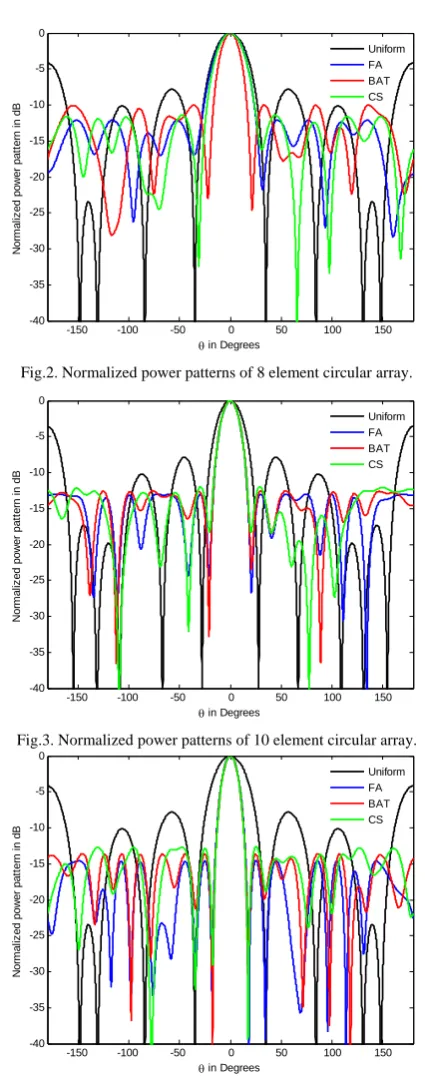
In this example, a 10-element circular array antenna is optimized using FA, Bat, and CS algorithms. The best results obtained are listed in Table 4. The normalized power patterns obtained by the three algorithms are compared with that of uniform circular array are shown in Fig 4. The maximum SLLs obtained by FA, Bat and CS are -13.00, -12.55 and -11.98 dB, respectively. It can be observed that FA gives slightly better maximum SLL.
Table 4. Comparison of results for 10 element circular array.
N FA Bat CS
Amplitude Spacing(λ) Amplitude Spacing(λ) Amplitude Spacing(λ)
1 0.6192 0.6246 0.6157 0.8919 0.4623 0.3176 2 0.9896 0.5774 0.2899 0.7681 0.4295 0.3441 3 0.7790 0.5415 0.0752 0.5820 0.8703 1.0000 4 0.9851 0.6604 0.6606 0.7220 1.0000 0.6902 5 0.6198 0.8851 0.7738 1.0000 0.9343 0.4243 6 0.9252 0.6075 0.4598 0.5751 0.6083 0.3079 7 0.7831 0.3380 0.5688 0.9704 0.8219 0.5997 8 0.5836 0.2568 0.6144 0.7635 0.5328 0.5998 9 0.7462 0.5977 0.6398 0.9662 0.5476 0.9047 10 0.9616 0.9869 1.0000 0.6313 0.7418 0.7535
C.12-element circular array antenna
Similarly, the optimized amplitudes and element separations obtained by the three algorithms are listed in Table 5. Fig 4 shows a comparison between the patterns obtained using different optimization methods as compared to uniform array. The maximum SLLs obtained using the FA, Bat, and CS methods are -14.56, -13.56 and -12.51 dB, respectively. It is observed that FA results are somewhat better than those obtained using Bat and CS.
Table 5. Comparison of results for 12 element circular array.
N FA Bat CS
Amplitude Spacing(λ) Amplitude Spacing(λ) Amplitude Spacing(λ)
-150 -100 -50 0 50 100 150 -40
-35 -30 -25 -20 -15 -10 -5 0
in Degrees
N
or
m
al
iz
ed power
pat
te
rn i
n dB
Uniform FA BAT CS
Fig.2. Normalized power patterns of 8 element circular array.
-150 -100 -50 0 50 100 150
-40 -35 -30 -25 -20 -15 -10 -5 0
in Degrees
Nor
m
al
iz
ed
pow
er
p
at
ter
n i
n d
B
Uniform FA BAT CS
Fig.3. Normalized power patterns of 10 element circular array.
-150 -100 -50 0 50 100 150
-40 -35 -30 -25 -20 -15 -10 -5 0
in Degrees
N
or
m
al
iz
ed power
pat
te
rn i
n dB
Uniform FA BAT CS
Fig.4. Normalized power patterns of 12 element circular array.
Table6. Comparisons of results obtained with the three algorithms over three design instances.
N Algorithms Max SLL(dB) FNBW(o) Directivity(dB) ADR Circumference(λ)
8 FA -12.11 63.22 6.49 4.19 5.81
BAT -10.00 42.88 7.18 3.16 6.98
CS -11.30 61.06 6.33 17.95 5.73
10 FA -13.00 41.53 8.96 3.84 7.99
BAT -12.55 41.62 8.48 13.29 7.95
CS -11.98 40.81 9.27 2.328 8.16
12 FA -14.56 36.22 10.68 4.49 9.33
BAT -13.56 35.14 10.15 4.93 9.36
CS -12.51 34.87 10.76 3.98 9.24
5. Conclusion
The synthesis of non uniform circular array to reduce max sidelobe level with beam width constraint has been presented using Firefly, Bat and Cuckoo Search algorithms. These algorithms search effectively for the optimized amplitude excitations and element separations that produce the low sidelobes. It is evident from the results that patterns generated by using Bat algorithm have better reduced beam width than the patterns produced by Firefly and Cuckoo Search algorithms. But the patterns produced by Firefly algorithm have low sidelobes compared to that of the patterns produced by the other two algorithms. It is also evident from the results that the length of the array (circumference) is also less for the optimized element separations produced by the Firefly algorithm when compared to that of the other two algorithms. The obtained normalized power patterns are compared with that of uniform circular array also. The methodology can be extended to other geometries and constraints.
References
[1] G. S. N. Raju, (2005): Antennas and Propagation, Pearson Education.
[2] Ioannides, P.I.; Balanis, C.A. (2004): Uniform circular arrays for smart antennas, IEEE Transactions on Antennas and Propagation, Vol. CA-3, pp. 2796-2799.
[3] Duhamel, R.H. (1952): Pattern synthesis for antenna arrays on circular, elliptical and spherical surfaces. EE research Lab, University of Illinois, Urbana, Technical report No. 16.
[4] Taylor, T.T. (1960): Design of circular apertures for narrow beam width and low sidelobes, IRE Transactions on Antennas and Propagation, 8(1), 17-22.
[5] Stearns, C.O.; Stewart, A.C., (1965): An investigation of concentric ring antennas with low sidelobes, IEEE Transactions on Antennas and Propagation, 13(6), pp. 856-863.
[6] Royer, G.M. (1966): Directive gain and impedance of a ring array of antennas, IEEE Transactions on Antennas and Propagation, 14(5), pp. 566-573.
[7] Chu, T.S. (1959): On the use of uniform Circular arrays to obtain omni directional patterns, IRE Transactions on Antennas and Propagation, 7(4), 436.
[8] Panduro, M.; Mendez, A. L., Dominguez, R. and Romero, G. (2006): Design of non-uniform circular antenna arrays for sidelobe reduction using method of Genetic algorithms, International journal of Electronics and communications, Vol. 60, pp. 713-717. [9] Shihab, M.; Najjar, Y.; Dib, N.; and Khodier, M. (1999): Design of non-uniform circular antenna arrays using Particle swarm
optimization, Journal of Electrical Engineering, Vol. 59, no. 4, pp. 216-220.
[10] Panduro, M.; Brizuela, C. A.; Balderas, L. I. and Acosta, D. A. (2009): A Comparison of Genetic algorithms, Particle swarm optimization, and differential evolution method for the design of scannable circular antenna arrays, Progress in Electromagnetics Research B, Vol. 13, 171-186.
[11] Khodier, M. M.; Al-Aqueel, M. (2009): Linear and Circular array optimization: a study using particle swarm intelligence, Progress in Electromagnetics Research B, Vol. 15, 347-373.
[12] Hammami, A.; Ghayoula, R., and Gharsallah, A. (2009): Uniform Circular phased arrays synthesis using SQP algorithm, Progress in Electromagnetics Research B, Vol. 15, 185-188.
[13] Benedetti, M.; Azaro, R.; Franceschini, D.; Massa, A. (2006): PSO- based real time control of planar uniform circular arrays, IEEE Antennas and Wireless Propagation letters, no.5, pp. 545-548.
[14] Roy, G. G.; Das, S.; Chakraborty, P.; Suganthan, P. N. (2011): Design of nonuniform circular antenna arrays using modified invasive weed optimization algorithm, IEEE Transactions on Antennas and Propagation, Vol. 59, no. 1, pp. 110-118.
[15] Singh, U.; Kamal, T.S. (2010): Design of non-uniform circular antenna arrays using Biogeography- based optimization, IET microwaves, Antennas and propagation, Vol. 5, no. 11, pp. 1365-1370.
[16] Basu, B.; Mahanti, G. K. (2010): A comparative study of Modified particle swarm optimization, Differential Evolution and Artificial Bees colony optimization in synthesis of circular array, International conference on power, control and Embedded systems, pp. 1-5.Nov29 –Dec 1.
[17] Sharaqa, A.; Dib, N. (2013): Circular antenna array synthesis using Firefly algorithm, Wiley periodicals, 20721. [18] Yang, X. S. (2008): Nature inspired metaheuristic algorithms. First edition, Luniver press, UK.
[19] Yang, X. S. (2010): A new metaheuristic Bat – inspired Algorithm. Nature inspired cooperative strategies for optimization (NISCO), studies in computational intelligence Vol. 284, Springer Berlin, pp. 65-74.
Author’s Information
T. Pavani received her AMIE degree in Electronics and Communication Engineering in the year of 2006 from Institution of Engineers (INDIA) and Master of Technology in Radar and Microwave Engineering in 2009 from Andhra University College of Engineering (A). Currently, she is working towards her Ph.D. degree in the department of Electronics and Communication Engineering, Andhra University College of Engineering (A). Her Research interests include Microwave Antennas, EMI/EMC and Applications of Soft computing. She is a life member of Institution of Engineers and SEMCE (INDIA).
Dr. G.S.N. Raju received his B.E., M.E. with distinction and first rank from Andhra University and Ph.D. from IIT, Kharagpur. At present, he is the Vice – Chancellor of Andhra University and a Senior Professor in Electronics and Communication Engineering. He is in teaching and research for the last 30 years in Andhra University. He guided 28 Ph.D.s in the fields of Antennas, Electromagnetics, EMI/EMC and Microwave, Radar Communications, Electronic circuits. Published about 304 technical papers in National/ International Journals/ Conference Journals and transactions. He is the recipient of ‘The State Best Teacher Award’ from the Government of Andhra Pradesh in 1999, ‘The Best Researcher Award’ in 1994, ‘Prof. Aiya Memorial National IETE Award’ for his best Research guidance in 2008 and Dr. Sarvepalli Radhakrishnan Award for the Best Academician of the year 2007, He was a visiting Professor in the University of Paderborn and also in the University Karlsruhe, Germany in 1994. He held the positions of Principal, Andhra University College of Engineering (A), Visakhapatnam, Chief Editor of National Journal of Electromagnetic Compatibility. Prof. Raju has published five textbooks Antennas and Wave Propagation, Electromagnetic Field Theory and Transmission Lines, Electronics Devices and Circuits, Microwave Engineering, Radar Engineering and Navigational Aids. Prof. Raju has been the best faculty performer in Andhra University with the performance index of 99.37%.
Dr. P.V.Sridevi received her B.Tech with distinction from Nagarjuna University, M.E
from P.S.G.College of Technology and Ph.D. from Andhra University. She is a professor in Electronics and Communication Engineering department, Andhra University College of Engineering, Andhra University. She is having 25 years of teaching and research experience. Her areas of interest are Antennas, Electromagnetics and VLSI. She has published 20 papers in National and International Journals.