Ganesh et al. World Journal of Pharmaceutical and Medical Research
FORMULATION AND STUDY OF ELEMENTARY OSMOTIC TABLET OF ACARBOSE
Dr. Ganesh Sanker S.*1 and Dr. (Sr.) Molly Mathew2
1
Research Scholar, The Vinayaka Missions University, Ariyanoor, Salem, Tamilnadu- 636308.
2
Principal, Malik Deenar College of Pharmacy, Seethangoli, Bela Post, Kasaragode-671321, Kerala.
Article Received on 19/12/2017 Article Revised on 09/01/2018 Article Accepted on 30/01/2018
INTRODUCTION
In recent years considerable attention has been made to develop more efficient and safe novel drug delivery system to overcome the drawback of conventional drug delivery system. This study focused on the design and development of new system of osmotic pump for the delivery of drug with constant release rate. Oral osmotic drug delivery systems are new approaches for controlled release dosage form. The survey of the literature indicates that extensive work was conducted in the development and fabrication of an osmotic drug delivery system for the pharmaceutical active materials. Many attempt where made to develop osmotic pumps which produce zero order delivery for an extended period of time for many active substance. The drug release mechanism from such system can be explained by diffusion, osmotic pumping and a combination of both.
Oral controlled release system continues to be the most popular amongst all the drug delivery system. Because pharmaceutical agents can delivered in controlled pattern over a long period by osmotic pressure, there has be an increase interest in the development of osmotic device over the past two decades.[1,3] The osmotic drug delivery system has recently become an important research area and expected to show significant growth in the future.
In matrix system the drug delivered through diffusion
presence of food, and the physiological factors of body. In osmotic drug delivery system, the principle of osmosis as driving force to release the drug from the system and release rate is unaffected by the above reasons.[6,18] In the present study, an osmotic drug delivery drug delivery system for Acarbose was devised and studied to reduce the drug dosing frequency and to produce a zero order drug release system.
The elementary osmotic pump first introduced by Theaves. EOP device consist of an osmotically active core surrounded by semi-permeable membrane with a small orifice drilled through the coating by laser or mechanical drills.The release rate from this type of system is dependent on the coating, solubility of the drug in the tablet core, and osmotic pressure difference across the membrane. It was observed that most of the core content release through orifice at constant rate, where the release mechanism primarily is osmotic with simple diffusion playing a major role.[6] The EOP offers a very easy formulation of system and high efficiency of drug release by maintaining zero order release kinetics.
A zero order delivery pattern was designed to produce plasma level within the desired range. Different formulation variables were studied and optimized to achieve the desired release profile.To maintain the drug concentration within the therapeutic window the drug dose and during interval are optimized thus ensuring
ISSN 2455-3301
WJPMR
AND MEDICAL RESEARCH www.wjpmr.com
*Corresponding Author: Dr. Ganesh Sanker S.
Research Scholar, The Vinayaka Missions University, Ariyanoor, Salem, Tamilnadu- 636308.
ABSTRACT
In this study a controlled Elementary osmotic pump for controlled release of Acarbose was developed based on the osmotic technology using an osmogen and evaluated the various parameters. Acarbose is very high soluble anti-hypoglycemic drug which is an ideal candidate for zero order drug delivery release. The formulation comprise of a core component with a semi-permeable coating polymer and cellulose acetate.The effect of osmogen, change in composition of coating solution, and various physiochemical studies were conducted. The FT-IR studies revealed that no physiochemical interaction between excipients and drug. The in vitro study of Acarbose osmotic tablet shows a significant effect on drug release up to 12h. The drug release kinetic of optimized formulation follows zero order non fickian release mechanism. The observed data’s were found to be very close to predicted values of most satisfactory formulation which demonstrates the feasibility of the optimization procedure in successful development of elementary osmotic tablet of Acarbose.
pump tablet have many disadvantages such as reducing risk of adverse reaction, zero order delivery rate, a high degree of in vitro–in vivo correlation and improve patient compliance.
MATERIALS AND METHODS
Materials[2,13,15]
Acarbose, Microcrystalline cellulose, PEG 400 was received from Yarrow chem, Mumbai. Mannitol, Fructose, Magnesium stearate, Talc, Cellulose acetate was purchase from SD Fine Chem. Ltd (Mumbai, India).
Methods
Preparation of core tablet[4,5,7,22]
The coretablets were prepared by direct compression method according to the various compositions of formulae given in table -1.
All the ingredients and drug were accurately weighed and mixed in a lab scale mixerto get a homogenized uniform mixture. The dry blend of mixture pass through sieves No: 80.Then mixture is compressed in to tablet using rotary tablet machine (Cadmach machinery, Ahmadabad) equipped with 10mm diameter, round plain and concave punch.Tablets werecompressed at an average weight of 300 mg and hardness of tablet kept as 7 Kg/cm2. Various formulation and dissolution parameter were analyzed to optimize the core tablets.
Table 1: Preparation of core tablet.
Sr. No Materials E1 E2 E3 E4 E5 E6 E7 E8 E9
1 Drug 75 75 75 75 75 75 75 75 75
2 Mannitol + NaCl 1:1.34 1:1.34 1:1.34 1:1.34 1:1.34 1:1.34 1:1.34 1:1.34 1:1.34
3 MCC 62.25 43.5 24.5 62.25 43.5 24.5 62.25 43.5 24.5
4 HPMC 1:0.75 1:1 1:1.25 * * * * * *
5 Eudragit RL 100 * * * 1:0.75 1:1 1:1.25 * * *
6 EC * * * * * * 1:0.75 1:1 1:1.25
8 TALC 2% 2% 2% 2% 2% 2% 2% 2% 2%
9 Magnesium Sterate 1% 1% 1% 1% 1% 1% 1% 1% 1%
Core Tablet Weight 300 300 300 300 300 300 300 300 300
Preparation of coating solution.[1,4, 12, 14,17]
The coating solution containing Cellulose Acetate (CA) - 3%and PEG-400 was prepared as per the formula given in table-2.
Table 2: Preparation of coating solution.[14]
Sr. No Coating solution PEG 400 : 3%CA
1 Cellulose Acetate 60
2 PEG 400 40
Accurately weighed quantity of CA and PEG 400 was added to acetone (60%). The mixture stirred until the formulation of clear solution. The mixture was stirred continuously for 10 minutes.
Coating and Drilling of core tablet[1,2,4,12]
Coating of core tablet was done by pan coater. Coating process parameters optimized with respect to coating pan speed, coating inlet air, temperature, atomizing air pressure and spray rate.
The manual coating procedure used was based on intermittent spraying and drying technique.
Finally, a drug release orifice with certain size was drilled by laser through the membrane was made by a micro drill on one side of each tablet.
Evauation of Osmotic Tablet Pre-Formulation Evaluation[2,6,21,22] 1. Angle of repose
The powder mass was allowed to flow through the funnel orifice kept vertically to a plane paper kept on the horizontal surface, giving a heap angle of powder on paper. The angle of repose was calculated by substituting the values of the base radius 'r' and pile height 'h' in the following equation:
Ө=tan-1
h/r
2. Bulk density
Bulk density was obtained by dividing the mass of powder by the bulk volume in cm3. It was calculated by using equation given below:
Df=M/Vp
Where, Df=Bulk Density M=Weight of sample in grams Vp=Final volume of powder in cm3
3. Tapped density
It is the ratio of total mass of the powder to the tapped volume of the powder. It is expressed in g/ml and is given by
Do=M/Vp Where,
Do=Tapped density
M=Weight of sample in grams
4. Carr's index
Carr developed an indirect method of measuring powder flow from densities. The percentage compressibility of a powder was a direct measure of the potential powder arch or bridge strength and stability. Carr's index of each formulation was calculated by
% Compressibility=Do–Df/Df x 100 Where,
Df=Fluff or poured bulk or bulk density Do=Tapped or consolidated bulk density
5. Hausner’s ratio
Hausner’s Ratio is the measure of the propensity of a powder to be compressed which is calculated using the following formulae:
Hausner ratio=Do/Df Where,
Df=Fluff or poured bulk or bulk density Do=Tapped or consolidated bulk density
Compatibility studies
1. Fourier transform infrared spectroscopy (FTIR)[1,1,22]
The use of FTIR technique allows pointing out the implication of the different functional groups of drug and excipients by analyzing the significant changes in the shape and position of the absorbance bands. In this method individual samples as well as the mixture of drug and excipients were ground and mixed thoroughly with potassium bromide (1:100) for 3–5 mins in a mortar and compressed into disc by applying pressure of 5 tons for 5 mins in hydraulic press. The pellet was kept in the sample holder and scanned from 4000 to 400 cm−1 in FTIR spectrophotometer. Then the characteristics peak of all samples as well as mixtures were obtained. Then the peaks of optimized formulation were compared with pure drug and excipients. If there was no interaction between the peaks of drug and excipients of optimized formulation then it was said to be compatible.
Physiochemical Evaluation 1. Appearance and shape
The general appearance of tablet includes the morphological characteristic like size, shape, colour etc.
2. Uniformity of thickness and diameter
The uniformity of the diameter and thickness was measured using vernier caliper. Ten tablets from each formulation were randomly selected and used. The average diameter and thickness of the tablet calculated and expressed in mm.
3. Hardeness[23]
Monsanto hardness tester was used to check the hardness of tablet. Ten tablets from each formulation were randomly selected and used. The tablet placed between the jaws of tester. The two jaws placed under the tension by spring and screw gauge. By turning the screw, the load was increased and at collapse the applied pressure
4. Friability[23]
The friability test was carried out to evaluate the hardness and stability instantly in Roche Friabilator. The percent loss in weight or friability (F) was calculated by the formula
F= (1-W/Wo) x 100
Where, F=Friability Wo=Initial weight
W=Final weight
5. Weight Variation
To study the weight variation 20 tablets from each formulation were weighed using an electronic balance and the test performed according to the official standard method.
6. Uniform drug content[20,21,23]
To perform uniform drug content 10 tablets were weighed and crushed to a fine power using motor and pestle. Accurately weighed sample equivalent to 75 mg of Acarbose was taken in a volumetric flask. The content was dissolved in small quantity of water and then volume is made up to 100 ml with remaining volume of water. The sample were diluted to the required concentration and analyzed spectrophotometrically at 210nm.
7. Dissolution study[2,5,12,20,21,22]
The in vitro dissolution study carried out using USP type II dissolution apparatus, operation condition were maintained at 37±0.5oC at 30 RPM. The dissolution media was phosphate buffer pH 7.4 up to the volume of 900 ml. During the study 5 ml of sample were withdrawn at every hour and same amount of fresh dissolution media was replaced. The withdrawn sample were diluted to the required concentration and analyzed spectrophotometrically at 210nm.
8. Kinetics of drug release[1,2,18,19,22]
The dissolution profile of all batches were checked to fitted to zero order, first order, higuchi, korsemeyer and peppas to assess the kinetics modeling of drug release.
RESULT AND DICUSSION
1. Powder properties
Table 3: Data of various pre-formulation evaluation parameters.
Sr. No Formulations Angle of Repose Bulk Density Tapped Density Hausner Ratio Comprssibility
1 E1 26.73 ± 0.28 0.4412 0.5263 1.19 16.17
2 E2 27.80 ± 0.428 0.4438 0.5282 1.19 15.97
3 E3 26.32 ± 0.63 0.4464 0.5172 1.15 13.69
4 E4 26.15 ± 0.15 0.4451 0.5263 1.18 15.43
5 E5 26.22 ± 0.15 0.4412 0.5245 1.18 15.88
6 E6 26.32 ± 0.637 0.4532 0.53 1.16 14.5
7 E7 26.56 ± 0.24 0.4464 0.5226 1.17 14.58
8 E8 26.89 ± 0.13 0.4505 0.5263 1.16 14.41
9 E9 27.21 ± 0.36 0.4478 0.53 1.18 15.52
2. Fourier transforms infrared spectroscopic studies (FTIR)[1,11,22]
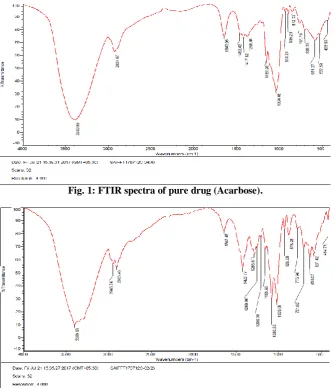
The FTIR spectra of drug and optimized formulation were recorded and shown in Figure-3 and 4. The major peaks were obtained at 581.27, 1034.45, 1643.96, and
3300-2930/cm-1for pure drug and the same characteristic bands of the drug in optimized formulation also shown without any significant spectral changes, thus there is no interaction between drug and excipients used in the formulation.
Fig. 1: FTIR spectra of pure drug (Acarbose).
Fig. 2: FTIR spectra of optimized formulation contains pure drug (Acarbose) and polymers.
3. Appearance and shape
The physical evaluation of the formulation was carried out for their appearance, shape and identification, which was shown in table:-4. The shape and size are identical
Table 4: Physical evaluation of the formulations E1 –E9.
Formulations Appearance Shape Identification
E1 White/off white coloured Circular tablet Passes E2 White/off white coloured Circular tablet Passes E3 White/off white coloured Circular tablet Passes E4 White/off white coloured Circular tablet Passes E5 White/off white coloured Circular tablet Passes E6 White/off white coloured Circular tablet Passes E7 White/off white coloured Circular tablet Passes E8 White/off white coloured Circular tablet Passes E9 White/off white coloured Circular tablet Passes
4. Physiochemical properties[2,6,19,20,21,22]
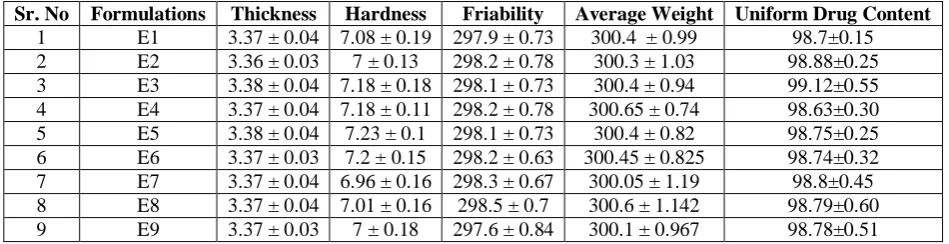
The physiochemical properties like;-hardness, thickness, uniform drug content, friability of prepared core tablets were recorded in table:-5. The hardness of tablet was found to be between6.96±0.16 to 7.23±0.1kg/cm2, while
the friability of tablet ranges between 297.6±0.84 to 298.5±0.7%. The tablets have enough hardness to withstand stress during handling and transportation. The uniform drug content of various formulations between 98.63±0.3 and 99.12±0.55 %w/w.
Table 5: Data of various physiochemical evaluation parameters.
Sr. No Formulations Thickness Hardness Friability Average Weight Uniform Drug Content
1 E1 3.37 ± 0.04 7.08 ± 0.19 297.9 ± 0.73 300.4 ± 0.99 98.7±0.15
2 E2 3.36 ± 0.03 7 ± 0.13 298.2 ± 0.78 300.3 ± 1.03 98.88±0.25
3 E3 3.38 ± 0.04 7.18 ± 0.18 298.1 ± 0.73 300.4 ± 0.94 99.12±0.55
4 E4 3.37 ± 0.04 7.18 ± 0.11 298.2 ± 0.78 300.65 ± 0.74 98.63±0.30
5 E5 3.38 ± 0.04 7.23 ± 0.1 298.1 ± 0.73 300.4 ± 0.82 98.75±0.25
6 E6 3.37 ± 0.03 7.2 ± 0.15 298.2 ± 0.63 300.45 ± 0.825 98.74±0.32
7 E7 3.37 ± 0.04 6.96 ± 0.16 298.3 ± 0.67 300.05 ± 1.19 98.8±0.45
8 E8 3.37 ± 0.04 7.01 ± 0.16 298.5 ± 0.7 300.6 ± 1.142 98.79±0.60
9 E9 3.37 ± 0.03 7 ± 0.18 297.6 ± 0.84 300.1 ± 0.967 98.78±0.51
5. Dissolution study[2,5,12,20,21,22]
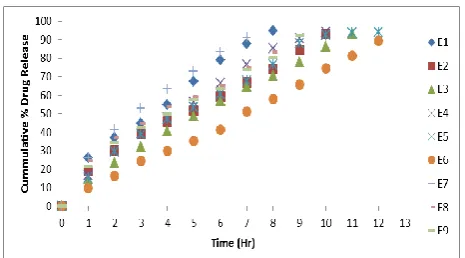
In elementary osmotic tablets the drug release rate depends on the concentration of the osmotic agents used and orifice size. The osmotic agent concentration increases then the osmotic pressure created inside the tablet also increases, the core compartment imbibes aqueous fluids from the surrounding environment across
the membrane and dissolves the drug so the release of the dug also will increase. Aperture diameter of orifices is one of the critical parameters thatgreatly influences release rate, lag time and release kinetics of the osmotic drug delivery devices.[21] These two factors will cause the release of the drug in diffusion manner.
Table 6: Cumulative drug release data of formulation E1-E9.
Time (Hr.) % CDR
E1 E2 E3 E4 E5 E6 E7 E8 E9
0 0 0 0 0 0 0 0 0 0
1 26.2 18.9 14.6 16.8 15.2 9.8 26.2 24.3 21.3
2 36.8 30.2 23.5 29.5 29.6 16.2 41.2 37.1 34.6
3 44.6 39.1 32.3 39.2 38.8 24.6 52.7 44.6 42.7
4 54.9 45.7 40.6 47.8 47.2 29.8 63.5 53.8 49.8
5 67.5 51.9 48.9 56.4 53.5 35.3 72.8 59.4 57.7
6 78.9 59.4 57.3 66.4 60.7 41.2 83.2 65.4 63.4
7 87.6 66.7 64.7 76.5 67.8 51.2 91 74.8 73.9
8 94.8 74.3 70.4 85.3 76.5 57.8 83.4 80.1
9 84.3 77.9 90.6 88.1 65.7 92 92.5
10 93.1 86.4 94 92.4 74.6
11 93.5 93.9 81.2
Fig. 3: In vitro drug release from formulation E1–E9.
6. Kinetics of drug release[16,19,21,22]
The in vitro release data was fitted to various kinetic models like higuchi, zero order, first order and peppas. When the data were plotted according to first order equation shows comparatively poor linearity with regression values of 0.855. Whereas the regression value for zero order equation was 0.977, which indicated that drug release from optimized formulation was independent of drug concentration. In controlled elementary osmotic pump the n value for peppas model was found to be in between 0.586 and 0.899.
Table 7: In vitro drug release kinetics of formulation E1 –E9.
Formulations Zero order First order Higuchi Peppas and Kosymeyer
R2 R2 R2 n R2
E1 0.977 0.965 0.971 0.638 0.983
E2 0.982 0.934 0.967 0.671 0.994
E3 0.993 0.916 0.958 0.782 0.998
E4 0.982 0.899 0.967 0.759 0.998
E5 0.965 0.855 0.973 0.733 0.991
E6 0.997 0.933 0.915 0.899 0.993
E7 0.964 0.927 0.987 0.639 0.999
E8 0.962 0.937 0.984 0.586 0.993
E9 0.972 0.931 0.975 0.637 0.993
CONCLUSION
The controlled elementary osmotic pump tablet of Acarbose had been successfully prepared. These devices can release their drug contents in a form of soluble or solid suspended particles out of the system by constantrelease rate. The optimal elementary osmotic pump tablet was able to deliver Acarbose at the rate of approximate zero order up to 12 h, independent of release media and agitation rate. The results showed that the SEOP can be a very effective device for the delivery of drug with zero order pattern. Finally, it can be concluded that preparation of osmotic pump tablet was simple to prepare, because there was no need for a push compartment. A more comprehensive pharmacokinetic study should be conducted in order to correlate in vitro-in vivo relation in the future, to confirm the obtained results.
REFERENCE
1. V. S. Brindha, A. Abdul Hasan Sathali, K. Arun and P. Shanmuga Priya; Swellable Osmotic Drug Delivery System of Amitriptyline Hydrochloride – Design and Evaluation; J. Curr. Chem. Pharm. Sc., 2012; 2(1): 55-68.
2. Pramod Kumar Sanjay Singh Brahmeshwar Mishra; Development and biopharmaceutical evaluation of extended release formulation of Tramadol hydrochloride based on osmotic technology; Acta Pharm, 2009; 59(1): 15–30.
3. Meena Rani, Rahul Surana, Chelladurai Sankar,
Brahmeshwar Mishra; Development and
biopharmaceutical evaluation of osmotic pump
tablets for controlled delivery of Diclofenac sodium; Acta Pharm, 2003; 53(4): 263–273.
4. Ali Nokhodchi, Mohammed N. Momin, Javad Shokri, Mahbobeh Shahsavari & Parinaz Ahmad Rashidi; Factors Affecting the Release of Nifedipine from a Swellable Elementary Osmotic Pump; Drug Delivery, 2008; 15: 43–48.
5. B. Mishra, C. Sankar, C. Dilip, V. Pravitha, Arun Raj, T. Anwar Sadique; Osmotically controlled Diclofenac sodium tablets: membrane and osmogens effects; Der Pharmacia Lettre, 2010; 2(6): 21-27. 6. Rashmin S Thakor, Falguni D Majmudar, Jayvadan
K Patel, Ganesh C Rajput and Manish P Patel; Development and evaluation of osmotic drug delivery system for calcium channel blocker drug; Der Pharmacia Lettre, 2010; 2(3): 43-51.
7. K H. Hussan Reza, K Mohammed Maideen, R. Kumaravelrajan; Formulation And In vitro Evaluation of Ketoprofen Osmotic Drug Delivery System Using Swellable Core Osmotic Pump Technology (Scot), June 2011; 3(04): 46-53.
8. Sudeesh Edavalath, Shivanand K, Kalyani Prakasam, B Prakash Rao and Goli Divakar. Formulation Development and Optimization of Controlled Porosity Osmotic Pump Tablets of Diclofenac Sodium; Int J of Phar and Pharmaceutical Sci, 2011; 3(1): 80-87.
9. Poptani Sanjay D, Gohel Mukesh C, Parikh Rajesh K, Patel Vipul P: Preparation And Evaluation of Osmotic Controlled Drug Delivery System of Metoprolol Tartarate: Int Bulletin of Drug Research, 1(1): 84-93
10. Basani Gavaskar, Subash Vijaya Kumar, Dilip Dodda: Effect of tablet formulation variables on Tramadol HcL elementary osmotic pump tablet: J. Drug development & research, 2(4): 730-735. 11. Bharadwaj P, Upaddhyay P. K, Agarwal V,
Chaurasia D., Chaurasia H. and Singh R: Development and Characterization of Elementary Osmotic Pump Tablets for Simultaneous Release of Metformin and Glipizide: Indian Drugs, 2012; 49(11): 19-29.
12. Narimane Lammari, Hadjira Rabti, Jumah M M Salmani, Eltayeb S Elamin, Qineng Ping: Taguchi orthogonal design array to optimize methylcellulose based elementary osmotic pump tablets for the delivery of highly water soluble drugs: Int J of Research in Controlled Release, 2014; 4(1): 1-10. 13. Rajagopal Kumaravelrajan, Nallaperumal
Narayanan, Venkatesan Suba: Development and Evaluation of Elementary Osmotic Pump for the Simultaneous Delivery of Nifedipine and Metoprolol Tartrate: Asian J of Pharmaceutics, 2016; 10(4): 583-594.
14. Mehta Tejal, Patel Kunal: Development and Optimization of Elementary osmotic pump tablet of Nicardipine Hydrochloride using central composite experimental Design, July-September 2013; 5(3): 382-395.
15. Lu Xu, Sanming Li, Hiakazu Sunada: preparation and evaluation in vitro and in vivo of Catopril elementary osmotic pump tablet: Asian J of pharmaceutical sci, 2006; 1(3-4): 236-245.
16. Rajesh Vooturi, Rameh Gannu, Ashok Tadishetty and Madhusudan Rao Yamsani: Development of controlled release formulation based on osmotic technology for Phenyl Propalamine Hydrochloride: in vitro, pharmacokinetic and pharmacodynamic characterization: Acta pharmaceutica sciencia, 2011; 53: 25-34.
17. D. Prabakaran, Paramjit Singh, Parijat Kanaujia, and Suresh P. Vyas: Effect of hydrophilic polymers on the release of Diltiazem Hydrochloride from elementary osmotic pumps: Int J of Pharmaceutics, 2003; 259: 173–179.
18. Yan Zhang, Zhirong Zhang, and Fang Wu: A novel pulsed-release system based on swelling and osmotic pumping mechanism: J of Controlled Release, 2003; 89: 47–55.
19. Rajan K. Verma1, Aditya M. Kaushal, and Sanjay Garg: Development and evaluation of extended release formulations of Isosorbide Mononitrate based on osmotic technology: Int J of Pharmaceutics, 2003; 263: 9–24.
20. M. Naga Ganesh & Y. Madhusudan Rao: Formulation And Evaluation Of Tramadol
Pharm Research And Biomedical Analysis, Jan-Mar 2016; 5(1): 01-09.
21. S. Padma priya, V. Ravichandran and V. Suba: Development and Evaluation of Swellable Elementary Osmotic Pump Tablets of Metoprolol Succinate and Ramipril: Global Journal of Pharmacology, 2013; 7(2): 179-186.
22. N. Arjun, D. Narendar, K. Sunitha, K. Harika, B.
Nagaraj: Development, evaluation, and influence of formulation and process variables on in vitro performance of oral Elementary osmotic device of
Atenolol: Int J of Pharmaceutical Investigation,