International Journal of Health Sciences and Research
www.ijhsr.org ISSN: 2249-9571
Original Research Article
Effectiveness of Educational Program on Knowledge
and Competence of Home Care Of Stroke Patients
among Care Givers
Dr. N. R. Gurjar
Professor, PhD in Nursing, NIMS Nursing College, NIMS University, Rajasthan, Jaipur.
ABSTRACT
Background: Home care of stroke patient is having great role in the patient recovery. Patient family members, relatives or close friend can play important role in care of patients. But how to continue proper care of the patient at home after discharge is big challenge for family care givers, they don‟t have knowledge what to do and don‟t have practice as well. At the time of discharge, family care givers may have anxiety and less confidence whether he or she may continue properly. Many studies proved that care givers played important role in the care of patient. In this view, researcher believes that it might be great help for family and the patients if they are taught about home care of stroke patients.
Objective: The study aim is to evaluate effectiveness of educational program on knowledge and competence of home care of stroke patients among care givers
Methods: The one group pre-test and post-test, pre-experimental design was used. Total 60 care givers of stroke patients were taken by convenient sampling technique. The study was done in NIMS hospital from 1st Nov.2018 to 31st Jan.2019.
Results: Knowledge and competence of home care of stroke patient among caregivers was significantly greater in post test then pre test.
Conclusion: The educational program is important at the time of discharge to increase knowledge and competence of home care of stroke patients among care givers. The researcher believes that it certainly helpful for the patient‟s early recovery as well as relieves fear and tension of care givers.
Key words- Effectiveness, educational program, knowledge, competence, home care, care givers.
INTRODUCTION
Stroke is the major cause of disability. Annually, 15 million people worldwide suffer a stroke. Of these, 5 million die and another 5 million are left permanently disabled, placing a burden on family and community. Stroke burden is projected to rise from around 38 million DALYs globally in 1990 to 61 million DALYs in 2020. [1]It is very difficult for the health professional and as well as for the patient and family member to continue care in the hospital for long time. Patients with stroke take long time to recover from the
They need to understand how to care at home. Kyeong Woo Lee, (2015) reported that about one third (33.8%) of caregivers did not have adequate knowledge of how to properly care for stroke patients; in fact, a significant number of caregivers demonstrated inappropriate and insufficient knowledge in several areas. [2] Maeshima S (2013) revealed that family members are unable to continue therapy at home because they don‟t know the care in stroke. If they are given teaching on how to care the patients at home or how to continue rehabilitation care at home, then they may do better than without knowledge. [3] It is well known that in many disease family members play important role in caring patient at home. Similarly in stroke, patient‟ family caregivers play significant role throughout the post-stroke recovery process starting from day one and more importantly after discharge in continuing care at home. Care from the family members is very important to patients‟ recovery. Many studies proved that caregivers can promote positive post-stroke recovery outcomes. [4] Kerry Rae Creasy (2015) described that family-centered care is a model of collaborative healthcare that encourages collaboration and partnership among patients, families, and providers with respect to the planning, delivery, and evaluation of health care. [5] Hong SE, (2017) revealed that after education program, satisfaction of care givers or family members was significantly higher on care of stroke patients. [6] Bum-Chul Jung, Hyun-Joo Kim.(2014) reported that more effective and significant impact on reducing depression and burden of family caregivers with stroke patients after rehabilitation education program. [7]The study aim was to determine the effectiveness of educational program on knowledge and competence of home care re of stroke patients among care givers.
MATERIALS AND METHODS Research approach:
Quantitative research approach
Research design:
One group pre test post test pre experimental research design.
Population
care givers of the stroke patients Setting:
Neuro ward, NIMS Medical College & Hospital, NIMS University, Rajasthan, Jaipur.
Sample and Sample size:
60 care givers of the stroke patients attending stroke patients admitted in hospital.
Sampling technique
Convenient sampling technique was adopted to select the sample for the study.
Description of the tool-
Section I: Consists of demographic variables of the care givers.
Section II: Consists of knowledge questionnaire on home care of stroke patients.
Section III: Consists of 5 point Likert scale on competence of home care of the stroke patients.
Data collection procedure
Before collecting the data prior permissions were obtained from the concerned authorities of the hospital. The care givers of the stroke patients were explained about study and its objectives. Study participants were also explained that confidentiality and anonymity will be maintained for their given information. Then depending on the availability, care givers of admitted stroke patients were given pre test and then educational program on home care of stroke patient was delivered and then subsequently participant was involved in the certain care which to be continue at home by care giver. Post test was conducted after 5 days of pre test to evaluate effectiveness on knowledge and competence of home care of stroke patient. Same procedure was continued for other care givers till the getting of desired samples size.
Data was analyzed using descriptive and inferential statistics. Distribution of subjects with respect to demographic variables was presented using frequencies and percentages. Mean standard deviation and mean percentage was used to describe the knowledge of the care givers. Further statistical significance of the effectiveness of the educational program was analyzed using paired „t‟ test.
RESULT
Section I: To assess demographic variables of care givers of stroke patients.
The study finding shows that majority 30 (50%) of the participants were in the age group of 36 year and above, 20 (33.33%) of them belonged to 26-30 years of age, 7 (11.67%) of them belonged to31-35 years of age and very few 3(5%) were 21-25 Years old. Majority 48 (80%) of care givers were male and12 (20%) of care givers were female. The finding on educational status revealed that 40 (66.67%) care givers were having primary education, 12(20%) care givers were having middle level education, 6(10%) care givers were having to secondary level education, and very few 2(3.33%) care givers were having to senior secondary level of education. Finding shows that 35(58.33%) of care givers were from rural area, 15 (25%) of care givers were from urban and 10(16.67%) of care givers were from semi-urban.
Section II: To assess knowledge and competence of home care of stroke patients among care givers.
Table 1: frequency and percentage distribution of knowledge of home care of stroke patients among care givers. N=60
Table 1: shows that 70.83% of care givers had an inadequate knowledge, 18.33% had moderate knowledge and 10.83% of care givers had adequate knowledge regarding home care of stroke patients. Whereas in post test, 51.66% of care givers had an adequate knowledge, 40.00% had moderate knowledge and 8.33% of care givers had inadequate knowledge regarding home care of stroke patients.
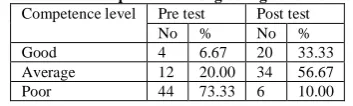
Table:2 frequency and percentage distribution of competence of home care of stroke patients among care givers. N=60
Competence level Pre test Post test No % No % Good 4 6.67 20 33.33 Average 12 20.00 34 56.67 Poor 44 73.33 6 10.00
Table 2: shows that maximum 44(73.33%) care givers had poor competence, 12(20.00%) had average competence and 4 (6.67%) had good competence of home care of stroke patients whereas in post test maximum 34(56.67%) care givers had average competence , 20(33.33%) had good competence and 6 (10.00%) had poor competence of home care of stroke patients. Section I: Evaluation of effectiveness of educational program on knowledge regarding home care of stroke patients among care givers.
Table 3:Comparison between pre test and post test knowledge scores regarding home care of stroke patients among care givers. N=60
df= 59 ,* P <0.05 level of significant.
Practice level Pre test Post test No % No % Good 6 10.83% 31 51.66% Average 11 18.33% 24 40.00% Poor 43 70.83% 05 8.33%
S. No. Knowledge variables/areas M a x . S c o re
Pre-test Post-test Effectiveness
M e a n M e a n p e rc e n t S .D . M e a n Me a n p e rc e n t S .D . M e a n M e a n p e rc e n t S .D . Pa ire d „t ‟ va lu e
Table 3: depicts that mean pre test knowledge was 12.2 with standard deviation 5.75.The post test mean knowledge was 22.15 with standard deviation 47.75. The overall mean score was 9.95 (SD=0.982) with the paired `t„ value of 9.597. Thus, it was revealed that the post test mean score was significantly higher than the pre test mean score. The table value of paired „t‟ test at 5% level of significance and 59 degrees of freedom is 1.6711. Hence, the table value was less than the calculated „t‟ value. Hence, the educational program was effective to enhance knowledge about home care of stroke patients among care givers.
Table 4: Comparison between pre test and post test competence scores regarding home care of stroke patients among care givers. N=60
df= 59 ,* P <0.05 level of significant
Table 4: reveals that mean competence score of home care of stroke patients among care givers was 17.77 (SD=00.50) with paired „t‟ value of 7.482. Thus, it was revealed that the post test mean competence score of home care of stroke patients among care givers was significantly higher than the pre test mean score. The table value of paired „t‟ test at 5% level of significance and 59 degrees of freedom is 1.6711. Hence, the table value was less than the calculated „t‟ value, Hence, educational program was effective to improve competence in home care of stroke patients among care givers.
DISCUSSION
Patient‟ family care giver in patient recovery after stroke is one of the important aspects of care. It has advantages on both sides that means for the patient a well as for the family members. It is well known that after stroke, its takes long time to get recovery from the disease. This recovery can be enhanced by strengthening care of the patient. During post recovery period, when stroke rehabilitation team feels that patient can continue certain care at home and can be saved from unnecessary expenditure then patient should be discharge as it is great help for the patient as well as for the patient. But here again it is better if someone takes responsibilities to continue care at home. It is very much essential to
continue care at home without interrupting for early recovery as well as to prevent other complications. In this regard researcher believed that if family care giver of stroke patient is given education about certain essential home care of stroke patient then it may effectiveness of educational program on knowledge and practice of home care of stroke patient among family care givers.
In regard to socio-demographic data of the family care givers, the finding revealed that majority 30 (50%) of the family care givers were in the age group of 36 year and mostly 48 (80%) of care givers were male. Regarding the level of education, around 40 (66.67%) care givers were having only primary education. In this study, majority 35(58.33%) participants were from rural area and then followed by participants from urban area. These finding supported by another study done by Rajkamal Jain et al (2016) where majority of the respondents 12 (40%) belongs to the age groups between 36-45 years. [8]
Regarding levels of care givers‟ knowledge about home care of stroke patient, the study results revealed that there were highly statistically significant improvements among care givers‟ knowledge on home care of stoke patient. These findings were in accordance with Rajkamal Jain et al (2016) who reported that the self instructional Module on care of
competence score
Max. Score Pre-test Post-test Effectiveness Paired „t‟ value
M
e
a
n
M
e
a
n
p
e
rc
e
n
t
S
.D
.
M
e
a
n
M
e
a
n
p
e
rc
e
n
t
S
.D
.
M
e
a
n
M
e
a
n
p
e
rc
e
n
t
S
.D
.
7.482*
stroke patient was effective in terms of increasing the knowledge of the primary care givers. [8] In addition, Dr Bhatia (2015), the structured teaching program was effective in improving the knowledge of the care givers of stroke patients. [9]
Regarding care givers ‟competence of home care of stroke patients, the study results revealed that there were highly statistically significant improvements among care givers ‟ competence on home care of stroke patients after educational program. Sararin Pitthayapong (2017) revealed that After participating in the program, family caregivers in the experimental group significantly improved their post-stroke care knowledge and skills as compared to those in the control group (F = 585.81, p < .001). [10] In addition, Choi JS, [1] Seo YM reported significant promotion of knowledge and practice of caregivers among experimental group after educational program. [11]
CONCLUSION
Based on the findings of the present study, it can be concluded that:
- There were statistical significant improvements in care givers‟ knowledge and practice for home care of stroke patients after educational program than pre intervention period.
- Implementation of educational program for care givers of stroke patient revealed an improvement in care givers confidence in home care of the patients.
-Moreover improves care givers‟ knowledge and practice improve outcomes of patients with cerebrovascular accidents disease, and improve quality of life for stroke patient. So nurses should give more emphasis on teaching care givers in regard to home care of stroke patients in attempt to improve early recovery, quality of life of the patients.
ACKNOWLEDGEMENT
I would like to express my sincere thanks to especially to nursing staff of neuro ward and team of stroke rehabilitation including neurophysician, physiotherapist
who had played important role in administering educational intervention to care givers and helped care givers to learn required home care of stroke patients. Without their cooperation and active involvement, this research would have not be possible. I thank all participants for their active participation in the research. I would also like to show gratitude to all other friends and hospital person who have supported me to bring this study.
REFERENCES
1. Global burden of stroke.[cited 2019 April 2]
Retrivedfrom:https://www.who.int/cardi ovascular_diseases/en/cvdatlas15burden _stroke.pdf?ua
2. Kyeong Woo Lee, Su Jin Choi, Sang Beom Kim, et al. A Survey of Caregivers' Knowledge About Caring for Stroke Patients. Ann Rehabil Med. 2015 Oct; 39(5): 800–815.
3. Maeshima S, Ueyoshi A, Osawa A, , et al. Mobility and muscle strength contralateral to hemiplegia from stroke: benefit from self-training with family support. Am J Phys Med Rehabil. (2003); 82: 456-462.
4. National stroke association (US).Caregivers and Family, National Stroke Association (Ameraica); 2017 [Cited 2019 April2]. Retrived from:
https://www.stroke.org/we-can-help/caregivers-and-family/
5. Creasy KR, Lutz BJ, Young ME, et al. Clinical Implications of Family-Centered Care in Stroke Rehabilitation. Rehabil Nurs. 2015 Nov-Dec;40(6):349-59
6. Hong SE, Kim CH, Kim EJ, et al. Effect of a Caregiver's Education Program on Stroke Rehabilitation. Ann Rehabil Med. 2017 Feb;41(1):16-24.
8. Rajkamal Jain, Aruna S. , Dr. A.T.S. Giri. Effectiveness of Self Instructional Module on “Care of Stroke Patients” Among Primary Caregivers. IOSR Journal of Nursing and Health Science. 2016;5(3):1-7
9. Rohit Bhatia, Arunima Thomas, Meena. Agarwal. Effectiveness Of A Structured Teaching Programme In Improving The Knowledge And Skills Of The Care Givers And Preventing Secondary
Complications In Hospitalized Stroke Patients Neurology. 84(14) :147
10.Sararin Pitthayapong. A Community Based Program for Family Caregivers for Post Stroke Survivors in Thailand. Asian Nursing Research. 2017 June; 11 (2):150-1576.
11.Choi JS, Seo YM. Kwon IS. Effects of education on knowledge and practice of caregivers of the stroke patient. Taehan Kanho Hakhoe Chi. 2006 Dec;36(7): 1175-82.
******