Outcomes of Infant Sleep Problems: A Longitudinal Study of Sleep,
Behavior, and Maternal Well-Being
Peiyoong Lam, MBBS; Harriet Hiscock, MBBS; and Melissa Wake, MBChB, MD
ABSTRACT. Objectives. In a community sample of children aged 3 to 4 years with previous infant sleep problems, we aimed to 1) establish proportions with recurring, persisting, and resolving sleep problems; 2) identify early predictors of later sleep problems; and 3) identify comorbidities of persistent or recurrent sleep problems at age 3 to 4 years.
Methods. A follow-up community survey was con-ducted of mothers of children aged 3 to 4 years who had, as 8- to 10-month-old infants with identified sleep prob-lems, participated in a community-based, randomized, controlled trial of a brief sleep intervention from 3 mid-dle-class local government areas in Melbourne, Austra-lia. Infant sleep problems (standardized maternal ques-tionnaire), maternal well-being (Edinburgh Postnatal Depression Scale), child behavior problems (Child Be-havior Check List for ages 1.5 to 5 years), marital satis-faction (Dyadic Adjustment Scale), and family function-ing (General Functionfunction-ing Scale, McMaster Family Assessment Device) were measured.
Results. Seventy-three percent (114 of 156) of mothers responded, 36 (32%) of whom reported a current problem with their child’s sleep. Current sleep problems were similar regardless of infant sleep intervention. Twelve percent (14 of 114) reported that their child’s sleep prob-lem had persisted, and 19% (21 of 113) reported that it had recurred. Children with current sleep problems were more likely still to be nursed to sleep by an adult and had slightly higher mean scores on Child Behavior Check List subscales for Aggressive Behavior (54 vs 52) and Somatic Problems (55 vs 53). Their mothers had higher Edinburgh Postnatal Depression Scale scores (median: 8 vs 5) and more difficulties with their partner undermin-ing the management of their child. However, early de-pression did not predict current sleep problems. Families of children with sleep problems were functioning as well as those without sleep problems.
Conclusions. Persistence or recurrence of infant sleep problems in the preschool years is common and is asso-ciated with slightly higher child behavior problems and maternal depression scores. Results suggest that depressive symptoms are a result rather than cause of sleep problems. Despite this, families of children with sleep problems are functioning well. Pediatrics
2003;111:e203–e207. URL: http://www.pediatrics.org/cgi/ content/full/111/3/e203; childhood sleep disorder,
per-sistence, longitudinal study, maternal depression, be-havior problems.
ABBREVIATIONS. EPDS, Edinburgh Postnatal Depression Scale; CBCL, Child Behavior Check List.
B
etween 36%1and 45%2of Australian parentsreport a problem with their infant’s sleep in the second 6 months of life. Despite the prev-alence of infant sleep problems and their associ-ated morbidities,2–7few studies have examined the
natural history of early infant sleep problems.7–9
These few have suffered from small sample sizes8,9
or followed infants with severe sleep problems only.7,9
Only 1 study has sought to identify predictors of persistent sleep problems and found that maternal depression in infancy was associated with persistent sleep problems in the preschool years.7No study has
examined family functioning or maternal well-being once an infant with a sleep problem has reached the preschool age. We do not know whether families of infants with sleep problems experience ongoing stress, discord, or maternal depression.2– 4,6,7 Data
about the natural history of sleep problems and their consequences could be useful for health profession-als who counsel parents about the likely outcomes for their child with sleep problems.
Several randomized, controlled trials have shown that infant sleep problems are amenable to treatment with behavioral interventions in the short term.8,10,11
However, little is known about the efficacy of behav-ioral intervention beyond 4 months and whether such interventions are used by parents for subse-quent children with sleep problems.
In 1998, we conducted a randomized, controlled trial of a simple, behavioral infant sleep intervention (the Infant Sleep Study) that led to significant reduc-tions in infant sleep problems and maternal report of depression symptoms 4 months later.10 In 2001,
when the children were aged 3 to 4 years, we fol-lowed the participants of the earlier trial, all of whom had sleep problems at entry to the Infant Sleep Study. We aimed to 1) establish proportions of chil-dren with recurring, persisting, and resolving sleep problems; 2) identify early predictors of later sleep problems; and 3) identify whether persistent or re-current sleep problems at age 3 to 4 years are asso-ciated with comorbidities such as child behavior From the Centre for Community Child Health, Royal Children’s Hospital,
Parkville, Australia.
Received for publication Jul 3, 2002; accepted Nov 12, 2002.
Reprint requests to (H.H.) c/o Centre for Community Child Health, Royal Children’s Hospital, Flemington Rd, Parkville 3052, Australia. E-mail: [email protected]
problems, maternal depression, and poor family functioning.
METHODS Design
This study comprised a follow-up survey of a group of mothers who, 3 years earlier, had participated in a community-based, randomized, controlled trial (n⫽156) of a brief sleep intervention designed to improve both infant sleep and maternal well-being (the Infant Sleep Study).10The mother–infant pairs were recruited
from a large community survey in 3 middle-class local govern-ment areas in Melbourne, Australia, which has been described in detail elsewhere.2Briefly, mothers who reported a problem with
their infant’s sleep were randomized into a control group (given written information about normal sleep) or intervention group (behavior management). Behavior management consisted of stan-dard sleep strategies such as controlled crying, “camping out,” and phasing out sleep associations such as the use of a pacifier or frequent night feeds.10 At follow-up, intervention mothers
re-ported significantly fewer infant sleep problems and depression symptoms than control mothers, particularly those mothers who were depressed at recruitment.10
When their children were aged 3 to 4 years, all mothers who had taken part in the Infant Sleep Study were mailed an invitation to participate, a study information sheet, and the written study questionnaire. A second questionnaire package was sent to moth-ers who had not returned the first package after 1 month.
Measures
Baseline (6 –12 Months)
Mothers recorded details of their child’s sleep over the past 2 weeks and whether they considered their child’s sleep to be a problem; if yes, then mothers rated its severity on a 7-point visual analog scale. Maternal symptoms of depression were assessed using the Edinburgh Postnatal Depression Scale (EPDS), a 10-item scale with scores ranging from 0 to 30. Scores ⱖ10 and ⬎12 indicate probable depression in community and clinical samples, respectively.12,13Mothers rated their stress levels (1⫽“no
prob-lems or stresses” to 5 ⫽ “many problems and stressful”) and coping (1⫽“extremely well” to 5⫽“not at all”) on global 5-point scales.14Two additional questions assessed limits on daily
func-tioning as a result of maternal emotional or physical health prob-lems (adapted from a generic health measure, the SF6).
Outcome (3– 4 Years)
Mothers recorded details of the same child’s sleep details over the past 2 weeks and whether they considered their child’s sleep to be a problem. If the child’s sleep was a problem, then mothers rated its severity on the same 7-point visual analog scale used at 6 to 12 months. Intervention mothers were asked whether they had used sleep strategies taught in the Infant Sleep Study for their child or any additional children who may have developed sleep problems. All mothers were asked whether they had sought extra help for their child’s sleep problem. Mothers again completed the EPDS and rated stress, coping, and daily functioning.
The Child Behavior Check List (CBCL; for ages 1.5 to 5 years) was used to quantify behavior issues. It has been validated to detect clinically significant internalizing and externalizing child behavior traits.15,16Factors potentially associated with child sleep
and behavior problems were assessed, including marital satisfac-tion (measured by the single-item version of the Dyadic Adjust-ment Scale)17 and parenting (measured by 3 study-designed,
4-point global scales addressing day-to-day behavior, sleep issues, and parent cooperation). Family functioning was measured by the General Functioning Scale section of the McMaster Family Assess-ment Device. Mean scores of 2.0 or more on this 12-item validated scale are considered indicative of unhealthy family function-ing.18,19Ethics approval was obtained from the Ethics in Human
Research Committee of the Royal Children’s Hospital, Melbourne, Australia.
Analyses
Proportions of children with recurrence, resolution, and persis-tence of sleep problems were calculated. Current sleep problems
(yes/no) and maternal depression scores were compared between those who originally were in the intervention and control groups. Outcome measures were compared between children with and without a sleep problem at outcome. Two logistic regression mod-els were designed to 1) determine significant early (6 –12 months) predictors of sleep problems at 3 to 4 years, controlling for group membership, and 2) determine significant concurrent correlates of sleep problems at 3 to 4 years. Categorical data were compared with2test, whereas continuous 2-group comparisons were made
with 2 samplettests or Mann WhitneyUtests as dictated by data distributions. All data were analyzed with Stata, Version 6.0 (Stata Corp, College Station, TX).
RESULTS Sample Characteristics
A total of 114 of the 156 mothers from the original Infant Sleep Study completed the survey, a response rate of 73%. The mean age of mothers was 37 years (standard deviation: 4; range: 28 –51). The majority of the mothers were employed (52%) and were married or in a de facto relationship (94%) with partners who were employed (97%). The mean age of the children was 43 months (standard deviation: 4; range: 36 –51), 57% were male, and 88% of families had 2 or more children.
There was no significant difference between re-sponders and nonrere-sponders in the initial severity of their child’s sleep problem, initial EPDS score, pres-ence of a sleep problem at the end of the Infant Sleep Study, maternal employment status, or the number of children in the family. However, nonresponders were more likely to be from the control than inter-vention group of the Infant Sleep Study (2⫽ 4.69;
P⫽.03).
Sleep Patterns
Night waking at 3 to 4 years of age continued to be common. Seventy-eight percent of mothers reported that their child awoke overnight at least once during the week, and of these waking children, 43% (38 of 89) were reported to awake 4 or more nights per week. Mothers most often responded to their child overnight (53%); in only 7% of cases did no one respond to the child overnight (Table 1).
Persistence, Resolution, and Recurrence of Sleep Problems
Despite the prevalence of night waking, just 32% (36 of 114) of mothers reported a current problem with their child’s sleep. Of these, 49% rated the se-verity of the sleep problem as being ⱖ4 out of a possible 7 (Table 1). Forty-seven percent of all moth-ers reported that their child had had additional prob-lems with sleep since completing the Infant Sleep Study.
Twelve percent (14 of 114) of children had a per-sistent sleep problem, ie, had a sleep problem both at the end of the Infant Sleep Study and at the time of this survey. Of these children, 57% of mothers rated the severity of their sleep problem as beingⱖ4 out of a possible 7.
conclusion of the Infant Sleep Study but were re-ported to have a sleep problem at the time of this survey. Of these children, 38% of mothers rated the severity of their sleep problem as beingⱖ4 out of a possible 7.
Of the 78 (68.5%) children in the original study who were not perceived to have a sleep problem at follow-up, 12% (9 of 78) were in fact awaking 4 or more times per week. There was no significant dif-ference in the prevalence of perceived sleep prob-lems in the children of the original intervention ver-sus control group (36% vs 26%,2⫽1.3,P⫽.3).
Use of Sleep Strategies
Of the mothers who had reported a problem with their child’s sleep, 58% (31 of 53) of mothers from the original intervention group reported using sleep strategies taught during the Infant Sleep Study for ongoing management of their child’s sleep behavior. Of the mothers who had ⬎1 child, 53% (54 of 101) reported that they had other children with sleep problems. Of these 54 mothers, 30 had been in the
intervention group in the Infant Sleep Study and 75% of them reported that they had used the sleep strat-egies learned from the Infant Sleep Study for their other children.
Factors Associated With Persistent Sleep Problems In the logistic regression models, no infant, mater-nal or family factors from the origimater-nal Infant Sleep Study (conducted when the children were aged 6 –12 months) predicted the presence of sleep problems at the age of 3 to 4 years. Current sleep patterns asso-ciated with a sleep problem included frequent night waking (P⬍.0001) and requiring the presence of an adult to nurse the child to sleep (P⫽ .003). Neither the presence of daytime napping, male gender or where the child spent most of the night were associ-ated with maternal report of a sleep problem.
Child Behavior
The mean CBCL scores obtained for all individual subscales were close to mean values for the norma-tive sample, as were the mean summary scores for internalizing and externalizing behavior.15 With the
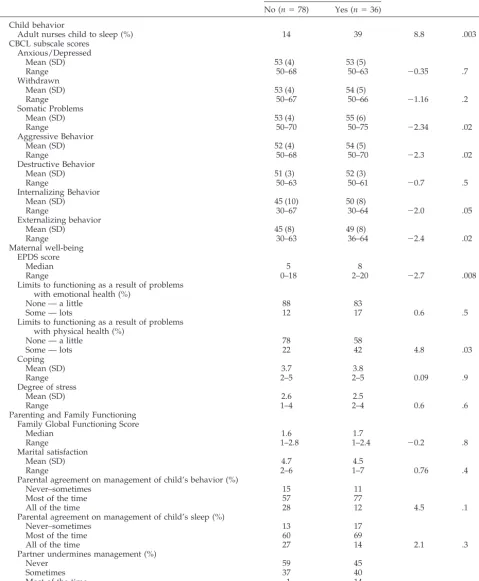
exception of the Sleep Problems subscale, the maxi-mum values obtained all were below the clinically significant cutoff of the 98th percentile. Although not reaching the clinically significant cutoff, children with sleep problems had significantly higher mean scores on Internalizing and Externalizing Behavior and the Aggressive Behavior and Somatic Problems subscales of the CBCL than children without sleep problems (Table 2).
Maternal Well-Being
Twenty-seven percent of mothers scored ⱖ10 on the EPDS, and 16% scored⬎12. This is similar to the prevalence (15.4%) in a representative sample of mothers in the same Australian state.20There was no
significant difference in the median EPDS scores for mothers who had received an intervention during the Infant Sleep Study and the mothers in the control group (7 vs 5.5,z⫽0.62,P⫽ .54).
Mothers of children with sleep problems at 3 to 4 years had higher median EPDS scores (8 vs 5;P ⫽ .008; 95% confidence interval: ⫺4.5– 0.7), reported more limitations of daily functioning as a result of physical health problems (P⫽.03), and reported that their partner undermined their management of their child’s behavior (P⫽ .04). Mothers of children with and without sleep problems did not differ in how they were coping, their stress, their family function-ing, or their marital satisfaction (Table 2).
DISCUSSION
This is the first study to examine the long-term outcomes of sleep problems in a community sample of infants, together with the long-term impact of a behavioral sleep intervention on infant sleep prob-lems. Sleep problems were identified in approxi-mately one third of the 3- to 4-year-old children surveyed, all of whom had had significant sleep problems as infants. These children at 3 to 4 years were more likely to need an adult to nurse them to sleep. They also had higher Internalizing and Exter-TABLE 1. Sleep Characteristics of 3- to 4-Year-Old Children
Variable n
Sleep problem (%) 32
Severity of sleep problem (%; range 1–7)
ⱕ3 51
4–5 38
6–7 11
Adult nurses child to sleep (%) 22
Sleep site (%)
Own bed in own room 64
Own bed in sibling’s room 22
Parent’s bed 11
Other 3
Evening bedtime (PM)
Mean (SD) 7:53 (42 min)
Range 6:30–10:00
Time taken to fall asleep (min; median [range]) 15 (1–75) Number of disturbed nights per week (%)
0 22
1 11
2 16
3 18
4 or more 33
Number of wakings per night (%)
0 39
1 47
2 13
3 2
Who responds to the waking child overnight (%)
No one 7
Mother 53
Father 17
Child comes to parent’s bed 15
Other 8
Duration of night waking (min)
Median 5
Range 1–30
Morning rising (am)
Mean 6:55 (38 min)
Range 5:30–8:00
Number of naps per day (%)
0 52
1 48
Length of usual nap (min)
Mean (SD) 80 (30)
Range 25–180
nalizing Scores and Aggressive Behavior and So-matic Problems subscale scores of the CBCL than children without sleep problems. Their mothers had higher EPDS scores as well as difficulties with their partner undermining the management of their child. Despite this, the children and their families were
generally functioning well, and 69% of mothers re-ported that their child’s sleep problem had resolved from infancy. The resolution of sleep problems in children who had received an infant sleep interven-tion was similar to those who had not.
Thirty-two percent of our cohort had sleep prob-TABLE 2. Association Between Independent Variables at age 3 to 4 Years and Current Sleep Problems
Variable Sleep Problem 2/z PValue
No (n⫽78) Yes (n⫽36) Child behavior
Adult nurses child to sleep (%) 14 39 8.8 .003
CBCL subscale scores Anxious/Depressed
Mean (SD) 53 (4) 53 (5)
Range 50–68 50–63 ⫺0.35 .7
Withdrawn
Mean (SD) 53 (4) 54 (5)
Range 50–67 50–66 ⫺1.16 .2
Somatic Problems
Mean (SD) 53 (4) 55 (6)
Range 50–70 50–75 ⫺2.34 .02
Aggressive Behavior
Mean (SD) 52 (4) 54 (5)
Range 50–68 50–70 ⫺2.3 .02
Destructive Behavior
Mean (SD) 51 (3) 52 (3)
Range 50–63 50–61 ⫺0.7 .5
Internalizing Behavior
Mean (SD) 45 (10) 50 (8)
Range 30–67 30–64 ⫺2.0 .05
Externalizing behavior
Mean (SD) 45 (8) 49 (8)
Range 30–63 36–64 ⫺2.4 .02
Maternal well-being EPDS score
Median 5 8
Range 0–18 2–20 ⫺2.7 .008
Limits to functioning as a result of problems with emotional health (%)
None — a little 88 83
Some — lots 12 17 0.6 .5
Limits to functioning as a result of problems with physical health (%)
None — a little 78 58
Some — lots 22 42 4.8 .03
Coping
Mean (SD) 3.7 3.8
Range 2–5 2–5 0.09 .9
Degree of stress
Mean (SD) 2.6 2.5
Range 1–4 2–4 0.6 .6
Parenting and Family Functioning Family Global Functioning Score
Median 1.6 1.7
Range 1–2.8 1–2.4 ⫺0.2 .8
Marital satisfaction
Mean (SD) 4.7 4.5
Range 2–6 1–7 0.76 .4
Parental agreement on management of child’s behavior (%)
Never–sometimes 15 11
Most of the time 57 77
All of the time 28 12 4.5 .1
Parental agreement on management of child’s sleep (%)
Never–sometimes 13 17
Most of the time 60 69
All of the time 27 14 2.1 .3
Partner undermines management (%)
Never 59 45
Sometimes 37 40
Most of the time 1 14
All of the time 1 0 8.6 .04
lems at 3 to 4 years, slightly lower than the 41% reported in another longitudinal study of 308 in-fants.7However, in that study, no behavioral
inter-vention was offered and persistence of a sleep prob-lem might therefore be more likely.7
We were interested in the generalizability over time of the behavioral interventions taught during the Infant Sleep Study. Of the mothers who were in the intervention group and had another child with sleep problems, 75% were able to use the sleep strat-egies learned from the Infant Sleep Study to manage these problems. We could find no other study that reported on generalizability of sleep behavior inter-ventions.
Our study also explored the relationship among child sleep problems and maternal well-being, fam-ily functioning, and child behavior. Maternal depres-sion has been repeatedly associated with sleep dis-turbance in childhood,7,21and in at least 1 study, it
predicted persistent child sleep problems.7 In
con-trast, maternal EPDS score at age 6 to 12 months did not predict sleep problems at the age of 3 to 4 years in this study. However, current maternal EPDS score was significantly higher in mothers who had chil-dren with a sleep problem. This suggests that high EPDS scores may be a consequence rather than a cause of childhood sleep problems. Previous studies have suggested that children with sleep problems are more likely to display more externalizing behavior problems.4 Although a similar pattern was seen in
our cohort, the severity of externalizing behavior problems in children with persistent sleep problems did not fall into the clinical range.5
The strengths of this study include the prospective nature of the data collection. The high response rate (73%) in this sample suggests that our results are likely to be representative of a middle-class Austra-lian population. Response bias was likely to be min-imal as mothers who did not respond were no more likely to be depressed or report more severe infant sleep problems at baseline than mothers who did respond. However, because data were collected from middle-class families, results of this study may not generalize to a wider population. Mothers reported on child sleep, child behavior, and their own well-being. Although depressed mothers may be more likely to perceive their child as having difficulties with sleep, this was not evident in our previous community sample (n ⫽ 738).2 In fact, child sleep
patterns were identical for problem sleepers whether they were reported by depressed or nondepressed mothers.2
Despite the high incidence of night waking in our cohort, families and children are generally function-ing well. Most sleep problems do resolve, but almost 1 in 5 will return. This may be because the nature
of the sleep problem may have changed such that the sleep strategies taught in the original study may no longer be appropriate. Alternatively, “booster ses-sions” may be required to maintain treatment effects. Therefore, families should be encouraged to gener-alize the use of simple sleep strategies to other chil-dren when appropriate or seek additional help if sleep problems recur.
REFERENCES
1. Armstrong KL, Quin RA, Dadds MR. The sleep patterns of normal children.Med J Aust.1994;1:202–206
2. Hiscock H, Wake M. Infant sleep problems and postnatal depression: a community based study.Pediatrics.2001;107:1317–1322
3. Armstrong KL, Van Haeringen AR, Dadds MR, Cash R. Sleep depriva-tion or postnatal depression in later infancy: separating the chicken from the egg.J Paediatr Child Health.1998;34:260 –262
4. Lavigne JV, Arend R, Rosenbaum D, et al. Sleep and behavior problems among preschoolers.Dev Behav Pediatr.1999;20:164 –169
5. Owens-Stively J, Frank N. Child temperament, parenting discipline style, and daytime behavior in childhood sleep disorders.Dev Behav Pediatr.1997;18:314 –321
6. Kataria S, Swanson MS, Trevathan GE. Persistence of sleep disturbances in preschool children.J Paediatr.1987;110:642– 646
7. Zuckerman B, Stevenson J, Bailey V. Sleep problems in early childhood: continuities, predictive factors and behavioral correlates. Pediatrics. 1987;80:664 – 671
8. Jenkins S, Owen C, Bax M, Hart H. Continuities of common behavioural problems in pre-school children. J Child Psychol Psychiatry.1980;25: 75– 89
9. Thunstrom M. A 2.5-year follow-up of infants treated for severe sleep problems.Ambul Child Health.2000;6:225–235
10. Hiscock H, Wake M. Does a behavioural infant sleep intervention improve infant sleep and maternal mood? A randomised controlled trial.BMJ.2002;324:1062
11. Ramchandani P, Wiggs L, Webb V, Stores G. A systematic review of treatments for settling problems and night waking in young children. BMJ.2000;320:209 –213
12. Boyce P, Stubbs J, Todd A. The Edinburgh Postnatal Depression Scale: validation for and Australian sample.Aust N Z J Psychiatry.1993;27: 472– 476
13. Murray L, Carothers AD. The validation of the Edinburgh Postnatal Depression Scale on a community sample.Br J Psychiatry. 1990;157: 288 –290
14. Smith J, Prior M. Temperament and stress resilience in school-age children: a within-families study.J Am Acad Child Adolesc Psychiatry. 1995;34:168 –179
15. Achenbach TM, Ruffle TM. The Child Behavior Checklist and related forms for assessing behavioural/emotional problems and competen-cies.Pediatr Rev.2000;21:265–271
16. Wake M, Hesketh K, Lucas J. Teething and tooth eruption in infants: a cohort study.Pediatrics.2000;106:1374 –1379
17. Sharpley CF, Rogers JH. Preliminary validation of the Abbreviated Spanier Dyadic Adjustment Scale: some psychometric data regarding a screening test of marital adjustment.Educ Psychol Measurement.1984;44: 1045–1049
18. Miller IW, Epstein NB, Bishop DS, Keitner GI. The McMaster Family Assessment Device: reliability and validity.J Marital Fam Ther.1985;11: 345–356
19. Sawyer MG, Sarris A. Family assessment device: reports from mothers, fathers, and adolescents in community and clinic families.J Marital Fam Ther.1988;14:287–296
20. Astbury J, Brown S, Lumley J, Small R. Birth events, birth experiences and social differences in postnatal depression.Aust J Public Health. 1994;18:176 –184
DOI: 10.1542/peds.111.3.e203
2003;111;e203
Pediatrics
Peiyoong Lam, Harriet Hiscock and Melissa Wake
and Maternal Well-Being
Outcomes of Infant Sleep Problems: A Longitudinal Study of Sleep, Behavior,
Services
Updated Information &
http://pediatrics.aappublications.org/content/111/3/e203 including high resolution figures, can be found at:
References
http://pediatrics.aappublications.org/content/111/3/e203#BIBL This article cites 21 articles, 7 of which you can access for free at:
Permissions & Licensing
http://www.aappublications.org/site/misc/Permissions.xhtml in its entirety can be found online at:
Information about reproducing this article in parts (figures, tables) or
Reprints
DOI: 10.1542/peds.111.3.e203
2003;111;e203
Pediatrics
Peiyoong Lam, Harriet Hiscock and Melissa Wake
and Maternal Well-Being
Outcomes of Infant Sleep Problems: A Longitudinal Study of Sleep, Behavior,
http://pediatrics.aappublications.org/content/111/3/e203
located on the World Wide Web at:
The online version of this article, along with updated information and services, is
by the American Academy of Pediatrics. All rights reserved. Print ISSN: 1073-0397.