IJSRR, 7(4) Oct. – Dec., 2018 Page 446
Research article Available online www.ijsrr.org
ISSN: 2279–0543
International Journal of Scientific Research and Reviews
Performance Analysis and Evaluation In Data Mining: An Educational
Perspective
Bhardwaj Kumar Brijesh
Department of Computer Application, Dr. R. M. L. Avadh University, Faizabad
ABSTRACT
Information of data has a number of shrouded data. The handling technique for data chooses
what kind of data create. The regular quest is on to find out new ways to make it more effective and
efficient for students. In India instruction part has a great deal of data that can create important data.
This data can be utilized to build the nature of instruction. Be that as it may, educational
establishment does not utilize any information revelation process approach on these data. Data and
correspondence innovation puts its leg into the instruction division to catch and order ease data.
Presently a new research network, educational data mining (EDM), is developing which is crossing
point of data mining and instructional method. In this article we presented guideline of research done
in EDM with different portion of training segment.
KEYWORDS
:
Educational Data Mining, Approaches, MethodsDr. Brijesh Kumar Bhardwaj
Assistant Professor,
Department of Computer Application,
Dr. R. M. L. Avadh University, Faizabad
Bhardwaj Kumar Brijesh, IJSRR 2018, 7(4), 446-451
IJSRR, 7(4) Oct. – Dec., 2018 Page 447
I. INTRODUCTION
Quality instruction is a standout amongst the most encouraging obligations of any nation to
his comrades. Quality instruction does not mean abnormal state of information delivered. In any
case, it implies that training is delivered to understudies in productive way so they learn with no
issue. For this reason quality instruction incorporates highlights like: system of educating, persistent
assessment, classification of understudy into comparative kind, so that understudies have
comparative destinations, statistic, educational foundation and so forth. Coming of computer opens
another period in the field of database in light of the fact that of high accumulation capacity and
complex investigation. Immense number of data can be composed in any request on only a tick of
mouse 1, 6. It can investigate another learning on these data which was either inconceivable for a human personality or an exceptionally tedious process 3. Data without the applicable learning is futile. Learning can be viewed as the examples or attributes of the data. Crude data is some of the
time good for nothing since what we need is the information covered up in the data and not the data
all things considered 4. That is why another innovation has developed in the mid 1990's to bargain with the revelation of learning from data 5. It is called just data mining. Revealing concealed data is the crucial objective of data mining. Data Mining is especially utilized for discovering data designs
from the databases that give us new learning that thusly utilized as a part of basic leadership
procedure of the association 7.
II PERFORMANCE ANALYSIS STEPS
Data mining removes shrouded data with the assistance distinctive mining system.
Expectation, results and proposal are given by this data, which assist the client with taking further
choice 2, 4. It additionally manages the concern individual for whom data has been removed. In this part we talked about various examines did in the training segment utilizing data mining.
Understudies, teachers and scholarly capable individual can utilize these discoveries to enhance the
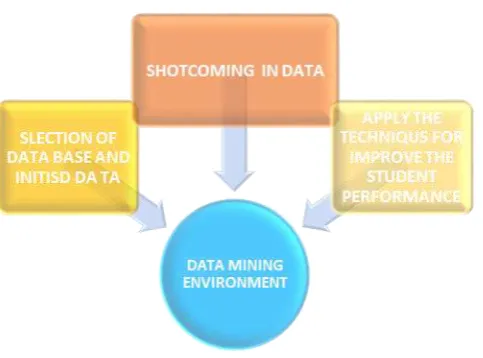
nature of training. Performance analysis steps (fig 1) have involved in improve the student
IJSRR, 7(4) Oct. – Dec., 2018 Page 448 Fig 1 Steps for improvement
III. DATA ANALYSIS
In this progression just those fields were chosen which were required for data mining. A
couple of inferred factors were chosen. While a portion of the data for the factors was extricated
Bhardwaj Kumar Brijesh, IJSRR 2018, 7(4), 446-451
IJSRR, 7(4) Oct. – Dec., 2018 Page 449 Table 1: Student Related Variables
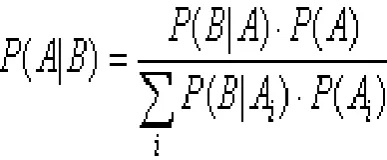
Bayes rule is a technique to estimate the likelihood of a property given the set of data as evidence or
input Bayes rule or Bayes theorem is-
After evaluation we found the complete information at differs stages.
IV. RESULT IMPACTS
It is found that the student’s performance is highly dependent on their grade obtained in
Senior Secondary Examination, which is shown in Fig.2
Variable Description Possible Values
Sex Students Sex {Male, Female}
CAT Students category {General, OBC, SC, ST} Med Medium of Teaching Hindi, English, Mix SFH Students food habit {veg , non-veg}
SOH Students other habit {drinking, smoking, both, not-applicable} LLoc Living Location {Village, Town, Tahseel, District}
Hos Student live in hostel or not
{Yes, No}
Fsize student’s family size {1, 2, 3, >3} FSat Students family status {Joint, Individual} FAIn Family annual income Status {BPL, poor, medium,
high} TColl Students grade in Senior Secondary
education
A – 80% - 89%, B – 70% - 79%, C – 60% - 69%, D – 50% - 59%, E – 40% - 49%,
F - < 40%} GSS Students College Type {Female, Co-education} FQual Father’s Qualification {no-education, elementary, secondary,
graduate, post- graduate, doctorate, not applicable}
MQual Mother’s Qualification elementary, secondary, graduate, post-graduate, doctorate, not-applicable} FOcc Father’s Occupation {Service, retired, not-applicable} MOcc Mother’s Occupation {House-wife, Service, retired,
not-applicable} GObt Grade obtained in
BCA
{First > 60% Second >45 & <60%
IJSRR, 7(4) Oct. – Dec., 2018 Page 450 Fig2ResultAnalysis
V CONCLUSION
Enlightening data can give us an enhanced comprehension of understudies'
information and better appraisals of their advance. The educational frameworks right now
confront number of issues. Data mining gives a deal of techniques, which can assist the
educational structure with overcoming these issues and upgrade the nature of instruction. It
will empower the basis to control the understudies and help instructors and administration in
improving the implementation of the establishment. It can improve an instruction framework
by empowering better comprehension of the understudies. The additional data can assist the
educationalist with control their classes better and the direction to improve arrangements.
REFERENCES
1. Pumpuang, Pathom, Anongnart Srivihok, and Prasong Praneetpolgrang.
"Comparisons of classifier algorithms: Bayesian network, C4. 5, decision forest and
NBTree for Course Registration Planning model of undergraduate students."
Systems, Man and Cybernetics, 2008. SMC 2008. IEEE International Conference on.
Bhardwaj Kumar Brijesh, IJSRR 2018, 7(4), 446-451
IJSRR, 7(4) Oct. – Dec., 2018 Page 451
2. Ranjan, Jayanthi, and Saani Khalil. "Conceptual framework of data mining process in
management education in India: an institutional perspective."Information
Technology Journal, 2008; 7(1): 16-23.
3. Romero, Cristóbal, Sebastián Ventura, Pedro G. Espejo, and César Hervás. "Data
Mining Algorithms to Classify Students." In EDM, 2008; 8-17.
4. Ogor, Emmanuel N. "Student academic performance monitoring and evaluation
using data mining techniques." Electronics, Robotics and Automotive Mechanics
Conference, 2007. CERMA 2007. IEEE, 2007.
5. Hien, Nguyen Thi Ngoc, and Peter Haddawy. "A decision support system for
evaluating international student applications." Frontiers In Education
ConferenceGlobal Engineering: Knowledge Without Borders, Opportunities Without
Passports, 2007. FIE'07. 37th Annual. IEEE, 2007.
6. Bresfelean, Vasile Paul. "Analysis and predictions on students' behavior using
decision trees in Weka environment." Information Technology Interfaces, 2007. ITI
2007. 29th International Conference on. IEEE, 2007.
7. Nghe, Nguyen Thai, Paul Janecek, and Peter Haddawy. "A comparative analysis of
techniques for predicting academic performance." Frontiers In Education
Conference-Global Engineering: Knowledge Without Borders, Opportunities
Without Passports, 2007. FIE'07. 37th Annual. IEEE, 2007.
8. Brijesh et. al., Recommendations In Higher Education using Data Mining
Techniques, Thesis Report, Singhania University, Rajasthan 2010.
9. Anshul Mishra, Dr. Devendra Agarwal and Dr. M. H. Khan, “A Critical Review of Fault Tolerance: Security Perspective”, International Journal of Computer Science