R E S E A R C H
Open Access
Combining lexical and context features
for automatic ontology extension
Sara Althubaiti
1,2, ¸Senay Kafkas
1,2, Marwa Abdelhakim
1,2and Robert Hoehndorf
1,2*Abstract
Background: Ontologies are widely used across biology and biomedicine for the annotation of databases. Ontology development is often a manual, time-consuming, and expensive process. Automatic or semi-automatic identification of classes that can be added to an ontology can make ontology development more efficient.
Results: We developed a method that uses machine learning and word embeddings to identify words and phrases that are used to refer to an ontology class in biomedical Europe PMC full-text articles. Once labels and synonyms of a class are known, we use machine learning to identify the super-classes of a class. For this purpose, we identify lexical term variants, use word embeddings to capture context information, and rely on automated reasoning over
ontologies to generate features, and we use an artificial neural network as classifier. We demonstrate the utility of our approach in identifying terms that refer to diseases in the Human Disease Ontology and to distinguish between different types of diseases.
Conclusions: Our method is capable of discovering labels that refer to a class in an ontology but are not present in an ontology, and it can identify whether a class should be a subclass of some high-level ontology classes. Our approach can therefore be used for the semi-automatic extension and quality control of ontologies. The algorithm, corpora and evaluation datasets are available athttps://github.com/bio-ontology-research-group/ontology-extension.
Keywords: Disease ontology, Embeddings, Neural network
Background
The biomedical community has spent significant
resources to develop biomedical ontologies which con-tain and define the basic classes and relations that occur within a domain. Biomedical ontologies are developed by domain experts and are often developed in conjunction with the needs arising in literature-based curation of biological databases.
Manual curation of databases based on literature is a very time-consuming task due to the massive amounts of literature, and automated methods have been developed
early on to aid in curation [1]. One of the key tasks in
computational support for literature curation is the auto-matic concept recognition of mentions of ontology classes
in text [2]. An ontology class is an intensionally defined
*Correspondence:[email protected]
1Computational Bioscience Research Center, King Abdullah University of
Science and Technology, 23955-6900 Thuwal, Saudi Arabia
2Computer, Electrical and Mathematical Sciences and Engineering Division, King Abdullah University of Science and Technology, 23955-6900 Thuwal, Saudi Arabia
entity that has a formal description within an ontology and axioms that determine its relation with other classes [3]. In natural language, multiple terms and phrases can be used
to refer to an ontology class [4], and the formal
depen-dencies within an ontology further determine whether a term refers to a class or not (i.e., whether a term refers to a particular class may depend on background knowledge, in particular subclass relations, contained in an
ontol-ogy). For example, the Disease Ontology (DO) [5] declares
Prediabetes syndrome (DOID:11716) to be a subclass of Diabetes mellitus(DOID:9351), and based on this information we assume that any reference to, or mention of, Prediabetes syndrome is also a reference to Diabetes mellitus(with respect to DO).
There are several text mining systems designed for ontology concept recognition in text. These methods are either based on lexical methods and therefore applicable
to a wide range of ontologies [6,7] or they are
domain-specific and rely on machine learning [8]. Text mining
based-methods can also be used to automatically or semi-automatically construct and extend ontologies [9,10]. For
example, Lee et al. [11] focus on text mining of relations
that are asserted in text between mentions of ontology classes that has been used to refine ontology classes in the
Gene Ontology (GO) [12]. Text mining can also be used to
suggest new subclasses and sibling classes in ontologies,
for example Wächter and Schroeder [13] carried out a text
mining based-system from different text sources which is used for extending OBO ontologies by semi-automatically generating terms, definitions and parent–child relations.
Xiang et al. [14] have developed a pattern-based system
for generating and annotating a large number of ontology terms, following ontology design patterns and providing logical axioms that may be added to an ontology. Recently, clustering based on statistical co-occurrence measures were also used to extend ontologies [15].
Here, we introduce a novel method relying on machine learning to identify whether a word used in text refers to a class that could be included in a particular ontol-ogy. Essentially, our method classifies terms to determine if they are usually mentioned in the same context as the labels and synonyms of classes in an ontology (which are used as seeds to train the classifier); this classifier can then be applied to unseen terms. Furthermore, our method can also be used to expand ontologies by suggesting terms that are mentioned within the same context as specific classes in an ontology.
We demonstrate the utility of our method in identi-fying words referring to diseases from DO in full text articles. We select the DO because the labels and syn-onyms of DO classes are relatively easy to detect in text and a large number of computational methods rely on
access to a comprehensive disease ontology [16–19]. Our
method achieves highly accurate (F-score >90%) and
robust results, is capable of recognizing multiple different classes including those defined formally through logical operators, and combines dictionary-based and context-based features; therefore, our method is also capable of finding new words that refer to a class. We manually evaluate the results and suggest several additions to the DO.
Methods
Building a disease dictionary
We built a dictionary from the labels and synonyms of classes in the Disease Ontology (DO), downloaded
on 5 February 2018 from http://disease-ontology.org/
downloads/. The dictionary consisted of 21,788 terms belonging to 6,831 distinct disease classes from DO. We
utilized the dictionary with the Whatizit tool [20] and
annotated the ontology class mentions along with their identifiers in approximately 1.6 million open access
full-text articles from the Europe PMC database [21] (http://
europepmc.org/ftp/archive/v.2017.06/) and generated a corpus annotated with mentions of classes in DO. We preprocessed the corpus by removing stop words such as “the”, “a”, and “is” as well as some punctuation characters.
Generating context-based features
We use Word2Vec [22] to generate word embedding.
Specifically, we use a skip-gram model which aims to find word representations that are useful for predicting the surrounding words in a given sentence or a document consisting of sequence of words;w1,w2, ...,wK. The objec-tive is to maximize the average log probability using the following formula:
V(w)= 1 K
K
k=1
K
−c≤j≤c;j=0
log p(wK+j|wK) (1)
where word vectorsV(w)are computed by averaging over
the number of wordsK andcis the size of the training
context. We generated the word embedding by using the default parameter settings of the Word2Vec gensim imple-mentation: vector size (dimensionality) of 100, window size 5, minimum occurrence count of 5, and we use a skip-gram (sg) model.
Supervised training
We carried out a set of experiments to choose the optimal training algorithm to design our model. In our experi-ments we used default parameters for the training algo-rithms but different hidden layers for Artificial Neural
Networks (ANNs) [23]. Our experiments show that the
ANN model outperforms an SVM model [24] (see
Addi-tional file 1: Table 1 for full details), and our model
performs best with 200 neurons in a single hidden layer (we tested a single hidden layer with a size of 10, 50, 100, and 200 neurons). We report results accordingly to a model with 200 neurons in the remainder of this work. In ANNs, multiple neurons are organized in layers. Typically, different layers perform different kinds of
transforma-tions on their inputs [25]. In our experiments, we used
an ANN with an input layer of different sizes, a single hidden layer that uses a sigmoid activation function, and an output layer that differs based on the experiment. We train each classifier in a supervised manner, using 10-fold stratified cross-validation. Additionally, we report testing performance on an independent 20% testing set which we generated by randomly removing data points before training.
Recognizing ontology classes in text
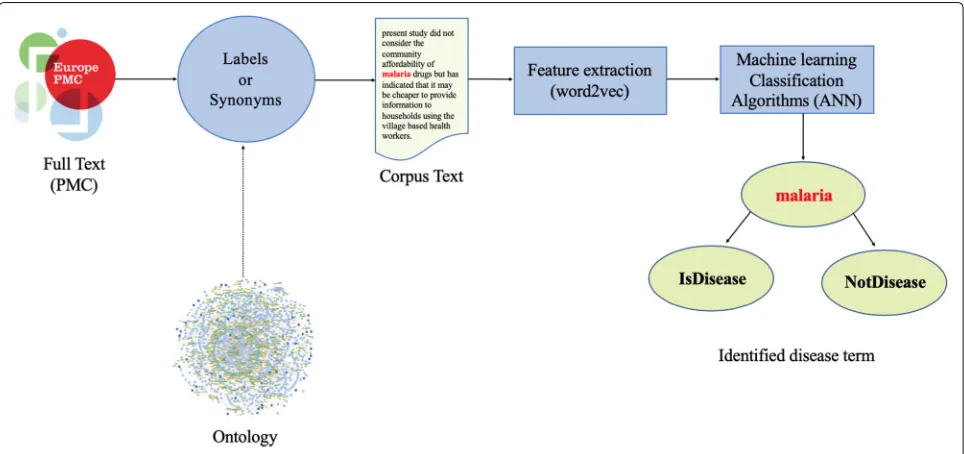
We used two approaches to recognize the mention of ontology classes in text. Our first approach relies solely on labels and synonyms of the classes within a given
to a class inO. We first obtain an ontologyOin the Web
Ontology Language (OWL) [26] format and extract a list
of class labels and synonymsLfromO; we further utilize
a text corpusT as input to our method. Then, we
gener-ate word embeddings (i.e., vector-space encodings of the contexts in which a word occurs) for all words in our text
corpusTand train a supervised machine learning model
to classify whether a word refers to a class in Oor not
(using theL’s words as positive training instances and all
others as negative instances).
Figure1illustrates the workflow of our first approach.
Our method is generic and can, in principle, be applied to any ontology as long as the ontology provides labels (or synonyms), these labels can be identified in text, and the ontology from which the labels are extracted is more or less limited to a single domain. For example,
refer-ence ontologies in the OBO Foundry [27] are usually
single domain ontologies and therefore suitable for our method. Ontologies that would not be suitable are appli-cation ontologies that cover multiple domains, such as the
Experimental Factor Ontology (EFO) [28] (although our
methods can be applied to parts of it). It is most useful to extend an existing ontology with new labels, synonyms, or classes.
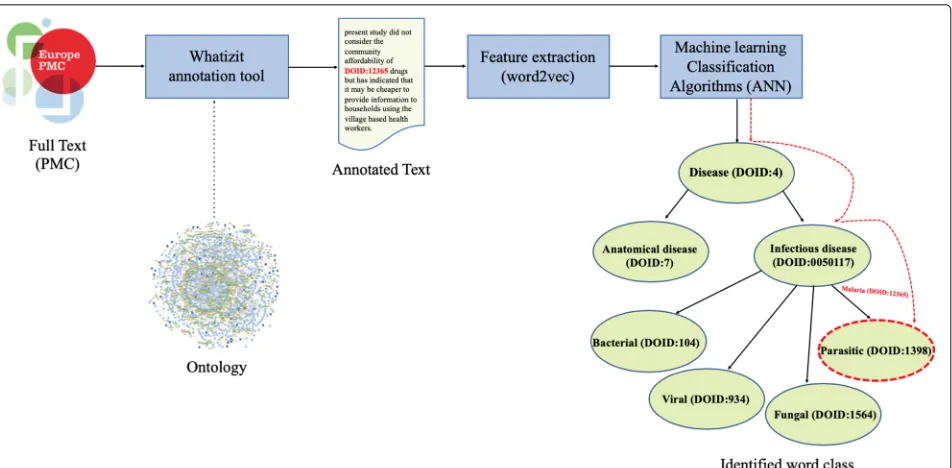
In our second approach, we rely on annotations from
the Whatizit tool [20] to identify the mention of ontology
classes in text and determine their specific superclasses in
an ontology. Our approach takes an ontologyOin OWL
format, a set of ontology classesS = {C1, ...,Cn}, and a
corpus of textTas inputs.
This approach first uses Whatizit as a named entity recognition and normalization tool to normalize class
labels and synonyms in text by replacing all mentions of a class with the class identifier (i.e., the class URI). We annotate 15,183 distinct terms using Whatizit; the total dictionary consists of 21,788 terms (derived from the labels and synonyms of classes in DO). We then train Word2Vec model that captures the context of the men-tion of the class and generates a vector space embedding for that class. Given such vector space embeddings for
a set of classes in O, we use the vector space
embed-dings as input to a machine learning method that classifies whether another class appears in a similar context. We use this method to determine if a class should belong the
superclass ofCinO. Figure2illustrates the workflow of
this approach.
The main difference between the two approaches is that the first approach broadly identifies terms or words that refer to classes within a domain (as defined by the sum of classes within an ontology) while the second approach can determine whether a term or word refers to a class that should appear as a subclass of a more specific ontol-ogy class. Both methods generate “seed” words in text and then use these seeds first to generate context-based fea-tures (through Word2Vec) and use these context-based features in a supervised machine learning classifier.
Manual analysis process
We manually evaluate some of our findings. The manual evaluation is based on the medical expert knowledge of the evaluator who is a trained clinician, and supplemented by literature search to validate some findings or resolve conflicts. Mainly, results were confirmed by searching for review papers that characterize a condition. Overall,
Fig. 2Annotation-based workflow. In this workflow, we first normalize the mentions of disease classes in the corpus and then apply Word2Vec to generate embeddings for classes, not merely words
manual curation following the suggestions by our classi-fier took 10-15 min per sample (which included identify-ing related classes in the DO and draftidentify-ing an explanation for cases which disagree with the DO).
Results
Broad classification of domain-specific terms: application to diseases
Our method is a workflow that can be used to identify whether a term or phrase commonly refers to a class that may be included in a domain-specific ontology as a label, synonym, or a new class. To achieve this goal, we use the existing labels and synonyms within a domain-ontology as “seeds” to train a machine learning classifier that determines whether a new term is sufficiently similar to an existing label or synonym and may therefore also be included in the ontology. We represent terms primarily by the context in which they occur within a large corpus of
text; we use Word2Vec [22] for this purpose. We then train
an Artificial Neural Network classifier in a supervised manner to distinguish between the terms already included within a domain ontology (and therefore expected to refer to a particular kind of phenomena) and randomly chosen terms not included in the ontology (and therefore most likely not referring to a phenomenon within the domain of the ontology).
We demonstrate our method using the Human
Dis-ease Ontology (DO) [5] and applying it to the terms
occurring in a large corpus of full-text biomedical articles
(see “Methods”). First, we tested whether our approach is
capable of identifying words that refer to theDiseaseclass
(DOID:4), i.e., whether our method can detect terms that refer to a disease. We generated word embeddings for every disease terms and other words in our corpus of full-text articles.
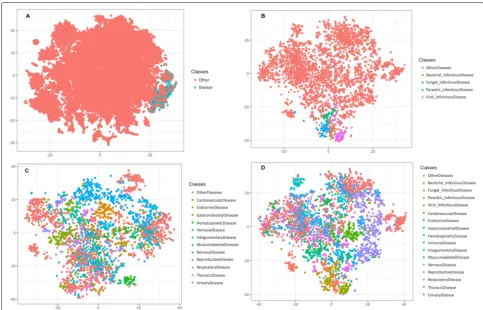
Figure3 illustrates the distribution of the terms
refer-ring to a diseases in DO and other words mentioned in our corpus which do not belong to DO using the t-SNE
dimensionality reduction [29]. We can see that the terms
are clearly different and should be separable through a machine learning system.
Therefore, we trained a machine learning model to recognize whether a word refers to the disease or not using the word embeddings as input. We split the vec-tor space embeddings into a training and testing dataset and consider all embeddings referring to disease as pos-itive instances and all others as negatives. We do not apply any filtering before selecting the positive or negative samples. We randomly select negatives equal to the num-ber of positives (7,932 positives and 7,932 negatives). We withhold 20% of randomly chosen positive and negative instances for testing, train a model on the remaining 80% through 10-fold cross validation, and report the perfor-mance results on the 20% test set. Evaluated on the testing set, we can distinguish between disease and non-disease
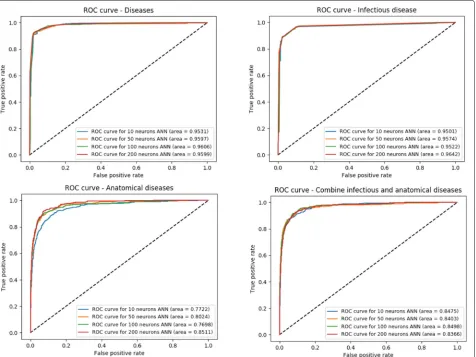
terms with an F-score of 95% and AUC of 96% (see Table1
and Figure4).
Fig. 3 a) The visualization of the embeddings using the t-SNE for binary-classification taskb) The visualization of the embeddings using the t-SNE for classifying infectious diseases.c) The visualization of the embeddings using the t-SNE for classifying anatomical diseases.d) The visualization of the embeddings using the t-SNE for classifying the combination of infectious and anatomical diseases
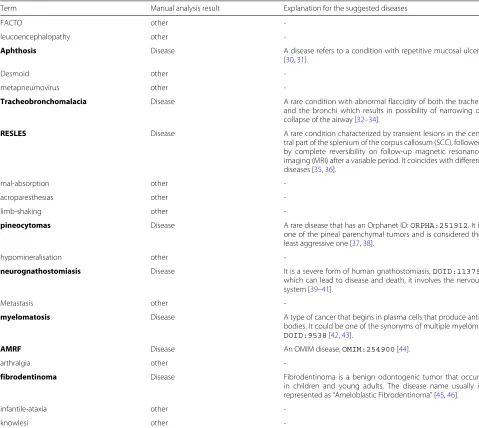
classes), we performed a manual analysis on a set of 20 false positive samples out of 197 which are not the label or synonym of a disease class DO but are classified as disease
by our classifier (see Table2). We found that the majority
of the 20 false positive samples refer to either diseases or phenotypes (where phenotypes are the observable char-acteristics of an organism that may occur manifestations, or signs and symptoms, of a disease, but do not constitute
a disease on its own). For example,Aphthosis is a
pre-diction of our method which refers to a human disorder that is not currently in the DO; the majority of false pos-itives are disease-related terms that do not explicitly refer
to a disease. For example, we predictedmal-absorptionas
a disease term which may refer to a phenotype in some contexts. Our findings indicate that an ANN classifier can identify known terms referring to diseases, and can further suggest novel terms which may prove useful for ontology development and extension.
Fine-grained classification: distinguishing between groups of diseases
As our method showed capability to identify terms refer-ring to a disease, we next tested whether our method can also distinguish between different types of diseases. For this purpose, we used the embeddings generated from a pre-processed corpus in which we normalize all mentions
Table 1F-score and AUC for our four experiments using different hidden layer sizes
Classification Hidden layer sizes 10 50 100 200
Number of classes F-score AUC F-score AUC F-score AUC F-score AUC
Diseases 2 94.65% 95.31% 94.83% 95.97% 95.32% 96.06% 94.49% 95.99%
Infectious disease 5 95.65% 95.01% 96.01% 95.74% 95.43% 95.22% 95.68% 96.42%
Anatomical disease 13 69.18% 77.22% 70.15% 80.24% 70.20% 76.98% 72.00% 85.11%
Infectious + anatomical diseases 17 71.07% 84.75% 73.13% 84.03% 72.61% 84.98% 72.67% 83.66%
Fig. 4ROC curves for each experiment (Diseases, Infectious disease, Anatomical disease and a combination of Infectious disease + Anatomical disease)
of a disease in our corpus using Whatizit tool. The dis-ease dictionary that we utilized with Whatizit includes a total of 21,788 terms (labels and synonyms) from DO. We found that 15,183 of these 21,788 terms appeared in our corpus and we generate an embedding vector for each of them. We then first trained a neural network model to
recognize whether a disease-term refers to theInfectious
Disease(DOID:0050117)class or not, and furthermore whether our method is able to distinguish between the four different types of infectious disease in DO (i.e., bac-terial, fungal, parasitic, or viral infectious disease). As training data, we used the word embeddings generated for DO classes, and we used the Elk reasoner to split them into four types of infectious diseases, and an additional class for diseases that are not a subclass ofInfectious
Dis-ease in DO. We randomly select 20% of the disease in
DO as validation set and train the neural network classi-fier using 10-fold cross-validation on the remaining 80% to separate diseases into one of the five classes (non-infectious, bacterial, fungal, parasitic and viral infections).
Table1shows the performance achieved on the validation
set. While the performance is less than predicting whether a term refers to a disease, our classifier can distinguish between specific disease classes.
We manually analyzed a set of 20 false positive samples
out of 38 which are not a subclass ofInfectious diseasein
the DO but are classified as infectious by our classifier (see
Table 3). We found that 7 of these 20 cases can be
sug-gested to be subclasses of the specific infectious disease they have been classified with but do not have a subclass relation asserted or inferred in DO. For example, the term
syphilitic meningitis(DOID:10073) is a disease that our method classify as a bacterial infectious disease but it is not classified as infectious in the DO.
Moreover, to test the strength of our method to distin-guish between disease classes, we further trained a neural network model to distinguish between the 12 different
subclasses ofDisease of anatomical entity(DOID:7), as
well as an additional class for diseases not classified as
Table 2Manually analyzed disease terms predicted as disease
Term Manual analysis result Explanation for the suggested diseases
FACTO other
-leucoencephalopathy other
-Aphthosis Disease A disease refers to a condition with repetitive mucosal ulcers
[30,31].
Desmoid other
-metapneumovirus other
-Tracheobronchomalacia Disease A rare condition with abnormal flaccidity of both the trachea and the bronchi which results in possibility of narrowing or collapse of the airway [32–34].
RESLES Disease A rare condition characterized by transient lesions in the
cen-tral part of the splenium of the corpus callosum (SCC), followed by complete reversibility on follow-up magnetic resonance imaging (MRI) after a variable period. It coincides with different diseases [35,36].
mal-absorption other
-acroparesthesias other
-limb-shaking other
-pineocytomas Disease A rare disease that has an Orphanet ID:ORPHA:251912. It is
one of the pineal parenchymal tumors and is considered the least aggressive one [37,38].
hypomineralisation other
-neurognathostomiasis Disease It is a severe form of human gnathostomiasis,DOID:11379, which can lead to disease and death, it involves the nervous system [39–41].
Metastasis other
-myelomatosis Disease A type of cancer that begins in plasma cells that produce
anti-bodies. It could be one of the synonyms of multiple myeloma DOID:9538[42,43].
AMRF Disease An OMIM disease,OMIM:254900[44].
arthralgia other
-fibrodentinoma Disease Fibrodentinoma is a benign odontogenic tumor that occurs
in children and young adults. The disease name usually is represented as “Ameloblastic Fibrodentinoma” [45,46].
infantile-ataxia other
-knowlesi other
-The terms in bold represent the correctly validated terms (by a clinician) that classified as diseases terms using our method (in Diseases classification experiment).
same method to split the classes in training and test set as
before. Results are shown in Table1and demonstrate that
our method can also be useful to classify diseases in their anatomical sub-systems.
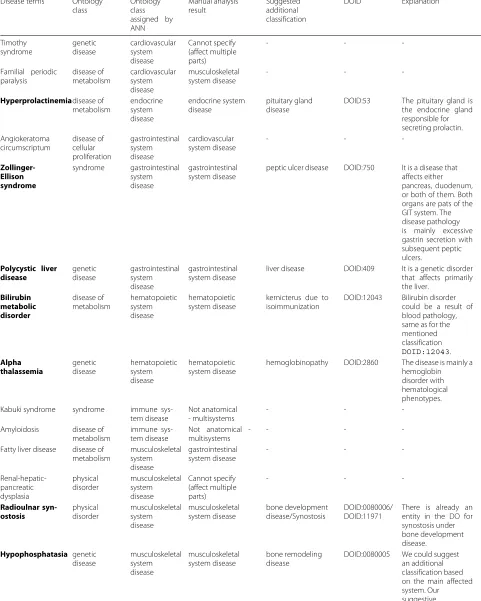
We manually analyzed a set of 20 false positive samples
out of 127 which are not a subclass of Anatomical
dis-easein the DO but are classified as being a subclass of a
particular anatomical system disease by our classifier (see
Table4). We found that 12 of the 20 false positives can be
suggested to be subclasses of the specific anatomical sys-tem disease they have been classified with but do not have such a subclass relation asserted or inferred in DO. For
example, we classifyNarcolepsy(DOID:8986) as a
Ner-vous system anatomical disease, and this may be added as a new subclass axiom to DO.
As it is often inconvenient to train separate classifiers, we also combined both tasks and trained a multi-class classifier to classify disease classes either as infectious or anatomical, or as other disease. We evaluate the
perfor-mance of this combined model (see Table 1), and our
machine learning system achieves an AUC up to 84% (see
Figure4). These results demonstrate it may be possible to
identify new subclasses, although the performance drops when we increase the complexity of the classification problem by distinguishing between more subclasses.
Discussion
Table 3Sample of manually analyzed disease terms predicted as infectious disease
Disease terms Ontology class assigned by ANN
Manual analysis result Suggested additional classification
DOID Explanation
Pelizaeus-Merzbacher disease
Viral infectious disease Non-infectious (inherited disorder)
- -
-Kaposi’s sarcoma Viral infectious disease Viral infectious disease herpes simplex DOID:8566 The disease is caused by Human herpesvirus 8 which is Herpesviridae infection.
maxillary sinusitis Bacterial infectious disease Bacterial infectious disease (usually start viral and progress to either bacterial or fungal)
- - It is an infection in the
maxillary sinuses which could be due to different etiology, one of them is bacterial [47].
keratosis follicularis Bacterial infectious disease Non-infectious (genetic disease)
- -
-chronic rheumatic pericarditis
Viral infectious disease The condition is triggered by autoimmune reaction to infection, mainly group A streptococci.
- -
-gastroparesis Viral infectious disease In most cases the nerve is damaged by diabetes or surgery, however, a viral infection might be a cause
- - A condition in which the
stomach suffers from paresis that affects the food movement to the small intestine [48,49].
osmotic diarrhea Bacterial infectious disease symptom - -
-familial cold autoinflammatory syndrome
Viral infectious disease Non-infectious (inherited disease)
- -
-angular cheilitis Fungal infectious disease Etiology is controversial, most commonly fungal or bacterial.
- - Ambiguous.
Binder syndrome Viral infectious disease Congenital disease - -
-hypohidrosis Bacterial infectious disease Multi-causal - -
-Sjogren’s syndrome Viral infectious disease autoimmune disease - -
-median rhomboid glossitis
Fungal infectious disease Etiology is controversial, however it is considered as a variant of orallesion associated with candida infection [50].
- - Ambiguous.
Goodpasture syndrome Viral infectious disease autoimmune disease - -
-syphilitic meningitis Bacterial infectious disease Bacterial infectious disease syphilis DOID:4166 Considering the same concept of etiology, both diseases are caused by bacterial infection (Treponema pallidum).
acute diarrhea Viral infectious disease symptom - -
-WHIM syndrome Bacterial infectious disease Congenital disease - -
-erythrasma Fungal infectious disease Bacterial infection disease - -
-chronic wasting disease Parasitic infectious disease Neurodegenerative disorder
- -
-scarlet fever Bacterial infectious disease Bacterial infectious disease rheumatic fever DOID:1586 The disease is caused by Group A bacteria of the genus Streptococcus, same causative agent for Rheumatic fever.
Table 4Sample of manually analyzed disease terms classified as affecting particular anatomical systems
Disease terms Ontology class Ontology class assigned by ANN Manual analysis result Suggested additional classification DOID Explanation Timothy syndrome genetic disease cardiovascular system disease Cannot specify (affect multiple parts) - - -Familial periodic paralysis disease of metabolism cardiovascular system disease musculoskeletal system disease - -
-Hyperprolactinemiadisease of metabolism endocrine system disease endocrine system disease pituitary gland disease
DOID:53 The pituitary gland is the endocrine gland responsible for secreting prolactin. Angiokeratoma circumscriptum disease of cellular proliferation gastrointestinal system disease cardiovascular system disease - - - Zollinger-Ellison syndrome syndrome gastrointestinal system disease gastrointestinal system disease
peptic ulcer disease DOID:750 It is a disease that affects either pancreas, duodenum, or both of them. Both organs are pats of the GIT system. The disease pathology is mainly excessive gastrin secretion with subsequent peptic ulcers. Polycystic liver disease genetic disease gastrointestinal system disease gastrointestinal system disease
liver disease DOID:409 It is a genetic disorder that affects primarily the liver. Bilirubin metabolic disorder disease of metabolism hematopoietic system disease hematopoietic system disease
kernicterus due to isoimmunization
DOID:12043 Bilirubin disorder could be a result of blood pathology, same as for the mentioned classification DOID:12043. Alpha thalassemia genetic disease hematopoietic system disease hematopoietic system disease
hemoglobinopathy DOID:2860 The disease is mainly a hemoglobin disorder with hematological phenotypes. Kabuki syndrome syndrome immune
sys-tem disease
Not anatomical - multisystems
- -
-Amyloidosis disease of metabolism
immune sys-tem disease
Not anatomical -multisystems
- -
-Fatty liver disease disease of metabolism musculoskeletal system disease gastrointestinal system disease - - - Renal-hepatic-pancreatic dysplasia physical disorder musculoskeletal system disease Cannot specify (affect multiple parts) - - -Radioulnar syn-ostosis physical disorder musculoskeletal system disease musculoskeletal system disease bone development disease/Synostosis DOID:0080006/ DOID:11971
There is already an entity in the DO for synostosis under bone development disease. Hypophosphatasia genetic disease musculoskeletal system disease musculoskeletal system disease bone remodeling disease
Table 4Sample of manually analyzed disease terms classified as affecting particular anatomical systems (Continued)
the disease is mainly affecting
mineralization of the bone with phenotypes similar to those of Rickets DOID:10609.
Narcolepsy disease of mental health
nervous system disease
nervous system disease
* * *
Aceruloplasminemia disease of metabolism nervous system disease
nervous system disease
neurodegeneration with brain iron accumulation
DOID:0110734 The disease main pathophysiology is either the absence or dysfunction of ceruloplasmin with subsequent iron accumulation in various organ, mainly the brain.
Glomangiomatosis disease of cellular pro-liferation
nervous system disease
cardiovascular system disease
- -
- Deafness-dystonia-optic neuronopathy syndrome
disease of metabolism nervous sys-tem disease
nervous system disease
nervous system disease; since it covers many subclasses to which we can map many aspects of this disease
DOID:863 The disease’s phenotypes reflect neurological affection of multiple parts in the nervous system.
Trophoblastic neoplasm
disease of cellular proliferation
reproductive system disease
reproductive system disease
Female
reproductive organ cancer
DOID:120 The term refers to the group of
malignant neoplasms that consist of abnormal proliferation of trophoblastic tissues similar to
choriocarcinoma DOID:3596and gestational trophoblastic neoplasia DOID:3590. Cryptorchidism physical disorder reproductive
system disease
reproductive system disease
testicular disease DOID:2519 The term refers to undescended testicle.
*Nacrolepsy: is classified as a sleep disorder which is correct, however, the class itself is a subclass to mental disorders. Since there are some neurological disorders that have shown a strong association with sleep disorder such as: neurodenegrative disorders such as tauopathy which involve Alzheimer’s diseases (DOID:10652) [51], synucleinopathy which involve Parkinsonism (DOID:14330) [52], and Genetic neurodegenerative disorders such as Machado-Joseph disease (DOID:1440) [53] or Huntington’s disease (DOID:12858) [54]. We suggest a new classification in which sleep disorders may also be a subclass of nervous system diseases (neurodegenerative disorder) [55] The terms in bold represent the correctly validated terms (by a clinician) that classified as anatomical diseases terms using our method (in Anatomical disease classification experiment).
approach on the DO [5] which is widely used in
biomed-ical research [56]. As case studies, we focused on two
high-level classes in the DO: Infectious Diseases and
Anatomical Diseases. We have evaluated our method both using common performance measures in machine learn-ing as well as through manually investigatlearn-ing some of the predicted false positives.
When applying our method to the DO, our false positive predictions often include phenotypes or, in some cases, pathogens. It is well-established that it is challenging to
distinguish between diseases and phenotypes in
litera-ture [57–59], as evidenced by the large overlap between
disease ontologies and phenotype ontologies [19].
Simi-larly, diseases and pathogens can often have very similar
names [60,61], thereby making it challenging to
terms cover disease symptoms, signs and the investiga-tional results that might be related to that disease. Some phenotypic terms are more diverse; for example, con-genital hemolytic anemia is a form of hemolytic anemia with congenital onset. The term is included in both the
Human Phenotype Ontology (HP) (HP:0004804) and
disease ontology (DOID:589). From a clinical point of
view, it could be a type of disease under the umbrella of hemolytic disorders with a congenital onset; however, congenital hemolytic anemia may also be a phenotype for certain diseases. For this reason, deciding on some terms to be identified either as phenotypes or diseases can be complex, challenging, and context-dependent.
Another limitation of our method is the use of the
Wha-tizit tool [20] to detect and normalize mentions of
ontol-ogy classes in text. In our first use-case – the extension of ontologies with new labels and synonyms – we classify terms that occur in text without relying on any prior text processing which has some drawbacks such as considering a word as disease name within a general context. We use Whatizit for our second use-case – the detection of sub-class axioms – while the performance of Whatizit is less than domain- and task-specific named entity recognition
and normalization tools [62], Whatizit’s key advantage
is that it is a lexical, rule-based method that does not require any training and is able to recognize multi-word terms. Whatizit can therefore be applied to a wide range of ontologies without the need to generate a training dataset. To evaluate the performance of Whatizit, we tested it on
the NCBI disease corpus [16] using their test set
con-taining 100 abstracts. In our evaluation, Whatizit has a precision of 75% and recall of 15% and an F-score of 26%
with an accuracy of 90% (see Additional file2). One of the
reasons for the low recall is the number of diseases which
are included in the Medical Subject Headings (MeSH) [63]
or the Online Mendelian Inheritance in Man (OMIM)
[64] vocabulary but not in DO. Furthermore, Whatizit
ignores many disease abbreviations since they are not included in DO (and therefore in the vocabulary used by Whatizit).
Conclusions
We presented a general method for semi-automatically extending ontologies with new labels, synonyms, classes, or some general subclass axioms. Our approach is based on machine learning algorithms utilizing vector repre-sentation of the ontology classes generated from full text articles. We demonstrated the utility of our approach on the Human Disease Ontology (DO), specifically by find-ing new candidate classes, labels, and synonyms to add
to DO such asAphthosis, and by identifying new axioms
that relate disease classes to their infectious agent or anatomical systems. Our method can help to improve the quality and coverage of ontologies in the ontology
development process by automatically suggesting terms to include (either as labels of new classes or synonyms of existing classes) and suggesting missing subclass axioms. In the future, we plan to expand our study to other ontologies and to defined classes to further analyze its robustness.
Supplementary information
Supplementary informationaccompanies this paper at
https://doi.org/10.1186/s13326-019-0218-0.
Additional file 1:Different conducted experiments based on different classification tasks.
Additional file 2:The evaluation of analyzing NCBI abstracts annotated using Whatizit tool.
Abbreviations
ANNs: Artificial neural networks; AUC: Area under curve; DO: Disease ontology; EFO: Experimental factor ontology; GO: Gene ontology; HP: human phenotype ontology; MeSH: Medical subject headings; OMIM: Online mendelian inheritance in man; OWL: Web ontology language; ROC: Receiver operating characteristic; Sg: Skip-gram
Acknowledgement
Not applicable.
Authors’ contributions
RH conceived of the study; ¸SK, SA, and RH designed the experiments. SA conducted the experiments, implemented the software and evaluated the results. MA manually evaluated the results. SA drafted the manuscript; ¸SK and RH contributed to revising the manuscript. All authors have read and approved the final version of the manuscript.
Funding
This work was supported by funding from King Abdullah University of Science and Technology (KAUST) Office of Sponsored Research (OSR) under Award No ˙URF/1/3454-01-01, FCC/1/1976-08-01, and FCS/1/3657-02-01.
Availability of data and materials
All source code developed for this study is available fromhttps://github.com/ bio-ontology-research-group/ontology-extension.
Ethics approval and consent to participate
Not applicable.
Consent for publication
Not applicable.
Competing interests
The authors declare that they have no competing interests.
Received: 2 October 2018 Accepted: 24 December 2019
References
1. Müller H-M, Kenny EE, Sternberg PW. Textpresso: an ontology-based information retrieval and extraction system for biological literature. PLoS Biol. 2004;2(11):309.
2. Rebholz-Schuhmann D, Oellrich A, Hoehndorf R. Text-mining solutions for biomedical research: enabling integrative biology. Nat Rev Genet. 2012;13(12):829.
3. Hoehndorf R, Schofield PN, Gkoutos GV. The role of ontologies in biological and biomedical research: a functional perspective. Brief Bioinform. 2015;16(6):1069–80.
5. Schriml LM, Arze C, Nadendla S, Chang Y-WW, Mazaitis M, Felix V, Feng G, Kibbe WA. Disease ontology: a backbone for disease semantic
integration. Nucleic Acids Res. 2011;40(D1):940–6.
6. Jonquet C, Musen MA, Shah N. A system for ontology-based annotation of biomedical data. In: Bairoch A, Cohen-Boulakia S, Froidevaux C, editors. Data Integration in the Life Sciences. Berlin, Heidelberg: Springer; 2008. p. 144–52.
7. Kafkas ¸S, Dunham I, McEntyre J. Literature evidence in open targets-a target validation platform. J Biomed Semant. 2017;8(1):20.
8. Leaman R, Islamaj Do ˘gan R, Lu Z. Dnorm: disease name normalization with pairwise learning to rank. Bioinformatics. 2013;29(22):2909–17. 9. Wong W, Liu W, Bennamoun M. Ontology learning from text: A look
back and into the future. ACM Comput Surv. 2012;44(4):1–36.https://doi. org/10.1145/2333112.2333115.
10. Brewster C. Book review: Ontology learning from text: Methods, evaluation and applications, edited by Paul Buitelaar, Philipp Cimiano and Bernado Magnini. Comput Linguist. 2006;32(4):569–72.https://doi.org/10. 1162/coli.2006.32.4.569.
11. Lee J-B, Kim J-j, Park JC. Automatic extension of Gene Ontology with flexible identification of candidate terms. Bioinformatics. 2006;22(6): 665–70.https://doi.org/10.1093/bioinformatics/btl010.
12. Ashburner M, Ball CA, Blake JA, Botstein D, Butler H, Cherry JM, Davis AP, Dolinski K, Dwight SS, Eppig JT, Harris MA, Hill DP, Issel-Tarver L, Kasarskis A, Lewis S, Matese JC, Richardson JE, Ringwald M, Rubin GM, Sherlock G. Gene ontology: tool for the unification of biology. Nat Genet. 2000;25(1):25–9.https://doi.org/10.1038/75556.
13. Wächter T, Schroeder M. Semi-automated ontology generation within OBO-Edit. Bioinformatics. 2010;26(12):88–96.
14. Xiang Z, Zheng J, Lin Y, He Y. Ontorat: Automatic generation of new ontology terms, annotations, and axioms based on ontology design patterns. J Biomed Semant. 2015;6(1):. https://doi.org/10.1186/2041-1480-6-4.
15. Liu F, Li G. The extension of domain ontology based on text clustering. 10th International Conference on Intelligent Human-Machine Systems and Cybernetics (IHMSC). China. 2018;01:301–4.https://doi.org/10.1109/ IHMSC.2018.00076.
16. Do ˘gan RI, Leaman R, Lu Z. NCBI disease corpus: A resource for disease name recognition and concept normalization. J Biomed Inform. 2014;47: 1–10.https://doi.org/10.1016/j.jbi.2013.12.006.
17. Xie C, Mao X, Huang J, Ding Y, Wu J, Dong S, Kong L, Gao G, Li C-Y, Wei L. Kobas 2.0: a web server for annotation and identification of enriched pathways and diseases. Nucleic Acids Res. 2011;39(suppl_2):316–22. 18. Osborne JD, Flatow J, Holko M, Lin SM, Kibbe WA, Zhu LJ, Danila MI,
Feng G, Chisholm RL. Annotating the human genome with disease ontology. BMC Genomics. 2009;10(1):6.
19. Hoehndorf R, Schofield PN, Gkoutos GV. Analysis of the human diseasome using phenotype similarity between common, genetic, and infectious diseases. Sci Rep. 2015;5:10888.
20. Rebholz-Schuhmann D, Arregui M, Gaudan S, Kirsch H, Jimeno A. Text processing through web services: calling whatizit. Bioinformatics. 2007;24(2):296–8.
21. Consortium EP. Europe pmc: a full-text literature database for the life sciences and platform for innovation. Nucleic Acids Res. 2014;43(D1): 1042–8.
22. Mikolov T, Sutskever I, Chen K, Corrado GS, Dean J. Distributed representations of words and phrases and their compositionality. In: Advances in Neural Information Processing Systems. New York: Curran Associates Inc.; 2013. p. 3111–9.
23. Rosenblatt F. The perceptron: a probabilistic model for information storage and organization in the brain. Psychol Rev. 1958;65(6):386. 24. Vapnik VN. The Nature of Statistical Learning Theory. Berlin, Heidelberg:
Springer; 1995.
25. Hemanth DJ, Estrela VV. Deep Learning for Image Processing Applications. Advances in Parallel Computing, vol 31. Amsterdam: IOS Press; 2017, pp. 27–49.
26. Grau BC, Horrocks I, Motik B, Parsia B, Patel-Schneider P, Sattler U. OWL 2: The next step for owl. Web Semant Sci Serv Agents World Wide Web. 2008;6(4):309–22.
27. Smith B, Ashburner M, Rosse C, Bard J, Bug W, Ceusters W, Goldberg LJ, Eilbeck K, Ireland A, Mungall CJ, et al. The OBO foundry: coordinated evolution of ontologies to support biomedical data integration. Nat Biotechnol. 2007;25(11):1251.
28. Malone J, Holloway E, Adamusiak T, Kapushesky M, Zheng J, Kolesnikov N, Zhukova A, Brazma A, Parkinson H. Modeling sample variables with an experimental factor ontology. Bioinformatics. 2010;26(8):1112–8. 29. Maaten Lvd, Hinton G. Visualizing data using T-SNE. J Mach Learn Res.
2008;9:2579–605.
30. Lynde CB, Bruce AJ, Rogers RS. Successful Treatment of Complex Aphthosis With Colchicine and Dapsone. Arch Dermatol. 2009;145(3): 273–6.https://doi.org/10.1001/archdermatol.2008.591.http://arxiv.org/ abs/https://jamanetwork.com/journals/jamadermatology/articlepdf/ 711961/dst80026_273_276.pdf.
31. Liang MW, Neoh CY. Oral aphthosis: management gaps and recent advances. Ann Acad Med Singap. 2012;41(10):463–70.
32. Murgu SD, Colt HG. Tracheobronchomalacia and excessive dynamic airway collapse. Respirology. 2006;11(4):388–406.
33. Morrison RJ, Hollister SJ, Niedner MF, Mahani MG, Park AH, Mehta DK, Ohye RG, Green GE. Mitigation of tracheobronchomalacia with 3d-printed personalized medical devices in pediatric patients. Sci Transl Med. 2015;7(287):287.
34. Bairdain S, Smithers CJ, Hamilton TE, Zurakowski D, Rhein L, Foker JE, Baird C, Jennings RW. Direct tracheobronchopexy to correct airway collapse due to severe tracheobronchomalacia: Short-term outcomes in a series of 20 patients. J Pediatr Surg. 2015;50(6):972–7.https://doi.org/10. 1016/j.jpedsurg.2015.03.016.
35. Liu J, Liu D, Yang B, Yan J, Pu Y, Zhang J, Wen M, Yang Z, Liu L. Reversible splenial lesion syndrome (resles) coinciding with cerebral venous thrombosis: a report of two cases. Ther Adv Neurol Disord. 2017;10(12):375–9.
36. Zhang S, Ma Y, Feng J. Clinicoradiological spectrum of reversible splenial lesion syndrome (resles) in adults: a retrospective study of a rare entity. Medicine. 2015;94(6):512.
37. Martins J, Moreira S, Carneiro Â, Vila-Chã N. Progressive supranuclear palsy motor phenotype in a patient with pineocytoma. Neurology. 2016;87(3):340.https://doi.org/10.1212/WNL.0000000000002870.
https://n.neurology.org/content/87/3/340.full.pdf.
38. Fakhran S, Escott EJ. Pineocytoma mimicking a pineal cyst on imaging: True diagnostic dilemma or a case of incomplete imaging? Am J Neuroradiol. 2008;29(1):159–63.https://doi.org/10.3174/ajnr.A0750.
http://www.ajnr.org/content/29/1/159.full.pdf. 39. Katchanov J, Sawanyawisuth K, Chotmongkol V, Nawa Y.
Neurognathostomiasis, a neglected parasitosis of the central nervous system. Emerg Infect Dis. 2011;17(7):1174.
40. Penchom J, Pewpan MI, Hiroshi Y, Porntip L, Kittisak S, Chaisiri W, Chatchai T, Amnat K, Viraphong L, Yukifumi N, Wanchai M. A recombinant matrix metalloproteinase protein from gnathostoma spinigerum for serodiagnosis of neurognathostomiasis. Korean J Parasitol. 2013;51(6):751–4.https://doi.org/10.3347/kjp.2013.51.6.751.http:// parasitol.kr/journal/view.php?number=1744.
41. Kulkarni S, Sayed R, Garg M, Patil V. Neurognathostomiasis in a young child in india: A case report. Parasitol Int. 2015;64(5):342–4.https://doi. org/10.1016/j.parint.2015.05.008.
42. Taube T, Beneton MNC, McCloskey EV, Rogers S, Greaves M, Kanis JA. Abnormal bone remodelling in patients with myelomatosis and normal biochemical indices of bone resorption. Eur J Haematol. 1992;49(4):192–8.
https://doi.org/10.1111/j.1600-0609.1992.tb00046.x.http://arxiv.org/abs/ https://onlinelibrary.wiley.com/doi/pdf/10.1111/j.1600-0609.1992. tb00046.x https://onlinelibrary.wiley.com/doi/pdf/10.1111/j.1600-0609.1992.tb00046.x.
43. Nieuwenhuizen L, Biesma DH. Central nervous system myelomatosis: review of the literature. Eur J Haematol. 2008;80(1):1–9.https://doi.org/10. 1111/j.1600-0609.2007.00956.x.
https://onlinelibrary.wiley.com/doi/pdf/10.1111/j.1600-0609.2007.00956.x. 44. Badhwar A, Brodtmann A, Trenkwalder C, Andermann E, Andermann F,
Rivest J, Caviness J, Dowling JP, Winkelmann J, Berzen L, Lambert M, Gonzales M, Hernandez-Cossio O, Berkovic SF, Narayanan S, Carpenter S. Action myoclonus–renal failure syndrome: characterization of a unique cerebro-renal disorder. Brain. 2004;127(10):2173–82.https://doi.org/10. 1093/brain/awh263.http://oup.prod.sis.lan/brain/article-pdf/127/10/ 2173/1130417/awh263.pdf.
reported in the literature. J Oral Maxillofac Surg. 2017;75(7):1425–37.
https://doi.org/10.1016/j.joms.2016.12.038.
46. Takeda Y, Sato H, Satoh M, Nakamura S, Yamamoto H. Pigmented ameloblastic fibrodentinoma: a novel melanin-pigmented intraosseous odontogenic lesion. Virchows Arch. 2000;437(4):454–8.https://doi.org/10. 1007/s004280000249.
47. Penttilä M, Savolainen S, Kiukaanniemi H, Forsblom B, Jousimies-Somer H. Bacterial findings in acute maxillary sinusitis—european study. Acta Otolaryngol. 1997;117(sup529):165–8.
48. OH JJ, KIM CH. Gastroparesis after a presumed viral illness: Clinical and laboratory features and natural history. Mayo Clin Proc. 1990;65(5): 636–42.https://doi.org/10.1016/S0025-6196(12)65125-8. 49. Kundu S, Rogal S, Alam A, Levinthal DJ. Rapid improvement in
post-infectious gastroparesis symptoms with mirtazapine. World J Gastroenterol. 2014;20(21):6671.
50. Pili FMG, Erriu M, Piras A, Garau V. Application of the novel method in the diagnosis and treatment of median rhomboid glossitis
candida-associated. Eur J Dent. 2014;8(1):129–31.https://doi.org/10.4103/ 1305-7456.126268.
51. Brzecka A, Leszek J, Ashraf GM, Ejma M, Ávila-Rodriguez MF, Yarla NS, Tarasov VV, Chubarev VN, Samsonova AN, Barreto GE, Aliev G. Sleep disorders associated with alzheimer’s disease: A perspective. Front Neurosci. 2018;12:330.https://doi.org/10.3389/fnins.2018.00330. 52. dos Santos AB, Kohlmeier KA, Barreto GE. Are sleep disturbances
preclinical markers of parkinson’s disease? Neurochem Res. 2015;40(3): 421–7.https://doi.org/10.1007/s11064-014-1488-7.
53. Pedroso JL, Braga-Neto P, Felício AC, Dutra LA, Santos WAC, do Prado GF, Barsottini OGP. Sleep disorders in machado–joseph disease: Frequency, discriminative thresholds, predictive values, and correlation with ataxia-related motor and non-motor features. Cerebellum. 2011;10(2): 291–5.https://doi.org/10.1007/s12311-011-0252-7.
54. Piano C, Bentivoglio AR, Cortelli P, Marca GD. Motor-related sleep disorders in huntington disease. a comment on: Neute et al.: “nocturnal agitation in huntington disease is caused by arousal-related abnormal movements rather than by rapid eye movement sleep behavior disorder” by neutel et al. Sleep Med. 2016;20:172–3.https://doi.org/10.1016/j.sleep. 2015.08.008.
55. Kono S. Chapter six - aceruloplasminemia: An update. In: Bhatia KP, Schneider SA, editors. Metal Related Neurodegenerative Disease. International Review of Neurobiology, vol 110. Cambridge: Academic Press; 2013. p. 125–51.https://doi.org/10.1016/B978-0-12-410502-7. 00007-7.
56. Tauber B, Munro J, Nickle L, Giglio M, Schor M, Felix V, Schriml LM, Mitraka E, Hyman B, Greene C, Le C, Bearer C, Bisordi K, Jeng L, Campion N, Sreekumar P, Lichenstein R, Kibbey S, Kurland D, Oates CP. Human Disease Ontology 2018 update: classification, content and workflow expansion. Nucleic Acids Res. 2018;47(D1):955–62.https://doi. org/10.1093/nar/gky1032.http://oup.prod.sis.lan/nar/article-pdf/47/D1/ D955/27437186/gky1032.pdf.
57. Pletscher-Frankild S, Pallejà A, Tsafou K, Binder JX, Jensen LJ. Diseases: Text mining and data integration of disease–gene associations. Methods. 2015;74:83–9.https://doi.org/10.1016/j.ymeth.2014.11.020.
58. Collier N, Oellrich A, Groza T. Toward knowledge support for analysis and interpretation of complex traits. Genome Biol. 2013;14(9):214.https://doi. org/10.1186/gb-2013-14-9-214.
59. Collier N, Tran M-V, Le H-Q, Oellrich A, Kawazoe A, Hall-May M, Rebholz-Schuhmann D. A hybrid approach to finding phenotype candidates in genetic texts. In: Proceedings of COLING 2012. Mumbai: The COLING 2012 Organizing Committee; 2012. p. 647–62. 60. Kafkas S, Abdelhakim M, Hashish Y, Kulmanov M, Abdellatif M,
Schofield PN, Hoehndorf R. Pathophenodb, linking human pathogens to their phenotypes in support of infectious disease research. Sci Data. 2019;6(1):79.https://doi.org/10.1038/s41597-019-0090-x. 61. Kafkas S, Hoehndorf R. Ontology based mining of pathogen-disease
associations from literature. J Biomed Semant. 2019;10(1):15.https://doi. org/10.1186/s13326-019-0208-2.
62. Rebholz-Schuhmann D, Kafkas S, Kim J-H, Yepes AJ, Lewin I. Monitoring named entity recognition: the league table. J Biomed Semant. 2013;4(1): 19.https://doi.org/10.1186/2041-1480-4-19.
63. Sewell W. Medical subject headings in medlars. Bull Med Libr Assoc. 1964;52(1):164–70.
64. Hamosh A, Scott AF, Bocchini CA, Amberger JS, McKusick VA. Online Mendelian Inheritance in Man (OMIM), a knowledgebase of human genes and genetic disorders. Nucleic Acids Res. 2005;33:514–7.https://doi.org/ 10.1093/nar/gki033.
Publisher’s Note