CASE CONTROL STUDY OF KRIMIDANTA IN VIEW OF AYURVEDA
Chaudhari Rupali1M.D. kriya Sharir, Ph.D. scholar M.U.H.S. Nashik,
2M.D. Kriya Sharir Ph.D. Ayurveda H.O.D. Kriya Sharir Department,
Sumatibhai Shah Ayurveda Mahavidyalaya, Malwadi, Hadapsar, Pune, Maharashtra,
INTRODUCTION
As per Ayurveda well balanced tridoshas are the basic unit of a healthy life, while imbalance among them causes disease. Now a day there is considerable increase in dental problems such as toothache, dental caries, gingivitis, periodontitis etc1. These disease are
Research Article International Ayurvedic Medical Journal ISSN:2320 5091
The dental disease are categorized as
Vitiated vata dosha may cause structural deformity at the tooth surface. Tooth starts paining and becomes black, becomes mobile with bleeding gums. This syndrome may be called "Krimidanta." (Dental caries)
pariksha to study Dantarogas
Krimidanta described in Sushruta Samhita sheetadanta/dantaharsha(sensitive teeth), (mobile), sravi (pus formation) and
with foul smell). Dantad type of disease is due to
(unknown bacteria) which destroy dental structure and gums.
were observed in Jalgoan Dist. Maharashtra. 30 male and female aged
were included of Maharashtrian community. Volunteers having pregnancy, menopause, chronic hormonal diseases like Diabetes mellitus, hypo/hyper thyroidism, parathyroidism, bone deformities like osteoarthritis, malignancy were excluded .Clinical assessment was done according to symptoms present in
parameter and gradation for each symptom was rays, Danta sampad symptoms are verified. Koth (degeneration) is 33.33%. X
is 26.67%, Vedana (pain) is 76.67%, and Durgandha that the Vatprakop symptoms were found most symptoms were also found 40% in
Krimidanta may be correlated and tested with of the symptoms.
Key Words: Asthi dhatu Krimidanta chidra pittaprakop
CASE CONTROL STUDY OF KRIMIDANTA IN VIEW OF AYURVEDA
Chaudhari Rupali1, Sathe Kalpana Dilip2M.D. kriya Sharir, Ph.D. scholar M.U.H.S. Nashik, Maharashtra, India M.D. Kriya Sharir Ph.D. Ayurveda H.O.D. Kriya Sharir Department,
Sumatibhai Shah Ayurveda Mahavidyalaya, Malwadi, Hadapsar, Pune, Maharashtra, India
well balanced are the basic unit of a healthy imbalance among them causes disease. Now a day there is considerable increase in dental problems such as toothache, dental caries, gingivitis, . These disease are
categorized as Dantaroga
dantashool, krimi danta (dental caries), etc in Ayurveda.2
The Pathophysiology of krimidanta, mainly points towards the vitiated vata dosha causing structural deformity at the tooth surface. Further, it
International Ayurvedic Medical Journal ISSN:2320 5091
ABSTRACT
The dental disease are categorized as dantashool, krimi danta etc.
cause structural deformity at the tooth surface. Tooth starts paining and becomes black, becomes mobile with bleeding gums. This syndrome may be
." (Dental caries) in Ayurveda. To develop methodology
Dantarogas for clinical research in Ayurveda . Symptoms of Sushruta Samhita are dalana/maharuja/vedana
(sensitive teeth), krishnachidri/koth (black caries),
(pus formation) and sasanrambho/durgandha yukta shoth (inflammation type of disease is due to shonitaj krimi / adrishya krimi (unknown bacteria) which destroy dental structure and gums. Patients of dental cari were observed in Jalgoan Dist. Maharashtra. 30 male and female aged 30 to 45 years were included of Maharashtrian community. Volunteers having pregnancy, menopause, chronic hormonal diseases like Diabetes mellitus, hypo/hyper thyroidism, m, bone deformities like osteoarthritis, malignancy were excluded .Clinical
done according to symptoms present in krimidanta as per dation for each symptom was done by Trividh pariksha
symptoms are verified. Opinion of Dentist was taken.
is 33.33%. X-ray shows chidra(hollowness), Shoth (inflammation) is 76.67%, and Durgandha (bad breath) is 6.67%. It is observed prakop symptoms were found most in Krimidanta (60%).
symptoms were also found 40% in Krimidanta. Symptoms of Dantaroga like may be correlated and tested with Trividh parikshaand the gradation method
Asthi dhatu Krimidanta chidra pittaprakop
CASE CONTROL STUDY OF KRIMIDANTA IN VIEW OF AYURVEDA
Maharashtra, India M.D. Kriya Sharir Ph.D. Ayurveda H.O.D. Kriya Sharir Department,
Sumatibhai Shah Ayurveda Mahavidyalaya, Malwadi, Hadapsar, Pune, Maharashtra,
Dantaroga such as (dental caries),
The Pathophysiology of
, mainly points towards the causing structural deformity at the tooth surface. Further, it
International Ayurvedic Medical Journal ISSN:2320 5091
in Ayurveda. cause structural deformity at the tooth surface. Tooth starts paining and becomes black, becomes mobile with bleeding gums. This syndrome may be To develop methodology of Danta Symptoms of maharuja/vedana (toothache), (black caries), chala danta
(inflammation adrishya krimi Patients of dental caries
30 to 45 years were included of Maharashtrian community. Volunteers having pregnancy, menopause, chronic hormonal diseases like Diabetes mellitus, hypo/hyper thyroidism, m, bone deformities like osteoarthritis, malignancy were excluded .Clinical as per Ayurvedic
with their X-taken. Severity of
combines with plaque to form dental caries, gingival and periodontal diseases. Among the three dosha dominant vata makes teeth hollow and damages nerves, the food particles and dirt get accumulated in this cavity and can damage nerves. This results in bad breath and accumulation of bacteria (small krimi). Teeth starts paining, becomes black, get swollen, becomes mobile with bleeding gums. This syndrome may be called "Krimidanta." (Dental caries) in Ayurveda.
AIM
-To study " Krimidanta" with Ayurvedic perspective
OBJECTIVE
-To develop methodology to study Dantarogas for clinical research in Ayurveda as this might help future studies in Danta Parikshan.
REVIEW OF
Acharya Charaka and Sushruta have described danta as a type of Asthi dhatu.3 On the other hand Acharya Sharangadhara has described Danta as Asthi upadhatu.4 Danta is one of the substance which cannot be decomposed (na vishiryante)5 in the body without decay.
Symptoms of Krimidanta described in Sushruta Samhita are dalana/maharuja/vedana (toothache), sheetadanta/dantaharsha (sensitive teeth), krishnachidri/koth (black caries), chala danta (mobile), sravi (pus formation) and sasanrambho/durgandha yukta shoth (inflammation with foul smell).6
Dantad type of disease is due to shonitaj krimi / adrishya krimi (unknown bacteria) which destroy dental structure and gums. If immobile can be treated
with steam, bloodletting and vatahar medicines; if mobile extraction of tooth can be done.7
MATERIAL AND METHODS -A complete literature review related to subject present in Ayurvedic samhitas, various Books and Articles written by Ayurvedic scholars and relevant modern literature has been taken. Patients of dental caries were observed with trividh pariksha and their X-rays were taken.
Study site- Jalgoan Dist. Maharashtra. Sample size- 30
Inclusion criteria -Sex - Male and Female
Age - 30 to 45 years. Community – Maharashtrian
Exclusion Criteria
-1. Pregnancy, Menopause, Chronic
Hormonal diseases like Diabetes Mellitus, hypo/hyper thyroidism, parathyroidism, bone deformities like osteoarthritis, malignancy.
Study Evaluation
-1. Clinical assessment has been done according to symptoms present in krimidanta as per Ayurvedic parameter and gradation for each symptom has been done.
2. Observation has been done by Darshana, Sparshana and Prashna Pariksha (Trividh pariksha).
3. Danta sampad symptoms are verified.8
4. Opinion of Dentist has been taken. 5. Modern parameter -X-ray has been
taken of affected teeth. OBSERVATION:
Observation based on correlative
symptoms of dental caries and Krimidantawith Gradation. Table No. 1
Decay(Krishna chidra/ koth)
Inflammation(shoth)
Pain(vedana)
Foul smell (durgandha)
Photo No. 1 (Koth) Photo No. 2 (Vedna)
Photo No. 3 (Shoth)
Statistical analysis of Data based on Frequency and percentage.
Graph No -1
Gender
Male Fem ale 10.33%
20.67%
Graph No -2
Koth
Koth
Fr
eq
ue
nc
y
Graph No -3
Shoth
Shoth
F
re
q
u
e
n
c
y
Graph No -4
Vedna
Vedna
F
re
q
u
en
cy
Graph no.-5
Durgandha
7, 23% 2,7%
9, 30%
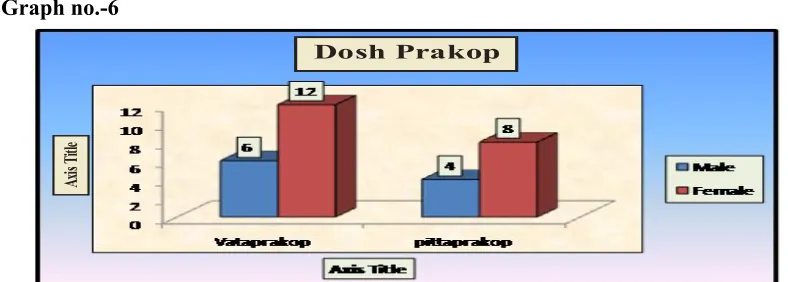
Graph no.-6
Ax
is
Tit
le
Dosh Prakop
Vataprakop Symptoms - Vedana, Tod, Bhed Pittaprakop Symptoms - Shoth, Aaraktavarna
Table no.-2 -Master Table
Sr.No. Category Frequency Percentage
1 Gender Male 10 33.33
Female 20 66.67
2 Decay (Koth) Mild 6 20.00
Moderate 14 46.67
Severe 10 33.33
3 Inflammation (Shoth) Nil 7 23.33
Mild 6 20.00
Moderate 9 30.00
Severe 8 26.67
4 Pain (Vedana) Nil 1 3.33
Mild 2 6.67
Moderate 4 13.33
Severe 23 76.67
5 Foul Smell (Durgandha)
Nil 7 23.33
Mild 12 40.00
Moderate 9 30.00
Severe 2 6.67
6 Dosh prokop (Vitiation of dosh)
Vata 18 60%
Pitta 12 40%
Kapha 00 00%
DISCUSSION
1) Severity of Koth is 33.33%. X-ray shows chidra (hollowness) and the emergency of treatment.
2) Severity of Shoth is 26.67% . 3) Severity of Vedana is 76.67%.
4) Severity of Durgandha is 6.67% . 5) Symptoms of krimidanta like Koth, Shoth, Vedana and Durgandha may be correlated and tested with the gradation method of above symptoms.
symptoms were found most in Krimidanta (60%) . Pittaprakop symptoms were also found 40% in Krimidanta. Study population had signs and symptoms of toothache, headache, sometimes swelling, pus and sensitivity in tooth affected.
INFERENCE-Symptoms of Dantaroga like
Krimidanta may be correlated and tested with darashana- Sparshana- prashana parikshaand the gradation method of the symptoms.
REFERENCES-1. William G. Shafer, Mayanard K.Hine, Barnet, M. Levy, A text book of Oral pathology 4th edition, page no. 432, 447 and
Priya Verma Gupta, Dental diseases differential diagnosis, Jaypee, 2008, Page no.118-159
2. Kaviraj Ambikadatta Shastri Sushrita
Samhita, Chaukhamba Sanskrit
Sansthan, 1993 Purvardha, Ni.16/29, page no. 297.
3. Vaidyaraj Jadhavji Trikamji acharya , cakrapanidatta, 4th edition,
Munshiram Manoharlal
publishers,1941, Cha.sha.7/6, page no.337.
Kaviraj Ambikadatta Shastri Sushrita
Samhita, Chaukhamba Sanskrit
Sansthan, 1993 Purvardha, Su sha.5/21 page no.44
4. Vd. Gangadhar Shastri Sathe, Raghuvanshi prakashan, 4th edition, 1983, Sharangdhar samhita, part -1 5/13, page no. 31
5. Kaviraj Ambikadatta Shastri Sushrita
Samhita, Chaukhamba Sanskrit
Sansthan, 1993 Purvardha, Su su.26/24, page 110.
6. Kaviraj Ambikadatta Shastri Sushrita
Samhita, Chaukhamba Sanskrit
Sansthan, 1993 Purvardha,
Ni.16/29-32, page no. 297.
7. Kaviraj Ambikadatta Shastri Sushrita
Samhita, Chaukhamba Sanskrit
Sansthan, 1993 Uttarardha, 54/15, page no. 297.
8. Nepal Rajguru Pandit Hemraj
Sharma and Shrisatyapal
Bhishagacharya, Chaukhamba
Sanskrit Sansthan, 7thedition Vi. San.2057, Kashyapa Samhita Su. 20/8, page no. 13.
CORRESPONDING AUTHOR Dr. Sathe Kalpana Dilip
M.D. Kriya Sharir Ph.D. Ayurveda H.O.D. Kriya Sharir Department, Sumatibhai Shah Ayurveda
Mahavidyalaya, Malwadi, Hadapsar, Pune, Maharashtra, India
Email: [email protected]
Source of support: Nil