Degree Programme of Computer Science and Engineering
Katariina Laakkonen
Contracts in Agile Software
Develop-ment
Master’s Thesis
Espoo, September 10, 2014
Supervisor: Professor Juha Laine
Degree Programme of Computer Science and Engineering MASTER’S THESIS Author: Katariina Laakkonen
Title:
Contracts in Agile Software Development
Date: September 10, 2014 Pages: 83 Professorship: Software Engineering and Business Code: T-76 Supervisor: Professor Juha Laine
Instructor: Tomi Tuominen M.Sc. (Tech.)
Agile software development is no longer a new innovation: it has been around for over 10 years and a study shows that it is now used in over half of the software companies in Finland. Using agile software development methods also means that contracts need to be defined differently. For example, the traditional approach where the customer defines requirements at the beginning of the project and then leaves the supplier to implement them by themselves is not possible in agile projects.
The interdisciplinary study conducted in this thesis shows the five most critical aspects that need to be taken into account in agile contracting: agile development practices, pricing, change management, early termination of the project, and war-ranties and liabilities. Traditional contracting, agile ideology, general contracting terms used in Finland, Sweden and Norway, as well as a case contract from a Finnish agile consulting company are evaluated based on each of these aspects. Despite the popularity of agile development in Finland, the study shows that general contracting terms used are not very agile. This thesis shows the main discrepancies between the Finnish general contracting terms and agile ideology, as well as the work done with agile general contracting terms in Sweden and Norway. The clear conclusion is that the Finnish ICT industry needs proper agile general contracting terms so that each agile company does not have to make up their own contract from scratch.
Keywords: agile, contracts, IT2010, JIT 2007 Language: English
Tietotekniikan tutkinto-ohjelma TIIVISTELM ¨A Tekij¨a: Katariina Laakkonen
Ty¨on nimi:
Sopimukset ketteriss¨a ohjelmistokehitysmenetelmiss¨a
P¨aiv¨ays: 10. syyskuuta 2014 Sivum¨a¨ar¨a: 83 Professuuri: Ohjelmistotuotanto ja
-liiketoiminta
Koodi: T-76 Valvoja: Professori Juha Laine
Ohjaaja: Diplomi-insin¨o¨ori Tomi Tuominen
Ketter¨a ohjelmistokehitys ei ole en¨a¨a uusi keksint¨o: ketter¨a¨a kehityst¨a on tehty yli 10 vuotta ja tutkimus osoittaa, ett¨a yli puolet suomalaisista ohjelmistoyri-tyksist¨a k¨aytt¨a¨a ketteri¨a menetelmi¨a. Ketterien menetelmien k¨aytt¨o tarkoittaa my¨os sit¨a, ett¨a sopimukset on m¨a¨aritelt¨av¨a eri tavalla. Esimerkiksi perinteinen tapa, jossa asiakas m¨a¨arittelee ohjelmiston vaatimukset projektin alussa, mink¨a j¨alkeen toimittaja toteuttaa ohjelmiston itsen¨aisesti, ei ole mahdollista ketteri¨a menetelmi¨a k¨aytett¨aess¨a.
T¨ass¨a diplomity¨oss¨a toteutettu poikkitieteellinen tutkimus osoittaa viisi t¨arkeint¨a asiaa, jotka tulee huomioida kun tehd¨a¨an sopimuksia ketteriin projekteihin: kette-rien menetelmien vaatimat k¨ayt¨ann¨ot, hinnoittelu, muutoksenhallinta, projektin ennenaikainen p¨a¨att¨aminen sek¨a takuu ja vastuut. N¨ait¨a n¨ak¨okulmia k¨aytt¨aen ty¨oss¨a arvioidaan perinteist¨a sopimusoikeutta, ketter¨a¨a ideologiaa, yleisi¨a sopi-musehtoja Suomesta, Ruotsista ja Norjasta sek¨a esimerkkisopimusta er¨a¨alt¨a suo-malaiselta ketter¨alt¨a konsulttiyritykselt¨a.
Vaikka ketter¨a kehitys on suosittua Suomessa, tutkimus osoittaa, ett¨a k¨ayt¨oss¨a olevat yleiset sopimusehdot eiv¨at ole kovin ketteri¨a. T¨ass¨a diplomity¨oss¨a n¨aytet¨a¨an t¨arkeimm¨at eroavaisuudet ketter¨an ideologian ja suomalaisten yleisten sopimusehtojen v¨alill¨a sek¨a osoitetaan, kuinka ruotsalaiset ja norjalaiset ketter¨at sopimusehdot ovat oikeasti kohtuullisen soveltuvia ketteriin projekteihin. Selv¨a loppup¨a¨atelm¨a on, ett¨a Suomen IT-ala tarvitsee kunnolliset yleiset sopimusehdot ketter¨a¨an kehitykseen, jotta jokaisen ketter¨an yrityksen ei tarvitse kehitt¨a¨a omia sopimuksia alusta alkaen.
Asiasanat: ketteryys, sopimukset, IT2010, JIT 2007 Kieli: Englanti
I would like to express my gratitude to my supervisor, Prof. Juha Laine, for the useful comments, remarks and engagement through the learning process of this master thesis. Furthermore, I would like to thank my instructor Tomi Tuominen from Houston Inc. for the instructions and support on the way. I would also like to thank my family and friends for their understanding and support throughout the entire process. Finally, I would like to thank all my colleagues at Houston Inc. for their endless encouragement.
Espoo, September 10, 2014 Katariina Laakkonen
1 Introduction 7
1.1 Agile software development . . . 7
1.2 Agile today . . . 9
1.3 Case company: Houston Inc. . . 11
1.4 Research questions and methodology . . . 12
1.5 Content of the thesis . . . 13
2 Background 15 2.1 Trust and risks in contracting . . . 15
2.2 Different types of agile projects . . . 18
2.3 Proactive contracting . . . 21
2.4 General contracting terms . . . 24
2.5 Agile in the case company . . . 25
3 Development practices in contracts 27 3.1 Traditional development . . . 27
3.2 Agile principles . . . 28
3.3 Practices in the general contracting terms . . . 30
3.4 Practices in the case company . . . 31
4 Pricing models 33 4.1 Traditional pricing models . . . 33
4.1.1 Fixed price . . . 34
4.1.2 Time and Materials . . . 36
4.1.3 Target-cost . . . 37
4.2 Agile pricing . . . 40
4.2.1 Fixed price agile . . . 40
4.2.2 Time and materials in agile . . . 41
4.2.3 Target-cost and agile . . . 42
4.2.4 Fixed price per unit of work . . . 42
4.3 Pricing in the general contracting terms . . . 43 5
5 Change management 47
5.1 Traditional change management . . . 47
5.2 Agile change management . . . 47
5.3 Change in the general contracting terms . . . 49
5.4 Change management in the case company . . . 50
6 Contract termination 52 6.1 Traditional termination conditions . . . 52
6.2 Agile termination principles . . . 54
6.3 Termination in the general contracting terms . . . 55
6.4 Contract termination in the case company . . . 57
7 Warranties and Liability 58 7.1 Warranties in traditional contracting . . . 58
7.2 Agile warranties . . . 60
7.3 Warranties in the general contracting terms . . . 61
7.4 Warranties in the case company . . . 63
8 Results 64 8.1 Summary of the findings . . . 64
8.2 How proactive the general terms are? . . . 68
8.3 Improvement suggestions . . . 70
9 Discussion 72
10 Conclusions 74
11 Evaluation 77
Introduction
Agile software development methods are widely used nowadays and most ICT-professionals see them preferable over waterfall development – as we can see from the second section of this chapter. Still, the development of contractual models and general contracting terms have fallen behind the trend, and the models used for waterfall software development do not work well with the agile ideology. Usage of the old-fashioned contracting terms in an agile project can be difficult, but it can also prevent the project from efficiently using the agile practices and both customer and supplier may lose the benefits of agile methodology.
One of the reasons why agile contracting models and contracting terms are falling behind is because customers are used to waterfall contracts and they like the certainty a fixed-everything contract seemingly offers: they pay certain amount of money and get the software they needed. Luckily, also the customers are waking up to the harsh reality of software development: customers cannot know what they want before they see it, change to the requirements is inevitable, and ultimately the customer is the one that suffers when fixed-price project fails. Agile contracting models are needed to balance the risks between both parties and give both the incentive to work together towards the success of the joint project. It is time for cooperative contracts instead of confrontational ones.
1.1
Agile software development
In 2001, 17 software developers published the Manifesto for Agile Software Development (Beck et al., 2001) describing a lightweight software develop-ment method. The Agile Manifesto emphasizes the following values:
• Individuals and interactions over processes and tools
• Working code over comprehensive documentation
• Customer collaboration over contract negotiation
• Responding to change over following a plan
Agile development is an umbrella term for several lightweight agile im-plementations including Scrum, eXtreme programming (XP), and Kanban. Each has its own terminology and approach to development, but the ba-sic values described in the agile manifesto apply to them all. There are six common features that all of the implementations have: collaboration, code reviews, small teams, short release schedules, time-boxing, and constant testing (Coram and Bohner, 2005). Instead of heavy long-term planning or comprehensive feature documentation, requirements are broken into small tasks, developed iteratively in small, cross-functional teams and integrated and tested continuously. After each iteration the customer gets high-quality, working and tested software.
The highest priority in agile development is to satisfy the customer by delivering valuable software early and continuously, making the working soft-ware the primary measure of progress. Deliveries of the softsoft-ware should be frequent, preferably every couple of weeks, and changes to the requirements in order to gain higher customer value are welcomed in any state of the development. (Beck et al., 2001) At the end of each release, the customer gets a working product that can be evaluated, and requirements can then be changed and prioritized for the following releases. Contrary to traditional de-velopment, where the set of features are fixed and the delivery date changes, in agile development the release schedule is fixed but the features can change. This time-boxing helps to focus the customer and reduces unnecessary gold-plating. (Coram and Bohner, 2005)
In agile development, rapid response to change is more important than strictly following a plan. The plan is always only as good as it was when initially written, and since in software projects things always change, the plan needs constant updating. Often the changes are so fast that the plan simply cannot be updated fast enough, thus dogmatically following it does not make sense. This does not mean that in agile the code is just a pile of hacks but instead the plan needs to be as lightweight and easily modifiable as possible. For example, Scrum uses post-it notes on a board for a sprint ”plan”. (Coram and Bohner, 2005)
All agile implementations are highly collaborative, and business repre-sentatives and developers should work together daily since the most efficient way of communication is face-to-face conversation (Beck et al., 2001). In-formal communication is valued over comprehensive documentation when
constantly spreading information inside the team as well as to all the other stakeholders. Customer collaboration is crucial in agile development, and the customer representative should be ”committed, knowledgeable, collab-orative, representative, and empowered”. The customer is encouraged to actively participate in the development process by giving them the product right from the beginning of the project and the opportunity to change their mind about it whenever necessary. (Coram and Bohner, 2005)
Takki (2002) describes traditional IT-contracting so that it can be as-similated with construction work where precise drawings are necessary right at the beginning of the project, and that the importance of thorough and comprehensive specifications cannot be overemphasized. It is a common Finnish saying that ”well planned is already half done”, but according to Takki (2002), in IT projects well planned is already almost completely done. He also states that the comprehension and quality of requirements in the contract annex are inversely proportional to the amount of problems that will be escalated during the implementation phase. The most common dis-agreements are related to whether the project outcome is equal to what was agreed. Another disagreement relates to, in fixed-price contracts, whether some work is part of the original agreement or additional work that is sepa-rately charged, and correspondingly in time and materials contract, whether the work has been taken into account in the cost estimate or not.
Takki (2002) thinks that the idea of finalizing plans during the implemen-tation phase will expose the project to endless disagreements and problems. This base for traditional contracting has fundamental discrepancies with ag-ile ideology which values ”responding to change over following a plan” and ”working software over comprehensive documentation” (Beck et al., 2001). This discrepancy causes challenges when contracting for agile projects in an environment used to doing contracts for traditional software development projects. This thesis will further explain these challenges and introduce pos-sible solutions based on previous research.
1.2
Agile today
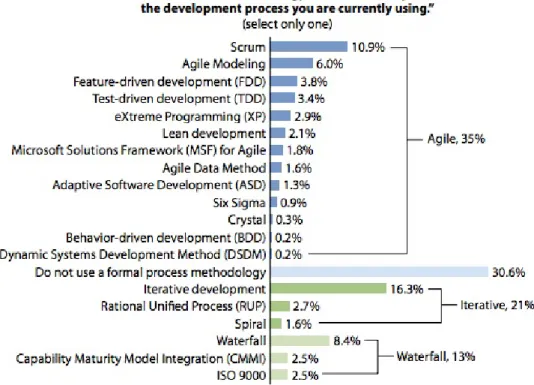
Agile ideology has been around for over 10 years and it is no longer a new or exceptional way of developing software but it is starting to be a mainstream development process. Figure 1.1 shows agile adaptation results from For-rester/Dr. Dobbs Global Developer Technographics Survey conducted in Q3 2009. 35 % of the respondents stated that they are using agile development processes, making agile more common than traditional waterfall (13 %) and iterative (21 %) development methods combined.
Rodr´ıguez et al. (2012) conducted a similar survey in 2011 about agile and lean development usage in Finland using the membership registry of The Finnish Information Processing Association (FIPA) and collecting 408 responses from 200 software intensive organizations. 55 % of the responders reported that they used either only agile or agile and lean methods combined in their development, where 42 % reported that they use no agile or lean methods. About half of the companies had been using agile for 2 years or less, and only 7 % had used agile for more than 5 years. Lean methods were even newer for the companies: over 70 % had been using them for 2 years or less. For the organizations not using agile yet, only 16 % had clear plans to start using agile or lean methods in the near future.
Even more remarkable figures exist, although they are from a company offering e.g. training on agile methods, thus their results may not be com-pletely reliable. The seventh annual ”State of Agile Development” -survey conducted in 2012 and sponsored by VersionOne, including 4048 participants mainly from North America (60% of the participants) but also from Europe (27 %), shows that approximately 84% of companies are practicing agile de-velopment. This means four percentage point increase compared to 80 % adoption rate in the same survey conducted in 2011. Half of the companies had been practicing agile development 2 years or less and only 14 % had been using agile for over 5 years, and half of the companies used agile in at least half of their projects. The study also shows that agile momentum is up: 83 % of the participants said they are going to use agile in future projects, which is a huge increase compared to the same study in 2011 when only 59 % of the participants had plans to implement agile. (VersionOne Inc., 2013) This data shows that agile is already a mainstream development process, though it is still quite new practice in most of the organizations. Even though agile emphasizes customer collaboration over contract negotiation, contracts are still needed when suppliers develop software for external customers with agile development methods. Still, general contracting terms at least in Fin-land are falling behind so companies have to make up their own contract terms for agile projects.
1.3
Case company: Houston Inc.
This thesis uses a Finnish consulting company called Houston Inc. and one of its contracts as a case sample about contracting in agile software devel-opment. Houston is a company specialized in agile and lean software velopment and offers its experienced personnel to implement customers’ de-manding software projects. Houston also offers consulting about agile project
management as well as agile coaching (e.g. certified scrum master, product owner, test-driven development).
Houston Inc. was founded in 2004 and it employs about 50 agile pro-fessionals mainly in Helsinki area. Houston is specialized in projects related to financial services (banking and insurance) but the customers vary from small to large companies in multiple different industries, e.g. telecommu-nications, journalism and gambling. Many of the projects are implemented using the latest Java EE technologies, but Houston’s personnel have com-petence in wide variety of both back- and front-end technologies as well as mobile development.
For example, Houston has participated in the development of a global digitized invoice solution used around Europe, combining of the information systems of two large life insurance companies, and development of a buying and selling system for stock funds. One larger project included e.g. de-velopment of financial background systems, an online banking service, and an interface for mobile applications. One example of a non-financial system developed by Houston is a used cars section of one of the highest-profile clas-sified ads services in Finland used by both private users as well as major car dealers.
The case contract used in this thesis is a quite well working agile contract between Houston Inc. and one of its longstanding customers. It was used in 2012 in a successful project where Houston developed a relatively large, custom, financial service for the customer. The contract tried to follow Hous-ton’s agile ideology as well as possible, and both client and supplier were very pleased with it.
1.4
Research questions and methodology
To summarize the content of this thesis, the aim is to answer to following research questions:• What special issues should be considered when contracting for agile software development projects compared to traditional software devel-opment projects?
• How well the general contracting terms in Finland and other Nordic countries fit agile projects?
• What could be improved in the agile contracting of the case company and more generally in Finland?
The first question about special characteristics of agile contracting is an-swered by conducting a literature study. This study uses some of the in-dustry’s basic literature such as the book ”Lean software development: an agile toolkit” from Poppendieck and Poppendieck (2003), as well as the most recent articles published about the specific topics of agile development. Also some more informal resources are used in order to find out about the state of the art practices used by agile professionals.
The general contracting terms and conditions for software development used in Finland (IT2010 and JIT 2007) are evaluated based on how well – or how bad – they work with the agile ideology and how they address the most important issues when negotiating contracts for agile projects. For compar-ison, Swedish and Norwegian terms designed for agile software development are evaluated based on the same special requirements. The parts irrelevant to the topic of the thesis, such as recruitment restrictions or confidentiality, are not covered in the study since the chosen software development methodology is not relevant when handling those kinds of issues in the contract. The intel-lectual property rights are covered only briefly: the important factor is that in agile projects all the rights to the software should belong to the customer. Because many companies, including the case company used in this thesis, have found the general contracting terms in Finland insufficient for agile software development projects, they have been forced to create their own terms and conditions. In order to answer to the third research question, a case study is conducted in order to find out how an agile consulting company has handled contracting for agile projects, how it differs from the general contracting terms, and what could the company do better.
Because of the case company being a consultancy company delivering customized software for (mostly) private-sector customers, the analysis is limited to customized private-sector projects when necessary. For example, the parts evaluated from IT2010 and JIT 2007 terms are the ones applicable for delivery of customized software. Also, the complex tendering process and other bureaucracy needed in projects where the customer is part of the Finnish public administration are not discussed in this thesis.
1.5
Content of the thesis
The first chapter of this thesis, the introduction, gives a general idea of agile software development and the ideology behind it. It also shows that, while agile is still quite new approach in many companies, it has became the mainstream software development methodology and the agile momentum is definitely up.
The second chapter of the thesis describes the background of agile sub-contracting and sub-contracting in more general level. First, the importance of trust and risk sharing in all contracting and the difficulties and opportuni-ties these two factors offer are addressed. The second part of the chapter explains the different types of agile subcontracting based on the asset speci-ficity. Then the chapter introduces an orientation to contracting that has many agile-like ideas: proactive contracting. Also the general contracting terms and conditions used in Finland (IT2010 and JIT 2007 for projects made for public administration) are described, as well as some general agile contracting terms used in Sweden and Norway. The final section of the chap-ter introduces the case company of which contracting ideology and a sample contract are analyzed in this thesis.
The following chapters introduce the problems agile contracting has com-pared to contracting in traditional development models. Commonly used pricing models and their suitability for agile development are evaluated, and also some more extreme models are introduced. Agile also requires e.g. cus-tomer participation in the project, thus requiring that the contract somehow covers agile principles. In addition, agile ideology does not match traditional termination clauses used in contracts, and incremental deliveries provide ad-ditional challenges for defining warranties for products. For all of these is-sues, this thesis introduces the traditional perspective, agile viewpoint, how the general contracting terms handle the specific issue and how the issue is handled in the case company.
The results chapter collects all the agile contracting issues and compares the principles the case company uses in contracting with the general contract-ing terms, as well as with the traditional and agile viewpoints for the issues. Finally, concrete suggestions are given for how to improve the contracting in the case company.
Background
Trust and risk sharing are the two most basic matters in contracting. With-out any trust between the contracting parties, there is no point of starting the project in the first place. The amount of trust in the relationship also influences the distribution of the legal conditions and the ethical principles in contracting, as well as how the risk is shared between the parties. The first section of this chapter discusses trust and risks in contracting.
The second section remarks that agile principles can be applied to differ-ent kinds of projects. The degree of social complexity and how the project management responsibility is divided in the project divides agile software development for multiple different subcontracting project types. The third part of the chapter describes an orientation to contracting that has many agile-like ideas: proactive contracting.
The final two sections of this chapter introduce the general contracting terms evaluated in this thesis. The two commonly used general terms in Finland – IT2010 and JIT 2007 – are selected. As a comparison of how agile contracting is done in other Scandinavian countries, the thesis also evaluates the Swedish General regulations for agile projects and the Norwegian Com-puter Society’s contract standards (PS2000). Finally this chapter introduces the case company’s ”Houston Way”, i.e. the way the case company sees agile and project work with customers.
2.1
Trust and risks in contracting
In every transaction where simultaneous exchange is not possible, trust and risk are involved (Jeffries and Reed, 2000). These risks can be either financial or social, e.g. fear of losing reputation (Blomqvist et al., 2005), and both sort and long term risks are important in contracting. Traditionally, customers
think mainly about short-term risks that can be assigned to be the supplier’s responsibility with fixed-price contracts. Usually these contracts do not take into account that maintenance of the (usually unsatisfying) system on a time and materials basis will cost a lot for the customer and, if the project is a failure, it will also affect the customers business, thus making the customer undertake the whole long-term risk. Ideally, both short and long term risks should be shared more equally so that both parties have the incentive to make the project a success. (Lichtenstein, 2004)
Trust is also often seen as the most important success factor for the busi-ness (e.g. Glover, 1994). Still, the conceptual definition of trust is difficult, even though in every-day sense trust is familiar to all. Everyone sees the meaning and role of trust differently and trust is always related to the con-text, thus making universal definition of trust impossible. (Blomqvist, 1997; Blomqvist et al., 2002) Luckily, some studies still exist that try to enlighten the concept of trust in the business context.
In the business context, an important trust factor is competence, i.e. skills and technical capabilities, which are the necessary base for the whole profes-sional relationship. What comes to accepting a certain level of risk, signs of goodwill, i.e. positive intentions towards the other and moral responsibility, are also needed. Positive intentions also show as proactive behavior and ef-fective cooperation in the partnership. (Blomqvist et al., 2002) With these two factors trust can be defined as ”actor’s expectation of the other party’s competence and goodwill” (Blomqvist, 1997).
Trust is a difficult concept, but crucial in long-term relationships. All circumstances cannot be precisely covered in a written contract and short-term inequities are inevitable, implying that trust towards the other party is needed in all contracting. This also means that if there is no trust at all, it is not reasonable to even try contracting: it is very unlikely that contracting without any trust would lead to a (successful) partnership. On the other hand, if the negotiating partners do trust each other, they will be able to save time and effort in negotiating, agreeing and executing contracts. (Blomqvist et al., 2005) Economists also believe that trust can reduce transaction costs (e.g. Chiles and McMackin, 1996). Both the negative and the positive factors therefore enforce the idea that trust is essential in contracting.
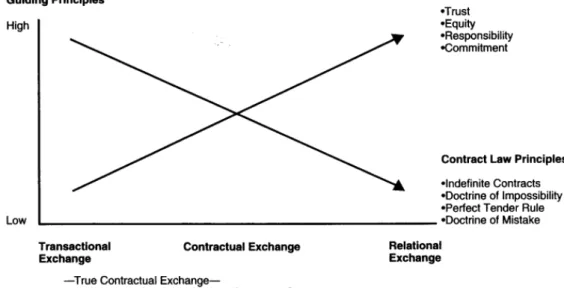
Contracts can also have less importance if trust exists. Figure 2.1 from Gundlach and Murphy (1993) shows the relative significance of contract law and ethics in different types of contractual situations. The horizontal axis has the three exchange forms: transactional, contractual and relational. The vertical axis shows the significance of the guiding principle. The two arrows – one for ethical and the other for contract law principles – show that when moving towards relational exchange, the importance of ethics (e.g. trust and
Figure 2.1: Relative significance of ethical and contract law principles (Gund-lach and Murphy, 1993)
commitment) increases where, on the other hand, the importance of contract law (e.g. indefinite contracts) decreases.
On the left side of the exchange forms -axis is transactional exchange i.e. simultaneous transfer of goods where precise rules guide the transac-tion. When both parties have accomplished their clearly agreed duties, pre-requisites for the transaction are met and the exchange can be completed. (Gundlach and Murphy, 1993) This kind of exchange can be e.g. buying a ready made software from a store, where ethical principles like trust are less important.
The other extreme is relational exchange on the right side of the axis, that involves complex transactions linked together over a longer period of time. Even though a contract may exist, contract law is not sufficient to handle this kind of close, long-term relationship. Thus trust and other ethical principles are mandatory when administering this kind of relationship that can be – in its most simple form – e.g. a frequent stay program at a hotel. (Gundlach and Murphy, 1993)
In the middle are the types of contracts that fall somewhere between the two extremes: contractual exchange where both legal and ethical principles are very important. Legal conditions of the contract are the base of the exchange but relying too strictly on the contract may not lead to the best outcome. The formal contract cannot address all the aspects of these kinds of
exchanges that have obligations with complex duties, therefore ethical prin-ciples such as trust are equally important in these relationships. (Gundlach and Murphy, 1993)
2.2
Different types of agile projects
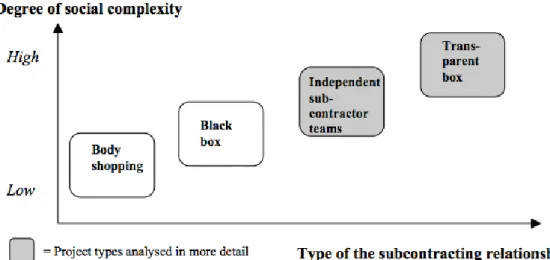
Agile software development has multiple different subcontracting project types depending on project management responsibility and the degree of social complexity. The depth of the relationship and level of dependency the customer has towards the supplier vary depending who has the most specific knowledge to give to the project. Different types of subcontracting project types based on degree of social complexity are introduced in figure 2.2, and the effect of asset specificity and allocation of management responsibility in them is described in figure 2.3.
The easiest project types are the two extremities: the customer or the subcontractor has the whole responsibility. If the customer is solely responsi-ble for the project management, the subcontractors also follow the customer’s process and are part of the customer’s social system. They are practically like rental workers – Pyysi¨ainen et al. (2003) calls this body shopping. This type leaves the whole risk of the project to the customer, since the supplier has no responsibility for the outcome of the project. On the other hand, if the customer can terminate the contract any time, they also have very little dependency for the supplier. These types of projects are usually developing a software that is close to customer’s business and the customer has all the domain knowledge, leaving the supplier’s asset specificity low and dependent on the technical skills of the individual members of the development team. (Laine et al., 2011) If the problem is not technically very demanding or the supplier does not have any other asset specificity e.g. related to project management, this leaves little power for the supplier related to pricing.
On the other hand, if the subcontractor has all the responsibility, they usually also follow their own process and work in a ”black box” from the point of view of the customer. The supplier is given clear, relatively unchanging requirements for an independent module that they develop using their own project management. The customer does not need to monitor the project continuously, and this type of project resembles more traditional develop-ment models where collaboration between the customer and the contractor is not that essential. (Pyysi¨ainen et al., 2003) This kind of project can be, for example, customization or integration of the supplier’s or third party’s product for the customer. The supplier has the special knowledge of the soft-ware and can take the responsibility of the technical solutions and customer
Figure 2.2: Classification of project types according to the degree of social complexity (Pyysi¨ainen et al., 2003)
Figure 2.3: Project management responsibility in different project types (Lassenius, 2012)
is more dependent of the supplier. This also gives the supplier more power to raise their prices. (Laine et al., 2011)
The most interesting projects are the ones in the middle in figure 2.3 – independent subcontractor teams and transparent box – where social com-plexity is high. In socially complex projects collaboration is mandatory, resource management is a shared responsibility, and common processes need to be defined. These projects are also the main focus in this thesis since they offer the most challenges for contracting.
The independent subcontractor project type is a project where the sub-contractor organizes its own teams and management for them and is given quite clearly specified, small(ish) tasks during the whole project. Usually, the development does not involve critical interfaces for other sites, reducing the need for active communication during the project. Still, it is important to share sufficient background knowledge about the requirements early in the project and standardize the clarification of the tasks, as well as make it easy to ask clarifying questions about the specifications. It is also important that the customer knows that the subcontractor has understood the require-ments properly (instead of being reluctant to ask questions) and that the subcontractor is not left alone with vague specifications. (Pyysi¨ainen et al., 2003)
Even though this kind of project does not usually contain critical in-terfaces for other sites, reliability of deliveries between teams has a major impact on the satisfaction: inconsistencies can cause a feeling of risk and uncontrollability, thus reducing the level of trust. The aim in this kind of subcontracting is to build a long-term relationship, making open evaluation critical when seeking optimal work practices. The beginning of the project should contain active communication that lays foundation for the standard-ized mode of development used during the project, e.g. by introducing dif-ferent sub-project teams to each other in order to build trust between (at least) the key communicators. (Pyysi¨ainen et al., 2003)
In the transparent box project type the subcontractor has more respon-sibility in the project, is involved right from the specification phase, and has its own planning responsibility. This kind of subcontracting is used when requirements are unclear, changes are expected and the customer needs spe-cific knowledge from the subcontractor. The subcontractor has quite much power to decide the specific development solutions they use, and they should be committed to the goals of the whole project. The relationship between the customer and the subcontractor is close and communication is inten-sive – standardized development practices are defined only to support active communication. (Pyysi¨ainen et al., 2003)
Figure 2.4: Proactive Contracting Levels (Haapio, 2010)
network so that no-one has doubts about others’ competence and all are will-ing and able to help other teams to solve sudden interface-problems. The teams cannot become attached to rigid rules but the development has to be continuously evaluated and continuous negotiations about the dependencies for other modules are inevitable. The frequent and reliable delivery process helps build trust between teams, which then helps the teams solve unpre-dictable events during the development. (Pyysi¨ainen et al., 2003)
2.3
Proactive contracting
Traditionally, contracts have been seen as simple one-shot transactions, and contract law has been based on enforcing of binding contracts instead of the idea of long-term cooperation. The goal has been on making one final, perfect contract that does not need flexibility, and if legal disagreements happen, the result is that one party is right (and wins) and the other party loses. In long-standing relationships this kind of mentality is not productive, instead both parties should be willing to aim towards win-win situations where both parties are satisfied – also when conflicts happen. (Pohjonen, 2006a)
Proactive contracting and proactive law are based on preventive law, which was started in 1950 in the United States by Louis Brown with his book Preventive Law. He was a pioneer of the field of preventive law: an
attorney that realized his clients could have prevented most of their prob-lems with good advice from their layers and better planning. Proactive law shares the views of preventive law, but – instead of prevention of legal prob-lems and lawsuits – the focus is on the client, multi-professional teamwork, and promoting successful business. (Nysten-Haarala, 2006) I.e. proactive law emphasizes self-reflection and responsibility: the focus is on how one can create the conditions for achieving goals without unnecessary problems instead of only reacting to something that is already happened or happening (Pohjonen, 2006b).
Proactive contracting and law are developed in interdisciplinary cooper-ation with lawyers and researchers (Pohjonen, 2006b). It is based on the real-life needs of businesses to start, manage and implement successful re-lationships and business actions without unnecessary problems. Contracts are only tools that are used to express and fulfill the will of the parties and should be linked to the corporate goals and strategy. The contracting should involve interaction of professionals with different special knowledge (e.g. le-gal and technical) in order to achieve the real will of each party. (Pohjonen, 2006a)
In proactive contracting, the rules and methods should be planned in a way that will prevent problems and will lead to successful partnership of the contracting parties. One of the main ideas is that problems are best to be solved where they are manifested: different actors such as project managers and developers should recognize the possible causes of problems and fix the reasons before conflicts happen. And if conflicts cannot be avoided, they should be handled in a way that does not need lawyers or court actions, and will keep the atmosphere for further cooperation as good as possible.
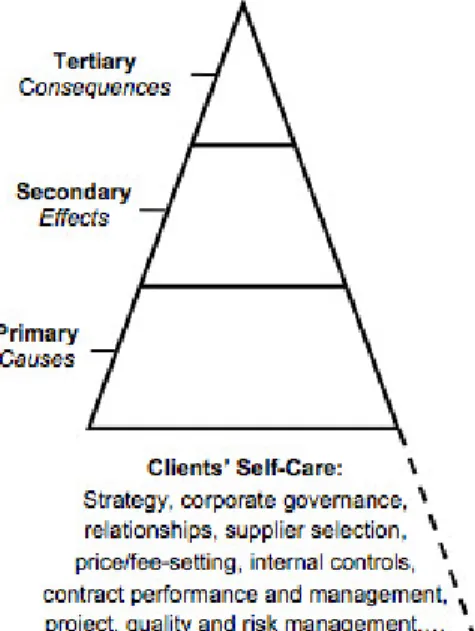
Proactive contracting can be described with a three level pyramid as seen in figure 2.4 from Haapio (2010). The primary level is the causes: proactive contracting aims to successful contractual relationships with good communi-cation and coordination, thus eliminating possible causes for problems. The contracting process is done in a way that helps recognize, correct and manage the expectations of each party and form a contract based on these expecta-tions. This makes it is possible to share responsibilities and balance risks and rewards in a clear and realistic way in the contract.
The secondary level is the effects, that aims to minimize risks and harmful consequences when problems do happen. This means that the contract is formed in a way that it is clear how to function when a risk is realized or some other problem occurs. Finally, the tertiary level is about consequences i.e. controlling the conflicts without going to court and minimizing the costs caused by conflicts. This helps resolve conflicts in a constructive way and the contractual relationship can last longer. (Haapio, 2010)
This pyramid can be interpreted so that proactive contracting is not an isolated function but needs to be part of the client’s business processes such as corporate governance and project management. Another interpretation of the figure is that it is not enough for the lawyers to deal with the legal issues in the secondary and tertiary levels, since actions on those levels only minimize the harmful effects and the client does not profit from the remedies or damages. Without success in the primary level and the client’s self-care, all other effort is wasted. Haapio (2010)
In practice, the aim of proactive contracting is to increase mutual under-standing and produce better contracting methods (Pohjonen, 2006a). The best way to achieve this, according to Haapio (2010), is that proactive lawyers and business managers together ”establish processes, practices, checklists, and templates that help the entire business team take care of the key issues in a systematic way”. This way everyone knows what they need to do and how to do it from the first time. It is also impossible in big organizations for the lawyers to prepare all the contracts and deals, thus the sales personnel should have the tools and knowledge to recognize opportunities and prevent problems on a daily basis. For example, various contract templates, project models and interactive internet programs exist to show how the contracting and business process should proceed (Pohjonen, 2006a).
Siedel and Haapio (2010) describe a medical analogy to explain proac-tive law. The traditional reacproac-tive management sees lawyers as an emergency function, like a patient who seeks doctoral treatment after catching malaria. The preventive aspect of proactive law tries to prevent legal harm by adding e.g. risk allocation clauses in the contract, similarly to a person using pills and a mosquito net to prevent getting malaria. The promotive aspect of proactive law tries to change the legal concern into business concern or busi-ness opportunity – so instead of malaria medication and netting, the root cause i.e. the mosquitoes are eliminated by draining swamps. If the root cause is eliminated, also the contract negotiations can be moved from the risk management systems, such as the malaria medication and netting, to something more constructive.
As an example of proactive contracting in practice, Haapio (2010) gives Metso Contract Library and Standard Templates for Purchase Contracts. Metso has business operations in over 50 countries and hundreds of Metso em-ployees around the world buy services and products for Metso. Metso’s con-tract templates and conditions cover the most important issues that should be taken into account in contract negotiations, and they can also be used by people who seldom participate the contracting. Metso has also included contracting training as part of their procurement training.
that has guidance and standard contracts for contracting for the public sector. The model terms and conditions with related guidance are free to download, and they have been used by e.g. the defense, health, and education sectors. The aim is to standardize the Private Finance Initiative (PFI) contracts in the UK, in order to achieve commercially balanced contracts and help the public sector to meet their requirements and get the best value for money. The guidance’s main objectives are to promote common understanding of the main risks in a PFI project, enforce consistent approach and pricing in similar projects, and reduce the costs and time needed for negotiating similar contractual issues over and over again. (Haapio, 2010)
2.4
General contracting terms
In Finland, IT2010 terms and conditions are widely used general terms and conditions for contracting in traditional information technology projects. They have been prepared in cooperation between the Central Chamber of Commerce of Finland, the Finnish Software Entrepreneurs Association, the Finnish Association of Purchasing and Logistics LOGY, the Federation of Finnish Technology Industries and the Finnish Information Processing As-sociation. Still, they can not be found suitable for agile development and are not commonly used in agile software development projects.
IT2010 terms and conditions are a draft of contract clauses that can be used in domestic deliveries between suppliers and customers in the field of information technology. They are prepared to make execution of agreements easier and to reduce contracting cost. The idea is not to remove the need for negotiating the content of the contract but to help parties focus on certain, important issues that should be considered in contracting.
IT2010 YSE general terms and conditions are meant to be the starting point of any contract dealing with the sale or licensing of information tech-nology products or suppling information techtech-nology services. In addition, a suitable annex (EAP, EJT, ELH, ELT, EOY, ETP or EVT) of special terms should be selected. For an agile software development project the suitable annex would be EJT special terms and conditions for deliveries of data sys-tems and customized software. If there are discrepancies between the EJT special terms and YSE general terms, the special terms and conditions are applied.
The Advisory Committee on Information Management in Public Admin-istration (JUHTA) is a committee set up at the Ministry of Finance of Fin-land to plan cooperation in information management, make studies and re-ports, and give recommendations for the public administration. One of the
recommendations of JUHTA is that ”the procurement of IT products and services by central government agencies; by state enterprises; by central gov-ernment institutions and funds; and by municipalities and municipal federa-tions” should use Terms and Conditions of Government IT Procurement i.e. JIT 2007. (JIT 2007, 1.1) In addition to the JIT 2007 General Terms and Conditions, a suitable annex is used when applicable – within the context of this thesis it would be Special Terms and Conditions for Procurement of Customized Applications i.e. JIT 2007 - Applications. The annex always takes precedence over the general terms if there are discrepancies between the two. (JIT 2007, 1.2)
This thesis will address the issues IT2010 terms and conditions would have if applied to agile projects. For comparison, also the similar problems found from JIT 2007 terms and conditions used in the procurement of IT products and services for the public administration are introduced. Also, a more suitable general terms for agile software development from Sweden and Norway are examined. Swedish General regulations for agile projects were published by the IT and telecommunication companies in 2012. The Norwegian Computer Society’s contract standards i.e. PS2000 terms were developed under the research Project 2000 organized by NTNU (Norwegian University of Science and Technology) and SINTEF (Norwegian: Stiftelsen for industriell og teknisk forskning, the largest independent research organi-zation in Scandinavia).
Both Swedish General regulations for agile projects as well as Norwegian Computer Society’s contract standards (PS2000) are intended to be used with projects that have no papproved specifications but the project re-quires quickly response to changing conditions during the implementation. The planning, implementation and monitoring of the project is guided in co-operation with the supplier and the customer, and the success of the project is dependent on how well the parties interact and control the project jointly.
2.5
Agile in the case company
The base for Houston Inc.’s way of doing agile is that we cannot predict: people writing specifications to the system before the project starts do not know what the end-user will actually need. We ask about the customer’s needs but – because of human nature – we only get rational answers that are not true. For example, Nokia had a touch screen mobile device a century ago but users told them that they do not want it and Nokia stopped the development. Another problem is that developers know too much about the product and make decisions based on that, leading to software doing wrong
things or right things in a wrong way. Developers really need feedback from the actual users – the sooner the better. (Teikari, 2012)
Clear concept for the new product is crucial for the project to succeed. Vague ideas need to be shaped into viable and technically feasible business concepts that have measurable goals. This is usually not easy to do alone but external expert can help by asking the questions one does not dare or know to ask. For this purpose, Houston offers Houston Accelerate -workshops to brighten the concept before the project. (Teikari, 2012)
Also agile projects need some specifications, which in traditional devel-opment methods can take months to define. Houston way of doing specifica-tions is Boot Camp: a two day intensive workshop to specify and plan the project. During the Boot Camp, the project stakeholders get together and a trained professional will squeeze the requirements and their priorities out of them. The end result of the Boot Camp is a prioritized, work-estimated release plan for the project. This plan can be used as the base for the con-tract, but agile principles should not be forgotten: this is just the first guess about the future software and will become more precise and change when the development starts. (Teikari, 2012)
Development practices in contracts
Traditionally, software development has had only minimal customer collab-oration: customers have been needed only at the requirements elicitation phase at the beginning of the project and during the acceptance testing at the end of the project. On the contrary, agile development is more customer-centric. In agile one of the main priorities is to produce maximum amount of value for the customer as early as possible in a form of a working soft-ware. This kind of development requires an active customer during the whole project, including implementation phase, which adds new requirements for the contracting.
This chapter addresses the requirements for agile contracting by first giv-ing an insight on how software development have been seen traditionally and then explaining the agile practices that must be taken into account in con-tracting. Then the general contracting terms are evaluated in order to find out whether they address these issues or not. Finally, the agile development practices the case company uses in contracts are introduced.
3.1
Traditional development
Traditionally, software development has been rationalized and engineering-based, grounded in the principles of hard systems thinking. The approach assumes that problems are fully specifiable and for every problem exists a predictable and optimal solution. The basis for predicting, measuring and controlling problems during the development is in comprehensive, in advance planning. (Nerur et al., 2005)
In traditional, process-centric software development the primary focus is on highly optimized and repeatable processes. By continuously measuring and refining the processes, sources of variations in the processes can be
fied and eliminated. This kind of traditional software development is driven by control and planning accomplished by a command and control style of management. Project manager has the authority and a role of a planner and a controller. (Nerur et al., 2005)
Customers are, of course, important in traditional software development, but their main role is during the early and late phases of the development process. They participate specifically in requirements elicitation and analysis, budget and contract negotiations, and acceptance testing. (Grisham and Perry, 2005) What comes to other activities during the development phase the customer participation is minimal: it contains some limited interactions with the development team during the implementation phase.
The traditional development where emphasis is on comprehensive, in ad-vance planning and customer involvement during the implementation is not needed gives the supplier free hands to execute the project using whatever working methods they prefer. No cooperation methods exceeding regular reporting of the project’s state to the customer is needed to be stated in the contract. Also the contract has only minimal requirements for the customer to e.g. participate in the requirements elicitation before the implementation starts and perform the acceptance tests after the project has been delivered.
3.2
Agile principles
In agile software development projects active customer engagement is crucial for the project to succeed (Nerur et al., 2005). In agile projects, the system is developed iteratively based on what the customer needs, which means the customer has to dedicate some of their time to the this collaborative develop-ment. With uninterested, overly busy or otherwise unavailable customer the supplier cannot deliver a system that actually fulfills the customer’s needs (and the requirements in the contract), thus agile contracts should issue the customer engagement to the project.
The customer’s role in any software development is to decide ”what to build”. In agile, this means that the customer is integrated part of the development team and works on-site with the team. The customer will write the user stories and discuss them with the rest of the development team, is responsible for the business decisions (e.g. prioritizing the user stories), and regularly tests the software to confirm it works as expected. This means that the customer must know the domain well enough to be able to do the necessary decisions. (Martin et al., 2004)
If agile software development, the customers are expected to be ”collab-orative, representative, authorized, committed, and knowledgeable” (Boehm
and Turner, 2003). In addition, the customer must be able to handle multiple tasks at the time and have managerial support. This all combined to a one person means that a suitable on-site customer must be a valuable member of the customer’s organization, and the organization may not be willing to donate such an asset to the software development team. The organization may see that using a valuable employee’s time to a software development project perceives little business value, and requiring that may have negative effects on the relationship with the customer. One possible solution to that can be that a knowledgeable engineer or manager acts as the supplement of the customer who is available only part-time. (Grisham and Perry, 2005)
In Scrum, the key representative of the customer is called the product owner and he is responsible for communicating the customer needs to the de-velopment team and keeping the product backlog in shape during the project. The contract should require that the customer nominates a product owner who will develop, prioritize and maintain the product backlog as well as participate to the required meetings such as sprint plannings or review meet-ings. Since the product owner is crucial for the project, the contract should also require that the product owner dedicates a reasonable part of their time and effort to the project and is available to respond the development team’s questions in a decent time. (Bird&Bird, 2012)
When using Scrum – or any other agile process model with short iter-ations – the contract should specify the agreed duration of each iteration (i.e. sprint). The duration of each sprint should be short (e.g. 2–4 weeks) and the duration of a individual sprint should not be extended under any circumstances. If all the agreed items in the sprint cannot be completed, the unfinished items should be put back to backlog to be implemented in the future sprints. (Bird&Bird, 2012)
Another key aspect in agile is to deliver working software to the customer after each iteration and have the software as the primary measure of progress. But how to determine this when the deliverables are small and missing lots of the features the final product needs to have? This can be achieved by defining an agreed ”Definition of Done” – ideally already in the contract – that can contain e.g. items like: all code is reviewed and tested (acceptance tests as well as non-functional tests such as performance tests), all code follows agreed coding standards and have been refactored when needed, and all necessary documentation has been completed. (Bird&Bird, 2012)
Hoda et al. (2009) also gives a worst case option to use with customers who cannot be convinced to use agile technologies: do not tell the customer about the agile process. The supplier is then usually forced to work under a fixed price contract and the customer is unaware of the internal agile practices used by the development team. This is probably still better than using
waterfall methodology and the customer is arguably happy to see the project results during the project. Still, this does not guarantee that the customer is available during the project.
3.3
Practices in the general contracting terms
IT2010 terms and conditions as such do not state what kind of process should be used in the project: EJT special terms and conditions say that work re-lated to the project should be performed using the supplier’s working meth-ods (IT2010 EJT, 5.7). So the supplier is free to use waterfall process or agile methodologies or anything they want, just some basic practices are defined in the terms. One practice is that based on the EJT special terms and condi-tions, the supplier has to report the progress of the project in writing at least once per month and, if the pricing is not a fixed price, also about the time used for the project (IT2010 EJT, 6.1). This kind of written, forced report-ing does not fit well with agile ideology where active customer collaboration is enforced.IT2010 EJT special terms and conditions also state that the project should have a steering group containing representatives from both parties which will organize the cooperation between the parties and supervise the implementation of the project. This group should meet at least after each de-livery phase and whenever either of the parties requests a meeting. (IT2010 EJT, 5.1) This is actually a sound approach for both traditional and agile development projects.
Also JIT 2007 terms define a similar steering group for the project that manages the cooperation of the parties and supervises the project. The group meets whenever requested and at least after each delivery phase. The supplier’s project manager is responsible for reporting to the steering group about the state of the project. In addition to that, both parties should have named contact person that monitors and supervises the fulfillment of the contract and communicates information regarding implementation of the contract to his own organization and to the other party. (JIT 2007, 4)
On the contrary to the two Finnish general terms, the Swedish general terms are based on iterative, agile development process where software is developed in consecutive time boxes (or in sprints if Scrum terminology is used). Parties should jointly agree how the time boxes form releases (e.g. is a time box equal to a release) in order to archive the goals stated for the project. Continuous cooperation is crucial in order to plan, implement and monitor the incremental work. This will take time from the customer, thus the terms state that the customer must e.g. ensure that decisions are
taken continuously during the implementation. The terms also require the customer’s representative to be qualified and competent and have necessary knowledge about the client’s business. (General Terms for Agile Projects, 3) Before each iteration, content for the time box is agreed and the contents should not change during the time box. At the end of the time box, the supplier will deliver the work for the customer, who will then – without a delay and still inside the time box – verify that the contents correspond to the plan and agreement in general. This verification is the basis for planning the next time box: if some items are not accepted (or not implemented), they are moved to later time boxes. (General Terms for Agile Projects, 4)
Norwegian PS2000 terms are also based on Scrum process where the roles required by Scrum are combined with the organizational model used in tra-ditional software development projects. Both parties have project managers, and project is steered by the steering group containing representatives from both parties (e.g. the project managers). In addition to the steering group, the contract should also specify a team-level cooperation between the par-ties. It is also possible to form specific work groups to evaluate, for example, specifications, prototypes and test results. (Laine et al., 2011)
An important factor in the PS2000 terms is the reasonable risk sharing between the customer and the supplier. Thus one of the customer’s respon-sibilities is to perform a risk analysis as a part of the requirement analysis performed before the implementation phase. The supplier will then complete the analysis. The result of the analysis is an uncertainty matrix where each of the risks is bared by the party more capable of handling the risk factors and minimizing the damages. (Laine et al., 2011)
3.4
Practices in the case company
Agile development needs more engagement from the customer than tradi-tional software development. In the case company, Houston Inc., the mini-mum requirement for the customer is to have full-time product owner for the project. The product owner has to have the required knowledge about the business and the customer’s clients, and is e.g. responsible for prioritizing the requirements and accepting the features. (Teikari, 2012)
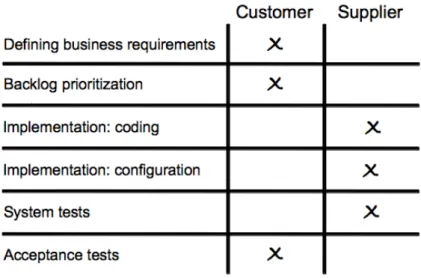
To prevent any misunderstandings, the responsibilities of each party should be clearly stated in the contract. The contract can e.g. have responsibility matrix that describes the responsibilities of both the customer and the sup-plier. Simplified example of this kind of responsibility matrix is shown in figure 3.1. (Teikari, 2012)
Figure 3.1: Example of a partial responsibility matrix
chemistry between supplier’s and customer’s personnel, are extremely im-portant in agile development projects where the supplier works within the customer’s premisses and with the customer’s personnel. Thus a client’s CEO tells in the book of Teikari (2012) that it is essential for the customer that the members of the development team can be replaced just by notifying the supplier.
The case company sees that every software project needs a business steer-ing group that steers the project with business decisions. The group will guide the project in long-term so that project will stay in line with the cus-tomer’s overall business. This group should contain members from both parties in order to keep the cooperation close and open. (Teikari, 2012)
The sample contract notes the importance of customer engagement and uses responsibility matrix to ensure the customer takes care of the duties necessary for the agile process. For example, the customer is responsible for having a reachable Product Owner, as well as for the business requirements in the product (and sprint) backlog and prioritization of them. The cus-tomer also conducts the acceptance tests for each delivery, and is obligated to nominate a member to the steering group.
The sample contract also notes the importance of good chemistry between the supplier’s development team and the customer’s personnel. Thus the sample contract gives the customer the right – with a reasonable cause – to request replacement of the suppliers resources in the project. The supplier must then immediately and without additional costs replace the person with another, equally competent one.
Pricing models
In some industries, calculating a price for a product is easy: just calculate the costs (e.g. material and labor costs) and add some margin. Unfortunately, in software development calculating the costs (and therefore also the price) beforehand is not that easy. Usually the product requirements are not thor-oughly known beforehand and they change during the development, which is also the base and motivator for agile software development.
This chapter introduces three commonly used pricing models: fixed price, time&materials and target cost pricing. These can all be used in both tra-ditional and agile software development projects – the second section of this chapter evaluates how well those models work with agile projects. The sec-ond chapter also introduces some more innovative pricing models that agile development enables.
The third section explains the pricing models used in the general con-tracting terms. IT2010 and JIT 2007 terms rely on using penalties where the Swedish and Norwegian agile terms both use some kind of shared pain and gain models. Similarly, the ideology of the case company as well as the clauses used in the case contract – both introduced in the final section of the chapter – rely strongly on the persuasion that bonuses work better than penalties.
4.1
Traditional pricing models
The three commonly used pricing models are fixed price, time&materials and target cost pricing. The first feels like low-risk model for the customer since the supplier bares the responsibility to finnish the project in time but may actually cause high long-term costs for the customer. In the second model the customer bares all the risks and, when applied to waterfall development,
Figure 4.1: Fixed Price, Fixed Scope (Stevens, 2009)
customer is tied to the supplier who has no incentive to keep the costs down. The third option is an attempt to share the pain and gain between the parties and is recommended e.g by Takki (2002).
4.1.1
Fixed price
Customers are used to fixed price, scope and time -contracts that feel simple and safe: the customer pays a certain amount of money and gets the system they ordered on an agreed date. Unfortunately, software projects are seldom that simple, thus fixed price contracts are not popular among the agile prac-titioners. Also for traditional software development, Takki (2002) suggests that fixed price should be used only if the requirements are well known before the project or the requirements are first gathered using hourly rate and fixed price is agreed only for the implementation phase.
The customers also like fixed price contracts since they can move the risk to the vendor. Though this might work for the sort-term risks, in long-term, if the project fails, the customer is the one who will suffer. Instead of always trying to transfer the risk to the other party of the contract, it should be evaluated who is the most competent party to handle the risk. For technically complex but quite stabile problems the supplier is probably in a good position to manage the risk and should assume it. However, in many software development projects the problem is uncertain or changing, thus the customer has a better position to manage the risk and fixed price contracts should be avoided. (Poppendieck and Poppendieck, 2003)
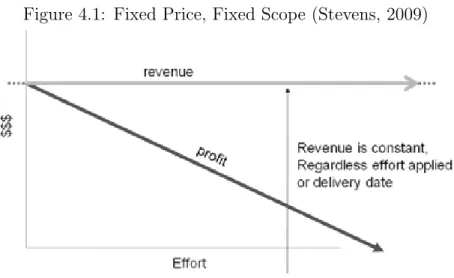
As can be seen from the figure 4.1, fixed-price contracts involve high risk for the supplier since they have to estimate the cost of the system before
Figure 4.2: Bonus / Penalty Clauses (Stevens, 2009)
any work has been done and without complete understanding of the domain and the complexity of the problem. An experienced supplier will include this risk in the bid but less competent vendors are likely to underbid. Since the supplier bidding the lowest price is usually selected, the customer may end up selecting the supplier that has the lowest understanding of the complex-ity of the problem and who has the highest probabilcomplex-ity to fail the project. (Poppendieck and Poppendieck, 2003) Also, the requirements for the soft-ware almost always change during the project, which in fixed-price projects mean ordering additional work from the supplier. Low bidding in the fixed price part of the project can then be compensated with high prices for the extra features, possibly making the project very expensive. (Takki, 2002)
In order to stay within the price and the scope of the project, suppliers can save effort by reducing the quality of the system e.g. by writing lower quality code and doing less testing. Though this may help the project finnish in time, it will also increase the future costs for the customer since the maintenance of a low quality software with high technical debt is not cheap. (Arbogast et al., 2010) The supplier may also need to aggressively protect their interests by delivering as little as possible in order to keep the schedule and budget, causing the customer to get less than they really want (Poppendieck and Poppendieck, 2003). Of course, this can also be seen as a business model: the supplier knowingly delivers a system that does not meet the true needs of the customer and then takes the profit from changing the unsatisfactory system to an useful one (Arbogast et al., 2010).
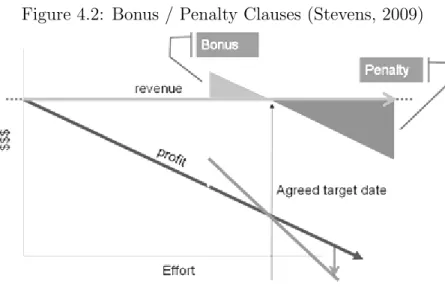
If the customer has real incentive for early completion of the project, bonus and penalty clauses where the supplier gets a bonus if the project
Figure 4.3: Time and Materials (Stevens, 2009)
finishes early and will pay penalty if it is late can be used with almost any of the pricing models. This combined stick and carrot -model used with fixed price pricing is shown in the figure 4.2. This bonus can be e.g. 50 % of the hours that go under the target, and should also be tied to the project schedule so that the supplier will not get the bonus if the project is finished late with low amount of hours used (Takki, 2002). When using this kind of pricing, it should be clear and transparent that the customer will economically benefit from the early completion of the project, otherwise the customer may misuse the penalties to get a cheaper product the longer the project takes. (Stevens, 2009)
4.1.2
Time and Materials
Time and materials contract is a contract where the customer pays the sup-plier for the time used for the project and for other expenses. It has the lowest risk for the supplier but, on the other hand, it does not take away the risks but just transfers them to the customer. Time and materials contract is good for dealing with uncertainty and complex problems but it also offers less security for the supplier since they cannot be certain how long the con-tract will last. Still, these concon-tracts are often considered to be good deals for the supplier as long as they last. (Poppendieck and Poppendieck, 2003) This supplier incentive for time and materials contract is illustrated in figure figure 4.3. For the customer, the incentive to use time and materials is that changes to the project are easy to make (Takki, 2002).
and require lot of trust that the supplier will use the charged time prop-erly. Actually, with time and materials contract the supplier has no reason to work efficiently since they make more money if the project takes more time (Poppendieck and Poppendieck, 2003). Eckfeldt et al. (2005) describes the mindset of many customers with a quote from a IT Manager: ”T&M is favorable for relatively smaller budget projects or when working with a consultant in which you have a high degree of confidence. For larger projects or when working with unknown consultants we typically prefer fixed price, at least initially, to maintain budget certainty. Once we are confident in the consultant’s ability to deliver as promised and we have a well-defined set of requirements we are more willing to shift to T&M.”
Time and materials contract can increase contract transaction costs if the customer does not have sufficient trust towards the supplier. The customer may feel the need to have extensive control over the costs and go through every cost and define wether they are acceptable or not. (Poppendieck and Poppendieck, 2003) Even when using time and materials pricing in traditional software development, the contract often has an agreed budget in order to reduce the risk for the customer. If this budget is clearly exceeded, the customer can terminate the project, but naturally has to pay for the work already done. (Takki, 2002)
Time and material contracts can be used with traditional software devel-opment projects, but they cause a risk to the customer since the customer is tied to the supplier who has no incentive to keep the costs down. (Pop-pendieck and Pop(Pop-pendieck, 2003) Even thought the customer might have the option to terminate the project when the agreed budget is used, in practice this is not usually possible. If traditional software development project is not finished, the customer will end up having an incomplete software that they cannot use before the original supplier (or someone else) will finnish it.
4.1.3
Target-cost
Both fixed price and time and materials contracts reinforce the traditional thinking that customer-supplier relationship is adversarial. One of the parties is always protecting themselves as the other is encouraged to self-serving behavior, which limits the possibility to greater success for both parties. What is needed is in the middle of the two extremes: the project risk should be shared and both parties should have a reason to drive towards the joint success of the project.
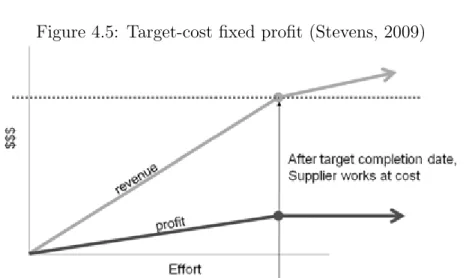
The base for a target-cost contract is a situation where both parties rec-ognize that the project details are uncertain and defining them needs mutual work, but also meeting a target cost is found very important in the project.
Figure 4.4: Target-cost shared pain&gain (Arbogast et al., 2010) Target cost Target profit Target customer payment Actual supplier cost Adjustment Actual customer payment Actual supplier profit 1,000,000 150,000 1,150,000 1,100,000 +60,000 1,210,000 110,000 1,000,000 150,000 1,150,000 900,000 −60,000 1,090,000 190,000
Adjustment =