Masters Theses (All Theses, All Years) Electronic Theses and Dissertations
2015-04-23
Enhancing Personalization Within ASSISTments
Christopher DonnellyWorcester Polytechnic Institute
Follow this and additional works at:https://digitalcommons.wpi.edu/etd-theses
This thesis is brought to you for free and open access byDigital WPI. It has been accepted for inclusion in Masters Theses (All Theses, All Years) by an authorized administrator of Digital WPI. For more information, please [email protected].
Repository Citation
Donnelly, Christopher, "Enhancing Personalization Within ASSISTments" (2015).Masters Theses (All Theses, All Years). 249. https://digitalcommons.wpi.edu/etd-theses/249
ENHANCING PERSONALIZATION WITHIN ASSISTMENTS
by
Christopher John Donnelly
A Thesis
Submitted to the Faculty
of the
WORCESTER POLYTECHNIC INSTITUTE
in partial fulfillment of the requirements for the
Degree of Master of Science
in
Computer Science
May 2015
APPROVED:
Professor Neil Heffernan, Advisor
Abstract
ASSISTments is an online adaptive tutoring system with the ability to provide assistance to students in the form of hints and scaffolding. ASSISTments has many features to help students improve their knowledge. Researchers run studies in order to discover ways for students to learn better but ASSISTments is missing one major aspect for researchers: student level personalization. It is easy to create an assignment for a particular class or school but it would take much longer to create an assignment for each student and it would be difficult for the teacher to look through many assignment reports. One of the strongest code blocks in coding is the if-then; allowing the program to branch off to another set of code under certain circumstances. ASSISTments needed an if-then system in order for students to branch off to other parts of the assignment under certain circumstances. With this, researchers would be able to personalize assignments to give more help to lower knowledge students or allow students to get a choice of what kind of tutoring they would like to receive. With this idea in mind, the basic if-then structure was implemented into ASSISTments using problem or problem set correctness as the condition statement. Once the if-then system was created opportunities opened to create additional experiments and run studies in ASSISTments. The basic if-then was limited in using correctness only for its condition statement. This meant that a new if-then system would need to be implemented to include custom condition statements that allowed the researcher to have the assignment branch on any condition using all the information recorded in the assignment. While work was being done on the if-then system, research was being done and two papers were written on partial credit in ASSISTments. Partial credit was found out to be as accurate as knowledge tracing in determining student performance on the next problem. Once a partial credit algorithm was found, a study using if-then was analyzed. It was found that there was no statistically significant difference between students who were given a choice on their feedback and students who received no choice.
Acknowledgements
I acknowledge funding from NSF (1316736, 1252297, 1109483, 1031398, 0742503, 1440753), ONR’s “STEM Grand Challenges,” and IES (R305A120125, R305C100024). Thanks to Neil Heffernan, Korinn Ostrow, and David Magid.
Table of Contents
Abstract ... i
Acknowledgements ... ii
Table of Contents ... iii
Table of Figures ... v
Table of Tables ... vi
Chapter 1: Introduction ... 1
Chapter 2: The If-Then Structure ... 4
The Tutor ... 4
Basic If-Then Structure ... 5
Advanced If Then ... 10
Create a language/grammar ... 10
Creating the parser ... 11
Adding custom condition ... 12
Custom Variables ... 14
Chapter 3: Improving Student Modeling Through Partial Credit and Problem Difficulty ... 18
INTRODUCTION ... 19
DATASET ... 21
Compared Models ... 26
Partial Credit Predicting Next Problem Correctness ... 27
Problem Difficulty Predicting Next Problem Correctness ... 30
Partial Credit and Problem Difficulty Predicting Next Problem Correctness ... 31
Knowledge Tracing ... 31
Performance Factors Analysis ... 33
Model Training And Testing ... 33
RESULTS ... 36
Discussion... 38
Contribution ... 40
Chapter 4: Optimizing Partial Credit Algorithms to Predict Student Performance ... 43
INTRODUCTION ... 43
METHODS ... 48
RESULTS ... 50
DISCUSSION ... 55
Chapter 5: Studies Using If-Then ... 57
IQP Studies ... 57
Choice Study Analysis and If-Then Evaluation ... 59
Data ... 60
Results ... 60
Conclusion ... 63
Future Work ... 66
References ... 68
APPENDIX A - Full EBNF Grammar ... 70
Table of Figures
Figure 2-1. Workflow of an if-then statement in coding.. ... 6
Figure 2-2. Basic layout of an if-then problem set... 8
Figure 2-3. This shortened grammar ... 10
Figure 2-4. How the old FinishedConditionService worked versus the new service. ... 13
Figure 2-5. An example condition statement being parsed. ... 14
Figure 3-1 An example problem featuring three hints for the skill “Equation Solving with Two or Fewer Steps” ... 26
Figure 3-2 Algorithm used to determine Partial Credit score based on first response, attempt count, and hint usage ... 28
Figure 3-3 The standard Knowledge Tracing model with all learned parameters and nodes explained .... 32
Figure 4-1 Problem Level RMSE ... 53
Figure 4-2 Student Level RMSE ... 53
Figure 4-3 Skill Level RMSE ... 53
Figure 5-1 Design for the new choice study using If-Then. ... 59
Table of Tables
Table 2-1. Basic if-then condition statement matrix.. ... 7
Table 3-1Skill details and distribution in resulting dataset ... 23
Table 3-2 Parameters for predicting Binary and Partial Next Problem Correctness from current problem Partial Credit ... 30
Table 3-3 Parameters predicting Binary and Partial Next Problem Correctness from current problem Difficulty ... 31
Table 3-4 Parameters predicting Binary and Partial Next Problem Correctness from Partial Credit and Problem Difficulty... 31
Table 3-5 Distribution of data across five folds ... 35
Table 3-6 Problem Level Average RMSE, R2, AUC, and Accuracy for Models Predicting Next Problem Correctness (NPC)... 37
Table 3-7 Skill Level Average RMSE, R2, AUC, and Accuracy for Models Predicting Next Problem Correctness (NPC)... 37
Table 3-8 Student Level Average RMSE, R2, AUC, and Accuracy for Models Predicting Next Problem Correctness (NPC)... 37
Table 4-1 Probabilities averaged across test folds for the model in which the penalization per hint and per attempt is 0.1 ... 49
Table 4-2 ANOVA results for groups of attempt and hint penalty models at each level of analysis ... 52
Table 5-1 IQP Studies running in 2014-2015 using If-Then. ... 57
Table 5-2 Means, SDs, and ANOVA Results for Effects of Choice in Full Sample ... 61
Chapter 1.
Introduction
ASSISTments is an online adaptive tutoring system used by over 50,000 students around the world that is offered as a free service of Worcester Polytechnic Institute. The platform was created over a decade ago by Neil Heffernan. With the help of numerous graduate and undergraduate students, ASSISTments has evolved steadily since its inception. The user population has doubled each year and new features and preferences are consistently in development for teachers and students.
The ASSISTments platform uniquely provides assistance to students in the form of adaptive feedback. This can take many forms, from simply correctness feedback to tutoring strategies including hints and scaffolding problems that provide worked examples. It also provides teachers with powerful assessment through a variety of reports, allowing teachers to easily isolate where students are struggling and enhance classroom techniques using a data driven model.
Currently in ASSISTments there is no student level personalization in assignments. If a researcher or a teacher wanted to assign problem sets based on how well a student did they would need to separate these problem sets and use data driven rules to assign to the students a specific problem set. ASSISTments also does not support giving a student a choice during their assignment. If a student wanted to get video feedback versus text feedback that is not possible in the current system.
The next chapter in this paper will explain the process involved in adding personalization and choice to ASSISTments through an if-then system. The first section will talk about the tutor
and how it works which will make explaining the if-then system much easier. In section 2.2, the basic if-then system will be discussed. The basic if-then system deals only with correctness and lays a foundation for the advanced system. Next, the advanced if-then system will be covered. This includes all the work in creating a custom language and grammar, along with the parser and the new if-then system itself. The advanced if-then system will allow for greater personalization and also open up a new infrastructure for researchers to use. Section 2.4 will cover that new infrastructure, which is variables being assigned and used in if statements. Researchers will be able to give variables their own values or read variables that are created by the ASSISTments system and use them in their if statements for even greater customization and personalization.
Chapters three and four discuss two papers written in parallel with the work done on the if-then structure. Chapter three discusses research done with partial credit and how it can be used to determine next problem correctness. Partial credit can show the difference between a student who does not know how to solve the problem and a student who made a minor mistake on the problem. Chapter four covers a grid search about finding the best partial credit algorithm. The best partial credit algorithm would give the students a score between 0 and 100, which correctly models student knowledge, instead of a correct/incorrect score, which is marked incorrect at the slightest mistake. Partial credit will be used in future analyses to determine differences between conditions; currently binary credit is the only thing used but partial credit will be able to provide more information.
The fifth chapter covers the studies currently running using the if-then system and continues on to analyze data obtained from another one of the if-then studies. The study analyzed is a choice study and shows how if-then can be used not only as a video check to remove students who cannot see video, but also a way to allow students to have a choice in what they get
for feedback. There are no significant results dealing with choice versus no-choice yet as there are only sixty students to have completed the study. The analysis does show, at this point, that students need to complete more problems to finish the assignment when given choice compared to those without choice. In terms of binary score and partial credit score, students in the choice group scored lower than those in the no-choice group. This study shows only one use of the if-then system; there are over a hundred studies running using if-if-then right now. All of these studies are using if-then in a slightly different way.
Chapter 2.
The If-Then Structure
2.1
The Tutor
The ASSISTments tutor is the application that runs when a student runs an assignment in ASSISTments. It is written in Java that is translated to javascript using the Google Web Toolkit (GWT). An assignment is an instantiation of a particular problem set. Each problem set contains problems and other problem sets. In its simplest form the tutor is a set of navigators and terminators working through the problem sets to finish the assignment. Each problem set has one navigator and terminator pair. The terminator tells the tutor when this particular problem set is finished and if this is the main problem set then the tutor tells the student the assignment is finished. If it is not the main problem set then the parent problem set’s navigator is told to move to the next problem or problem set. Problems and problem sets are represented with manifests in the tutor. A manifest contains a pointer to the actual problem or problem set along with properties that belong to that problem or problem set. Manifest will be used to talk about a problem or problem set throughout the rest of this paper so as not to repeat the phrase “problem or problem set” too many times. Navigators, in the tutor, decide which manifest to run. If the terminator is not finished then the navigator is told to go find another manifest from its list and the tutor will run that manifest. Running the manifest depends on whether its a problem or problem set. Running a problem set means creating a navigator and terminator for it and then having its navigator and terminator take control until that problem set is finished. Running a problem simply means printing the problem to the screen for the student to attempt. An example assignment would be a skillbuilder. Skillbuilders in ASSISTments are assignments that students complete in order to prove they know a specific skill. In order to complete a skillbuilder the student must get a certain number (usually three) of problems correct in a row. In the tutor this
would be a RandomNavigator and a CorrectInARowTerminator. The navigator randomly selects problems from the list that belongs to this problem set while the terminator keeps a counter of how many problems the student has correct in a row. Once the student hits 3 problems the terminator tells the navigator it’s all done and the tutor then alerts the student that the assignment is complete.
2.2
Basic If-Then Structure
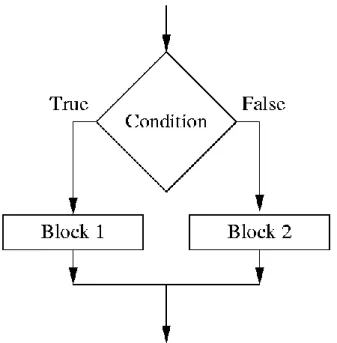
The base if-then structure was created in collaboration with David Magid. This project included adding the if-then problem set to the builder along with adding the support for this type of problem set into the tutor. This new problem set was envisioned to work exactly like an if-then statement in coding. Figure 2-1 shows the basic workings of an then statement in code. The if-then problem set will consist of three children manifests. Each child manifest corresponds to a different portion of the if-then statement. The first child would be the condition statement and will evaluate to either true or false depending on whether or not the child was considered correct. The second child would be the then statement and will run if the condition is true; the third child will be the else statement and run if the condition is false.
Figure 2-1. Workflow of an if-then statement in coding. The parser comes in and reads the condition statement. If the condition statement evaluates to true then the parser goes and runs code block 1. If the condition statement evaluates to false then the
parser goes and runs code block 2.
Once the if-then problem set was designed the tutor had to be updated to actually understand how to run the problem set. Since the tutor needed to only complete two of the three children manifests (condition and one of the branches), the IfThenElseTerminator was a simple class that extended a current terminator and that told the tutor to only complete two items. The difficult part was creating the IfThenElseNavigator as this would have to run the condition manifest and then determine if it should evaluate to true or false and then run the correct branch manifest. If the condition manifest is only a problem then evaluating true or false is easy as that is whether or not the student got the problem correct. ASSISTments already records the problem’s correctness and the only thing that had to be done was get that correctness to the navigator. Unfortunately the idea of correctness in a problem set did not exist until now. It was eventually decided that researchers may all have a different idea of correctness for a problem set so a setting was created in the builder. If the problem set is a skillbuilder, correct is determined by whether or not the
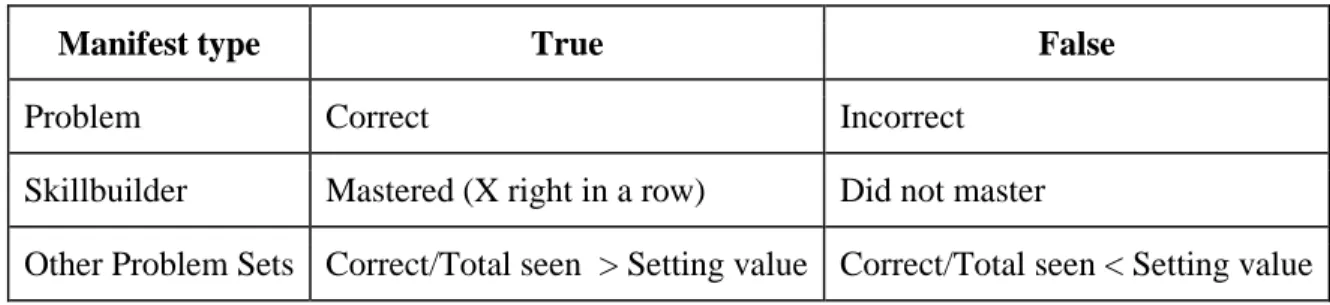
student mastered the skillbuilder (got X right in a row). If it is any other problem set then correct is determined by the percentage of problems the student got correct out of the total number of problems the student has seen. The condition is marked correct (true) if this percentage is greater than the percentage from the builder setting. Table 2-1 summarizes how and when the if-then condition statement is marked true or false.
Table 2-1. Basic if-then condition statement matrix. This table shows the requirements for a condition statement to be evaluated as true or false. There are only three different manifests that could end up being the condition: a problem, a
skillbuilder problem set, and any other problem set.
Manifest type True False
Problem Correct Incorrect
Skillbuilder Mastered (X right in a row) Did not master
Other Problem Sets Correct/Total seen > Setting value Correct/Total seen < Setting value
Now that correctness was determined, all that was left was getting the correctness to the navigator. The idea of FinishedConditions and a FinishedConditionService was then implemented. The FinishedConditionService is a service separate from the actual tutor that listens for student actions and updates FinishedConditions depending on certain actions. In this first iteration all the service cared about was the first student response action (when a student enters his/her first answer). The service then created a FinishedCondition for the problem the student is on and marked it as either correct or incorrect. A FinishedCondition is an object that contains data about a problem or problem set to be used at a later time. When a problem set is finished the service finds all the problem FinishedConditions that belong to that problem set and counts up all the correct and incorrect problems and stores those numbers in the problem set FinishedCondition. If the problem set was a skillbuilder then the FinishedCondition also contains
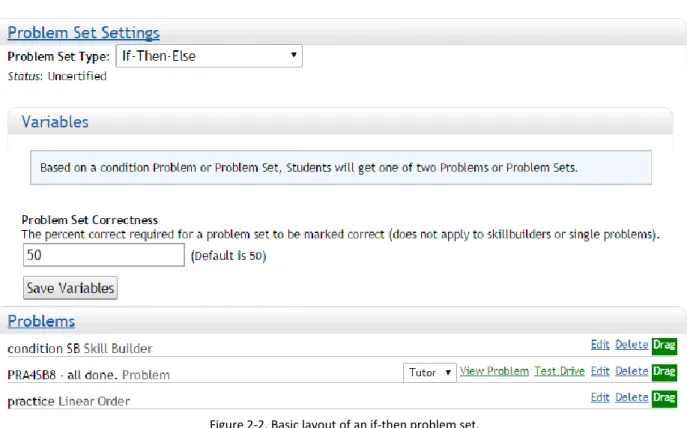
whether or not the student mastered the skillbuilder. Now when the student finishes the condition manifest the IfThenElseNavigator goes to the FinishedConditionService and asks for the correct FinishedCondition and is able to determine which branch manifest to run. After it decides which manifest to run the terminator will complete since the student finished two items and then the if-then problem set is complete. The if-if-then problem set was if-then released to the public and is currently being used in numerous experiments. Figure 2-2 shows an example If-Then problem set. In this example there is a skillbuilder condition. If the student masters the skillbuilder they are given problem PRA4SB8 which is a simple placeholder problem telling them they have finished the assignment. If they do not master the skillbuilder, then they move onto the practice problem set. “Problem Set Correctness” is not used in this case because the condition is a skillbuilder but would decide on the ratio between correct and incorrect problems needed to mark a problem set as correct
Once the basic if-then structure was released the next step was to create a more advanced version that would allow for more customization and did not only rely on correctness of a problem or problem set. Researchers would be able to write their own condition statements which allowed them to branch to either of the branch manifests on any condition they choose. The advanced version would not require all three children manifests and could access data from either a condition problem/problem set or from some variable map with user specific data or custom data set by the researcher. The first stage of the advanced if-then structure included building a parser to understand the custom condition statements the researchers write. That meant creating a language and a grammar for that language to help in building the parser and also guide researchers on how to construct their condition statements.
2.3
Advanced If Then
2.3.1
Create a language/grammar
To prevent confusion and allow for easily understandable condition statements, it was decided that the language will be written using a syntax like Java.
Example condition statements: problem.getCorrectness() > 20
(pr.isCorrect() == false) && (pr.getHintRequestCount() < 2)
The language had been created and defined in an Extended Backus–Naur Form (EBNF) Grammar. Having a language defined in this form will help in not only explaining the language that researchers can use but also designing and coding the parser to understand the researchers conditions. EBNF is a set of notations used to express a context-free grammar and is an extension of the basic Backus-Naur Form. Backus-Naur Form (BNF) is a notation for context-free grammars for describing programming languages in a human readable format (Might). EBNF was chosen because of the expressions that are allowed to make rules smaller and easier to read. Figure 2-3 shows a subset of the rules from the created grammar. Refer to Appendix A for the full EBNF grammar.
start = expr ;
expr = rel_expr | prop_expr | “(“, expr, and, expr, “)” | “(“, expr, or, expr, “)” ; rel_expr = lhs, rel_op, rhs;
lhs = “pr.”, p_method | “ps.”, ps_method; rel_op = “==” | “<” | “<=” | “>” | “>=” | “!=”; rhs = string | decimal | number | true | false;
Figure 2-3. This shortened grammar defines condition statements that access data from the FinishedCondition for the condition manifest. A handful of rules have been removed to save space but the full grammar can be found in APPENDIX A.
2.3.2
Creating the parser
After creating the grammar, research was done to find a program that exists that would read in an EBNF grammar and create a parser. JavaCC, an open source parser generator, was chosen to build the parser. A parser generator is a tool that reads a grammar specification and converts it to a program that can recognize matches to the grammar (JavaCC). JavaCC generators top-down (recursive descent) parsers which allows for the use of more general grammars and many other advantages over bottom-up parsers. Top-down parsers are able to parse any non-terminal in the grammar and pass values both up and down the parse tree (JavaCC Features). JavaCC reads in a config file that contains the grammar re-written using JavaCC’s syntax along with extra Java code. Given that config file, JavaCC then builds the parser and outputs a set of java files that can be dropped into any project and used right away. One major difficulty in building the parser was that it needed to be small and also have all the source java code along with the class files. In order for GWT to translate all the java code into javascript, to be used in browsers, it needs to have all the java source code. Most other parser generators required their specific jar to be included in the project but those jar files never contained source code. JavaCC on the other hand, created Java files so that GWT would be able to translate everything into javascript without a problem. One problem did arise though; JavaCC used Java’s built-in I/O classes to read and walk through the characters in the string it was parsing. This is a problem because in a browser there is no file system and no I/O. Fortunately, the newest beta release of JavaCC allowed for an option to build specifically for GWT (Ainsley). This particular build created a custom CharStream class to walk through the characters in the string being parsed and allowed the use of this parser in the tutor.
2.3.3
Adding custom condition
Once the parser was built the next step was to put it into the if-then structure and allow researchers to write their own condition statements. If-Then problem sets would still contain three children manifests but this time the condition would not be limited to whether the condition manfest was correct or not. The condition would be dependent on a custom statement written by the researchers. This meant editing how the second and third child was chosen and adding additional data to the FinishedConditions so there was more data than just a problem’s correctness. The first thing that had to be done was to update FinishedConditions with more information. In creating the basic if-then structure, a FinishedConditionService was created in the tutor which listened for student actions (ProblemStarted, StudentResponse, ProblemFinished, etc.) and would create the FinishedCondition for that problem or problem set when the student finished the particular problem or problem set. Adding additional information required a bit of code refactoring but was fairly straight forward. The service had to be told to listen for more student actions and then record the data from each action into the FinishedCondition object. Figure 2-4 shows the actions created while a student works on a problem and how the old FinishedConditionService responded to these actions compared to the new FinishedConditionService.
Figure 2-4. How the old FinishedConditionService worked versus the new service. In the new service, it would listen for each action and do something to the current FinishedCondition. In the old service, it would wait until the end to create the
FinishedCondition.
Now that FinishedConditions were updated with new information, the if-then navigator had to be updated to use the new parser and the updated FinishedConditions in order to determine which of the last two children manifests to run. The FinishedConditions were setup with a set of functions that allowed outside objects (like the parser) to get access to the additional data stored. The parser was setup to accept specific function strings so that when it read those functions it would call off to the FinishedConditions accessor functions to retrieve the data and then compare the returned values to those in the rest of the condition.
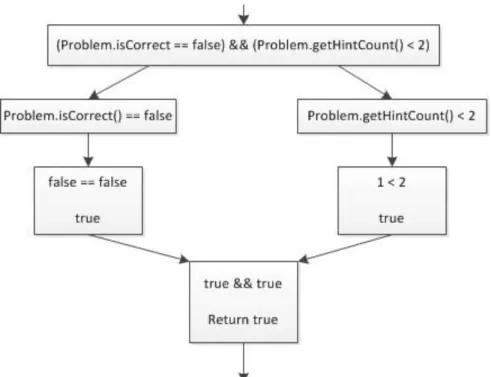
Figure 2-5. An example condition statement being parsed.
Now, when a student finishes the condition manifest, the if-then navigator will pass the corresponding finishedCondition and the condition statement to the parser and the parser will return a true (run the second child manifest) or a false (run the third child manifest) depending on the condition statement. Figure 2-5 shows an example condition statement being parsed. The parser splits the main statement into two expressions and then sees the problem tokens. The problem token tells the parser to access the FinishedCondition and use those function calls to evaluate the expressions. After parsing it returns the values up the tree until it is left with either a true or false and then returns that to the if-then navigator.
2.4
Custom Variables
The original plan was to spend some time creating a prettier user interface (UI) for the builder when creating If-Then problem sets. The main idea was to remove the need for the researcher to write their condition statement and instead use building blocks they would drag and drop and to
form the condition statement without running the risk of spelling or syntax errors. This idea was put aside to save time and to allow for more time to go toward including the user model and custom variables in the tutor and builder. As for the user model, this was pushed aside until after the custom variables were implemented because the user model information could be stored in the same manner as the custom variables and the parser would need to be updated to support both anyway.
The next goal was to allow researchers to add custom variable assignments into the builder and have the tutor keep track of them and the parser to have access to them. A couple of use cases for custom variables include, cross assignment variables and setting student knowledge. Cross assignment variables covers the idea that a variable was assigned a value during assignment one and that value will be used/read in an if statement in assignment two. An example would be if a student was part of an experiment and in their first assignment was put in condition group one. The variable would be assigned a value “condition group one” and that would then be used on the next assignment to either keep the student in condition group one or force the student into a different condition group. Setting student knowledge is as simple as assigning a variable to “low” or “high” knowledge and this variable is saved for later use in that assignment or use in a different assignment. Knowing a student’s knowledge can be helpful with deciding what set of problems to give the student.
Since time was running out most of the coding was done to create an infrastructure for these variables and then support for them was added. That meant that many of the use cases for custom variables weren’t fully implemented but the infrastructure exists to support the implementations when they are done. It was decided that variables could be assigned values at
two points during the execution of a manifest in the tutor; before the manifest is run, and after. These variables assignments were deemed PreVariableAssignments (run before) and PostVariableAssignments (run after). This was believed to be the best way to give researchers any opportunity to use custom variables. Once the builder was setup to allow for custom variable assignments, the tutor had to be updated to read them in and store them for use in the parser. The tutor was fairly complicated as variables could be used for so many things in the future the variable assignments had to be run at the correct time. PostVariableAssignments were run once the problem or problem set had finished and was fairly straight forward but PreVariableAssignments were harder. ASSISTments has received requests to allow variables in problems and allow variables to override certain settings in the manifest (for example the number correct in a row needed to master a skillbuilder). With this in mind, PreVariableAssignments needed to be run at a specific time in order for their values to be ready in case they were to be used for this particular problem/problem set. After running tests and exploring more about the tutor it turns out that the variable assignments can be run like the FinishedConditionService. There is another service in the tutor called the StateService, which was used to store the variable values. This service also listens to specific student actions and when those actions come through, the service was modified to run the pre and post variable assignments. Since most of the tutor is event driven and javascript is a single threaded environment, it’s possible to just wait for the student’s actions to come through to the StateService to run the variable assignments because every service needs to process each action before any new action or event is processed. This means that the small handful of events that tell the tutor to move onto the next problem or problem set will not be run until after everything has finished processing the current student actions. We now have an infrastructure for assigning variables values and retrieving these values.
The last thing left is to give the parser access to these variables and allow the if-then problem sets to use them. This meant that the grammar would need to be changed and the parser would need to be updated. Thankfully JavaCC makes this extremely easy. This involved updating the grammar config file to expect variable tokens along with problem/problem set tokens and then rebuilding the parser. With the new parser, the if-then navigator had to pass a pointer to the StateService to the parser so when the parser reads a variable token it will go and ask the StateService for the value of that variable and continue on with parsing like it had done before.
Chapter 3.
Improving Student Modeling Through
Partial Credit and Problem Difficulty
This chapter starts discussing research that was done while work was being done on the if-then system. The paper in chapter three introduces the idea of partial credit and how it can be used to analyze data instead of the binary scores currently being used for problem correctness. The idea of partial credit will be expanded upon in chapter four and used in the analysis in chapter five.
Student modeling within intelligent tutoring systems is a task largely driven by binary models that predict student knowledge or next problem correctness (i.e., Knowledge Tracing (KT)). However, using a binary construct for student assessment often causes researchers to overlook the feedback innate to these platforms. The present study considers a novel method of tabling an algorithmically determined partial credit score and problem difficulty bin for each student’s current problem to predict both binary and partial next problem correctness. This study was conducted using log files from ASSISTments, an adaptive mathematics tutor, from the 2012-2013 school year. The dataset consisted of 338,297 problem logs linked to 15,253 unique student identification numbers. Findings suggest that an efficiently tabled model considering partial credit and problem difficulty performs about as well as KT on binary predictions of next problem correctness. This method provides the groundwork for modifying KT in an attempt to optimize student modeling.
This chapter has been published at the following venue:
Ostrow, K., Donnelly, C., Adjei, S., & Heffernan, N. (2015). Improving Student Modeling Through Partial Credit and Problem Difficulty. In Russell, Woolf & Kiczales (Eds), Proceedings of the 2nd Annual Meeting of the ACM Conference on Learning at Scale. Vancouver, British Columbia, March 14-15. pp .11-20
3.1
INTRODUCTION
Modeling student learning within an intelligent tutoring system can be a daunting task. In order to make predictions about a student’s knowledge or their next problem correctness, models must decipher noisy input and isolate only those features that define the probability of knowledge or learning. As such, designers of intelligent tutoring systems have largely relied on Knowledge Tracing (KT), as presented by Corbett & Anderson (1995), to model the probability of student learning at real time within popular systems such as Cognitive Tutor (Koedinger & Corbett, 2006). Other methods, such Performance Factors Analysis, seek to model learning when considering overlapping knowledge components (i.e., skills) and individualized student metrics (Paylik, Cen, & Koedinger, 2009), offering an alternative to KT in certain circumstances.
Despite the popularity of KT and PFA, the standard models rely on binary input to establish predictions of students’ knowledge state or performance, failing to consider continuous metrics that would better individualize the model across students or skills. Expansion in the field educational data mining has since lead to a number of alternative or supplementary learning models. For instance, researchers have attempted to impart individualized prior knowledge nodes for each student (Pardos & Heffernan, 2010), to supplement KT with a flexible metric for item difficulty (Pardos & Heffernan, 2011), to ensemble various methods of binning student performance (i.e., partial credit) with standard KT models (Wang & Heffernan, 2011), and to consider the sequence of a student’s actions within the tutor to help predict next problem correctness (Duong, Zhu, Wang, & Heffernan, 2013).
Without modifying KT or PFA directly, adding parameters to student learning models can be a limited approach. Tabling methods that quickly establish maximum likelihood probabilities have previously been used by Wang & Heffernan (2011,2013) to test and optimize various potential adaptations to KT. Following in this process, the present study uses a tabling method to lay the groundwork for future modifications to KT that will allow for predictions of next problem correctness using the partial credit score and difficulty estimate of the current item. While previous work has shown the benefit of ensembling tabling methods with KT, we hope to use the findings presented herein to modify KT directly, as it has previously been suggested that ensembling can be a rather sensitive approach (Gowda, Baker, Pardos, & Heffernan, 2011).
Perhaps standard learning models rely on binary correctness as measured by a student’s first response at each skill opportunity (i.e., a sequence of correct and incorrect responses based on a student’s first action within each problem) due to the complexity of accurately and universally defining an algorithm that validates partial credit scores within intelligent tutoring systems. Within the majority of current learning models, a student would be penalized with a score of zero for taking advantage of the tutoring that plays an integral role in these platforms. Yet the primary goal of most intelligent tutoring systems is not solely to assess student knowledge, but to simultaneously promote student learning through adaptive feedback, making binary correctness a stale concept. Students often require multiple attempts to solve a problem or request system feedback for guidance, thus assigning value to the concept of partial credit. Attali and Powers (2010) suggested the benefits of considering partial credit when predicting learning outcomes in adaptive environments, as evidenced by the modification of standardized tests to allow partial credit when predicting GRE scores.
Within ASSISTments, an adaptive mathematics tutor, a naïve model of partial credit scoring was previously established by Wang and Heffernan (2011), termed the “Assistance” Model. This method calculated maximum likelihood probabilities for next problem correctness using a twelve-parameter table built from binning students’ hint usage and attempt count. In this manner, the authors used system features to indirectly gauge a partial credit metric that would help predict binary performance.
The present study provides methodological evidence that student modeling can be enhanced through the use of algorithmically derived partial credit scores and a binned metric of problem difficulty. We first use tabling method (a probabilistic approach employing maximum likelihood estimations) that considers the partial credit score of the current problem to predict both binary and partial next problem correctness. We also establish a more complex prediction table that considers both partial credit and problem difficulty. Through this novel concept, we hope to show that students can ultimately gain knowledge from a problem even if they fail to earn full credit. Our findings argue for the design of a modified KT model that is sensitive to a continuous measure of partial credit rather than binary input, and that isolates a known level of problem difficulty for each question. We seek to answer the following research questions:
1. Does an algorithmically determined partial credit score outperform binary metrics when used to predict next problem correctness?
2. Does a binned metric of current problem difficulty (e.g., Low, Medium, or High difficulty) provide a valid prediction of next problem correctness?
3. Can current problem difficulty supplement partial credit score to outperform similar modeling techniques?
The dataset used for this analysis was compiled from problem logs from the ASSISTments platform during the 2012-2013 school year. The original file included roughly 1.5 million rows of problem level data (i.e., each row detailed all logged actions for one problem for one student). For this study, we chose to analyze only the top ten most densely populated knowledge components. Attributes of these skills are further explained in Table 3-1. The dataset examined here has been made publicly available at (Ostrow, L@S 2015 Submission, 2014).
In order to properly calculate partial credit, approximately 5,000 rows were removed due to a lack of logged end time, meaning that these problems had never been properly completed. Using the platform’s current grading method, which is based on the students’ first response, these logs carry binary correctness scores. However, as the problem was ultimately considered incomplete, partial credit could not be determined with certainty and the logs were therefore excluded from analysis. Further, the analysis presented herein reports only on main problems. Scaffolding problems, a feedback style within the ASSISTments platform typically used to break a problem down into steps or to provide worked examples, were excluded from the final dataset. The decision to work with main problems was based in part on the justification made by Pardos & Heffernan (2011) when using a similar dataset from the ASSISTments platform. As scaffolding problems are guided, they offer a less accurate view of skill knowledge and skew performance data within an opportunity based analysis. An analysis of the remaining dataset revealed that only 0.3% of first actions were scaffold requests, further supporting the intuition that the removal of scaffolding data was appropriate.
Due to the time constraints involved in running multiple models with five fold cross-validation (explained further in the Compared Models and Model Testing and Training sections), we chose to restrict the dataset to a maximum of 15 opportunities per student per skill. This
reduced the dataset by 46,680 rows, primarily removing students who were excessively struggling and those gaming the system; the majority of students were unaffected by this refinement.
The resulting dataset consisted of 338,297 problem logs representative of 15,253 unique student identification numbers. On average, each student identifier linked to approximately 3.3 skills. Further exploration of this dataset revealed that it was comprised of 7,363 unique problems. A total of 3,787 unique assignments were made by 417 teachers spanning 231 schools. The skill content ranged from grades 6-8 as shown in Table 3-1. The majority of logged problems (over 90%) were completed by students who ‘mastered’ or finished the full assignment from which the problem originated.
Three types of questions were represented in the dataset. The majority of problems logged, 84.3%, were ‘mathematical expressions,’ a problem type that accepts any answer that is mathematically equivalent to the correct answer (i.e., answers of 1/2 and 0.5 are both accurate). In contrast, 12.5% of problems logged were ‘fill-in,’ a problem type that requires the student to input an exact string matching the preset correct response (i.e., if 1/2 was the preset answer, 0.5 would be incorrect). The remaining 3.2% of problems logged in the dataset were ‘multiple choice,’ featuring two or more answers available for selection.
Table 3-1Skill details and distribution in resulting dataset
Skill ID Definition Grade Level # Logs
(Rows)
% Resulting Dataset
277 Addition and Subtraction of Integers 7 44,731 13.2
311 Equation Solving with Two or Fewer Steps 7 44,005 13.0 280 Addition and Subtraction of Fractions 6 42,550 12.6 276 Multiplication and Division of Positive
Decimals
6 37,033 10.9
47 Conversion of Fractions, Decimals, and Percentages
67 Multiplication of Fractions 6 31,716 9.4
61 Division of Fractions 6 28,809 8.5
278 Addition and Subtraction of Positive Decimals 6 27,301 8.1
310 Order of Operations 8 25,132 7.4
79 Proportions 7 24,279 7.2
Further assessment of students’ responses provided insight into their first actions, attempt counts, and hint usage. For 95.5% of logged problems, the student’s first action was to make an answer attempt. Using ASSISTments’ current scoring scheme, these attempts would receive binary scores of either correct (1) or incorrect (0). Within this subgroup of logged problems, 24% of the problems were marked as incorrect while 76% were marked as correct. This suggests that a partial credit metric could provide benefit for approximately one quarter of attempted questions. Of the remaining logged problems, 4.2% represented first action hint requests, and 0.3% represented first action scaffolding requests.
Given that partial credit scores for the present study are algorithmically derived from an assessment of the student’s attempt count and hint usage for each logged problem, these variables were examined thoroughly. Analysis of attempt counts across logged problems revealed a minimum of 0 and a maximum of 496, with a mean of 1.47 and a standard deviation of 2.23. For logs that were marked as incorrect based on first action, mean attempts rose to 2.70 with a standard deviation of 3.99. Within the full dataset, students made a total of 496,533 attempts.
Hint counts were also analyzed across logged problems and compared to the total number of hints available for each problem. Each problem had at least one hint, usually serving as the bottom out hint (i.e., it provided the answer). The average number of hints available per problem was 3.38, with a standard deviation of 0.88. The majority of problems had three hints (38.9%) or
four hints (33.4%), with the maximum number of hints available in any problem topping off at seven. Across all logged problems, a total of 1,090,225 hints were available. Of the available hints, students only used a total of 167,371, or roughly 15.4%. The average number of hints used was 0.49 with a standard deviation of 1.20. For problem logs in which students answered incorrectly on their first attempt, 55.8% of available hints were utilized. Information particular to the bottom out hint showed that within problems initially answered incorrectly, only 14.5% of students proceeded to the bottom out hint. Thus, when struggling, the majority of students used the adaptive feedback inherent to the tutoring system in an appropriate manner. This provides further evidence for consideration of valid partial credit metrics.
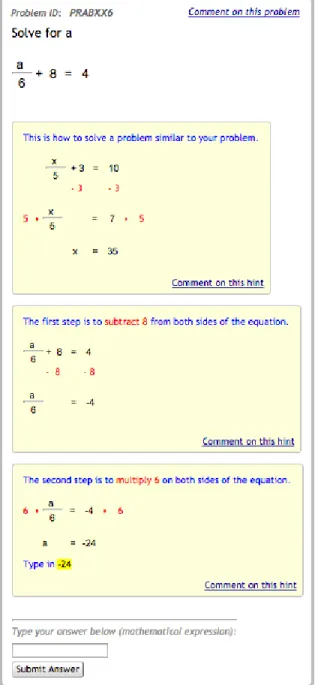
Figure 3-1 provides a screenshot of a typical problem within the ASSISTments tutor. Specifically, this problem is a representation of the second most densely populated skill in the 2012-2013 ASSISTments log file: “Equation Solving with Two or Fewer Steps.” This skill is exemplified, rather than highlighting the top skill, “Addition and Subtraction of Integers,” as the problem provides a more robust example of the system’s tutoring feedback. As shown in Figure 3-1, the student is presented with the equation and asked to solve for the missing variable. He or she can make an attempt to solve the problem, or may ask for the first of three hints. The hints increase in specificity, in an attempt to guide the student without providing excess assistance. The first hint shown in Figure 3-1 provides a worked example of a similar problem solving for the missing variable, x. If the student is unable to proceed using only the worked example, he or she can request the second and third hints as needed. The third hint in Figure 3-1 is the bottom out hint; it provides the correct answer (“-24”) in an attempt to keep the student from getting stuck in the assignment, as it is not possible to skip problems and return at a later point as one can with traditional bookwork.
Figure 3-1 An example problem featuring three hints for the skill “Equation Solving with Two or Fewer Steps”
3.3
Compared Models
The following subsections explain the design and brief history (when appropriate) of the five models compared in the current study. All five models are primarily designed to predict binary next problem correctness. For permitting models, we present predictions of partial credit next problem correctness using continuous probabilities for additional consideration.
3.3.1
Partial Credit Predicting Next Problem Correctness
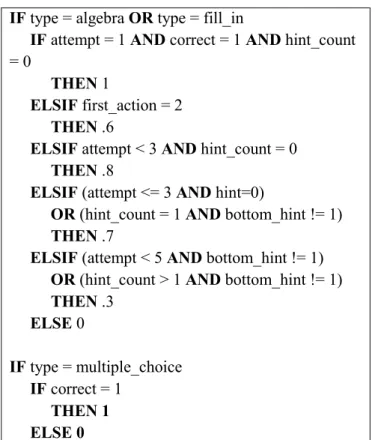
A naïve partial credit algorithm was derived by the ASSISTments design team in hopes of providing the system with partial credit scoring capabilities based on students’ attempt count and feedback usage. Scores were determined subjectively based on teacher input and a conceptual understanding of how students typically behave within the tutoring platform. For this study, the algorithm was altered slightly to consider multiple problem types and to account for the students’ first action. For instance, if a student asked for tutoring feedback without making an attempt to solve the problem, we felt that a larger penalty was merited.
The resulting algorithm used to define partial credit scores is depicted in Figure 3-2. Rather than establishing a deduction method on a per hint or per attempt basis as shown in previous work (Wang & Heffernan, 2011), the algorithm presented in Figure 3-2 places each logged problem into one of five partial credit bins (0, .03, 0.6, 0.7, 0.8, 1.0) by considering the logged data pertaining to first response type (attempt = 0, hint request = 1, scaffold request = 2), attempt count, and hint count.
For example, if a student makes only one attempt and is correct without requiring feedback, they earn full credit (a score of 1). This is similar to the notion of binary correctness on first response that ASSISTments currently employs. However, in the current method, all other first actions equate to an incorrect answer (i.e., requesting a hint or scaffold, or making a first attempt that is incorrect would both earn the student a score of 0).
As shown in Figure 3-2, after ruling out a ‘correct’ response, the partial credit algorithm considers whether the student requested a scaffold before even making an attempt. This behavior would suggest that either the student was not actually trying to answer the problem, or that he or she was struggling conceptually. Thus, rather than earning no credit, the student is only discounted to a score of 0.6.
IF type = algebra OR type = fill_in
IF attempt = 1 AND correct = 1 AND hint_count = 0
THEN 1
ELSIF first_action = 2 THEN .6
ELSIF attempt < 3 AND hint_count = 0 THEN .8
ELSIF (attempt <= 3 AND hint=0)
OR (hint_count = 1 AND bottom_hint != 1) THEN .7
ELSIF (attempt < 5 AND bottom_hint != 1) OR (hint_count > 1 AND bottom_hint != 1) THEN .3 ELSE 0 IF type = multiple_choice IF correct = 1 THEN 1 ELSE 0
Figure 3-2 Algorithm used to determine Partial Credit score based on first response, attempt count, and hint usage
Regardless of the student’s first action, if he or she uses less than three attempts and does not request any hints, they earn slightly more, with a score of 0.8. The next bin is marked by students who have three or fewer attempts and have not used a hint, or those who have asked for only one hint and were not provided the answer (i.e., if a student’s first action is to request a hint that is not the bottom out hint, they would fall into this bin). These students earn a score of 0.7. If the student can solve the problem within 5 attempts without seeing the bottom out hint, or if he or she uses multiple hints without ultimately reaching the bottom out hint, their partial credit score is 0.3. Finally, for students who use five or more attempts, or for those that see the answer, the problem is marked incorrect (a score of 0).
For multiple-choice questions the algorithm reverts to binary correctness because this type of problem does not usually provide feedback and guessing can be far more prevalent and
consequential. Thus, if a student fails to get the correct answer on their first attempt, he or she receives a score of 0. This method was employed to keep the problem type from gaining an unfair advantage within the dataset. For instance, using the algorithm applied to other problem types, a student guessing through a multiple-choice problem with only four responses would still receive a score of 0.3.
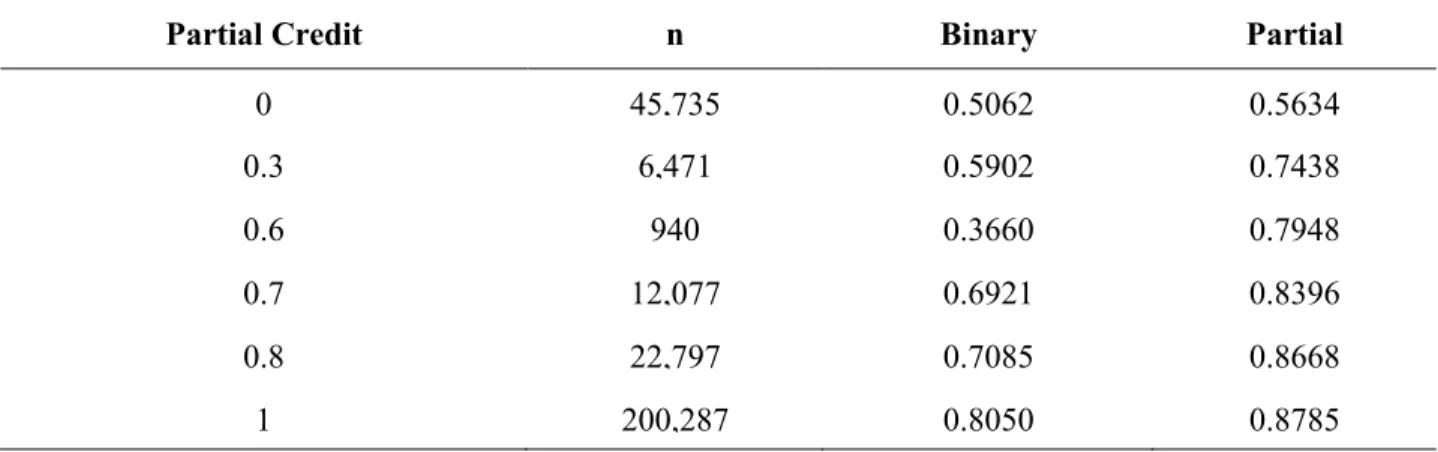
The full algorithm was run across the dataset and partial credit scores were obtained for each logged problem. These partial credit scores were then used to define a pivot table to predict averages for both binary and partial next problem correctness, using maximum likelihood estimation. Results are presented in Table 3-2. For all parameter Tables, the number of logged problems falling into respective bins is depicted by sample size, n. The distribution of the data suggests that slight improvements could be made to the partial credit algorithm as few students fell into the 0.6 bin. Of all available ‘next problem’ data, only 14.7% of logs had partial credit values between 0 and 1. Thus, 85.3% of students would be insured by the platform’s current method of binary correctness. This suggests that any significant finding among the models considered in the present study would be quite intriguing, as only a small portion of the sample is actually receiving the ‘partial credit’ treatment.
It should be noted that a potential problem inherent to this tabling method (apparent in all tabled models in the present study) is the inability to predict correctness on a student’s first opportunity within a skill, as there is no preceding problem data. This essentially causes the loss of 49,990 rows of data representing first problem predictions. Thus, sample sizes in Tables 3-2, 3-3, and 3-4 total 288,307 logs rather than 338,297.
Table 3-2 Parameters for predicting Binary and Partial Next Problem Correctness from current problem Partial Credit
Partial Credit n Binary Partial
0 45,735 0.5062 0.5634 0.3 6,471 0.5902 0.7438 0.6 940 0.3660 0.7948 0.7 12,077 0.6921 0.8396 0.8 22,797 0.7085 0.8668 1 200,287 0.8050 0.8785
3.3.2
Problem Difficulty Predicting Next Problem Correctness
A continuous metric of problem difficulty was calculated by retrieving data from all problems logged in the platform that were created before August 2012 (i.e., prior to the first timestamp in the modeling dataset). For each unique problem, all existing logs were averaged and a percentage of correct responses were determined. The resulting value offers an inverse metric of the problem’s difficulty level. For instance, a problem on which students averaged 80% on all previous opportunities would not be considered very difficult. This metric was then binned into Low, Medium, and High difficulties by defining Medium difficulty as scores falling within +/- 0.5 standard deviations from the mean. Considering the inverse nature of the metric, High difficulty problems therefore had continuous values below this cut off, and Low difficulty problems had continuous values above this cutoff.
The bins for current problem difficulty were used in a maximum likelihood probability table to predict averages for both binary and partial scores for next problem correctness. Resulting parameters are presented in Table 3-3.
Table 3-3 Parameters predicting Binary and Partial Next Problem Correctness from current problem Difficulty
Difficulty n Binary Partial
Low 91,712 0.7764 0.8465
Medium 107,901 0.7452 0.8297
High 88,694 0.6928 0.7895
3.3.3
Partial Credit and Problem Difficulty Predicting Next Problem
Correctness
Based on the definitions of partial credit and problem difficulty defined in the singular models above, our goal was to create a novel model that used a tabling approach to consider partial credit together with problem difficulty to make predictions about next problem correctness. For each logged problem, partial credit score and problem difficulty were referenced to determine parameters for both binary and partial credit next problem correctness. Resulting probabilities are presented in Table 3-4.
Table 3-4 Parameters predicting Binary and Partial Next Problem Correctness from Partial Credit and Problem Difficulty
High Medium Low
Partial Credit n Binary Partial n Binary Partial n Binary Partial
0 8,357 0.5130 0.5621 16,307 0.5027 0.5622 21,071 0.5062 0.5650 0.3 1,107 0.6035 0.7401 2,332 0.6017 0.7548 3,032 0.5766 0.7367 0.6 29 0.5902 0.8508 236 0.3388 0.7897 675 0.3661 0.7943 0.7 2,829 0.6971 0.8288 4,888 0.6987 0.8463 4,360 0.6816 0.8391 0.8 5,094 0.7770 0.8753 8,342 0.7354 0.8712 9,361 0.6473 0.8581 1 74,296 0.8116 0.8787 75,796 0.8072 0.8841 50,195 0.7921 0.8697
3.3.4
Knowledge Tracing
Knowledge Tracing (KT) is perhaps the most common method for modeling student performance. The standard KT model (Corbett & Anderson, 1995) has successfully proven itself
as the basis for modeling student knowledge within intelligent tutoring systems (Koedinger & Corbett, 2006) and thereby serves as a stable comparison for new work.
As shown in Figure 3-3, the standard model of KT is a Bayesian Network comprised of four learned parameters. Two parameters represent student knowledge (prior knowledge and learn rate) and two parameters represent student performance (guess rate and slip rate). The standard KT model is binary in that skills can only be in a ‘learned’ or ‘unlearned’ state, and questions can only be ‘correct’ or ‘incorrect.’ The model is updated with each skill opportunity based on the student’s performance by using the following equation as defined by Corbett & Anderson (1995):
Figure 3-3 The standard Knowledge Tracing model with all learned parameters and nodes explained
Forgetting does not factor into the standard KT model when observing individual skills, as guess and slip parameters are thought to account for incorrect answers within the students’ sequence of opportunities. For further information regarding the details of KT, refer to (Corbett & Anderson, 1995).
For this study, KT analysis was performed using the Bayes Net Toolbox (BNT), a popular open-source code for fitting directed graphical models within MATLAB (Murphy, 2001).
3.3.5
Performance Factors Analysis
Performance Factors Analysis (PFA) was proposed as an alternative to KT by Pavlik, Cen, and Koedinger (2009). The method can model problems with multiple skills and has been shown to accurately model and select practice within adaptive systems. PFA was derived from Learning Factors Analysis (LFA), an approach that considers a parameter for student ability, a parameter for the skill’s difficulty, and a learning rate for each skill. While PFA still considers skill difficulty, β, the model improves upon LFA by considering the frequency of both correct and incorrect answers in a student’s response pattern, rather than simply assessing the frequency of skill practice. Thus, PFA predictions are updated with each skill opportunity based on a cumulative history of the student’s successes (weighted by γ) and failures (weighted by ρ), as depicted in the following equation defined by Pavlik, Cen, and Koedinger (2009):
The log-likelihood (m) attained through this equation can then be passed through an exponential function to find the probability that the student will get the item correct. This model suggests that learning is defined by more than just skill practice, and that performance is strongly tied to skill acquisition.
For this study, PFA was performed using unpublished code within MATLAB. With properly formatted data, the analysis can also be performed using logistic regression in common statistical packages like IBM’s SPSS.
3.4
Model Training And Testing
Five-fold cross validation was used to train and test each model. In order to perform five-fold cross validation within our tabled models, the dataset was divided using a modulo operation on each student’s unique identification number. Thus, for every student in the file, student id mod 5
was called, returning a remainder falling into bins from 0 to 4, thereby assigning students to folds. The distribution of the resulting folds was roughly equivalent, as shown in Table 3-5. With 15,253 unique student identification numbers in the dataset, the largest fold had 3,082 student ids and the smallest fold had 2,996 student ids, leaving a range of 86 and a standard deviation of 33.7.
Within each iteration of the cross-validation process, the model was trained on approximately 80% of the data and tested on the 20% that had been held out. Thus, when trained on folds 1, 2, 3, and 4 (80% of the data) the model would impart predictions on fold 0 (the held out 20%). In this manner, for each tabling method described in Section 3, table parameters were learned using four training folds and predictions were made on the held out fold. The process was repeated for all folds, thus resulting in five probability tables for each prediction type (i.e., five ‘training’ tables for partial credit predicting binary next problem correctness). Using an extensive formula in Microsoft Excel, the predicted averages were then applied back to each logged problem respective of test fold. For predictions of binary next problem correctness, rather than arbitrarily selecting a cutoff point for classifying binary correctness (e.g., simply using values greater than 0.5 to convey ‘1’), we instead subtracted the prediction directly from the actual binary result. Thus, when predicting next problem correctness using partial credit alone, if the next problem is actually correct using binary standard, the resulting residual is calculated as: 1.0000 - 0.7085 = 0.2915. In this manner, residuals were calculated for each log entry in each test fold that contained data for next problem correctness.
A similar method of five fold cross-validation was coded into the KT and PFA analyses within MATLAB. Without modification, KT and PFA are not intended to accurately predict
partial credit next question correctness, and as such we have saved these analyses for future work.
Table 3-5 Distribution of data across five folds
Fold Unique Students # Logs % Dataset
0 3074 67,715 20.0
1 3046 68,081 20.1
2 3082 68,739 20.3
3 3054 67,996 20.1
4 2996 65,766 19.4
To compare our tabled models with KT and PFA, slight modifications were made to the standard modeling procedures. Unlike tabling, these models carry the benefit of being able to predict performance on a student’s first opportunity within a skill. Based on a ‘prior knowledge’ parameter, KT is able to predict the student’s initial knowledge state, K1, and therefore their performance on the first question, Q1. Similarly, the equation for PFA defaults a prediction of the skill’s difficulty parameter, β, as the student’s initial state. These values essentially define a baseline for the student’s knowledge, prior to any practice. Thus, in order to provide a fair comparison to tabled models, these first opportunity predictions were removed by shifting predictions to align with our ‘next problem’ analysis. Within KT, all subsequent skill opportunities were predicted using Expectation Maximization, a standard method for parameter learning within KT. The model was supplied the following initial parameters as ‘ground truths’ to begin the hill climbing process: prior knowledge = 0.30, learn rate = 0.20, forget rate = 0.00,
guess rate = 0.20, and slip rate = 0.08. Within PFA, all subsequent skill opportunities were predicted by updating the equation presented in the previous section. These modifications
resulted in the same number of data points for each model, providing grounds for fair comparison of the models.
Further, as noted briefly in the Dataset section, all models were restricted to 15 predicted opportunities per student per skill. This method was chosen largely to reduce the computation time required to fit KT using five-fold cross validation on such an extensive dataset. By capping the opportunity count, analysis time was reduced to approximately 20 hours. Other models were far less time intensive, all taking under three hours to arrive at predictions. Setting this restriction also served to reduce potential skewing in student level analyses by removing outliers with extensive opportunity counts.
3.5
RESULTS
All models were compared using the fit statistics of RMSE, R2, AUC, and model accuracy. As the tabled models were not restricted to binary input, fit statistics were also found for consideration of modeling partial credit next problem correctness.
For each model, these statistics were found at the problem log level, the skill level, and the student level where merited. These statistics were then averaged across the level of analysis, resulting in the findings presented in Table 3-6, Table 3-7, and Table 3-8, respectively. Thus, at the problem log level, fit statistics were determined overall for the 288,307 predictions, without consideration of student or skill before being averaged across all problems. At the skill level, ten sets of fit statistics were determined (one set for each skill), which were then averaged across skills. At the student level, 15,253 sets of fit statistics were determined (one set for each student), which were then averaged across students. The latter two procedures were intended to properly weight skill and students based on their contribution to the dataset, thereby improving measures of model fit.
Student level statistics of RMSE were calculated based on all predictions. However, it should be noted that measures of R2, AUC, and model accuracy could not be calculated for students with less than three skill opportunities. This discrepancy should affect all models equally, and thus we provide these measures for comparison in Table 3-8 with the caveat that they should not be directly compared to measures of student level RMSE.
Table 3-6 Problem Level Average RMSE, R2, AUC, and Accuracy for Models Predicting Next Problem Correctness (NPC)
Binary NPC Partial NPC
Model RMSE R2 AUC Accuracy RMSE R2 AUC Accuracy
Partial Credit + Problem Difficulty 0.4241 0.0674 0.6365 0.7310 0.3326 0.1062 0.5395 0.7298 Partial Credit 0.4244 0.0660 0.6309 0.7309 0.3327 0.1060 0.5351 0.7298 Problem Difficulty 0.4379 0.0057 0.5464 0.7300 0.3511 0.0043 0.3953 0.7298 Knowledge Tracing 0.4240 0.0680 0.6621 0.7298 -- -- -- -- Performance Factors Analysis 0.4227 0.0738 0.6644 0.7485 -- -- -- --
Table 3-7 Skill Level Average RMSE, R2, AUC, and Accuracy for Models Predicting Next Problem Correctness (NPC)
Binary NPC Partial NPC
Model RMSE R2 AUC Accuracy RMSE R2 AUC Accuracy
Partial Credit + Problem Difficulty 0.4224 0.0670 0.6300 0.7414 0.3284 0.1032 0.5130 0.7399 Partial Credit 0.4229 0.0656 0.6290 0.7414 0.3284 0.1031 0.5103 0.7399 Problem Difficulty 0.4364 0.0046 0.5323 0.7402 0.3473 0.0037 0.3560 0.7399 Knowledge Tracing 0.4225 0.0602 0.6500 0.7466 -- -- -- -- Performance Factors Analysis 0.4212 0.0664 0.6506 0.7499 -- -- -- --
Table 3-8 Student Level Average RMSE, R2, AUC, and Accuracy for Models Predicting Next Problem Correctness (NPC)
Binary NPC Partial NPC
Model RMSE* R2 AUC Accuracy RMSE* R2 AUC Accuracy
Partial Credit + Problem Difficulty 0.3864 0.1027 0.5431 0.7684 0.2702 0.1108 0.3593 0.7674 Partial Credit 0.3866 0.0994 0.5392 0.7683 0.2701 0.1057 0.3619 0.7674 Problem Difficulty 0.4064 0.0829 0.5219 0.7676 0.2941 0.0851 0.3145 0.7674 Knowledge Tracing 0.3897 0.1057 0.4425 0.7729 -- -- -- -- Performance Factors Analysis 0.3882 0.0970 0.5003 0.7754 -- -- -- --
3.6
Discussion
The fit statistics for both the problem log and skill level generalizations paint very similar pictures of the relative success of our tabling method. The combined Partial Credit and Problem Difficulty model performs about as well as KT at both levels of analysis. At these levels, PFA a