An Energy-Efficient Multi-Cloud Service Broker
for Green Cloud Computing Environment
By Bandar Aldawsari
A thesis submitted in partial fulfilment of the requirements of Liverpool John Moores University for the degree of Doctor of Philosophy
Abstract
The heavy demands on cloud computing resources have led to a substantial growth in energy consumption of the data transferred between cloud computing parties (i.e., providers, datacentres, users, and services) and in datacentre’s services due to the increasing loads on these services. From one hand, routing and transferring large amounts of data into a datacentre located far from the user’s geographical location consume more energy than just processing and storing the same data on the cloud datacentre. On the other hand, when a cloud user submits a job (in the form of a set of functional and non-functional requirements) to a cloud service provider (aka, datacentre) via a cloud services broker; the broker becomes responsible to find the best-fit service to the user request based mainly on the user’s requirements and Quality of Service (QoS) (i.e., response time, latency).
Hence, it becomes a high necessity to locate the lowest energy consumption route between the user and the designated datacentre; and the minimum possible number of most energy efficient services that satisfy the user request. In fact, finding the most energy-efficient route to the datacentre, and most energy efficient service(s) to the user are the biggest challenges of multi-cloud broker’s environment.
This thesis presents and evaluates a novel multi-cloud broker solution that contains three innovative models and their associated algorithms. The first one is aimed at finding the most energy efficient route, among multiple possible routes, between the user and cloud datacentre. The second model is to find and provide the lowest possible number of most energy efficient services in order to minimise data exchange based on a bin-packing approach. The third model creates an energy-aware composition plan by integrating the most energy efficient services, in order to fulfil user requirements. The results demonstrated a favourable performance of these models in terms of selecting the most energy efficient route and reaching the least possible number of services for an optimum and energy efficient composition.
Introduction ... 9
1.1 Introduction ... 10
1.1.2 Motivation: energy consumption reduction ... 12
1.1.3 Research Hypothesis ... 13
1.1.4 Research Problem ... 13
1.1.5 Novelty of the thesis ... 15
1.1.6 Research Scope ... 16
1.1.7 Aim and Objectives ... 16
1.1.8 Methodology ... 18
1.1.9 Thesis Structure ... 18
Cloud Computing ... 20
2.1. Introduction ... 21
2.2. Cloud Computing ... 21
2.2.1. Deployment models of cloud computing ... 23
2.2.2. The main players in cloud computing ... 25
2.3. Cloud Computing Virtualization ... 26
2.3.1. Virtualization Forms ... 27
2.3.2. Categories of server virtualisation ... 28
2.3.2.1. Hypervisor based virtualization: ... 28
2.3.2.2. Container based virtualization: ... 29
2.4. Cloud Services ... 30
2.4.1. Cloud service models ... 30
2.4.1.1. Infrastructure as a Service (IaaS): ... 30
2.4.1.2. Platform as a Service (PaaS): ... 31
2.4.1.3. Software as a Service (SaaS): ... 31
2.4.2. New hybrid service models ... 32
2.5. Cloud Service Brokerage ... 33
2.5.1. Cloud Service Broker Architectures ... 35
2.5.2. Resource Management in Cloud Broker ... 35
2.6. Summary ... 37
Network Routing and Energy Efficiency in Cloud Computing ... 38
3.1. Introduction ... 39
3.1.1. Cloud broker problem ... 39
3.1.1.1. Load Balancing Algorithms ... 42
3.1.2. Segment Routing ... 44
3.1.2.1 Traffic engineering ... 47
3.1.3. Routing algorithm to balance energy consumption ... 49
3.2. Energy efficiency in cloud computing ... 52
3.2.1. Energy Consumption In Cloud Datacentres ... 52
3.2.1.1 The main factors leading to waste-to-energy ... 53
3.2.1.2 Power saving strategies in Cloud ... 54
3.2.2 Energy Efficient Cloud Resources Allocation ... 57
3.2.2.1 Resources Allocation ... 57
3.2.2.2 Cloud Resources Allocation ... 58
3.2.2.3 On-demand resource allocation vs advanced resource reservation ... 60
3.2.3 Energy efficient service composition ... 65
3.2.3.1. Bin-packing approach ... 68
3.3. Discussion and Requirements ... 69
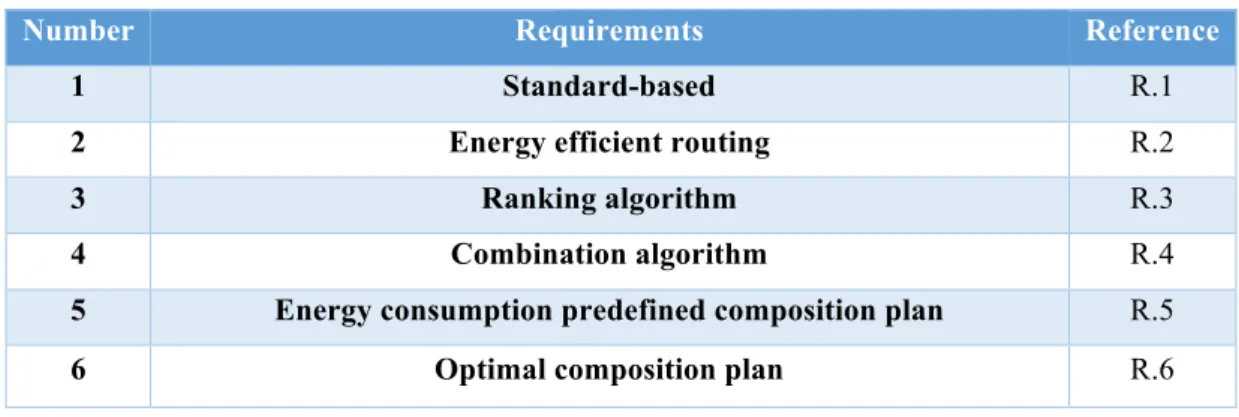
3.3.1. Requirements ... 71
3.5. Summary ... 72
An Energy Efficient Routing Algorithm ... 73
4.1. Introduction ... 74
4.2 Energy Efficient Routing ... 74
4.2.1 Basics and Rules ... 76
4.2.2 Modelling power consumption of the network ... 77
4.2.3 Modelling user connectivity to data centre ... 78
4.2.4 Formal analysis of network topology ... 79
4.2.5 Energy required for transportation ... 81
4.2.6 Time required for transportation ... 83
4.2.7 Energy and time required for computation ... 83
4.3. Implementation ... 83
4.3.1. Linear programming formulation ... 83
4.3.2. Goal programming formulation ... 86
4.3.3. Dynamic programming approach ... 87
4.4. Evaluation ... 88
4.4.1. Physical topology ... 89
4.4.2. Energy evaluation model and results ... 91
4.5. Summary ... 94
Bin-Packing Based Energy-Efficient Service Provision ... 95
5.1. Introduction ... 96
5.1.1. Service Composition Energy Consumption ... 96
5.2. The System Model ... 99
5.2.1. Formal datacentre-broker model ... 99
5.2.2. Formal datacentre-broker model ... 104
5.3. Implementation ... 105 5.3.1. Algorithmic Design ... 105 5.4. Evaluation ... 112 5.4.1 Experimental Settings ... 112 5.4.2 Experimental results ... 113 5.5. Summary ... 116
Energy-Aware Service Composition Algorithm for Multiple Cloud ... 117
6.1. Introduction ... 118 6.1.1. Service compositions ... 118 6.2. Model design ... 122 6.2.1. User-broker model ... 122 6.2.2. Datacentre-broker model ... 124 6.3. Implementation ... 126
6.4 Evaluation ... 132
6.4.1. Experimental settings ... 132
6.4.2 Results and analysis ... 135
6.5. Summary ... 140
Conclusion and Future Work ... 141
6.1. Conclusion ... 142 6.2. Contributions to knowledge ... 143 6.3. Future work ... 145 7. References ... 147 Appendix 1 ... 155 Appendix 2 ... 156
List of Figures
Figure 2.1 Cloud Computing concept (F. Liu et al. 2011) ... 22
Figure 2.2 number of isolated virtual servers to run on one single actual server (editor 2011) ... 27
Figure 2.3. Container based virtualization vs hypervisor based virtualization (Travostino et al. 2006) ... 28
Figure 2.4 three types of classic cloud service models (Kubernetes 2017) ... 30
Figure 2.5 cloud service brokerage roles to manage the broker ... 33
Figure 3.6 Resource Allocation (Nair and Porwal 2010) ... 59
Figure 4.7cloudelements, that contribute to the total energy consumption. ... 75
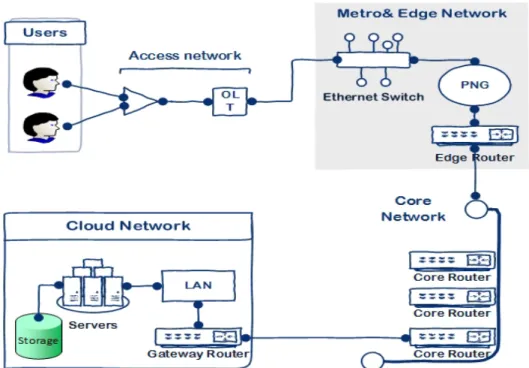
Figure 4.8Network structure (user connectivity to data centre) ... 78
Figure 4.9 Hierarchal topology of an Italian ISP ... 89
Figure 4.10 Path lengths of each route ... 92
Figure 4.11 Total energy of each route. ... 93
Figure 4.12 Average energy consumption per node of each route. ... 94
Figure 5.13 Conceptual representation of the proposed approach ... 103
Figure 5.14 Four main steps broker ... 107
Figure 5.15 Running time and energy consumption to find requested service ... 116
Figure 6.16: Five separate web services. ... 120
Figure 6.17 : BPMN composition ... 120
Figure 6.18 A conceptual representation of the proposed approach. ... 124
Figure 6.19 % reduction in the number of examined atomic services. ... 138
Figure 6.20 The average number of examined services. ... 138
Figure 6.21 Number of combined clouds in multi-cloud based service composition plan π. ... 139
List of Tables
Table 3.1 Proposed Broker Requirements ... 72
Table Algorithm 4.1.: Energy Efficiency Algorithm ... Error! Bookmark not defined. Table 4.3: Route A network components ... 90
Table 4.4 Route B network components ... 91
Table 4.5: Route C network components ... 91
Table 4.6 Route D network components ... 91
Table 5.7 Multiple-cloud providers and Services ... 104
Table 5.8 Multiple-cloud providers and Services sorted by energy consumption ... 105
Table Algorithm 5.1: Ordering the Cloud Providers in a descending order based on Total Energy Consumption ... 108
Table Algorithm 5.2: Finding an atomic service that matches the user request ... 109
Table Algorithm 5.3: Finding a predefined optimal composition plan 𝜋𝐵′ from a single provider ... 110
Table Algorithm 5.4: Creating an optimal services composition from multiple providers ... 111
Table 5.13 Cloud provider’s composition set per MCP. ... 112
Table 5.14 Number of services per composition. ... 113
Table 5.15: CPs and energy consumption per MCPs, before listing in an ascending order. ... 113
Table 5.16: CPs and energy consumption per MCPs, after listing in an ascending order. .. 113
Table 5.17: CPs and number of () composition plans per MCPs ... 114
Table 6.18 Multiple-cloud providers and services. ... 127
Table Algorithm 6.1 discovering a predefined optimal composition plan 𝜋𝐵′ from a single provider. ... 130
Table algorithm 6.2 The creation of a dynamic optimal composition plan 𝜋𝐵′ from multiple providers. ... 131
Table 6.21 Cloud providers composition set per multiple-cloud providers environment. .. 134
Table 6.22 Number of services per composition plans ... 134
Table 6.23 CPs and number of (π) composition plans per MCPs. ... 135
Table 6.24 CPs and number of (π) composition plans per MCPs. ... 136
ACKNOWLEDGMENTS
This thesis is the story of a journey throughout which I received help from many people, some of them helped me from outside and others gave me unforgettable internal motivation. I would like to thank my parents and my family for their love, patience and support at all times. I would like to thank my supervisor, Dr. Thar Baker for his intellectual guidance and continuous encouragement, which ensured the successful completion of this thesis. He always gave me freedom to think broadly and deeply into my research. The regular meetings conducted by him made me work more regularly and systematically. His endless amount of energy is really an inspiration for me to do better research. Also, I would like to thank Dr David England for his guidance and encouragement during my study. I would like also to thank Dr Martin Randles for his support.
FIRST CHAPTER
1.1
Introduction
Thanks to its on-demand utility pricing model, cloud computing has grown considerably to support online services both for businesses and for individuals. The business model is deemed simple and powerful: providers, offer services, end-users find the service they want, and when they have subscribed, high-speed network connection is put in place between them to enable them to use the selected services. As an advanced technology, it has revolutionised the Information and Communications Technology (ICT) industry. In other words, cloud computing has changed the way that services are offered through the Internet. It provides computing resources such as hardware, application development platforms and computer applications available as services over the Internet. These services are commonly known, respectively, as Infrastructure as a Service (IaaS), Platform as a Service (PaaS) and Software as a Service (SaaS). It represents a shift in the geography of computation, where the cloud resources’ physical location is not a barrier whatsoever for the users and providers. Therefore, the cloud computing resources can be accessed at anytime from anywhere in the world via the users’ machines that are connected to the Internet (Larumbe and Sansò 2012). Hence, on the one hand the users do not need to worry about where the resources/services are based and/or how they can be accessed and used. And on the other hand, cloud providers can offer their services/resources to anyone on the globe. Furthermore, cloud computing provides various benefits in terms of scalability, cost, maintenance and performance compared to the traditional computing (Baliga et al. 2011).
Based on the above, the heavy demands on cloud computing resources has led to a substantial growth in the data transferred between cloud computing parties (i.e., providers, data centres, users, and services), network traffic and the energy consumed by the huge infrastructure of cloud computing, which is needed to meet the users’ requests quickly and effectively. The cloud network traffic is forecasted to increase about threefold between 2013
and 2018 (Larumbe and Sansò 2012). Routing big data between the cloud computing parties requires a high bandwidth connection, which consumes larger amounts of energy (Chang Ge, Zhili Sun, and Ning Wang 2013) than just processing and storing big data on cloud data centres, and thus, producing high carbon dioxide emissions. When transferring such amounts of data into a data centre located quite far from the users’ geographical location, this power consumption becomes significantly high. Generally, there are two main pillars for energy consumption of cloud computing that should be dealt with efficiently and equally to achieve the most energy-efficient cloud computing environment: (i) the amount of energy consumed at the computation and processing of each service at the data centre and (ii) the amount of energy consumed on transporting the data between the user and the cloud data centre. Hence, it has become a high necessity to locate the lowest energy consumption route between the user and the designated data centre, and services that match the user request, while making sure the users’ requirements are met.
In its simplest form, one cloud provider provides all services required by a user. However, where this is not possible (i.e., more than one cloud provider is involved in producing the required service(s)) the service’s components/parts must be put together with care. A user’s request with a specification of the services required goes to the provider, who returns a reply to the user that contains the required services. When resource limitations or other constraints mean that a single service provider cannot meet all of the user’s needs, the model becomes more complex. Typically, this will be seen as composition of a number of services and the use of the model of broker-based cloud services (Aldawsari, Baker, and England 2015), with multiple cloud service providers collaborating in a multi-cloud environment so that the user can receive the desired service outcomes. The assumption must be that the various services coordinate their activities to avoid conflict in such matters as shareable resources and order dependencies, and also to avoid delays in communication.
This presents a huge challenge due to the following points:
• To meet environmental requirements as published in the 2011 report of PBL Netherlands Environmental Assessment Agency and JRC European Commission; (Jos G.J. Olivier, Greet Janssens-Maenhout, Jeroen A.H.W. Peters 2011).
• To reduce energy consumption (Baer 2008) and lower the volume of CO2
emissions by 15%-30% before 2020 to keep increases in global temperature below 2oC.
• To integrate fewer services from cross-continental and scattered providers to fulfil user demand, meaning that there is less data exchanged, leading to a reduction in the carbon footprint of the multi-cloud IoT environment. Moving lots of data between services has an impact on energy.
This thesis present three new models and their related algorithms to address the above issue. In the first one, the most energy efficient route between the user and cloud datacentre will be chosen in order to achieve the full green cloud computing. The second algorithm is based on a bin-packing approach and aimed at finding and integrate the lowest possible number of services in order to minimise data exchange. The last model focuses on the creation of energy-aware composition plan in order to fulfil user requirements, by searching for and integrating the most energy efficient services.
1.1.2 Motivation: energy consumption reduction
The Energy White Paper, published on 24 February 2003, sets out the government’s overall goals for the UK energy policy (Department for Transport 2003), and puts the UK on a path to cut CO2 emission by 60% by 2050. In addition, according to an IEEE Communication
Survey (Chang Ge, Zhili Sun, and Ning Wang 2013), the global electricity demand of cloud data centres was 623bn kWh in 2007, 416.2 tWh in 2015, which was significantly higher
than the UK’s total consumption of about 300 tWh, and is expected to rise up to 1963.74 tWh by 2020. For instance, a data centre in North Carolina consumes as much as 100MW of power, which is equivalent to about 80,000 US homes or 250,000 EU homes (Baer 2008). As explained above, in a typical scenario in a cloud environment, a user submits a job to a cloud service broker explaining the requirements of the needed services. The broker should then find the appropriate service provider or set of providers that serve the request. Yet, finding the most energy efficient route to a data centre and locating the best fit and the most energy efficient service, or set of services, that matches the user needs are the most challenging tasks for the multi-cloud brokers. The state-of-the-art in this domain focuses on the power consumption of the datacentre and its equipment, including server, storage and network equipment as well as new cooling and power management technologies.
Thus, this was the spark to conduct research in this area and find the best solution to solve the above-mentioned issues.
1.1.3 Research Hypothesis
The research hypothesis of this work is that, selecting the most energy efficient route to the cloud data centre alongside finding and integrating the lowest possible number of most energy efficient services from the least possible number of cloud providers can help in achieving a full green cloud computing environment, which eventually contributes to the energy saving goals by 2050.
1.1.4 Research Problem
Routing and transferring large amounts of data into a data centre located quite far from the users’ geographical location can consume larger amounts of energy than just processing and storing the same data on cloud data centres. Hence, it became a high necessity to locate the lowest energy consumption route between the user and the designated data centre, while
making sure the users’ requirements are met. On the other hand, when a cloud user submits a job (in the form of a set of functional and non-functional requirements) to a cloud service provider (data centre) via a cloud services broker; the broker is then responsible to find the best-fit service to the user request based on the user’s requirements. Finding the most energy-efficient route to the data centre, and best-fit service, in terms of energy consumption, to the user is the multi-cloud broker’s biggest challenge because:
• When a user request is submitted, all routes towards the data centre do not consume the same amount of energy. Therefore, a routing solution is needed to find the most energy efficient route to the data centre.
• In order to minimise the energy efficiency of cloud services (or resources), it is necessary to find and allocate suitable services, in terms of energy efficiency and power consumption, from lowest possible number of service providers. There has been a great deal of research into discovery and composition of cloud services, and tools have been developed with the power to serve users when they need it to use the services. A great deal of this research actually involved Infrastructure-as-a-Service (IaaS) layer and virtualisation types. However, searching for, allocating, and making provision plans for services that are energy efficient, is overlooked.
• While a number of heuristic IaaS solutions have been put forward, algorithms that will allocate resources in the most energy efficient way are still lacking. As time goes on, there is a development of hybrid cloud solutions combining IaaS and Platform-as-a-Service (PaaS) in a single cloud (OpenStack Heat is an example), and these are attractive because they make it possible for infrastructure and applications to be deployed together, but there is still not sufficient attention given to the energy efficient allocation of resources.
• There is no clear process for finding the most energy efficient services from multiple cloud providers that meet user needs.
1.1.5 Novelty of the thesis
This work makes a number of novel contributions, all of which have been, or are being, submitted to relevant research publications (Appendix I) and are summarised as follows:
• Defining and formalising the user-to-broker and data centre-to-broker models so that, the interconnection between the cloud user and a data centre, will be formalised by using a situation calculus model to define the logical state of the network. Once the interconnection is established and formalised, then the energy required for the transportation will be calculated.
• A high-end routing algorithm entitled Green Director (GreeDi), which acts as an intermediary bridge for directing the users’ requests to the green data centres based primarily on using the most energy efficient route.
• An algorithm to rank cloud service providers by total energy consumption.
• An algorithm to enable the broker to search for the best possible match by seeking a combination of individual atomic service and lowest energy consumption.
• An algorithm to allow the broker to search predefined composition plans and their energy consumption in order to find the best possible match for user requirements.
• An algorithm to allow the broker to build a new optimal composition plan by selecting the most energy efficient services from the smallest possible number of providers.
• An algorithm to discover a predefined optimal composition plan from a single provider.
1.1.6 Research Scope
This research proposes novel support for achieving an energy efficient cloud, which is achieved by:
• A high-end routing model to achieve the full green cloud computing environment ambition while making sure the users’ requirements, e.g. response time, are met. To create this model, we need to develop an algorithm that acts as an intermediary bridge for directing the user requests to the green data centres based primarily on using the most energy efficient route.
• A bin-packing based energy-efficient service model to find and integrate, from the largest possible number of service providers, the smallest possible number of services offering the highest level of energy efficiency. To enable this model, we need to create four algorithms to (i) Rank the Cloud Providers in a descending order based on total Energy Consumption, (ii) Find an atomic service that matches the user request, (iii) Find a predefined optimal composition plan from a single provider
and (iv) Create an optimal services composition from multiple providers. • A unique energy-aware multi-Cloud service composition model, which develops
energy efficient composition plans through the integration of the fewest services globally from service providers. To achieve this model, we need to create two algorithms to (i) discover a predefined optimal composition plan from a single provider and (ii) to create a dynamic optimal composition plan from multiple providers.
1.1.7 Aim and Objectives
The aim of this work is to create and evaluate an energy efficient multi-cloud broker to address the gap mentioned in (Section 1.1.4). It acts as an intermediary bridge for directing users’ requests to the data centres based primarily on using the most energy efficient route.
In addition, the broker manages the cloud services to find the most energy efficient service(s) that matches the user request; hence, achieving the most energy-efficient cloud computing environment. The primary objectives of this research include:
•
Perform an extensive literature study on the cloud brokerage systems, the available cloud services delivery platforms to extract the components and features of these platforms and enable the managing of cloud services in a multi-cloud environment and achieve the energy efficiency.•
Create a new energy efficient services delivery algorithm that will be run in a multi-cloud environment to act as an intermediary bridge for directing the user requests to the data centres based primarily on using the most energy efficient route.•
Create an energy-efficient service algorithm to find and integrate the smallest possible number of services offering the highest level of energy efficiency based on a bin-packing approach.•
Develop an energy-aware multi-Cloud service composition model, which develops energy efficient composition plans through the integration of the fewest services globally from service providers.•
Test and evaluate the proposed algorithms against the well-known algorithms using network simulations.1.1.8 Methodology
Objectives Methodology Chapters
Extensive literature study on the brokerage systems and routing solutions in the cloud environment
Conducting a literature review Chapter Two and chapter three
Create a new services delivery algorithm for directing the user requests to the data centres based primarily on using the most energy efficient route
Using Situation Calculus model, Integer Linear Programming, Goal-oriented programing, and Dynamic programming approach
Chapter Four
Development of an Energy-Efficient Service Provision model to find and integrate the lowest possible number of services offering the highest level of energy efficiency.
Bin-packing approach Using Integer Linear Programming and
IBM ILOG CPLEX
Optimization Linear Solver
Chapter Five
Development of a service
composition model, which develops energy efficient composition plans through the integration of the fewest services from globally distributed providers.
Using formal user requirements translation and transformation modelling and analysis
Chapter Six
1.1.9 Thesis Structure
The second chapter starts with the explanation of the cloud computing concept and its main players. In addition, it introduces the cloud service brokerage systems and their architectures resource management. Moreover, this chapter explains the cloud services models, cloud computing virtualization and the virtualization forms and categories. Furthermore, it describes the energy efficiency in cloud computing, the energy consumption in data centres and the energy efficient cloud resources allocation. The third chapter introduces the network
routing problem and the energy efficiency in cloud computing. It highlights the cloud broker selection problem and the energy consumpton issue in data centres and during the resource allocation.
Moreover, the fourth chapter intends to focus on the design and implementation of the energy efficient routing model for big data on the cloud model, which includes discussion about the situation calculus used to analyse the network topology. Moreover, linear, goal and dynamic programming modelling approaches will be discussed in this section. The fifth chapter presents the design and implementation of the bin-packing based multi-cloud model for energy efficient data-intensive applications and provides the main aim and objectives of this work. In addition, a detailed discussion on how the model works is presented in this chapter. The energy-aware service composition model and its design and implementation for multiple cloud applications, a detailed discussion of the proposed model and how it works is introduced in the sixth chapter. Finally, the research conclusion and the future work is presented in seventh chapter.
SECOND CHAPTER
2.1.
Introduction
The development of the proposed energy efficient multi-cloud broker in this thesis was inspired by previous works and is based on a number of paradigms, concepts and technologies which exist in cloud computing. Thus, as a convenient approach for presenting the overall state-of-the-art and related work, the literature review is structured into four main areas:
• Cloud computing environment: explaining the definition of the cloud computing concepts and its main players.
• Virtualisation: focusing on the virtualisation forms and the categories of virtualised servers.
• Cloud services: focusing on the classic cloud service models and the new hybrid one. • Cloud service brokerage: studying the architecture of existing cloud brokers and the
management of the resources when using a broker.
2.2.
Cloud Computing
Cloud computing represents the fastest growing area in Information and Communication Technologies (ICT) at present. It gives users a cost-efficient way of obtaining different types of computing resources by paying only for what they use. The way cloud services are provided allows users and companies to outsource almost all ICT functions including hardware resources, services, and applications.
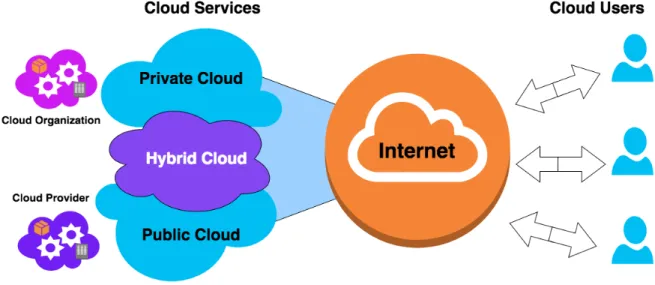
Figure 2.1 Cloud Computing concept (F. Liu et al. 2011)
The number and varieties of definitions of the cloud that can be found in the literature indicate, either explicitly or implicitly, the lack of a clear, complete and universally agreed definition of what this model comprises. Probably the most widely accepted one among the various definitions of cloud computing is the one put forward by NIST (National Institute of Standards and Technology) (F. Liu et al. 2011), which defines the cloud as:
“a pay-per-use model for enabling convenient, on-demand network access to a shared pool of configurable computing resources such as networks, servers, storage, applications, and services. It can be rapidly provisioned and released with minimal management effort or service provider interaction”.
Accepting this definition permits extraction of a number of key features of cloud computing, such as:
• On demand automated resource provisioning and user self-provisioning (known as cloud self-service).
• Access to resources from anywhere and anytime on the network.
• Ability to pool resources, which can be assigned dynamically to suit each client's needs regardless of physical location.
• Immediate scalability (a.k.a. scale up/down/out) so that peaks in demands can be dealt with.
• Metering based resources used; similar to the other utility payment model enable the pay-per-use approach.
2.2.1. Deployment models of cloud computing
There are four hosting deployment models of cloud computing dubbed private, community, public, and hybrid. These models represent the categories of cloud computing environment and are distinguished from each other by the purpose, size, and access way, as follows: Private cloud:
A private cloud is an infrastructure that is owned and managed by one single company, is used in that company’s private network, and is not available to other users. It is also known as an internal cloud; the platform for cloud computing is implemented on a cloud-based secure environment that is safeguarded by a firewall, which is under the governance of the IT department that belongs to a particular corporate (Victories 2015). For example, a private cloud can be used by a financial company who will still need to benefit from some of the advantages of cloud computing and is required to store sensitive data internally.
Community cloud:
A community cloud is a type of cloud hosting in which the setup is mutually shared between many organisations that belong to a particular community, i.e. banks and trading firms. It is a multi-tenant setup that is shared among several organisations that belong to a specific group which has similar computing apprehensions. The community members generally share similar privacy, performance and security concerns. The main intention of these communities is to achieve their business related objectives. A community cloud may be internally managed, or a third party provider can manage it. Hence, it can be hosted
externally or internally. The cost is shared by the specific organisations within the community, therefore, community cloud has a cost saving capacity (Victories 2015). An example of this cloud is that a few organizations might require a particular application that resides on one set of cloud servers. Instead of providing every organization their server in the cloud for this app, the hosting company shares their environment to allow multiple customers to connect and segment their sessions.
Public cloud:
A public cloud is a large, high-volume and high performance infrastructure owned by one or more companies and provides IT services through the Internet to a multiplicity of consumers. This model is a true representation of cloud hosting. In this model the service provider renders services and infrastructure to various clients all around the world. The customers do not have any distinguishability and control over the location of the infrastructure (Victories 2015). A good real life example of this cloud is Amazon Elastic Compute Cloud (EC2), IBM’s Blue Cloud, Sun Cloud, Google AppEngine and Windows Azure Services Platform
Hybrid cloud:
Hybrid clouds combine public and private clouds, with a company’s private cloud running those apps and/or managing that data that must be protected at all costs from external interference and from others among the company’s apps running on a public cloud. It can be an arrangement of two or more cloud servers, i.e. private, public or community cloud that is bound together but remain individual entities. Benefits of the multiple deployment models are available in a hybrid cloud hosting. A hybrid cloud can cross isolation and overcome boundaries by the provider; hence, it cannot be simply categorized into public, private or community cloud. It permits the user to increase the capacity or the capability by aggregation, assimilation or customization with another cloud package or service (Victories
2015). An example of this type of cloud is an organisation that could deploy an on-premises private cloud to host critical or sensitive workloads, but use a third-party public cloud provider, such as Google Compute Engine, to host less-critical resources, such as test and development workloads. In addition, a hybrid cloud could also use Amazon Simple Storage Service to hold customer-facing archival and backup data. Moreover, it could use a software layer, such as Eucalyptus, to enable private cloud connections to public clouds, such as Amazon Web Services (AWS).
2.2.2. The main players in cloud computing
Like in any other utility provisioning model (i.e., gas, electricity and water), cloud computing has three main players, which are: providers, brokers and users. Each of these players plays a specific role and has a certain purpose from cloud computing. This section provides further details and definitions of these players.
Cloud Provider:
A cloud provider is meant to provide cloud infrastructure, through which cloud services are hosted. All responsibility for managing, controlling and maintaining cloud resources and for handling users’ requests lies with the provider. A cloud computing provider’s typical goal is to maximize its revenues with its employed pricing scheme. The cost will usually be based on a per-use utility model.
Cloud users:
A user is defined as an account with permission to log into the cloud application to use cloud services. A named user with this permission is counted towards the user limit and it could be individuals, companies, groups in which pricing will differ from one another and their main goal is to obtain the highest level of quality of service (QoS) feasible for a reasonable price.
Cloud Broker:
The Broker acts on behalf of both cloud users and providers, distributing user requests between providers according to which provider is best suited to meet that particular request. In this sense, brokers are acting as travel agents; the user tells the broker which application (type of holiday) is needed and the broker decides which service providers (holiday companies) offer the best deal. This analogy cannot be carried too far – travel agents are responsible for the resort or other type of location to which they send their customers, while brokers have no responsibility for where the actual computer would be located. Further details about the existing brokers and the way the broker works are set out in the third chapter.
2.3.
Cloud Computing Virtualization
Server virtualisation has been used as a leading technology for sharing computing infrastructure for a while now. In fact, it was actually started back in the early 1960’s by companies such as General Electric, Bell Labs and International Business Machines (IBM) (editor 2011). In the same vein, virtualization technology is what makes cloud computing possible. It works through the abstraction of physical resources by multiplexing a number of virtual resources onto one physical one as shown in Figure 2.2 Virtualization provides flexibility, convenient management of resources, elasticity in resource management, and isolation, while also permitting the coexistence on the same hardware of a number of heterogeneous services.
Figure 2.2 number of isolated virtual servers to run on one single actual server (editor 2011) 2.3.1. Virtualization Forms
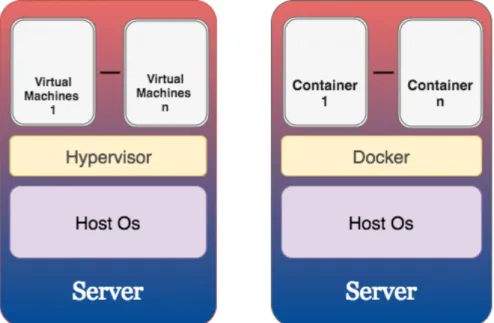
Virtualization can be used in different shapes and forms in cloud computing infrastructure, including: server virtualization; storage virtualization; and network virtualization. All three rest on the same principle of abstracting physical resource through partitioning. Cloud computing’s commonest method of resource abstraction is server virtualization, which – implemented in a variety of ways – permits a number of isolated virtual servers to run on one single actual server. Full virtualization, para-virtualization and OS-level virtualization are among the possible implementation methods. Full virtualization and para-virtualization both share the physical hardware by use of a hypervisor, but modify host and guest operating systems differently, as well as the way they interact among themselves, to make virtualisation happen. Virtualisation at the operating system level (OS-level), on the other hand, does not use a hypervisor; or virtual servers run the same host operating system, and this confers all functions that might otherwise be supplied by a hypervisor. It is therefore possible to divide server virtualisation into two types: virtualisation based on the hypervisor, and virtualisation based on the operating system or container. More information about this categorisation will be found in the next section.
2.3.2. Categories of server virtualisation
As discussed in the previous section, the way that is chosen to virtualise resources in cloud computing can be categorised in either of two ways: through hosted virtualisation with a hypervisor, or through container-based virtualisation.
2.3.2.1. Hypervisor based virtualization:
Hypervisor-based virtualisation was the way that virtualisation in the cloud was originally done. The hypervisor is a software layer tasked with managing physical server resources. Hypervisors in common use include: KVM (Kvm 2017), VMWare (VMware 2017), Microsoft Hyper-V (Hyper-v 2017), and Xen (Xen 2017). Virtual machines (VMs) can run a variety of operating systems including, but not limited to, Linux and Windows, whatever operating system may be run by the physical box that is hosting them. Introduction of an additional software layer by this type of virtualisation allows resource consolidation into virtualised servers (Srikantaiah, Kansal, and Zhao 2008) as well as providing live migration (Travostino et al. 2006) allowing VMs to be moved to other servers without being shut down.
2.3.2.2. Container based virtualization:
Container based virtualization is an easy-to-use alternative to using hypervisors (Soltesz et al. 2007) (Xavier et al. 2013). This technology operates at the level of the operating system, permitting one server to host a number of isolated virtual environments; they differ from other VMs in that, based on a single shared operating system, they all run the same operating system as the host and cannot run different OSs. The differences between these two forms of virtualisation are shown in Figure 2.3 Container-based solutions include: Docker (Docker 2017), Linux containers (LXC) (LinuxContainers 2017), Solaris Containers (SolarisContainers 2017), Virtuozzo Containers (VirtuozzoContainers 2017) and OpenVZ (OpenVZ 2017).
In order to specify the best-fit virtualisation technology to use, it is important to study the desired system’s features to have. For example, where flexibility and greater security are needed, or where there is a need to run different operating systems (Scheepers 2014), hypervisor based virtualization recommends itself. Otherwise, if the most important factor is performance, then container-based virtualisation comes into its own, being more manageable and providing performance at close to native level. The consolidation ratio is also higher and, because it allows one host to support a large number of instances, resource usage is more efficient. Container-based virtualisation brings with it portability, transport, and isolation at the process level across hosts.
The two categories of virtualisation do not exclude each other and they are increasingly being used together. Container-based virtualisation is frequently used to build PaaS environments, while IaaS cloud services really need hypervisors, so that having resort to both solutions means that complex services can be deployed over hybrid IaaS/PaaS cloud providers to bring together applications and the underlying infrastructure in such hybrid
solutions as Proxmox (Proxmox 2017), which enable both technologies to be supported on one physical server.
2.4.
Cloud Services
Cloud service models define the way in which services are provided to users. There are two model types: classic cloud service models and new hybrid ones.
2.4.1. Cloud service models
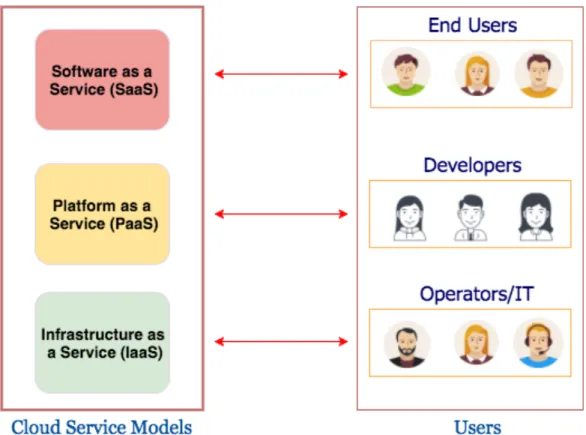
There are three types of classic cloud service models as shown in Figure 2.4: Infrastructure as a Service (IaaS), Platform as a Service (PaaS) and Software as a Service (SaaS).
Figure 2.4 three types of classic cloud service models (Kubernetes 2017)
2.4.1.1. Infrastructure as a Service (IaaS):
IaaS is the cloud services model that is easiest to understand, because in effect it sums up exactly what the cloud is about: provisioning and delivering such resources as virtual machines, physical servers, network and storage. Where companies previously invested in
their own infrastructure, they usually have to buy more than, most of the time, what they need because of peaks in demand. However, with the cloud computing IaaS model, they can now rent resources on-demand, based on their use and need using the pay-per-use model. An IaaS user can access the lowest level in the stack directly and build an application environment from the ground up. One such IaaS Cloud is Amazon Elastic Compute Cloud (EC2) (Amazon 2017).
2.4.1.2. Platform as a Service (PaaS):
PaaS is rather a more complex, higher level service than IaaS. In this level, software platform and an application development environment are provided, where users can build cloud applications and subsequently deploy and manage them without having to concern themselves with the details of the technology and infrastructure they are hosted on. Instead of waiting for time on an in-house machine to become available, developers can get on with the job straightaway, paying only for resources they use, as mentioned above. Well-known PaaS platforms include Google App Engine (GoogAppEngine 2017) and Microsoft Azure Services (MicrosoftAzure 2017).
2.4.1.3. Software as a Service (SaaS):
The highest-level Cloud service model is SaaS. The work is done for the user and provided through the Internet. Not only do the providers manage the infrastructure; they also provide and run application software, which can be accessed by users in the same way as those would access a locally hosted application. It is not necessary for users to know anything about the cloud and its associated technology – they do not even need to know that they are running a cloud-based application, but rather they need to focus on how to use these application to achieve their tasks. Facebook and Salesforce.com, for example, are SaaS applications. Large numbers of other commercially available systems including Google
Documents (GoogleDocs 2017) and Google Apps (G suite) (GSuite 2017), are some other examples.
2.4.2. New hybrid service models
As the users request more flexibility and more control in order to deploy applications in the way they choose and with having the control on both infrastructure and programs, the classic three layer concept has often been a subject of discussion. The consolidation of IaaS and PaaS is expected, while there is a steady blurring of divisions between cloud services so that IaaS and PaaS increasingly work together and are presented as two sides of the same coin, while new hybrid Cloud providers are emerging to provide a way for users to bring together a variety of services.
It is in the interests of such companies as Amazon, Microsoft and Google, as well as being clearly in the interests of users, but those users when requesting Cloud services, should not need to think about whether it is IaaS or PaaS that they need. One such emerging cloud service is Kubernetes (Kubernetes 2017), an offering from Google that combines IaaS and PaaS. The IaaS provider, Openstack (OpenStack 2017), is adding PaaS features in order to provide seamlessly combined IaaS-PaaS services by orchestrating Docker (Docker 2017) containers through the use of Openstack Heat.
451 Research (Jay Lyman 2014), is a global analysis company with a particular interest in IT innovation at the enterprise level. It says ”Although it is maturing in technology and market, PaaS is getting squeezed between consolidation with IaaS and heavy use of SaaS. PaaS will most likely survive as a category, but not necessarily as we know it today”, which indicates the new category to combine IaaS and PaaS in order to enable users to create a single continuum of services.
2.5.
Cloud Service Brokerage
NIST and Gartner have provided a definition of Cloud Service Brokerage (F. Liu et al. 2011; Gartner 2013), which revolves around a three-pronged categorization. According to the two organisations, cloud broker refers to a middle entity, which oversees the negotiations and relationships between cloud consumers and cloud providers; and manages the use, performance and delivery of cloud services (Forrester 2012). The focus of Gartner customisation and NIST intermediation is on promoting the existing service. Gartner integration and NIST arbitration share a similarity that is a reflected integration of diverse systems and flexible mediation. As shown in Figure 2.5, there are three cloud service brokerage roles:
Figure 2.5 cloud service brokerage roles to manage the broker
Aggregation focuses on the delivering of two or more services to several customers. However, this does not involve provision of new customisation, integration, and functionality; but rather it focuses on providing central management of security and SLAs.
Service aggregation models play an important role in the broker systems as they help to deploy customer applications across multiple cloud providers (L. Zhang, Fowley, and Pahl 2014). Some jobs across multiple cloud providers that offer similar or different types of services can be aggregated to meet user requirements. Sometimes, consumers may have specific time and limited budget and need their application to be distributed across multiple cloud providers to meet their requirements, in which case the aggregation helps the broker to achieve this task.
Customisation involves increasing or modifying capacities for improvement and promotion of service(s), alongside its analytics. Multiple services can be bundled and customised into one or more services that are contracted directly the cloud users. It enables the organisations to add more functionality using their own processes of choice rather than being limited by a vendor-specified approach. Moreover, customisation allows users to control the service based on their needs.
Integration tackles the problems associated with the functioning of independent services in a combined manner. It usually involves combining processes, resources and/or services vertically across the same cloud provider, or horizontally across multiple cloud providers. Conventional methods such as orchestration, mediation and transformation offer solutions to compose these resources together. Generally, the integration process allows the communicated data and information to be integrated via a mediation technique where the cloud broker can build services on top of the services, such as management capabilities or additional security. In addition, service discretion plays an essential role in cloud brokerage systems especially in the integration process. It enables the system to discover, deploy, and manage multiple services (Sun, Dong, and Ashraf 2012).
2.5.1. Cloud Service Broker Architectures
Cloud brokerage solutions are based on existing SaaS, PaaS, IaaS, cloud platform, and virtualisation. According to Fowley et al. (Fowley, Pahl, and Zhang 2013), there are three architectural patterns identified:
Cloud Management: supports monitoring, providing, deployment, and designing cloud resources. For instance, using management portals; this constitutes an expansion of the central lifecycle management (LCM), incorporating tracking features and interactive graphical forms. Rudimentary characteristics for integrating compatible services may be offered. A management layer is usually located within cloud architecture to management, which enhances scalable and effective provisioning within the following platforms.
Cloud Broker Platform: is used for supporting the types of broker activity such as integration, customisation, and aggregation that requires a specified language for description of services such as unified service description language (USDL) in a balanced manner and for definition of the integration mechanism. This originates from the common broker pattern in software design, applied on a cloud environment. To obtain the right solutions and to enable the customisation of applications in order to meet the end-user needs, each cloud service broker has a partnership with several computing platform providers.
Cloud Marketplace: builds up on broker platforms and it brings customers and providers together. Additionally, description of service for integrated and core services are critical in enhancing technical and functionality quality features. The second aspect that requires facilitation is trust. Notably, apps marketplaces are ubiquitous, thus the marketplace pattern reflects future cloud-specific marketplaces.
2.5.2. Resource Management in Cloud Broker
The support of diverse service consumers by the cloud brokers is based on its ability to integrate resources from many cloud providers. The users access the Web services hosted by
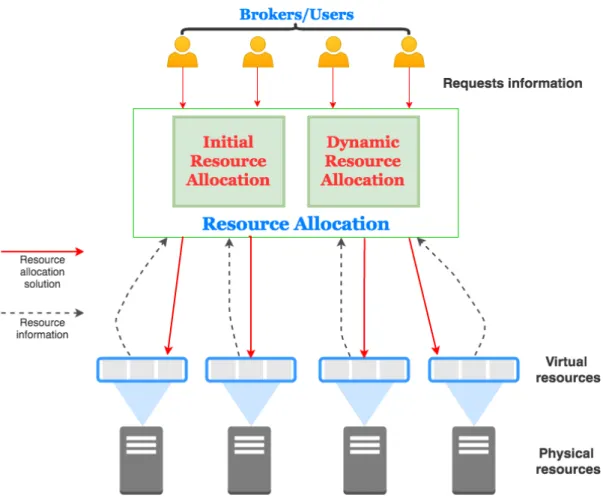
the cloud providers over the Web interface. Basically, the cloud provider aims at satisfying the SLA set with the client for the hosted services through the utilization of the minimal amount of hardware resources that is received from the cloud broker (Nair and Porwal 2010). On the other hand, the cloud broker targets profits improvement through the leasing of the optimal percentage for the requested computing resources provided to the consumers. Additionally, the computing environment has unpredictable differences such as software and fees leading to an excess the arrival rate of web request more than the expected value. Thus, it becomes necessary for the cloud broker to be asked for additional resources by the consumers. Therefore, it is important for the consumers to negotiate with the cloud provider for the resources by relying on pricing schemes that support in maintaining the SLA as well as minimizing the cloud resources costs (Nair and Porwal 2010). Furthermore, additional resources may be required by the multiple consumers via the cloud broker. Thus, it may lead to competition over the limited resources by the cloud providers.
The researchers now focus their attention towards the solutions addressing resource management challenges in data centres (Beloglazov and Buyya 2010). Mostly, the approaches fail to address the problems of management of resources within the framework of the organisation. The reliance on the cloud brokers helps in the integration of many resources from numerous cloud providers, which requires the exposure of the requirements to orchestrate and compose these resources. The recent literature has indicated that the efficient operation and management of the cloud computing environment is essential because the framework for federated cloud computing has increased in demand. Therefore, the cloud brokers provide the best hope for dealing with the multi-cloud environment complexities. In that regard, it emphasizes the need for efficient management and allocation of the resources in the model of relying on cloud brokers (Rogers and Cliff 2012).
2.6.
Summary
This chapter presented a literature review on a number of paradigms, concepts and technologies existing in cloud computing. It introduced cloud computing and explained the definition of the cloud computing concepts and its main players. Moreover, the cloud computing virtualisation and its forms and the categories of the servers were explained. In addition, this chapter highlighted the cloud services and their three classic cloud service models and the new hybrid one. Finally, the architecture of the cloud broker and the management of the resource when using the broker was explained.
THIRD CHAPTER
Network Routing and Energy
Efficiency in Cloud
3.1.
Introduction
The main objective of the service brokers is to direct the user requests to the best datacentre that has optimum performance. For example, the service broker policy must choose a data centre taking into consideration multiple factors such as availability, cost, and time. Online services have encouraged service providers and data centres to offer hosting in every geographical region, which obviously resulted in a high increase in network traffic and a matching rise in the energy consumed by the vast infrastructure (e.g., servers, routers, and switches). This chapter discusses the following issues:
• Network routing: presenting the routing problem in cloud computing when a broker selects a service. In addition, other techniques such as segment routing and sensor networks routing algorithms will also be discussed.
• Energy efficiency in cloud computing: explaining the energy issues in the cloud and its resources.
The chapter concludes with an outline of the main requirements for an energy efficient brokerage solution in multi-cloud environments, which paves the way to the design, development and evaluation of the proposed broker in following chapters.
3.1.1. Cloud broker problem
As mentioned above, the service broker relies on defined routing policies to choose the best possible data centre to serve/execute the coming job(s). The three standard routing policies are: (1) network latency-based (i.e., service proximity based routing) (Limbani 2012)(Sharma 2014), (2) response time-based (i.e., performance optimized) routing (Q. Zhang, Cheng, and Boutaba 2010) and (3) Dynamic load-based (i.e., dynamically reconfigure) routing (Rekha P.M. and Dakshayini 2014). In service proximity based routing, the broker selects the shortest path from the User Base (UB) to the data centre based on network latency, so transmission latency is considered by the service broker when routing
the traffic to the closest datacentre. The result of this routing policy is the overloading of the nearest data centre and communication channel to it, as it does not consider the channel bandwidth. Whereas in performance optimised routing policy, the broker selects the best path based on performance of all datacentres, thus the traffic is directed to the datacentre based on the best response time. This will be generalised as the status of any other datacentre. As such, any data centre with a zero-current load, will not be chosen unless a specific amount of time is known (i.e., Cool-Off-Time). This might render the data centre “idle” with no jobs assigned to it even if it was the closest to the UB (i.e., least latency) and highest bandwidth network path available (Rani, Chauhan, and Chauhan 2015). Alternatively, the dynamically reconfigured routing has similarities with proximity based routing, however the broker scales application deployment is based on the load faced (Limbani 2012) (Wickremasinghe, Calheiros, and Buyya 2010)(Semwal and Singh Rawat 2014).
As can be seen above, there are some drawbacks that are shared among the three service broker policies. For example, in service proximity based routing, the service broker does not include network bandwidth or the request data size, which might cause a significant degradation in overall performance, particularly in the case of big data or where there are multiple requests which share bandwidth and the same communication channel (i.e. file or gaming servers) (Rekha P.M. and Dakshayini 2014). Alternatively, performance optimised routing has similar problems as the service proximity routing policy. It takes into consideration server load by referencing previously performed jobs and choosing them accordingly, irrespective of job size and network bandwidth (Sharma 2014) (Sarfaraz Ahmed 2012). Lastly, dynamically reconfigured routing is inefficient if region numbers and quantity of data centres are limited; as it scales application deployment based on current load (Rekha P.M. and Dakshayini 2014).
Due to these issues, there has been additional research work aim at improving brokerage polices in terms of bandwidth, cost, workload, response time, and processing time. Limbani in (Limbani 2012) suggest a service broker policy which aims to choose the data centre with the lowest cost within the same UB region. Such a policy is not efficient in choosing the lowest cost data centre though. Yet, it still lacks competence as it does not consider work load, bandwidth, file size, and response time (Limbani 2012) (Rekha P.M. and Dakshayini 2014). Thus, (Semwal and Singh Rawat 2014) suggested a new policy that selects the data centre with the highest configuration to optimise the response time. Although the goal was reached, however, it also increased overall cost if the data centres were processing huge quantities of data (Deepak Kapgate et al 2014) (Mishra, Kumar, and Sreenu Naik 2014) (Rekha P.M. and Dakshayini 2014) (Semwal and Singh Rawat 2014).
Deepak et al. in (Deepak Kapgate et al. 2014) suggested a data centre selection algorithm based on how many times the data centre is selected in accordance with its memory requirement and processing capacity of the upcoming requests. The author focuses mainly on the reduction of the associated overheads and service response time whilst also improving overall performance. Given that the proposed algorithm can improve performance of the existing proximity algorithm, it still suffers an increase in the overall cost (Deepak Kapgate et al 2014). To get around this issue, Sharma, (2014) applies the Round-Robin load balancing policy so that the workload is distributed among multiple available data centres in the same region. The Round-Robin load balancing policies try to equalise the overall cost of the data centres. Vaishali Sharma results have shown resource utilisation efficiency under the proposed environmental simulation. But this might not necessarily be the case in all instances if the data centres have different configurations (Sharma 2014). As a consequence, Mishra, Kumar, and Sreenu Naik, (2014) suggested an extended Round-Robin service broker algorithm, which tries to distribute the coming
requests based on data centre ratings to enhance overall cost with a minimal response time. The suggested method is an improvement upon the random selection algorithms. Yet, if there exist some data centres that are faster than others, they will be frequently selected, and therefore get overloaded (Mishra, Kumar, and Sreenu Naik 2014) (Sharma 2014).
3.1.1.1. Load Balancing Algorithms
Appropriate load balancing techniques do not only assist in cost reduction, but also make enterprises meet user satisfaction (Nidhi Jain 2012) (Ali Alakeel 2012). Scalability is therefore a crucial feature of cloud computing, as cloud computing also gets affected by load balancing. Therefore, efficient load balancing, across multiple cloud data centres, helps in reducing energy consumption through improvement to resources utilization and hence overall distributed system performance.
In a cloud computing environment, load balancing algorithms are usually divided in two categories: Static Load Balancing Algorithms and Dynamic Load Balancing Algorithms (Randles, Lamb, and Taleb-Bendiab 2010).
Static Load Balancing Algorithm
Static load balancing algorithms assign tasks to the nodes, based only on the node’s ability to process new requests. However, they do not take into consideration any dynamic changes (e.g., server load, server availability and distance between user and server) of these attributes at run-time. Additionally, the algorithms cannot adapt to load changes during run-time. This process is solely based on existing knowledge of a node’s storage capacity, memory, processing power, and the most recent known communication performance. Round Robin (RR) and Weighted Round Robin (WRR) are most the commonly used static load balancing algorithms used in cloud computing (Randles, Lamb, and Taleb-Bendiab 2010). Round Robin algorithm does not consider the distance between clients and servers, server load,
server availability. In this algorithm, server selection for processing requests is done sequentially. The main problem with such an approach is inconsistencies in server performance, which can be overcome by WRR. In WRR, the weights are added to servers depending on the amount of traffic that is directed to servers. However, for long time connections it leads to load tilt (Randles, Lamb, and Taleb-Bendiab 2010).
Dynamic Load Balancing Algorithm
Dynamic load balancing algorithms consider both knowledge based on existing information gathered about network nodes in the cloud, and run-time properties which are gathered as the selected nodes process task components. The algorithms are given the tasks and might reassign them dynamically to the nodes based on the attributes gathered and calculated. Yet, they have accuracy and might result in greater efficiency of load balancing than the above static load balancing algorithm.
Least Connection (LC) and Weighted Least Connection (WLC) (Randles, Lamb, and Taleb-Bendiab 2010) are both commonly used dynamic load balancing algorithms. In the case of LC, the total number of connections on a server is identified at run time and the incoming requests are sent to the server with a smaller number of connections. But, LC does not take service capability into consideration, or the distance between clients and servers. Whereas WLC takes into consideration both the weight assigned to the service node W(Si) and the
current number of connections of the service node C(Si) (Tian Shaoliang, Zuo Ming 2007)
(Qi 2006). The issue with WLC is that, as time progresses the static weight cannot be subjected to correction, and the node will deviate from actual load conditions, which will result in imbalances in the load.
Ren, Lin, and Zou, (2011) made a prediction-based algorithm called exponential smoothing forecast. This is based on Weighted Least-Connection (ESBWLC), which can deal with long-connectivity applications. In this algorithm, the server load is calculated from various parameters such as size of disk occupation, number of connections, memory usage, and CPU utilisation. The load per processor (Load/p) is then calculated and the algorithm uses (Load/p) as an historical training set, then establishes a prediction model and makes a prediction of the value of the next moment. However, the ESBWLC algorithm does not consider distance between servers and clients, network delay and other factors. Kapgate and Narnaware, (2013) suggested Extended-ESBWLC, which can overcome this limitation. The Extended-ESBWLC algorithm calculates directly the client-side response time. This response time is stored for future reference. The response time at time instance ‘t+1’ can be predicted by using the current response time at time instance ‘t’ and the previously predicted response time for time instance ‘t’. This static service broker algorithm provides an improvement in results in terms of reduction in data centre loading, reduction of data centre request timing, and cost reductions of VM and data transfer. The author improves upon the service broker algorithm, called the service proximity service broker.
3.1.2. Segment Routing
Segment Routing (SR) is a network technology that offers a new method of packet forwarding that minimizes the need for keeping large numbers of network information states and therefore helps to overcome the TCAM deficiency problem (M.-C. Lee and Sheu 2016). A network makes use of an interior gateway protocol (IGP) for every pair of host communications within the same Software Defined Network (SDN) and Segment Routing (SDN/SR) domain. For example, the open shortest path first (OSPF) protocol allows, by default, routing to the destination. SR (Clarence Filsfils, Stefano Previdi 2017) uses a “node segment” which represents the activities a packet must follow to take whichever route is