A Monthly Double-Blind Peer Reviewed Refereed Open Access International e-Journal - Included in the International Serial Directories International Journal in IT and Engineering
Energy Efficient Cloud Data Centers: A Review
Rajni MittalStudentDept. of Computer Science & Technology DCRUST, Murthal
Mrs. KavitaRathiAssistant ProfessorDept. of Computer Science & Technology DCRUST, Murthal
Abstract: Energy consumption is becoming a matter of concern in cloud computing. Energy consumption by cloud data centers is increasing day by day which leads to the need of green cloud computing solutions. The servers used in cloud data centers are main cause of high energy requirements. Servers in the data centers consume much energy even when they are in idle state. So the basic idea is to switch the servers to sleep mode when they are not used to save energy. This review paper discusses several methods that lead maximum utilization of servers and cause more number of servers to sleep mode.
Keywords- Cloud data centers, Green computing, Migration, Virtualization, Sleep mode, Energy consumption.
INTRODUCTION
In recent years IT is needed in every kind of business organization. With the increasing use of IT services, the use of energy is also increasing. It effects financially as well as environment as CO2 emission is also
linked with the energy consumption. The problem of energy consumption is becoming a major issue. So green computing is required to handle this problem. Green computing ensures the maximum utilization of the computer resources.
Green computing is also used by cloud computing as the use of cloud in IT industry is increasing rapidly. Cloud has capability to offer various services to its clients(Jain, Mishra, and Peddoju 2013). The services provided by cloud are Infrastructure as a Service (IaaS), Software as a Service (SaaS) and Platform as a Service (PaaS)(T and H 2013). These services are provided with the help of cloud data centers which handle all the data and process the requests of the client.
This paper describes the various technologies that are being used for making one server could handle maximum number of requests and thus leaving more servers underutilized. The underutilized servers can be switched to sleep mode, that lead reduction in energy consumption.
LITERATURE REVIEW
Energy consumption in cloud data centers is becoming a major issue. For dealing with this issue MehiarDabbagh et al.(Dabbagh et al. 2015a)proposed an resource allocation framework that predicts the number of VM requests that will arrive at cloud data center in near future, the amount of resources associated with these requests, and based on that it will estimate the approximate number of physical machines required for fulfilling the demands.
Yashwant Singh Patel et al.(Patel, Mehrotra, and Soner 2015)discussed various application areas for green cloud computing. In this they have also made a study based on concerned areas of Green IT and their different objectives.
SomayehSoltanBaghshahi et al.(Baghshahi, Jabbehdari, and Adabi 2014)described live migration technique with the help of greedy algorithm. VMs are selected based on greedy algorithm. In this VMs of a cluster are given priority. This method reduces total migration time of a cluster.
Anton Beloglazov et al.(Beloglazov, Abawajy, and Buyya 2012)proposed an architectural framework and energy aware resource allocation in cloud date centers to reduce energy consumption.
Anubha Jain et al.(Jain et al. 2013)explored various metrics for analyzing power performance of cloud computing and data centers, then proposed possible techniques to minimize the power requirements.
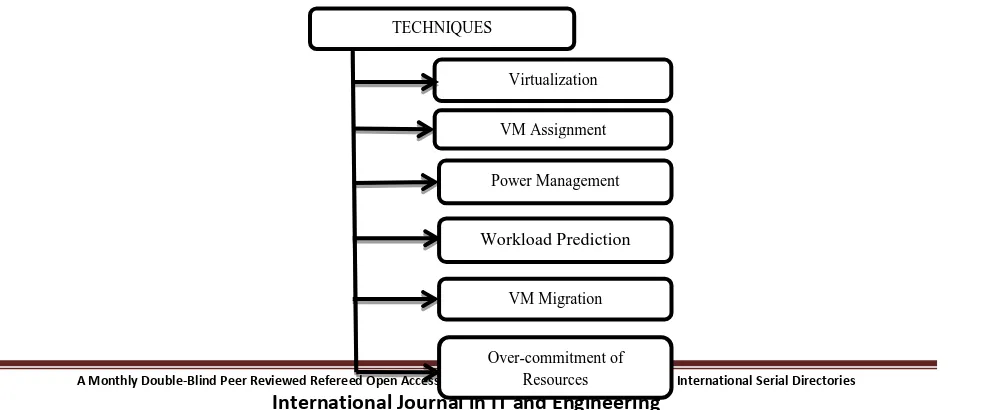
TECHNIQUES USED FOR MAKING CLOUD DATA CENTER GREEN
Fig. 1 Techniques used for making cloud data centers green
TECHNIQUES
Virtualization
VM Migration
Workload Prediction
A Monthly Double-Blind Peer Reviewed Refereed Open Access International e-Journal - Included in the International Serial Directories International Journal in IT and Engineering
Virtualization: All the data centers are virtualized now-a-days. Virtualization is the process of running many virtual servers on a single physical server. These virtual servers are called virtual machines (VM). The VMs are created and managed by software called virtual machine monitor. Each VM can have same or different operating system. Virtualization creates the illusion for the user that many physical machines are present but in actual they are not present. The resources of a single physical machine are shared between different VMs. As we can run many applications only on single machine, so the number of physical machines used at a time can be decreased. Hence the energy consumption is reduced and also the maintenance cost is reduced(Gouda et al. 2014; Uddin and Rahman 2010).
VM Assignment: When any VM request appears at the cloud provider, the scheduler takes care that which VM should be assigned to which PM. The PMs are assigned in such a way that least PMs can run the most VMs and as a result more PMs can be in sleep mode to save energy. Firstly, it tries to put the VM to any ON PM. But if there is no PM ON, that can execute the VM, then a new PM is kept ON and the VM is assigned to that PM.
The following methods are used:
a) Random Assignment: In this the VM can be assigned to any PM that is ON and is large enough to hold the VM.
b) Best fit Assignment: In this the VM is assigned to that PM that has the least space to hold the VM. The motive behind this is that more PMs with larger space will be available to handle the future large requests.
c) Release time aware Assignment: For this the release times of requests should be known in advance. Either the client can provide it or any prediction method can be used for this. Now the requests of similar release times are assigned to same PM. The benefit of this is would be that all the requests of one PM would complete at almost same time. So we would be able to keep that PM at sleep mode, hence reducing the energy consumption(Dabbagh et al. 2015b).
Power Management: In cloud data centers the main power consumption is done by CPU resource among all other resources. Previously the DVFS (Dynamic Voltage and Frequency Scaling) technique was used which saves the energy by adjusting the operating frequency and voltage of CPUs according to workload. But there are very less number of states to which these can be set and also DVFS can be applied only to CPU resource not on any else. Hence new technique of switching the servers to the sleep mode during idle time is established. It reduces power consumption at large scale(Beloglazov et al. 2012; Dabbagh et al. 2015a).
idle state before switching them to sleep mode. The servers should be kept in sleep mode at least for that time that they compensate the switching overhead. If the idle time is less, then more energy would be consumed instead of saving. So the duration of idle time is an important parameter to be kept in mind. So the prediction method is used which predict the time for which the servers would be free or not, by which the decision can be taken whether to switch the servers to the sleep mode or not. The predictor observe the workload for a certain amount of time(depends on predictor used), according to that future workload is predicted(Dabbagh et al. 2015a, 2015b).The paper(Dabbagh et al. 2015a) uses stochastic Wiener filter prediction. Some other prediction techniques are Last Minute predictor, Min predictor, Max predictor, Average Predictor, Exponential Weighted Moving Average predictor and Linear Regression predictor.
VM Migration: Migration refers to transferring VM from one PM to another. Migration is done for two purposes: load balancing and server consolidation. Load balancing is needed when the load on one machine is more, then the load between machines is balanced for better performance. Server consolidation is needed when we want that maximum VMs can be assigned to single PM, so that less PMs are used and rest underutilized PMs, after migrating their work, can be switched to sleep mode(Mohan and Shine 2013).
VM migration is of two types: Non-live migration (cold), live migration (hot). In cold migration interruption occurs in servicing the request. In this VM must be shut down and then transfer occurs. In hot migration no interruption occurs. The state of VM is transferred in this. The state include its memory, internal state of virtual CPU and local file system(Patel 2014).
For Live VM migration various techniques are used.
Pure stop and copy: In this the VM is suspended at the source, whole state of VM is copied at the destination PM and new VM is started at the destination PM. But this process will lead to high downtime, which would not beneficiary for real time processes.
Post-copy: In this VM is suspended for a very short time and only essential data is transferred to the destination PM. Then the VM is started at the destination and other data is transferred, when needed. This process will lead to high total migration time and performance will also degrade.
Pre-copy: In this VM execution is not stopped at the source, memory pages are copied from source to destination iteratively when VM continues to execute at the source. The memory pages which are changed during the execution are re-transferred to the destination. The pages which are changed frequently are the main problem of this process. The advantage of this process is that updations are available to the destination and we can activate the process any time(Patel 2014).
A Monthly Double-Blind Peer Reviewed Refereed Open Access International e-Journal - Included in the International Serial Directories International Journal in IT and Engineering
selection is done through these policies:
Minimization of Migration (MM) policy: This policy selects the minimum number of VMs that are required to lower the total utilization just below upper threshold. Mostly the VMs that are of highest utilization are migrated by this policy.
Highest Potential Growth (HPG) policy: As we know that every VM request specifies the resource parameters that it would use but it uses less than it specified. This policy migrate the VMs with highest difference of specified and used resource parameters.
Random choice policy: This policy randomly chooses the VMs that needed to migrate to lower the total utilization of PM. Policy uses a uniformly distributed random variable for this(Buyya, Beloglazov, and Abawajy 2010).
Over-commitment of resources: When any VM request arrives at cloud, the scheduler reserves the resources requested by clients. But these resources are not fully utilized because the client doesn’t know exactly how much resources would be used, so he reserves more resources that his request would need. This leads to under-utilization of resources and energy wastage. According to a survey 65% of reserved CPU resources and 45% of reserved memory resources are not utilized.
The over-commitment of resources tries to solve above problem by allocating more number of resources of a PM more than its capacity. This leads to allocating more VMs to a PM, hence more PMs could be switched to sleep mode resulting more energy savings.
The problem arises when there is overload on the PM. Due to overload VMs would face performance degradation and some VM can also crash that would violate the service agreement rules of the cloud with its clients. But we can handle the overload by migrating the VMs from that PM to other PMs(Dabbagh et al. 2015b).
CONCLUSION
This paper discussed the need of green computing in cloud data centers and the methods of making data centers more energy efficient. In summary, more number of servers should be switched to sleep mode and the active servers should be utilized optimally. Different but complimentary techniques used for energy efficiency are discussed. Virtualization is the key technique that is used almost everywhere. The other techniques discussed helps in making virtualized environment more energy efficient.
REFERENCES
Baghshahi, Somayeh Soltan, Sam Jabbehdari, and Sahar Adabi. 2014. “Virtual Machines Migration Based on Greedy Algorithm in Cloud Computing.” International Journal of Computer Applications
96(12):32–35. Retrieved (http://www.scientific.net/AMR.1046.508).
Heuristics for Efficient Management of Data Centers for Cloud Computing.” Future Generation
Computer Systems 28(5):755–68. Retrieved
(http://linkinghub.elsevier.com/retrieve/pii/S0167739X11000689).
Buyya, Rajkumar, Anton Beloglazov, and Jemal Abawajy. 2010. “Energy-Efficient Management of Data Center Resources for Cloud Computing : A Vision , Architectural Elements , and Open Challenges.”
The University of Melbourne, Australia (Vm):1–12.
Dabbagh, Mehiar, Bechir Hamdaoui, Mohsen Guizani, and Ammar Rayes. 2015a. “Energy-Efficient Resource Allocation and Provisioning Framework for Cloud Data Centers.” IEEE Transactions on
Network and Service Management 12(3):377–91. Retrieved
(http://ieeexplore.ieee.org/lpdocs/epic03/wrapper.htm?arnumber=7111351).
Dabbagh, Mehiar, Bechir Hamdaoui, Mohsen Guizani, and Ammar Rayes. 2015b. “Toward Energy-Efficient Cloud Computing: Prediction, Consolidation, and Overcommitment.” (April):56–61.
Gouda, K. C., Anurag Patro, Dines Dwivedi, and Nagaraj Bhat. 2014. “Virtualization Approaches in Cloud Computing.” 12(4):161–66.
Jain, Anubha, Manoj Mishra, and Sateesh Kumar Peddoju. 2013. “Energy Efficient Computing- Green Cloud Computing.” 978–82.
Mohan, Anju and S. Shine. 2013. “Survey on Live VM Migration Techniques.” International Journal of Advanced Research in Computer Engineering and Technology 2(1):155–57. Retrieved (http://ijarcet.org/wp-content/uploads/IJARCET-VOL-2-ISSUE-1-155-157.pdf).
Patel, Pradip D. 2014. “Live Virtual Machine Migration Techniques in Cloud Computing : A Survey.” 86(16):18–21.
Patel, Yashwant Singh, Neetesh Mehrotra, and Swapnil Soner. 2015. “Green Cloud Computing : A Review on Green IT Areas for Cloud Computing Environment.” 327–32.
T, ARTHI and SHAHUL HAMEAD H. 2013. “Energy Aware Cloud Service Provisioning Approach For Green Computing Environment.” IEEE.
Uddin, Mueen and Azizah Abdul Rahman. 2010. “Server Consolidation: An Approach to Make Data Centers Energy Efficient and Green.” International Journal of Scientific & Engineering Research,